ABSTRACT
NAVARANGE, NAKUL. Energy Efficiency and Trade-off with Delay in Jamming-Resistant Collaborative Wireless Broadcast Networks. (Under the direction of Dr. Huaiyu Dai).
We study collaborative multi-channel wireless broadcast networks where nodes that have
completely obtained the message being broadcast act as relays and transmit the same
message to facilitate collaborative broadcast. Our study is conducted in the context of
jamming-resistant networks based on Uncoordinated Frequency Hopping, where all the
nodes hop over a large number of channels randomly and independently of each other. As the
first step towards understanding such Collaborative Networks, we study Ideal Collaborative
Networks, which ignore the relay accumulation process in practice. We focus on energy
consumption of these networks and find the optimal number of transmitters that a
collaborative network should deploy for message broadcast in order to minimize the network
energy consumption. We further explore the dependence of this quantity on important
network parameters such as the network size and the number of channels, as well as its
scaling behavior. We find that the optimal number of transmitters scales only with the
number of available channels; it increases with network size initially but approaches a
constant value in asymptotically large networks. We also examine trade-off between network
energy consumption and broadcast delay and demonstrate how to achieve the desired
trade-off.
We then study Practical Collaborative Networks, which feature accumulation of the
relays, and obtain the corresponding results regarding optimal number of transmitters. Based
important insights into practical collaborative networks. Our results indicate that
collaboration significantly enhances energy efficiency.
There are two necessities for collaborative networks in our study: they need to control
the number of relays (preferably around the optimal value) and they further need to
determine the end of broadcast (as quickly as possible). However, it is challenging to
accomplish either goal in practice, especially in multi-channel networks and without a central
authority. We present a distributed and energy-efficient protocol that fulfills these two
Energy Efficiency and Trade-off with Delay in Jamming-Resistant Collaborative Wireless Broadcast Networks
by
Nakul Navarange
A thesis submitted to the Graduate Faculty of North Carolina State University
in partial fulfillment of the requirements for the degree of
Master of Science
Electrical Engineering
Raleigh, North Carolina
2012
APPROVED BY:
_______________________________ ______________________________ Dr. Alexandra Duel-Hallen Dr. J. Keith Townsend
________________________________ Dr. Huaiyu Dai
DEDICATION
यां याआशीवार्दानेहाप्रबंधपूणर्होऊशकला,
यामा याआई-बाबांना, ताई-दादाला
आिणताईआ यालाकृतज्ञतेनेसादर !
- नकुल
To my dear family,
I hope every page of this Thesis
reflects my gratitude and respect for you!
BIOGRAPHY
Nakul Navarange received his Bachelor of Engineering degree in Electronics and
Telecommunications from Vivekanand Education Society’s Institute of Technology,
ACKNOWLEDGMENTS
I am deeply indebted to Dr. Huaiyu Dai for his valuable and knowledgeable guidance for my
Thesis. I am thankful to him for the active support and incessant motivation he provided me
throughout my work.
I am grateful to the faculty members of the Department of Electrical and Computer
TABLE OF CONTENTS
List of Tables ... vii
List of Figures ... viii
1. Introduction ... 1
2. System Model ... 9
2.1 Network Model ... 9
2.2 Attacker Model ... 12
3. Energy Consumption of Uncoordinated Frequency Hopping ... 14
3.1 Uncoordinated Frequency Hopping ... 15
3.2 Energy Consumption of Uncoordinated Frequency Hopping ... 16
4. Ideal Collaborative Networks ... 19
4.1 Collaborative Uncoordinated Frequency Hopping ... 19
4.2 Introduction to Ideal Collaborative Networks ... 22
4.3 An Approach to Solve Linear-Exponential Equations: nlog ... 23
4.4 Optimal Number of Transmitters for Ideal Collaborative Networks ... 27
4.5 Dependence of nt,opt on Network Parameters ... 30
4.5.1 Dependence of the argument and the parameter of nlog on network parameters .. 31
4.5.2 Dependence of nt,opt on N ... 33
4.5.3 Dependence of nt,opt on C ... 35
4.5.4 Dependence of nt,opt on M ... 36
4.5.5 Dependence of nt,opt on Er/Et ... 38
4.5.6 Dependence of nt,opt on pj ... 39
4.6 Dependence of Energy Consumption on Network Parameters ... 39
4.7 Effect of Negligible Energy Consumption for Reception ... 41
4.8 Trade-off between Energy Consumption and Broadcast Delay ... 43
5. Energy Consumption of Collaborative Uncoordinated Frequency Hopping ... 46
5.1 Scaling Law for Energy Consumption ... 48
5.2 Theoretical Estimates for Energy Consumption of CUFH Networks ... 50
6. Protocol Design for Efficient Collaborative Uncoordinated Frequency Hopping ... 52
6.1 Collaborative Uncoordinated Frequency Hopping: Requirements and Challenges ... 52
6.3 Practical Protocol for Efficient Collaborative Uncoordinated Frequency Hopping ... 55
7. Simulation Results ... 59
8. Conclusions ... 72
References ... 74
LIST OF TABLES
LIST OF FIGURES
Figure 4.1: nlog and natural logarithm ... 24
Figure 7.1: Comparison of theoretical and simulated energy consumption of Ideal networks ... 60
Figure 7.2: Energy-optimal number of transmitters for Ideal networks, theory & simulations ... 60
Figure 7.3: Energy Consumption of UFH and CUFH ... 62
Figure 7.4: Penalty of using suboptimal number of relays ... 62
Figure 7.5: Energy-Optimal number of transmitters, Ideal and CUFH networks ... 65
Figure 7.6: Energy consumption of CUFH with nt,opt for itself and for corresponding ICN .. 66
Figure 7.7: Dependence of energy-optimal number of transmitters on C ... 66
Figure 7.8: Optimal number of transmitters for the best trade-off, Ideal and CUFH networks ... 70
Figure 7.9: Performance evaluation of CUFH-r ... 70
Figure 7.10: Comparison of energy consumption by different protocols and conditions ... 71
1.
Introduction
Wireless communication is of broadcast nature and is vulnerable to various security threats
including, but not limited to, jamming attacks at the physical layer. Such attacks are aimed at
transmitting signals at sufficiently high power to interfere with legitimate transmission
making it difficult or even impossible to correctly decode the desired signal. Several
countermeasures have been proposed in the literature to overcome or to mitigate the effect of
physical-layer jamming. Some of the most prominent and effective anti-jamming measures
include Spread-Spectrum (SS) Techniques. SS techniques spread the signal energy over a
wide frequency spectrum making it difficult to detect or jam the signal. SS techniques are
largely categorized into two classes, namely Direct Sequence (DS) and Frequency Hopping
(FH). In DSSS, each data bit being transmitted is multiplied with a high-frequency
pseudo-random chip sequence, which is unique to that transmitter, and is thus spread over a wide
bandwidth. In FHSS, data sequence is divided into packets of equal length and each packet is
transmitted on a separate channel that is selected according to a pseudo-random hopping
sequence, making the transmission span a large bandwidth as a result. There are two
1. They require the chip sequence or the hopping sequence to be shared a-priori among
all the communicating devices to facilitate complete message reception and correct
decoding at all the receivers;
2. The sequence needs to remain confidential among the legitimate network nodes to
achieve resistance to jamming.
While the SS techniques achieve good jamming resistance, this requirement of a
pre-shared secret among all the network nodes gives rise to some scalability and security
problems. Scalability concerns arise from the requirement that the chip or hopping sequence
needs to be known a-priori to all the nodes. Although this keeps malicious nodes out of the
network, on the downside, this may not allow other legitimate nodes to participate in the
network communication at a later stage. Specifically, this requirement does not allow two
nodes that do not share a secret key to communicate. Secondly, data confidentiality for the
entire network is under threat even if a single node is compromised. Once the secret key is
revealed, communication based on SS techniques does not remain confidential and is
vulnerable to security attacks.
To alleviate the above concerns with SS techniques, schemes that do not depend on
pre-shared secrets have been proposed in the literature. As an improvement over FHSS, a
novel anti-jamming technique named Uncoordinated Frequency Hopping (UFH) is proposed
in [1]. In UFH, the source node divides the message to be broadcast into several packets and
sends each packet over a randomly selected channel with one packet in each time slot. At the
slot. The process continues until all the network nodes receive the message completely.
Because all the nodes hop randomly, the technique eliminates the need to have a shared
secret key among the network nodes and is effective in establishing a key to facilitate further
communication. Importantly, this randomization makes it difficult for the jammers to launch
an effective long-term attack. All nodes hop independently of each other and the resultant
absence of coordination among the nodes gives the technique its name. An uncoordinated
counterpart of DSSS, named UDSSS, is proposed in [2] where the source node and the
receivers randomly select their chip sequences for every message from a set of publicly
known spreading sequences. A combination of these two techniques, named hybrid
UFH-UDSSS, is proposed in [3].
Other anti-jamming techniques exist in the literature apart from these uncoordinated
SS techniques. A channel surfing approach is discussed in [4] where sensor nodes adapt their
channel assignments to restore network connectivity and overcome interference and is
complemented with consideration of spatial retreats in [5]. Different ways to detect jamming
attacks in wireless networks are discussed in [6]. Optimal network defense policies against
jamming attacks are treated in [7]. Frequency hopping using uncoordinated seed disclosure is
proposed in [8]. Randomized Differential DSSS is introduced in [9] as a parallel approach to
enable communication without shared keys in presence of jamming. A method based on
delayed seed disclosure in DSSS is treated in [10].
Although Uncoordinated SS techniques ensure that all the nodes receive the message
without a shared secret while achieving good resistance to jamming, lack of coordination
broadcast delay over conventional SS techniques. An attempt to improve the efficiency is
made in [11] and it utilizes erasure coding combined with a one-way authenticator based on
bilinear maps. However, it is found to reduce the communication latency only by a half.
With the aim of increasing communication efficiency, a technique that allows
collaboration among the nodes in a UFH-based network is proposed in [12]. The technique,
named Collaborative Uncoordinated Frequency Hopping, gives rise to a class of networks
that do not depend on pre-shared keys, are resistant to jamming and exhibit increased
communication efficiency as compared to UFH networks because of collaboration among
nodes. In a Collaborative UFH network, nodes that have received the complete message
serve as relays and transmit the same message to facilitate collaborative broadcast. Having
multiple transmitters to aid the broadcast process over multiple channels utilizes spectral
diversity and is shown to be effective in terms of reducing the broadcast delay. This approach
is extended to multi-hop networks to utilize spectral as well as spatial diversity in [13].
In a Collaborative UFH network, every node that receives the complete message
serves as a relay. Deploying an unconstrained number of relays works well for small
networks where the number of nodes is (significantly) less than the number of channels.
However, for large-scale networks, where the number of nodes far exceeds the number of
channels available, allowing all the nodes to serve as relays may not be the optimal strategy.
This is because when the number of transmitters far exceeds the number of available
channels, collisions occur on every channel with high probability. The result is unproductive
transmission and unnecessary increase in broadcast delay. This raises a question whether it is
may be beneficial. Existence of an optimum for the number of relays to be used is discussed
in [14]. An optimal value for the number of relays that maximizes the probability of
reception for a node is derived; and it is shown that the same value results in minimum
broadcast delay. Results indicate that as long as the number of nodes exceeds the number of
channels it is beneficial to control the number of relays to the optimal value in order to
minimize the broadcast delay. This technique attains more efficiency than Collaborative UFH
networks and gives rise to another type of collaborative networks where the number of relays
is constrained. We will refer to these improved networks as CUFH networks.
In the UFH-related literature so far, emphasis has been on improving communication
efficiency by means of reducing the broadcast delay whereas sufficient attention has not been
paid to energy consumption of such networks. Most of the devices used for wireless
communications today are battery-operated and have limited supply of power that constrains
their ability to function without replenishment of the power supply i.e. their useful lifetime.
In many cases, it is difficult or even infeasible to replenish or replace the power supply but
the devices are still expected to function properly for years; a good example being that of
sensor networks deployed in inaccessible places. Energy consumption in such networks is
therefore of prime significance and needs to be considered as the most important metric of
performance when their communication efficiency is determined.
The focus of our work is to study energy consumption of jamming-resistant
collaborative wireless broadcast networks and to improve their energy efficiency so as to be
able to practically realize and deploy this new class of networks in power-constrained
CUFH consists of two phases: relay accumulation and collaborative broadcast. As the
first step towards analyzing CUFH networks, we overlook the first phase and consider Ideal
Collaborative Networks, which are simplified equivalents of CUFH networks thus formed.
Such simplification facilitates mathematical analysis, with the essence of collaborative
broadcast intact, and offers important insights into performance of CUFH networks.
In practice it is desirable to reduce both the energy consumption and broadcast delay
of a wireless network. In the CUFH networks considered, reducing the energy consumption
can be accomplished by reducing the number of active transmitters whereas the broadcast
delay can be reduced by having more transmitters, up to a certain limit in both cases. Trying
to minimize either of the metrics individually results in an increased value of the other which
may be undesirable. Thus, there is a trade-off between energy consumption and delay in
CUFH networks, which is an important factor for the networks that need to exhibit good
performance along both the metrics. Hence it is of interest to provide a joint consideration to
energy consumption and delay to study their trade-off and to examine how to achieve the
desired trade-off.
It can be seen that efficient performance of a CUFH network depends on two key
factors:
1. The number of relays needs to be controlled at the optimal value and
2. The transmitters need to stop transmitting when all the nodes have received the
message completely
Given that CUFH involves multiple independent transmitters spread throughout the network,
or without transmission of acknowledgement packets from receivers to transmitters.
Nevertheless, both of these possible solutions are difficult to implement in distributed
multi-channel networks in the presence of jammers. This highlights the need for a practical and
distributed protocol to enable implementation of CUFH networks in practice.
Following is a summary of our main contributions:
We analyze energy consumption of collaborative networks and demonstrate that
collaboration achieves significant improvement in energy efficiency
We derive the optimal number of transmitters to minimize energy consumption of
collaborative networks and study its dependence on the network size, number of
channels, number of packets in a message and jamming probability
We jointly consider energy consumption and broadcast delay of collaborative
networks, examine their off and demonstrate how to achieve the desired
trade-off
We present a practical and distributed protocol to facilitate implementation of
efficient collaborative networks and illustrate its superior performance.
While our study has the context of jamming-resistant broadcast for concreteness, many of our
results can be extended to general multi-channel networks including emerging cognitive
radio networks.
The content in this Thesis is organized as follows: Section 2 introduces system model.
Section 3 gives a discussion about energy consumption of UFH networks. Section 4 presents
energy-optimal number of transmitters. Section 5 contains a treatment of CUFH networks. Section 6
presents a distributed and energy-efficient protocol for CUFH networks. Section 7 presents
2.
System Model
2.1 Network Model
We consider a single-hop wireless broadcast network with one source node and N receiver
nodes, each of which is assumed to possess transceiver capabilities. The source node can be a
base station or a stand-alone wireless node like other receivers. The source node possesses
the message that needs to be broadcast to the entire network. The source node divides this
message into M packets of equal length, each of which may include overheads along with a
portion of the message.
C orthogonal channels are available to the network, which may be contiguous or may
exist across several frequency bands. Each channel supports a fixed data rate. Each node is
considered to be able to transmit or receive on one channel at a time, although our work can
be extended to encompass sophisticated wireless devices that can transmit or receive on
multiple channels at a time.
Time is divided into slots of equal length and slots for all the nodes are assumed to be
perfectly aligned, i.e. the network is supposed to be time-synchronous. A time slot needs to
be long enough so that one packet can be transmitted within one time slot completely. Thus
the duration of each time slot depends upon the length of each packet and the data rate
The source node selects a channel from the set of C available channels at the
beginning of each time slot and transmits one packet on the same. It sequentially and
recurrently transmits all the M packets in this manner until all the receivers have completely
received the message. Each receiver, on the other hand, tries to receive all the packets by
selecting a channel to listen to at the beginning of each time slot until it receives the message
completely. Various strategies for channel selection by network nodes are proposed and
analyzed in [12]. The strategy that is treated in this work is the one where all the nodes
randomly and independently select a channel for each time slot.
In CUFH, a relay is defined as a node that functions as a receiver in the beginning,
obtains the complete message through reception process and then transmits the same
message. All the relays function similarly as that of the source node; except that each relay
needs to receive the entire message itself, before it can forward the same. Although all the
transmitters1 transmit packets sequentially and continuously, each of them begins
transmitting at different times (because when a relay begins to transmit depends on when it
completes message reception, which may be different for all the relays) and hence during any
given time slot, different transmitters are found transmitting different packets. This gives rise
to channel collisions when two or more transmitters transmit different packets on the same
channel during a time slot and a receiver tuned to that channel cannot decode any of those
packets correctly. In other words, the network is considered to be asynchronous with respect
to packet transmission. This consideration is more practical than an assumption that all the
transmitters transmit the same packet during a time slot. The reason is although it may be
easy to obtain packet-synchronization, it is difficult to maintain the same over the duration of
broadcast and the network can quickly become packet-asynchronous even if a subset of
relays loses synchronization.
It is assumed that each transmitter consumes Et amount of energy to transmit data for
one time slot. On the other hand, each node requires Er amount of energy to remain in
reception mode for one time slot. It is assumed that a receiver consumes Er amount of energy
per time slot regardless of whether it does or does not receive a packet during that slot.
Some important definitions are given below:
1. Node reception delay: It is the delay (in terms of number of time slots) since the
beginning of the broadcast until a node under consideration completely receives the
message.
2. Network broadcast delay: The delay (in terms number of time slots) since the
beginning of the broadcast until all the receivers in the network completely receive
the message.
3. Probability of successful packet reception: Probability that a given receiver
successfully receives and correctly decodes a packet during a time slot.
4. Network energy consumption: Sum of energy consumption of the source node for
transmission, energy consumption of all the receivers for reception and energy
consumption of all the relays for transmission over the entire duration of the
2.2 Attacker Model
We consider presence of an attacker which is unbounded in power but which cannot
influence the entire useful spectrum at the same time. That way during each time slot, there
are at least a few channels that are not affected by the attacker and over which successful
transmission is possible. The attacker can adopt three strategies as detailed in [1]:
1. It can jam the legitimate transmission at physical layer by transmitting interfering
signals at sufficiently high power so that the desired message cannot be correctly
decoded by a receiver due to interference
2. It can transmit at such a high power that the attacker’s message is the one that seems
to be the desired message to a receiver due to high signal strength while the legitimate
message appears as background noise i.e. it can modify the message
3. It can insert a different message that it generated using the network’s pre-shared
secret that it obtained.
Out of these three strategies, we consider the attacker to resort to jamming as it is shown to
be the most powerful of the three.
Furthermore, the attacker (jammer) can be either non-responsive or responsive. A
non-responsive jammer simply jams a chosen subset of channels during each time slot. A
responsive jammer, on the other hand, senses the spectrum during each time slot to identify
the channels that have ongoing legitimate transmissions and then jams those particular
channels.
We consider the jammer to be able to jam Cj channels per time slot. This way,
be modeled as a single jammer for convenience. Another effect of this consideration is that
our work holds valid irrespective of jammer’s type. The probability that a given channel is
jammed during a time slot, called ‘jamming probability’, can then be given as
j j
p C C.
As mentioned before, we assume that pj 1 i.e. the jammer cannot jam all the C channels
3.
Energy Consumption of Uncoordinated Frequency Hopping
Spread-Spectrum (SS) techniques are some of the most prominent countermeasures to
jamming attacks at physical layer. SS techniques are aimed at spreading the desired signal
over a wide bandwidth so that it becomes difficult to detect or jam the signal. SS techniques
are classified into two categories:
a. Direct-Sequence Spread Spectrum (DSSS)
Each bit of the message is multiplied by a high-frequency ‘chip sequence’ at the transmitter.
The spreading operation increases the signal bandwidth by a large amount.
b. Frequency-Hopping Spread Spectrum (FHSS)
All the nodes in the network periodically and synchronously switch their channel according
to a pre-shared ‘hopping sequence’, due to which every node is tuned to the same channel at
a given time.
Although conventional SS techniques achieve good resistance to jamming, they suffer from
some key drawbacks:
1. Their jamming resistance depends upon a secret key, which is either a chip sequence
or a hopping sequence. It thus becomes important for the network to preserve the
confidentiality of the key throughout message broadcast for sustained resistance to
2. More importantly, the secret key needs to be shared a-priori among all the nodes in
the network. A node that does not have the key cannot communicate with the
network. While this requirement keeps attackers out of the network, it does not allow
two legitimate nodes that do not share a secret key to communicate with each other,
either.
Attempts have been made to overcome the aforementioned shortcomings of traditional SS
techniques. As an improvement over FHSS, a novel anti-jamming technique is proposed in
[1] which is described below.
3.1 Uncoordinated Frequency Hopping
Uncoordinated Frequency Hopping (UFH) is an anti-jamming technique introduced in [1]
that utilizes frequency-hopping but does not depend on pre-shared keys. Basic mechanism of
UFH can be explained as follows:
The source node divides the message to be broadcast into multiple packets. At the
beginning of each time slot, it randomly selects a channel from the pool of multiple
channels that are available and transmits one packet on it. It transmits all the packets
sequentially in this manner and repeats the process until all the network nodes receive
the message completely.
At the other end, receivers randomly and independently choose a channel at the
beginning of every time slot and listen to it for the duration of the slot. A receiver
successfully receives and decodes a packet during a time slot only if both of the
selected by the receiver during that slot and the channel is not jammed. A receiver
continues this process until it receives all the packets.
It is evident that UFH does not require network nodes to share any secret key as every node
hops randomly and independently of other nodes. This way, UFH overcomes both the
drawbacks of conventional FHSS systems. The absence of coordination among network
nodes gives the technique its name.
3.2 Energy Consumption of Uncoordinated Frequency Hopping
It will be interesting to study energy consumption of UFH towards determining its energy
efficiency. There is only one transmitter in UFH and it transmits throughout the broadcast
process. Each of the N receivers remains in reception mode for every time slot until it
completely receives the message and then hibernates to save energy. We can write average
network energy consumption of UFH for a message broadcast as
E[ ]Eu EtE[Du]NErE[ ]Ru , (3.1)
where E[Du] average network broadcast delay of UFH and E[Ru] is the average node
reception delay of UFH, which is the same for all receivers due to symmetry. Approximate
expressions for E[Du] and E[Ru] in terms of time slots are derived in [15] and are respectively
given as
1
1
E[ ]
(1 )
MN
u
k
j k
MC D
p
1
1
E[ ]
(1 )
M
u
k
j k
MC R
p
.Approximations are due to the fact that we assume receiver nodes to be independent whereas
in a strict sense, they are not. This is because two receivers that select the same channel
during a time slot experience the same outcome. Although both the receivers select the
channel independently, their end results are dependent. But it turns out that effect of such
dependence is not noticeable and that these approximations can safely be used.
Lemma 3.1:
Kth Harmonic number involved in the expressions above can be bounded as
1
1
1 1
ln
(2 1) 2
K
k k
K
K K
where 0.5772is the Euler-Mascheroni constant [16].
Proposition 3.1:
Combining all the expressions and bounds stated above, we can conclude that
E[ ]Eu CN (3.2)
Observations
Average energy consumption in UFH scales linearly with the network size as well as
reception delay scale linearly with the number of channels and for extremely large
networks, reception energy consumption dominates total energy consumption.
On the other hand, average energy consumption of the source node scales as
ClnN
i.e. only logarithmically with network size.
Average network energy consumption in UFH increases with number of packets as
ln
M M . This suggests that fewer the packets into which a message is divided, lesser
is network energy consumption. However, dividing the message into fewer packets
makes each packet longer and a time slot has to be lengthened accordingly so that one
packet can still be accommodated within one time slot. However, with longer time
slots the hopping frequency reduces, all the nodes stay on the same channel for longer
duration and the network becomes more vulnerable to jamming attacks. Thus, there is
a trade-off between network energy consumption and resistance to jamming with
4.
Ideal Collaborative Networks
Uncoordinated Frequency hopping introduced in [1] enables two or more nodes to
communicate without any pre-shared key and simultaneously achieves good resistance to
jamming. However, nonexistence of a common key requires all the nodes to hop over
available channels randomly and independently of each other. This inherent absence of
coordination among the nodes results in very low communication efficiency. Broadcast delay
of a UFH-based network is usually orders-of-magnitude more than broadcast delay of a
corresponding FHSS-based network. We now discuss one of the most promising attempts
towards improving efficiency of UFH.
4.1 Collaborative Uncoordinated Frequency Hopping
To enhance communication efficiency of networks based on UFH, an idea to allow
collaboration among nodes of a UFH network is introduced in [12], which gives rise to
Collaborative UFH. In Collaborative UFH, the source node divides the message into several
packets and transmits those using UFH. At the other end, receivers try to receive all the
packets using UFH. The difference arises after a receiver completes its process of message
reception: after it completely receives the message, a receiver begins to act as a relay and
network nodes collaborate with each other during the broadcast process, which gives the
technique its name. Collaborative UFH is shown to exhibit significant improvement in
communication efficiency, by means of achieving large reduction in broadcast delay. It
corroborates the notion that having more than one transmitter will usually benefit the
network by facilitating the broadcast.
In collaborative UFH, every receiver that completely receives the message serves as a
relay i.e. the number of transmitters (including the source) will approach the network size
over the course of broadcast. In terms of broadcast delay, this will mostly benefit small-scale
networks, where network size is less than the number of available channels. However, in case
of large-scale networks, where the number of nodes far exceeds the number of available
channels, having far more transmitters than the number of channels at hand will result in
collisions on almost every channel with high probability, which will lead to degradation in
performance. We can see that it may not be necessary for every receiver to act as a relay and
that a sufficiently large network can benefit by being selective about deploying relays.
This idea is proposed and elaborated on in [14], along with a proposition that there
exists an optimum for number of relays that a collaborative network should deploy in order
to achieve minimum delay. Deploying optimal number of relays is shown to minimize
network broadcast delay and constitutes an improvement over Collaborative UFH of [12],
which is nonselective in nature. In the discussion from here onwards, we refer to this
improved and selective scheme for collaboration, where the number of relays is deliberately
controlled at the optimum, as Collaborative Uncoordinated Frequency Hopping (CUFH).
Phase 1:
The source node transmits the message using UFH and receivers try to receive the same
using UFH as well. After a receiver completely receives the message, it begins to act as a
relay and broadcasts the same message. However, such accumulation of relays is permitted
only until there is desired number of relays in the network. Phase 1 ends when the network
has gathered optimal number of relays.
Phase 2:
No additional relays are formed during phase 2. The source and the relays accumulated
during phase 1 continue to broadcast until all the receivers receive the message successfully.
It will be of certain interest to mathematically analyze CUFH and get a quantitative
idea of improvement it achieves over UFH. However, there are some challenges involved in
analyzing CUFH:
CUFH networks are highly stochastic in nature; all the nodes hop in a random manner
and independently of each other, giving rise to lack of coordination
It is difficult to mathematically represent the process of relay accumulation.
Both the factors put together make it difficult to characterize a CUFH-based broadcast
process exactly and to present an accurate model to facilitate analysis. As a result, it becomes
a fairly challenging exercise to present precise mathematical expressions for network
broadcast delay and node reception delay, both of which are important metrics for
4.2 Introduction to Ideal Collaborative Networks
As the first step towards analysis of CUFH networks, we can overlook the process of relay
accumulation and focus only on collaborative broadcast. This gives rise to a simplified
analog of a CUFH network that is proposed and developed in [14], [15] and is named ‘Ideal
Collaborative Network’. An Ideal Collaborative Network assumes that the required number
of relays has already been formed, neglects the process of accumulation of relays and
considers only the second phase of CUFH.
An Ideal Collaborative Network consists of one source node, nr relays and N
receivers. All the relays possess the message since the beginning, just like the source, and
they transmit the message right from the start of broadcast. In other words, there are nr relays
since the beginning of and throughout the broadcast process. Since an Ideal Collaborative
Network already has sufficient number of relays, no new relays are accumulated and a
receiver hibernates after it completely receives the message. An Ideal Collaborative Network
thus captures the essence of CUFH networks. It turns out that neglecting the process of relay
formation greatly simplifies analysis and fairly accurate expressions for average network
broadcast delay as well as for average node reception delay2 can be obtained, which are given
in [15] as
1
1
E[ I] MN
k
t
n k
M D
p
(4.1)and
1
1
E[ ]I M
k
t
n k
M R
p
, (4.2)respectively3. In the expressions above, pnt is the probability of successful packet reception
and is given as
(1 j)nt nt t
n
p M a b p ,
with 1 1
1
1 M Ca and 1 1 C
b . Total number of transmitters present in the Ideal
network is denoted as nt and is given as nt nr1. A discussion about determining nt for a
given Ideal Collaborative Network will follow.
4.3 An Approach to Solve Linear-Exponential Equations: nlog
Before we begin our analysis, it will be useful to consider a special class of equations which
may be named ‘Linear-Exponential’ equations. Such equations exhibit the following form:
1 2 1 3 4 0
x x
xc c c c x c ,
where ci’s are constants. With the help of a linear transformation,y x c 2 and necessary
algebraic operations, the equation above reduces to
1 1
2 0y
y c d d (4.3)
with di’s as constants. To solve such linear-exponential equations, we introduce a
mathematical function and name it ‘nlog’.
3 Once again, approximations are due to the fact that we assume receivers to be independent whereas in a strict sense, they
Definition 4.1:
nlog ; iff
y
ye
y x x
y
(4.4)
where α is a parameter.
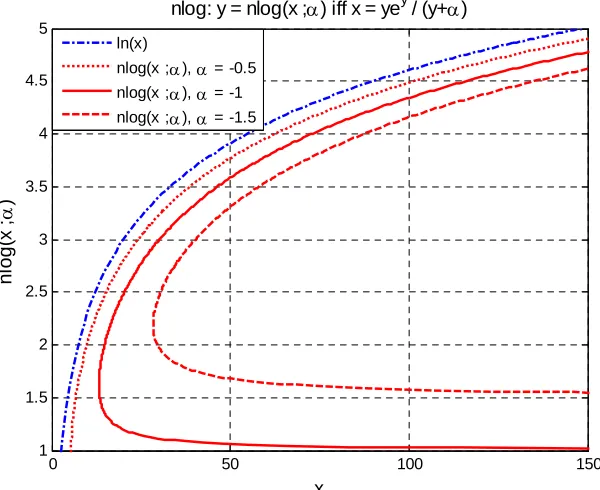
It can be seen that nlog (pronounced ‘en-log’) is inverse of xe xx . A plot of nlog for a
few values of the parameter α is depicted in Figure 4.1 along with natural logarithmic
function for comparison. A given value of α characterizes one curve4.
Figure 4.1: nlog and natural logarithm
4 Note that nlog is technically not a function. But it turns out that only the upper arm in the first quadrant is of
interest in this problem (the lower arm yields negative solution for optimal number of transmitters). Hence, when we mention nlog in this work, we mean this upper arm and it corresponds to a monotonically increasing
0 50 100 150
1 1.5 2 2.5 3 3.5 4 4.5 5
nlog: y = nlog(x ;) iff x = yey / (y+)
x
nl
og
(x
;
)
ln(x)
Note that as the absolute value of the parameter increases, the upper arm of the curve of nlog
moves closer to the logarithmic function. The solution of a linear-exponential equation is
obtained using the particular curve of nlog which corresponds to the parameter α under
consideration5.
Definition 4.2:
The point in the first quadrant from which the two arms of nlog diverge is defined as the ‘tip’
and it corresponds to (xtip, ytip).
Lemma 4.1:
Beyond its tip, nlog is bounded, from both above and below, by natural logarithmic function,
up to certain offset i.e.
nlog x; ln ( )x x xtip.
Proof:
Consider any arbitrary x0xtip and let 0.6
Part I
Let y1 lnx0dand y2 nlog
x0;
where value of d will be decided later. By definitionof nlog we have
2
1 2
2
y
y d y e
e
y
.
5 Interesting discussion about solving another type of linear-exponential equations can be found in [17] and [18] 6 Only negative values are of interest since α < 0 for our problem, as will be clear later. However, Lemma 4.1
1 2 ( )2
y y f y d
,
where f y( ) ln2
y2 (y2)
. Because 0, f y( )2 is a decreasing function of y y2 2 and its minimum value is 0. In other words, f y( )2 is always nonnegative because of which
1 2 0 0
y y d .
0 0 0
lnx d nlog x ; x x dtip, 0
Part II
Let y1 lnx0d and y2 nlog
x0;
while value of d will be decided later. We have fromthe definition of nlog
2
1 2
2
y
y d y e
e
y
.
1 2 ( )2
y y f y d
Because f y( )2 is a decreasing function ofy2, its maximum will be attained when y2 takes on
the minimum possible value i.e. ytip. It is thus clear that
1 2 0 ln tip ( tip )
y y d y y .
0 0 2 2
lnx d nlog x ; x x dtip, ln y (y )
Combining results from both the parts, we can conclude
Corollary 4.1:
nlog x; is an increasing function of x, x xtip.
Proof:
Because nlog is bounded from both above and below by a monotonically increasing function
beyond xtip, we conclude thatnlog
x;
increases with x x xtip.4.4 Optimal Number of Transmitters for Ideal Collaborative Networks
We focus on energy consumption of Ideal Collaborative Networks and find the optimal
number of transmitters that minimizes average energy consumption of a given Ideal
Collaborative Network. We then study dependence of energy consumption and optimal
number of transmitters on important network parameters.
Since an Ideal Collaborative Network deploys nt transmitters from the beginning and
has N receivers, average energy consumption of an Ideal Collaborative Network for a single
message broadcast can be written as
E[ ]EI n Et tE[DI]NErE[ ]RI ,
where approximate expressions for E[DI]and E[ ]RI are given according to (4.1) and (4.2)
respectively. Using these expressions, we can elaborate the equation above which gives an
expression for average energy consumption.
Lemma 4.2:
H(
)
H( )
E[ ]
(1 ) (1 )
t t r
I
j j
nt nt nt nt
n E MN NE M
E
a b p a b p
, (4.5)
where H(K) denotes the Kth harmonic number.
We have seen that in order to achieve optimal performance, it not necessary for all the
nodes to serve as relays and the network actually benefits by sensibly controlling the number
of relays at a specific value which is found to be optimal for the network. In other words, the
number of transmitters in an Ideal Collaborative Network (nt) need not be the same as the
network size N and there exists an optimal number of transmitters that an Ideal Collaborative
Network should deploy in order to achieve minimum energy consumption. As the first step
towards making collaborative networks more energy-efficient, we now attempt to find a
mathematical expression for the energy-optimal number of transmitters of an Ideal
Collaborative Network.
It can be verified that E[ ]EI is a convex function of nt and thus its minimum can be
found by taking derivative. After some simplification, E[ ]I 0
t E n gives
0 1 ln 1 lnln ln ln
t t
t t
n n b
a a b
n n
b a b a a
, (4.6)
where H( )
H( )
r
t
NE M
E MN
is constant for a given network and depends mainly on the network
size and on the number of packets. Equation (4.6) exhibits a special linear-exponential nature
which can be represented as
1 2 3 0
t t t t
n n
with L and Bi’s as constants. With the help of a linear transformation, (4.6) can be rewritten
as
y
0y l m n ,
where 1
ln t y n a , a l b ,
1 ln ln ln a a b m b a and
2 1ln ln
ln
a a b
a n
b a
. The
equation above is similar in form to (4.3) and can be rearranged as
y
n m
yl m y ,
which can then be rewritten as
ln ( ln )
ln ln
y l
n m
y l e
m y l l
with a change of base from l to e. Comparing the equation above to the definition of nlog in
(4.4), we can write
1
nlog ; ln . ln
n
y m l
l m
Proposition 4.1:
The optimal number of transmitters that minimizes average energy consumption of Ideal
Collaborative Networks, nt,opt, is
,H( )
1 1
nlog ; ln
H( ) ln ln r t opt t a b
E N M
n b
n m
m a E MN a
. (4.7)
2 ln
ln
ln ln a b
n b
m a a b
.
The parameter is always negative since 1 a b 0.
Importantly, the parameter depends only on the number of available channels along
with the number of packets while it is completely independent of the network size.
For a collaborative network, the number of available channels and the number of
packets into which a message is divided are usually fixed. That way the parameter α
turns out to be a constant for a source node, even if the network size changes because
of nodes leaving or joining the network. It means that to evaluate the first term of
(4.7), a source node needs to utilize only one particular curve of nlog, which
corresponds to its parameter α, regardless of the network size. This facilitates
distributed implementation with low memory requirements.
4.5 Dependence of n
t,opton Network Parameters
The optimal number of transmitters that minimizes average energy consumption of Ideal
Collaborative Networks depends on important network parameters viz. the network size N,
the number of available channels C, number of packets into which a message is divided M
and the ratio of energy-costs of reception and transmission Er/Et. It is interesting to study
dependence of nt,opt on these network parameters and to examine its behavior as these
parameters take on asymptotically large values. Before doing so, it becomes necessary to first
examine how nlog varies with these network parameters, which becomes clear after we study
4.5.1 Dependence of the argument and the parameter of nlog on network parameters
We first observe how the argument and the parameter of nlog depend on important network
parameters.
Dependence of the argument (m):
We have seen the expression for the argument
1
ln ln ln a a b m b a ,
where a, b and μhave been defined before. We now utilize some approximations.
Lemma 4.3:
1 exp 1,
ln 1 1.
y
x xy x y
x x x
Note that 1 1 ( 1) a
b M C ,
and based on above
1 1
lnb ln 1
C C
,
1 1 ( 1)
lna ln 1 1 M
M C MC
.
Using the aforementioned bounds on Harmonic numbers in Lemma 3.1, expression for the
H( ) 1
exp
( 1) H( ) ( 1) ( 1)
H( )
exp exp ln .
( 1) ln ln ( 1)( 1) ( 1)
r
t
r
t
E N M MC M
m
M C E MN M M
E M N C M
E M C N M C M M
Thus, the argument increases with N and Er/Et while it decreases with M as well as C. This is
because M M 1 and C C1 decrease with M and C respectively.
Dependence of the parameter (α):
We have seen that the parameter of nlog can be expressed as
2 ln ln ln a b a b .Using the approximations stated in Lemma 4.3, α can be approximated to
2 1
( 1) 1 C
M M C
. (4.8)
The parameter is seen to decrease with M as well as C and is independent of N. Furthermore,
for large values of C, α can be simplified to
1
1
( 1) C
M M
.
In other words, when the number of available channels is very large (which is usually the
case for FHSS-based systems), the parameter is nearly independent of C. In either case,
reduces with increasing M and with decreasing , the curve of nlog ‘rises’ i.e. it moves
4.5.2 Dependence of nt,opt on N
Corollary 4.1 states that nlog is an increasing function of its argument. We have seen that the
argument in our case monotonically increases with N. Putting both the facts together we infer
that ynlog
m;
monotonically increases with N. Referring to (4.4), as N takes on highervalues, ynlog
m;
increases, y becomes nearly equal to y (since α is a smallnumber cf. (4.8)) and ynlog
m;
starts approaching ln
m , which is evident from (4.4).The difference between nlog
m;
and ln
m , say 1, is thus a decreasing function of Nand tends to zero as nlog
m;
ultimately converges with ln
m . This relationship can berepresented as
1
nlog m; ln m N ,
where 1
N 0 for large N. Using the relationship above with (4.7), we can write
, 1 1 11 1 1
ln
ln
ln ln
ln ln ln
1 1
ln ln ln ln
ln ln ln
,
ln ln
t opt a a
b b
n m N
a
b a N
a a b a b a
b a N
a b a b
.
where the second equality follows from the definition of the argument (m). The first term in
reaching zero eventually. Thus, the energy-optimal number of transmitters nt,opt increases
with network size initially.
When nlog
m;
actually reaches ln
m for large values of N, 1
N 0. Thus forasymptotically large N
,
ln ln ln
1 ln
ln 1
t opt
b a M
n M C
a b M
, (4.9)
where the second equality follows from the approximations in Lemma 4.3. Thus for
asymptotically large Ideal Collaborative networks, the energy-optimal number of transmitters
is constant and depends only on C and M.
Insights
As the network grows in size, the optimal number of transmitters that minimizes
average energy consumption increases but eventually approaches a finite constant
value that is independent of the network size. In other words, nt,opt does not scale with
N i.e.
, 1 w.r.t.
t opt
n N.
This is reasonable because if nt,opt were to grow with N without a bound, the number
of transmitters would far exceed the number of available channels at some point. This
would lead to collisions on almost every channel with high probability, resulting in
Interestingly, the asymptotic value of nt,opt is identical to the number of transmitters
*r
n that minimizes average node reception delay of Ideal Collaborative Networks.
This can be explained as follows: for large values of N, the second term in (4.5) i.e.
energy consumption of receivers dominates total network energy consumption and
minimizing network energy consumption becomes equivalent to minimizing this
second term, which is done by minimizing reception delay of individual nodes. This
leads to an important inference: for asymptotically large Ideal Collaborative
Networks, energy-optimal configuration is delay-optimal as well.
4.5.3 Dependence of nt,opt on C
We will first study scaling of nt,opt with the number of available channels. Because the
argument of nlog
m;
decreases with C and nlog is an increasing function, nlog
m;
approaches ytip for asymptotically large C so
nlog m; 1 w.r.t.C.
However,
1ln ab C and
1lna C .
,t opt
n C
. (4.10)
Comments
The implication that the energy-optimal number of transmitters grows linearly with the
has, more is the number of transmitters it can afford to deploy without incurring conflicts
among transmitters.
There is yet another perspective: the number of transmitters a network deploys should be
on the order of C; deployment of fewer transmitters cannot avail maximum possible
advantage of collaboration whereas using too many transmitters results in collisions on
channels and inefficient transmission.
4.5.4 Dependence of nt,opt on M
We have seen that with increasing M, absolute value of the parameter (α) reduces and tends
to zero. As |α | reduces, ynlog
m;
approaches ln
m which is clear from (4.4) andcan also be observed in Figure 4.1. Following the similar line of reasoning as in 4.5.2 above,
we conclude with the help of (4.7) that for asymptotically large values of M,
,
ln ln ln
lim 1
ln
t opt M
b a
n C
a b
. (4.11)
Dependence of nt,opt on M when M is finite is not easy to perceive mathematically,
though. This is because with increasing M, absolute value of the parameter ( ) reduces and
the curve of nlog moves further close to the logarithmic curve i.e. the curve of nlog rises. But
on the other hand, increasing M reduces the value of the argument of nlog in our case (as the
argument is a decreasing function of M) and a lower argument means a lower value of nlog.
These two variations are thus conflicting and the exact outcome of this interplay is unclear.
Insights
The optimal number of transmitters that minimizes average energy consumption of
Ideal Collaborative Networks increases with the number of packets and for
asymptotically large M, it approaches a constant value which is set by the number of
available channels. In other words, nt opt,
1 with respect to M.The fact that the asymptotic value of nt,opt is governed by the number of channels
corroborates the inference of (4.10) i.e. the optimal number of transmitters should be
on the order of number of channels.
Increase in the number of packets increases probability of channel collisions as well as
the broadcast delay, both of which lead to increased energy consumption. On one
hand, the network needs to deploy fewer transmitters to avoid collisions whereas
reducing the broadcast delay requires more transmitters. It turns out that the penalty
incurred (in terms of additional energy consumption) due to increased broadcast delay
exceeds the penalty incurred due to increased number of collisions and the network
actually saves energy by deploying more transmitters as it helps reduce the broadcast
delay.
On the other hand, the number of transmitters
*r
n that minimizes the network
broadcast delay is found to decrease with increasing number of packets [14]. This
means that as far as broadcast delay is concerned, penalty incurred due to increased
the possible benefits (in terms of reduced broadcast delay) due to having more
transmitters. This demonstrates the opposite trends that nt,opt and *
r
n exhibit.
However, for asymptotically large M, both nt,opt and *
r
n converge to the same value
given in (4.11) implying that with asymptotically large number of packets,
energy-optimal configuration is delay-energy-optimal as well.
4.5.5 Dependence of nt,opt on Er/Et
It can be seen that our formulation depends on the relative costs of reception energy
consumption and transmission energy consumption. It would hence be interesting to study
how the energy-optimal number of transmitters varies with relative costs of reception and
transmission i.e. with E Er t. As ν increases, so does the argument of nlog
m;
and
nlog m; approaches ln
m . By reasoning similar to that in 4.5.2 above, we can say thatnt,opt increases with ν and for asymptotically large values of ν
,
ln ln ln
1 ln
ln 1
t opt
b a M
n M C
a b M
. (4.12)
Thus, energy-optimal number of transmitters for Ideal Collaborative Networks increases with
ν but does not scale with ν; it instead approaches the constant value given by (4.12). This is
reasonable because with increasing value of ν the relative cost of reception increases and
energy consumption for reception dominates the total network energy consumption. As a
consumption, the second term in (4.5), which is accomplished by the value of nt,opt given
above.
At the other extreme lies an interesting case when the cost of reception energy
approaches zero. It reveals some interesting aspects about relative performance of
collaborative and non-collaborative schemes and is treated in 4.7.
4.5.6 Dependence of nt,opt on pj
Surprisingly, energy-optimal number of transmitters for Ideal Collaborative Networks does
not depend on the jamming probability. This can be explained as follows: all the nodes in a
CUFH network hop over available channels in a random manner and independently of each
other. Hence every node, transmitters and receivers alike, is equally probable to hop onto a
jammed channel. In other words, each node is equally affected by the jammer in average
sense. This can also be seen from (4.5), where both the terms (corresponding to transmitters
and receivers respectively) are weighed by the same factor of jamming probability. What is
affected by the jammer is the network energy consumption, but not the number of
transmitters that minimizes the same.
4.6 Dependence of Energy Consumption on Network Parameters
It is certainly interesting to analyze how average energy consumption of Ideal Collaborative
Networks depends on network parameters. We refocus on (4.5)
H(
)
H( )
E[ ](1 ) (1 )
t t r
I
j j
t t t t
n n n n
n E MN NE M
E
a b p a b p
In the following we verify that with optimal number of transmitters in place,
ant bnt
1does not scale.
2 1
exp exp 1
( 1)
1
exp ,
( 1) 2 ( 1)
t
n
t t
t t t
t
t t
n
n n a
a b b
b
n n
C M C
n n n
C M C M C
where the second equality follows from the definitions of a and b along with aforementioned
approximation
1x
y exp
xy
x1. The third equality is obtained from Taylor’sseries expansion of exas
2 1
2!
x x
e x .
Because the energy-optimal number of transmitters scales with C cf. (4.10), it is clear that the
expression above for
ant bnt
does not scale. Combining this result with that of Lemma3.1, which implies H K