Enhanced Steganographic Method using 3-bit
Grayscale Arithmetic Texture Synthesizer
K.R.Lavanya
Lecturer, Dept. of C.S.E., JNTUACEK, JNTU Anantapur, Andhra Pradesh, India
ABSTRACT: I propose an enhanced steganographic method that adopts a grayscale arithmetic texture synthesizer based on MRF for effective communication by increasing the confidentiality. Every synthesized cover image has eight gray values (30, 60, 90, 120, 150, 180, 210 and 240). The secret message is encrypted using AES algorithm before embedding in the cover image. Then the encrypted message is partitioned into bit sequence of 3-bit words (000 to 111) where each 3-bit word maps to eight gray values respectively. Left circular shift is performed on those gray values to embed different 3-bit words into different pixel values to enhance the security.
KEYWORDS: Steganography, Markov Random Field(MRF), Grayscale, AES algorithm, Left circular shift I. INTRODUCTION
Now a day, internet communication forces us to protect data with high security to avoid hacking. We have three major ways to provide security: Cryptography, Watermarking and now steganography.
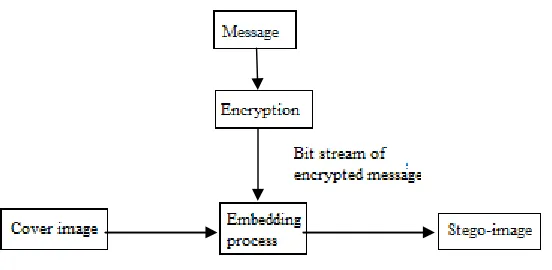
Steganography is a process of covering the secret message inside other file. As no one knows that a message is being sent through image, except the intended user, steganography is more secure than cryptography. Many steganographic methods have been projected for effective communication.
As the images traverse through internet, its size affects the length of the secret message that it cover. MRF[1,2,3] gray scale texture synthesizer is used here to overcome this drawback.
Fig. 1: Data Embedding in Cover image II. RELATED WORK
1. TEXTURE SYNTHESIS BASED ON MRF:
This synthesis shows a dependency relationship among pixels with its neighbors. Based on MRF synthesizer, energy function E(x) can be computed to find the required size of a cover image. Required notations to define E(x) are listed below.
x : Initial M x N texture in matrix form and x(i,j)ϵ S.
Ω= {x | xt= x(i,j) S} ∀ 0 ≤ i ≤M and 0 ≤ j ≤ N.
θk: Weight of direction k.
k= min {1, P(Y)/P(X)}
The improved probability for all xϵΩ is P(x): P(x) =
( )
∑ ( )
Ω
Where E(x)= ∑ . ( )
+ ∑ . ∑ ( , )
W( ) : the weight of pixel and n is the size of neighborhood, let n=2, for 2nd order neighborhood. H(x,y)=H(y,x) and
H(xi,xi+k)= θk x I(xi,xi+k)
If xi=xi+k, I(xi,xi+k) = -1 else 1.
Algorithm:
Step 1: for j=1 to M.N, assign xj= v, where v ϵ S.
Step 2: for j=1 to M.N,
2.1: consider yi=xi∀ i ≠j and assign yi=v where v is randomly selected from S. 2.2: k= min {1, P(Y)/P(X)}
2.3: assign x ← y with probability k.
Step 3: Repeat 2nd step until we reach convergence of the cover image.
III.PROPOSED ALGORITHM
Embedding Algorithm:
Input: α: number of dependent locations,
C: cipher text, which is an encrypted secret message using AES algorithm and streamed as 3-bit words, k: constant value to signify the embedded pixels.
T: number of left circular shifts to be applied on gray values with respect to 3-bit words in Table 1, Step 1:
Let the starting embedding location as (0,0) and then scan the cover image in lexicographic order. Step 2:
Every time read a 3-bit word x from the stream of cipher text C. Step 3:
Apply left circular shift on gray scale values for T times and find the first pixel that come across while scanning, whose pixel value is x.
Step 4:
Increase its pixel value to x+k. Step 5:
Find next α – dependent pixel locations by using the current pixel location. Step 6:
Description of Proposed algorithm:
We take eight grayscale values(30,60,90,120,150,180,210,240) to map with 3-bit words (000,001,010,011,100,101,110,111) respectively as shown in Table 1.
3-bit word 000 001 010 011 100 101 110 111 Pixel value 30 60 90 120 150 180 210 240
Table -1: Gray scale values with corresponding 3-bit words
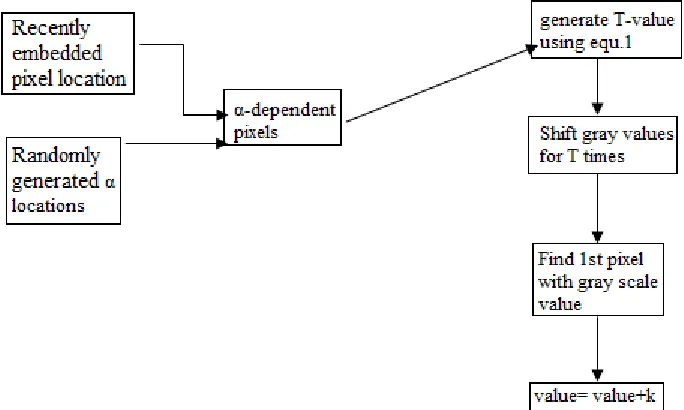
For every 3-bit word, before embedding, apply left circular shift for T times to the gray scale values so that the different 3-bit words will be embedded into different pixels. Then select α fixed locations randomly to generate α
dependent pixel locations based on last embedded pixel location. Last embedded + α = α
Pixel location locations dependent pixel locations
For example consider (a,b) be the last embedded pixel location and
(x
1,y
1), (x
2,y
2) are the randomly selected
fixed α locations, then
((a+
x
1) mod M,(b+y
1) mod N) and((a+
x
2) mod M,(b+y
2) mod N) will be the dependent pixel locationsWe use these pixels’ values to calculate T by using the formula as follows: T= ∑∝ ( −30) 30 8 ____ eq(1)
where piis the value of dependent pixel.
After calculating the T value, perform left shift for T times and find the first pixel with the corresponding gray scale value and increase its pixel value by k units.
Extraction Algorithm:
Input: α: number of dependent locations,
Stego-image of size MxN,
k: constant value that signified the embedded pixels.
T: number of left circular shifts to be applied on gray values with respect to 3-bit words in Table 1, Step 1:
Set the pixel (0,0) as the latest embedded and scan the stegoimage in the order of embedded process. Step 2:
Find all the pixels’ locations with value v
ϵ
{30+
k, 60+
k, 90+
k, 120+
k, 150+
k, 180+
k, 210+
k, 240+
k}, decrease pixel value of those pixels by k.Step 3:
Apply left circular shift for the gray scale values (30, 60, 90, 120, 150, 180, 210, 240) for T times with respect to the 3-bit words (000,001,010,011,100,101,110,111) according to Table-1.
Step 4:
Compute α dependent locations with respect to the latest embedded location. Step 5:
Calculate T by eq.(1) Step 6:
Repeat step 2 to step 5 until no pixel with the pixel value v
ϵ
{30+
k, 60+
k, 90+
k, 120+
k, 150+
k, 180+
k, 210+
k, 240+
k}.IV.SIMULATION
Consider the following assumptions to simulate an example of embedding an encrypted message.
1: An stegoimage of size – 4x8 [0:3, 0:7] and start at left most pixel (0,0) as latest embedded pixel at first. 2: let C: Cipher text with the bit sequence of {101,010,011,001}
3: α = 2 and randomly selected fixed pixel locations (α) are : {(1,1),(2,3)}and k=4
4: let T=0 initially, number of left circular shifts to be performed on gray values with respect to 3-bit words, as shown in Table -1
EMBEDDING PROCESS:
1. To embed the first word 101, find the first pixel with the gray value 180, as T= 0.
From the fig.(a), pixel (0,7) contains 180 which corresponds to 101. So update (0,7) value from 180 to 180+4=184 as shown in
.(b).
As (0,7) is latest embedded pixel, α dependent locations are:
(0,7) +(1,1) = (1,0)
(0,7)+(2,3)= (2,2). These are the α locations with pixel values 30, 150 respectively.
then T= + = 0+ 4 = 4 mod 8=4
2. So apply left circular shift T =4 times on Table -1, to embed next pixel 010. After performing shift operation, 210 is the gray scale value w. r. t. 3-bit word 010 now. From the fig.(a), pixel (1,1) contains gray scale value 210. Increase its pixel value to 210+4= 214, shown in fig.(b).
As(1,1) is the latest embedded pixel, α dependent pixel locations are:
(1,1)+(1,1)=(2,2) and
Then T= + = 4 + 1 = 5 mod 8 =4
3. Apply left circular shift for 5 times, to embed 3rd 3-bit word 011.. After performing shift operation, 150 is the gray scale value w. r. t. 3-bit word 011 now. From fig.(a), pixel (1,2) contains gray scale value 150. Increase its pixel value to 150+4=154, shown in fig.(b).
As (1,2) is the latest embedded pixel, α dependent pixel locations are:
(1,2)+(1,1)=(2,3) and
(1,2)+(2,3)=(3,5). These are the new α dependent locations with gray values 210, 90 respectively.
Then T= + = 6 + 2 = 8 mod 8 =0
4. So no need to apply left circular shift to embed 4th 3-bit word 001.
From fig.(a), pixel (3,5) contains the gray value 90 which corresponds to 001. Increase it to 90+4=94, shown in fig.(b).
90 30 30 120 150 150 60 180 30 210 150 120 120 180 180 210 30 120 150 210 60 240 240 180 210 210 150 60 30 90 90 210
Fig.(a) pixel values of 4x8 cover image
90 30 30 120 150 150 60
30 120 120 180 180 210 30 120 150 210 60 240 240 180 210 210 150 60 30 90 210
Fig.(b) pixel values of 4x8 stego-image image V. CONCLUSIONANDFUTUREWORK
The proposed method use 3-bit gray scale values to increase the payload capacity of the cover image. So huge
message can be embedded in the given cover image. As any one needs α fixed locations to extract the cipher text, it’s
hard to retrieve the secret message without knowing α locations, which are sent to the receiver using secret key. So this
proposed method helps to overcome the drawback of limited size of cover image for embedding.
REFERENCES
1. G.R. Cross and A.K. Jain, ‘Markov Random Field Texture Models’, IEEE transactions on Pattern Analysis and Machine Intelligence, vol.5, No. 1, 25-39, 1983.
2. F.J.Chang, ‘A Steganographic Method Using MRF-Synthesized Textures as Cover Images’, M.S. Thesis, National Tsing Hua University, Hsinchu, Taiwan, April 2011.
4. C.C. Chen and C.C.Chen, ‘Texture Synthesis: A Review and Experiments’, Journal of Information Science and Engineering, Vol. 19, No. 2, 371-380, 2003.
5. N.F. Johnson and S. Jajodia, ‘Steganalysis of images Created Using Current Steganographic Software’, Int’l Workshop in Information Hiding, Berlin, Vol. 1525, 273-289, 1998.
6. Kuo-Chen Wu and Chung-Ming Wang, ‘Steganography Using Reversible Texture Synthesis’, IEEE Transactions on Image Processing, Vol. 24, No. 1, 130-139, January 2015.
7. J. Fridrich, M. Goljan and R. Du, ‘Detecting LSB steganography in color and gray-scale images’, IEEE MultiMedia, Vol. 8, No. 4, 22-28, Oct/Dec 2001.
8. C. Han, E. Risser, R. Ramamoorthi, and E. Grinspun, ‘Multiscale texture synthesis’, ACM Trans. Graph., vol. 27, No. 3, 2008.
9. Z. Ni, Y.-Q. Shi, Ansari, and W. Su, ‘Reversible data hiding’, IEEE Trans. Circuits Syst. Video Technol., Vol. 16, No. 3, 354-364, Mar.2006.
10. A. A. Efros and W. T. Freeman, ‘Image quilting for texture synthesis and transfer’, in Proc. 28th Annu. Conf. Comput. Graph. Interact. Techn., 2001, 341-346.
BIOGRAPHY