Living. (Under the direction of Jason C. Allaire, Ph.D.)
The present study builds on the growing body of research examining the relationship between basic cognitive functioning and instrumental task performance. Specifically, the aim of the study was to determine if specific cognitive abilities were related to overall and
ii
Examining Domain-Specific Relationships between Cognitive Functioning in Older Adulthood and Performance on Observed Tasks of Daily Living
by
Taryn Rose Patterson
A thesis submitted to the Graduate Faculty of North Carolina State University
in partial fulfillment of the requirements for the Degree of
Master of Science
Psychology
Raleigh, North Carolina 2010
APPROVED BY:
________________________________ _________________________________
____________________________ Jason C. Allaire, Ph.D. Chair of Advisory Committee
ii
DEDICATION
iii
BIOGRAPHY
“…But we lean forward to the next crazy venture beneath the skies”
iv
ACKNOWLEDGEMENTS
v
TABLE OF CONTENTS
Page
List of Figures ……… vii
List of Tables ………. viii
Introduction ………... 1
Review of the Literature ……… 1
Instrumental Functioning in Older Adults ……… 1
Assessing Instrumental Functioning in Older Adults ……… 2
Subjective Assessments ………. 2
Objective Assessments ……….. 4
Predictors of Instrumental Functioning in Older Adults ………... 7
Cognition and Instrumental Functioning: Global Relationships ………... 7
Specific Cognitive Abilities and Instrumental Functioning ………... 8
Cognitive abilities and Domain-Specific Instrumental Functioning ………….. 10
Demographic Predictors ………. 15
Summary……….. 16
Specific Aims………... 17
Method……….. 18
Participants ………. 18
vi
Procedure………. 19
Measures……….. 19
Analytic Approach………... 22
Results……….. 24
Specific Aim 1: Factor Structure of the OTDL-R..……….. 24
Specific Aim 2: Relationships among demographic and cognitive…….. 25
variables on overall and domain-specific OTDL performance: MIMIC model results Specific Aim 3: Mediation………..………. 28
Discussion……… 29
vii
LIST OF FIGURES
Page
Figure 1. One-factor solution to the Revised Observed Tasks of Daily ……….…….. 35 Living assessment.
Figure 2. Three-factor and hypothetical second-order model of the…..……… 36 Revised Observed Tasks of Daily Living assessment.
Figure 3. MIMIC Model with direct and indirect standardized regression …………... 37 weights among cognitive predictor variables, demographic predictor
variables, overall OTDL performance, and domain-specific OTDL performance.
viii
LIST OF TABLES
Page
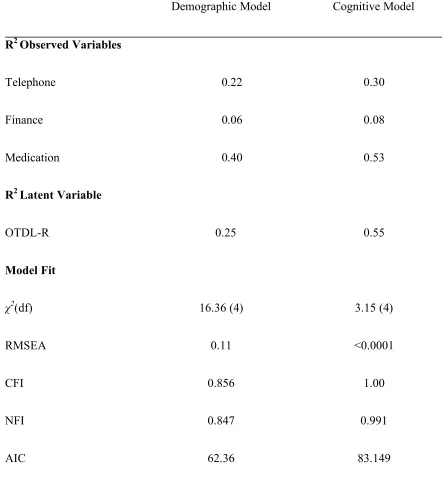
Table 1. Fit Indices of Individual Measurement Models……….……… 38 Table 2. Variance Accounted by Observed Variables and Model Fit for…..……….. 39 Demographic and Cognitive Predictor MIMIC Models of the
Revised Observed Tasks of Daily Living assessment.
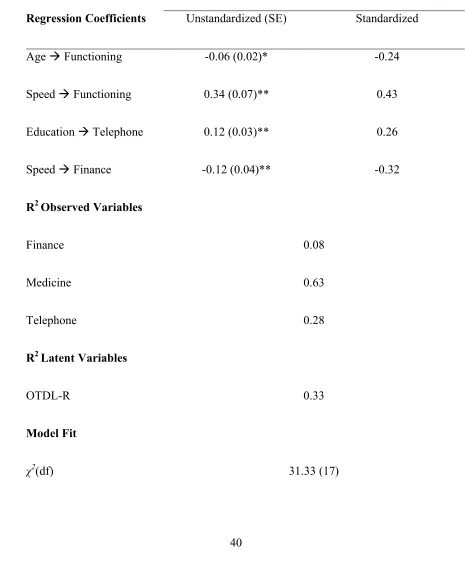
Table 3. Standardized and Unstandardized Estimates for Final MIMIC Model …... 40
1
Introduction
“Successful aging” refers to maintenance of functional capacities, components of which include cognitive, social, and physical activities (Rowe & Kahn, 1997). Consequently, sustained independence, as determined by maintained levels of functioning in adulthood, is a primary concern for many. Functional activities can refer to two different categories:
activities of daily living (ADLs, such as feeding and bathing; Katz, Ford, Moskovitz, Jackson, & Jaffe, 1963), and instrumental activities of daily living (IADLs, such as taking medication, handling finances, and cooking; Lawton & Brody, 1969). Most of the previous research on functional activities has focused on determinants of decline and maintenance such as cognitive functioning. However, a main criticism of this research is that functional activities are usually assessed through the use of subjective self-reports which do not assess actual ability or competency, nor do they assess individual ability to perform various tasks within a single domain of functioning (Allaire et al., 2009; Guralnik, Branch, Cummings, & Curb, 1989). In addition, prior research has not clearly identified which cognitive abilities are associated with specific domains of instrumental functioning. Using an objective measure of instrumental functioning, the current study will examine the extent to which a broad array a of basic cognitive abilities account for individual differences in overall competency, as well as within the domains of medication use, financial management, and telephone use.
Review of the Literature
Instrumental Functioning in Older Adults
2
that require a certain amount of cognitive competence to perform, such as preparing meals, managing finances, and taking medications (Lawton & Brody, 1969). Such activities go beyond more basic tasks of daily living, such as bathing and dressing, and require a higher level of memory, planning, and execution in order to properly carryout the task. Due to the greater cognitive complexity of IADLs, such activities are not surprisingly more strongly related to cognitive ability than are ADLs (Burton, Strauss, Hultsch, & Hunter, 2006;
McCue, Rogers, & Goldstein, 1990). Taken together, ADLs and IADLs reflect the minimum level of capacity required for independent living(Katz et al., 1963).
The inability to perform both categories of everyday functional tasks is associated with greater use of health care services (Wolinsky, Miller, Prendergast, Creel & Chavez, 1983), increased risk of institutionalization (Branch & Jette, 1982), and increased risk of mortality (Manton, 1988; Simonsick, Lafferty, Phillips, Mendes de Leon, Kasl, Seeman et al., 1993). Previous studies have found that maintaining independence in older adulthood is often cited as integral to maintaining well-being and sustaining adequate quality of life (Baltes & Carstensen, 1996). Loss of independence in older adulthood due to chronic illness or disability, therefore, is strongly associated with feelings of helplessness and impaired coping mechanisms (Gignac, Cott, & Badley, 2000).
Assessing Instrumental Functioning in Older Adults
Subjective Assessments
3
report ratings by the participant or a proxy-rating obtained by a caregiver or relative is problematic for at least four reasons. First, subjective ratings are susceptible to potentially inaccurate responses; they rely on subjective evaluation, may be prone to memory
inaccuracies, or independently influenced by such things as depression, personality, cognitive status, and social desire to maintain optimal levels of functioning (Kempen, Steverink,
4
moderate to weak correlations have been found between self- or proxy reports of functional status and performance-based assessments (Farias, Harrell, Neumann, & Houtz, 2003; Reuben, Valle, Hays & Siu, 1995).
Objective Assessments
5
The second approach to assessing objective performance is typically used by
clinicians and is referred to here as the “clinical approach.” The clinical approach typically utilizes actual real-world stimuli such as a check or a medicine bottle, but simply ask participants to perform one discrete action (Giannovetti, Libon, Buxbaum, & Schwartz, 2002; Griffith, Belue, Sicola, Krzywanski, Zamrini, Harrell, & Marson, 2003; Okonkwo, Wadley, Griffith, Ball, & Marson, 2006), thereby eliminating the inherent multidimensional nature of most everyday tasks. A single question about a domain such as medication
adherence ignores the multidimensional nature of the everyday task (e.g. remembering to take the medication, understanding the label, taking the correct dose at the correct time, etc). As the name suggests, findings from the clinical approach are largely based on patient samples of older adults who often have been diagnosed with mild cognitive impairment (MCI) or dementia.
The Revised Observed Tasks of Daily Living (OTDL-R; Diehl et al., 2005) is a unique
means of assessing objective instrumental functioning that combines the multidimensionality
of everyday cognition and the physical, real-world stimuli used in the clinical approach. The
OTDL-R asks participants to perform discrete, cognitively complex, observable actions in
response to an experimenter prompt, such as making change with coins and bills, balancing a
6
contact, and mortality. The OTDL, therefore, uses an ecologically valid approach to everyday cognition by observing and evaluating an individual’s ability to manipulate objects in the
environment.
Specifically, the OTDL-R consists of nine total multidimensional objective tasks, three
in each of the domains of medication use (following medicine label directions, understanding an aspirin pamphlet, and completing a patient record form); telephone use (finding and dialing a number from the yellow pages, finding and dialing a number from a directory of social service resources from the phone book, and using a discount rate chart from a phone book); and financial management (making change with coins and bills, balancing a
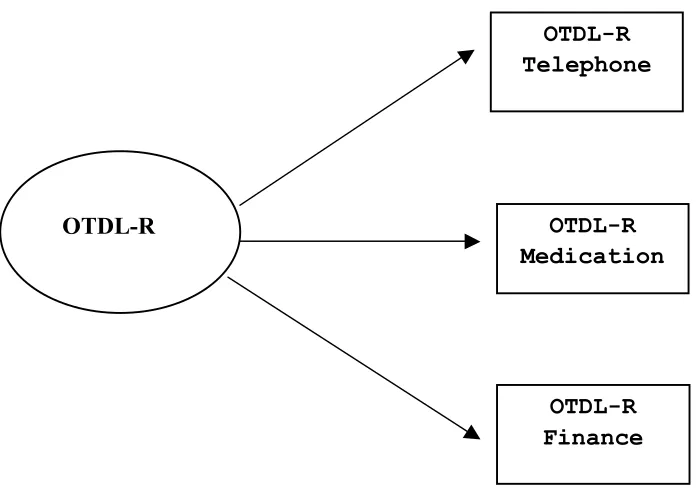
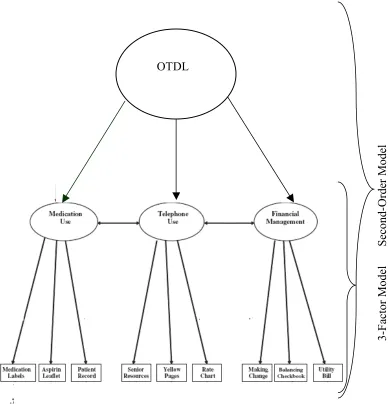
checkbook, and paying a utility bill with a check and mailing it). Confirmatory factor analysis on the OTDL-R has shown that both a one-factor and a three-factor model of everyday competence provided a good fit to the observed data (Diehl et al., 2005). The single-factor solution (see Figure 1) specifies one overall OTDL factor, composed of three composite scores; medication use, telephone use, and finance. The three-factor model (see Figure 2) specifies a separate factor for each of the domains which are comprised of several individual items assessing each domain respectively. The latter model provides additional support for the multidimensionality of older adults’ everyday problem solving and was consistent with findings reported by Diehl et al. (1995) on the original version of the OTDL. However, the large intercorrelations among the latent factors suggested that a more
7
factor structure best fits the data. Utilizing the OTDL-R, due to the fact that this type of assessment necessitates both understanding cognitively complex actions as well as actually performing them, will allow for a more multidimensional examination of the relationship between cognition and instrumental functioning.
Predictors of Instrumental Functioning in Older Adults
Regardless of assessment type, many studies have found evidence of age differences and age-related decline in instrumental functioning (Diehl et al., 2005; Fleishman, Spector, & Altman, 2002). For instance, Diehl and colleagues (2005) found a significant cross-sectional negative correlation between age and IADL performance (r = -.24), as did Willis, Tennstedt, and Marsiske (2006) who observed a longitudinal decline in functioning for both
experimental and control groups over a five year period. Given these age differences and the importance of maintaining competency in instrumental domains of functioning for successful aging, many studies have attempted to explain age-related differences, as well as individual differences unrelated to age, by more proximal constructs, particularly cognitive functioning. Cognition and Instrumental Functioning: Global Relationships
8
determined that lower overall cognitive functioning, as determined by the Telephone Interview of Cognitive Status (TICS; Brandt, Spencer, & Folstein, 1988), was predictive of later ADL and IADL disability. In other studies (e.g. Burton et al., 2006; McCue et al., 1990), cognitive status was not predictive of individual ADLs, but was predictive of the IADL tasks. Similarly, Cromwell and colleagues (2003) identified significant relationships between overall cognitive status and impairments within Lawton and Brody’s (1969) IADL domains of telephone use, medication use, and financial management.
These findings suggest that cognition is related to instrumental functioning, and even specific domains of functioning. However, they do not identify the specific cognitive abilities that might be related to overall instrumental functioning or perhaps to specific domains of functioning. An in depth examination of these relationships would lead to a greater understanding of whether or not individual functional capacities are uniquely related to individual domains of cognition, thereby elucidating pathways potentially amenable to intervention (Royall, Lauterbach, Kaufer, Malloy, Coburn, & Black, 2007).
Specific Cognitive Abilities and Instrumental Functioning
9
Royall, Palmer, Chiodo, and Polk (2004) found that decline in a measure of executive function was a more salient predictor of IADL decline than the MMSE for a population of older adults residing in a continuing care community. In addition, intervention research utilizing cognitively normal populations has found that improved reasoning ability (Willis et al., 2006), and speed of processing (Edwards, Wadley, Myers, Roenker, Cissell, & Ball, 2001) are related to less difficulty with IADLs, as assessed by both self-reported and objective ratings of functioning.
Similarly, studies examining everyday cognition have found a relationship between assessments of basic cognitive abilities and everyday cognition (Allaire & Marsiske, 1999; 2002; Willis & Schaie, 1986; 1993). Allaire and Marsiske (1999) utilized a battery of paper-and-pencil measures of everyday problem solving within IADL domains of medication use, financial planning, and food preparation, and found that verbal knowledge, declarative memory, and inductive reasoning significantly predicted community-dwelling older adults’ everyday cognitive performance. In addition, these cognitive abilities mediated all of the age-related variance in instrumental performance. Finucane, Mertz, Slovic, and Schmidt, (2005) reported that working memory and processing speed were significantly related to
10
speed were associated with greater comprehension errors collapsed across the three domains. Similarly, Burton et al. (2006) examined whether measures of specific cognitive abilities (i.e. memory, executive functioning, and speed of processing) were more useful in predicting problem solving abilities than measures of global cognitive functioning. Results indicated that global measures of cognitive functioning, as well specific cognitive abilities, were important predictors of older adults’ ability to solve problems of everyday living on the Everyday Problems Test. Results from research by Diehl and colleagues (1995; 2005) have also shown that overall performance on the OTDL is significantly related to a number of traditional measures of psychometric intelligence (ranging from r = .33 with memory to r = .68 with fluid intelligence). Performance on the OTDL-R was positively related with older adults’ performance on tests that assessed basic cognitive functioning such as verbal ability, memory, inductive reasoning, and perceptual speed.
Clearly these studies link specific cognitive abilities to instrumental functioning. However, they fall short of identifying which abilities are related to specific subdomains of instrumental functioning. Specifically, greater examination of abilities such as memory, inductive reasoning, and processing speed, may elucidate domain-specific relationships potentially amenable to intervention.
Cognitive Abilities and Domain-Specific Instrumental Functioning
11
reasoning have been linked to performance on a financial ability (Okonkwo et al., 2006). Barberger-Gateau and colleagues (1999) found that processing speed was associated with all four IADL domains (e.g., telephone, transportation, medication, and finance). A number of more specific relationships was also found: visuo-spatial perception/attention and
transportation use, conceptual abilities/orientation and telephone use, episodic memory and medication use, conceptual abilities/orientation as well as episodic memory/semantic ability and financial management.
Interestingly, the vast majority of research examining domain-specific relationships between cognitive abilities and specific functional domains falls under the clinical approach. However, most of this research has been conducted comparing group differences in
12
impairment in MCI participants in that not all individuals demonstrated impairment, perhaps due to differential progression of impairment.
Allaire and colleagues (2009) examined not only the prevalence of impaired abilities within the domains of medication use, financial management, and nutrition/food preparation, but the unique contribution of the Everyday Cognitive Battery (ECB) memory test in
predicting MCI status. They found significant differences between MCI and non-MCI individuals in frequency of reported IADL difficulty; a greater proportion of participants in the MCI group reported dependency on others for preparing meals and paying bills/handling money. Furthermore, MCI participants performed significantly worse on all three everyday memory domain subscales, with performance on the domains of medication use and financial management serving as unique and significant predictors of MCI group membership.
13
(Diehl et al., 1995) that found that high scores on the cognitive ability measures were associated with higher performance on the OTDL. Specifically, significant correlations ranged from .31 (perceptual speed and telephone use) to .68 (fluid intelligence and medication use). All three factors of the OTDL (food preparation, telephone use, and medication), had the strongest associations with fluid intelligence.
Although knowledge of both general and domain-specific instrumental functioning is important in fostering independence in older adulthood, the ability to manage one’s
medications is arguably a critical and highly modifiable component. There is a breadth of research on the effects of cognitive impairment on medication management and subsequent quality of adherence. Researchers have examined the key role memory plays in medication adherence and comprehension due to the fact that memory can have either direct effects on a medication regimen, or indirect effects where improper comprehension about a medication leads to suboptimal management (Ley, 1986). Such an examination is an ideal way to connect an everyday task that is not only a vital component in the daily lives of older adults, but is necessarily contingent on cognitive behaviors including comprehension, working memory, long-term memory, prospective memory, and reasoning (Park, 1992b). Park and colleagues (1994) focused on the cognitive aspects of medication comprehension,
14
Similarly, Neupert and McDonald-Miszczak (2004) examined cognitive and
metacognitive predictors of cued recall for verbal medication information after a 24-hr delay and found a significant interaction between age and working memory, with medication recall contingent on working memory ability in older adults. More importantly, they found that both younger and older adults are typically overconfident when gauging their ability to recall important medical information, which might have serious implications for community dwelling older adults who are, on average, prescribed more medications as compared to younger adults (Neupert & McDonald-Mizczak, 2004). Research that employs an
ecologically valid approach to the study of adherence has found that age may not be a factor in non-adherence. Rather it may be factors such as lower cognitive capacity, specifically working memory and executive functioning, (Neupert & McDonald-Mizczak, 2004; Insel et al., 2006), or self-report busyness (Neupert, Patterson, Davis, & Allaire, 2010) that are equally influential factors.
15
studies merely observed if patients were able to perform a discrete, everyday task, but were not asked to solve problems with that domain of functioning, which limits the predictive utility of such assessments.
The current research proposes to examine the relationships between specific cognitive abilities and specific everyday functional domains in an attempt to more fully understand the process that promotes functional maintenance, and subsequent independence, in older adults within specific everyday domains. Little research has examined the predictive utility of domain-specific cognitive performance, such as on everyday assessments of medication and financial management, and subsequent effects on real-world functional outcomes. It would therefore be important to know if OTDL-R performance is uniquely predicted by domain-specific performance on a multidimensional assessment of everyday cognition (assessing domains of food preparation, medication use, and telephone use) above and beyond the predictive utility of basic cognitive abilities.
Demographic Predictors
In addition to cognitive abilities, extant research has attempted to identify
16
These results are consistent with previous findings that also identified a significant relationship between education and telephone use (Farias et al., 2003). Although the latter research did not find a significant relationship between age and telephone use, it should be noted that much domain-specific research has utilized populations of cognitively impaired individuals. This research has, however, highlighted the importance of identifying both direct and indirect relationships between predictors, overall performance, and domain specific performance. Ignoring potential direct relationships may overestimate the actual relationship that exists between a predictor and overall cognitive performance.
Summary
It is important to identify cognitive predictors of not only overall functional status, but of individual domains of instrumental functioning. Doing so may lead to more accurate detection of everyday functioning abilities that need immediate attention, thereby potentially informing more specific avenues for intervention. Ideally, such an improvement in
17
cognitive functioning and performance on an objective instrumental functioning as assessed by the OTDL-R. Specifically, through the use of a multiple indicators multiple causes (MIMIC) modeling approach, the relationship between cognitive functioning and domain-general (overall performance) and domain specific (medication, finance, and telephone use) instrumental functioning will be examined.
Specific Aims
The present study intended to first examine the factor structure of the OTDL-R in order to determine through confirmatory factor analysis if a one, three, or second order factor model best fits the data. Based on previous research, it is hypothesized that both a 3-factor, and single-factor model will provide a good fit to the data, with a single-factor model perhaps offering a more parsimonious fit (Diehl et al., 1995; 2005).
18
Lastly, the present study intended to explore the extent to which cognitive abilities
mediate the relationship between demographic characteristics (age and education) and performance on the OTDL-R. Based on previous literature, we hypothesized that processing speed may mediate the relationship between age and telephone use, as well as education and telephone/finance (Ayotte et al., 2008; Farias et al., 2003)
Method Participants
Participants were recruited by the researchers from local community centers,
churches, and retirement facilities. Each participant was paid $100 for their participation, as well as an additional $50 for every referral they made to the researchers for potential
participants. The sample consisted of 204 community dwelling elders (130 white, 74 non-white) ranging in age from 60 to 91 years (M = 73 years old, SD = 6.85). Participants’ average yearly income was $32,500 (SD = $10,000; range = < $5,000 - >$45,000) and the average years of education was 15.36 years (range = 5-24 years, SD = 3.19 years).
Approximately 64% of the sample was European American, 35% was African American, and 1% reported as being Hispanic. Additionally, 60% of the participants were female.
Design
19
present investigation. A daily diary design was used which consisted of a pretest and eight daily sessions. The current investigation utilized the pretest data exclusively.
Procedure
Testing locations included surrounding senior centers, churches, and community organizations. Individuals who expressed interest in participating in the study were contacted via telephone, given more information about the intentions of the study, and briefly screened in order to determine eligibility. If interested and eligible, potential participants were
scheduled for a pretest session. Baseline testing was led by either the Primary Investigator or a trained graduate research assistant and occurred in groups of no more than five participants at a time. At this testing session, each participant received a 2-hour psychological test battery that included both paper-and-pencil and computer administered tests. Before each test, instructions were given verbally and administered under timed conditions by imposing fixed test times with a preset timer when appropriate. Measures that were administered by the computer began with ample practice sessions so participants became familiar and
comfortable with responding via the computer keyboard. The specific measures included in Phase 2 are provided below.
Measures
20
The Center for Epidemiological Studies-Depression (CES-D) scale. Due to the potential relationship that exists between depression and subsequent performance on cognitive and functional tasks, the CES-D (Radloff, 1977) was used to control for such effects.
The Observed Tasks of Daily Living Assessment- Revised (R). The OTDL-Revised (Diehl et al., 2005) is a behavioral measure of everyday competence that requires adults to perform a set of discrete, observable actions in response to a question by an interviewer. Participants were asked to complete three tasks within each everyday domain, such as balancing a checkbook or following directions on a medicine label. The OTDL-R includes a total of nine tasks, three in each of the domains of medication use (following medicine label directions, understanding an aspirin leaflet, and completing a patient record form); telephone use (finding and dialing a number from the yellow pages, finding and dialing a number from a directory of social service resources from the phonebook, and using a rate discount chart from a phonebook); and financial management (making change with coins and bills, balancing a checkbook, and paying a utility bill with a check and mailing it). Each main task in the OTDL- R (e.g., finding and dialing a number from the yellow pages) has a number of subtasks or steps (e.g. first finding the number), yielding a total of 28 items on which scores were assigned.
21
their actions were scored as correct (1) or incorrect (0) for each step, with total scores
ranging from 1 to 4 depending on the task. For the purpose of the present analyses, composite scores were created for each of the domains (medication, telephone, finance) by summing the tasks and subtasks associated with that domain. The composite domains were then utilized as indicators for the single factor model. On average, administration of the OTDL-R takes 20-30 minutes. Alphas for the three domains were .71 for medication use, .66 for telephone use, .71 for financial management, and the internal consistency for the total measure was .82 (Diehl, Marsiske, Horgas, Rosenberg, Saczynski, & Willis, 2005).
Cognitive Ability Measures
Choice Reaction Time (CRT) Task (Hultsch et al., 2002; MacDonald, Hultsch, & Dixon, 2003). This task assessed processing speed by asking participants to identify as quickly as possible the location of an object on the computer screen by pressing the
corresponding key on the keyboard. Participants were presented with a stimulus of four plus signs arranged horizontally on the screen. After a delay of 1,000 ms, one of the plus signs change to a box, and the participants must subsequently press the key on the keyboard that corresponds to the location of the box on the computer screen. Scores consisted of average milliseconds to complete each item.
22
Scores consisted of average milliseconds to complete each item.
Letter Series Test (Thurstone, 1962). This 48-item measure assessed inductive reasoning, or the ability to extract novel relationships in over-learned material. Participants were asked to correctly identify the letter that comes next in a series of letters presented on the computer screen for a total of four minutes. For example if the letters presented were “a b a b c d c” the participant would press the correct letter that would come next in the series, which would be “d”. The correctly classified items were summed to represent an overall score, with the highest possible score being 30.
Rey Auditory Verbal Learning Task (AVLT; Rey, 1941). This task required participants to study a list of 15 semantically unrelated words on a laptop computer for 1 minute and then recall as many of the words from the list as possible. The number of correctly recalled words was used as the total score; there is no penalty for intrusion or preservation errors. The total time allotted to complete the test was 2 min; 1 min to study the list and 1 min for recall.
23
N-Back (Kirchner, 1958). The n-back task assessed working memory capacity. A list of 52 letters was presented at a rate of 1s with a 500 ms interval between stimuli. The
participant’s task was to determine whether the letter presented was the same or different from the letter 1-back or 2-back. Participants were told to press the number ‘1’ key when the letter matches the letter of the instructed amount of letters back (e.g. 1-back or 2-back), and press ‘2’ when the letter was not a match. For example, if the letters presented are K, L, S, L, the responses for the 2-back task to the letter ‘S’ would be ‘2’ for a non-match, whereas the response to the letter ‘L’ would be ‘1’ for a match. Separate scores were calculated for the 1-back and 2-1-back trials, where a participant's score on each task is the number of correct answers out of the 50 1-back and 50 2-back trials.
Analytic Approach
In order to identify relationships among basic cognitive abilities, specific domains of cognition, and subsequent performance on the OTDL-R, the multiple indicators multiple causes (MIMIC) modeling approach was utilized. The MIMIC model is a subset of structural equation modeling in which there are multiple indicators for each latent variable (analogous to confirmatory factor analysis) and multiple covariates, or predictor variables (Jones & Gallo, 2002; Muthén, 1989). The MIMIC model approach can be inclusive of both
24 Results Specific Aim 1: Factor Structure of the OTDL-R
In order to identify which of the three potential models (single-factor, three-factor, second-order) best fit the data, confirmatory factor analyses were conducted using AMOS 16.0. A single–factor as well as a three-factor model were estimated followed by a second-order model. Adequate fit was determined by the Maximum Likelihood Estimation,
represented as a chi-square statistic, the root mean square error of approximation (RMSEA), and at least one additional relative fit index, such as the comparative fit index (CFI), Bentler-Bonett Normed Fit Index (NFI), or Tucker-Lewis Index (TLI) (Hu & Bentler, 1999). Lastly, each model was compared to one another to determine which best represented the factor structure of the OTDL. Model comparisons were made using Akaike's Information Criterion (AIC; Akaike, 1983) values, with small AIC values indicating more optimal models.
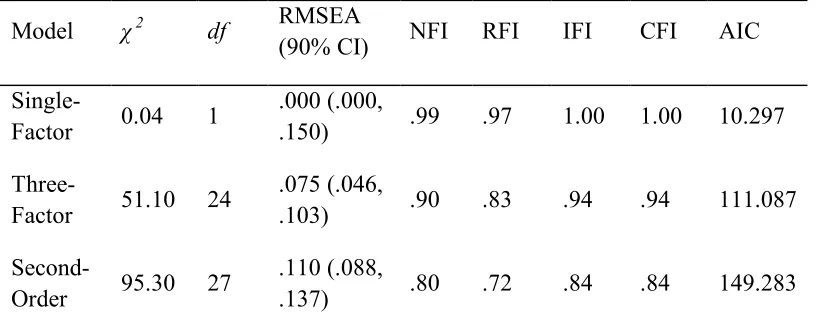
The single-factor model (see Figure 1) consisted of three indicator variables (telephone, medication, finance) comprising the latent variable “OTDL-R”. The indicator variable medication loaded most highly in the latent OTDL-R factor, with a beta weight of 0.89, followed by the indicator telephone use with a beta weight of .42, and lastly the indicator finance with a beta weight of .04. The model adequately fit the data χ2(1) = 0.04, p
> .05, RMSEA < .0001 (90% CI = .000, .150), with relative fit indices indicating a good fit as well (NFI = .99, CFI = 1.00). The resulting AIC value was 10.297.
25
the single-factor model (telephone, medication, and finance) were now treated as latent factors, each with three indicators. For example, the three indicators of the finance domain were a) participant scores for making change, b) balancing a checkbook, and c) questions regarding a utility bill. The model did not fit the data as well as the single-factor model, but was acceptable χ2(24) = 51.10, p <.001, RMSEA = .075 (90% CI = .046, .103), with relative fit indices indicating an acceptable fit (NFI = .90, CFI = .94). The resulting AIC value was higher than the AIC value from the single-factor model, at 111.087.
Lastly, a second-order model was tested (see Figure 2). This model was identical to the three-factor model; however a second-order latent variable “OTDL-R” was included with the Telephone, Medication, and Finance factors as indicators. The model did not fit the data well χ2(27) = 95.30, p <.001, RMSEA = .110 (90% CI = .088, .137), with relative fit indices indicating a poor fit (NFI = .90, CFI = .84). The resulting AIC value was the highest of the three models, at 149.283.
In sum, analyses verified that both a single-factor and three-factor model adequately fit the data. The single-factor structure of the OTDL-R was most parsimonious and had the lowest AIC value, replicating findings from Diehl and colleagues (2005). Therefore, was used as the base model for subsequent demographic and cognitive MIMIC models (see Table 1).
Specific Aim 2: Relationships among demographic and cognitive variables on overall and domain-specific OTDL performance: MIMIC model results
26
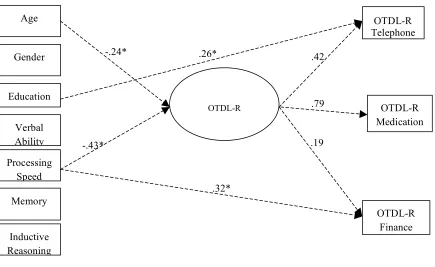
predictor MIMIC model, as well as the cognitive predictor MIMIC model (see Figure 3). For the demographic variable model, hypothesized paths from each demographic predictor (age, gender, and education) to the overall OTDL-R latent factor were first estimated. Significant paths would indicate that specific predictors were related to the overall latent construct of OTDL-R. Paths from each demographic predictor to the indicators of the overall OTDL-R factor were then estimated. Significant paths would indicate that specific demographic variables were related to performance on specific tasks with in a domain (i.e. finance) controlling for overall OTDL-R performance.
The demographics model fit the data poorly, χ2(4) = 16.36, p = .003, CFI = .86, RMSEA = .114, and accounted for 25% of the total variance in the latent OTDL-R factor. The path from age to the OTDLR factor was negative and significant, with a beta weight of -.47. Significant domain-specific paths included the path from education to the telephone domain (β = 0.25, p<.001), with higher levels of education related to better telephone use and related activities.
27
tasks with in a domain (i.e. finance) controlling for overall performance (OTDL-R). The cognition model fit the data well, χ2(4) = 3.15, p = .53, CFI = 1.00, RMSEA <.0001, and accounted for 55% of the total variance in the OTDL-R factor. The paths from the composite predictor speed to the latent variable OTDL-R (β = 0.23, p < .05) as well as from speed to the domain finance (β = -.31, p<.001) were significant. Interestingly, although these two paths both included the composite predictor speed, resulting relationships were in opposite directions: slower speed of execution was related to better overall latent functioning, whereas faster speed was related to better performance in the finance domain. The path from speed to the indicator finance, while controlling for overall OTDL-R performance, accounted for approximately 9% of the variance in financial ability.
28 Specific Aim 3: Mediation
The next step was to examine whether the cognitive variables mediated the
relationships between demographic variables and everyday functioning. Since speed and age were both significant predictors of the OTDL-R factor, it was tested whether speed mediated the impact of age on OTDL-R performance. First, the path from age to OTDL-R was
estimated (β = -.35, p <.001). With the addition of the path from speed to OTDL-R, the age-OTDL-R relationship was reduced (β = -.22, p = .003). Sobel test results (Sobel, 1982) indicated that speed significantly (t = 3.74, p < .001) mediated the relationship between age and OTDL. Follow up commonality analysis revealed that 16% of the variance in OTDL-R was shared between age and speed; only 1% was unique to age and 14% was unique to speed.
29
Discussion
The primary goal of the current study was to examine the relationships that exist among traditional laboratory-based assessments of cognitive functioning and performance on an objective assessment of instrumental functioning, the OTDL-R, through the use of a multiple indicators multiple causes (MIMIC) modeling approach (i.e. a latent variable approach to data analysis). Such an approach allows for the examination of the relationships between cognitive functioning and domain-general instrumental functioning (overall OTDL-R performance) and domain specific instrumental functioning (medication, finance, and telephone use) while simultaneously controlling for the effects additional variables may exert on subsequent performance. Results suggested that speed was a significant predictor of both overall and domain-specific instrumental functioning within the domain of finance.
Interestingly, slower speed was related to better overall OTDL-R functioning, whereas faster speed was related to better performance in the finance domain. Results reveal the importance of examining multidimensional and multidirectional relationships that exist among cognitive variables and instrumental functioning.
30
to be a significant predictor of telephone use. Education, however, was not predictive of performance in the finance domain, contrary to Ayotte’s findings. Such a discrepancy may be due to inherent differences in the examined populations; Ayotte and colleagues utilized data from the Baltimore Study on Black Aging (BSBA) in which education may have played a more significant role for low-income African American older adults.
With regard to cognitive predictors of overall and domain-specific instrumental performance, contrary to previous findings (Barberger-Gateau et al., 1999; Ley, 1986, Neupert & McDonald-Mizczak, 2004), memory was not found to be predictive of
performance within the domains of medication and finance. In addition, reasoning was not related to performance within the domain of finance as was previously found by Okonkwo and colleagues (2006). A main distinction should be made between characteristics of previous studies and those of the present study: the present study utilized an objective measure of overall instrumental functioning inclusive of subdomains of functioning
(telephone, medication, finance). Each subdomain consisted of several related questions (see Figure 2), each of which may tap different cognitive abilities. For example, within the
31
overarching domain. In doing so, we may more fully understand exactly where assistance is needed within a domain of instrumental functioning, and be able to tailor subsequent
interventions to more defined aspects of functional activities.
Such an approach has been taken with research examining medication
comprehension. Researchers have looked at whether or not a particular item, or required action, within an overall medication domain was reliant on inferential processes, could be interpreted in literal terms, or was disproportionately complex as compared to the other items within the domain (Park, 1994). Similarly, research examining financial capacity often utilizes assessments that can be divided into both understanding and applying financial concepts (i.e. prioritizing, understanding, and preparing bills; Okonkwo et al., 2006). For the purpose of the present study, we examined relationships between predictors and the overall subdomain rather than examining the components of the domain, and this may have limited our ability to discern between different tasks within a single domain.
As noted, the most interesting finding was the differential predictive relationship speed had with overall instrumental functioning and domain-specific functioning within the domain of finance. Slower speed of execution was related to better overall OTDL-R
32
instrumental abilities. This may indicate that IADL composite scores, or factors, that include financial capacity items may not be accurately capturing this ability. Secondly, the low loading of the finance domain may explain why speed differentially predicts performance on overall and domain-specific functioning. The finance domain did not contribute a significant amount of variance to the OTDL-R factor, so when speed is a predictor variable of the OTDL-R factor, it is predicting individual differences in medication and nutrition
exclusively. This may explain the finding that slower speed was related to better performance in the medication and telephone domains, yet faster speed of processing was related to better performance in the finance domain. From an intuitive stance, it can be argued that taking one’s time with regard to medication regimens or telephone use may lead to greater accuracy, whereas faster speed of processing may benefit accuracy in domains largely reliant on
working memory or numeracy skills.
33
cognitive detriments. The present finding of a multidirectional relationship within the single ability of speed of processing may suggest that it is more beneficial to focus not on speed of execution but rather accuracy when examining performance on some daily activities.
There are a number of caveats that should be considered when interpreting the results of this study. First, only about 32% of the variance in instrumental functioning was
accounted for by the demographic and cognitive variables included in this study, suggesting that there are a number of other sources of individual differences that were not included in the study. For instance, it may be beneficial to include assessments of health as both instrumental functioning and cognition can be negatively affected by poor health status. Furthermore, as racial and ethnic minorities come to make up a larger percentage of the total population, finding ways to improve minority health has taken on heightened urgency;
theories of aging and subsequent practice can no longer be based on homogenous populations that do not reflect society at large. Including race or ethnicity as a potential predictor may help to identify functional differences, which may indicate deeper systemic inequities that have resulted in domain-specific deficits. Lastly, the laboratory-based nature of the present study prohibits extrapolation to real-world outcomes. Future research should examine the predictive validity of the OTDL-R in the hopes that it would be useful in identifying functional pathways amenable to intervention.
34
multidimensionality, and may overlook meaningful and perhaps clinically important sources of individual differences. In order to more fully understand not only the multidimensional relationships between cognitive variables and subsequent outcomes, but the relative importance of such relationships in functional terms (i.e. how everyday abilities are
differentially affected by declines in cognitive domains), the MIMIC modeling approach may prove valuable in uncovering such relationships. The next step would be to bridge this
35
Figure 1. One-factor solution to the Revised Observed Tasks of Daily Living assessment (Diehl et al., 2005).
OTDL
OTDL-R
OTDL-R Telephone
OTDL-R Medication
36 OTDL
Figure 2. The three-factor model of the Revised Observed Tasks of Daily Living (Diehl et al., 2005), and a hypothetical second order factor solution.
3-F
ac
tor
M
ode
l
ç
S
ec
ond
-O
rde
r
M
ode
l
ç
ç
37 *p < .05
Figure 3. MIMIC Model with direct and indirect standardized regression weights among cognitive predictor variables, demographic predictor variables, overall OTDL performance, and domain-specific OTDL performance.
-.24* Age
Memory
Inductive Reasoning Processing
Speed
OTDL-R Education
Gender
Verbal Ability
OTDL-R Medication
OTDL-R Finance .26*
.32*
-.43* .19
.79 .42
38 Table 1
Fit Indices of Individual Measurement Models
Model χ 2 df RMSEA
(90% CI) NFI RFI IFI CFI AIC
Single-Factor 0.04 1
.000 (.000,
.150) .99 .97 1.00 1.00 10.297
Three-Factor 51.10 24
.075 (.046,
.103) .90 .83 .94 .94 111.087
Second-Order 95.30 27
.110 (.088,
.137) .80 .72 .84 .84 149.283
Note: Note: RMSEA = root mean square error of approximation; CI = confidence interval; NFI = normed fit index; RFI = revealed factor intensity; IFI =
39 Table 2
Variance Accounted by Observed Variables and Model Fit for Demographic and Cognitive Predictor MIMIC Models of the Revised Observed tasks of Daily Living Assessment
Demographic Model Cognitive Model
R2 Observed Variables
Telephone 0.22 0.30
Finance 0.06 0.08
Medication 0.40 0.53
R2 Latent Variable
OTDL-R 0.25 0.55
Model Fit
χ2(df) 16.36 (4) 3.15 (4)
RMSEA 0.11 <0.0001
CFI 0.856 1.00
NFI 0.847 0.991
40 Table 3
Standardized and Unstandardized Estimates for Final MIMIC Model Final Model
Regression Coefficients Unstandardized (SE) Standardized
Age Functioning -0.06 (0.02)* -0.24
Speed Functioning 0.34 (0.07)** 0.43
Education Telephone 0.12 (0.03)** 0.26
Speed Finance -0.12 (0.04)** -0.32
R2 Observed Variables
Finance 0.08
Medicine 0.63
Telephone 0.28
R2 Latent Variables
OTDL-R 0.33
Model Fit
41 Table 3 Continued
RMSEA 0.06
CFI 0.969
NFI 0.940
AIC 127.333
42
REFERENCES
Akaike, H. (1983). Information measures and model selection. International Statistical Institute, 44, 277-91.
Albert, M., Moss, M.B., Blacker, D., Tanzi, R., & McArdle, J.J. (2007). Longitudinal cognitive change in cognitive performance in individuals with mild cognitive impairment. Neuropsychology, 21(20), 158-169.
Allaire, J. C., & Marsiske, M. (1999). Everyday cognition: Age and intellectual ability correlates. Psychology and Aging, 14, 627-644.
Allaire, J. C., & Marsiske, M. (2002). Well- and ill-defined measures of everyday cognition: Relationship to elders’ intellectual ability and functional status. Psychology and Aging, 17, 101-115.
Allaire, J.C., & Whitfield, K.E. (2004). Relationships among education, age, and cognitive functioning in older African Americans: the impact of desegregation. Aging
Neuropsychology and Cognition, 11(4), 443–449.
Allaire, J.C., Gamaldo, A., Ayotte, B.J., Sims, R., & Whitfield, K. (2009). Mild cognitive impairment and objective instrumental everyday functioning: the everyday cognition battery memory test. Journal of the American Geriatrics Society, 57,120–125.
Ayotte, B.J., Allaire, J.C., & Whitfield, K.E. (2008). Understanding Within-group Variability of Everyday Cognition in Older African American Adults: A MIMIC Model
Approach.
43
maintenance, and daily use. Encyclopedia of Applied Psychology, 1, 394-392. Baron, R. M., & Kenny, D. A. (1986). The moderator-mediator variable distinction in social
psychological research: Conceptual, strategic, and statistical considerations. Journal of Personality and Social Psychology, 51, 1173-1182.
Baltes, M.M., & Carstensen, L.L. (1996). The process of successful ageing. Aging and Society, 16, 397-422.
Béland, F., Zunzunegui, M.V. (1999). Predictors of functional status in older people living at home. Age Aging, 28:153–159.
Branch, L.G. & Jette, A.M. (1982). A prospective study of long-term care
institutionalization among the aged. American Journal of Public Health, 72(12), 1373-1379.
Brandt, J., Spencer, M., & Folstein, M. (1988). The Telephone Interview for Cognitive Status. Neuropsychiatry, Neuropsychology, and Behavioral Neurology, 111–117. Burton, C. L., Strauss, E., Hultsch, D. F., & Hunter, M. A. (2006). Cognitive functioning
and everyday problem solving in older adults. The Clinical Neuropsychologist, 20(3), 432-452.
Centers for Disease Control and Prevention and The Merck Company Foundation. The State of Aging and Health in America 2007. Whitehouse Station, NJ: The Merck Company Foundation.
44
Community-Dwelling Older Women. Journal of Gerontology: Social Sciences, 54B(5), S262-S27O.
Cromwell, D.A., Eagar, K., & Poulos, R.G. (2003). The performance of instrumental activities of daily living scale in screening for cognitive impairment in elderly community residents. Journal of Clinical Epidemiology, 56, 131–137.
Daly, E., Zaitchik, D., Copeland, M., et al. Predicting conversion to Alzheimer disease using standardized clinical information. Archives of Neurology, 57, 675–680.
Diehl, M., Marsiske, M., Horgas, A.L., Rosenberg, A., Saczynski, J.S., & Willis, S.L. (2005). The revised Observed Tasks of Daily Living: A performance-based assessment of everyday problem solving in older adults, Journal of Applied Gerontology, 24; 211-230.
Edwards, J.D., Wadley, V.G., Vance, D.E., Wood, K., Roenker, D.L., & Ball, K.K. (2005). The impact of speed of processing training on cognitive and everyday performance. Aging & Mental Health, 9(3), 262-271.
Edwards, J.D., Wadley, V.G., Myers, R.S., Roenker, D.L., Cissell, G.M., & Ball, K.K. (2002). Transfer of a speed of processing intervention to near and far cognitive functions. Gerontology, 48, 329-340.
45
Fleishman, J.A., Spector, W.D., & Altman, B.M. (2002). Impact of differential item functioning on age and gender differences in functional disability. Journal of Gerontology: Social Sciences, 57B(5) S275–S284.
Giannovetti, T. Libon, D.L., Buxbaum, L.J., & Schwartz, M.F. (2002). Naturalistic impairments in dementia. Neuropsychologia, 40, 1220–1232.
Giovannetti, T., Bettcher, B.M., Brennan, L., Libon, D.J., Burke, M., Duey, K., Nieves, C., & Wambach, D. (2008). Characterization of Everyday Functioning in Mild Cognitive Impairment: A Direct Assessment Approach. Dementia and Geriatric Cognitive Disorders, 25,359-365.
Gignac, M.A., Cott, C., & Badley, E.M. (2000). Adaptation to chronic illness and disability and its relationship to perceptions of independence and dependence. The Journals of Gerontology, 55(6), 362-372.
Griffith, H.R., Belue, K., Sicola, A., Krzywanski, S., Zamrini, E., Harrell, L., & Marson, D.C. (2003). Impaired financial abilities in mild cognitive impairment: A direct assessment approach. Neurology, 60, 449-457.
Guralnik, J.M., Ferrucci, L., Simonsick, E.M., & Salive, M.E. (1995). Lower extremity function in persons over the age of 70 years as a predictor of subsequent disability. New England Journal of Medicine, 332, 556–561.
Horgas, A.L., Elliot, A.F., & Marsiske, M. (2009). Pain assessment in persons with dementia: Relationship between self-report and behavioral observation. Journal of the
46
Hu, L., & Bentler, P. M. (1999). Cutoff criteria for fit indexes in covariance structure analysis: Conventional criteria versus new alternatives. Structural Equation Modeling, 6, 1-55.
Insel, K., Morrow, D., Brewer, B., & Figueredo, A. (2006). Executive function, Working memory, and medication adherence among older adults. Journal of Gerontology: Psycological Sciences, 61B(2), P102–P107.
Jones, R.N., & Gallo, J.J. (2002). Education and sex differences in the Mini Mental State Examination: Effects of differential item functioning. The Journals of Gerontology: Psychological Sciences and Social Sciences, 57B(6), P548–P558.
Johnson, J.K., Lui, L.Y., & Yaffe, K. (2007). Executive function, more than global cognition, predicts functional decline and mortality in elderly women. Journal of Gerontology: Medical Sciences, 10, 1134–1141.
Katz, S., Ford, A.B., Moskowitz, R.W., Jackson, B.A., Jaffe, M.W. (1963). Studies of illness in the aged: the index of ADL: a standardized measure of biological and psychosocial functioning. The Journal of the American Medical Association, 185, 914–919.
Kempen, G.I., Steverink, N., Ormel, J., Deeg, D.J. (1996). The assessment of ADL among frail elderly in an interview survey: self-report versus performance-based tests and determinants of discrepancies. Journal of Gerontology:Psychological Sciences, 51, 254–60.
Kruger, J. & Dunning, D. (2009). Unskilled and unaware of it: How difficulties in
47
Lawton, M. & Brody, E. (1969). Assessment of older people: Self-maintaining and instrumental activities of daily living. Gerontologist, 9(3), 179-186.
Ley, P. (1986). Cognitive variables and noncompliance. Journal of Compliance in Health Care, 1, 171–188.
Manton, K. G. (1988). A longitudinal study of functional change and mortality in the UnitedStates. Journal of Gerontology, 43(5), 153-161.
McCue, M., Rogers, J. C., & Goldstein, G. (1990). Relationships between
neuropsychological and functional assessment in elderly neuropsychiatric patients. Rehabilitation Psychology, 35, 91–99.
McGuire, L.C., Ford, E.S., & Ajani, U.A. (2006). Cognitive Functioning as a Predictor of Functional Disability in Later Life. American Journal of Geriatric Psychiatry, 14(1), 36-42.
Muthén, B. (1989). Latent variable modeling in heterogeneous populations. Psychometrika, 54, 557-585.
Neupert, S.D, & McDonald-Miszczak, L. (2004). Younger and older adults’ delayed recall of medication instructions: The role of cognitive and metacognitive predictors. Aging, Neuropsychology, and Cognition, 11, 428-442.
Neupert, S.D., Patterson, T.R., Davis. A.A., & Allaire, J.C. (2010). Age Differences in Daily Predictors of Forgetting to Take Medication: The Importance of Context and
48
Okonkwo, O.C., Wadley, V.G., Griffith, H.R., Ball, K., & Marson, D.C. (2006). Cognitive correlates of financial abilities in mild cognitive impairment. The Journal of the
American Geriatrics Society, 54, 1745–1750.
Ostchega, Y., Yoon, S.S., Hughes, J., & Louis, T. (2008). Hypertension awareness, treatment, and control-continued disparities in adults: United States, 2005–2006. NCHS Data Brief, 3, 1-8.
Owsley, C., McGwin, G., Sloane, M.E., Stalvey, B.T., & Wells, J. (2001). Timed
instrumental activities of Daily living tasks: Relationship to visual function in older adults. Optometry and Vision Science, 78(5), 350-359.
Petersen, R.C. (2004). Mild cognitive impairment as a diagnostic entity. Journal of Internal Medicine, 256, 183–194.
Preacher, K. J., & Hayes, A. F. (2004). SPSS and SAS procedures for estimating indirect effects in simple mediation models. Behavior Research Methods, Instruments, & Computers, 36(4), 717-731.
Radloff, L. (1977). The CES-D scale: A self-report depression scale for research in the general population. Applied Psychological Measurement, 3, 385-401.
Reuben, Valle, Hays, & Siu. (1995). Measuring physical function in community-dwelling older persons: A comparison of self-administered, interviewer-administered, and performance-based measures. Journal of the American Geriatrics Society, 43(1), 17-23.
49
impairment: a population based validation study. Neurology, 56, 37–42. Rowe, J.W., & Kahn, R.L. (1997) Successful aging, Gerontologist,37(43), 3-40.
Royall, D.R., Lauterbach, E.C., Kaufer, D., Malloy, P., Coburn, K.L., & Black, K.J. (2007). The cognitive correlates of functional status: A review of from the Committee on Research of the American Neuropsychiatric Association. The Journal of
Neuropsychiatry and Clinical Neurosciences, 19, 249–265.
Royall, D.R., Chiodo, L.K., & Polk, M.J (2000). Correlated of disability among elderly retirees with “subclinical” cognitive impairment. Journal of Gerontology:Medical Sciences, 55A(9), M541–M546
Schwarz, G. (1978). “Estimating the Dimension of a Model.” Annals of Statistics 6, 461-4.
Simonsick, E. M., Lafferty, M.E, Phillips, C.L., Mendes de Leon, C.F., Kasl, S.V., Seeman, T.E., Fillenbaum, G., Hebert, P., & Lemke, J.H. (1993). Risk due to inactivity in physically capable older adults. American Journal of Public Health, 83(10), 1443– 1450.
Spiro, A. III, & Brady, C.B. (2008). Integrating health into cognitive aging research andtheory: Quo vadis? In: Hofer SM, Alwin DF, editors. The Handbook of Cognitive Aging: Interdisciplinary Perspectives. Newbury: Sage Publications, 260–283.
50
Thurstone, T.G. (1962). Primary mental ability for Grades 9-12 (Rev. ed.). Chicago, IL: Science Research Associates.
Edwards, J.D., Wadley, V.G., Myers, R.S., Roenker, D.L., Cissell, G.M., & Ball, K.K. (2001). Transfer of a speed of processing intervention to near and far cognitive functions. Gerontology, 48(5), 329-334.
Weinberger, M., Samsa, G., Schmader, K. et al (1992). Comparing proxy and patients’ perceptions of patients’ functional status: Results from a geriatric outpatient clinic. Journal of the American Geriatrics Society, 40, 585–588.
Weshcler, D. (1981). WAIS-R manual. New York: Psychological Corporation. Willis, S.L. (1987). Cognitive training and everyday competence. Annual Review of
Gerontology and Geriatrics, 7, 159- 188.