Scholarship at UWindsor
Scholarship at UWindsor
Electronic Theses and Dissertations Theses, Dissertations, and Major Papers
1-1-1969
The evolution of the U.S. Containment Policy in Asia.
The evolution of the U.S. Containment Policy in Asia.
Richard John Pilliter University of Windsor
Follow this and additional works at: https://scholar.uwindsor.ca/etd
Recommended Citation Recommended Citation
Pilliter, Richard John, "The evolution of the U.S. Containment Policy in Asia." (1969). Electronic Theses and Dissertations. 6582.
https://scholar.uwindsor.ca/etd/6582
THE EVOLUTION OE THE U. S. CONTAINMENT POLICY IN ASIA
Submitted to the Department of Political Science at the University of Windsor in partial fulfillment of the requirements for the degree of Master of Arts.
Richard John Pilliter B.A.
Faculty of Graduate Studies
INFORMATION TO USERS
The quality of this reproduction is dependent upon the quality of the copy submitted. Broken or indistinct print, colored or poor quality illustrations and photographs, print bleed-through, substandard margins, and improper alignment can adversely affect reproduction.
In the unlikely event that the author did not send a complete manuscript and there are missing pages, these will be noted. Also, if unauthorized copyright material had to be removed, a note will indicate the deletion.
®
UMI
UMI Microform EC52765
Copyright 2008 by ProQuest LLC.
All rights reserved. This microform edition is protected against unauthorized copying under Title 17, United States Code.
ProQuest LLC 789 E. Eisenhower Parkway
Approved 'byf.
Containment is a policy most often associated with
the Truman Doctrine, the Marshall Plan and RATO and of
course the prevention of Soviet expansionism. The policy's
success in Europe has often overshadowed the fact that it
has also been the foundation of America's Asian policy since
the outset of the Korean War. A study of the evolution of
the United States Asian containment policy shows that it
has created rather than solved problems in American rela
tions with Asia. The present tragedy in Vietnam, a product
of the policy; is the prime example.
Containment was formulated as a policy for Europe,
based on the conditions in Europe. It was hastily extended
to Asia to cover the Korean War and was continued in the
post-Korean War period without proper consideration for
Asian needs and wants. The differences in opinion between
American policy-makers and many Asian leaders concerning
these vital factors has greatly handicapped the policy.
The fact that American official rhetoric, originally a
device used to "sell” the policy to the American public,
became at times the basis for actual policies, has further
o
hindered the containment policy.
In Asia, containment has evolved into an open-ended
commitment to defend every nation against communist pres
sures regardless of /the fact that the cost was at times
out of proportion to the American interest involved..
American policy-makers have overextended' the principles of
containment, valid in Europe, and misapplied them in Asia.
As a result, Americans now find their country in a
catastrophic situation in Vietnam, and their efforts to
(
The United States today faces many serious foreign
policy issues; Vietnam, the Middle East and the question
able status of RATO in Europe to mention "but a few. The
most pressing and divisive issue, of course, is the war in
Vietnam. Yet, while the debate has centered on Vietnam,
many leading Americans are questioning almost all aspects
of American policy in Asia. The debate on Vietnam has
come to express the "even more basic divisions and doubts 1 about American purposes and interests in Asia generally."
Thus numerous questions have arisen, such as: What is
America's Asian policy; what are its objectives; do the
objectives reflect the national interest of the United
States; has the policy been successful; if so, why is the
United States involved in the Vietnam War; if the policy
has been unsuccessful, why?
These questions are difficult ones, and some may
have no single absolute answer, but the Vietnam War has
brought out the need to at least attempt to find the
answers.
^Bernard K. Gordon, Toward Disengagement in Asia: A Strategy for American Foreign Policy, (Englewood Cliffs,
1969), p T 1.
In order to begin to answer some of the questions,
it is necessary to go beyond Asia as the area of study,
lor example, to understand the basic underlying principle
in America’s Asian policy for most of the postwar period -
containment, it is necessary to begin at its roots in
Europe.
The study of American policy in Asia is clouded
by the overriding ambiguity of Asia's relation to the U.S.
national interest. While America has since the days of
the Open Door Policy and the acquisition of the Philippines
always expressed an interest in Asia, American leaders
have failed to clearly define what this is. It has been
said that "beneath the confusion, reversals, of policy and
moralistic generalities which have made up the surface of
the Asiatic policy since McKinley, one can detect an under
lying consistency which, however vaguely, reflects the
permanent interests of the United States in Asia. This
2 principle is ... the maintenance of the balance of power."
However, since Hans J. Morgenthau made this claim in 1951,
it may be asked today whether the containment policy in
Asia has been based on this principle; and, if so, whether
the policy has been able to achieve the maintenance of the
balance of power.
It will be the purpose of this thesis to analyse
o
^Hans J.. Morgenthau, "Policy of the U.S.A.",
Political Quarterly, January, 1951, p. 43.
I is an introductory chapter which discusses the concept
of containment itself in its original European context.
This is done in order to convey what is meant by the term
"containment" and also to provide the basis of a comparison
with containment as it evolved as an Asian Policy.
The following chapter deals with the Korean War.
Korea, as will be shown, is the place where containment was
first applied in Asia. However, the war's importance goes
beyond the fact that it marked the beginnings of contain
ment in Asia; for it was during the Korean War and at its
conclusion that perceptions were acquired by American leaders
which were to serve as guide lines for the containment policy
up to and into the Vietnam War.
Next there is a chapter devoted to a general
discussion of the instruments of containment at work in
Asia between the Korean War and the Vietnam War.
And finally, Vietnam is used as a case study of
containment . While the United States has admittedly made
many mistakes in its specific Vietnam policy, I will attempt
to prove to the reader that the failures in Vietnam are
representative of the failures in the entire Asian contain
ment policy.
James Burnham writing in 1953 on containment said
that "to review the record of the containment policy is not
to perform an autopsy but to diagnose the conditions of a
3
still breathing organism." I believe that his words are
still valid today, but ponder the question whether it might
not better serve American interests if this were not so.
•z
James Burnham, Containment or Liberation, (New York, 1953), p. 72.
I am indebted to the members of my thesis committee
whose efforts have aided me immeasurably in the completion
of this work. Mr. B. E. Burton, M. Soc. Sc., my thesis
director, who has given me not only the benefit of his
experience and knowledge in political science by his careful
consideration of my efforts and his valuable suggestions,
but also graciously afforded his time and encouragement.
To both Mr. L. Leduc, M.A., and Dr. Wurfel in the Department
of Political Science, I wish to express my gratitude for
their advice on matters of content and organization.
My thanks also go out to the entire faculty of the
Department of Political Science who have generously assisted
me in my efforts.
Finally, I would like to thank Mrs. Burkell, the
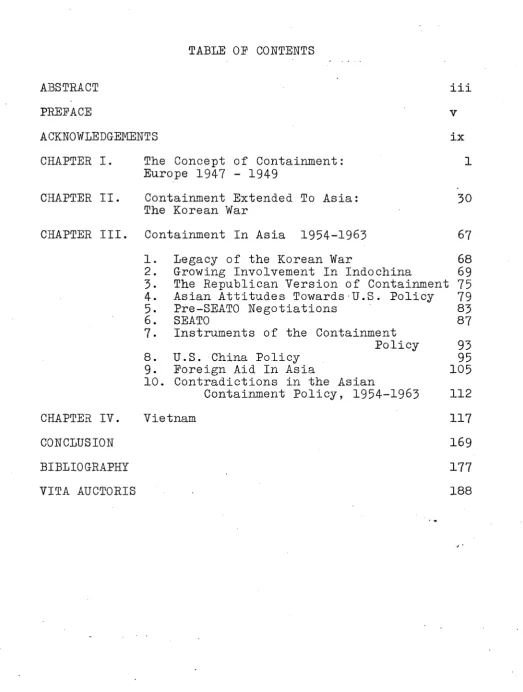
TABLE OE CONTENTS
ABSTRACT iii
PRERACE v
ACKNOWLEDGEMENTS ix
CHAPTER I. The Concept of Containment: 1
Europe 1947 - 1949
CHAPTER II. Containment Extended To Asia: 30
The Korean War
CHAPTER III. Containment In Asia 1954-1963 67
1. Legacy of the Korean War 68
2. Growing Involvement In Indochina 69
3. The Republican Version of Containment 75
4. Asian Attitudes Towards U.S. Policy 79
5. Pre-SEATO Negotiations 83
6. SEATO 87
7. Instruments of the Containment
Policy 93
8. U.S. China Policy 95
9. Roreign Aid In Asia 105
10. Contradictions in the Asian
Containment Policy, 1954-1963 112
CHAPTER IV. Vietnam 117
CONCLUSION 169
BIBLIOGRAPHY 177
THE CONCEPT OE CONTAINMENT Europe 1947 - 1950
It is clear that the United States cannot expect in the foreseeable future to enjoy political
intimacy with the Soviet Regime. It must continue
to regard the Soviet Union as a rival, not a
partner in the political arena. . . .
. . . the United States (warrants) entering with
reasonable confidence upon a policy of firm contain ment, designed to confront the Russians with unalter able counter-force at every point where they show signs of encroaching upon the interests of a peaceful
and stable world. 1
These words are taken from George Kennan's famous
article, "The Sources of Soviet Conduct" which appeared in
Eoreign Affairs July, 1947- It marks the first time the
word "containment" is used to refer, to American foreign
policy objectives. Twenty-two years later, containment is
still a most appropriate word to describe American foreign
policy objectives, although its present ambiguous meaning
has brought the United States into the Vietnam War.
Mr. Kennan's article while it is responsible for
naming the United States postwar policy, it does not mark
the actual beginnings of the policy. Actually the initial
^"George Kennan, "The Sources of Soviet Conduct",
Eoreign Affairs, xxv, No. 4, July, 1947, pp. 566-82.
program of the containment polipy was the Truman Doctrine
(March, 1947) which preceded the Kennan exposition. The
famous writing of Mr. Kennan was not an official statement
of U.S. policy, hut an academic endeavor to describe the
realities of the then existing Soviet-American relations, J
with a personal suggestion of how the (Jnited States could
meet the situation.
The Truman Doctrine was to usher the United States
into a position of international involvement to an extent
previously unknown in that nation's history, outside of the
two World Wars. Some students of American foreign policy
have claimed that it was inevitable that the United States
become a dominant force in international affairs after
World War II. This assumption seemed to be based on the
fact that the power positions of the nations of the world
had altered as a result of World War II and the United
States had emerged from this shuffle as the strongest nation
on the face of the globe. However, while it may have appeared
inevitable to most of the world leaders and some American
statesmen at that time, it was not inevitable to the
majority of the American people.
The United States in the immediate postwar years
(1945 to mid-1946) had entered into a phase that Gabriel 2
Almond describes as "utopian romanticism". It was a time
2
at last been secured and thus there was no reason why the
world would not settle back into normalcy and order. Pew
Americans among the general populace were in the mood to
pay attention to world problems at the close of World War II.
Por those few who were concerned about the problems of a
bankrupt and devasted Europe, and the possible consequences
of atomic weaponry, they believed that such problems could
be adequately resolved by the United Nations through
programs of relief and rehabilitation and peaceful negotia
tions .
While the Truman Administration was-.- dismayed in
the immediate post-war period by the expansionist tendencies
displayed by the Soviet Union, most Americans did not realize
that the Soviet actions would complicate the cooperation
both nations had enjoyed in their war-time alliance. They
could not foresee the future problems of negotiating with
the Soviet Union that were to occur in the United Nations.
Instead, many Americans retained an image of the Soviet
Union as the land "of the heroic Soviet people", a nation
lead by Joseph Stalin, a great patriot, whom Americans
viewed as "a tough bargainer- but still a bargainer."^
With this perception of the Soviets, the American people
had little reason to conclude, that the Soviet Union had
o
3
Ibid., p. xiii.
4
embarked upon a policy for world domination.
The belief in the lasting nature of the peace won
by the allies and their preoccupation with the settling of
domestic problems lead the American public to demand a
speedy demobilization. In the eight-month period, May,
1945 to March, 1946, the United States reduced its armed
forces from 3-5 million to 400,000 men. This program was
carried out despite the continual warnings from the British
Government that deliberate and unilateral disarmament was
exceedingly dangerous until the Soviet Union had been made
to live up to its Yalta obligations. When the Truman
Administration seemingly disregarded the British warnings,
former Prime Minister Churchill appealed directly to the
American public. Churchill had little immediate success in
changing the American people's attitude, but in the process
he did coin the phrase "iron curtain", a phrase that has
since come to dominate the American imagination.
Thus, if one was to draw conclusions based on the
temper of the American people at that time, one would not
reasonably conclude that the United States was on the
threshold of a new phase in its foreign policy.
Many men in the Truman Administration and some U,S.
Congressmen, however, did not share their constituents'
optimism. These men maintained a watchful eye on the Soviet
5
by them. Their decision to act, however, was not prompted
by a direct Soviet action, but rather came in response to
a decision by Great Britain.
In February, 1947, the British government informed
the United States that Britain could no longer afford to
continue the economic and military burden of insuring Greek
independence. Greece at the time was in the midst of civil
war between the conservative government and the Greek
Communists. All intelligence reports indicated that with
the British withdrawal, "the Communist insurgents would
succeed in seizing control 'within a matter of w e e k s ’ unless
the Government of Greece received prompt and large-scale
&
aid." Truman believed if the Communists were successful
in Greece, it would only be a matter of time before Turkey
7
and Iran would also crumble before the Soviet power. The
possible results of a Communist victory in Greece had even
wider implications than these nations losing their independence.
Britain had long theorized that Russian control of Greece and
the Dardanelles would constitute a threat to the European
balance of power. If this balance was to be upset, the
very security of Europe would be threatened, and it had
g
Seyom Brown, The Faces o_f Pow e r , Constancy And Change In Unite_d_ States_ Fo_reign Policy From Truman "To Johnson, (hew York, 1968)’, "p." 40."*
7
always been an assumption of American foreign policy that
European security was vital for its own security. It had
"been a proven fact that when the European balance had been
disrupted, as it had twice in the previous three decades,
the United States had found itself in war. Truman inter
preted the Greek crisis in such a way that the maintenance
of the pro-Western regime in Greece was essential if vital
American interests were to be secured.
Britain's admission that it could no longer meet
the task of preserving Greek independence, placed before
the United States the cold fact of a bipolar world. Then
Undersecretary of State Acheson in explaining the Greek
crisis to a bipartisan group of Congressional leaders
stated:
Only two great powers remain in the world, the United States and the Soviet Union. ... and it was clear that
the Soviet Union was aggressive and expanding. Eor
the United States to take steps to strengthen countries threatened with Communist subversion ... was to protect the security of the United States .... 8
Acheson concluded that the Truman Administration had no
real alternative but to meet this perceived Soviet threat
in Greece. In stating the Administration's position, the
Undersecretary said that America had a choice, either to
act "with energy" to meet the situation or lose by default.
America's decision to meet the challenge posed by
8
Brown, op. cit., pp. 40-41. q
to Congress on March 12, 194-7. The message contained a
request for a Congressional appropriation of $4-00 million
for economic and military aid to Greece and Turkey. In
explaining the necessity for such aid, Truman did not
identify America's direct interest in Greece and Turkey or
their importance in the maintenance of the European balance
of power. Instead, Truman's request was explained in terms
of "a vague and indeterminate commitment to the support of
freedom everywhere. Underlying the President's message
seemed to be the acknowledgment of a long-held American
belief, that they were a chosen people and the time had once
more come for the United States to save the world, as it
had been compelled to do in the previous World Wars. Explicit
in the message was the acknowledgment of a basic conflict
between the United States and the Soviet Union. Truman
defined this conflict in broad ideological terms. In his
Congressional message he stated:
At the present moment in world history, nearly every nation must choose between alternative ways of life. One way of life is based upon the will of the majority and is distinguished by free institutions, representa tive government, free elections, guarantees of indi vidual liberty, freedom of speech and religion and freedom from political oppression.
The second way of life is based upon the will of a
minority forcibly imposed upon the majority. It
relies upon terror and oppression, a controlled
press and radio, fixed elections, and the suppression
of personal freedoms. 11
President Truman, in announcing his administration's
global commitment to support freedom, went far beyond the
immediate crisis in Greece. It is at this point that "the
12
Truman Doctrine merges into the policy of containment."
The containment policy, as expressed in the Truman
Doctrine, gave the impression, either intentionally or
unintentionally, that the United States had embarked upon
a "Holy Crusade" against communism. Such an impression was
instrumental in aligning Congressional support and the
support of the American people for this "new" policy.
Truman, in appealing to America's human emotions, brought
before the American public a sense of danger and moral
obligation, that a "factual" explanation of the Greek civil
war by itself could not have accomplished. The American
people's previous reluctance to become involved in world
affairs was transformed into support for a policy of involve
ment, because they felt such a policy was necessary if the
American way of life was to be preserved. This messianism
or crusading spirit was not an innovation in American foreign
policy; it had been periodically evident in previous policies.
However, since the Truman Doctrine, this emotionalism has
■^From a message of the President to a joint session
of Congress, March 12, 1947. Department of State Bulletin,
xvi, March 23, 1947, pp. 536-537.
12
often times obstructing American decision-maker's percep
tion of a situation.
The immediate programs of the containment policy
■were not of the same vague general nature and the ’’open-
ended" commitment Truman expressed. On the contrary, the
principal programs of the containment policy up until 1950,
the Marshall Plan and NATO, which followed the Truman
Doctrine, were designed specifically to fortify Western
Europe economically and militarily, so that, that area
would be able to resist a Soviet threat.
In 1947 "the picture of Europe was one of mammoth
15
slow-moving crisis." W.W. Rostow in his book The United
States In The World Arena writes that
There was a growing awareness (on the part of the Truman Administration) that something big had to be done in Europe to avoid a disaster to the American interest; that a substantial program of economic aid addressed constructively to the problems of economic recovery was required to deal with the
multiple threats to the Eurasian power balance. 14
The Truman administration had become especially con
cerned with the internal situations in Prance and Italy.
In both these nations domestic communist parties had shown
increased strength. The American policy-makers feared that
unless the internal instability of these nations and all of
15
W. W. Rostow, The United States in the World Arena,
(New York, I960), p. 209.
209-Western Europe was corrected the Communist would exploit
the crisis, and W'estern Europe would fall under Communist
control from within. Although the Truman Administration was
fully aware of the potential external threat the Soviet
Union posed to Western European security,, they maintained
that the economic instability of the region posed a much
more immediate threat.
President Truman reasoned that the rise in communist
appeal in Prance and Italy was due, for the most part, to
the increasing despair among their working classes. This
despair was caused by these nations' inability to rebuild
their economies after the War. Hunger, poverty and despera
tion, not ideological beliefs, were considered by U.S. policy
makers, to be the conditions which laid Western Europe inter
nally vulnerable to Communist domination. American leaders
held the belief that once these internal problems were
rectified, Western Europe would be able to insure its own .
security. However, the United States recognized the fact
that the countries of Western Europe were not able to solve
their internal problems alone; American assistance would be
necessary. In a response to Western Europe's needs, the
Truman Administration devised a program of economic
assistance.
The assistance program, known as the Marshall Plan,
was named, after the then American Secretary of State, George
Marshall. . The program offered economic aid to all nations
determing their respective needs. The Marshall Plan
■was intended to he a program directed toward the countries
of Western Europe, hut Secretary Marshall in announcing
the program was careful in his choice of words, so as not
to exclude the countries of Eastern Europe and its leader,
the Soviet Union, from possible participation. Marshall,
in his initial announcement of the program, declared, "Our
policy is directed not against any country or doctrine, hut
15
against hunger, poverty, desperation and chaos." The
announcement of the Marshall Plan was worded in such a way
that it could he interpreted as an American effort to heal
the split between Communist and non-Communist Europe through
economic assistance and collaboration. Marshall was keenly
aware of the political repercussions that a verbal restric
tion on participation would have brought about. Had the
program been limited to just the Western European countries,
the United States would have been vulnerable to verbal attacks
from the restricted nations. America could then have been
accused of reinforcing the division of Europe and intensify
ing the cold war. Additionally, a program which distinctly
excluded the Soviet dominated Eastern European nations from
participation might have alienated the Communist workers in
Prance and Italy, whose numerical strength was in part
responsible for the program's being. "One of the purposes of
the Marshall Plan had been to gain the political allegiance
15
of the working class" and thus "render them immune to the
blandishments of Communism.1,16
Marshall never really anticipated Russian or East
European participation in the program. Noting the Congress
ional feeling of animosity toward the Soviet Union, he
fully realized that participation by the Soviet Union or
its satellites in the program would have insured the
assistance program's defeat in the Congress. The American
Congress, in fact, had become so anti-Soviet that a program
which would assist this "Soviet enemy" could have been
interpreted as being an act of treason. However, since
Russian refusal to participate in the program seemed assured
Marshall felt that in extending an open invitation to all
nations,' the Soviet Union, in refusing, could be accused of
continuing and aggravating the cold war.
Russian refusal to participate in the Marshall Plan
seemed inevitable due to the program's construction. The
United States had devised the program in such a way, that
had the Soviet Union decided to participate, it would have
had to disclose information concerning its economy as well
as allowing the United States some control in its future
economic planning and that of its satellites. Russia, if
it had participated would have found itself to be involved
16 ^
Spanier, op. cit., p. 44.
17
in a program that was assisting the stabilization of
European capitalism and thus such an offer was naturally
declined by the Soviet Union. In stating its reason for
refusing to participate in the assistance program, the
Soviet Union claimed that the Marshall Plan "would repre
sent an intolerable interference in the internal affairs
of the European countries," and therefore was no more than
18
a plan to increase United States imperialism. The Soviet's
vocal denunciation of the program, assured Congressional
approval for the Marshall Plan.
The Marshall Plan was eagerly welcomed by the
countries of Western Europe, especially Great Britain and
France. In all, seventeen nations of Western and North
19
Western Europe participated in the program. The United
States asked the participating countries to present a plan
for their common needs that were necessary for recovery.
The plan, the members devised, became the basis of the
Organization for European Economic Cooperation. The members
of the Organization pledged to "cooperate in reducing
tariffs and other barriers to trade and to promote with
vigor the development of productivity through (the)
18
Jules Davids, America And The World of Our Time, (New York, I960), p. 411.
19
Austria, Belgium and Luxembourg, Denmark, France, Greece, Iceland, Ireland, the Netherlands, Norway, Portugal, Sweden, Turkey, the United Kingdom, Western Germany and
14
20
efficient use of the resources at their command." In
the first four year period (1948 to 1952) American
assis-21
tance through the program amounted to $13 billion. '
Marshall Plan aid was a massive success in restoring
economic stability to Western Europe. .By 1950, that area
was already exceeding its pre-war production rate by 25 per
22
cent. The "dollar gap", a term used in the post-war years
to describe Europe's inability to obtain enough dollars for
the purchase of commodities required for its economic
2'3 recovery, was soon reduced from $12 billion to $2 billion.
The economic assistance provided through the Marshall Plan
enabled the countries of Western Europe to establish a
stable economic basis from which future progress and social
reform would be possible.
American policy-makers made the Marshall Plan the
cornerstone of their new containment policy. In assisting
Western Europe rebuild its economy, American policy-makers
felt the end product would be the strengthening of free
institutions in these countries, which they believed was a
necessity, if Western Europe was to meet the internal threat
of communism. The importance the United States placed on
20
Spanier, ojo. cit. , p. 42.
21
Truman, op. cit., p. 119.
22
Spanier, £p. cit., p. 43.
strengthening free institutions abroad was stated in the.
preamble of U.S. Public Law 472, April 3, 1948. The pre
amble described the Law, of which the Marshall Plan was a
part, as an act
;.. to promote world peace and the general welfare, national interest and foreign policy of the United States, through economic, financial and other measures necessary for the maintenance of conditions abroad
in which free institutions may survive and be con sistent with the maintenance of the strength and stability of the United States. 24
President Truman, on signing this Law, called it
25 America's answer to the challenge facing the free world,."
American policy-makers were to find, however, that
a program of financial assistance alone was not a sufficient
instrument for deterring the Communist threat in Western
Europe.
In February, 1948, the Soviets engineered a coup
d' etat in Czchoslavakia. News of this event was received
with great alarm by American leaders but Western European
leaders were even more concerned because of their proximity
to the area. To some members of the West, Truman and
Churchill in particular, the event resembled Hitler's
26 actions concerning Czechoslavakia prior to World War II.
Pour months later, in June, 1948, the Russians imposed a
^Burnham, ojo. cit. , p. 52.
25Ibid., p. 52.
26
16
blockade on West Berlin. The Soviet's attempt to dislodge
the West from Berlin, following closely behind the "fall"
of Czechoslovakia to Communism, instilled such a sense of
insecurity in Western Europe, that a heavy strain was put
on their economic recovery programs. The peoples of Western
Europe, faced with what they considered to be a Soviet
threat to their security, began to despair. ' They feared
that Soviet power would one day come to dominate the entire
European continent. Therefore, many Europeans felt that
the sacrifices they were asked to make to achieve economic
stability were in vain, for they would not be able to reap
the benefits of such a recovery, if they were under Soviet
domination. It became apparent to Western European leaders
that economic recovery could not be achieved, until their
nations were militarily secured.
afterward, it is evident that in the elections of 1946 the Communists and their left-Socialist puppets had an absolute majority in the Czechoslovak parliament of 50.8 per cent
(and a commanding one of 55-67 in the key provinces of
Bohemia and Moravia). While there is some suggestion
that this majority would have been reduced in the forthcoming elections, in 1948, the majority of political activists in Czeckoslovakia were in the Communist Party or its satellite organizations; the population was apathetic and, if may be, even generally approving the coup." Edmund Stillman,
"The Political Issues: Pacts and Bantasies" in Can We Win
In Vietnam? by Prank E. Armbruster, Raymond D. Gastil,
Herman Kahn, William Pfaff and Edmund Stillman, (Hew York,
1968), p. 143 fn. Also see Edmund Stillman, "The Pall of
Czechoslovakia", The Hew York Times Magazine, February 18,
Five European nations, noting their need for
military security, took the initiative and formed a
military alliance. In March, 1948, Great Britain, France,
the Netherlands, Belgium and Luxembourg signed the Brussels
Pact, a collective defense alliance. According to the
provisions of the alliance the contracting parties pledged
to come to the assistance of any member country that was
attacked, with military and any other aid in their power
to produce.
President Truman immediately announced America's
approval of the Brussels Pact. In speaking to the Congress
Truman said, "The determination of the free countries of
Europe will be matched by an equal determination on (the
27 part of the United States) to help them to do so."
Truman was especially pleased with the multilateral design
of the alliance, which he viewed as a notable step towards
European unity. However, for all its good intentions, the
alliance, because of the individual military weaknesses of
its members, was an ineffective force if faced by a Soviet
challenge. If Western Europe was to be militarily secured,
an alliance in which the United States was a member would
be necessary. The United States was the only nation in
the world which had the military strength to successfully
meet a Soviet attack.
Following the Brussels Pact, the United States
27
18
Senate passed the Vandenberg Resolution which went on
record as being in favor of regional arrangements of
collective security based on continuous and effective
28
self-help and mutual aid. The Congress overwhelmingly
approved the resolution, a factor which was to greatly
assist the Truman Administration in forming a similar
security alliance.
Although Congress had approved the basic premise
of a security alliance, the Truman Administration realized
that it was still not prepared at that time to accept
American membership in a purely military alliance during
peace time. Thus, the Administration faced a dilemma; the
needs of Europe were military, and yet, there was some
Congressional disapproval of a strictly military alliance.
In its final draft for a collective defense alliance,
American policy-makers attempted to skirt the problem of
Congressional opposition by emphasizing the common heritage
and civilization shared by the United States and Western
Europe and the need of continuing cooperation between the
two while de-emphasizing the basic military structure of
the alliance.
The resulting alliance is known as the North Atlantic
Treaty Organization (NATO) “7^ After some heated debating,
28Ibid, p. 422.
29
the U. S. Senate in April, 1949, ratified the alliance.
The heart of the alliance is found in Article 5 in the
text. It states:
The parties agree that an armed attack against one or more of them in Europe or North America shall be considered an attack against them all; and conse quently they agree that, if such an armed attack, each of them in exercise of the right, of individual or collective self-defense recognized by Article 51 of the Charter of the United Nations will assist the Parties so attacked by taking forthwith indivi dually and in concert with other Parties, such action as it deems necessary, including the use of armed force, to resolve and maintain the security of the
North Atlantic Area. 30
Despite the claims made by the advocates of NATO
that the alliance was of a unique nature, it was basically
an old-fashioned military alliance. While the text of
the alliance was so worded that cooperation could be
extended beyond the military sphere, there was no doubt
among the contracting parties that the alliance's primary
function was military. There seems to be two main reasons
why the Truman Administration intentionally blurred the
dominant military aspects of the alliance; first, the need
to gain Senate approval of the alliance and secondly, the
Administration's reluctance "to abandon their high
idealis-31
tic way for a descent into power politics." American
30
Pull text of North Atlantic Treaty Organization signed April 4, 1949 in Hearings, "North Atlantic Treaty," U . S . Senate Committee on Foreign Relations, 1st Session,
Part (Washington, 194971 PP*
1-3-31
193-20
policy-makers refused to admit that NATO was essentially
a "traditional device, one strictly in the European
tradi-32
tion, worked essentially hy European rules." Although
the United States refused to concede this fact, it was
this very same fact that made the alliance possible and
initially successful. American officials spoke of NATO
as an alliance "embodying the concept of containment,"
which it indeed did, however, "they might more accurately
have said the Western Powers had put together in NATO a
balance of power coalition, hopeful of holding a military
line in Europe."
NATO, with its basic military orientation, was in
fact to make the division between East and West more pro
nounced. Although NATO, prior to the Korean War, had not
yet evolved into its present complex structure, with a
unified command structure, and there were then no American
military bases in Europe outside of Germany, the alliance
made it quite clear to the Soviets that the United States
was willing to meet, "by force if necessary," a Soviet
challenge, at every point where the Soviet Union showed
signs of encroaching upon West European interests.
.American leaders firmly believed that such a commitment
would deter the Soviet Union from launching an attack on
Western Europe. The Truman Administration viewed NATO as
■^Coral Bill, "The Containment of China," The Year book of World Affairs 1968, (London, 1968), p. 134.
an instrument which would assist the United States in
avoiding all-out war.
During the 1948-1949 period, the West envisaged
its greatest security danger "in terms of an overt Soviet
34
attack in Europe that might lead to global war." NATO's
defense strategy was, therefore, based on this assumption,
and thus relied on the United States' strategic air-defense,
the only Western defense which could overcome the Soviet
combat power. In 1949, after the Soviet Union exploded its
first atomic device, the NATO strategy was seriously
questioned. Nonetheless, the strategy remains the same
today, although conventional weapons and combat forces have
been added to the defense structure. NATO marked the
beginning of the military aspect of the containment policy,
an aspect which for the most part has dominated the policy
ever since.
The policy of containment in its initial years
(1947-1949) was essentially a policy designed to meet the
threat of Soviet expansion into Western Europe. Eor
President Truman and the members of his administration a
Communist threat and a Soviet threat were identical and
they used the terms interchangeably. In announcing the
containment policy Truman said the United States must
support the cause of freedom everywhere against the evils
of Communism, yet his early policy suggests that Truman
34
22
really meant the United States would support any nation,
faced with a Communist threat, that was considered vital
to European security and thus vital to American security.
This interpretation seems valid if one compares the Ameri
can response to the Communist threat in Europe to the
American response to Communist activity in China during
the same period.
China, after World War II, was engulfed in a civil
war. The Nationalist regime, under the leadership of
Chiang Kai-shek, a wartime ally of the United States, had
been greatly weakened by the effects of the extended war
with Japan. On the other hand, the strength of the
Communists had increased. Though probably of marginal
significance the Soviet Union lent military support to the
Communists by placing at their disposal surrendered
■55
Japanese arms. By early 1949, it became apparent to the
Kuomintong that it would be defeated by the Communists,
unless it received massive outside assistance, which the
American leaders rightly interpreted to mean American
intervention. The Truman Administration refused, and indeed,
was, because of demobilization, in no position to give that
degree of assistance, though it had already supplied sub
stantial military and economic aid.to the Nationalists. In
the fall of 1949, Chiang Kai-shek was forced to flee from
Mainland China to the island of Formosa. Mao Tse-tung, leader
of the Communist forces claimed victory and on October 1,
1949 formally announced the establishment of the People's
Republic of China.
The news of a Communist victory shocked and enraged
many Americans. They could not believe- that their "long
time friends," the Chinese, were to be ruled by a Communist
regime. Heavy demands were placed on the Administration to
explain how such an event had been allowed to occur. Some
American Congressmen, especially the so-called "China bloc",
demanded to know what policy the Administration intended to
pursue in regards to the new regime on mainland China. The
Administration replied that because they believed the situa
tion in China was still unstable, their immediate policy
would be one of "wait and see." The Government of the
United States had just recently taken upon itself heavy
commitments in Europe and was not prepared, at that time,
to do the same in Asia. American policy-makers, therefore,
intended to keep a watchful eye on the Chinese situation and
any further developments that might occur, and when they felt
the situation had stabilized itself, they would make a deci
sion as to what policy to pursue there.
During World War II, American policy-makers antici
pated a friendly China which after the war would become the
~56
"mainstay of a new emerging balance of power in the Ear East."
2 4
To further this desire, the United States initiated actions
which conferred upon China the status of a great power.
It was primarily through the efforts of the American
Government that China was awarded one of the five permanent
seats on the United Nations Security Council; China was
thus granted equal status on that Council with the Soviet
Union, Great Britain, France and the United States.
However, despite America's war-time efforts to make
China a leading Asian power, they were for naught, for China
was not even a unified nation in the immediate post-war
37
years. The United States, during the waning years of
World War II and up until 1947, supported the Nationalist
regime politically, economically and within limits militarily,
in an effort to estahlish peace in China. In 1947, President
Truman sent George Marshall to China in an attempt to mediate
a settlement in the Chinese civil war hut Marshall's efforts
failed. Marshall in explaining his failure to achieve a
settlement, stated the main obstacle had been a lack of cooper
ation by both parties. Marshall's report indicated that the
Nationalist regime was in need of reform and that the United
States could do little to settle the struggle between the
two factions. Further reports brought out the fact that
Chiang Kai-shek's Government was corrupt, inefficient and
■ZQ
reactionary. This type of Government "did not provide a
o
37
Truman, ojo. cit. , p. 62.
politically effective instrument through which to carry
out the social and economic reforms China needed," if
China was to he a stable nation, let alone an effective
leader in Asia.
By late 1948, Secretary of State Marshall in effect
abandoned the Kuomintong regime, although his policy was
not one of total or prompt disengagement.4® Because of
some Congressional opposition to its China policy and in
order to insure full authorization of its Economic Recovery
Program, the Truman Administration was forced to accept a
heavy Congressional appropriation for aid to Chiang under
the Marshall Plan.44 Such action was to complicate later
attempts by the United States to disengage itself from
the Chinese civil war, for it tied American policy to the
Kuomintang.
During 1948, and early 1949, the position of the
Nationalist regime steadily deterioriated to the point that
a Communist victory seemed assured. On July 30, 1949, in
anticipation of an imminent Communist victory, the United
States State Department issued a "White Paper" on United
States relations with China. In this document the Adminis
tration's position was summed up thus:
Spanier, ojo. cit., p. 80.
4®Tang Tsau, ojo. cit., pp. 492-493*
2 6
The unfortunate hut inescapable fact is that the ominous results of the civil war in China was beyond
the control of the United States. Nothing that this
country did or could have done within reasonable limits of its capabilities could have changed that result; nothing that was left undone by this country
has contributed to it. It m s the product of internal
Chinese forces, forces which this country tried to
influence but could not. A decision was arrived at
within China, if only a decision by default. 42
After the People's Republic of China came into
existence, the Truman Administration continued its efforts,
which began in earnest in January, 1949 to disengage itself
from the Kuomintang regime, despite some heated Congression
al objection. In January, 1950, Truman stated:
The United States Government will not pursue a course which will lead to involvement in the civil conflict
in China. Similarly, the United States Government
will not provide military aid or advice to the Chinese
forces on Formosa. 45
In addition to disengaging itself from the immediate conflict
in China, the Administration felt it could do little else
but sit and wait, until the conflict was resolved. The
probability of extending formal recognition to the People's
Republic of China, while the Nationalists remained in power
on Formosa, was remote. The Truman Administration was
already under heavy Congressional attack because of its China
policy, and any official proposal to recognize the Communist
regime would only intensify the furor of its opponents, who
42
letter of Transmittal, accompanying The China White Paper, August, 1948, (Stanford, 1962), p. xvi.
45
were already accusing the Administration of selling Chiang
Kai-shek "down the river." Under these circumstances
the Administration's only recourse was to wait until the
Communists gained control of Formosa, which they believed
44
was inevitable. Once the Communist had control of the
r
%
mainland and Formosa the civil war would end and China
would be a unified nation under one government. American
policy-makers hoped that as soon as this had taken place,
45
recognition would follow in due time. However, before
such a situation was to occur, the Korean War broke out,
and as a result American policy toward Formosa was
drastically altered.
The United States' policy toward China, during the
period 1947-50, was based on the realities of the situation
as viewed by the Truman Administration. A pblicy of contain
ment was not pursued in China, although such a policy was
being pursued in Europe, because Truman did not believe a
policy of containment could be successful in China. Ameri
can policy-makers stated that all their information indicated
nothing short of a full-scale American intervention would
have saved the nationalist regime, and it was questionable
A C
whether even such an intervention would have been successful.
4 4
Blum, ojo. cit., pp. 109-110.
45Ibid., p. 110.
2 8
She United States faced an entirely different situation in
China then it did in Europe. In Europe there was every
indication that American objectives, the economic recovery
and military security of the region, could be achieved,
whereas in China no such assurance offered itself. In
Western Europe, most of the people viewed' Communism as an
external force that was seeking domination. In China,
however, according to Dean Acheson "the foreign domination
had been masked behind the facade of a vast crusading move
ment which apparently (was seen by) many Chinese to be
47
wholly indigenous and national." Under these circumstances
a policy of containment would have been to no avail. The
policy of containment to function successfully, had to have
the people's support in resisting Communism; this was not
the case in China.
The Containment Policy, therefore, for all intents
and purposes, during the period 1947-1949, was a policy that
applied exclusively to Western Europe. Its objective was
the security of Western Europe which involved the stemming
of Soviet expansion in that area. In practice, containment
was a regional policy, based on a balance of power concept
rather than an ideological conflict despite the rhetorical
flourishes. The concept of an ideological conflict seems
to have been introduced in an attempt to obscure the reality
of a balance of power strategy, a strategy condemned and
47
blamed for causing the First World War.
The globalization of containment in terms of
operational commitments as well as rhetoric was to begin
II
CONTAINMENT EXTENDED TO ASIA: The Korean War
The decision,by President Truman and his advisers
to disengage the United States from the Chinese Civil War,
made it clear that his administration intended to make the
security of Western Europe the prime objective of their
efforts. In order to meet the heavy demands of their
European commitment, American policy-makers, felt that
the U. S. commitment in Asia had to be limited."*' In early
1950 the Truman Administration made their desire to limit
.American commitments in Asia known publically in a series
of announcments. Early in January, 1950 Truman announced
the United States would not protect the island of Formosa.
Secretary of State Dean Acheson on January, 12, 1950, in a
speech before the National Press Club, amplified Truman's
earlier announcement. In this speech Acheson defined the
United States defense strategy in the Far East. He stated:
(The United States) defensive perimeter runs along the Aleutians to Japan and then goes to the Ryukyus. 2
Davids, o j d. cit. , p. 436.
0
2
Full text of speech in Department of State Bulletin, January 23, 1950, pp. 111-119.
accorded special mention in the American strategy. The
"defensive perimeter" defined by the then Secretary of
State, noticeably excluded, both Formosa and South Korea.
Some critics of the Truman Administration later claimed
that this statement of American security interest in Asia,
excluding South Korea, encouraged the Forth Koreans to
attack, because it led the latter to believe that the
United States would make no response. Acheson's speech,
however, merely reflected the Truman Administration's
belief that the next war would be a world-war and that
Europe was likely to be its site. Under such circumstances
Formosa and South Korea were not considered to be strate-
gically important to the United States. In no way did
Acheson insinuate that the areas omitted from the "defensive
perimeter" were to be automatically forfeited to the Com
munists. On the contrary, he made it perfectly clear that
any Communist aggression in the area should be met, but
that it would have to be met by the nation attacked and the
United Nations. Further on in the speech Acheson had stated
It must be clear that no person can guarantee these
areas against military attack. But it must also be
clear that such a guarantee is hardly sensible or
necessary within the realm of practical relationships. Should such an attack occur - one hesitates to say where such an armed attack could come from - the
initial reliance must be on the people attacked to
^David Rees, Korea: The limited War , (New York,
32
resist it and then upon the commitments of the entire civilized world under the Charter of the United Nations which so far has not proved a weak reed to lean on by any people who are
determined to protect their independence against
outside agression. 4
The North Korean attack on South Korea, June 24,
1950, cauised American policy-makers to reevaluate their
stated position in the Ear East. In early 1950 the United
States had primarily thought of Korea in terms of its
strategic significance in the context of America's military
concept of "total-war." The military leaders concurred,
with the policy-makers' belief that the next war involving
the United States would be a global war, in which case
"Korea would be of relatively minor importance." American
military strategists had further concluded that Korea in
a global war, would be almost impossible to defend in any
event.^ The security of South Korea thus was viewed pri
marily, from the point of military strategy, with the poli
tical significance of its security never seriously considered.
No thought was given to the possible repercussions on Ameri
can policy if the Communists were to expand its control over
South Korea, because American policy-makers never anticipated
an isolated Communist attack but rather thought in terms of
a global confrontation. The invasion of South Korea led to
a re-appraisal by American policy-makers of both the situation
^Department of State Bulletin, op. cit., Jan. 23> 1950.
5 i
of South Korea and their Asian policy in general.
The United States originally viewed the attack on
South Korea as the first explosion in a far greater con-
7
flict. In the spring of 1950, American intelligence
reports had claimed "that the Communists in many parts of
the world were preparing a pattern of conquest for (that)
g
summer." Based on the information they had received the
aggression in Korea was viewed hy American decision-makers
as merely a first step in a greater Communist onslaught.
Inherent in the United States' interpretation of the North
Korean attack was the assumption that the Kremlin was
Q
ultimately responsible for the aggression. This interpre
tation rendered the political importance of South Korean
security in American policy unquestionable.• The Truman
Administration felt that the Kremlin was using Korea as a
testing site, in which American determination and will power
7
Michael Donelan, The Ideas of American Foreign .Policy, (London, 1963), p. 149.
g
Hanson Baldwin, New York Times, July 2, 1950 quoted by Alexander George, "American Policy-Making and the North Korean Aggression" in Korea And The Theory of Limited W a r , ed.
by Allen Guttman, (Boston, 1967), p. 67. See also Truman,
Memoirs, Vol. II, ojo. cit., p. 331. In Baldwin's account the
word "Communist" is used while Truman in his account uses the
term "Soviet". It is evident, however, both men meant the
Soviets. q
Truman, Memoirs, Vol. II, o j d. cit. , p. 336, Rees,
o p . cit. , p. 19, Alexander George, ojo. cit., p. 67, John W. Spanier, The Truman-MacArthur Controversy And The Korean W a r ,
(Cambridge, Massachusetts, 1959), in 23•
3 4
to resist Communist military expansion was being tested.
The Administration felt if the U.S. failed to make an
appropriate response to the situation, there would be
far-ranging repercussions. Truman and his advisers concluded
that if the United States did not meet this Soviet challenge,
the Soviets would succeed:
... in demonstrating to the world their (Soviet) own strength and resolution, and conversely, American fear and unreliability; in disintegrating the Western alliance; in forestalling the creation of a situation of strength in the Pacific; and in frightening the leaders of the neutralist nations of Southeast Asia
and the Middle East. The resulting power vacuums
would provoke further acts of aggression and render
World War III inevitable ... 11
Korea, therefore, was regarded by American decision-makers
as an extension and related to the "dangerous conflict of
Russo-American power politics"in Europe. In viewing the
Worth Korean aggression in this context, President Truman,
his political advisers and his military advisers were in
12
complete agreement - the Soviet challenge had to be met.
The first action the United States took was to alert
the Security Council of the United Nations of the North
Korean aggression. The American desire to see U.N. partici
pation in meeting the Korean situation seems to have been
^Spanier, The Truman-MacArthur Controversy And The
Korean W a r , o p . cit., p. 29, Tang Tsftu, o p . cit., p. 557.
■^Spanier, Ibid., p.
direct challenge to the whole system of collective security,
and thus it fell under the auspicies of the United Nations.
It was also consistent with the earlier stated position
of the United States, that any Communist aggression in an
area not included in the United States' "defensive perimeter"
should be met by the United Nations. Secondly, the United
Nations was already involved in Korea. Ernest Gross, Ameri
can deputy representative at the United Nations stated, "the
North Korean attack was an 'invasion upon a state which the
United Nations, itself, by action of its General Assembly,
had brought into being. It is armed aggression against the
Government elected under United Nations supervision.1" ^
And finally, the "American depreciation of power and un
willingness to recognize and accept power as a factor in
human affairs (made) it psychologically necessary to ration
alize actions in the international arena in terms of
ideo-15 logical objectives and universal moral principles."
On June 25, 1950, the United Nations Security Council
adopted a resolution, drafted by the United States, which
declared,
~^Ibid., p. 108., Leland M. Goodrich, Korea A Study of U.S. Policy in the United Nations, (New York, 1956),
pp. 102-103.
“^Spanier, The Truman-MacArthur Controversy And The
Korean W a r , o p . cit., p. 39.
3 6
that the action of the North Korean forces constituted "a breach of the peace," called for "the immediate cessation of hostilities," called upon the North
Korean authorities "to withdraw forthwith their armed forces to the thirty-eighth parallel," requested the United Nations Commission to submit its recommendations and to keep the Council informed of the execution of the resolution, and called upon all Members "to render every assistance to the United Nations in the execution of this resolution and to refrain from giving assistance
to the North Korean authorities. 16
This U.S. resolution made it clear-that the desired objective
in Korea was the re-establishment of the status quo*ante bel'lum.
American leaders pessimistic about the probability
of North Korean compliance with the U.N. resolution, under
took some unilateral action in meeting the Korean crisis.
In a press statement on June 26, it was announced that
American arms and equipment would be sent to the South
17
Korean forces from American bases in Japan.• On the follow
ing day, June 27, President Truman announced additional
American action. The President declared that American naval
and air forces had been ordered "to give the Korean
Govern-1 ft
ment troops cover and support " and the Seventh Fleet had
been ordered into the Formosa Straits to neutralize the
island of Formosa. The Seventh Fleet was to prevent, if
Goodrich, o j d. cit. , pp. 105-106. The resolution
was passed by a 9 to 0 vote with Yugoslavia abstaining. The Soviet Union's representative was absent at the time, in a protest, which had begun in early January, against the Council's refusal to unseat the Chinese Nationalist
representative.
17
Goodrich, o j d. cit. , p. 107.