ISSN(Online): 2320-9801
ISSN (Print): 2320-9798
I
nternational
J
ournal of
I
nnovative
R
esearch in
C
omputer
and
C
ommunication
E
ngineering
(An ISO 3297: 2007 Certified Organization)
Vol. 4, Issue 7, July 2016
An Enriched Adaptive Genetic Algorithm for
Solving Reactive Power Problem
Aditya Bumanapalli
Final year, Department of Electronics & Communication Engineering, VNR VJIET, Hyderabad, India
ABSTRACT: This paper presents Enriched Adaptive Genetic Algorithm (EAGA) for solving reactive powerproblem
.The projected algorithm is based on the newly developed adaptive strategy and introduces a normalized fitness between the current individual and other individuals in the population to the control probability of mutation. In the projected adaptive genetic algorithm the probability of cross over and mutation pc and pm are varied depending on the fitness values of the solutions and the normalized fitness distance between the solutions in the evaluation process to prevent premature convergence and refine the convergence performance of genetic algorithms. These ideas are entrenched into projected algorithm for solving Reactive power problem.
KEYWORDS: Enriched adaptive genetic algorithm, probability of crossover, probability of mutation, reactive power
problem.
I. INTRODUCTION
Optimal reactive power dispatch problem is one of the difficult optimization problems in power systems. The sources of the reactive power are the generators, synchronous condensers, capacitors, static compensators and tap changing transformers. The problem that has to be solved in a reactive power optimization is to determine the required reactive generation at various locations so as to optimize the objective function. Here the reactive power dispatch problem involves best utilization of the existing generator bus voltage magnitudes, transformer tap setting and the output of reactive power sources so as to minimize the loss and to enhance the voltage stability of the system. It involves a nonlinear optimization problem. Generally, the optimal VAR dispatch problem has many objectives such as: reducing the fuel costs: ameliorating the supply quality and reliability by improving the voltage profile over the system; and enhancing the system security by uploading the system equipment. The reactive power optimization problem is a nonlinear combinatorial optimization problem.Previously many types of mathematical methodologies like linear programming, gradient method (Alsac et al., 1973; Lee et al., 1985; Monticelli et al., 1987; Deeb et al., 1990; Hobson, 1980; Lee et al., 1993; Mangoli et al., 1993; Canizares et al., 1996) [1-8] has been utilized to solve the reactive power problem, but they lack in handling the constraints to reach a global optimization solution. In the next level various types of evolutionary algorithms (Berizzi et al., 2012; Roy et al., 2012; Hu et al., 2010; Eleftherios et al., 2010) [9-12] has been applied to solve the reactive power problem. The proposed algorithm is based on the recently developed adaptive strategy (Srinivas, M and Patnaick, L.M,1994) [13]and introduces a normalized fitness between the current individual and other individuals in the population to the control probability of mutation. In the adaptive genetic algorithm the probability of cross over and mutation pc and pm are varied depending on the fitness values of the solutions and the normalized fitness distance between the solutions in the evaluation process to prevent premature convergence and refine the convergence performance of genetic algorithms. The performance of proposed algorithm is evaluated on standard IEEE 30 bus power system.
II. PROBLEM FORMUMATION
The objective of the reactive power dispatch problem is to minimize the active power loss and can be written in equations as follows:
ISSN(Online): 2320-9801
ISSN (Print): 2320-9798
I
nternational
J
ournal of
I
nnovative
R
esearch in
C
omputer
and
C
ommunication
E
ngineering
(An ISO 3297: 2007 Certified Organization)
Vol. 4, Issue 7, July 2016
Where F- objective function, PL – power loss, gk- conductance of branch,Vi and Vjare voltages at buses i,j, Nbr- total number of transmission lines in power systems.
A Voltage profile improvement
To minimize the voltage deviation in PQ buses, the objective function (F) can be written as:
(2)
Where VD - voltage deviation, - is a weighting factor of voltage deviation. And the Voltage deviation given by:
(3) Where Npq- number of load buses
B Equality Constraint
The equality constraint of the problem is indicated by the power balance equation as follows:
(4)
Where PG- total power generation, PD - total power demand.
C Inequality Constraints
The inequality constraint implies the limits on components in the power system in addition to the limits created to make sure system security. Upper and lower bounds on the active power of slack bus (Pg), and reactive power of generators (Qg) are written as follows:
(5)
(6)
Upper and lower bounds on the bus voltage magnitudes (Vi) is given by:
(7)
Upper and lower bounds on the transformers tap ratios (Ti) is given by:
(8)
Upper and lower bounds on the compensators (Qc) is given by:
(9)
Where N is the total number of buses, Ng is the total number of generators, NT is the total number of Transformers,Nc is the total number of shunt reactive compensators.
III. SIMPLE GENETIC ALGORITHM
GAs is search algorithms based on the mechanics of natural genetics and natural selection. The GA is a population search method. A population of strings is kept in each Generation. The simulation of the natural processes of reproduction, gene crossover and mutation produces the next generation.
A Reproduction
ISSN(Online): 2320-9801
ISSN (Print): 2320-9798
I
nternational
J
ournal of
I
nnovative
R
esearch in
C
omputer
and
C
ommunication
E
ngineering
(An ISO 3297: 2007 Certified Organization)
Vol. 4, Issue 7, July 2016
BCrossover
Crossover is the primary genetic operator, which promotes the exploration of new regions in the search space. It is a structured, yet randomized mechanism of exchanging informing between strings. This operation is similar to that of two scientists exchanging information. Crossover begins by selecting at random two members previously placed in the mating pool during reproduction. A crossover point is then selected at random and information from one parent, up to the crossover point is exchanged with the other member, thus creating two new members for the next generation.
CMutation
Although reproduction and crossover effectively search and recombine existing chromosomes, they do not create any new genetic material in the population. Mutation is capable of overcoming this shortcoming. It is an occasional (with small probability) random alternation of a chromosome position.
DSelection Method
Here, Roulette wheel selection method is followed. This is fitness proportional selection mechanism. The better fit strings get selected often to pass on their information to their off springs.
IV. ENRICHEDADAPTIVE GENETIC ALGORITHM (EAGA)
EAGA is developed based on the canonical genetic algorithm (CGA). The CGA consists of an n-tuple of binary strings bi of length l, where the bits of each string are considered to be the genes of an individual chromosome
and where the n-tuple of individual chromosomes is said to be a population. In a multiple variable optimization problem, the individual variable coding is usually concatenated into a complete string. To decode a string, bit strings with specified string length are extracted successfully from the concatenated string and the sub strings are then decoded and mapped into the value in the corresponding search space. There are three main GA operators: reproduction, crossover, and mutation. The reproduction operator allows highly productive chromosomes (strings) to live and produce off springs in the next generation. The crossover operator, used with a specified probability, exchanges genetic information by splitting two chromosomes at a random site and joining the first part of one chromosome with second part of another chromosome. Mutation introduces occasional changes of a random string position with a specified mutation probability.
A Reproduction, Crossover and Mutation
The significance of Pc and Pm in controlling GA performance has long been acknowledged in GA research. The crossover probability Pc controls the rate at which solutions are subjected to crossover. The higher value of Pc, the quicker are the new solutions introduced into the population. As Pc increases, however, solutions can be disrupted faster than selection can exploit them. Mutation is only a secondary operator to restore genetic material. Nevertheless, the choice of Pm is critical to GA performance. Large values of Pm transform in the GA into a purely random search algorithm, while some mutation is required to prevent the premature convergence of the GA to sub optimal solutions. Identifying optimal settings for Pc and Pm is an important problem for improving the convergence performances of GAs and has been studied by many researchers.
B Adaptive Strategy
ISSN(Online): 2320-9801
ISSN (Print): 2320-9798
I
nternational
J
ournal of
I
nnovative
R
esearch in
C
omputer
and
C
ommunication
E
ngineering
(An ISO 3297: 2007 Certified Organization)
Vol. 4, Issue 7, July 2016
(10)
(11)
Where k1, k2, k3 and k4 have to be less than 1.0 to constrain Pc and Pm to the range 0.0 - 1.0 fc is the larger of fitness values of the individuals selected for crossover and fi is the fitness of the ith chromosome to which the mutation with probability Pm is applied.
V. EAGA IMPLEMENTATION TO REACTIVE POWER PROBLEM
When applying EAGAs to solve a particular optimization problem, two main issues are taken into consideration namely:(i) Representation of the decision variables(ii) Treatment of constraints
A. Representation of the decision variables
While solving optimization problems using EAGA, each individual in the population represents a candidate solution. In the reactive power dispatch problem, the elements of the solution consists of the control variables namely; Generator bus voltage (Vgi), reactive power generated by the capacitor (QCi), and transformer tap settings (tk). These variables are represented in their natural form that is generator bus voltage magnitude and reactive power generation of capacitor are represented as floating point numbers whereas, the transformer tap setting , being a discrete quantity with tapping ranges of ± 10% and a tapping step of 0.025 p.u is represented from the alphabet (0, 1, ….8). The use of floating point numbers and integers to represent the solution alleviates the difficulties associated with the binary-coded GA for real variables.
B. Treatment of constraints
The function of each individual in the population is evaluated according to its ‘fitness’ which is defined as the non-negative figure of merit to be maximized. It is associated mainly with the objective function. In the RPD problem here the objective is to minimize the active power loss and maximize Eigen values of the jacobian matrix of the singular value decomposition while satisfying the equality and inequality constraints.
C. EAGA for Reactive power Problem
a. Start.
b. Read line data, bus data.
c. Generate random variables for V,G, T, QC for NP.
d. Decode the nh population and carryout load flow and get the solution. e. The fitness function is calculated
f. By Roulette wheel selection from the mating pool. g. Carry out crossover, Mutation and form new children.
ISSN(Online): 2320-9801
ISSN (Print): 2320-9798
I
nternational
J
ournal of
I
nnovative
R
esearch in
C
omputer
and
C
ommunication
E
ngineering
(An ISO 3297: 2007 Certified Organization)
Vol. 4, Issue 7, July 2016
EAGA Flow chart in Fig .1 has been given below for solving reactive power Dispatch problem
Fig 1. Flow Chart of EAGA Algorithm for Reactive Power Optimization Problem
VI. SIMULATION RESULTS
Validity of proposed EAGA algorithm has been verified by testing in IEEE 30-bus, 41 branch system and it has 6
Start
At Gen = 0 set parameters
encode control variables
initialize population
Decode control
variables
Max generation?
Evaluate the statistics of
chrome in current population
Load flow solution
program
Update P
cand P
mOutput results
P
c> rand [0,1]
Gen = gen + 1
Crossover to form two children
Take parents as
children
Store children to
Next generation
P
m> rand [0,1]
Return Mutation
Stop
Y
N
N
N
Y
ISSN(Online): 2320-9801
ISSN (Print): 2320-9798
I
nternational
J
ournal of
I
nnovative
R
esearch in
C
omputer
and
C
ommunication
E
ngineering
(An ISO 3297: 2007 Certified Organization)
Vol. 4, Issue 7, July 2016
slack bus and 2, 5, 8, 11 and 13 are considered as PV generator buses and others are PQ load buses. Control variables limits are given in Table 1.
Table 1 Primary Variable Limits (Pu)
Variables Min. Max. category
Generator Bus 0.90 1.10 Continuous
Load Bus 0.90 1.05 Continuous
Transformer-Tap 0.92 1.01 Discrete Shunt Reactive
Compensator
-0.10 0.30 Discrete
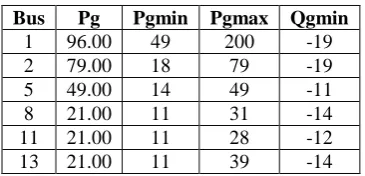
In Table 2 the power limits of generators buses are listed.
Table 2Generators Power Limits
Bus Pg Pgmin Pgmax Qgmin
1 96.00 49 200 -19
2 79.00 18 79 -19
5 49.00 14 49 -11
8 21.00 11 31 -14
11 21.00 11 28 -12
13 21.00 11 39 -14
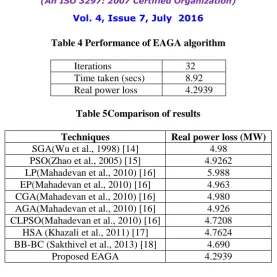
Table 3 shows the proposed EAGA approach successfully kept the control variables within limits.Table 4 narrates about the performance of the proposed EAGA algorithm.Fig 1 shows about the voltage deviations during the iterations and Table 5 list out the overall comparison of the results of optimal solution obtained by various methods.
Table 3After optimization values of control variables
Control Variables EAGA
V1 1.0519
V2 1.0479
V5 1.0299
V8 1.0398
V11 1.0786
V13 1.0562
T4,12 0.00
T6,9 0.01
T6,10 0.90
T28,27 0.91
Q10 0.10
Q24 0.10
ISSN(Online): 2320-9801
ISSN (Print): 2320-9798
I
nternational
J
ournal of
I
nnovative
R
esearch in
C
omputer
and
C
ommunication
E
ngineering
(An ISO 3297: 2007 Certified Organization)
Vol. 4, Issue 7, July 2016
Table 4 Performance of EAGA algorithm
Iterations 32
Time taken (secs) 8.92 Real power loss 4.2939
Table 5Comparison of results
Techniques Real power loss (MW)
SGA(Wu et al., 1998) [14] 4.98
PSO(Zhao et al., 2005) [15] 4.9262 LP(Mahadevan et al., 2010) [16] 5.988
EP(Mahadevan et al., 2010) [16] 4.963 CGA(Mahadevan et al., 2010) [16] 4.980 AGA(Mahadevan et al., 2010) [16] 4.926 CLPSO(Mahadevan et al., 2010) [16] 4.7208
HSA (Khazali et al., 2011) [17] 4.7624 BB-BC (Sakthivel et al., 2013) [18] 4.690
Proposed EAGA 4.2939
VII. CONCLUSION
In this paper, a new approach called Enriched Adaptive Genetic Algorithm (EAGA) has been demonstrated and applied to solve optimal reactive power dispatch problem. In the adaptive GA, low values of Pc and Pm , are assigned to high fitness solutions, while low fitness solutions have very high values of Pc and Pm . The best solution of every population is ‘protected’. The proposed approach is applied to optimal reactive power dispatch problem and tested on the IEEE 30 bus system. The simulation results indicate the effectiveness and robustness of the proposed EAGA approach in solving optimal reactive power dispatch problem.
REFERENCES
[1] Alsac.O and B. Scott,(1973) “Optimal load flow with steady state security”,IEEE Transaction. PAS , pp. 745-751.
[2] Lee K.Y ,ParuY.M,Oritz J.L,(1985) “A united approach to optimal real and reactive power dispatch” , IEEE Transactions on power Apparatus and systems, PAS-104 : 1147-1153
[3] Monticelli.A,M.V.F Pereira ,and S. Granville, (1987) “Security constrained optimal power flow with post contingency corrective rescheduling” , IEEE Transactions on Power Systems :PWRS-2, No. 1, pp.175-182.
[4] Deeb.N ,ShahidehpurS.M, (1990) “Linear reactive power optimization in a large power network using the decomposition approach”,IEEE Transactions on power system, 5(2) : 428-435
[5] Hobson.E, (1980),“Network consrained reactive power control using linear programming”, IEEE Transactions on power systems PAS -99 (4) ,pp 868-877.
[6] Lee .K.Y ,Y.M Park , and J.L Oritz, (1993) “Fuel –cost optimization for both real and reactive power dispatches” , IEE Proc; 131C,(3), pp.85-93.
[7] Mangoli.M.K and K.Y. Lee, (1993), “Optimal real and reactive power control using linear programming” ,Electr.PowerSyst.Res, Vol.26, pp.1-10.
[8] Canizares.C.A,A.C.Z.de Souza and V.H. Quintana ,(1996) “ Comparison of performance indices for detection of proximity to voltage collapse ,’’vol. 11.no.3, pp.1441-1450.
[9] Berizzi.C.Bovo,M.Merlo,andM.Delfanti,(2012), “A ga approach to compare orpf objective functions including secondary voltage regulation,” Electric Power Systems Research, vol. 84, no. 1, pp. 187 – 194.
[10] Roy.P,S.Ghoshal,andS.Thakur,(2012),“Optimal var control for improvements in voltage profiles and for real power loss minimization using biogeography based optimization,” International Journal of Electrical Power and Energy Systems, vol. 43, no. 1, pp. 830 – 838.
[11] Hu.Z,X.Wang, andG.Taylor,(2010),“Stochastic optimal reactive power dispatch: Formulation and solution method,” International Journal of Electrical Power and Energy Systems, vol. 32, no. 6, pp. 615 – 621.
ISSN(Online): 2320-9801
ISSN (Print): 2320-9798
I
nternational
J
ournal of
I
nnovative
R
esearch in
C
omputer
and
C
ommunication
E
ngineering
(An ISO 3297: 2007 Certified Organization)
Vol. 4, Issue 7, July 2016
[14] Wu.Q.H,Y.J.Cao,andJ.Y.Wen,(1998),“Optimal reactive power dispatch using an adaptive genetic algorithm”, Int.J.Elect.Power Energy Syst. Vol 20. Pp. 563-569.
[15] Zhao.B,C.X.Guo,andY.J.CAO,(2005),“Multiagent-based particle swarm optimization approach for optimal reactive power dispatch”,IEEE Trans. Power Syst. Vol. 20, no. 2, pp. 1070-1078.
[16] Mahadevan.K,KannanP.S,(2010)“Comprehensive Learning Particle Swarm Optimization for Reactive Power Dispatch”, Applied Soft Computing, Vol. 10, No. 2, pp. 641–52.
[17] Khazali.A.H,M.Kalantar,(2011),“Optimal Reactive Power Dispatch based on Harmony Search Algorithm”, Electrical Power and Energy Systems, Vol. 33, No. 3, pp. 684–692.