ROBUST DATABASE WATERMARKING TECHNIQUE OVER NUMERICAL DATA
HOSSEIN MORADIAN SARDROUDI
A dissertation submitted in partial fulfillment of the requirements for the award of the degree of
Master of Science (Computer Science)
Faculty of Computer Science and Information Systems Universiti Teknologi Malaysia
iii
iv
ACKNOWLEDGMENT
v
ABSTRACT
vi
ABSTRAK
vii
TABLE OF CONTENT
CHAPTER TITLE PAGE
DECLARATION DEDICATION
ACKNOWLEDGEMENT ABSTRACT
ABSTRAK
TABLE OF CONTENTS LIST OF TABLES
LIST OF FIGURES
ii iii iv v vi vii x xi
1 INTRODUCTION 1
1.1 Introduction 1
1.2 Background of the Problem 3
1.3 Statement of the Problem 4
1.4 Research Aim 7
1.5 Objectives of Research 8
1.6 Research Scope 8
1.7 Significance of the Research 11
1.8 Organization of the Research 11
2 LITERATURE REVIW 21
2.1 Introduction 11
2.2 Watermarking 13
viii
2.3.1 Multimedia Watermarking 18
2.3.2 Relational Database Watermarking 11 2.3.2.1 Type of Database Watermarking 12 2.3.2.2 Basic Methods for Database
Watermarking 14
2.3.2.3 Related Works for Multi-bit (Image) Watermarking over
Numerical Data 17
2.3.2.4 Weakness of Described Methods 21 2.3.2.5 Attack to Database Watermarking 26
2.4 Summary 28
3 METHODOLOGY 04
3.1 Introduction 31
3.2 Research Design 31
3.3 Phase 1: Watermarking Algorithm Design 32
3.3.1 The Proposed Embedding Method 33
3.3.2 The Proposed Extracting Method 34 3.4 Phase 2: Watermarking Algorithm Analysis 35
3.5 Dataset 36
3.6 Summary 38
4 DESIGN OF THE IMAGE COORDINATE
DATABASE WATERMARKING 04
4.1 Introduction 41
4.2 Embedding Process 41
4.3 Extracting Process 44
4.4 Proposed Embedding Method uses Image Coordinate 47
4.5 Summary 55
5 RESULTS AND DISCUSSION 76
5.1 Introduction 56
ix
5.3 Embedding Watermark 61
5.4 Attacks 61
5.4.1 Deletion Attack 62
5.4.2 Insertion Attack 71
5.4.3 Modification Attack 81
5.5 Summary 111
6 CONCLUSION 242
6.1 Introduction 111
6.2 Findings 111
6.3 Contributions of the Study 111
6.4 Future Works 113
6.5 Summary 113
x
LIST OF TABLES
TABLE NO. TITLE PAGE
5.1 Minimizing Method 1 68
5.2 Minimizing Method 2 69
5.3 Minimizing Method 1 and 2 69
5.4 Correction Factors for Different Fraction Numbers 72
5.5 Deletion Attack (Table size: 30,000 tuples) 73
xi
LIST OF FIGURES
FIGURE NO TITLE PAGE
1.1 Basic Database Watermarking Processes 3
2.1 Classification of information hiding techniques
(Petitcolas, Anderson and Kuhn, 1999) 13 2.2 Details classification for watermarking 17
2.3 Watermarking Framework 21
2.4 (a) Original image, (b) %1 deletion, (c) %2 deletion 32 2.5 (a) Original image, (b) Extracted image (Image size:
164*168, number of tuples: 100,000, missing
probability: %2.65) 36
3.1 Original Framework of Proposed Methodology 42
3.2 Proposed method for watermarking relational database 43
3.3 Embedding Process 44
3.4 Extracting Process 45
3.5 Watermark logos 49
4.1 Embedding Procedure 54
4.2 Extracting Procedure 57
4.3 Example for pairing method 64
4.4 Example of using pairing method 65
5.1 Sum of Data Variation in a Relation with 30,000
Tuples 70
5.2 Sum of Data Variation in a Relation with 100,000
xii 5.3 Sum of Data Variation in a Relation with 580,000
Tuples 71
5.4 CF Value for Coordinates Vector and Proposed Method after Deletion Attack (Table Size: 30,000
Tuples) 74
5.5 Extracted Images after Deletion Attack (Table Size:
30,000 Tuples) 75
5.6 CF Value for Coordinates Vector and Proposed Method after Deletion Attack (Table Size: 100,000
Tuples) 77
5.7 Extracted Images after Deletion Attack (Table Size:
100,000 Tuples) 78
5.8 CF Value for Coordinates Vector and Proposed Method after Deletion Attack (Table Size: 580,000
Tuples) 80
5.9 Extracted Images after Deletion Attack (Table Size:
580,000 Tuples) 81
5.10 CF Value for Coordinates Vector and Proposed Method after Insertion Attack (Table Size: 30,000
Tuples) 83
5.11 Extracted Images after Insertion Attack (Table Size:
30,000 Tuples) 84
5.12 CF Value for Coordinates Vector and Proposed Method after Insertion Attack (Table Size: 100,000
Tuples) 86
5.13 Extracted Images after Insertion Attack (Table Size:
100,000 Tuples) 87
5.14 CF Value for Coordinates Vector and Proposed Method after Insertion Attack (Table Size: 580,000
Tuples) 89
5.15 Extracted Images after Insertion Attack (Table Size:
590,000 Tuples) 90
xiii Method after Modification Attack (Table Size: 30,000
Tuples)
5.17 Extracted Images after Modification Attack (Table
Size: 30,000 Tuples) 93
5.18 CF Value for Coordinates Vector and Proposed Method after Modification Attack (Table Size:
100,000 Tuples) 95
5.19 Extracted Images after Modification Attack (Table
Size: 100,000 Tuples) 96
5.20 CF Value for Coordinates Vector and Proposed Method after Modification Attack (Table Size:
580,000 Tuples) 98
5.21 Extracted Images after Modification Attack (Table
CHAPTER 1
INTRODUCTION
1.1 Introduction
The speed of computer technologies and the growth of Internet have made duplication and distribution of digital information simpler. Copyright protection of intellectual properties has, therefore, become an important issue. One way for copyright protection is watermarking. It means securely embedding of some specific information about the copyright holder (company logos, image, text, ownership descriptions, etc.) into the digital object to be protected (Petitcolas, Anderson and Kuhn, 1999). Since several years ago, as an adequate technique to perform copyright protection, digital watermarking method has been widely used in image, audio, video and other areas, and gains productive issues (Chaokun et al., 2008).
2 relational data. Relational data watermarking technology can provide the necessary copyright protection on the basis of ensuring relational data availability (Chaokun et al., 2008).
Watermarking in relational frameworks is a very young technology that has just begun its maturity cycle towards full deployment in industry-level applications. The main motivation for relational database watermarking is to protect relational databases mainly those published online (e.g., parametric specifications, surveys, and life sciences data), from tampering and pirated replicas. A watermark can be regarded as some sort of data that is embedded into elemental data for tamper detection, localization, ownership proof, and/or traitor tracing reasons. Database watermarking techniques complement the database protection (Yingjiu, 2008). The basic idea is change some of attributes value to another value, if such change is tolerable in certain applications; or change physically the order of tuples, if changing the order of tuples is acceptable in related application and database. Database watermarking technology enables us to hide an imperceptible, robust, and secure data in relational database.
For implementing copyright of digital products like relational databases, database watermarking method is a powerful way. It embeds copyright authentication data which is called mark or watermark into original data to keep safe copyright of digital product data. Relational database watermark is generally invisible or imperceptible. It combines the watermark with original data and hides it in original data without destroying it, and could live through some operations which do not ruin the important value or commercial value of original data (Chen et al., 2008)
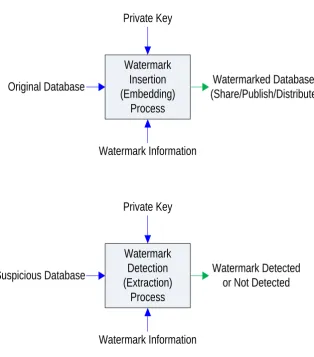
3 methods a private secret key is used to embed watermark information into an original relational database in order to create the watermarked database, for sharing, publication or distribution database. By giving proper private secret key and watermark information, a watermark detection process can be applied to any mistrustful database so as to find out whether or not a legal watermark can be detected. A doubtful database can be any watermarked database or innocent database, or a mixture of them because of several database attacks. Copyright protection, ownership proof, traitor tracing, tamper detection and localization, are main purposes of database watermarking (Yingjiu, 2008).
Watermark Insertion (Embedding)
Process Private Key
Original Database Watermarked Database (Share/Publish/Distribute
Watermark Information
Watermark Detection (Extraction)
Process Private Key
Suspicious Database Watermark Detected or Not Detected
Watermark Information
4
1.2 Background of the Problem
The piracy of digital assets like software, images, video, audio and text or data has long been a bother for owners of these properties. Inserting digital watermarks into these assets is one major way for protecting these data ownership. Most of the watermarking algorithms add a few errors into the object being watermarked. These deliberate errors are called marks. The marks must have an insignificant contact on the usefulness of the data and should manage in such a way that a malicious attacker cannot demolish marks without making the data useless. All these marks together make the watermark. It should be noticed that watermarking action does not prevent copying of digital objects, but it can prevent unofficial copying by presenting methods for verifying the original ownership of a digital objects (Agrawal, Haas and Kiernan, 2003).
The watermarking techniques can be fragile, robust, or semi-fragile. Fragile watermarks do not survive transformations to the original host signal and their purpose is tamper detection and localization of the original signal. Robust watermarking scheme provides a mark that can only be removed when the original content is destroyed as well. Typically, many of the applications for copyright protection, ownership proof, or traitor tracing involve relatively high quality original content and the imperceptibility criterion is critical for such applications. Semi-fragile watermarking techniques differentiate between common signal transformations and deliberate attack. It is robust to common signal transformations attack but is fragile to deliberate attack (Yingjiu, 2008).
5 attributes value will render the whole database useless. Secondly, some methods are not blind detection and too fragile to be applicable to the data that is constantly updated (Xiangrong, Xingming and Minggang, 2007).
Watermarking methods are greatly focused in the area of image, audio, video, text, natural language and software, but less studied on relational databases, and studying in this area can help to improve the methods and techniques for the purpose of protecting data.
In relational database area, watermarking issues provides copyright protection of database data by embedding or hiding the digital information called mark or watermark. The embedded data can later be detected or extracted from the watermarked object (database) for identifying the copyright owner. To achieve this objective, various robust watermarking methods have been rapidly developed in the current decade. Proof-of-ownership watermarks are secret marks embedded into database using a secret private key without which a detector cannot determine its presence. These marks are designed for use as proof of rightful ownership, perhaps in a court of law. Attacks on copyright marking systems are quite various and different, especially since the set of “un-sensible” or "acceptable" alterations to data is difficult to identify (Craver, Wu and Liu, 2001).
1.3 Statement of the Problem
6 audio), have been proposed to keep away from their misusage. Implementation of these watermarking schemes require more focus on robustness, trustworthiness and imperceptibility (Craver, Wu and Liu, 2001)
Because of the difference in data properties, while the basic processes in relational database watermarking are totally comparable to those in watermarking multimedia issue, the approaches developed for multimedia watermarking cannot be directly used for databases. In general, database relations vary from multimedia data in significant ways and therefore need a different class of information-hiding techniques. Unlike multimedia data whose elements are vastly correlated, database relations composed of separate objects or tuples. The tuples can be inserted, deleted, or modified usually in either legal updates or malicious attacks. No existing watermarking methods for multimedia data are designed to support such tuples operations (Yingjiu, 2008)
7 meaning. For example synonym replacement is acceptable. Equivalently, for a group of numbers, the utilization of the data may be placed in real values, in the relative values of the numbers, or in the distribution (Sion, 2007).
Rights protection for some data is more critical issues where it is vital, sensitive, valuable, and about to be outsourced. Data mining application is an example, where data is sold in pieces to parties specialized in mining it, for example, sales patterns database, oil drilling data, or financial data. Airline reservation and scheduling portals are other scenarios in which data is made available for direct, interactive use. According to the nature of most of the data, it is very hard to associate rights of the originator over it. To solve this issue, watermarking techniques can be used (Sion, 2007).
Another critical issue related to database watermarking is attack to watermark. A trade-off exists between the expected level of marking resilience and resistance to various attacks, and the ability to keep data quality in the result, according to the original data. It is simple to find that, if the encoded watermark is to be very "strong" one can easily alter the whole database data aggressively, but at the same time almost certainly also destroy its real value. As data quality requirements become increasingly restrictive, any applied watermark is unavoidably more weak and open to attack (Sion, 2007).
A robust approach that can minimize and measure the data variation should be proposed. Therefore, the following questions are answered in this study:
i) How to embed watermark bits into database with minimum data variation?
8 iii) How to measure data variation and analyze results in comparison with
other methods?
1.4 Research Aim
A digital watermark is a technique that embeds a mark in a digital object by making small changes in the digital object. The three key methods of digital watermark are:
i) The method of prepare watermark data. ii) The watermark embedding algorithm. iii) The watermark extraction algorithm.
9
1.5 Objectives of Research
This research objectives can listed as below:
i) To study existing database watermarking methods.
ii) To enhance a method for embedding marks into database with minimum data modification.
iii) To propose a robust watermarking method against intentional and unintentional attacks, and evaluate the proposed method by comparing the results with previous methods.
1.6 Research Scope
10
1.7 Significance of the Research
The digital products may very easily be copied by the illegal techniques; therefore the copyright owner's rights and digital assets cannot be efficiently saved. So the research of digital objects copyright protection has the essential functional significance. Relational database watermarking is the method to protect the copyright of the relational database, and called as the last line of defense for the database copyright protection
This research develops a database watermarking algorithm that minimizes the modification of database data and making the mark more robust in comparison with other methods. The proposed algorithm can be used for proof the ownership right of the data in relational database. In this way, if a third party approaches the database it is not expected to get the mark easily since all information is embedded by means of this technique. Another usage of the algorithm is that it can be used in authentication purposes.
1.8 Organization of the Research
This research consists of six chapters:
Chapter 1: presents introduction, problem background, problem statement, aim, objectives, scopes and significant of this research.
11 Chapter 3: discusses on the methodology used in this research.
Chapter 4: is designing of the proposed method. Chapter 5: discusses the experimental result.
REFERENCES
Agrawal, R., Haas, P.J. and Kiernan, J. (2003) 'Watermarking relational data: framework, algorithms and analysis', VLDB, vol. 3.
Agrawal, R. and Kiernan, J. (2002) 'Watermarking Relational Databases', Proceedings of the 28th VLDB Conference, Hong Kong.
Al-Haj, A. and Odeh, A. (2008) 'Robust and Blind Watermarking of Relational Database Systems', Journal of Computer Science 4, pp. 1024-1029.
Blackard, J.A., Dean, D.J. and Anderson, C.W. (1998) Forest CoverType, 28 August,
[Online], Available: HYPERLINK
"http://kdd.ics.uci.edu/databases/covertype/covertype.html"
http://kdd.ics.uci.edu/databases/covertype/covertype.html [Jun 2010].
Chaokun, W., Jianmin, W., Ming, Z. and Guisheng, C. (2008) 'ATBaM: An Arnold Transform Based Method onWatermarking Relational Data', International Conference on Multimedia and Ubiquitous Engineering.
Chen, X., Chen, P., Yanshan, H. and Longjie, L. (2008) 'A Self-resilience Digital Image Watermark Based on Relational Database', International Symposium on Knowledge Acquisition and Modeling.
Cox, I.J., Miller, M.L. and Bloom, J.A. (2000) 'Watermarking Applications and their properties', Int. Conf. On Information Technology‟2000, Las Vegas.
Craver, S.A., Wu, M. and Liu, B. (2001) 'WHAT CAN WE REASONABLY EXPECT FROM WATERMARKS', New York.
Cui, H., Cui, X. and Meng, M. (2008) 'A Public Key Cryptography Based Algorithm for Watermarking Relational Databases'.
106 Dustdar, S. and Schreiner, W. (2005) 'A survey on web services composition', Int. J.
Web and Grid Services, vol. 1, no. 1.
Guo, H., Li, Y., Liu, A. and Jajodia, S. (2006) 'A Fragile Watermarking Scheme for Detecting Malicious Modifications of Database Relations'.
Gupta, G. and Pieprzyk, J. (2008) 'Reversible And Blind Database Watermarking Using Difference Expansion', ICST, Adelaide.
Huang, K., Yue, M., Chen, P. and He, Y. (2009) 'A Cluster-Based Watermarking Technique for Relational Database', First International Workshop on Database Technology and Applications.
Hu, Z., Cao, Z. and Sun, J. (2009) 'An Image Based Algorithm for Watermarking Relational Databases', International Conference on Measuring Technology and Mechatronics Automation.
Jamasebi, R., Johnson, N.L., Kaffashi, F., Redline, S. and Loparo, K.A. (2008) 'A Watermarking Algorithm for Polysomnography Data', 30th Annual International IEEE EMBS Conference, Vancouver, British Columbia, 4.
Jinghai, R. and Xiaomeng, S. (2005) 'A Survey of Automated Web Service Composition Methods'.
Koz, A. (2002) Digital Watermarkong Based On Human Visual System.
Kutter, M. and Petitcolas, F.A.P. (1999) 'A Fair Benchmark For Image Watermarking Systems', Electronic Imaging ‟99. Security and Watermarking of Multimedia Contents, Sans Jose, CA.
Li, Y., Guo, H. and Jajodia, S. (2004) 'Tamper detection and localization for categorical data using fragile watermarks', Washington, DC.
Li, Y., Swarup, V. and Jajodia, S. (2003) 'Constructing a Virtual Primary Key for Fingerprinting Relational Data', Washington, DC.
Li, Y., Swarup, V. and Jajodia, S. (2005) 'Fingerprinting Relational Databases: Schemes and Specialties'.
Meng, M., Cui, X. and Cui, H. (2008) 'The Approach for Optimization in Watermark Signal of Relational Databases by using Genetic Algorithms', International Conference on Computer Science and Information Technology.
Nikola, M. and Miroslaw, M. (2004) 'Current Solutions for Web Service Composition'.
107 "file:///D:\\Files\\Dissertation\\Watermarking\\Database%20Watermarking\\ww w.nist.gov" www.nist.gov .
Petitcolas, F.A.P., Anderson, R.J. and Kuhn, M.G. (1999) 'Information Hiding|A Survey', IEEE, 1062-1078.
SEOG-CHAN, O., DONGWON, L. and SOUNDAR, R.T.K. (2006) 'A Comparative Illustration of AI Planning-based Web Services Composition', ACM SIGecom Exchanges, vol. 5, no. 5, December, pp. 1-10.
Sion, R. (2004) 'Proving Ownership over Categorical Data', 12. Sion, R. (2007) 'Rights Assessment for Relational Data'.
Sion, R., Atallah, M. and Prabhakar, S. (2003) 'Rights Protection for Relational Data', San Diego, California.
Sun, J., Cao, Z. and Hu, Z. (2008) 'Multiple Watermarking Relational Databases Using Image', International Conference on MultiMedia and Information Technology. Wang, Z. and Bovik, A.C. (2002) 'A universal image quality index', IEEE SIGNAL
PROCESSING LETTERS.
Wang, H., Cui, X. and Cao, Z. (2008) 'A Speech Based Algorithm for Watermarking Relational Databases'.
Xiangrong, X., Xingming, S. and Minggang, C. (2007) 'Second-LSB-Dependent Robust Watermarking for Relational Database', Third International Symposium on Information Assurance and Security.
Xiangwei, L., Fang, X.W. and GUO, J. (2009) 'Semi-automatic Web Service Composition optimization with Global Constraint', 2009 Second International Symposium on Electronic Commerce and Security.
Yingjiu, L. (2008) 'Database Watermarking: A Systematic View', in Atluri, V. and Warner, J. Handbook of Database Security, Springer US.