ABSTRACT
PAEPLOW, COLLEEN GRAHAM. Easy as 1, 2, 3: Exploring the Implementation of Standards-Based Grading in Wake County Elementary Schools. (Under the direction of Dr. Bonnie Fusarelli.)
Wake County Public School System‘s (WCPSS) 102 elementary schools have
implemented standards-based grading. This grading practice is aligned with North Carolina‘s Student Accountability Standards and the WCPSS Promotion/Intervention policy. Standards-based report cards were designed to reflect student mastery of state standards and provide an objective measure of student grade level performance. With its focus on student mastery of content material, standards-based grading is intended to reduce teacher subjectivity which may bias a student‘s grade, and therefore provide a more equitable grading system resulting in a more meaningful grade. This grade is communicated to parents via the student‘s report card. The goal of this study was to examine the implementation of this grading practice. Utilizing a mixed methods study design, teachers‘ understanding and use of standards-based grading and the equity of the resulting grades were examined. Quantitative methods were utilized in two ways: 1) to select a sample of teachers for participation in focus groups, and 2) to examine the distribution of students‘ grades by subgroup in order to analyze standards-based grading as a equitable grading practice. An intensity sample of six schools with the strongest and weakest correlations between classroom grades and End-of-Grade scores (a previously validated measure of student knowledge of state standards) were the primary data source for this study. Within the sample of schools, four to twelve teachers who participated in a focus group at their school informed the qualitative exploration of the level of
Teachers‘ understanding and use of this student progress reporting practice was examined qualitatively to determine the degree to which standards-based grading has been
implemented.
The fundamental characteristics of standards-based grading—mastery and the separation of homework from content grades—were described in WCPSS‘ documentation and clearly articulated by teachers. WCPSS‘ standards-based grading system is consistent with the research recommended practices of mastery and separation of homework from content grades; however, WCPSS‘ system of combining objective grades into one final grade was inconsistent with research recommended practices. The analysis of WCPSS‘ standards-based grading revealed a strong relationship between students‘ classroom grades and EOG scores indicating this grading system accomplishes its intended purpose of assessing
students‘ knowledge of North Carolina‘s curriculum. Although grades varied considerably by ethnicity, additional analysis revealed similar correlations between fourth-quarter grades and EOG scores across ethnic groups and academic risk factor (ranging <0.1 by subgroup for reading and mathematics). Furthermore, the ability to use second-quarter grades to predict students‘ success on EOG exams would provide educators with a valuable mid-year indicator used to identify students who with additional support could be on grade level by the end of the year. Indeed, the results of this study indicate standards-based grading may have value beyond traditional grading practices. The benefits of this grading practice include providing a grading system with equity potential, providing a predictive tool to identify struggling
This study‘s findings enlighten grading research by providing evidence of the application of standards-based grading within a large school district and an indication of the equity potential inherit within this grading system. In light of the scarcity of grading research on the implementation of standards-based grading and the absence of prior research
Easy as 1, 2, 3: Exploring the Implementation of Standards-Based Grading in Wake County Elementary Schools
by
Colleen Graham Paeplow
A dissertation submitted to the Graduate Faculty of North Carolina State University
in partial fulfillment of the requirements for the degree of
Doctor of Philosophy
Educational Research and Policy Analysis
Raleigh, North Carolina
2011
APPROVED BY:
_______________________________ ______________________________
Dr. Bonnie Fusarelli Dr. Jessica DeCuir-Gunby
Committee Chair
________________________________ ________________________________
DEDICATION
BIOGRAPHY
ACKNOWLEDGEMENTS
I would like to acknowledge Wake County Public School System‘s (WCPSS‘) staff for their cooperation and participation in this study. In addition to WCPSS providing permission to conduct research within the district through the external research review process, school principals were also willing to allow research on their school campuses. The staff was genuinely interested in their continued growth and in acquiring a deeper
TABLE OF CONTENTS
LIST OF TABLES ... viii
LIST OF FIGURES ... x
CHAPTER 1 ... 1
Background of the Study ... 3
Overview of the Standards Movement ... 3
Federal and State Guidance ... 4
Wake County Public School System ... 5
Purpose of the Study ... 6
Definition of Key Terminology ... 7
Significance of the Study ... 11
Overview of the Approach ... 13
Chapter Summary ... 14
CHAPTER 2 ... 15
What are the Purposes of Grades? ... 15
What is the Current Grading Debate? ... 17
Traditional A-F Grading ... 18
Standards-Based Grading ... 24
When and Why Standards-Based Grading Developed? ... 29
Standards Movement ... 29
No Child Left Behind (NCLB) ... 30
Development of Standards-Based Grading ... 31
Where has Standards-Based Grading been Employed? ... 32
Federal Guidance ... 32
State and District Examples ... 33
Why is this Significant? ... 36
Link Between Social Justice and Grading ... 37
Implementation and Equity Considerations ... 46
Who will be the Focus of the Grading Study? ... 47
WCPSS Policies Regulating Standards-Based Grading ... 51
Chapter Summary ... 53
CHAPTER 3 ... 56
Research Design... 57
Research Questions ... 59
Quantitative Methods ... 60
Data Collection ... 62
Data Analysis ... 63
Qualitative Methods ... 68
Data Collection ... 68
Data Analysis ... 74
Validity and Reliability ... 77
Subjectivity Statement ... 78
Limitations of the Study... 80
Chapter Summary ... 81
CHAPTER 4 ... 83
Quantitative Findings ... 84
School Sample ... 84
Teacher Sample ... 86
Student Population Demographics ... 89
Distribution of Standards-Based Grades ... 91
Correlation of Standards-Based Grading and EOG Scores ... 111
Standards-Based Grading Utilized to Predict EOG Scores ... 113
Qualitative Findings ... 116
Responses to Prompt Questions ... 116
Explanation of WCPSS‘ Standards-Based Grading ... 118
Training on Standards-Based Grading ... 133
Initial Reaction to Standards-Based Grading ... 136
Implementation of Standards-Based Grading ... 138
Standards-Based Grading Representative of Students‘ Ability ... 168
Challenges with Implementing Standards-Based Grading ... 174
Improvements to Standards-Based Grading ... 185
Chapter Summary ... 192
CHAPTER 5 ... 195
Contextualization of Grade/EOG Correlations ... 196
Predictive Ability of Second-Quarter Grades ... 198
Consistent Correlations by Student Subgroup ... 198
Teachers‘ Understandings and Misconceptions... 199
Creating the Report Card Grade ... 205
Recommendations ... 207
Discussion ... 211
Future Research ... 215
Chapter Summary ... 216
REFERENCES ... 218
APPENDIX ... 224
APPENDIX A - Data Collection Timeline on the Standards-Based Grading Study ... 225
APPENDIX B - Demographic Questionnaire... 226
APPENDIX C - Focus Group Script ... 227
APPENDIX D - Participant Consent Form ... 228
APPENDIX E- Wake County Public School Systems Research Study Application ... 229
APPENDIX F - North Carolina State University Institutional Review Board ... 234
APPENDIX G - End of Grade Mathematics Grade 4 Sample Items ... 240
APPENDIX H - Wake County Public School System Report Card Grades 2-5 ... 241
APPENDIX I - Guide to Reporting Student Progress for Standards-Based Grading ... 243
APPENDIX J - Fact Sheet on new WCPSS Elementary Report Card ... 245
LIST OF TABLES
Table 1.1 Elements Associated with Traditional A-F Grading Compared to Standards-Based
Grading ... 8
Table 1.2 WCPSS Standards-Based Grading Performance Levels ... 9
Table 2.1 Non-Inclusive List of State and District Examples of Standards-Based Grading .. 34
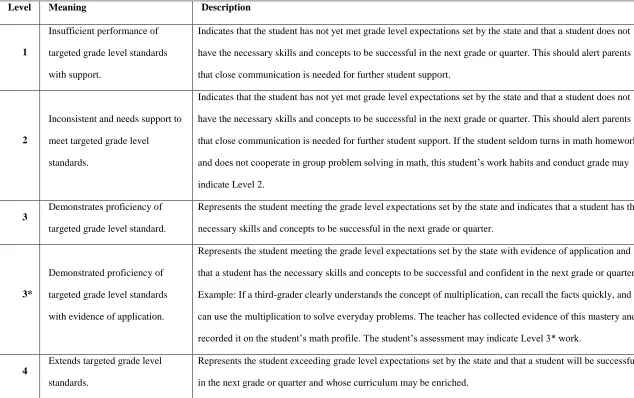
Table 2.2 WCPSS Standards-Based Grading Performance Level Descriptions ... 49
Table 2.3 WCPSS Standards-Based Grading Work Habits Levels... 50
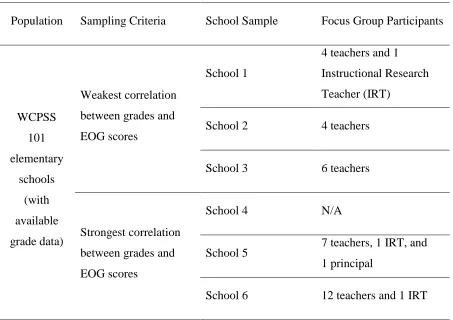
Table 3.1 Elementary Teachers Sampling Model ... 71
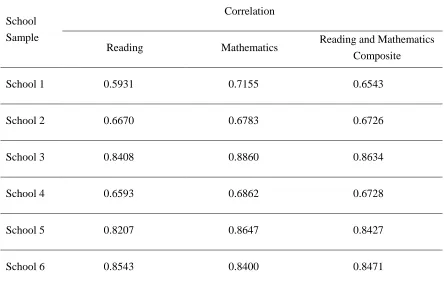
Table 4.1 Correlations between EOG and Fourth Quarter Grades by Sample School ... 85
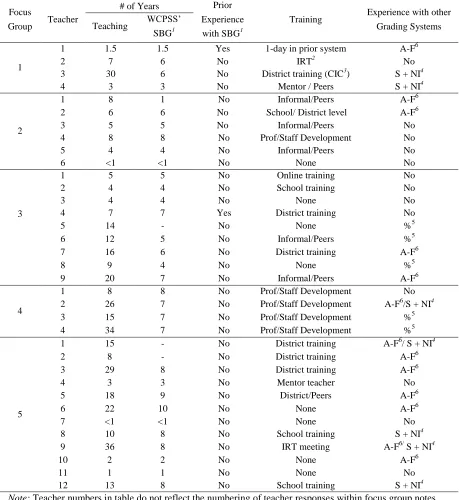
Table 4.2 Teacher Focus Group Sample ... 87
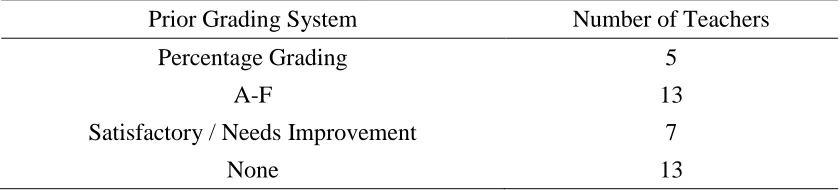
Table 4.3 Teacher Reported Experience with Prior Grading Systems ... 88
Table 4.4 WCPSS Schools K-5 Demographics by Grade Level, 2009-10 ... 90
Table 4.5 Sample Schools K-5 Demographics, 2009-10 ... 91
Table 4.6 Fourth-Quarter Reading and Mathematics Grades by Grade Level, 2009-10 ... 93
Table 4.7 Fourth-Quarter Reading and Mathematics Grades by Sample School, 2009-10... 99
Table 4.8 EOG Reading and Mathematics Levels by Sample School, 2009-10 ... 105
Table 4.9 Fourth-Quarter Reading and Mathematics Grades by 2009-10 EOG Level, Grades 3-5 ... 106
Table 4.10 Correlation of Fourth-Quarter Grade and EOG by Grade Level, 2009-10 ... 112
LIST OF FIGURES
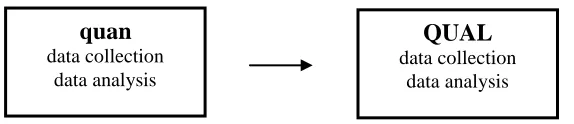
Figure 1.1. Theoretical relationship between teacher prejudice, teacher expectations, and student achievement ... 41 Figure 3.1. Sequential Explanatory Mixed Methods Study Design (Creswell, 2009) ... 58 Figure 4.1. Percentage of Students by Grade Level and Grade Performance Level in Reading 2009-10 ... 95 Figure 4.2. Percentage of Students by Grade Level and Grade Performance Level in
Mathematics 2009-10. ... 97 Figure 4.3. Percentage of Students Enrolled in 2009-10 by Subgroup and 4th Quarter
Reading Grade ... 102 Figure 4.4. Percentage of Students Enrolled in 2009-10 by Subgroup and 4th Quarter
Mathematics Grade ... 104 Figure 4.5. Percentage of Students by Grade Performance Level in Reading and Mathematics
by 2009-10 EOG Level ... 107 Figure 4.6. Percentage of Students in 2009-10 by Grade Performance Level in Reading and
Reading EOG Level and Grade Level, Grades 3-5 ... 109 Figure 4.7. Percentage of Students in 2009-10 by Grade Performance Level in Mathematics
CHAPTER 1
INTRODUCTION TO THE STUDY
To be competitive in the global labor market, today‘s students are required to learn an ever-widening amount of information. The large amount of material covered by North
Carolina‘s Standard Course of Study (NCSCS) represents the desire of educators to prepare students to be competitive on a global scale. Given the amount of material that must be taught, how do we know if students understand the material covered? Exactly how students should be assessed on this information is currently being debated by educators. For many years researchers have been concerned with the imprecision of the United States‘ A-F grading system. As evidence of this imprecision, researchers point to the standardized tests results for students earning A‘s and B‘s in high poverty areas being comparable to students in more affluent schools earning C‘s and D‘s (Lekholm & Cliffordson, 2008; U.S. Department of Education, 1994).
What constitutes an A is not always clear. A-F grading scales that dominate American school systems on the surface give the impression that they are accurate and reliable
culmination of a student‘s work is often assessed relative to the performance of other students.
Some educators have embraced standards-based grading as an alternative to an A-F grading system (Perlstein, 2003). Standards-based report cards provide detailed information on the skills a student is expected to master either through a narrative or with numbers or symbols (Manzo, 2001; O‘Conner, 2007). Standards-based grading is focused on student mastery of content material which researchers argue is a more objective measure of student knowledge (Guskey, 2001; Marzano, 1998; O‘Conner, 2007). While there is limited research comparing the reliability of standards-based grading to that of traditional grading, initial grading research conducted by Haptonstall (2010) indicated a greater correlation between standards-based grades and the Colorado Student Assessment Program (CSAP), a
standardized assessment, than found between traditional grades and the CSAP.
Background of the Study
Districts across the United States have been expanding and changing the traditional A-F letter grading system to more detailed standards-based reporting (Manzo, 2001). Unlike traditional grades, standards-based grades communicate student proficiency on set criteria. Given that traditional grading has been a mainstay in the U.S. it is helpful to briefly consider the origins of standards-based grading nationally and within WCPSS. In order to understand the context in which standards-based grading developed it is helpful to examine the
development of the standards movement.
Overview of the Standards Movement
"With standards and assessments now in place, educators face the daunting task of how best to grade and report student learning in terms of those standards" (Guskey, 2001, p. 20). How can we be sure our students are learning the state standards and that student grades reflect that knowledge? "When reporting on student work, educators need a clear,
comprehensive grading system that shows how students are measuring up to standards" (Guskey, 2001, p. 20). Standards-based grading with its emphasis on measuring student achievement against established criteria offers us a method of communicating whether students are meeting set standards.
Federal and State Guidance
Wake County Public School System
Due to a concern that students‘ grades were not consistent, that students‘ mastery of the NCSCS was not reflected on their report card, and that parents were not properly
informed of student progress, WCPSS implemented a standards-based grading system and report card at the elementary school level. In 2001-02, WCPSS piloted a new performance-based report card utilizing standards-performance-based grading at five elementary schools.
Administrators, teachers, and parents at the five schools participating in the pilot worked for two years to develop a new elementary school grading system and report card designed to promote consistency in the grading process and provide parents better information regarding their child's progress toward mastering the NCSCS (K-5 Standards-Based Grading and Reporting: Fact Sheet, 2003). In 2003-04, twenty-two additional schools implemented the new standards-based grading practice and resulting report card. In 2005-06, the balance of WCPSS‘ 88 elementary schools adopted this new grading system. The number of elementary schools was expanded to 102 in 2009-10 due to the addition of new schools.
The standards-based report card was implemented to align with North Carolina‘s Student Accountability Standards and the WCPSS Promotion/Intervention policy. This new tool was designed to provide parents and students with details about the student‘s
Card, 2010). Student performance on content material is considered separate from their work habits and conduct.
Purpose of the Study
Standards-based grading represents a departure from the A-F grading scale
historically used in schools and from what most teachers were taught and have previously employed within their classrooms. Thus, the degree to which this policy has been understood and implemented is of interest. The purpose of this research was to investigate teachers‘ understanding of standards-based grading, to explore how standards-based grading has been implemented within WCPSS elementary schools, and to evaluate the assumption that this method of grading is an equitable grading practice. Teacher responses generated from school level focus groups informed the qualitative exploration of the level of understanding and resulting implementation of standards-based grading within WCPSS. The implementation of standards-based grading was examined in terms of teachers‘ understanding and application of this grading method and explored through the use of teacher focus groups and document analysis of grading practices. The examination of teacher understanding was important to this study since it impacts the level of implementation and since the fidelity of implementation was pivotal to providing a true assessment of this grading practice and the resulting report card. Finally, the quantitative examination of student grades informed the equity
considerations implicit in standards-based grading.
grading into higher grade levels. Therefore, a fundamental reason for this research was to inform decision makers regarding the implementation of standards-based grading within WCPSS elementary schools. In order to provide a common understanding of what is meant by key terminology, the next section will provide definitions of key concepts discussed in this study.
Definition of Key Terminology
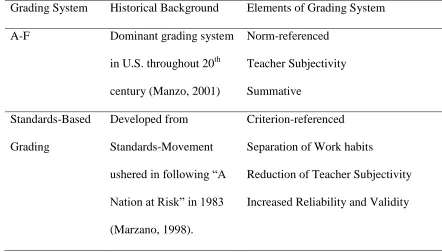
In order to understand the grading debate it is critical to clarify key terminology. The first distinction that must be addressed is the basic difference between a standards-based grading system and the A-F grading system. Table 1.1 highlights common grading practices associated with both traditional A-F grading systems and standards-based grading systems. Common elements within traditional A-F grading systems include norm-referenced grading where students are graded in relation to their peers, teacher subjectivity whereby teachers are given greater freedom to determine what elements are included in a student‘s grade, and summative grading which reflects the culmination of students‘ efforts within the class. Grades have also traditionally served as a sorting mechanism enabling schools to place students in course trajectories based on prior classroom performance (Resh, 2009). While this grading purpose has wider implications both at the secondary and college levels since this study is focused at the elementary level and WCPSS elementary students receive core
instruction within randomly assigned grade-level classrooms, this grading purpose will not be examined as part of this study. While there are variations in standards-based grading systems, there are key elements they have in common. Standards-based grading is
habits are considered separately from subject content. Since a set criteria must be met and grades reflects only student performance within the subject area, teacher subjectivity is reduced and reliability and validity of grades are improved.
Table 1.1
Elements Associated with Traditional A-F Grading Compared to Standards-Based Grading Grading System Historical Background Elements of Grading System
A-F Dominant grading system
in U.S. throughout 20th century (Manzo, 2001)
Norm-referenced Teacher Subjectivity Summative
Standards-Based Grading
Developed from Standards-Movement ushered in following ―A Nation at Risk‖ in 1983 (Marzano, 1998).
Criterion-referenced Separation of Work habits
Reduction of Teacher Subjectivity Increased Reliability and Validity
Since this study focused on WCPSS‘ standards-based grading system, it is imperative to define what is meant by based grading within WCPSS. Within WCPSS‘ standards-based grading system the determination of a student‘s performance level is standards-based on a variety of assessment data on each objective presented during the grading period. Work habits and conduct are graded separately from the student‘s proficiency on content material
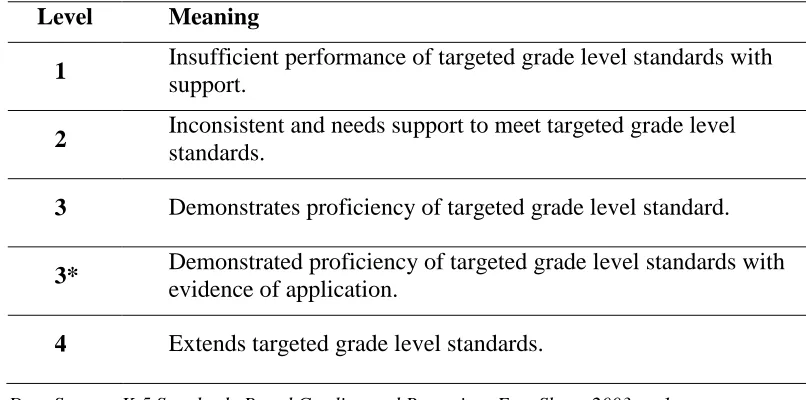
Course of Study and indicate whether the student has the necessary skills and concepts to be successful in the next quarter or next grade‖ (K-5 Standards Based Grading and Reporting: Fact Sheet, 2003, p.1). Rather than averaging the student‘s cumulative work, standards-based grading assesses a student‘s mastery of an objective (a minimum of three observations are required for each objective) and assigns a 1-4 rating for that objective (see Table 1.2). When a student has three recorded observations with a performance level 3 or better for an
objective then the student has mastered that objective. Table 1.2
WCPSS Standards-Based Grading Performance Levels
Level Meaning
1 Insufficient performance of targeted grade level standards with
support.
2 Inconsistent and needs support to meet targeted grade level
standards.
3 Demonstrates proficiency of targeted grade level standard.
3* Demonstrated proficiency of targeted grade level standards with
evidence of application.
4 Extends targeted grade level standards.
Data Source: K-5 Standards-Based Grading and Reporting: Fact Sheet, 2003, p.1
Work habits are not considered a part of the student‘s performance on a given objective, but are captured under a separate 1-3 rating. WCPSS‘s elementary report cards separate student performance from the student‘s conduct and work habits.
Carolina established a Standard Course of Study to determine competencies on a rigorous set of a statewide uniform standards for each grade level and each high school course (NC DPI, 2010).
Another key concept to consider is WCPSS‘ definition of work habits. To assess student work habits and conduct, teachers are asked to report whether a student has met ―expectations in cooperating with others, respecting others, and observing rules and procedures‖ (Understanding the Elementary School Report Card, 2010, p. 2). Teachers indicate if a student ―uses time wisely, listens carefully, completes assignments, writes legibly, works independently or seeks help when needed, and completes work‖
(Understanding the Elementary School Report Card, 2010, p. 2). Students conduct and work habits are rated as: 3 - meets expectations, 2 - inconsistently meets expectations, or 1 - does not meet expectations (Understanding the Elementary School Report Card, 2010).
The final concept to consider is the definition of equity as it applies to grading. Within the classroom equity refers to allowing all students the ability to learn in a manner that meets their needs. Furthermore, all students are valued and treated fairly. As educators in order to understand the meaning of grades we must start with the shared expectation that all students will be treated fairly (Friedman, 1998). Fair or equitable treatment of students in terms of how they are assessed within a classroom is the foundation of an equitable grading system. With a general understanding of the development of standards-based grading, the purpose of this study, and the key terminology associated with the grading debate, the next section outlines the significance of this study and its contribution to current grading
Significance of the Study
Standards-based grading emerged from the standards movement. There has be a renewed emphasis on ensuring all students receive a core set of knowledge and that students comprehend this essential information (Wheelock, 1995). The standards movement
addressed the concern that students were only partially exposed to the state standard course of study. Districts across the U.S. have been expanding and changing the traditional A-F letter grading system with more detailed standards-based reporting. While school systems that have implemented a standards-based report card detailing student progress have found mixed results, current research is sparse. Standards-based grading with a focus on student mastery is posited as a less subjective and therefore more equitable and accurate grading practice. However, to realize its potential as an equitable grading system, standards-based grading must be implemented with fidelity. Equitable policies are only equitable when practice is also equitable.
This study offers invaluable information on the implementation and application of standards-based grading. Due to the difficulty of assessing the implementation of this grading system through quantitative methods alone, qualitative methods were utilized to elicit greater understanding of the implementation of standards-based grading. This study explored the degree to which WCPSS‘s standards-based grading practices were understood and
interviews as part of a small pilot study in 2006; these preliminary data suggested that the level of implementation was impacted by teacher‘s level of experience with this grading practice. An interview with a new teacher revealed she was not offering level 4 learning opportunities, nor was she assessing any students at level 4 during the first quarter. She reported that none of her students received a level 4 on their first quarter report since she was not certain how to recognize student work at this level. Thus, whether level 4 opportunities are consistently offered across WCPSS classrooms is not certain. The degree to which teaching to level 4 and providing level 4 opportunities for all WCPSS students are not
consistent represents unequal access to teaching for understanding and unequal assessment of that understanding. Level 4 opportunities refer to presenting course material which extends the targeted grade level standards and provides for assessment of student performance which demonstrates extension of the targeted grade level standards. Inequality of opportunities and exposure has the potential to create unequal access to education within WCPSS‘ elementary schools. Thus, an examination of whether WCPSS‘ standards-based grading has reached its equity potential was necessary. This study‘s examination of student grades by subgroup illuminates the level of equity within WCPSS‘ standards-based grading.
providing data on teacher understanding and the implementation and application of standards-based grading within a large school district.
Overview of the Approach
Chapter Summary
WCPSS implemented a standards-based policy aligned with North Carolina‘s Student Accountability Standards and the WCPSS Promotion/Intervention policy. WCPSS‘ 102 elementary schools utilize standards-based report cards designed to reflect student mastery of state standards and provide an objective measure of student grade level performance.
Research suggests that standard-based grading offers a more equitable grading system with a focus on student mastery of content material which should reduce teacher subjectivity and the resulting biases within a student‘s grade. Chapter 2 provides a description of the
CHAPTER 2
REVIEW OF THE LITERATURE
The purpose of this chapter is to explore grading literature regarding the
development, prevalence, and equity potential of standards-based grading. This chapter is organized around addressing the who, what, where, when, and why of standards-based grading. By utilizing grading literature to answer each question this chapter presents the development of standards-based grading, its potential to be a more equitable grading system, and suggests next steps for grading research. Prior to a discussion of the current grading debate and the development of standards-based grading, it is essential to first examine the purpose of grades.
What are the Purposes of Grades?
At the most rudimentary level, grades provide a ―process of abstracting a great deal of information into a single symbol for ease of communication‖ (Stiggins, 2005, p. 278). While grades may serve a variety of purposes, educational researchers have identified a few
fundamental reasons for assigning grades. Many researchers agree that grades serve as a communication tool (Carlson, 2003; Jung & Guskey, 2007; Marzano, 2000; O‘Conner, 2002, 2007; Stiggins, 2005; Tomlinson, 2005), a method of providing feedback on student
achievement (Marzano, 2000), an instructional planning tool (Marzano, 2000), a method of motivation or incentive (Marzano, 2000; O‘Conner, 2002, 2007) and a sorting mechanism (Resh, 2009).
used to communicate student behavior (Carlson, 2003; Jung & Guskey, 2007; O‘Conner, 2007; Tomlinson, 2005). The fact that grades communicate multiple factors is problematic since ―putting together such a variety of information makes it very difficult to clearly understand what grades mean‖ (O‘Conner, 2002, p. 16). Guskey (2002) found that while teachers, parents, and students, as the primary stakeholders regarding grades, all recognized the importance of including multiple sources of information to determine a student's grade, parents were the least knowledgeable about what evidence is considered in determining a student's grade. Moreover, teachers, parents, and students ranked communication with parents, feedback to students, selection or grouping, provision of incentives, evaluation of school programs, and lack of effort and responsibility in the same order of importance in determining a student's grade (Guskey, 2002). However, as grade level increased all parties tended to rate communication with parents as less important and feedback to students as a more important purpose of grading (Guskey, 2002).
should be the result of knowledge gained rather than the goal (Huhn, 2005). Furthermore, traditional grades have served as a sorting mechanism in which schools sort students into course trajectories based on prior classroom performance (Resh, 2009). While this grading purpose has implications at the secondary and college levels it is beyond the scope of this study. Within WCPSS elementary schools students receive core instruction within randomly assigned grade-level classrooms; thus, the implications of sorting would not manifest at this level.
Using grades as an effective method of communicating student achievement requires that grades be valid representations of student knowledge on a given subject and reliable across classrooms. To this end, educators are currently engaged in a debate regarding the merits of traditional grading versus the potential of standards-based grading. The next section of this paper will outline this grading debate.
What is the Current Grading Debate?
reliability with the A-F grading system in light of increased accountability requirements has led to an increased focus on the standards movement and standards-based grading.
Traditional A-F Grading
Concerns have been raised over the use of norm-referenced grading, the level of teacher subjectivity, and summative grading practices which are characteristics associated with A-F grading systems (Cross & Frary, 1999; Guskey, 2001; O‘Conner, 2007; Perlstein, 2003). These factors contribute to a lack of validity and reliability in traditional grading. Empirical evidence has confirmed the relationship between student grades and standardized assessments (Paeplow, 2008b; U.S. Department of Education, 1994). The variation in the number of A‘s and B‘s across student subgroups elicits questions regarding the reliability and validity of traditional grades (Paeplow, 2008b). Researchers have also found variations in the number A‘s and B‘s across college classrooms (DeBoer, Anderson, & Elfessi, 2007).While there is limited empirical evidence comparing the reliability of standards-based grading and traditional grading practices, in a recent study Haptonstall (2010) found a greater correlation between standards-based grades and the Colorado Student Assessment Program (CSAP), a standardized assessment, than found between traditional grades and the CSAP.
grade distributions between classrooms, norming the student performances sets students in competition for the highest grades. By definition a normal curve requires half of the students to be below average and half above average (Guskey, 2001). Winter (2002) suggests that through the process of normalization, raw scores are converted into ―context free evaluation‖ in which a student‘s performance is considered relative to other students. However, some researchers question whether this grading practice is an accurate reflection of student knowledge. Grades must reflect actual student understanding of criterion-referenced standards and not artificially determined distributions (O‘Conner, 2002).
teacher subjectivity, which may bias a student‘s grades, is seen as less problematic than not capturing a student‘s work habits, conduct, ability, and growth (Cross & Frary, 1999).
Teacher subjectivity is visible when we consider grading variations (such as the number of A‘s given) and instructors‘ attitudes toward their own grading practices. DeBoer, et. al. (2007) not only found considerable variation in the number of A‘s and B‘s given by the 78 college instructors they sampled, but they also found vastly different attitudes regarding grading. Some teachers seemed to take pride in giving few A‘s, viewing this as evidence that their course was challenging while other instructors viewed struggling students as a reflection on their ability to teach the subject material. In Guskey‘s (2006) grading study, he elicited from teachers and professors their experience as students and found that educators had clear recollections, some more than 20 years prior, of grading experiences they felt were unfair or biased. Guskey (2006) concluded that:
At all levels of education, therefore, educators must strive to ensure that the
procedures they use in assigning grades or marks to students‘ work are explicit, clear, and as objective as possible. They also must work hard to guarantee that their
personal opinions and unconscious biases do not influence their grading practices. Above all, teachers and professors must base their grading policies and practices on criteria that will be judged by all to be just, equitable, and unprejudiced. (p. 13)
received by students does not clearly communicate the student‘s level of understanding. O‘Conner (2007) suggests that grades should be organized around standard objectives and that student report cards should reflect the student‘s competency with these standards. Grades must reflect student knowledge of course material. This is an easily attained goal when grading one assignment, but becomes more difficult when the student's grade encompasses multiple assignments (Brookhart, 1999; O‘Conner, 2007; Winters, 2002). Since traditional grading practices often mean that the student‘s grade may include behavioral factors or may have missing grades counted as zeros, the average student grade represents more than just the level of their content understanding.
Including Behavior in Grades. While measurement specialists recommend
separating work habits and student achievement, combining behavior and subject knowledge remains a common practice (Bookhart, 1994). Grades communicate student achievement, but when behavioral factors are included in the student‘s grade grades are poor communicators of student knowledge. ―Everyone who has a need to know about a student‘s performance in school certainly can be told that she or he is ‗a nice student who tries hard,‘ but they also have a right to know the specific level of her or his knowledge in a particular subject at a given point in time‖ (O‘Conner, 2007, p. 19). However, not only have academic and
Including Zeros in Grades.Another way in which summative grading produces an invalid grade is by including zeros in the final grade. McMillian, Myran, and Workman‘s (2002) research found that a substantial percentage of teachers at the elementary level included zeros in their calculation of student grades. Zeros are often factored into the grade either as punishment (due to behavioral infractions such as cheating) or due to a missing assignment. When zeros are included in a student‘s cumulative grade the resulting grade does not accurately reflect student achievement (O‘Conner, 2007). O‘Conner (2007) identified three major problems with including zeros in a student‘s grade:
Zeros give a numerical value to something that has never been assessed and that therefore has no basis in reality.
They can have counterproductive effects on student motivation. They involve inappropriate mathematics. (p. 86)
Since the zero does not represent student knowledge, or lack thereof, the grade produced gives a mathematically incorrect evaluation of student achievement. Furthermore, students who receive more than one zero may feel hopeless and thus become disengaged; these apathetic students may become discipline problems (O‘Conner, 2007). Factors such as norm-referenced grading, teacher subjectivity, and summative grading practices, which are
common with traditional grading, decrease the validity and/or reliability of the resulting grades.
23). "Information from classroom assessments--grades, scores, and judgments about students' work resulting from tests, assignments, projects, and other work--must be meaningful and accurate (that is, valid and reliable)‖ (Brookhart, 1999, p. iii). The resulting grades should accurately reflect a student‘s level of achievement (Brookhart, 1999). Student grades that encompass multiple assignments make it more difficult to achieve this goal (Brookhart, 1999; Winters, 2002). It is critical that grades ―carry real meaning‖ and accurately reflect this meaning (Brookhart, 1999).
Reliability refers to consistency of grades across classrooms for similar academic performance. Teachers strive to evaluate their students in a fair manner that represents the student's achievement and thus provides a reliable assessment of the student‘s knowledge.
Although the measurement community has an obligation to identify the technical complexities of measuring and including these factors in grades and of the bias these factors may introduce to grades, we have to recognize that to students, teachers, administrators, and possibly parents, there is considerable face validity to grades that include extraneous factors. (Cross & Frary, 1999, p. 59)
Due to the face validity of including student work habits in the final grade, this practice and the subjectivity it introduces into a student‘s grade often go unexamined.
Students, parents, and community members assume that grades are reliable measures of student achievement. The assumption is that a grade of C indicates a student understands course content at a basic level but does not have an exceptional understanding of the
that are considered in determining a student‘s grade. K-12 educators and administrators constantly strive to establish and implement equitable and meaningful grades that accurately represent student performance (Carlson, 2003). While a student receiving an A in science may tell her parent that their child really knows her chemistry it could also reflect her participation in class—raising her hand often and turning in signed quizzes promptly. However, it will not communicate the difficulty of those quizzes or whether they were far easier than those given at another school or even another classroom within the same school (Perlstein, 2003). Standards-based grading provides an alternate method of assessing student performance in the classroom.
Standards-Based Grading
Recently educators have amplified report cards by providing information on a student‘s proficiency on various standards as an initial step toward standardizing grades (Perlstein, 2003). Districts across the U.S. have been expanding and changing the traditional A-F letter grading system with more detailed standards-based reporting. Through either a narrative evaluation format or with numbers or symbols these standards-based report cards provide detailed information on skills a student is expected to master (Manzo, 2001).
However, parents and the public have been reticent to abandon the letter grading system that has been a fixture of the U.S. education system throughout the last century. The expanded report cards provide parents with information on specific skills that their child is able to master rather than just a letter grade for each subject (Manzo, 2001).
presented by Principal Amy Jordan of Ashland Elementary in Manassas, her teachers and parents both embraced the new report cards. However, the new Chancellor of New York City, Joel I. Klein, immediately discontinued use of the newly implemented elementary school report card since its 10 pages detailing over 100 skills was found to be ―too mystifying for parents and too taxing for teachers" (Perlstein, 2003, p. 2). In spite of the scarcity of research on the implementation of standards-based grading and the mixed results in the research that does exist, standards-based grading is likely to gain in popularity in light of the current focus on accountability and students meeting set educational standards under the No Child Left Behind Act of 2001. A fundamental component of standards-based grading is the assessment of student mastery against a criterion-referenced standard.
Criterion-Referenced Standards. Criterion-referenced grading is a key element of the standards movement with its emphasis on assessing student knowledge of set standards. "In a standards-based system, grading and reporting must be criterion-referenced" (Guskey, 2001, p. 20). With criterion-referenced standards a student‘s performance is measured against established criteria with differentiated levels of quality. Assessment of student performance is not measured against the performance of other students, but against the set performance standards (Guskey, 2001). Since the primary goal of standards-based grading is for students to be proficient on all objectives within the curriculum, ―the key to reaching this goal is to evaluate every student‘s achievement using similar criteria, consistently applied at all levels‖ (O‘Conner, 2007, p. 3).
Measurement specialists recommend grades not incorporate a student's attitude, effort, and conduct, along with academic performance and growth. "If teachers were to embrace grading practices as recommended by most measurement specialists, more valid indicators of
academic achievement would result" (Cross & Frary, 1999, p. 58). Given this
recommendation why are parents, school administrators, or the general public not calling for reform (Cross & Frary, 1999)? A key factor in this lack of public outcry is an expectation that uniformly high performance in each area will combine to a high overall score and at the same time an acceptance that the student's overall score will be lowered by poor performance in any area (Cross & Frary, 1999). Therefore, parents, teachers, and students accept that work habits are a contributing factor in a student‘s final grade. While measurement specialists have maintained that separating work habits from student performance would more accurately reflect student achievement and decrease teacher subjectivity, there remains wide spread acceptance of the merging of work habits with performance to produce the student‘s overall grades (Cross & Frary, 1999).
(1994) and Cizek et al. (1996). Among the ―hodgepodge‖ of factors included in student grades academic performance remained the most important factor. However, their study found that nontest performance and behavior factors—work habits, extra credit, and participation—were important factors in determining student grades (McMillian, et al., 2002).
Under standards-based grading students‘ grades are based on their performance on the standard course of study and work habits and conduct are treated separately. ―Reporting achievement separately from behaviors means that everyone can know as accurately as possible what a grade means in achievement terms‖ (O‘Conner, 2007, p. 21). Current research has found mixed results regarding the utility of a standards-based grading system (Perlstein, 2003). Regardless of these mixed finding, measurement specialists maintain that more accurate grading would result from the separation of work habits and student
performance (Cross & Frary, 1999).
Validity and Reliability of Grades. ―The most fundamental measurement principle
related to meaningful assessment and grading is the principle of validity‖ (Allen, 2005, p. 218). Validity in grading refers both to the validity of the assessment itself and its ability to communicate accurately to others (Allen, 2005). One way of examining the validity of grades is to examine the correlation between these two measures of student knowledge—
material, remains unclear. DeBoer, et. al. (2007) not only found considerable variation in the number of A‘s and B‘s given by the 78 college instructors they sampled, but they also found vastly different attitudes regarding grading with some professors taking pride in the limited number of A‘s given to students. The unequal distribution of grades by student subgroup within standardized achievement level calls into question the reliability and validity of grades (Paeplow, 2008b). While there is limited empirical evidence comparing the reliability of standards-based grading and traditional grading practices, in a recent study Haptonstall (2010) found a greater correlation between standards-based grades and the Colorado Student Assessment Program (CSAP), a standardized assessment, than found between traditional grades and the CSAP.
By removing extraneous factors and reflecting only student achievement, standards-based grades are a more valid method of communicating student knowledge of the subject matter. For grades to accurately communicate student achievement educators must ―...add greater detail to the reporting system, by identifying the achievement targets covered by the grade reported‖ (Stiggins, 2005, p. 301).
The increased focus on educational standards represents the desire to increase grading reliability. Even within the same subject there may be a great deal of variation in the
When and Why Standards-Based Grading Developed?
Districts across the United States have been expanding and changing the traditional A-F letter grading system to more detailed standards-based reporting (Manzo, 2001). Unlike traditional grades, standards-based grades communicate student proficiency on set criteria. Given that traditional grading has been a mainstay in the U.S. it is helpful to now consider the origins of based grading. In order to understand the context in which standards-based grading developed it is helpful to examine the development of the standards
movement.
Standards Movement
The standards movement ushered in a renewed emphasis on ensuring all students receive a core set of knowledge and that students comprehend this essential information (Wheelock, 1995). Even with curriculum guides in place current research has found that these guides often do not transfer into classroom procedure. Within the classroom, each teacher makes judgment calls as to what should be emphasized, added, or even excluded from the lessons (Marzano, 1998). This subjectivity translates into different learning experiences across classrooms. The standards movement addresses the concern that students were only partially exposed to the state standard course of study. The modern standards movement can be traced to the publication of A Nation At Risk in 1983. This publication caused a dramatic shift in educational reform rhetoric ―so that it came to embody a concern for the basic safety of our nation‖ (Marzano, 1998, p. 1). A Nation At Risk held that the mediocrity of the
concern spurred by this report led to the first educational summit in Charlottesville, Virginia attended by President George H. W. Bush and the state governors. Six broad goals set at the conference were later published in The National Education Goals Report: Building a Nation of Learners (National Education Goals Panel [NEGP], 1991). Two of the six goals were focused on specific academic standards (Marzano, 1998). Following the summit content area standards were established by national subject-matter organizations with the guidance of the National Council of Teachers of Mathematics. By 1998, standards had been defined for most of the content areas taught in U.S. schools. While the U.S. Department of Education funded much of the efforts to identify these standards, most states set their own standards (Marzano, 1998). A Nation At Risk described the problems with the U.S. education system and turned the spotlight on the current system (Marzano, 1998).
No Child Left Behind (NCLB)
Development of Standards-Based Grading
It soon became apparent that standards-based education had the potential to improve two areas of the American education system: (1) development of a well-articulated
curriculum, and (2) change focus from educational outputs to educational inputs (Marzano, 1998). According to Marzano (1998) the standards movement has great potential to improve student achievement. While the transition to focusing on standards has been clumsy, it has initiated a conversation around what our students should know about a given subject. The standards movement has moved the conversation away from questioning if academic
achievement is important, to viewing the importance of academic achievement as a foregone conclusion (Scherer, 2001). As standards are put into place it is critical that educators are mindful of what factors contribute to the successful use of standards within our schools, districts, and states. Standards-based report cards have been implemented in public school systems across the United States as one method of implementing standards-based grading (Cherniss, 2010).
Where has Standards-Based Grading been Employed?
While the federal government has elevated the importance of state standards, there are no federal policies regarding standards-based grading. The federal government has
however provided some guidance as to the implementation of standards-based grading. There are many examples of how standards-based grading has been interpreted and implemented across states and school districts.
Federal Guidance
Given that ―education is a domain that is implicitly reserved to the states by the Tenth Amendment of the U.S. Constitution,‖ it is only fitting that there is no federal policy
directing states to implement standards-based grading (Fowler, 2004, p. 141). As part of the U.S. Department of Education‘s Teacher-to-Teacher 2008 Summer workshops series, the Standards-Based Education and Student Report Cards workshop provided a description of standards-based grading. This workshop explored the implication of standards on student report cards, provided practical ways to integrate standards-based instruction with assessment and grading to increase student learning, provided a strategy for using standards-based
State and District Examples
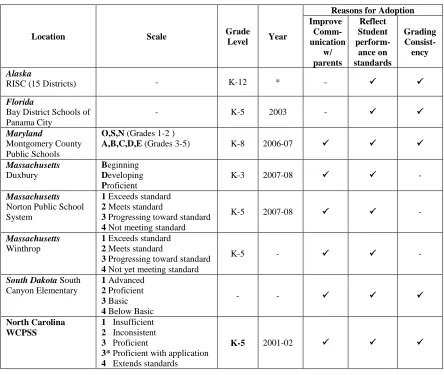
Table 2.1
Non-Inclusive List of State and District Examples of Standards-Based Grading
Location Scale Grade
Level Year
Reasons for Adoption Improve Comm-unication w/ parents Reflect Student perform-ance on standards Grading Consist-ency Alaska
RISC (15 Districts) - K-12 * -
Florida
Bay District Schools of Panama City
- K-5 2003 -
Maryland
Montgomery County Public Schools
O,S,N (Grades 1-2 )
A,B,C,D,E (Grades 3-5) K-8 2006-07
Massachusetts Duxbury
Beginning
Developing
Proficient
K-3 2007-08 -
Massachusetts Norton Public School System
1 Exceeds standard
2 Meets standard
3 Progressing toward standard
4 Not meeting standard
K-5 2007-08 -
Massachusetts Winthrop
1 Exceeds standard
2 Meets standard
3 Progressing toward standard
4 Not yet meeting standard
K-5 - -
South Dakota South Canyon Elementary
1 Advanced
2 Proficient
3 Basic
4 Below Basic
- -
North Carolina WCPSS
1 Insufficient
2 Inconsistent
3 Proficient
3* Proficient with application
4 Extends standards
K-5 2001-02
Dash (-) indicates information not available
While there are some variations in how standards-based grading has been implemented, within these examples there are some shared elements—reflecting the
students given enough time and appropriate instruction can learn. Mastery occurs at different times for different learners. With accurate assessment aligned to the state‘s objectives and appropriate corrections when students have not learned the material all students can and will master the curriculum objectives (South Canyon Elementary, 2008).
While mastery of standards is consistent across examples, other elements are present within some systems and not in others. For instance, similar to WCPSS, South Canyon instituted standards-based grading to increase consistency in grading across teachers and grade levels. South Canyon‘s 1-4 standards-based grading scale corresponds to WCPSS with two notable exceptions: (1) WCPSS added the 3* in response to teacher feedback regarding the difficulty distinguishing between a level 3 and 4 during the pilot at five schools, and (2) level 4 at South Canyon is defined as working above grade level while WCPSS‘ level 4 does not indicate students working above grade level, but rather extending the targeted grade level standards (South Canyon Elementary, 2008).
In a 2010 qualitative study of standards-based grading, Cherniss provided further evidence of the implementation of standards-based report cards. In this study of a K-5 school in Southern California, teachers reported that ―the standards based report card was the logical and necessary next step in aligning state standards to student achievement‖ (Cherniss, 2010, Abstract).
While there are numerous researchers (Guskey, 2002; Marzano, 1998; O‘Conner, 2007; etc.) questioning traditional grading and calling for standards-based grading practices, there has been little to no research discussing the social justice implications around moving toward a less subjective approach to grading. The next section of this chapter addresses the why of standards-based grading.
Why is this Significant?
Standards-based grading, with its emphasis on ensuring all students receive a core set of knowledge, addresses many of the threats to validity and reliability common with
Link Between Social Justice and Grading
With grading comes questions of fairness and justice; thus, an examination of the research concerning equitable grading practices and the impact of grading on sub-populations of students (Asian, Black/African American, American Indian, Hispanic/Latino, White, Multiracial, Students with Disabilities, Free or Reduced-Priced Lunch recipients, and Limited English Proficient students) is necessary (Schrag, 2001). Prior to discussing fair grading it is important to examine this concept. Schrage (2001) calls for ―grading policies designed to foster a more egalitarian ethos‖ (Schrage, 2001, p. 5).
To the extent that we egalitarians are serious about instituting greater equality and not merely formulating theories for our colleagues to ponder, we need to consider our own and our institution‘s grading practice in light of their potential role in inching us toward a more egalitarian society. (Schrag, 2001, p. 8)
One way of examining equity and its relationship to student learning is through the lens of social justice. While there is a lack of consensus among educational researchers as to the definition of social justice, most of the key published literature on social justice (e.g., Adams et al. 1997; Ayers et al. 1998; Cochran-Smith 1999, 2004; Darling-Hammond et al. 2002; Michelli & Keiser 2005; Oakes & Lipton 1999; Villegas & Lucas 2002; Zeichner 2003) agrees that the core of teaching is not only improving students‘ learning, but also impacting students‘ life chances by challenging inequalities present in schools and the wider society. A fundamental requirement of this perspective is the recognition of the unequal ―distribution of educational opportunities, resources, achievement, and positive outcomes between minority or low-income students and their white, middle-class counterparts‖
(Cochran-Smith, Shakman, Jong, Terrell, Barnatt, & McQuillan, 2009, p. 350). There is also a shared belief that teachers should operate both as educators and advocates committed to their role in reducing existing inequalities by redistributing educational opportunities (Cochran-Smith, et al., 2009; Ludlow, Enterline, & Cochran-Smith, 2008).
have ―strong‖ family backgrounds. Resh (2010) used five indicators of family background including mother‘s educations, father‘s education, mother or father‘s occupation (higher of the two), wealth, and an index of educational resources within the home. Although the magnitude of the correlation between SES and academic achievement was greater than that of SES and grade distribution or students‘ sense of deprivation, Resh posited that this finding could be due to the legitimization of grading practices even in light of inequalities. Resh (2010) stated that ―educational systems (as well as other socializing agencies) are probably successful in inculcating meritocratic, equalitarian norms to students of all SES levels. Hence, ‗weak‘ students coming from lower SES strata, adjust their entitlement accordingly and accept their (lower) grades as just‖ (p. 13). Effective grading practices rely on students‘ perceived fairness (Pepper & Pathak, 2008). A sense of justice or injustice is person
dependent. Indeed, Resh (2010) stated that ―a sense of (in)justice is a subjective perception of an individual that the reward s/he receives (actual reward) does not match the reward s/he deserves (just reward)‖ (p. 1). While a sense of justice or injustice may be subjective, Pepper and Pathak (2008) asserted that students perceive grades fairly if they are based on fair grading practices. They found that grading practices that were based on explicit rules, included frequent feedback, and incorporated proactive teacher techniques (i.e encouraged participation) were perceived as fair. Regardless of students‘ sense of fairness student grades maybe impacted by teachers‘ perceptions; thus, the next section addresses the role of
teachers‘ perceptions and its impact on student achievement.
perceptions and grading practices as they relate to equity. Guttmann and Bar-Tal (1982) found that when teachers (who participated in an in-training service of the Israeli Ministry of Education) were provided information regarding only students' ethnic origins they responded stereotypically—perceiving Asian-African students (this ethnic classification is commonly used by the Israeli Census Bureau Abstracts in reference to the Jewish population) to have ―lower academic ability, less academic interest, less diligence, and worse home conditions than students of European-American origin‖ (p. 525). McKown and Weinstein (2008) found that in classrooms where students reported teachers differential treatment of high and low achieving students, ―teacher expectations of European American and Asian American students were between .75 and 1.00 standard deviations higher than teacher expectations of African American and Latino students with similar records of achievement‖ (p. 235).
In addition to the negative perceptions held by teachers based on students‘ racial group, teachers may also hold negative perceptions of low-income students. Benner and Mistry (2007) found a high percentage of teachers with low expectations for low-income students with almost half (48%) not expecting these students to graduate high school and the vast majority (80%) not expecting postsecondary school attendance. These results
demonstrate how teachers‘ negative perceptions can lessen their expectations for students. Thus, in order to understand how teacher biases manifest within a classroom we must next consider how these biases may affect teacher expectations and in turn impact students.
on a student‘s subgroup which in turn impacts student achievement. Figure 1.1 provides a visual diagram of the theoretical relationship between these factors.
Figure 1.1. Theoretical relationship between teacher prejudice, teacher expectations, and student achievement
Low expectations within the classroom affect teaching practices: ―studies find that teachers with low expectations tend to provide students less positive attention and
reinforcement and fewer opportunities to learn‖ (Benner & Mistry, 2007, p. 150).
Additionally, teacher expectations may manifest in the climate created and in the difficulty level of the material provided. Teachers may provide a ―warmer socioemotional climate‖ and more challenging learning materials to students for which they hold high expectations
(Bergh, et al., 2010). Teacher expectations may also impact grading practices. Resh (2009) compared grading considerations and student capacity and revealed that approximately half of the teachers held that differentially grading ―weak‖ and ―strong‖ students was just. The teachers reported weighting effort and the ―need for encouragement‖ more heavily in their ―weak‖ students‘ grades (p. 315).
Another way in which teacher perceptions may impact students‘ educational experiences is the affect on students‘ perceived and realized academic outcomes. For
instance, Benner and Mistry (2007) found a strong relationship between teacher expectations and students‘ educational expectations, competency beliefs, and academic achievement. Rubie-Davies‘ (2006) study confirmed the effect of teacher expectations on students‘ self
Student achievement Teacher
prejudice
perception. She found that although students entered the year with similar self-perceptions, students with high-expectation teachers ended the year with slightly higher academic self perception while students with low-expectation teachers experienced a dramatic decrease in self perception. In Rubie-Davies‘ (2010) study she found teachers with low expectations for their students perceived students as trying hard. While these teachers held expectations below students‘ actual achievement, they viewed work habits more positively. However, teachers‘ positive perception of work habits did not seem sufficient to counter negative perceptions of their academic abilities since the study‘s findings indicate that these teachers had a weak relationship with student achievement while high expectation teachers had a strong positive relationship to student achievement. Teachers‘ biases and lowered expectations toward certain student groups are particularly problematic when they negatively impact student achievement.
Impact on Student Achievement. Teachers‘ expectations not only impact how
students perceive their academic abilities, but also their academic achievement. As students move through the educational system their learning trajectories diverge (Grubb, 2009). There is a cumulative effect of inequality on student learning trajectories such that over time
Achievement gaps exist not only across schools, but across classrooms within a school. Some of the differences across classrooms could be the result of teacher attitudes (Bergh et al., 2010). Guttman and Bar-Tal (1982) found that ―teachers' stereotypic perception causes differential expectations of students' academic achievement‖ (p. 526). It should be noted, however, when additional information was available and teachers were asked to provide expectations for matched students within their own classroom there was no
relationship between ethnic origin and student grades. These results indicate the necessity of further research on the connection between teachers‘ perception and student grades
(Guttmann & Bar-Tal, 1982). Since teachers assign grades within their own classroom, grades are more likely to reflect the teacher‘s perception. Thus, studies that examine student achievement (beyond grades) may offer additional insight. More recent research has found a relationship between teacher expectations and student achievement (Bergh et al., 2010; Rubie-Davies, Hattie, & Hamilton, 2006). Bergh et al.‘s (2010) study of the relationship between teacher expectations and student achievement found that although student
achievement gaps were unrelated to teachers‘ self-reported measure of prejudiced attitudes, ―the implicit measure of teacher prejudiced attitudes, however, was found to explain differing ethnic achievement gap sizes across classrooms via teacher expectations‖ (p. 497). In fact, they found that teachers with negative prejudiced attitudes toward ethnic minorities (students of Turkish and Moroccan origin) were more likely to evaluate these students as less
more prejudiced teachers than in the classrooms of less prejudiced teachers. Rubie-Davies, et al. (2006) examined teacher expectations at the beginning of the year and student
achievement at the end of the year and found teacher expectations to be significantly higher for all ethnic groups with the exception of Maori students (the four ethnic groups included in the study were New Zealand European, Maori, Pacific Islander, and Asian). They also found that while the students (including the Maori) entered the year with similar academic
achievement, at the end of the year the Maori had made the least gains of all student groups. Thus, the student group in which teachers expected the least experienced the least amount of growth. Given the influence teachers have on student learning and the potential for bias, teacher preparation programs have begun to address issues of equity and social justice.
Teacher Preparation Programs. Increasingly teacher preparation programs are incorporating social justice into their programs‘ curricula in order to provide new teachers with an understanding of how to reach all learners. As would be expected considering the variability of the definition of social justice, there is considerable variation in what is meant by the phrase ―teacher education for social justice‖ (Ludlow, et. al., 2008, p. 194). At the core teaching social justice includes the recognition of unequal access to educational opportunities and resources and the resulting disparities in educational achievement outcomes between minority and low-income students and their white middle-class counterparts; and the expectation that teachers operate both as educators and advocates committed to reducing achievement gaps between student groups (Ludlow, 2008).
Cochran-Smith, et al.‘s (2009) qualitative study found that this was not the case. Indeed, through teacher interviews and classroom observations they found that:
… teacher candidates focused on ensuring pupils‘ learning rather than merely boosting their self-esteem or spreading political ideologies, as critics of the social justice agenda suggest. In classrooms, candidates concentrated on teaching content and skills but also had a critical perspective, built on pupils‘ cultural resources, and attempted to reach every pupil. We argue that teaching for social justice, or what we title ―good and just teaching,‖ reflects an
essential purpose of teaching in a democratic society in which the teacher is an advocate for students whose work supports larger efforts for social change. (p. 347)
uniformly accepted the purposeful inclusion of social justice into teacher training may be the best way to ensure this key educational value is not overlooked.
The connection between social justice and standards-based grading has not yet been made within the research and thus provides an opportunity for this study to explore this, as yet, undeveloped research area. However, for standards-based grading, as with any initiative, to reach its full potential it must be implemented with fidelity.
Implementation and Equity Considerations
Implementing standards-based grading within WCPSS requires teachers provide opportunities for students to be exposed to, and assessed on, a 1-4 assessment scale. The standards-based grading system implemented in WCPSS‘ elementary schools requires students demonstrate understanding by applying and extending knowledge of the standard-course of study in order to reach the highest achievement level, level 4 (K5 Standards-Based Grading and Reporting, 2003). However, the degree to which level 4 instruction and
While there are numerous researchers discussing standards-based grading, there is limited empirical research on this grading practice and its implementation within classrooms and virtually no research examining its potential for increased equity in student grades across student subgroups. Thus, this study will seek to address both the implementation of
standards-based grading and its impact on student subgroups within a large school district. The next section describes the subjects of this grading study.
Who will be the Focus of the Grading Study?
This literature review informs the study of how standards-based grading has been implemented within WCPSS elementary schools and evaluates the assumption that this method of grading is an equitable measurement of students‘ mastery of the NCSCS.
Standards-based grading was born out of the desire to ensure all students are exposed to, and assessed on, the NCSCS. Due to a concern that students‘ grades were not consistent,
students‘ mastery of the NCSCS was not reflected on report cards, and that parents were not properly informed of student progress, WCPSS implemented a standards-based grading report card at the elementary level.
Background