Simulation between the Heart in Human Body and
Intersections in Roads
(Case Study: Tahrer Square Intersection)
Eng.Fatma Mohamed Elnawawy
Urban planning engineer
Dr. Pasent Hesham Ahmed Yousef
Faculty of Urban & regional planning – Cairo University – Tel.: 01001323466
Abstract: In this paper we focused on traffic congestion in Cairo city, through the prediction of traffic congestion in the future in 2025. Cairo city is considered as an example for city of highly congestion roads. In this study we found that in 2025 there are some roads that will be fully loaded by cars, those cars will not move easily from its place because of the congestion in the intended roads. So we began to think about the heart in the human body as it is controlling the circulatory system in the human body, and how can we simulate the human heart with the city roads. We began with the heart and how it works, then we saw some of the intersections in the world then we analyzed the idea of mimicking the human heart with the city roads specially the city squares and applying the concluded idea on an intersection in Cairo city presented in Tahrer square as one of the main squares which is indicated for having several congestion problems.
Introduction
In one of the first author travels to Riyadh and Riyadh Municipality, she got interesting results using the Trans cad program that can predict the conditions of the traffic of any city in the future. So we collected a lot of information about roads in Cairo, then we put those materials on the Trans cad program. From the collected data and after using the Trans cad program, we found an Unnatural disaster that will happen in Cairo roads by 2025, that will appear in many streets ( as shown in the two figures 1 and 2) as congestions so that the cars will not move easily due to the strength of the congestion in those roads. This will cost people and government a great loss of time that can be converted
to money easily. As the time lost in traffic jam in the road intersections is considered as a challenge in this paper to solve. And for finding a solution for this problem we approached a mimics concluded from the human body that will be explained in this paper.
fig.1. The current situation presenting the roads flow in Cairo city
0
-0.35 0.35
-0.55 0.55
-0.77 0.77
-0.93 0.93
-1 More than 1 Level of service
N
current situation
fig.2. The expected situation in 2025 presenting the roads flow in Cairo city
Background:
1- Introducing the heart in the human body What is the heart?
The heart is a hollow, cone-shaped muscle that's about the size of an adult fist and usually found to the left of our breastbone.
The heart is the most important organ in our body. It is basically a complex pump, responsible for circulating blood, oxygen and nutrients around the body.
Every heart is made up of three layers: • an inner lining called the endocardium
• a middle layer of muscle called the myocardium • an outer fluid-filled sac known as the pericardium.
N
Expected in 2025
0
-0.35 0.35
-0.55 0.55
-0.77 0.77
-0.93 0.93
-1 More than 1 Level of service
The heart is divided into four chambers:
• the right atrium and left atrium are the upper chambers of the heart • the right ventricle and left ventricle are the lower chambers.
A muscular wall called the septum separates the right and left sides of the heart. Each of the chambers has valves. The valves have different names:
• the tricuspid valve is at the exit of the right atrium • the mitral valve is for the left atrium
• the pulmonary valve is at the exit of the right ventricle • the aortic valve is at the exit of the left ventricle.
Their purpose is to allow blood to move forwards through the heart and to prevent it from flowing backwards into the previous chamber. How does the heart work?
The heart muscle contracts in two stages to squeeze blood out of the heart. This is known as systole.
• In the first stage, the upper chambers (atria) contract at the same time, pushing blood down into the lower chambers (ventricles).
• Blood is pumped from the right atrium down into the right ventricle and from the left atrium down into the left ventricle.
• In the second stage, the lower chambers contract to push
this blood out of the heart to either the body via your main artery (aorta) or to the lungs to pick up oxygen.
• The heart then relaxes – known as diastole. Blood fills up the heart again, and the whole process, which takes a fraction of a second, is repeated.
The different sides of the heart have different functions: (fig.3,4)
• On the right side, the upper chamber fills with
oxygen-depleted blood from your body and pushes it via the lower chamber and the pulmonary artery back to the lungs. Here blood picks up oxygen and releases carbon dioxide.
• On the left side, the upper chamber fills with
oxygen-rich blood from the lungs. This is pumped via the lower chamber into the aorta and out to the body to provide cells with the crucial oxygen they need.
fig.3.What is the heart? fig.4. How does the heart works?
What makes the heart beat? (fig.5)
On average, most people have a heart rate of around 72 beats per minute at rest. This varies according to fitness, age, exertion and general health.
Each heart beat is triggered by an electrical pacemaker - a group of cells in the heart that have the ability to generate electrical activity. They cause electrical impulses to spread over the heart and make it contract.
The largest natural pacemaker of the heart is called the sinoatrial or SA node and is found in the right atrium. From it, specialized groups of cells that carry the electrical charge lead off to the rest of the heart.
fig.5.what makes the heart beat?
In the end we can say that the heart is a connector between the Arteries and veins of the body, same like the intersection which is the connector between the roads and streets in the city.
2- Some example of the Intersections around the world :
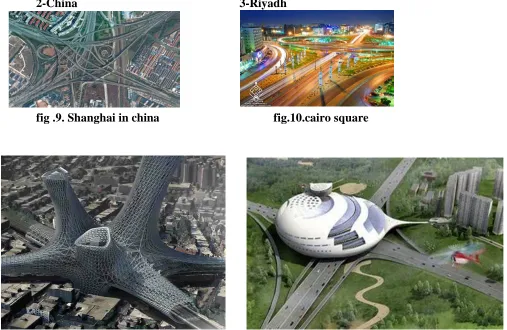
In this section we through light on some good examples of intersections in different cities all over the world as shown in the figures (6-100 and the proposed models of intersection In figures (11-12).
1-USA
Fig.6. CHIKAGO intersection fig .7. LISANGLOUS intersection fig.8. GORGIA intersection
2-China 3-Riyadh
fig .9. Shanghai in china fig.10.cairo square
Fig.11,fig,12, intersection in the future presented in the global design trend of intersections in the future
3- Application of the proposed solution on the Tahrir Square:
In this case study we found that Tahrir Square is in the center of Cairo city, and we can connect the different roads branching from Tahrir Square by making intersections in Tahrir Square. This solution is not enough so there should be other intersections in other places. We considered the studies which were made by the government in Egypt, and then we figured up an idea to connect the roads in greater Cairo. Then we mugger if the solution will be effective or not by Trans cad program.
1-Tahrir Square as a case study:
Fig.13. Neighborhoods Tahrir Square fig.14. Uses in Tahrir Square and fig,15. Residential use
the surrounding area the surrounding area in Tahrir Square
Reference:
Fig.16. Government buildings in fig.17.Land prices for Tahrir fig.18.Buildings Tahrir rises for Tahrir Square Square and the surrounding area Square and the surrounding area
fig.19.Buildings Cases fig.20.buildings Construction fig.21.Movement axes and entrances
It was necessary to study the land uses in surrounding the Tahrir Square to see how much impact that will affect the heart in Tahrir Square on neighboring region and how to link between Tahrir Square and between parts of Greater Cairo to achieve liquidity in traffic.
We found that the Tahrir Square is limited with General Service Buildings and entertaining editorial garage, residential and administrative buildings that represent great significance and during the design the building in the heart will be preserved in Cairo's Tahrir Square.
Also in Tahrir Square area there are residential buildings with a historical character and editing area around the downtown area that are
frequently out of residential buildings with a historical character and good condition and they will not be removed.
Frequently Downtown area is full of administrative and governmental buildings of great importance for Egyptian citizens and can be only removed in the case of transferring them to other places.
Also the price of land in the editing area exceeded 8,000 pounds per meter and this underlines the lack of Aslant in any building work for the liberation of the project. Heights around Tahrir Square does not exceed the 10 levels and therefore making a big heart and a huge editing and be a hallmark of the whole compelling and signs such as the tower and others, and will therefore be the heart of Cairo landmark, and buildings have been instances between medium and good.
The construction materials were structural in most buildings, and the entrances to Tahrir Square from Qasr al-Nil Bridge and Kasr el Aini is the center of the country and from Ramses Street and another building next to Tahrir.
2-Places of traffic congestion in Tahrir Square
fig.22. Places of traffic congestion in Tahrir Square
3-The Proposed solution to roads problems in the heart of Cairo's Tahrir Square:
ﻛﺗ قطﺎﻧ
ﻛﺗ قطﺎﻧ
ﻛﺗ قطﺎﻧ
Fig.23.graffic heart complex model fig.24.plan for the solution of the Problem
Fig.25. perspective 1 for the solution of the Problem Fig.26. perspective 2 for the solution of the Problem
Fig.27. perspective 3 for the solution of the Problem
4- Evaluation and conclusion of the proposed solution:
N
Reffrence :
1. Datzma, K. (2009, Dec.). "Pineda Extension linking I–95 in Melbourne seen as economic lift for area" (PDF). Brevard Business News 27 (49). Retrieved 2011-11-08
Average rates Crush V/C
Average speed roads C
Average number of vehicles on main roads V
0.719 160,000.00 115,000
The future status without the application of the proposed solution
0.523 220,000.00 115,000
The future status with the application of the proposed solution
20% The expected rate of change
0 -0.35 0.35 -0.55 0.55 -0.77 0.77 -0.93 0.93 -1 more than1 Service levels for the major
road network Tahrir Square area(the current situation) Future service to major road
network Tahrir Square district levels(Without applying the solution) Future service levels in Tahrir Square
area with the presence of the proposed bridges
Service levels for the major road network in Cairo area(the current
situation) Future service of major road
network in Cairo city district levels(Without applying the
solution) Future service levels in Cairo
city area with the presence of the proposed bridges
2. Elnawawy. F., “The Issue of City Transportation Planning and Circulatory and Nervous Systems in Human Beings An applied Case on Greater Cairo, MSc Thesis –faculty of Engineering Cairo University, Cairo, Egypt , 2015.
3. Michael d. Makovon Translated by Dr. Ayman Kamal Abul-Magd (heart in health and disease) Egyptian International Publishing Longman
4. Mickle Mackphorn, translated to Arabic by Ayman K. Aboulmaagd(Heart in health and ill) ,Longman
5. http://www.netdoctor.co.uk/hearthealth/howtheheartworks.htm
6. http://www.ijtra.com/special-issue-view/study-of-some-international-experiences-in- the-field-of-transportation-traffic-and-roads-comparison-with-blood-circulation-and-nerve-cells-in-human-body-.pdf
7. http://www.tt5.com/pictures/powerful-highway-interchanges-photos.html
8. 2-17 the IRF world meeting &EXHIBITION NOVEMBER 10-14, 2013-Ridah, KSA
9.
http://www.akhbar-tech.com/7501/14-crazy-skyscrapers-from-the-future-designed-to-solve-real-problems