
Recent results on diffractive and forward physics at HERA
Yuji Yamazaki1,aon behalf of the H1 and ZEUS Collaborations 1Rokkodai-cho 1-1, Nada, Kobe, 657-8501 Japan
Abstract.
Recent studies on diffractive processes inepscattering at HERA are reviewed. Heavy quark production in diffractive processes was studied by tagging aD∗meson in diff rac-tive DIS events. The cross section for events with a prompt photon in the final state was also measured. The data are well reproduced by models using diffractive parton densities determined from inclusive diffractive DIS cross sections. Two studies were also made on exclusive vector meson production. The cross-section ratioσ(ψ(2S))/σ(ψ(1S)), which reflects the difference in transverse shape of the charmonium wave functions, are com-pared to various models. Moreover, the diffractiveρ0photoproduction with a forward
neutron, which has two vertices with small-pT recoil, were measured to study factorisa-tion properties. The data show some indicafactorisa-tion of re-scattering.
1 Introduction
HERA, the onlye±pcollider, has provided opportunities to study high-energy electron-proton colli-sions beyond the electroweak scale. The main process, the Deep-Inelastic Scattering (DIS), probes the internal quark structure of the proton via exchanged virtual photons (γ∗). The point-like nature of the virtual photon withQ2Λ
QCD, whereQ2is the negative mass of the virtual photon, ensures that
the photon probes the quarkonic structure of the proton.
The DIS process can also be interpreted as collisions ofγ∗p, which allows discussion of the DIS and photoproduction processes in the same framework; the DIS process can be considered as a special case ofγ∗pcollisions where the Q2 of theγ∗ is large ( Λ
QCD). In the photoproduction process, Q2≈0 and no hard scale is present if there is no high-p
Tparticle in the final state and the process is
described by the exchange of particles. In processes where a hard scale is present, individual partons are visible and the cross sections can be calculated in perturbative QCD.
Diffractive processes at HERA are characterised as a colourless exchange between the virtual photon and the proton, where the photon system dissociates into a hadronic systemXwhile the proton may remain intact or may dissociate to a systemY. The the momentum exchanged at the p → Y vertex,t, is typically small (−t≤ΛQCD) unless the mass of the systemYis large. There it is expected
that the exchanged state at the proton vertex is particle-like e.g. pions, Reggeons or "Pomerons" (IP). It may be, however, that the exchange can be explained by partonic colourless states e.g. (dressed) two gluons and can be interpreted by pQCD calculations.
(P)
p p(p )
xIP
Y IP
t
Rapidity Gap
σ
0
0.2 5 < Q2 < 100 GeV 2 < 0.03 IP
x
0.02 < y < 0.65 MY < 1.6 GeV > 1.5 GeV
T,D*
p |t| < 1 GeV 2
< 1.5
D*
η -1.5 <
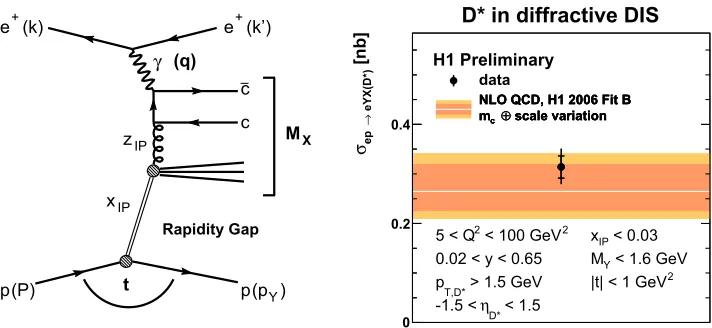
Figure 1. (left) A typical diagram of charm quark pair production in photon-dissociative diffractive processes inepscattering. (right) The charm quark production cross section in comparison to the NLO QCD calculation using H1 2006 Fit B diffractive PDF [1].
HERA allows quantitative investigations to be made of the partonic content of such exchanges by measuring the cross section behaviour of Diffractive DIS (DDIS), which is defined as DIS processes with diffractive final states (experimentally defined as a presence of large rapidity gap, observation of the fast-going proton or neutron, etc.). The gluon density in the exchange can also be extracted through the scaling violation behaviour of the DDIS cross sections inQ2 (for example in Ref. [1]),
provided that the factorisation holds between theγ∗vertex and other part of the DDIS diagram. The factorisation was theoretically proven for DDIS but not for other processes, such as diffraction in photoproduction or hadron-hadron collisions, even with a presence of a hard scale. The factorisa-tion breaking may lead to "absorpfactorisa-tion" or re-scattering between two diffractive systems. The cross sections are then suppressed from the theoretical predictions based on the diffractive parton densities extracted from DDIS. Such behaviour was first largely advertised by the Tevatron measurements on dijet production in diffraction [2]. There are several observations also at HERA, e.g. photoproduced dijets [3] as well as thet−distribution in forward neutron production [4].
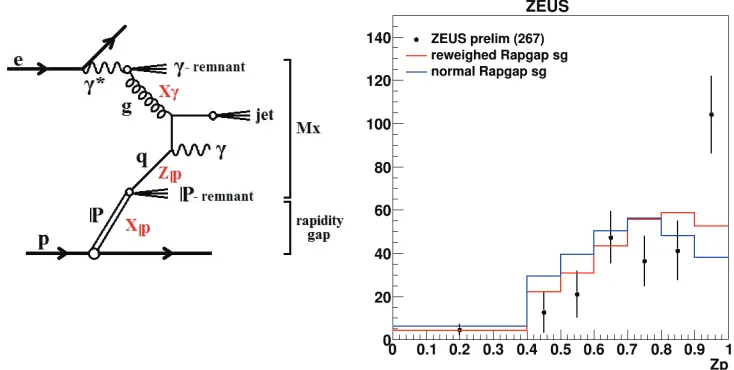
Figure 2. (left) An example of diagrams where a prompt photon is produced with a quark jet in the resolved
diffractive photoproduction process inepscattering. (right) The zIP dependence of the cross sections with a
prompt photon, a jet and a large rapidity gap in photoproduction.
2
D
∗production in diffractive DIS
Charm quarks in diffractive DIS are predominantly produced through the so-called boson-gluon fusion
diagram (Fig. 1(left)). The cross sections with aD∗in diffractive DIS are therefore sensitive to the
gluonic content of the diffractive exchange.
The cross section was measured with 281pb−1 of ep collisions by the H1 Collaboration in the
deep-inelastic regime (5 < Q2 < 100GeV2) with a presence of a large rapidity gap from the edge
of the detector in the proton direction, hence selecting either events with proton staying intact or
dissociated to a small mass stateY.
The cross section (Fig. 1(right)) shows good agreement with the NLO prediction within the
un-certainty if using the diffractive PDF H1 2006 Fit B [1] extracted from the scaling violation of the
inclusive diffractive DIS data. This indicates that the factorisation holds in diffractive DIS. Diff
eren-tial cross sections are also measured as a function of other variables described in Fig. 1(right). All the
distributions are well reproduced by the NLO calculation, providing a cross-check on the diffractive
parton densities, in particular the gluon density.
3 Prompt photon production in diffractive photoproduction
This measurement requires an isolated photon and a jet in the photon dissociation system in addition
to the presence of a large rapidity gap in photoproduction events. The advantage of a photon+a jet
over dijet events is (a) less sensitive to the QCD radiation and (b) more sensitivity on quark content
of the diffractive exchange as the prompt photon couples only to quarks (Fig. 2(left)).
The fraction of parton momentum involved in the hard scattering with respect to the two incoming
“particles”, for the photon (xγ) and for the diffractive exchange (zIP), can be reconstructed using the
momentum of the photon and jet. The events are further classified as "direct" and "resolved" events
)
2
(GeV
2
Q
0
10
20
30
40
50
60
70
80
0
0.2
0.4
-1
ZEUS 468 pb
-1
H1 27 pb
-1
p: 6.3 pb γ H1
LM = 2 δ KMW:
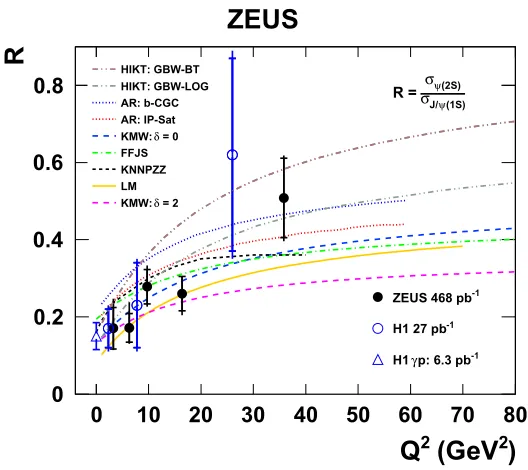
Figure 3.The cross section ratioσ(ψ(2S))/σ(ψ(1S)) as a function ofQ2in comparison to various models.
is resolved-enriched. The fraction of the resolved and direct processes in the RAPGAP model was reweighted so as to describe the data.
Theoretical prediction by RAPGAP reproduces well various distributions, such asETandηof the photon and jets. The only exception iszIPdistribution (Fig. 2(right)). It fails to describe the peak near zIP=1 observed in the data. This may indicate that the model lacks some diagrams like two partons in
the diffractive exchange with very asymmetric configuration i.e. one of the two partons carries almost the entire momentum of the diffractive exchange. Such diagrams are higher-twist contribution and not included in the framework of the QCD fit to diffractive DIS cross sections.
4 The production ratio
ψ
(2
S
)
/ψ
(1
S
)
in diffractive DIS
This process measures the cross section ratio of the quasi-elastic charmonium productionep→eψY whereY is either a proton or a state with small mass. The ratioσ(ψ(2S))/σ(ψ(1S)) is expected to have a strong dependence inQ2, which is originated from different wave function shape of 1S and 2S
onium states. The wave function of the 1S state is always positive, while the function for the 2S state has a node at around 0.35 fm.
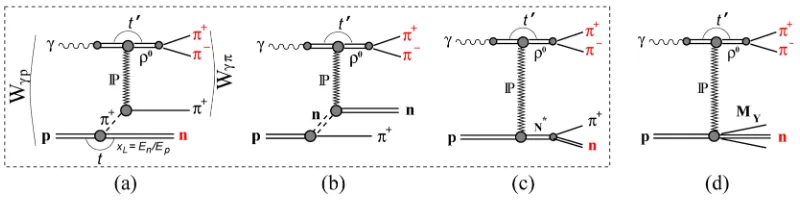
Figure 4.Diagrams for processes contributing toρ0production with a leading neutron at HERA. Three processes
are considered as signal: (a) pion exchange (b) neutron exchange and (c) a neutron produced from the decay an excited nucleon or from a non-resonantπ+nstate. The event with a neutron produced from dissociation of the systemYis considered as background (d).
The data in Fig. 3 was measured with full luminosity of HERA runs and greatly improves the pre-cision of the previous measurement. The data confirms qualitatively the above-explained expectation. Looking into detail, the data behaviour is consistent with many of the models although some of the models are excluded. The ratio is flat against other variables likeW, the centre-of-mass energy of the
γ∗psystem, and|t|.
5 Exclusive
ρ
0photoproduction with a fast neutron
Exclusiveρ0production with a fast neutron is a process without the explicit presence of a hard scale
since both the outgoing neutron andρ0 do not carry high transverse momentum. It is therefore
ap-propriate to describe the process in terms of particle exchange. For events with largexL = En/Ep, the dominant process is one-pion exchange (OPE) (Fig. 4 (a)). This allows the diffractive production ofγπscattering to be studied, especially by comparing to the results from exclusive production ofρ0
without a tagged neutron.
There are other two other diagrams (Fig. 4 (b) and (c)), which do not leave any significant activity in the forward part of the detector and are considered as signal in this analysis. The neutrons through the proton dissociation systemYis considered as background and was subtracted.
The shape of the measured neutron spectrum is well reproduced by choosing appropriate “pion flux” models among those proposed (see the Ref.[8] for more detail). The production rate is, however, suppressed by about a factor two. The cross section ratioσγπ→ρ0π/σγp→ρ0pwas measured 0.25±0.06,
which is far less than that expected from the additive quark model (∼0.6). Similar suppression was observed in inclusive neutron production[10]. This may be an indication of absorptive correction.
The exponential slope parameters of the leading neutronbn determined from thepT dependence
σ(xL,pT)=Aexp (bnp2
T) was measured at HERA for inclusive neutron production [9] and compared
to models with various pion flux, giving constraint to models (Fig. 5(right)). A similar measurement was made for the exclusiveρ0production and is shown in Fig. 5. The behaviour is quite different from
the inclusive measurement at highxL. This may be a further indication of the presence of re-scattering, which predicts to suppress the events with a neutron with largepT.
References
xL
0.4 0.6 0.8
0 10
xL
0.4 0.6 0.8
0 10
H1
0 2 4
0.3 0.4 0.5 0.6 0.7 0.8 0.9 1 xL Bishari
ZEUS 40 pb-1 Q2> 2 GeV2
pT2< 0.476 xL2 GeV2
Systematic uncertainty
Figure 5.(left) The exponential slope parameterbn for the exclusiveρ0 production. (right) The corresponding parameters for inclusive DIS with a leading neutron[9].
[2] CDF Collaboration, T. Affolder et al., Phys. Rev. Lett.84, 5043 (2000). [3] H1 Collaboration, A. Aktas et al., Eur. Phys. J.C51, 549 (2007). [4] ZEUS Collaboration, S. Chekanov et al., Nucl. Phys.B776, 1 (2007). [5] H1 Collaboration, H1prelim-16-011, available under:
http://www-h1.desy.de/h1/www/publications/htmlsplit/H1prelim-16-011.long.html. [6] ZEUS Collaboration, ZEUS-prel-15-001, available under:
https://inspirehep.net/record/1368789?ln=en
[7] ZEUS Collaboration, H. Abramowicz et al., Nucl. Phys.B909, 934 (2016). [8] H1 Collaboration, V. Andreev et al., Eur. Phys. J.C76, No. 1, 41 (2016). [9] ZEUS Collaboration, S. Chekanov et al, Nucl. Phys.B776, 1 (2007).
![Figure 5. (left) The exponential slope parameter bn for the exclusive ρ0 production. (right) The correspondingparameters for inclusive DIS with a leading neutron[9].](https://thumb-us.123doks.com/thumbv2/123dok_us/8143861.1357579/6.482.50.431.84.263/figure-exponential-parameter-exclusive-production-correspondingparameters-inclusive-leading.webp)
