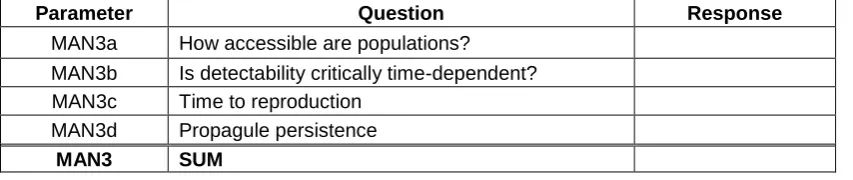
1
Framework and guidelines for conducting risk analyses for alien species
Sabrina Kumschick
1,2*, John R Wilson
1,2, Llewellyn C Foxcroft
31
Centre for Invasion Biology, Department of Botany & Zoology, Stellenbosch
University, Private Bag X1, Matieland 7602, South Africa
2
South African National Biodiversity Institute, Kirstenbosch National Botanical
Gardens, Claremont 7735, South Africa
3
Centre for Invasion Biology and Conservation Services, South African National
Parks, Private Bag X402, Skukuza 1350, South Africa
*corresponding author: [email protected]
Abstract
This report presents a framework for analysing the risk of alien taxa under South
Africa's National Environmental Management: Biodiversity Act of 2004, and the Alien
and Invasive Species Regulations of 2014. While the report was initially designed to
meet a specific South Africa need, the risk analysis processes developed can, we
believe, be transferred to any specified geographic region. In outlining a series of
questions related to a taxon’s likelihood of invasion and the consequences thereof,
i.e. the potential impacts, the report provides a structure for collating data relevant to
the process of listing taxa as well as a process for developing recommendations that
is both mathematically sound, transparent, and that explicitly takes uncertainty into
account. The framework is based on collating information according to international
standards in biological invasions (specifically the IUCN Environmental Impact
Classification of Alien Taxa Scheme, the CBD's scheme for classifying invasion
pathways, and the Unified Framework for Biological Invasions proposed by
Blackburn
et al
. 2011). The risk analysis framework is currently being implemented in
South Africa in an effort to underpin national regulatory lists of invasive species.
Keywords
: Risk analysis, risk assessment, biological invasions, regulations, policy,
risk management
2
Introduction
Species are being moved around the world by humans (both accidentally and
deliberately) in increasing numbers, and in new ways. When introduced to new
biogeographical regions, some of these alien taxa establish and spread without
further human assistance (i.e. they become invasive). While many alien taxa are
highly beneficial, some alien taxa can have significant negative impacts on the
recipient environment and socio-economy. In order to deal with such undesirable
consequences and to mitigate future impacts, frameworks for the regulation of alien
taxa have been developed all over the world. Such regulations often include lists of
species for which certain activities are prohibited or restricted. Decisions on these
lists require a scientific analysis of risk.
The process of risk analysis is composed of hazard identification, risk assessment,
risk management, and risk communication. In the context of alien taxa, the hazard is
that an alien species once introduced will either directly or indirectly (e.g. through
acting as a vector for parasites) have undesired environmental or socio-economic
impacts. Risk assessment consists of assessing the likelihood and consequences of
a given alien taxon causing such negative impacts. And risk management deals with
options to reduce the risk including within the context of potential benefits. Finally
risk communication is about how the information is made accessible (see Annexure
1 for a glossary).
The purpose of this report is to present a framework for the analysis of the risks
associated with alien taxa and to provide a structure for collating evidence for listing
alien taxa. The report aims to ensure that this process is done in a transparent and
repeatable manner that aligns with national and international agreements, policies
and best practices.
The risk analysis framework presented here is specifically designed for the purpose
of listing alien species under the regulatory framework of the South African National
Environmental Management: Biodiversity Act (NEMBA, Act 10 of 2004) Alien and
Invasive Species Regulations (hereafter called NEM:BA A&IS Regulations;
Department of Environmental Affairs 2014). The regulations prescribe specific
management actions and require cognisance of the benefits to stakeholders. While
the risk analysis concepts are imbedded in various scientific literature, we present
the applicability and guidance of a practical framework. We also provide guidance on
risk scoring (how to assess each point) and determining a confidence score (how
confident you are in giving a specific score). Under the NEM:BA A&IS Regulations,
additional information is required to obtain a permit for a category 2 species, and to
obtain a permit to import a species, specifically there needs to be information about
the restricted activities (e.g. where organisms are to be housed, and what protocols
are in place to provide their spread). For details of how the framework aligns with the
regulations see Supplementary Material Appendix S0.
Structure of the framework
The framework is divided into five sections: 1)
Background
(BAC) provides
3
behavioural traits of the taxon that could lead to its arrival, establishment and spread;
3)
Consequences
(IMP) include the recorded and likely impacts of the taxon; 4)
Risk
management
(MAN) includes questions related to the ability to control a taxon in the
context of whether the taxon is beneficial in some situations and results in a
recommendations for listing taxa; 5)
Reporting
provides guidance on how to
communicate the outcomes of the analysis. Section 2) and 3) together form the Risk
assessment, and 4) includes Risk management considerations. All the sections
together form the Risk analysis (Figure 1, Table 1).
Figure 1.
A schematic of the risk analysis framework described here. For each
chapter there are a number of parameters which need to be assessed (see Table 1).
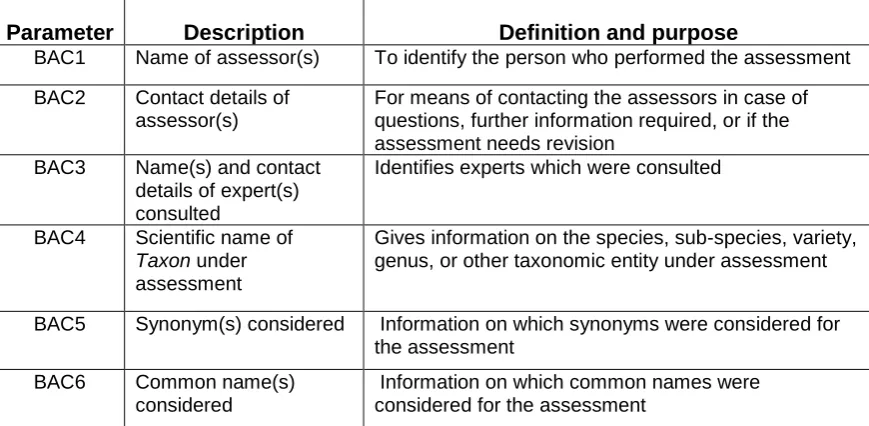
Table 1.
A list of
information needed to complete the risk analysis.
Parameter
Description
Definition and purpose
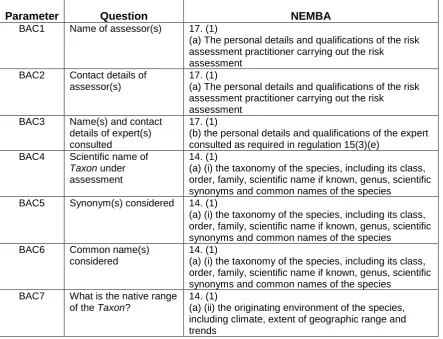
BAC1 Name of assessor(s) To identify the person who performed the assessment
BAC2 Contact details of assessor(s)
For means of contacting the assessors in case of questions, further information required, or if the assessment needs revision
BAC3 Name(s) and contact details of expert(s) consulted
Identifies experts which were consulted
BAC4 Scientific name of Taxon under assessment
Gives information on the species, sub-species, variety, genus, or other taxonomic entity under assessment
BAC5 Synonym(s) considered Information on which synonyms were considered for the assessment
BAC6 Common name(s) considered
4
Parameter
Description
Definition and purpose
BAC7 What is the native range of the Taxon?
Information on the distribution range of the taxon is I Important for the assessment as the framework is designed for alien species specifically
BAC8 What is the global alien range of the Taxon?
This is crucial as for some questions, only information in the alien range is considered
BAC9 Geographic scope = the Area under
consideration
Delimits the assessment area
BAC10 Is the Taxon present in the Area?
Crucial for management recommendations (e.g., prevention vs. control)
BAC11 Availability of physical specimen
To link the identification of the taxon to a physical sample, i.e. so that in the future if need be it will be possible to determine what the Taxon’s identity was compared to at the initial identification. I.e. if it turns out in future that the identification could be wrong, we need to be able to understand why it was identified as that particular Taxon
BAC12 Is the Taxon native to the Area or part of the Area?
Important for management as this framework only deals with alien species
BAC13 What is the Taxon’s introduction status in the Area?
Can aid management decisions
BAC14 Primary (introduction) pathways
This information will be used to answer questions on likelihood of entry
LIK1 Likelihood of entry via unaided primary pathways
The probability of the Taxon to arrive and enter an area without human assistance
LIK2 Likelihood of entry via human aided primary pathways
The probability of the Taxon to arrive and enter an area human aided
LIK3 Habitat suitability Forms part of the likelihood of a Taxon to establish
LIK4 Climate suitability Forms part of the likelihood of establishment
LIK5 Unaided secondary (dispersal) pathways
Assesses spread potential
LIK6 Human aided secondary (dispersal) pathways
Assesses spread potential aided by humans
IMP1 Environmental impact Includes impacts caused by the Taxon on the environment through different mechanisms
IMP2 Socio-economic impact Includes impacts caused by the Taxon on different socio-economic sectors
*IMP3 Closely related species’ environmental impact
If no data on the Taxon itself is available, this includes impacts caused by related taxa on the environment through different mechanisms
*IMP4 Closely related species’ socio-economic impact
If no data on the Taxon itself is available, this includes impacts caused by related taxa on different socio-economic sectors
5
Parameter
Description
Definition and purpose
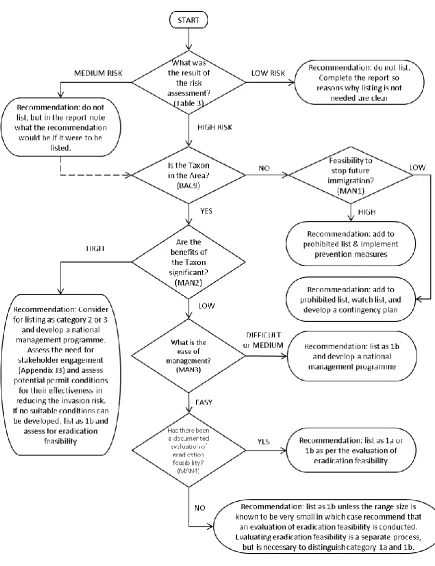
#MAN1 What is the feasibility of stopping future
immigration?
Important for effectiveness of control, as new influx of propagules needs to be stopped to control the Taxon
effectively and sustainably
#MAN2 Benefits of the Taxon Socio-economic and environmental benefits are included to assess the need of stakeholders for the
Taxon
#MAN3 Ease of management To provide indication of how easy the Taxon is to manage in the Area as this will influence risk management decisions.
#MAN4 Has the feasibility of eradication been evaluated?
Indicates whether the feasibility of eradicating the
Taxon from the Area has been formally evaluated or not. Note the evaluation of eradication feasibility is a separate process to the risk analysis framework.
*not assessed if IMP1 and IMP2 can be filled in respectively, i.e. information on
impact is available for the
Taxon
6
Scope of assessment
As the risk analysis performed here is meant so serve as the evidence base for the
listing of alien species under the NEMBA A&IS Regulations, these should not be
used as evidence to answer any of the questions. Furthermore, the analysis should
not be filled in to fit the current listing category (for taxa already regulated) but should
be done independently of these regulations.
The region under assessment is referred to as the
Area
in the remainder of the
document and in the framework (see BAC9)
.
In most cases assessments will be
done on the level of a country (in this case South Africa), but the only criterion is that
the
Area
is clearly specified (e.g. it could be a province of South Africa).
The taxon under assessment is referred to as the
Taxon
(see BAC4-BAC6). The
Taxon
can be a species, sub-species, genus or any other taxonomic level. Risk
analyses are mostly carried out on individual species, but this is not always
appropriate, e.g. if the taxonomy of a group is not well resolved; if species are
difficult to distinguish but the whole group (i.e., genus or family) is of potential
concern (e.g. certain invertebrate plant pests like mites or rust fungi); and if there are
important differences between sub-species.
Guidance on scoring risk and confidence
A thorough literature review on the
Taxon
should be conducted to find all relevant
information. If no information is published on the
Taxon
, closely related taxa should
be considered, for example congeners. If this is the case, it needs to be clearly
indicated in the comments of the respective questions where such information was
used. Experts on the
Taxon
should be consulted, especially if the
Taxon
is data
deficient or data are not readily available, including indigenous knowledge where the
Taxon
is native. Some information can be extracted from national and international
databases on native and alien species, e.g. the Global Invasive Species Database,
Global Biodiversity Information Facility, and the Red List of Threatened Species. A
list of potential sources of information can be found in the Supplementary Material
Appendix S1. It is also possible to assess the respective taxa in expert groups, e.g.
through workshops and working groups.
7
input into specific questions, including links to the databases or information if
possible.
The confidence score should give an indication regarding the certainty of the answer,
in other words, how confident the assessor is that the answer provided is correct.
This generally depends on the amount and quality of data available on the
Taxon
.
Guidance on confidence rating is based on the one described in the EPPO pest risk
assessment decision support scheme (Hawkins et al. 2015), and given in the
Supplementary Material (Appendix S2).
All these sections are mandatory and have to be filled in.
Data sources
Some useful data sources to answer certain questions are given in the
8
Risk analysis framework
The questions are described here in detail. For each question, a section in the
Answer sheet needs to be filled in, generally consisting of Response, Confidence,
Comments/Rationale, and References. Unless otherwise stated, all these sections
need to be filled in.
1) Background
The background gives important information on the assessor, the
Area
, and the
Taxon
.
BAC1 Name of assessor(s)
Give the full name and surname of the main assessor and any additional assessors. The lead
assessor takes responsibility for the assessment and is the author/assessor for correspondence. Add more lines if more assessors were involved.
BAC2 Contact details of assessor(s)
Add more lines if more assessors were involved.
BAC3 Name(s) and contact details of expert(s) consulted
This can include internal (within same organisation or group of assessors) or external (including international) experts or reviewers, which influenced, commented or amended the document before submission. In the comments, outline the kind of contribution these experts made. Add additional lines if several experts were consulted.
BAC4 Scientific name of Taxon under assessment
The biological entity under consideration. The full scientific (binomial) name as well as taxonomic authority is required. In most cases, this will be a species, but it could be another taxonomic level (e.g. genus or sub-species). Mention the taxonomic level under comments. The organism under
assessment will be called the "Taxon” in the rest of the document. Check ITIS (http://www.itis.gov/) or a taxon specific taxonomic database for the correct nomenclature, and note the validity of the name under comments. Note in the references which database was used for the species
identification/name.
BAC5 Synonym(s) considered
List synonyms of the scientific (Latin) name of the Taxon which were considered for this assessment. Only list names included in the literature search, not synonyms which were not considered. Check for synonyms in ITIS (http://www.itis.gov/) or a taxon specific taxonomic database. Note in the references which database was considered.
BAC6 Common name(s) considered
List common names of the Taxon which were considered for this assessment. Only list names included in the literature search, not all recorded common names. In the comments, indicate where the common names are used, and which languages were considered.
BAC7 What is the native range of the Taxon?
The Taxon’s biogeographic distribution provides useful context for understanding the actual and potential range of the Taxon. Here, a description in words is required, which can aid the literature search. If the Taxon’s native range includes the Area or part of the Area, see BAC12.
9
BAC8 What is the global alien range of the Taxon?
This includes the Taxon’s global alien range, including the range within the Area. The distribution of the Taxon’s introduced range provides useful context for understanding the actual and potential range of the Taxon and provides guidance for the literature search. For example, we are only interested in negative impacts caused in the alien range for the impact scoring and classification, even though some species also have undesirable effects in the native range under certain conditions.
A map of the alien range should be provided, if possible. If the map is available in a file, please insert a low res copy (<1MB) as an appendix to the Answer sheet and provide the file name and (if possible) a link to a higher resolution copy.
BAC9 Geographic scope = the Area under consideration
Specify the geographic entity under consideration, i.e. the geographic scope of the assessment. In most cases this will be the whole of South Africa, but can also be only a part of the country, for example a single province, a national park or a river catchment. The region under assessment will hereafter be referred to as the “Area”. The Taxon should generally only be assessed in its alien range.
BAC10 Is the Taxon present in the Area?
Note if the Taxon is present anywhere in the Area. In the case where the presence of the species is not confirmed but a record has been noted, include field visits, as appropriate.
BAC11 Availability of physical specimen
In the Response, state if a physical sample was collected in the Area (yes/no). The name of the herbarium/museum and its accession number / record of the Taxon in the Area should be provided in the respective section. The record should have been checked by a national and/or international taxonomic expert, and the person at the herbarium/museum who identified the sample and date should also be given.
If the Taxon has not previously been reported as present in the Area and the identity is not certain OR if no herbarium or museum record is available, contact a relevant specialist. Record all information that can be obtained from the specialist; including a reference to some herbarium or museum, so that in the future if need be it will be possible to determine what the Taxon’s identity was compared to at the initial identification, i.e. if it turns out in future that the identification could be wrong, we need to be able to understand why it was identified as that particular Taxon.
BAC12 Is the Taxon native to the Area or part of the Area?
Indicate whether the Taxon is native or alien and select one of the answers provided for each (yes, no, or don’t know). If native to parts of the Area, specify its native and alien range in the Comments. If alien to the whole or parts of the Area, clarify under BAC7 that only alien ranges are considered for this assessment. If the Taxon is native to the whole of the Area, it should not be considered for listing under the NEMBA Regulations in that Area and does not go through the assessment process. For species native to the mainland but alien on the off-shore islands, listing should only be considered for the islands, i.e. the Area (as specified under BAC7) should be the islands.
BAC13 What is the Taxon
’s introduction status in the Area?
If the Taxon is present in the Area, define its introduction status as follows (according to Blackburn et al. 2011; described in more detail in Supplementary Material Appendix S4):
- alien in cultivation/captivity: individuals transported beyond the limits of its native range and in captivity, quarantine or cultivation, i.e., individuals provided with conditions suitable for them, but explicit measures of containment or explicit measures to prevent spread are in place
- alien outside of cultivation/captivity: individuals transported beyond the limits of native range and directly released into the new environment, or individuals escaped from cultivation/captivity, but incapable of surviving for a significant period or, if surviving in the wild, no reproduction or, if reproduction occurring, population not self-sustaining
- established: individuals surviving outside of cultivation/captivity in locations where introduced, reproduction occurring, and population self-sustaining
10
BAC14 Primary (introduction) pathways
List historical, currently known and potential future entry pathways for the Taxon in the Area and other introduced ranges. The pathway classification is based on the one accepted by the Convention on Biological Diversity (CBD), and is given in Appendix S3 (modified from Essl et al. 2011). Provide information on all categories and, if available, on the sub-categories in the Response.
2) Likelihood
This section deals with the likelihood of the
Taxon
to enter (LIK1 & LIK2), establish
(LIK3 & LIK4) and spread (LIK5 & LIK6) in the
Area
, which is representing the steps
alien taxa need to take in order to become invasive. This section therefore assesses
the likelihood of the
Taxon
to become invasive.
All the answers are described in scenarios for each level separately, with each level
being an order of magnitude more likely than the next lower level. If the answer is
unknown, it is set as p = 1 due to the precautionary principle (i.e., a high likelihood is
assumed if not known).
Generally, all the answers in this section are structured in the same way, and they
follow the logic described here:
•
Extremely unlikely (p = 0.000001): less likely than winning the lottery if you
play it once
•
Very unlikely (p = 0.0027): less likely than a new person you meet having their
birthday on the same day as yours
•
Unlikely (p = 0.027): less likely than rolling 2 sixes when playing dice
•
Fairly probable (p = 0.5): less likely than getting heads when flipping a coin,
i.e., fifty-fifty
•
Probable (p = 1): more likely than fifty-fifty (it is likely to happen in more than 5
times out of 10)
The probability levels p represent the likelihood of an event happening, and will be
used to calculate a final likelihood of an invasion to occur (see Figure 2 and Table 2).
The questions in this section represent the invasion process, with two questions for
each step in the process (i.e., entry, establishment, and spread). Each answer to the
questions in this section is attached to a probability value p as indicated in brackets
in the response options (i.e., Extremely unlikely: p = 0.000001; Very unlikely: p =
0.0027; Unlikely: p = 0.027; Fairly probable: p = 0.5; Probable: p = 1; Don’t know: p =
1).
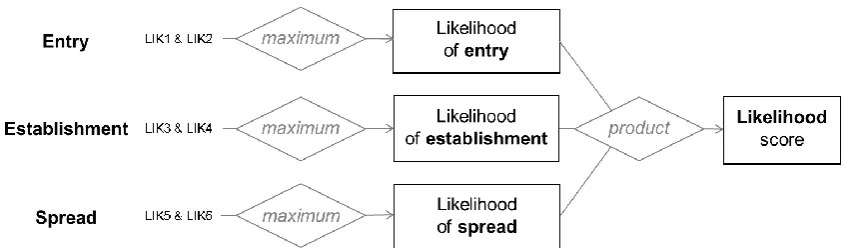
Figure 2 illustrates how to calculate a final Likelihood score from the answers
11
Figure 2 The calculation of a final likelihood score from the likelihood questions LIK1-LIK6. The likelihood descriptions to extract a Risk score for the Risk assessment in Table 3 can then be found in Table 2.
Table 2: Transcription of Likelihood scores into descriptions for the Risk score in Table 3. The Likelihood score is calculated as in Figure 2.
Likelihood score
Likelihood (description)
< 0.000001
Extremely unlikely
0.000001 ≤ p < 0.0027
Very unlikely
0.0027 ≤ p < 0.027
Unlikely
0.027 ≤ p < 0.5
Fairly probable
p ≥ 0.5
Probable
LIK1 Likelihood of entry via unaided primary pathways
If the Taxon is present in the Area (see BAC10), the probability of entry should be set as 1. Still fill in this section as if the Taxon was not present and give details on pathways, as this can inform risk management and the feasibility to stop future immigration. However for the calculations, use the probability of 1.
Estimate the probability that the Taxon enters the Area from outside the Area through unaided pathways within the timespan of a decade. Consider the unaided pathways mentioned under BAC14. Features of the Taxon which favour unaided entry include presence in neighbouring countries and regions, water or wind dispersed propagules (e.g. floating propagules), the ability to fly long distances, the ability for fish to move from one river catchment where introduced, to another via connected waterways. Animal dispersal is also considered here, except domestic and farm animals which are included under LIK2. The following factors can aid entry via animals: edible parts (e.g. fruits) which are eaten by animals, propagules with spines/barbs/sticky substances which can attach to animals, very small propagules which can get stuck in fur and feathers, pests attached to plants or animals. List the pathways and corresponding likelihoods in the comments section. In the response, give the highest likelihood for any pathway. The assessment should be based on the likelihood of entry based on current and future pathways.
Response options:
Extremely unlikely (p = 0.000001): the Taxon and its propagules are highly sessile and are known never to disperse on its own – proof is required for inability to move, otherwise classify as “Very unlikely”.
Very unlikely (p = 0.0027): the Taxon and its propagules are sessile and do not usually disperse on their own
Unlikely (p = 0.027): the Taxon is sessile, but it can disperse during one specific life stage, dispersal capabilities are slow and short distance
12
Probable (p = 1): highly mobile Taxon with dispersal capability fast and over large distances Don’t know (p = 1): no information is available on the unaided pathways available to the Taxon
LIK2 Likelihood of entry via human aided primary pathways
If the Taxon is present in the Area (see BAC10), the probability of entry should be set as 1. Still fill in this section as if the Taxon was not present and give details on pathways, as this can inform risk management and the feasibility to stop future immigration. However for the calculations, use the probability of 1.
Estimate the probability that the Taxon enters the Area from outside the Area through the pathways mentioned under BAC14 which are human mediated (as opposed to unaided, which are covered in LIK1) within the timespan of a decade. List the pathways and corresponding likelihoods in the
comments section. This also includes entry from neighbouring countries (consider it could in future be introduced into neighbouring countries). In the response, give the highest likelihood for any pathway. The assessment should be based on the likelihood of introductions based on current and future pathways. For taxa which are already present in the Area, mainly focus on unintentional pathways.
Response options:
Extremely unlikely (p = 0.000001): There is currently no human aided entry pathway available/in use for the Taxon, and no future pathway is expected to arise
Very unlikely (p = 0.0027): There is currently a human aided entry pathway available/in use, but the Taxon is highly sensitive to movement and is unlikely to arrive alive at any life stage
Unlikely (p = 0.027): There is a human aided entry pathway available/in use which is infrequently used, and/or future new pathways are expected to arise; also, the Taxon is not expected to arrive in high numbers
Fairly probable (p = 0.5): Several human aided entry pathways are available/in use but not regularly used, and/or some potentially lead to a high number of introductions
Probable (p = 1): Several human aided entry pathways available and regularly used for the Taxon, and high numbers of individuals expected.
Don’t know (p = 1): no information is available on the human aided pathways used by the Taxon
LIK3 Habitat suitability
Indicate the likelihood of the Taxon to find suitable habitats in the Area for survival and reproduction. Habitat includes the presence of suitable food items, hosts, pollinators, seed dispersers, and other biotic conditions. If the Area encompasses multiple habitats, consider those that are most likely suited and mention in the comments section which habitats were assessed. Thus also take the habitat specificity of the Taxon into account. Artificial habitats include for example (with increasing degree of artificiality) gardens, zoos, greenhouses, indoor habitats.
Response options:
Extremely unlikely (p=< 0.000001): the Taxon is extremely specialised and there is no suitable habitat in the Area, none of the key conditions for the Taxon’s survival are met
Very unlikely (p = 0.0027): the Taxon is highly specialised, but there is reason to assume that it might adapt to some biotic habitat conditions; only highly artificial habitats which are rare or difficult to maintain are suitable.
Unlikely (p = 0.027): the Area provides habitat that is only partly suitable to the Taxon; certain artificial habitats are suitable
Fairly probable (p = 0.5): the key conditions are met, but only in a marginal part of the Area; also non-artificial habitats suitable.
Probable (p = 1): all key biotic habitat conditions are met in a large part of the Area. Don’t know (p = 1): no information is available on habitat requirements of the Taxon
LIK4 Climate suitability
Indicate the likelihood of the Taxon to find suitable climate in the Area for survival and reproduction. Use the native and alien ranges as references for the Taxon’s distribution, as obtained in BAC7 and BAC8. As a minimal standard, use published maps of climate zones to check whether the climate in the Area is suitable for the Taxon. Such maps include the following:
- Koeppen-Geiger climate zones, updated by Peel et al. (2007)
13
Climate models are more desirable and lead to a higher confidence in the assessment. If the Area encompasses multiple climate zones, consider those that are most likely suited and mention in the comments section which climatic zones were assessed. For species already present in the Area, the answer cannot be “extremely unlikely”.
Response options:
Extremely unlikely (p = 0.000001): The Area provides no suitable climate (including artificially created environments)
Very unlikely (p = 0.0027): The Area provides no suitable climate, but suitable climate can be artificially created in small (<5%) parts of the Area.
Unlikely (p = 0.027): The Area provides little (<5%) climatic overlap with the known distribution of the Taxon, excluding artificially created suitable habitats.
Fairly probable (p = 0.5): The main climatic requirements are met in a marginal (>5% but <20% - one fifth) part of the Area.
Probable (p = 1): The main climatic requirements are met in a larger part (>20%) of the Area. Don’t know (p = 1): no information is available on the climatic requirements of the Taxon
LIK5 Unaided secondary (dispersal) pathways
This includes the unaided pathways currently or potentially bringing the Taxon from the occupied regions to elsewhere within the Area. It excludes unaided pathways bringing propagules from areas outside of the Area into the Area (covered in LIK1). Indicate the probability that the Taxon disperses naturally from a population within the Area to currently unoccupied regions and habitats. Mention details of the expected dispersal pathways and mechanisms in the comments section. More precisely, try to estimate the probability that the Taxon can disperse > 50 km in a decade. Features of the Taxon which favour unaided dispersal include water or wind dispersed propagules (e.g. floating propagules), the ability to fly long distances, the ability for fish to move from one river catchment where introduced, to another via connected waterways. Animal dispersal is also considered here, except domestic and farm animals which are included under LIK6. The following factors can aid dispersal by animals: edible parts (e.g. fruits) which are eaten by animals, propagules with spines/barbs/sticky substances which can attach to animals, very small propagules which can get stuck in fur and feathers, pests attached to plants or animals.
Response options:
Extremely unlikely (p = 0.000001): the Taxon and its propagules are highly sessile and are known never to disperse on their own – proof is required for inability to move, otherwise classify as “Very unlikely”.
Very unlikely (p = 0.0027): the Taxon and its propagules are sessile and do not usually disperse on their own
Unlikely (p = 0.027): the Taxon is sessile, but it can disperse during one specific life stage, dispersal capabilities are slow and short distance (< 50km in 10 years)
Fairly probable (p = 0.5): the Taxon is mobile and can reach a high dispersal capability during one of its life stages
Probable (p = 1): highly mobile Taxon with dispersal capability fast and over large distances Don’t know (p = 1): no information is available on unaided dispersal pathways used by the Taxon
LIK6 Human aided secondary (dispersal) pathways
This includes the human aided pathways currently or potentially bringing the Taxon from the occupied regions and habitats elsewhere within the Area. This question does not include dispersal from outside of the Area to the Area as this is covered in LIK2. Indicate the probability that the Taxon gets
dispersed from a population within the Area to uninvaded habitats. Intentional and unintentional pathways need to be considered. Mention details of the expected pathways in the comments section. The likelihood score relates to the proximity of the Taxon to human and domestic/farm animals and frequency of contact, which allows it to be dispersed in these kinds of dispersal pathways, as well as traits and features of the Taxon which facilitate for it to be moved around.
More precisely, try to estimate the probability that human-mediated dispersal takes (propagules of) the Taxon > 50 km in a decade.
14
ornamental plants and be transported unnoticed. Dispersal by domestic and farm animals is included here.
Response options:
Extremely unlikely (p = 0.000001): the Taxon is not present in places accessible by humans, domestic and/or farm animals
Very unlikely (p = 0.0027): the Taxon is only present in places humans, domestic and/or farm animals can reach with difficulty, and/or has no features which make it likely to be dispersed human aided
Unlikely (p = 0.027): the Taxon is present in places where humans, domestic and/or farm animals occasionally occur, and/or has features which make it possible to be dispersed human aided, but only exceptional cases
Fairly probable (p = 0.5): the Taxon is present in places easily accessible by humans and/or it or its propagules are easily moved, i.e. it possesses some feature mentioned above
Probable (p = 1): the Taxon is present in a place frequented by humans, and it or its propagules are easily and regularly moved due to features mentioned above
Don’t know (p = 1): no information is available on the human aided pathways used by the Taxon
3) Consequences
In this section, all evidence of impacts in the global alien range (including the
Area
)
available for the
Taxon
needs to be collated and scored for environmental impacts
and socio-economic impacts. Data on the impacts of the
Taxon
itself from the
Area
or other alien regions are the most desirable (IMP1a)-k) and IMP2a)-f)). Only if no
data are available on the
Taxon
in any alien range globally should it be classified as
Data Deficient (DD) under IMP1 and IMP2.
If this is the case, i.e. no data are available for the Taxon on impacts anywhere in its
global alien range, look for data of congeners or other closely related species with
similar life history traits and fill in IMP3 and IMP4.
Additionally consider data in the native range of the
Taxon
, and/or estimate the
magnitude of impact possible for the
Taxon
in the
Area
based on biological,
ecological and behavioural traits in IMP5. This needs to be filled in regardless of
whether information on IMP1 and IMP2 is available, but can lead to similar results if
the impact of the
Taxon
has been well studied.
The environmental impact (IMP1) is based on the Environmental Impact
Classification of Alien Taxa (EICAT) system by Blackburn
et al.
(2014), Hawkins
et
al.
(2015), and the socio-economic rating (IMP2) based partly on the Generic Impact
Scoring System (GISS) by
Kumschick
et al.
(2015) and Nentwig
et al.
(2016).
Due to the lack of comprehensive impact studies for most species in many regions,
the assessment of consequences includes information on impact available from the
literature in the
Area
and other alien ranges of the
Taxon
(IMP1 and IMP2).
Additionally, if no data is available on impact for the
Taxon
, information of closely
related species is included (IMP3 and IMP4). These measures (IMP1-4 respectively)
give the currently recorded evidence of impact. For a measure of future potential and
currently unrecorded impact of the
Taxon
in the
Area
, IMP5 includes considerations
on the
Taxon
’s traits, behaviour and ecology and considers impacts recorded in the
native range.
15
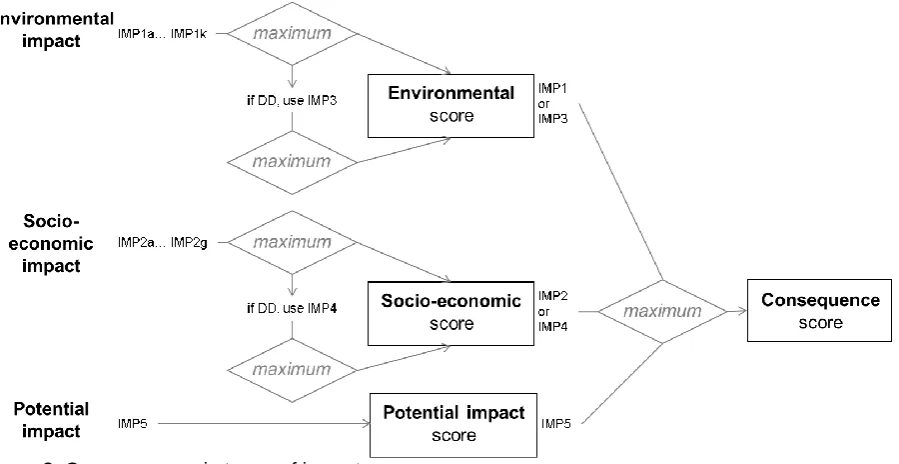
the maximum impact level should be taken between all the impact measures
(IMP1-5). This impact level is then used to calculate the risk score as described in Table 3.
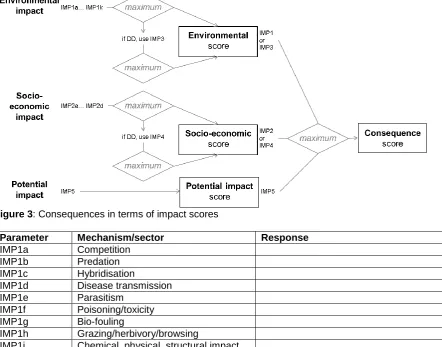
Figure 3: Consequences in terms of impact scores
IMP1 Environmental impact
The consequence assessment is based on the Environmental Impact Classification of Alien Taxa (EICAT) scheme. EICAT classifies taxa into minimal concern (MC), minor (MN), moderate (MO), major (MR), massive (MV) according to the magnitude of impact they cause. Detailed descriptions of all the impact levels are given in IMP1a)-IMP1k) below.
Fill in the Answer sheet for each of the mechanisms as described below (IMP1a-IMP1k). Then use the scheme provided in Figure 3 to calculate the environmental impact score (IMP1), which is basically the maximum of all the mechanisms. Report on the maximum impact found in any of the mechanisms for the global alien range in the Response for IMP1, and the main mechanism affected in the Rationale, but provide information on all the sectors and impact scores in IMP1a)-IMP1k),
including detailed information on the references used for the assessments. If impact assessments have been conducted previously for the Taxon and are available in the literature, information can be extracted from there and no detailed search is needed.
16
IMP1a Competition
What is the evidence in the global alien range of the Taxon for impact through competition? Does the Taxon compete with native taxa for resources (e.g. food, water, space), leading to deleterious impact on native taxa somewhere in its global alien range?
Classify the Taxon in an impact level according to the descriptions below. If no data is available, the Response is Data Deficient (DD).
Massive (MV) Major (MR) Moderate (MO) Minor (MN) Minimal Concern (MC)
Competition resulting in replacement or local extinction of one or several native species; changes in community composition are irreversible
Competition resulting in local or population
extinction of at least one native species, leading to changes in community composition, but changes are reversible when the alien taxon is removed
Competition resulting in a decline of
population size of at least one native species, but no changes in community composition
Competition affects fitness (e.g., growth, reproduction, defence,
immunocompetence) of native individuals without decline of their populations
Negligible level of competition with native species; reduction of fitness of native
individuals is not detectable
IMP1b Predation
This consists of the Taxon preying on native taxa somewhere in its global alien range, and includes direct and indirect effects (e.g. via mesopredator release), leading to deleterious impact on native taxa.
Classify the Taxon in an impact level according to the descriptions below. If no data is available, the Response is Data Deficient (DD).
Massive (MV) Major (MR) Moderate (MO) Minor (MN) Minimal Concern (MC)
Predators directly or indirectly (e.g., via mesopredator release) resulting in replacement or local extinction of one or several native species (i.e., species vanish from communities at sites where they occurred before the alien arrived); changes in community composition are irreversible
Predators directly or indirectly (e.g., via mesopredator release) resulting in local or population extinction of at least one native species, leading to changes in community composition, but changes are reversible when the alien taxon is removed
Predators directly or indirectly (e.g., via mesopredator release) resulting in a decline of population size of at least one native species but no changes in community composition
Predators directly or indirectly (e.g., via mesopredator release) affecting fitness (e.g., growth, reproduction) of native individuals without decline of their populations
17
IMP1c Hybridisation
The Taxon hybridises with native species somewhere in its global alien range, leading to deleterious impact on native species.
Classify the Taxon in an impact level according to the descriptions below. If no data is available, the Response is Data Deficient (DD).
Massive (MV) Major (MR) Moderate (MO) Minor (MN) Minimal Concern (MC)
Hybridisation between the alien taxon and native species is common in the wild; hybrids are fully vigorous and fertile; pure native species cannot be recovered by removing the alien, resulting in replacement or local extinction of native species by introgressive hybridisation (genomic extinction)
Hybridisation between the alien taxon and native species is common in the wild; F1 hybrids are vigorous and fertile, however offspring of F1 hybrids are weak and sterile (hybrid breakdown), thus limited gene flow between alien and natives; individuals of the alien taxon and hybrids discernible from pure natives, pure native populations can be recovered by removing the alien and hybrids.
Hybridisation between the alien taxon and native species is regularly observed in the wild; hybrids are vigorous, but sterile (reduced hybrid fertility),limited gene flow between alien and natives, local decline of
populations of pure native species, but pure native species persists
Hybridisation between the alien taxon and native species is observed in the wild, but rare; hybrids are weak and never reach maturity (reduced hybrid viability), no decline of pure native populations
No hybridisation between the alien taxon and native species observed in the wild (prezygotic barriers),
hybridisation with a native species might be possible in captivity
IMP1d Transmission of disease
The Taxon transmits diseases to native species somewhere in its global alien range, leading to deleterious impact on native species.
Classify the Taxon in an impact level according to the descriptions below. If no data is available, the Response is Data Deficient (DD).
Massive (MV) Major (MR) Moderate (MO) Minor (MN) Minimal Concern (MC)
Transmission of diseases to native species resulting in replacement or local extinction of native species (i.e., species vanish from communities at sites where they occurred before the alien arrived); changes in community composition are irreversible Transmission of diseases to native species resulting in local or population extinction of at least one native species, leading to changes in community composition, but changes are reversible when the alien taxon is removed
Transmission of diseases to native species resulting in a decline of population size of at least one native species, but no changes in community composition
Transmission of diseases to native species affects fitness (e.g., growth, reproduction, defence,
immunocompetence) of native individuals without decline of their populations
18
IMP1e Parasitism
The Taxon parasitizes native species somewhere in its global alien range, leading directly or indirectly (e.g. through apparent competition) to deleterious impact on natives.
Classify the Taxon in an impact level according to the descriptions below. If no data is available, the Response is Data Deficient (DD).
Massive (MV) Major (MR) Moderate (MO) Minor (MN) Minimal Concern (MC)
Parasites or pathogens directly or indirectly (e.g., apparent competition) resulting in replacement or local extinction of one or several native species (i.e., species vanish from communities at sites where they occurred before the alien arrived); changes in community composition are irreversible Parasites or pathogens directly or indirectly (e.g., apparent competition) resulting in local or population
extinction of at least one native species, leading to changes in community composition, but changes are reversible when the alien taxon is removed
Parasites or pathogens directly or indirectly (e.g., apparent competition) resulting in a decline of
population size of at least one native species but no changes in community composition
Parasites or pathogens directly or indirectly (e.g., apparent
competition) affecting fitness (e.g., growth, reproduction, defence,
immunocompetence) of native individuals without decline of their populations
Negligible level of parasitism or disease incidence (pathogens) on native species, reduction of fitness of native
individuals is not detectable
IMP1f Poisoning/toxicity
The Taxon is toxic, or allergenic by ingestion somewhere in its global alien range, inhalation or contact to wildlife, or allelopathic to plants, leading to deleterious impact on native species.
Classify the Taxon in an impact level according to the descriptions below. If no data is available, the Response is Data Deficient (DD).
Massive (MV) Major (MR) Moderate (MO) Minor (MN) Minimal Concern (MC)
The alien taxon is toxic/allergenic by ingestion, inhalation, or contact to wildlife or allelopathic to plants, resulting in replacement or local extinction of native species; changes in community composition are irreversible
The alien taxon is toxic/allergenic by ingestion, inhalation, or contact to wildlife or allelopathic to plants, resulting in local or population extinction of at least one native species (i.e., species vanish from communities at sites where they occurred before the alien arrived), leading to changes in community composition, but changes are reversible when the alien taxon is removed
The alien taxon is toxic/allergenic by ingestion, inhalation, or contact to wildlife or allelopathic to plants, resulting in a decline of
population size of at least one native species, but no changes in community composition (native species richness)
The alien taxon is toxic/allergenic by ingestion, inhalation, or contact to wildlife or allelopathic to plants, affects fitness (e.g., growth, reproduction, defence,
immunocompetence) of native individuals without decline of their populations
The alien taxon is not
19
IMP1g Bio-fouling
The accumulation of individuals of the Taxon on wetted surfaces leads to deleterious impact on native species somewhere in its global alien range.
Classify the Taxon in an impact level according to the descriptions below. If no data is available, the Response is Data Deficient (DD).
Massive (MV) Major (MR) Moderate (MO) Minor (MN) Minimal Concern (MC)
Bio-fouling resulting in replacement or local extinction of one or several native species (i.e., species vanish from communities at sites where they occurred before the alien arrived); changes in community composition are irreversible Bio-fouling resulting in local or
population
extinction of at least one native species, leading to changes in community composition, but changes are reversible when the alien taxon is removed
Bio-fouling resulting in a decline of population size of at least one native species, but no changes in community composition
Bio-fouling affects fitness (e.g., growth, reproduction, defence,
immunocompetence) of native individuals without decline of their populations
Negligible level of bio-fouling on native species; reduction of fitness of native
individuals is not detectable
IMP1h Grazing/herbivory/browsing
Grazing, herbivory or browsing by the Taxon leads to deleterious impact on native plant species somewhere in its global alien range.
Classify the Taxon in an impact level according to the descriptions below. If no data is available, the Response is Data Deficient (DD).
Massive (MV) Major (MR) Moderate (MO) Minor (MN) Minimal Concern (MC)
Herbivory resulting in replacement or local extinction of one or several native plant species (i.e., species vanish from communities at sites where they occurred before the alien arrived); changes in community composition are irreversible Herbivory resulting in local or population
extinction of at least one native plant species, leading to changes in community composition, but changes are reversible when the alien taxon is removed
Herbivory resulting in a decline of population size of at least one native species, but no changes in community composition
Herbivory affects fitness (e.g., growth, reproduction, defence,
immunocompetence ) of individual native plants without decline of their populations
20
IMP1i Chemical, physical or structural impact on ecosystem
The Taxon causes changes to either: the chemical, physical, and/or structural biotope characteristics of the native environment; nutrient and/or water cycling; disturbance regimes; or natural succession, leading to deleterious impact on native species somewhere in the Taxon’s global alien range. Classify the Taxon in an impact level according to the descriptions below. If no data is available, the Response is Data Deficient (DD).
Massive (MV) Major (MR) Moderate (MO) Minor (MN) Minimal Concern (MC)
Many changes in chemical, physical, and/or structural biotope
characteristics; or changes in nutrient and water cycling; or disturbance regimes; or changes in natural succession, resulting in replacement or local extinction of native species (i.e., species vanish from communities at sites where they occurred before the alien arrived); changes (abiotic and biotic) are irreversible Changes in chemical, physical, and/or structural biotope characteristics; or changes in nutrient cycling; or disturbance regimes; or changes in natural succession, resulting in local extinction of at least one native species, leading to changes in community composition, but changes are reversible when the alien taxon is removed Changes in chemical, physical, and/or structural biotope characteristics; or changes in nutrient cycling; or disturbance regimes; or changes in natural succession, resulting in a decline of
population size of at least one native species, but no changes in community composition Changes in chemical, physical, and/or structural biotope characteristics; or changes in nutrient cycling; or disturbance regimes; or changes in natural
succession detectable, affecting fitness (e.g., growth, reproduction, defence,
immunocompetence ) of native
individuals without decline of their populations
No changes in chemical, physical, and/or structural biotope
21
IMP1k Interaction with other alien species
The Taxon interacts with other alien taxa, (e.g., through pollination, seed dispersal, habitat
modification), facilitating deleterious impact on native species somewhere in its global alien range. These interactions may be included under other impact mechanisms (e.g., predation, apparent competition) but would not have resulted in the particular level of impact without an interaction with other alien species.
Classify the Taxon in an impact level according to the descriptions below. If no data is available, the Response is Data Deficient (DD).
Massive (MV) Major (MR) Moderate (MO) Minor (MN) Minimal Concern (MC)
Interaction of an alien taxon with other aliens (e.g., pollination, seed dispersal, habitat modification) facilitates
replacement or local extinction of one or several native species (i.e., species vanish from communities at sites where they occurred before the alien arrived), and produces
irreversible changes in community composition that would not have occurred in the absence of the species. These interactions may be included under other impact categories (e.g., predation, apparent competition) but would not have resulted in the particular level of impact without an interaction with other alien taxa.
Interaction of an alien taxon with other aliens (e.g., pollination, seed dispersal, habitat modification) facilitates local or population
extinction of at least one native species, and produces changes in community composition that are reversible but would not have occurred in the absence of the species. These interactions may be included under other impact categories (e.g., predation, apparent competition) but would not have resulted in the particular level of impact without an interaction with other alien taxa.
Interaction of an alien taxon with other aliens (e.g., pollination, seed dispersal, habitat modification) facilitates a decline of population size of at least one native species, but no changes in community composition; changes would not have occurred in the absence of the species. These interactions may be included under other impact categories (e.g., predation, apparent competition) but would not have resulted in the particular level of impact without an interaction with other alien taxa.
Interaction of an alien taxon with other aliens (e.g., pollination, seed dispersal) affects fitness (e.g., growth, reproduction, defence,
immunocompetence ) of native species’ individuals without decline of their populations; changes would not have occurred in the absence of the species. These interactions may be included under other impact categories (e.g., predation, apparent competition) but would not have resulted in the particular level of impact without an interaction with other alien taxa.
22
IMP2 Socio-economic impact
Assess the socio-economic impact of the Taxon in its global alien range (i.e. everywhere it has been introduced outside of its native range). Perform a generic impact scoring on the Taxon as described in IMP2a) to IMP2g) below. This concerns impacts on the following sectors:
(a) agriculture (b) animal production (c) mariculture/aquaculture (d) forestry
(e) infrastructure (f) human health (g) human social life
Fill in the Answer sheet for each of the sectors (IMP2a-IMP2g), and use Figure 3 to calculate the main socio-economic impact score. Report on the maximum impact found in any of the sectors and any alien range in the Response to IMP2, and the main sector affected in the Rationale, but provide information on all the sectors and impact scores in IMP2a)-2g), including detailed information on the references used for the assessments.
If no data on impact are available for the Taxon in any part of its alien range globally on any of the sectors described below, mark the Taxon as Data Deficient (DD) here and additionally fill in IMP4.
IMP2a Impacts on agricultural production
This concerns impacts through damage to crops or plantations, but also to horticultural and stored products. Impacts include competition with weeds, direct feeding damage (from feeding traces which reduce marketability to complete production loss) but also reduced accessibility, usability or
marketability through contamination. Impacts include the need for applying pesticides which involve additional costs, also by reducing market quality. Impacts usually lead to an economic loss.
Classify the Taxon in an impact level according to the descriptions below. If no data is available, the Response is Data Deficient (DD).
Massive (MV) Major (MR) Moderate (MO) Minor (MN) Minimal Concern (MC)
Major impacts with complete
destruction and economic loss.
Major impacts with high damage, often occurring or with high probability, major economic loss. Medium impacts, large-scale or frequently, pesticide application necessary, medium economic loss.
Minor impacts, in the range of native species, but more wide-spread, minor economic loss.
Minor impacts, in the range of native species, only locally, negligible economic loss.
IMP2b Impacts on animal production
Impacts through competition with livestock, transmission of diseases or parasites to livestock and predation of livestock. Intoxication of livestock through changes in food palatability, secondary plant compounds or toxins, weakening or injuring livestock, e.g. by stinging or biting. Also impacts on livestock environment such as pollution by droppings on farmland which domestic stock are then reluctant to graze. Hybridization with livestock. Impacts include the need for applying pesticides which involve additional costs, also by reducing market quality. Impacts usually lead to an economic loss. Classify the Taxon in an impact level according to the descriptions below. If no data is available, the Response is Data Deficient (DD).
Massive (MV) Major (MR) Moderate (MO) Minor (MN) Minimal Concern (MC)
Major impacts with complete
destruction and economic loss.
Major impacts with high damage, often occurring or with high probability, major economic loss. Medium impacts, large-scale or frequently, pesticide application necessary, medium economic loss.
Minor impacts, in the range of native species, but more wide-spread, minor economic loss.
23
IMP2c Impacts on mariculture/aquaculture
Impacts through competition with taxa in mariculture/aquaculture, transmission of diseases or parasites to taxa in mariculture/aquaculture and predation of cultured taxa. Also impacts on culture environment such as pollution by droppings in water. Hybridization with cultured taxa. Impacts include reduction in market quality. Impacts usually lead to an economic loss.
Classify the Taxon in an impact level according to the descriptions below. If no data is available, the Response is Data Deficient (DD).
Massive (MV) Major (MR) Moderate (MO) Minor (MN) Minimal Concern (MC)
Major impacts with complete
destruction and economic loss.
Major impacts with high damage, often occurring or with high probability, major economic loss. Medium impacts, large-scale or frequently, pesticide application necessary, medium economic loss.
Minor impacts, in the range of native species, but more wide-spread, minor economic loss.
Minor impacts, in the range of native species, only locally, negligible economic loss.
IMP2d Impacts on forestry production
Impacts on forests or forest products through plant competition, parasitism, diseases, herbivory, effects on tree or forest growth and on seed dispersal. Impacts may affect forest regeneration through browsing on young trees, bark gnawing or stripping and antler rubbing. Damage includes felling trees, defoliating them for nesting material or causing floods. Impacts include the need for applying
pesticides which involve additional costs, also by reducing market quality. Impacts usually lead to an economic loss.
Classify the Taxon in an impact level according to the descriptions below. If no data is available, the Response is Data Deficient (DD).
Massive (MV) Major (MR) Moderate (MO) Minor (MN) Minimal Concern (MC)
Major impacts with complete
destruction and economic loss.
Major impacts with high damage, often occurring or with high probability, major economic loss. Medium impacts, large-scale or frequently, pesticide application necessary, medium economic loss.
Minor impacts, in the range of native species, but more wide-spread, minor economic loss.
Minor impacts, in the range of native species, only locally, negligible economic loss.
IMP2e Impacts on human infrastructure and administration
Impacts include damage to human infrastructure, such as roads and other traffic infrastructure, buildings, damps, docks, fences, electricity cables (e.g. by gnawing or nesting on them) or through pollution (e.g. by droppings). Impacts through root growth, plant cover in open water bodies or digging activities on watersides, roadside embankments and buildings may affect flood defence systems, traffic infrastructure or stability of buildings. Impacts may affect human safety and cause traffic accidents. Impacts include the need for applying pesticides, their development costs and further registration or administration costs, as well as costs for research and control. Impacts usually lead to an economic loss.
Classify the Taxon in an impact level according to the descriptions below. If no data is available, the Response is Data Deficient (DD).
Massive (MV) Major (MR) Moderate (MO) Minor (MN) Minimal Concern (MC)
Major impacts with complete
destruction and economic loss.
Major impacts with high damage, often occurring or with high probability, major economic loss. Medium impacts, large-scale or frequently, pesticide application necessary, medium economic loss.
Minor impacts, in the range of native species, but more wide-spread, minor economic loss.
24
IMP2f Impacts on human health
Injuries (e.g. bites, stings, scratches, rashes), transmission of diseases and parasites to humans, bioaccumulation of noxious substances, health hazard due to contamination with pathogens or parasites (e.g. of water, soil, food, or by faeces or droppings), as well as secondary plant compounds, toxins or allergen substances such as pollen. Impacts include the need for applying pesticides which due to their low selectivity and/or residues may have side-effects on humans. Via health costs, impacts usually lead to economic costs.
Classify the Taxon in an impact level according to the descriptions below. If no data is available, the Response is Data Deficient (DD).
Massive (MV) Major (MR) Moderate (MO) Minor (MN) Minimal Concern (MC)
Major impacts, fatal issues, high economic costs.
Major impacts with high damage, often occurring or with high probability, but rarely fatal, major economic costs. Medium impacts, large-scale or frequently, pesticide application necessary, medium economic loss.
Minor impacts, in the range of native species, but more wide-spread, minor economic loss.
Minor impacts, in the range of native species, only locally, negligible economic loss.
IMP2g Impacts on human social life
Noise disturbance, pollution of recreational areas (water bodies, rural parks, golf courses or city parks), including fouling, eutrophication, damage by trampling and overgrazing, restrictions in accessibility (e.g. by thorns, other injuring structures, successional processes, or recent pesticide application) to habitats or landscapes of recreational value. Restrictions or loss of recreational activities.
Classify the Taxon in an impact level according to the descriptions below. If no data is available, the Response is Data Deficient (DD).
Massive (MV) Major (MR) Moderate (MO) Minor (MN) Minimal Concern (MC)
Major impacts with complete
destruction and loss of recreational value, major economic loss.
Major impacts with high damage, often occurring or with high probability, recreational value of a location strongly affected, major economic loss. Medium impacts, large-scale or frequently, pesticide application necessary, medium economic loss.
Minor impacts, in the range of native species, but more wide-spread, minor economic loss.
Minor impacts, in the range of native species, only locally, negligible economic loss.
IMP3 Closely related taxons’ environmental impact
This section is only considered if the Response is Data Deficient (DD) in IMP1.
Consider here data of congeners or other closely related taxa with similar life history traits and their environmental impacts in their global alien range. In detail, perform a classification of impacts as described in IMP1a-IMP1k for closely related and similar taxa. Note which taxa was/were considered in the Rationale, and report on the details of the different impact mechanisms on the Answer sheet. In the Response to IMP3, note the maximum impact found in any mechanism.
IMP4 Closely related taxons’ socio-economic impact
This section is only considered if the Response is Data Deficient (DD) in IMP2.