829 | P a g e
128 BIT MODIFIED CARRY SELECT ADDER USING
BINARY TO EXCESS-ONE CONVERTER
M.Srinivasaperumal
1, S.Pavithra
2,
V.S.Kavya Lekshmi
3, K.MohammedArshad
41,2,3,4 Dept. of ECE , SNS College of Technology
Coimbatore,( India)
ABSTRACT
Design of power-efficient and high-speed data path logic systems are one of the most substantial areas of research in VLSI system design in many data-processing processors Carry Select Adder (CSLA) is one a fastest adders used to perform arithmetic functions. The upcoming technologies depicts that there is a scope for reducing the area and power consumption in the CSLA. To significantly reduce the area and power of the CSLA this work uses a simple gate level modification . Based on this modification CSLA architecture have been developed and can be compared with the regular CSLA architecture. However,the regular CSLA is not area efficient because it uses multiple pairs of Ripple Carry Adders (RCA) to generate partial sum and carry by considering carry input, then the final sum and carry are selected by the multiplexers (mux). The basic idea of this work is to use Binary to Excess-1 Converter (BEC) instead of RCA in the regular CSLA to achieve high speed and low power consumption. The results analysis shows that the proposed CSLA structure is better than the regular CSLA.
Keywords: Carry Select Adder (CSLA),Ripple Carry Adders (RCA), VHDL Modelling & Simulation.
I. INTRODUCTION
In the main area of research in VLSI system design, area and power reduction in data path logic systems
play a major role. .For high performance processors and systems High-speed additionand multiplication
havealways been a fundamental requirement.The speed of addition in digital adders is limited by the time needed
to propagate a carry through the adder. Only after the preceding bit position has been summed and a carry
propagated into the next position the sum for each bit position in an elementary adder is generated
sequentially.The production of carries has become the major speed limitingfactor in any adder. And also many
authors have considered the addition problem. The CSLA is used in many computational systems to
moderate the problem of carry propagation delay to generate the sum. by independently generating many
carries and then select a carry . However, the CSLA is not area efficient as it uses multiple pairs of Ripple
Carry Adders (RCA) to generate partial sum and carry by considering carry input and then the final sum
and carry are selected by the multiplexers (mux). Inorder to runover above problem, the basic idea of the
proposed work is by using n-bit binary to excess-1 code converters (BEC) to advance the speed of addition. This
830 | P a g e
the regular CSLA to acquire lower area and power consumption. The lesser number of logic gates than the FullAdder (FA) structure is the main advantage ofBEC.
II. LITERARYREVIEW
This model depicts a 16 bit modified carry select adder shows reduction in area coverage and power consumption
when compared to regular carry select adder with increase in delay. The reduced number of gates in the work
offers the reduction of area and the total power. 16 bit area efficient CSLA is designed which provides 32%
reduction in area when compared with R-CSLA and 12.5% reduction in area when compared with M-CSLA. If
the number of bits has been further increased a great reduction in area and power consumption can be expected
[1].
The Carry Select is one of the fastest adders used in many data processing processors to perform fast arithmetic
functions [2]. The modified square root carry select adder has been developed by making some changes in gate
level by downsizing the field and power diminution. The modified SQRT CSLA has slightly larger delay. The
area and power of 64 bit modified SQRT CSLA are reduced by 17.4% and 15.4% respectively.
The distinguished results shows that the power delay product and also the area delay product of the contemplated
design show a decrease for all sizes which testifies the success of the method and not the mere trade-off of delay
for power and area [3].
III.FUNDAMENTAL ADDER BLOCK
Ripple Carry Adder (RCA) shows the compresseddesign but their estimation time is prolonged. Carry
Look-Ahead Adder (CLA) is used in time critical applications to derive fast results but it leads to increase in
area. But the carry select adder provides a compromise or bridgeway between the small areas but longer
delay of RCA and large area with small delay of Carry Look Ahead adder.
Ripple Carry Adder consists of cascaded “N” single bit full adders. Output carry of previous or preceding adder
becomes the input carry of next or succeeding full adder. Therefore, the carry of this adder traverses longest
path called worst case delay path through N stages. Fig. 1 shows the block diagram of Ripple carry adder. The
delay of the adder increases with the value of Nin a linear way. RCA in spite of having an advantage of covering
least area, it has the lowest speed amongst all the adders because of large propagation delay. Now CSLA
postulates aadvanced way to get around this linear dependency that is to assume all possible values of input carry
i.e. 0 and 1 and figure out the result in prior.Result can be selected using the multiplexer stage once the original
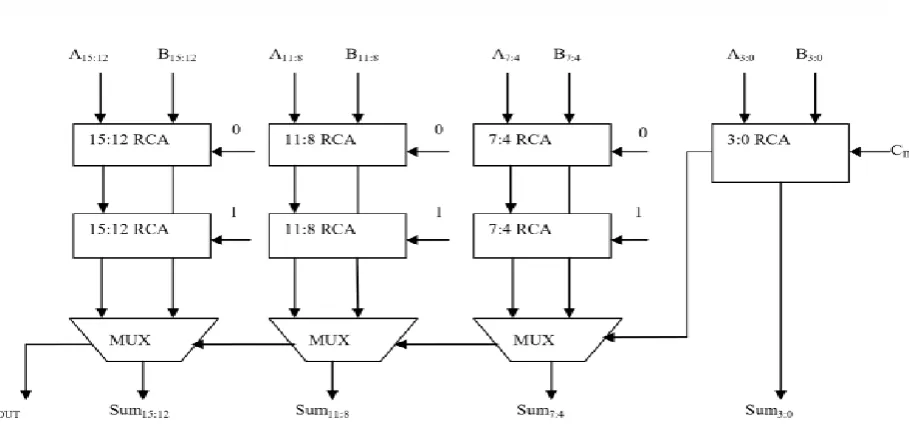
value of carry is known. To develop the partial sum and carry by overbearing input carry Cin=0 and Cin=1,the
standard CSLA makes use of dual RCA’s then the multiplexers select the final sum and carry.
831 | P a g e
IV. BEC
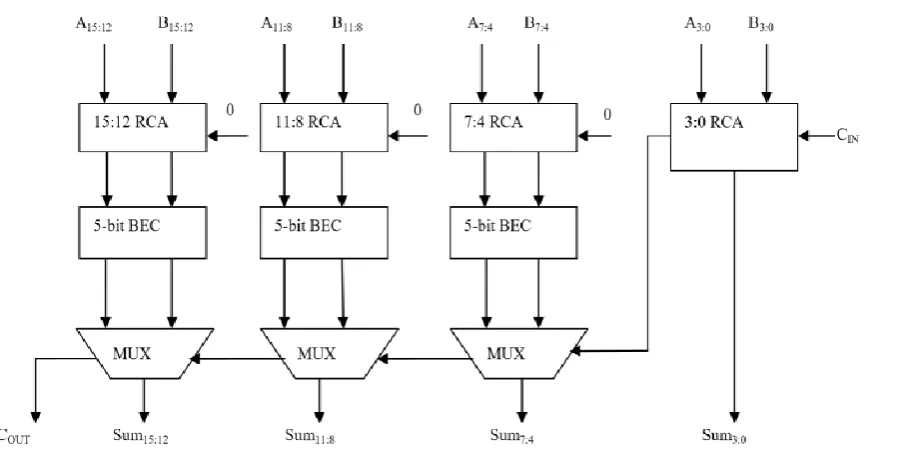
The key action of the CSLA is accessed by using the 4-bit BEC along with the multiplexer. One input of the 8:4
multiplexer gets as it input (B3, B2, B1, and B0) and another input of the multiplexer is the BEC output [1]. This
produces the two possible sectional results in parallel and according to the control signal Cin, the multiplexer is
used to select either the BEC output or the direct inputs. The importance of the BEC logic stems from the large
silicon area reduction when the CSLA with large number of bits are designed. The Boolean expressions of the
4-bit BEC is listed as (note the functional symbols NOT, & AND, XOR) X0 = ~B0 X1 = B0 ^ B1 X2 = B2 ^ (B0
& B1) X3 = B3 ^ (B0 & B1 & B2) The basic idea of this work is to use Binary to Excess- 1 converter (BEC)
instead of RCA with Cin=1 in conventional CSLA BEC uses less number of logic gates than N-bit full
adder structure inorder to optimise area and power. N-bit RCA is replaced by N+1 bit BEC .Therefore,
Modified CSLA has low power and less area than conventional CSLA. CSLA has been picked for correlation
with modified design using BEC as it has more stabilised delay, less area and low power. In order toreduce the
delay, area and power, the design is modified by using BEC instead of RCA with Cin=1. Further also, the
parameters like delay, area and power can be lessened.
Fig.2. 4-b BEC
832 | P a g e
Fig. 3 4-bit BEC with 8:4 muxV. ARCHITECTURE OF 16BIT MODIFIED LINEAR CARRY SELECT ADDER
This modified linear CSLA has 3 blocks namely RCA, BEC and MUX .Each block does different operations.
For example, RCA does the addition operation which delivers the carry separately. The main advantage is that it
eliminates the propagation delay which generally occurs in the regular CSLA. The main composition of BEC is
AND(&), NOT(~) and XOR (^).The use of BEC in the CSLA resulted in better area efficiency. On the other
hand, it is also utilised to reduce the propagation delay that occurs in the conventional CSLA. In the 16 bit
modified linear CSLA, BEC has been used to obtain better power efficiency. The ripple carry adder generally
consists of full adders. In this design, a 4 bit ripple carry adder containing four full adders is used. Full adder
does the general operation of adding the binary numbers and giving out the carry along with the sum.
833 | P a g e
Fig. 5 16-bit conventional carry select adderVI. ARCHITECTURE OF 128-BIT CSLA
A 16-bit carry select adder(CSLA) can be refined in two different sizes namely uniform block size and variable
block size. The number of bits required for BEC logic is 1 bit, similarly a 32, 64 and 128-bit can also be
developed in two modes of different block sizes. Ripple-carry adders are the thick and most compressed full
adders, but their performance is circumscribed by a carry that should broadcast from the least significant bit to
the most-significant bit. The various CSLA can also be developed by using ripple carry adders.
The significance of the BEC logic stems from the large silicon area subjection when the CSLA with large
number of bits are designed. The Boolean expressions of the 8-bit BEC is listed improved up to 40% to
90%, by performing the additions in parallel, and reducing the maximum carry delay. The design of the 128-b
regular CSLA is shown in Fig. 6. It has five groups of RCA. The delay and area interpretation of each group are
shown in Fig. 3, in which the numerals with in specify the delay values, e.g., sum2 requires 10 gate delays.
834 | P a g e
VII. MODIFIED ARCHITECTURE OF 128-BIT LINEAR CSLA
In this design, some of the RCA blocks are replaced with the BEC, that leads to reduced area and propagation
delay .The propagation delay and area count of the modified linear CSLA for a range of bits are compared and
analysed. The results are clearly demonstrated.Low power, less delay and reduced area than all the other adder
structures. It is also slightly faster than all the other adders. In this way, the transistor enumeration of proposed
CSLA is reduced having reduced area and low power which makes it elementary and efficient for VLSI
hardware utilisation.
Fig.7 Modified architecture of 128 bit
835 | P a g e
VIII. SIMULATION RESULTS
The design scheduled in this paper has been developed using Verilog-HDL and synthesised in Xilinx
ISE. The simulation result for the above itemized 128 bit modified linear carry select adder is depicted using
Xilinx software. The simulated files are trucked in to the synthesised tool and the corresponding values of delay
and area are noted.
IX. CONCLUSION AND FUTURE WORK
This work presents a Efficient Architecture of modified linear Carry Select Adder simple approach to reduce
the area, delay Design by Common Booleanand power of CSLA architecture.The conventional carry select
adder has the disadvantage of more power consumption and occupying more chip area. The proposed CSLA
using common Boolean logic has low power, less delay. The reduced number of gate of this work offers the great
advantage in the optimisation of area and total power. By increasing the number of bits,the great shrinkage in the
area and power can be scheduled.
REFERENCES
[1] AkhileshTyagi, “A Reduced Area Scheme for Carry-Select Adders”, IEEE International Conference on
Computer design, pp.255-258, Sept 1990
[2] BehnamAmelifard, FarzanFallah and MassoudPedram, “Closing the gap between Carry Select Adder and
Ripple Carry Adder: a new class of low-power high-performance adders”, Sixth International Symposium
on Quality of Electronic Design, pp.148-152. April 2005.
[3] B.Ramkumar, Harish M Kittur and P.MaheshKannan, “ASIC implementation of Modified Faster Carry Save
Adder”, European Journal of Scientific Research, vol.42, pp.53-58, 2010
836 | P a g e
[5] KuldeepRawat, TarekDarwish. andMagdyBayoumi, “A low power and reduced area Carry Select Adder”,45th Midwest Symposium on Circuits and Systems, vol.1, pp. 467-470,March 2002.
[6] M.Moris Mano, “Digital Design”, Pearson Education, 3rd edition, 2002.
[7] O. J. Bedrij, “Carry-Select Adder”, IRE transactions on Electronics Computers, vol.EC-11, pp. 340-346,
June1962.
[8] Youngjoon Kim and Lee-Sup Kim, “64-bit carry-select adder with reduced area”, Electronics Letters, vol.37,
issue 10, pp.614-615, May 2001.
[9]. T.-Y. Chang and M.-J. Hsiao,“Carry-Select Adder using single Ripple-Carry Adder”, Electronics letters,
vol.34, pp.2101-2103, October 1998.
[10] Youngjoon Kim and Lee-Sup Kim, “A low power carry select adder with reduced area”, IEEE International