1707 |
P a g e
An Objective of Service Level Agreement (SLA) in Cloud
Computing Environment
Er. Preetpal Kaur
(Assistant Professor)
(Computer Science, Guru Nanak National College(Co-Ed),Nakodar,Punjab)
ABSTRACT
Cloud computing is an internet based computing, providing the on demand services through the internet such as servers, storage disk, different platforms and applications to any business level company or organization with universal independence. The online user select the services according to their requirements and pay according the use. So, there should be some agreement which depicts the reliability of the provided services and customer relationship management features to succeed the working environment of the cloud environment. A service-level agreement (SLA) is a contract between a service provider and its internal or external customers. In this agreement documents, the provider will mentioned the services and defines the performance standards which the provider is obligated to meet. This can be a legally binding formal or an informal "contract" .The agreement may involve separate organizations, or different teams within one organization. SLA is an agreement defines the services contents that will be offered to the customer within the specified timeline. Basically, SLA achieved its goal by accessing different components and aspects. Customer, service and multilevel based levels are the backbone of SLA which purposely offered services to maintain the agreement between customer and an organization. On the other hand, unique stages of SLA performs the step by step level to offered services and maintains its components. As well as different metrics are also the part of SLA body to measure the complexity, cost and satisfaction of the customer regarding the services mentioned in SLA document.
Keywords- IAAS(Infrastructure as a service), PAAS(Platform as a service), QOS(Quality of
service). SAAS(Software as a service), SLM(Service level Management),
I. INTRODUCTION
1708 |
P a g e
level agreement(SLA) companies are confident that help is only a phone call away. So, need to access SLA to access cloud services from cloud service provider because it is effective, the process is faster and the IT cost is lower. The risk of business failure or productivity losses is transferred from customer’s business to SLA service provider with fixed cost solutions. Basically, a service-level agreement is an agreement between two or more parties, where one is the customer and the others are service providers.The transparency, customer service and convenience of giving credits on the part of the cloud service provider are important in customer and service provider relationship.SLA is also known as service level adherence .The service provider providing the service and the company that’s receiving the services about what the uptime numbers will look like. While uptime is an important number having it written into service level agreement.
This paper which is based on the structure of SLA shows how SLA deals between dealer and customer with its different levels. Supporting different stages of SLA lifecycle will be discussed which can be easily emphasis on the use and power of SLA. Different metrics will also be discussed which can be calculate the different measurement tools. Finally, benefits will also be discussed which will show the importance and need of SLA.
1.1.Types of SLAs
The SLA tool can be used as a tool to measure the efficiency, effectiveness of the service delivery and also used as a tool for continues improvement of the services offered to the customer. To understand thoroughly, we need to first understand two main types of SLA.There are following two types of SLA are:
1.1.1 Off-the-shelf SLAs:This type of SLA can find this on their website. They offer credits toward the monthly bill for SLA violations. These are non-negotiable and usually unacceptable to enterprises wanting to host critical services on the cloud.
1.1.2. Negotiable SLAs: These are more expensive because they are customized for the client.
1.2 Parameters of SLA
SLAs are also very popular among internal departments in larger organizations. For example, the use of a SLA by an IT helpdesk with other departments (the customer) allows their performance to be defined and benchmarked. So, it must have the following parameters:
Reliability must be there in SLA. when the service is available (percentage uptime) and the limits outages can be expected to stay within
SLA must be Responsiveness in all aspect of agreement. Such as the punctuality of services to be performed in response to requests and scheduled service dates.
There must be a procedure for reporting problems such as who can be contacted, how problems will be reported, procedure for escalation, and what other steps are taken to resolve the problem efficiently
1709 |
P a g e
List of services the provider offered to the user along with a definition of each service. Easy to understand metrics to evaluate if the provider is delivering the services at the promised level. Mechanism to monitor the services.
II. ASPECTS AND REQUIREMENTS OF SLA
SLA statements written must be measurable, achievable, relevant and timely and should remain specific for cloud services aimed at minimizing ambiguities for both the cloud consumer and the cloud service providers.There are various consideration that must be specified within an SLA. Some of the key elements that help make a compact SLA are described below:
2.1 Service Availability: Percentage of time the service is guaranteed to be available. The SLA document must have information about the service uptime. The promise time considered to be 99.5% or higher. The service will be always available and update information should be available for the users according the user’s requirement.Following are the few areas that need careful perusing:
Specify how the provider will inform you about the uptime. Ideally, it should be for each billing period which is usually monthly.
Specify the minimum outage duration to qualify as downtime. For example, 5 minute,10 minutes,20 minutes or more. These must be specified in the SLAs.
Some cloud providers average their SLA downtime over the entire year. That means your service could be down for longer period in some weeks.
2.2 Data Locations: The SLAs must specify the data locations. Many countries prohibit personal data of citizens to be stored outside the border. For example, there are regulations that force sensitive data such as healthcare and finance, to be located within certain geographical boundaries. The SLAs must specify the locations and data centers where your information will reside. The user should have the right to visit and audit the attributes of the data center such as physical and network security, Disaster Recovery strategies, maintenance processes, electrical and cooling redundancy etc.
2.3 Downtime Credits: The provider may put a cap on the percentage of a customer’ s bill that can be reduced for downtime credits. The credits are usually meager and less than the hard and soft losses such as lost sales opportunity, goodwill, brand image, productivity.
1710 |
P a g e
2.5 Data Encryption for security: SLA must specify if the data at rest and in-motion will be encrypted or not. Details of encryption procedure and access policies must be specified.2.6 Set the maintenance period scheduled: The SLA must specify if the services will be available during scheduled maintenance periods. If yes, the SLA uptime during the maintenance windows should be specified along with the information about replication and business continuity planning(BCP) work during scheduled maintenance or when the primary data copy is down.
2.7 Read Hidden Cost: Read the hidden costs. User SLA may have a clause that if a reported problem is found to be due to the consumer’s fault, the consumer can be billed for the time and material used to investigate the issues. In such a case, there might be no upper limit on the bill amount or any statement on how to decide if the reported problem is due to a consumer’s fault.
2.8 Floating Terms: SLA are paper document signed by both parties, however, they may refer to policies and terms that are published on a website. The cloud provider may not be required to inform customers of changing to the terms. However, they must specify what can or cannot be changed and the new terms should be applicable to all the customers. They must inform the customers before the change. The SLA must have an easy exit clause, if the new terms are unacceptable. The consumer should be aware of the local laws where the data center and the cloud provider are located. If law enforcement agencies seize the cloud provider’s equipment or the cloud provider goes bankrupt, they should give enough notice to the consumer to save or migrate data to another cloud ’ s provider.
III. THREE LEVELS OF SLA
Service level agreements are also defined at different levels:
Figure1: levels of SLA
1711 |
P a g e
organization for the services such as finance system, payroll system, billing system, procurement/purchase system, etc.3.2 Service-based SLA: An agreement for all customers using the services being delivered by the service provider. For example: A mobile service provider offers a routine service to all the customers and offers certain maintenance as a part of an offer with the universal charging. Another example as an email system for the entire organization. There are chances of difficulties arising in this type of SLA as level of the services being offered may vary for different customers (for example, head office staff may use high-speed LAN connections while local offices may have to use a lower speed leased line).
3.3 Multilevel SLA: The SLA is split into the different levels, each addressing different set of customers for the same services, in the same SLA.
3.3.1 Corporate-level SLA: Covering all the generic service level management (often abbreviated as SLM) issues appropriate to every customer throughout the organization. These issues are likely to be less volatile and so updates (SLA reviews) are less frequently required.
3.3.2 Customer-level SLA: covering all SLM issues relevant to the particular customer group, regardless of the services being used.
3.3.3 Service-level SLA: covering all SLM issue relevant to the specific services, in relation to this specific customer group.
IV. COMPONENTS OF SLA
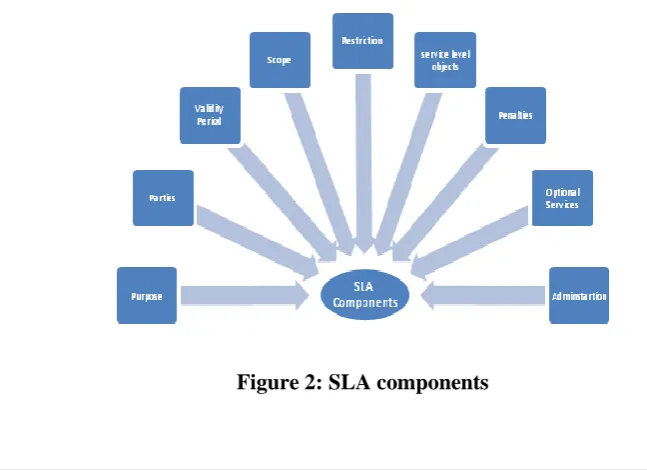
An SLA defines the delivery ability of a provider, the performance target of consumers‟ requirement, the scope of guaranteed availability, and the measurement and reporting mechanisms .An ideal SLA has the following components shown in the Fig 2.
1712 |
P a g e
Purpose – mentions why SLA is formed. Parties – mentions the parties included in the SLA and their jobs.
Validity Period- states the time period covered by the SLA. This is defined by both the start time and the final time of the period.
Scope – describes the services mentioned in the SLA; SLA structure should illustrate the service so that the consumer can simply recognize the services procedure.
Restrictions – states the essential steps to be done in order to supply the required service levels.
Service-level objectives – the service levels that are approved by the customer and the providers. It contains a group of service level indicators such as; availability, performance, and reliability. Each part of the service level, like availability will have a target level to complete. Service Level objectives have day-time restrictions related to them to describe their validity.
Penalties – describes what is to be done when the provider cannot achieve the goals in the SLA. If the SLA is taken with an external provider, there should be a choice of concluding the contract.
Optional services – services that are not ordinarily needed by the customer, but might be needed as exclusion. Administration – defines the procedures formed in the SLA to achieve and measure its goals.
V. SLA LIFE CYCLE
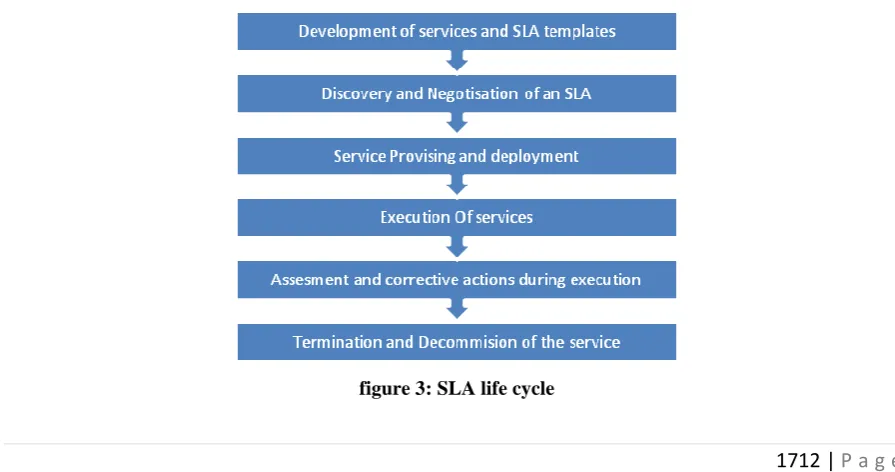
SLA has six main stages to be completed. These stages are as follows; development of both service and SLA templates, discovery and negotiation of an SLA, service provisioning and deployment, execution of the service, assessment and corrective actions during execution, and both termination and decommission of the Service. The different stages are shown in the following figure:
1713 |
P a g e
5. 1. Development of Service and SLA Templates
This stage includes the identification of customer requirements and needs, the network capabilities, the identification of the suitable service features and parameters, service’s levels, service execution environment, and the implementation of the standard of SLA templates.
5.2. Negotiation of an SLA
In this stage, the negotiation of an SLA with the consumer to select the values of SLA parameters related to specific services, the costs of selected services, the costs incurred by the service provider when the SLA is violated, the definition and at last periodicity of the reports associated with service to be delivered to the service customer. The negotiation is making between the service provider and consumer about to reduce the cost, or set the package about more than one service etc. Suppose, the customer just want online application services with its automatic update then the cost negotiable can be initiated from customers with cloud service provider in SLA. In SLA document, the sections like duration of convention, payment, time of reply, risk management criteria etc are also mentioned. When the SLA form is set, cloud users can look at the SLA conditions and react by signing the SLA, compromising again or ending the compromise. As there are four various kinds of cloud services, a cloud user could sign a convention with four various agents (IaaS agent, PaaS agent, and SaaS) which obtain the job of stating SLA parameters and finish the compromise procedure. This kind of compromise can be good if the cloud user needs more than one kind of cloud service.
5.3. Service Provisioning and Deployment
This stage include the service’s resource provisioning, where the service is enabled and prepared for the service shopper consumption, configuration of the network which might be to achieve specific requirements in the service, or to support the service network overall, and service activation. Service provisioning and deployment stage may need the reconfiguration of the service resources to support the execution stage which will lead to a successful achievement of the SLA parameters.
5.4. Execution of the Service
This stage is the actual test of the service. It consists of three main phases , The first is service execution and monitoring, Then the real time of reporting and at last the validation of QOS which refers to the quality of service. The final phase of this stage is SLA violation processing
5.5. Assessment and Corrective Actions during Execution
1714 |
P a g e
SLA. Overall service assessment for major activities are readjusting of service goals, service operations modifying, defining the support problems of the service, and finally establishing different service levels.5.6. Termination and Decommission Of the Service
Termination and Decommission of the Service stage in charge with the termination of the service. This termination may be a result of different reasons; it might be an issue in the contract, expiration, or violation. The decommissioning of discontinued services can cause termination to the SLA.
VI. SERVICE-LEVEL AGREEMENT METRICS FOR SAAS ,PAAS SAAS CLIENTS
The cloud service models (IaaS, PaaS, SaaS, etc.) offer new paradigms of computing resources and IT enabled capabilities for all types of organizations. so need to have legal relationship between consumer and service provider for long term and reliable relationship. SLAs will ensure the consumer receives all the services availed as agreed by the provider and of course ensure money’s worth for the client. There are various metrics levels for service models in SLA document.
6.1 SLA Metrics for IaaS
Firms such as amazon.com supply infrastructure as a service. Many clients don not know clearly which significant parameter must be declared in the hardware side of the SLA. The study mentioned the mainly significant parameters for clients who are concerned in utilizing cloud as an infrastructure service as shown in the following table:
Parameter Description
CPU capacity CPU speed for VM (Virtual Machine) CPU capacity CPU speed for VM (Virtual Machine)
Memory size Cash memory size for VM
Boot time Time for MV to be ready for use
Storage Storage size of data for short or long term of contract
Response time Time to complete and receive the process
Auto scaling Boolean value for auto scaling feature
1715 |
P a g e
6.2. SLA Metrics for PaaS
In platform as a service case, developers who exploit PaaS do not need to install instruments or organize hardware to do the developing jobs. For SLA metrics associated to PaaS, the study illustrates the key parameters that can be utilized as an essential principle when developers wish for compromising with PaaS suppliers as shown in Table.
Parameter Description
Integration Integration with e-services and other
platforms.
Scalability Degree of use with a large number of
online user.
Pay as you go billing Charging based on resources or time
of service.
Environments of deployment Supporting offline and cloud systems
Browsers Firefox, Explorer, etc.
Table2: Parameter list of PaaS
6.3. SLA Metrics for SaaS
Superior examples of SaaS are mail, calendar and social web sites supplied by Google, Yahoo and Microsoft.
The study shows the familiar metrics and parameters for SaaS as an illustration of metrics for this kind of cloud service as shown in Table3.
Parameter Description
Reliability Ability to keep operating in most cases
Usability Easy built-in user interfaces
Scalability Used with individual or large organizations
Availability Uptime of software for users in specific time
1716 |
P a g e
VII. CONCLUSION
SLA shows an essential consideration of trust between the customers and service provider of cloud computing
marketplace. To use the cloud service it must be a clear view between both.. It is crucial that the consumer of
cloud services fully understand all the terms of the provider's SLA, and that the consumer consider the needs of
their organization before signing any agreement. SLA must be full of benefits list as Enhanced relationship between the parties, customer acceptance level, Enhanced Service Quality as well as offers the services according to the customer’s requirements. From the performance point of view, service must be accomplished on time as when a customer has a deal or contract for the service provider, then the provider translates and determines the response time depending on its requirements. After that, the service provider gets service resources from the infrastructure during whole duration of contract. QOS is the major tool of SLA publicity of any cloud computing organization with positive reliability and fault tolerance factor which can make strong knot between customer and service provider.
REFERENCES
[1]1.http://www.chinacloud.cn/upload/2011-07/11073107539898.pdf 2.https://arpitapatel.files.wordpress.com/2014/10/cloud-computing-bible1.pdf [2]3. http://ijniet.org/wp-content/uploads/2015/08/12.pdf
[3]4. http://www.ijcce.org/papers/225-W0004.pdf
[4]5.https://archives.opennebula.org/_media/community:open_challenges_in_cloud_computing.pdf [5]6.https://pdfs.semanticscholar.org/8ad9/ bab2356b6f397 645d2dd4b2c7ae35485cd13.pdf [6]7.https://apprenda.com/library/glossary/definition-cloud-middleware/
[7]8.http://citeseerx.ist.psu.edu/viewdoc/download?doi=10.1.1.747.810&rep=rep1&type=pdf [8]9. http://www.cloudbus.org/reports/SLA-UtilityComputing2010.pdf