882 | P a g e
Control of a Double -Effect Evaporator using Neural
Network Model Predictive Controller
1
Srinivas B.,
2Anil kumar K.,
3*Prabhaker Reddy Ginuga
1,2,3
Chemical Eng. Dept, University College of Technology, Osmania University Hyderabad( India)
ABSTRACT
The dynamic models describing Multiple Effect Evaporator are nonlinear ODE’s and it makes the
performance of conventional PID controller deteriorates. Present work is about the Advanced controller i.e.,
The Neural network based model predictive controller are designed to control the concentration of the Double
Effect Evaporator. The simulation study has been done using MATLAB & SIMULINK. The overshoot value and
settling time are used to evaluate the performance of advanced control strategy. The simulation results show
that the Neural networks Model predictive controller has a superior performance than conventional PID
controller.
Keywords - Dynamic model, Evaporator, MATLAB Simulation, NN predictive controller, and
Superior performance.
I INTRODUCTION
Evaporation is a process of removing water or other liquids from a solution and thereby concentrating it. The
time required for concentrating a solution can be shortened by exposing the solution to a greater surface area
which in turn would result in a longer residence time or by heating the solution to a higher temperature. But
exposing the solution to higher temperatures and increasing the residence time results in the thermal degradation
of many solutions, so in order to minimize this, the temperature as well as the residence time has to be
minimized. This need has resulted in the development of many different types of evaporators.
The multiple effect evaporation system is formed a sequence of single effect evaporators, where the vapour
formed in one effect is used in the next effect. The vapour reuse in the multiple effect system allows reduction
of the salt and the temperature to low values and prevents rejection of large amount of energy to the
surrounding, which was the main drawback of the single effect system. In addition to the desalination industry,
the main bulk of the multiple effect evaporation processes is found in the food, pulp and paper, petroleum, and
petrochemical industries.
H. Andre. and R.A. Ritter, (2003) presented the study work on the modelling and control of an industrial
multiple-effect evaporator system used for black liquor recovery. They developed model with combination of
phenomenological and empirical (neural networks) approaches, based on industrial data. An advanced
model-predictive control strategy, allowing for manipulated variable constraints, compares favourably with a classical
883 | P a g e
C. H. Runyon,. et al., (2010) presented the nonlinear dynamic behaviour of a double effect evaporator system.
The governing equations are solved using Advanced Continuous Simulation Language (ACSL). Simulations are
performed for a commercial double effect tomato paste evaporator using two possible control configurations.
Experimental measurements are obtained for a commercial double fleet evaporator. Simulation results of
product solids concentration are compared with experimental measurements in response to varying feed solids
concentration.
Dwi Argo Bambang, et al (2013) presented a novel technique to improve the performance of
Proportional+Integral+Differential (PID) control to reduce the speed of the steam flow rate and search optimal
points in the evaporation process of Multiple Effect Evaporator (MEE).
J.C. Atuonwu et al., (2009) presented a recurrent neural network-based nonlinear model predictive control
(NMPC) scheme in parallel with PI control loops. It is developed for a simulation model of an industrial-scale
five-stage evaporator. Input-output data from system identification experiments are used in training the network
using the Levenberg-Marquardt algorithm. The same optimization algorithm is used in predictive control of the
plant. The scheme is tested with set-point tracking and disturbance rejection problems on the plant, while
control performance is compared with that of PI controllers, a simplified mechanistic model-based NMPC
developed in previous work and a linear model predictive controller (LMPC). Results show significant
improvements in control performance by the new parallel NMPC-PI control scheme.
Praveen Yadav, Amiya K Jana(2010) presenteda detailed study on a commercial double-effect tomato paste
evaporation system. The modeling equations formulated for process simulation belong to backward feeding
arrangement.
In the present work, the design and evaluation of neural networks based predictive controller has been done for
multiple-effect (i.e., double effect) evaporator system.
II MODELING OF THE DOUBLE EFFECT EVAPORATOR SYSTEM
The assumptions involved in the formulation of model are listed as : i) Negligible heat losses to the
surroundings, ii) Constant liquid holdup and negligible vapour holdups iii)Total temperature around the system
is constant and iv)No boiling point elevation of the solution.
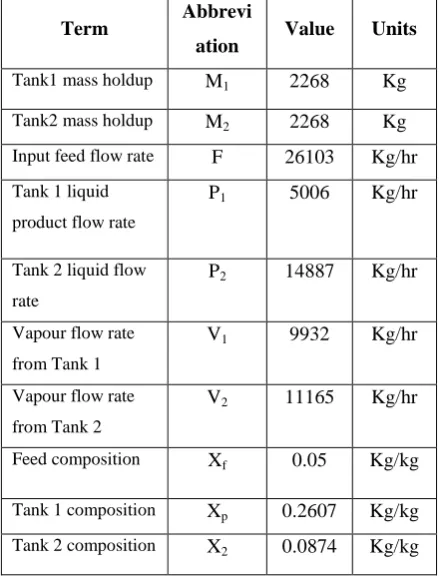
The double-effect evaporator system is shown in Figure 1. The two effects are numbered from left to right as
Tank1 and Tank 2, the raw feed having flow rate F, concentration Xf, enters Tank 2.The mass hold ups in the
tanks are M1 and M2 . V1and V2 are vapour flow rates from the overhead of two Tanks. P1and P2 are the
product flow rates from the two effects with product concentrations, as Xp and X2.
The unsteady- state solid component balance equations for two tank evaporator system is written as,
(1)
884 | P a g e
Figure 1. Double Effect evaporator process
Table 1 Operating conditions of Double Effect Evaporator
Term Abbrevi
ation Value Units
Tank1 mass holdup M1 2268 Kg
Tank2 mass holdup M2 2268 Kg
Input feed flow rate F 26103 Kg/hr
Tank 1 liquid
product flow rate
P1 5006 Kg/hr
Tank 2 liquid flow
rate
P2 14887 Kg/hr
Vapour flow rate
from Tank 1
V1 9932 Kg/hr
Vapour flow rate
from Tank 2
V2 11165 Kg/hr
Feed composition Xf 0.05 Kg/kg
Tank 1 composition Xp 0.2607 Kg/kg
Tank 2 composition X2 0.0874 Kg/kg
885 | P a g e
III DESIGN OF A NEURAL NETWORKS MODEL PREDICTIVE CONTROLLER
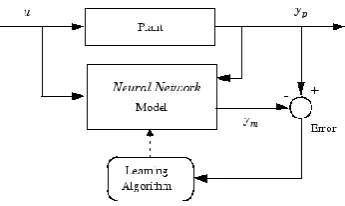
There are typically two steps involved when using neural networks for control: 1. System identification 2.
Controller design. In the system identification stage, develop a neural network model of the plant that needs to
be controlled. In the controller design stage, use the neural network plant model to design (or train) the
controller.
The model predictive control method is based on the receding horizon technique. The neural network model
predicts the plant response over a specified time horizon. The predictions are used by a numerical optimization
program to determine the control signal that minimizes the following performance criterion over the specified
horizon
(3)
Where N1, N2, and Nu define the horizons over which the tracking error and the control increments are
evaluated. The u′ variable is the tentative control signal, yr is the desired response ym is the network model
response. ρ value determines the contribution that the sum of the squares of the control increments has on the
performance index.
The neural networks model of double effect evaporator is shown in Figure 2. The neural networks architecture
for training is given in Figure 3 and the optimum number of neurons in hidden layer is obtained as 13. Figure 4
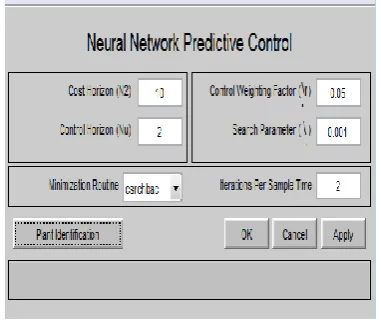
gives the model predictive controller parameters.
.
886 | P a g e
Figure 3. Plant identification of Neural Network model predictive controllerFigure 4. The Neural network model predictive controller
887 | P a g e
Figure 6.. Training error of Neural NetworksThe PRBS data generation plot of double effect evaporator is provided in Figure 5. The training error plots are
given in Figure 6.
IV RESULTS AND DISCUSSION
The
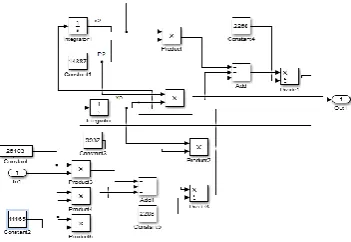
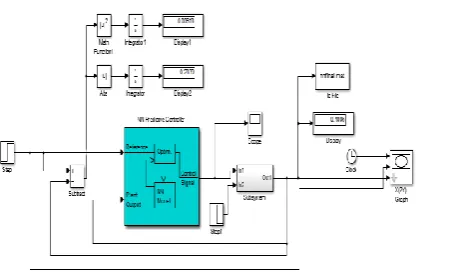
Closed loop Simulation diagrams for PID and NNMPC are given in Figure 5, Figure 6 and Figure 7Figure 7. Closed loop SIMULINK program of PID controller
888 | P a g e
Figure 10. Closed loop SIMULINK program of Neural Network Model predictive Controller
The control objective is to keep the various performance specifications such as rise time, settling time,
maximum overshoot, steady state error, IAE and ISE less within desirable limits.
Servo problem
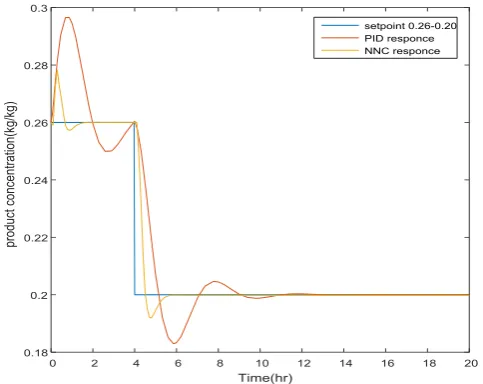
The series of step changes in set point studied are 0.26 to 0.35 &0.26 to 0.20.The closed loop response of
Neural networks Model predictive controllers(NNMPC) and PID controller for above set point changes shown
in Figure 11 and Figure 13. From these results, NNMPC controller is found to be the faster than PID controller.
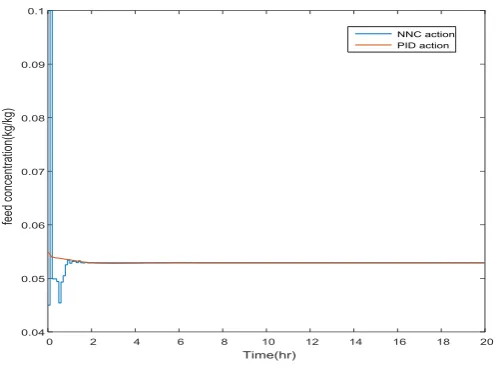
The corresponding actions are plotted in Figure 12 and Figure 14
The PID Controller parameters obtained from the IMC method are
= 0.14,
= 0.38hr and
= 0.09hr
889 | P a g e
Figure 12. Control action of NNMPC and PID controllers for responses shown in Figure 11.
Figure 13. Closed loop response of NNMPC and PID controllers for set point change from 0.26 to 0.20 for product concentration.
Regulatory problem
The regulatory problem is studied by giving the disturbance in the feed flow rate. The step disturbance is given
from 26103 to 28712 kg/hr. The Closed loop response of NNMPC and PID controllers is shown in Figure 14.
The corresponding control actions are plotted in Figure 15. These results shows that Neural Network MPC
Controller is found to be superior to the conventional PID controller for load changes of the MEE with lower
890 | P a g e
Figure 14. Closed loop responses of NNMPC and PID controller s for the load change from 26103 to 28712 kg/hr.
Figure 15. Control action of NNMPC and PID controller for regulatory responses shown in Figure 14
V CONCLUSIONS
Based on simulation results, the following conclusions are made: The closed loop responses of both the
advanced Neural Networks model Predictive controller and conventional PID controller have been compared
for set point changes and in the presence of disturbances. It has been observed that the present Neural
Networks Model Predictive Controller gives lesser overshoot and lower settling time than that of PID
controller. Thus, NNMPC is found to be better than PID controller. However, NNMPC shows oscillatory
891 | P a g e
VI. Acknowledgements
Authors are thankful for Research Support from TEQIP-II at University College of Technology, Osmania
University Hyderabad,
REFERENCES
[1]. H. Andre and R.A. Ritter, Dynamic Response of a Double Effect Evaporator, Can. J. Chem. Eng. 46, 2010, 259–264
[2]. J. C. Atuonwu., Cao. Y, Rangaiah. G.P. and Tadé, M.O. Nonlinear model predictive control of a multistage
evaporator system using recurrent neural networks, Proceedings, IEEE Conference on Industrial Electronics and
Applications, Xian, China, 2009,1662-1667
[3]. Dwi Agro Bambang, Yusuf Hendrawn, Dimas Firmanda Al Rizza,Anung Nugroho Jaya Laksono
Optimization of PID controller parameters on flow rate control system using particle Multiple Effect Evaporator
particle swarm optimization (2013)
[4]. Praveen Yadav and Jana, Amiya K. Simulation and Control of a Commercial Double Effect Evaporator:
Tomato Juice, Chemical Product and Process Modeling: 2010,Vol. 5: Iss. 1, Article 6.
[5]. C.H. Runyon, T.R.Rumsey & K. L. McCarty Dynamic simulation of Nonlinear Model of a Double effect