Abandoned Object Detection Using Back
Tracing Verification
Pavankumar K. Parmar1, Prof. Dr. M. P. Satone2
PG Student [VLSI& Embedded System], Dept. of ECE, K.K.Wagh Institute of Engg. Education & Reasearch,
Nashik, India1
Professor, Dept. of ECE, K.K.Wagh Institute of Engg. Education & Reasearch, Nashik, India2
ABSTRACT: In visual surveillance system, it is very important to analyse each and every thing. This paper describes
and shows the method to detect the abandoned objects using raspberry pi processor coded using Python 3.7 and also helps to avoid the future disasters. The proposed system takes video as input and converts them in to the frames. System does the morphological operations on frames to find the abandoned object and motion of owner of that object. The system has kalman filter and gabor filter for motion and edge detection in the frames. An alarm is fired after detecting the abandoned object to get the attention about that object.
KEYWORDS: Abandoned Object Detection, Raspberry Pi, Python, Morphological Operation, Kalman Filter, Gaber
filter, Visual surveillance system.
I.INTRODUCTION
In the visual surveillance research, detection of abandoned object or luggage is referred to as the problem of left-luggage detection. It is a hard task for public security, particularly for identifying suspicious stationary objects. Because there is no category object type that can be assumed as have been misplaced or abandoned or left, common object detection methods such as training an object detector for a particular category of objects are inappropriate for performing such task. Recent years have seen a stark rise in terrorist attacks on crowded public places such as airports, train stations and subways, nightclubs, shopping malls, markets, etc. Many surveillance tools have been employed in the fight against terror. Although video surveillance systems have been in operation for the past two decades, the analysis of the video footage has seldom ventured out of the hands of human operators. Recent studies [1] have brought into fore the limits to human effectiveness in analysing and processing crowded scenes, particularly in video surveillance systems consisting of multiple cameras. The advent of smart cameras with higher processing capabilities has now made it possible to design systems which can possibly detect suspicious behaviours (in general) and abandoned objects (in particular). A number of algorithms have been suggested in the recent past to deal with the problem of abandoned-object-detection. Due to their dependence on complex probabilistic mathematics, most of these algorithms have failed to perform satisfactorily in real time scenarios. In addition, the other difficulty of detecting an abandoned object under occlusion adds to the overall complexity. Some proposed algorithms have dealt with partial occlusion (by moving people) but complete or prolonged occlusion (by another object) has not yet been tackled. Furthermore, the background subtraction methods employed in the above methods are either computationally intensive or lack dynamically updating features [2][3].
II.SYSTEM APPROCH
A. Block Diagram
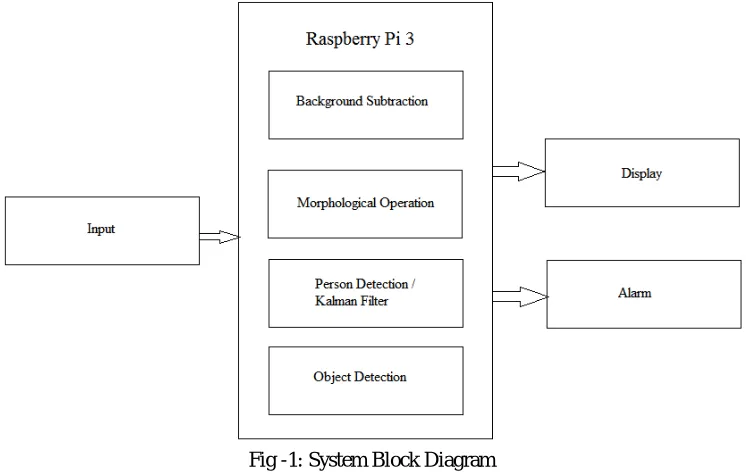
on which we can see the performance or output of project and an speaker is attached which works like an alarm foe the system.
Fig -1: System Block Diagram
The input which is given is in the form of video, which is having “.avi” extension, .avit files are easy o use easy to process and require less space than other standard formats. It is having resolution of 320 x 240p or 640 x 480p. Raspberry Pi processor is the most powerful processor available today in low cost. It is easy to use for various applications. The input which is given to raspberry pi is further processed as per the operations or task defined in it. It does the main processes like background subtraction for getting foreground, then it does morphological operations on frames, frames are nothing but the images converted from video at a particular rate. On those frames operations like erosion, dilation, binarization etc are performed which helps to get the information from the frames which is helpful to extract the features. Kalman filter is implemented using the python coding in he raspberry pi which is needed for the pedestrian or person detection. Object detection is the main purpose of project and it is done by raspberry pi with less complications due to its fast processing speed.
B. Background Segmentation
Numerous background subtraction method is available in the literature survey. The most famous being based on Gaussian mixture models, the first of which was proposed by Friedman and Russell [3] and then modified by several authors [4] to suit their specific requirement. In this system, a new background subtraction technique based on the Approximate Median algorithm is developed. This method is adaptive, dynamic, non-probabilistic and intuitive in nature. Like the majority of other methods [5], we also use pixel colour/intensity information for background processing.
C. Operations
The algorithm to separate background as well as foreground for the incoming image is based on the ‘Approximate Median Model’ [6]. However, our technique requires two reference background images, namely, ‘Current Background’ and ‘Ideal Previous Background’. One of the interesting features of this technique is that both the backgrounds are updated randomly. The first one is updated frequently while the second one updates slowly with a slow rate. The 1st frame which is of the incoming video is initialized or labelled as ‘Current Background’. Subsequently, the intensity of each pixel of this current background is compared with the corresponding pixel of the coming frame after every few seconds. If it is less, then the intensity of that pixel of current background is incremented by 1 unit, otherwise it is decremented by 1 unit. In case of equality, the pixel intensities remain constant. This way, even if the foreground is changing at a fast rate or speed, it will not affect the background but if the foreground is stationary, it gradually mixes with the background. Since we are interested in all those objects which are stationary for a long period of time, we maintain another set of background images called ‘Ideal Previous Background’. Here, all those pixels which do not belong to the prospective abandoned objects information are made equal to that of ‘Current Background’. This is done at an interval of every 30 seconds. Difference of the two backgrounds represents binary image with the white portion representing foreground as a blobs [6].
Morphological image processing is a collection of non-linear operations related to the shape or morphology of features in an image. Morphological operations rely only on the relative ordering of pixel values, not on their numerical values, and therefore are especially suited to the processing of binary images. Morphological operations can also be applied to greyscale images such that their light transfer functions are unknown and therefore their absolute pixel values are of no or minor interest.
Fig -2: Morphological operations
1) Normal Frame 2) Processed using median Filter 3) Resized Image4) Threshold image
D. Tracking
The next process in object detection is tracking the different blobs so as to find which blobs correspond to abandoned objects. The first step in this process is to create a set, Track, whose elements have three variables: blob- Properties, hit-Count and miss-Count. The next step is to analyse the incoming image for all the blobs. If the area change and the centroid position change, as compared to any of the elements of the set Track are below a threshold value, we increment hit-Count and reinitialize miss-count with a zero; otherwise we create a new element in the Track-set, initializing the blob-properties variable with the properties of incoming blob and hit-Count and miss-Count are initialized to zero. We then run a loop through all the elements of the set. If the hit-Count goes above a user defined threshold value, an alarm is triggered. If the miss-Count goes above a threshold, we delete the element from the set. These two steps are repeated until there are no incoming images. Take area, centroid, bounding boxes (b-box) and total number of blobs (n) as input from Blob Analysis block [7].
E. Proposed Approach
Approach is explained in stepwise manner as below;
I. Object Detection with Background Subtraction and Segmentation. II. Assigning Region of Interest i.e.ROI.
III. Using Morphology to eliminate gaps or spaces between pixels of any detected object for more accuracy and smoothens of the object.
IV. Using Kalman and Gabor Filter to detect persons in the frame and relate them with the abandoned object which is detected.
The above steps shows how the system is build to achieve the main moto of the project. In the processor the input is processed using background subtraction and segmentation methods to achive object detection. The video frame which is provided in the system is operated as ROI. Morphological operations are much important to extract the features, comparing the frames, and to reduce the spaces between pixels for more accuracy and to increase the smoothness of images. Kalman filter is used for motion detection of persons, this information is gathered from pre-processing the frames.
III.SYSTEM FLOW
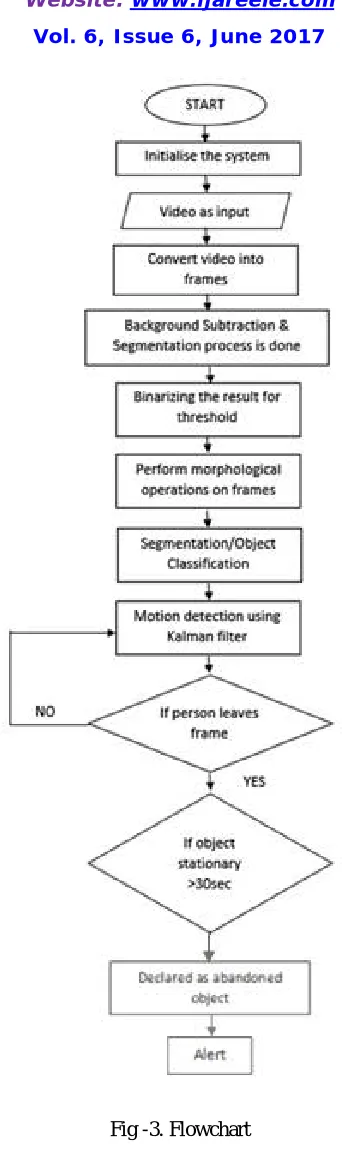
The figure 3 defines the step wise performance of the system, as we can see that after initialization the video which is given to the system as an input is processed and converted into the frames which are important and useful for further processing. The flow is explained in stepwise manner as below;
I. Give video as input.
II. Process the video and conver them in to the frames.
III. For pre-processing step, background subtraction, binarization is done to get threshold value. IV. On frames morphological operations are done to extract the features.
V. Using kalman filter motion detection is done.
VI. Condition is checked by comparing the frames for a person leaving frame. VII. If the object is stationary for a given duration is checked.
IV. RESULT AND DISCUSSION
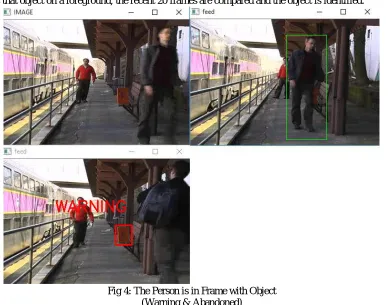
The 1st window shows the normal frame of a video in which the person is moving handling a bag or a particular object, as he places that object on a foreground, the recent 20 frames are compared and the object is identified.
Fig 4: The Person is in Frame with Object (Warning & Abandoned)
In 2nd window that person getting tracked using kalman filter. In 3rd frame the object which is placed is detected and warning message is shown on the screen also that object is highlighted and an alarm is fired to get the attention of security person.
V. CONCLUSION
In the proposed system,the Raspberry pie processor gives us fast and proper processing. As input is provided as Video to the processor it processes the input video with further faster rate and converts that video into number of frames which are then processed using morphological operations and Kalman Filter. All those processed frames are then compared, while comparing those all frames Background and Foreground information is Abstracted and object is detected.
REFERENCES
[1] Y. Tian, R. S. Feris, H. Liu, A. Hampapur, and M.-T. Sun, Robust detection of abandoned and removed objects in complex surveillance videos, IEEE Trans. Syst.,Man, Cybern. C, Appl. Rev., vol. 41, no. 5, pp. 565576, Sep. 2011.
[2] Q. Fan, P. Gabbur, and S. Pankanti, Relative attributes for largescale abandoned object detection, in Proc. IEEE ICCV, pp. 27362743, Dec. 2013.
[4] R. H. Evangelio, T. Senst, and T. Sikora, Detection of static objects for the task of video surveillance, in Proc. IEEE WACV, pp. 534540, Jan. 2011.
[5] P. F. Felzenszwalb, R. B. Girshick, D. McAllester, and D. Ramanan, Object detection with discriminatively trained part-based models, IEEE Trans. Pattern Anal. Mach. Intell., vol. 32, no. 9, pp. 16271645, Sep. 2010.
[6] . L. Li, R. Luo, R. Ma, W. Huang, and K. Leman, Evaluation of an IVS system for abandoned object detection on PETS 2006 datasets, in Proc. IEEE Workshop PETS,pp. 9198, Mar. 2006.