ISSN(Online): 2320-9801
ISSN (Print): 2320-9798
I
nternational
J
ournal of
I
nnovative
R
esearch in
C
omputer
and
C
ommunication
E
ngineering
(An ISO 3297: 2007 Certified Organization)
Vol. 3, Issue 8, August 2015
Optimal Configuration and Emerging
Protocols in Wireless Sensor Network
A.Shobanaashmi1,K.Ranjithsingh2
Research Scholar, Dept. of CS, PGP College of Arts & Science, Namakkal,Tamilnadu, India1
Assistant Professor, Dept. of CS, PGP College of Arts & Science, Namakkal,Tamilnadu, India2
ABSTRACT: Wireless sensor network is emerging field because of its wide applications in various fields and least cost. A wireless sensor network is a group of small sensor nodes which communicate through radio interface. These sensor nodes are composed of sensing, computation, communication and power as four basic working units. But limited energy, communication capability, storage and bandwidth are the main resource constraints. Our survey is based on various aspects of wireless sensor networks. In this paper we also discussed various types of WSNs, their applications and briefly discuss various categories of routing protocols.
KEYWORDS: WSN, Sensor nodes, Applications, Sensor Networks types, Routing Protocols.
I. INTRODUCTION
A wireless sensor network is defined as a collection of a large number of tiny low power, low cost and multi-functional sensor nodes which are randomly and highly distributed either inside the system or very close to it. Sensor nodes which are very small in size consist of a sensing unit, data processing unit, and geographic positioning system, power supply unit such as battery or solar cell and communicating components such as radio systems. The position or location of these tiny sensor nodes need not be absolute and we can get position of the node using GPS; this not only gives random placement but also means that protocols of sensor networks and its algorithms must possess self organizing abilities in inaccessible areas. Distributed or dispersed sensor networks (DSNs) have recently emerged as an important research area. This development has been spurred by advances in sensor technology and computer networking. It is economically feasible to implement DSNs, but there are several technical challenges that must be overcome before DSNs can be used for today’s increasingly complex information gathering tasks.
WSNs have both civilian and military applications include scene reconstruction, environment monitoring, motion tracking and detection, battlefield monitoring, remote sensing, worldwide awareness, etc. They are usually time-critical and cover a large geographical region, and need reliable delivery of correct information for their completion of operation.
TYPES OF WIRELESS SENSOR NETWORKS
According to previously research work done five types of wireless sensor networks are possible depending upon where and how sensors are installed to monitor data. According to these properties of sensor deployment we can classify WSNs into five basic types namely; ground (terrestrial) WSN, underground WSN, aquatic (underwater) WSN, multi-media WSN, and mobile WSNs.
Ground (Terrestrial) WSNs
ISSN(Online): 2320-9801
ISSN (Print): 2320-9798
I
nternational
J
ournal of
I
nnovative
R
esearch in
C
omputer
and
C
ommunication
E
ngineering
(An ISO 3297: 2007 Certified Organization)
Vol. 3, Issue 8, August 2015
again, ground(terrestrial) sensor nodes however can be equipped with a secondary power source such as battery or solar cell. So due to this it is always important for sensor nodes to conserve energy. For a ground(terrestrial) WSN, energy can be conserved with short transmission range, multi-hop routing, eliminating data purity, in-network data aggregation, minimizing delays, and using low duty-cyclic operations.
Underground WSNs
Collection of a number of sensor nodes placed inside crust of earth or in a cave or in a mine and they are used to monitor underground events such as volcanic conditions etc. Extra sink or base station nodes are located above crust of earth to transmit information from the sensor nodes to the sink (base station). These type of WSN are much more expensive than a ground (terrestrial) WSN in terms of deployment, equipment, and maintenance. Underground sensor nodes are more expensive because necessary equipment parts must be selected to ensure reliable communication through rocks, soil, water, and other contents residing inside crust. The internal conditions environment makes wireless communication a challenge due to high levels of attenuation and signal losses.
Unlike ground WSNs, the deployment of an underground WSN requires careful planning and energy and cost considerations. Energy is an important constraint in underground WSNs. Like ground (terrestrial) WSN, underground sensor nodes are equipped with a limited battery power source and once deployed into the crust or ground , it is difficult to recharge or replace a sensor node’s battery.
Aquatic (Underwater) WSNs
It consist of a number of sensor nodes and vehicles deployed inside water. As opposite to ground (terrestrial) WSNs, aquatic (underwater) sensor nodes are more expensive and fewer sensor nodes are deployed in sensing region. Autonomous aquatic (underwater) vehicles are used for exploration or gathering data from sensor nodes. As compared to a dense deployment of sensor nodes in a ground WSN, a sparse deployment of sensor nodes is placed at sea level (underwater). Typical aquatic (underwater) wireless communications are implemented through transmission of acoustic waves.
Multi-media WSNs
Combination of a number of low cost sensor nodes equipped with microphones and cameras. These sensor nodes interconnected with each other over a wireless connection for data sensing, data processing, data correlation, and data compression. Multi-media WSNs are used to enable monitoring and tracking of events in the form of multimedia applications.
Mobile WSNs
Collection of moving sensor with their interaction with sensing environment. Moving sensor nodes have the capacity to sense, compute, and communicate like non-moving nodes. Mobile WSNs are used in military and other industrial applications.
II. SENSOR NETWORK ARCHITECTURE DESIGN
A Wireless sensor network is defined as a network of so many small low cost, disposable, low power devices, called sensor nodes, which are randomly distributed in order to perform their allotted tasks such as weather monitoring, fire sensing etc.
ISSN(Online): 2320-9801
ISSN (Print): 2320-9798
I
nternational
J
ournal of
I
nnovative
R
esearch in
C
omputer
and
C
ommunication
E
ngineering
(An ISO 3297: 2007 Certified Organization)
Vol. 3, Issue 8, August 2015
Fig1. Block diagram of DSN from functionality point of view
The sensor unit contains a sensor and ADC (Analog to Digital Converter). The sensing unit is responsible for sensing data according to ADC commands, and then returning the analog data it senses. ADC is a translator that tells the CPU what the sensor unit has sensed, and also commands the sensor unit what to do. Communication unit is responsible to receive command or query from and transmit the data from CPU to the base station or sink. CPU is responsible for performing data operations such as data removal, data aggregation etc. Power unit supplies power to whole nodes system. Each node may also contain two optional components such as location finding system and mobilizer to find the knowledge of location with high accuracy.
III. WIRELESS SENSOR NETWORKS APPLICATIONS
According to literature survey we can categorize the applications of WSNs into Defence applications, forest applications, medical science applications, Domestic applications, and industrial applications:
Defence applications:
WSNs can be an integral part of defense command, security control, data communications, computation, intelligence, targeting systems such as (C4ISRT), surveillance, reconnaissance etc.
Forest applications:
Some environmental applications of sensor networks include tracking and recording the movements of small animals ,birds and insects, monitoring environmental conditions, earth monitoring and exploration.
Medical Science applications:
ISSN(Online): 2320-9801
ISSN (Print): 2320-9798
I
nternational
J
ournal of
I
nnovative
R
esearch in
C
omputer
and
C
ommunication
E
ngineering
(An ISO 3297: 2007 Certified Organization)
Vol. 3, Issue 8, August 2015
Industrial applications:
Some industrial applications of WSNs are building virtual keyboards, monitoring product quality, environmental control in office buildings, robot control, interactive toys etc.
IV. ROUTING SCHEMES IN WIRELESS SENSOR NETWORKS
Routing can be defined as a process of finding a path between the source node and the sink or destination node to perform data transmission. In WSNs the network layer is often used to implement the routing of the incoming data. As we know that generally in multi-hop networks the source node cannot reach the sink node directly. So, intermediate sensor nodes have to forward their packets to the destination nodes. The formation of routing tables gives the solution. These contain the lists of node option for any given packet destination. Routing table is the task of the routing algorithm along with the help of the routing protocol for their construction and maintenance.
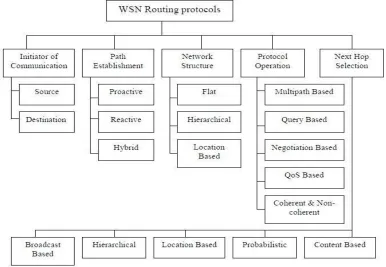
Figure 2.WSN Routing Protocols Classification
A. Path establishment Based Routing Protocols
According to path establishment based routing protocols routing paths are established according to three types; proactive protocol, reactive and hybrid protocol. Proactive protocols are those kind of protocols those compute all the routes before they are actually required and then store these routes in a routing table present at each node. Whereas reactive protocols are those kinds of protocols those compute routes only when they are required. Hybrid protocols use a combination of both proactive and reactive routing protocols.
Proactive Protocols:
ISSN(Online): 2320-9801
ISSN (Print): 2320-9798
I
nternational
J
ournal of
I
nnovative
R
esearch in
C
omputer
and
C
ommunication
E
ngineering
(An ISO 3297: 2007 Certified Organization)
Vol. 3, Issue 8, August 2015
Reactive Protocols:
A reactive routing protocol comes under on demand routing protocol category. So they do not maintain the global information of all the nodes in a network. Here the route establishment between source and destination is based on demand according to the requirement of the network. In order to discover a route from source to destination a route discovery query and then route reply strategy is followed. Hence, in reactive routing methodology, route selection is on demand by using route query packets before route establishment.
Hybrid Protocols:
Hybrid Protocols are combination of both proactive and reactive routing protocols. This routing methodology is applied to large networks. These protocols use clustering approach which makes the network more stable and scalable. The network structure is divided into many clusters and these clusters are maintained dynamically and if a node is added or left a particular cluster then this type of methodology uses proactive technique when routing is required within clusters and reactive technique when routing is required across the clusters.
B. Network Based Routing Protocols
Protocols which are divided according to the structure of network which is very crucial for the required operation are comes under the category of network based routing protocols. The protocols comes under this category are further subdivided into three subcategories according to their operations. These protocols are,
Flat-Based Routing:
Flat based routing is required where a large amount of sensor nodes are required and each and every node plays same role. Since here the number of sensor nodes are very large therefore it is not possible to assign a particular identification (Id) number to each and every node. It leads to data-centric routing strategy in which sink node sends query to a group of particular nodes in a sensing field and waits for their responses. Few Examples of Flat-based routing protocols are:
o Energy Aware Routing (EAR).
o Sequential Assignment Routing (SAR).
o Directed Diffusion (DD).
o (MCFA).
o Sensor Protocols for Information via Negotiation (SPIN).
o Minimum Cost Forwarding Algorithm
o Active Query forwarding in sensor network (ACQUIRE).
Hierarchical-Based Routings:
Hierarchical based routing strategy is best match in those situations when network scalability and efficient communication is required. It is also known as cluster based routing protocols. Hierarchical-based routing is energy efficient methodology in which higher energy nodes are randomly selected as cluster heads for processing and transmitting data towards base station where as low energy nodes are used for sensing and send information to their cluster heads. In this way hierarchical-based routing helps largely to the network scalability, lifetime enhancement and minimum energy consumption. Some available hierarchical-based routing protocols are;
o Hierarchical Power-Active Routing (HPAR).
o Threshold sensitive energy efficient sensor network protocol (TEEN).
o PEGASIS
o Minimum energy communication network (MECN).
Location-Based Routing:
ISSN(Online): 2320-9801
ISSN (Print): 2320-9798
I
nternational
J
ournal of
I
nnovative
R
esearch in
C
omputer
and
C
ommunication
E
ngineering
(An ISO 3297: 2007 Certified Organization)
Vol. 3, Issue 8, August 2015
between sensor nodes is calculated by the strength of signal received from those nodes and coordinates are calculated by exchanging information between neighbouring sensor nodes. Few location-based routing protocols are:
o Sequential assignment routing (SAR).
o Ad-hoc positioning system (APS).
o Geographic adaptive fidelity (GAP).
o Greedy other adaptive face routing (GOAFR).
o Geographic and energy aware routing (GEAR).
o Geographic distance routing (GEDIR).
C. Operation Based Routing Protocols
WSNs applications are categorized according to their functionalities. Hence routing protocols are classified according to their functions to meet these functionalities.
1. Multipath Routing Protocols:
Multipath routing protocols are those routing protocols those provide multiple path selection for a message to reach its destination thus increasing network performance and decreasing delay in network. Due to increased overheads better network reliability is achieved through sending periodic messages network paths are kept alive and hence greater energy is consumed. Multipath routing protocols are:
Multi path and Multi SPEED (MMSPEED).
Sensor Protocols for Information via
Negotiation (SPIN)
2. Query Based Routing Protocols:
Query based routing protocols works by sending and receiving queries for data. In this category the destination node sends query of interest from a node through network and node with this interest matches the query and send back to the node which initiated the query. The query is normally written in high level languages. Query based routing protocols are:
Sensor Protocols for Information via Negotiation (SPIN).
Directed Diffusion (DD).
COUGAR.
3. Negotiation Based Routing Protocols:
Negotiation based routing protocols uses high level data descriptors for the removal of redundant data transmissions through negotiation process. Generally these protocols make intelligent decisions either for communication or other actions based on facts such that how much resources are present. Negotiation based routing protocols are
Sensor Protocols for Information via Negotiation (SPAN).
Sequential assignment routing (SAR).
Directed Diffusion (DD).
4. QoS Based Routing Protocols:
QoS based routing protocols, network required to have a balance approach for the QoS of applications of system. Here the application can be delay sensitive so to achieve this QoS metric. Here network have to look also for its energy consumption which is another metric when communicating to the sink. So in order to achieve QoS, the cost function for the desired QoS also needs to be mentioned. Examples of such routing are:
Sequential assignment routing (SAR).
SPEED.
ISSN(Online): 2320-9801
ISSN (Print): 2320-9798
I
nternational
J
ournal of
I
nnovative
R
esearch in
C
omputer
and
C
ommunication
E
ngineering
(An ISO 3297: 2007 Certified Organization)
Vol. 3, Issue 8, August 2015
5. Coherent and non-coherent processing:
In the operation of wireless sensor networks data processing is a major component. Hence, routing techniques follow different data processing techniques. There are two types of data processing based routing.
6. Non-coherent data processing:
In this category of data processing, sensor nodes will locally process the raw data before being transmitted to other nodes for further processing of data. The sensor nodes that perform further processing of data are known as the aggregators.
7. Coherent data processing:
In coherent data processing based routing, after minimum processing the data is forwarded to aggregators. The minimum processing basically includes tasks like duplicate suppression, time stamping etc. When all sensor nodes are sources and send their data to the central aggregator node, a huge amount of energy will be consumed and hence this process has a higher cost.
D. Initiator of Communication Based Routing Protocol
Communication Based Routing Protocol depends on the communication between network components, where they generally in sleep mode temporary. When any part of a network, the sink (destination, base station) node or the source node, needs service from other part of network, it will initiate the routing with other part to send or receive the control or data packets.
Source Initiator Routing Protocol
Destination Initiator Routing Protocol.
E. Next-Hop Selection Based Routing Protocols
1. Content-based routing protocols:
Content-based routing protocols determine the next-hop on the route purely based on the query content. This type of routing protocols fits the most to the architecture of sensor networks, since the base station do not query specific nodes rather it requests only for data regardless of its origin.
Directed Diffusion.
GBR.
Energy Aware Routing.
2. Probabilistic routing protocols:
These protocols based on assumption that all sensor nodes are randomly deployed and homogeneous. By using this routing protocol, next-hop neighbour for each message to be forwarded are randomly selected by nodes and probability of selecting a certain neighbour is inversely proportional to its cost.
3. Location-based routing protocols:
These protocols select the next-hop towards the destination based on the known position of the neighbours and the destination. The position of the destination may denote the centroid of a region or the exact position of a specific node. Location-based routing protocols can avoid the communication overhead caused by flooding, but the calculation of the positions of neighbours may result extra overhead. The local minimum problem is common for all decentralized location-based routing protocols: it might happen that all neighbours of an intermediate node are farther from the destination than the node itself. In order to circumvent this problem, every protocol uses different routing techniques.
ISSN(Online): 2320-9801
ISSN (Print): 2320-9798
I
nternational
J
ournal of
I
nnovative
R
esearch in
C
omputer
and
C
ommunication
E
ngineering
(An ISO 3297: 2007 Certified Organization)
Vol. 3, Issue 8, August 2015
4. Hierarchical-based routing protocols:
In case of hierarchical protocols, all nodes forward a message for a node (also called aggregator) that is in a higher hierarchy level than the sender. Each node aggregates the incoming data by which they reduce the communication overload and conserve more energy. Therefore, these protocols increase the network lifetime and they are also well-scalable. The set of nodes which forward to the same aggregator is called cluster, while the aggregator is also referred as cluster head. Cluster heads are more resourced nodes, where resource is generally means that their residual energy level is higher than the average. The reason is that they are traversed by high track and they perform more computation (aggregation) than other nodes in the cluster. Hierarchical routing is mainly two-layer routing where one layer is used to select cluster heads and the other layer is used for routing.
LEACH (Low Energy Adaptive Clustering Hierarchy) protocol.
5. Broadcast-based routing protocols:
In broadcasting based routing protocols each sensor node in the network decides individually whether to forward a message or not. So the functioning of these protocols is very straightforward. So if a node decides to forward massage, it simply re-broadcasts the message and if it declines to forward message, the message will be dropped. MCFA (Minimal Cost Forwarding Algorithm).
V. CONCLUSIONS
Wireless Sensor Networks are one of the emerging fields in research area. A wireless sensor network has a remarkable feature to monitor environmental and physical phenomenon such are temperature, pressure, humidity etc. In this paper we discussed various aspects of wireless sensor networks and also discussed various types of WSNs and their applications and classify various categories of routing protocols. The routing protocols in WSN has become one of the most important research areas and introduced unique challenges compared to traditional data routing in wired networks. The main aim behind the routing protocol design is to keep the sensors operating for a long time, thus extending the network life time. Although many routing protocols have been proposed for sensor networks, many issues still remain to be addressed.
REFERENCES
1. S.K.Singh, M.P. Singh and D. K. Singh, “Routing Protocols in Wireless Sensor Networks –A Survey”, International Journal of Computer Science & Engineering Survey (IJCSES), Vol.1, No.2, November 2010.
2. I.F. Akyildiz, W. Su*, Y. Sankarasubramaniam, E. Cayirci. “Wireless Sensor Networks: a survey”, Published by Elsevier Science B.V.,ISSN: 1389-1286/02/$ ,Vol. 38 ,Page No. 393–422, December 2001.
3. Jun Zheng and Abbas Jamalipour, “Wireless Sensor Networks: A Networking Perspective”, a book published by A John & Sons, Inc, and IEEE, 2009.
4. Nikolaos A. Pantazis, Stefanos A. Nikolidakis and Dimitrios D. Vergados " Energy-Efficient Routing Protocols in Wireless Sensor Networks: A Survey" IEEE communications surveys & tutorials, ISSN: 1553-877,Issue No.2,Vol.15,Page No. 551-591, Second quarter 2013.
5. Kemal Akkaya, Mohamed Younis”A Survey on routing protocols for wireless sensor network,”2 Nov 2010.
6. I. Akyildiz, W. Su, Y. Sankarasubramaniam, and E. Cayirci,”A Survey On Sensor Networks”, IEEE Communications Magazine, Volume 40, Number 8, pp.102-114, 2002.
7. Akkaya, K. and Younis, M., “ A survey on routing protocols for wireless sensor networks”, Ad Hoc Networks, Vol 3, Page No. 325–349,2005. 8. I.F. Akyildiz, W. Su, Y. Sankarasubramaniam, and E. Cayirci, “A Survey on Sensor Network”, IEEE Communication Magazine, vol. 40, no. 8,
Aug. 2002, pp. 102-114.
9. Kemal Akkaya and Mohamed Younis, “A Survey on Routing Protocols for Wireless Sensor Networks”, Ad hoc Networks, vol. 3, no. 3, May 2005, pp. 325-349.
10. Hussein Mohammed Salman, “Survey of Routing Protocols in Wireless Sensor Networks”,International Journal of Sensors and Sensor Networks, Vol. 2, No. 1, 2014.
11. Jennifer Yick, Biswanath Mukherjee, Dipak Ghosal, “Wireless sensor network survey”,computer networks,ISSN: 1389-1286,Vol. 58,Page No.2292-2330,April 2008.