ISSN(Online): 2319-8753 ISSN (Print) : 2347-6710
I
nternational
J
ournal of
I
nnovative
R
esearch in
S
cience,
E
ngineering and
T
echnology
(An ISO 3297: 2007 Certified Organization)
Vol. 5, Special Issue 13, October 2016
Application of Differential Evolution
Algorithm in Prediction of Time Series Data
Satyendra Nath Mandal1, Jit Saha2
Assistant Professor, Department of Information Technology, Kalyani Govt. Engg. College, Kalyani, Nadia, India1
M.Tech Final Year, Department of Computer Science & Engineering, Kalyani Govt. Engg. College, Kalyani, Nadia,
India 2
ABSTRACT: Several statistical and soft-computing methods have been applied to predict the time series data in different fields. In this paper, an algorithm has been proposed to predict the time series data based on Differential Evolution algorithm. The performance of proposed algorithm has been measured by Mean Absolute Percentage Error (MAPE) metric. It has been observed that in most of the cases the performance of the proposed algorithm is better compare to other applied methods in same data set. Finally, the algorithm has been tested on several time series data predicted by the other methods.
KEYWORDS: Statistical and soft-computing methods, Differential Evolution, Time Series data, Mean Absolute
Percentage Error (MAPE).
I.INTRODUCTION
In recent time several evolutionary algorithms have been applied to different real life optimization problems and the results given by them is satisfactory. Differential Evolution (DE) is one of the latest evolutionary based optimization algorithms, proposed by Storn& Price. Like other evolutionary-type algorithms, DE is population based algorithm and it represents the candidate solutions by chromosomes based on real numbers. In recent times this algorithm has been applied in several optimization problems from different field of science.
PuspanjaliMohapatra and Alok Raj have applied DE on Indian stock market prediction. They have compared performance of two algorithms differential evolution (DE) and Back propagation (BP) for training a Functional Link Artificial Neural Network (FLANN) based ANN to get optimized value of weights of underlined neural network. The DE optimized FLANN has been always performed well than BP optimized FLANN in terms of MAPE & RMSE. Juan Peralta Donate, XiaodongLi,Germa´nGutie´rrezSa´nchez and AraceliSanchis de Miguel have applied DE to training automatic design of artificial neural networks (ADANN) for predicting time series data. The performance of DE has been compared with other two algorithms- GA, EDA (estimation of distribution algorithms) and famous time series prediction software Forecast Pro for predicting passenger, temperature, Dow-Jones and Quebec and Mackey– Glass data set. Results have revealed that for Mackey–Glass data set DE optimized ANN has outperformed over
Forecast Pro software.
YuelinGao and Junmei Liu have proposed a new version of DE, Multi objective Differential Evolution Algorithm with Multiple Trial Vectors (MTVDE) for finding optimal values of different multi objective optimization function. To evaluate the performance of the proposed algorithm it has been applied in several benchmark functions along with another evolutionary based algorithm and most of the cases MTVDE has performed well than other multi-objective based evolutionary algorithm (MOEA).
ISSN(Online): 2319-8753 ISSN (Print) : 2347-6710
I
nternational
J
ournal of
I
nnovative
R
esearch in
S
cience,
E
ngineering and
T
echnology
(An ISO 3297: 2007 Certified Organization)
Vol. 5, Special Issue 13, October 2016
Ching-Wei Chien, Zhan-Rong Hsu and Wei-Ping Lee have proposed modified DE (MDE) algorithm to train the recurrent functional neural fuzzy network (RFNFN) for forecasting the non-linear and delayed time series data. In proposed algorithm two mutation factors F1& F2 have been defined for whole population. Results have shown that
MDE converges to optimal value in less time with respect to DE/1 and DE/2 and MDE’s worst performance is even better than average performance better than other two.
Fuqing Zhao, MingmingHuo and Weijun Ma have incorporated Memetic Algorithm (MA) and aself adaptive mutation operator to classical DE to diversify the population, to increase local search capability and to improve algorithm convergence speed. In order to test the performance of the proposed algorithm it has been applied to typical benchmarks functions and results have revealed that proposed method has better convergence compare to classical DE. NasimulNoman and Hitoshi Iba have proposed a crossover-based adaptive local search (LS) operation for enhancing the performance of standard differential evolution (DE) algorithm and it has been applied in several benchmark functions.
Rahib H. Abiyev and VasifHidayatAbiyev have applied DE to train the Fuzzy Wavelet Neural Networks (FWNN) for for prediction of stock prices. Results have revealed that DE has trained the FWNN as compare to GA.
In this paper, DE algorithm has been applied for time series prediction. Here at first initial populations of chromosomes have been created randomly in the search space. Here each chromosome is a D-dimensional vector, where D is the number of input data. The initial populations of chromosomes have been created randomly in search space. Each chromosome represents the predicted data of input. After that, initial fitness of each chromosome has been calculated. Next, at each iteration or each generation of the algorithm mutation, cross-over and selection, these three steps have been performed for every chromosome of the population. The whole procedure has been carried out for 1000 iterations. At the end of 1000th iteration, chromosome having the best fitness has been considered as the predicted values of the input data.
II.THEORY
A. DE OVERVIEW
The DE algorithm belongs to family of evolutionary algorithm. It uses the same operators- mutation, cross-over and selection like GA. But it has several differences with GA. Unlike GA the decision variables are real numbers and mutation step of DE is completely different than mutation step of GA. For constructing solution, GA depends on crossover while DE depends on mutation operation [9]. This mutation operator is a unique tool of DE for attack any optimization based problem.
B. PARAMETERS AND TERMINOLOGY OF BASIC DE
B.1.Chromosome
In DE each element of the population is called as chromosome which is a concept of any evolutionary based algorithm. Each chromosome is represented as D-dimensional vector.
B.2. Scaling factor or mutation factor (F)
In mutation operator, F is used to amplifying the difference of two chromosomes. It is a very important parameter of mutation operator. Value of this parameter vastly affects the performance of the algorithm. Value may be fixed or it can be adaptive during the execution of the algorithm. The main job of this parameter is to balance exploration and exploitation property of the algorithm. In initial stage it finds much more global optimal solutions; and has strong local
search ability in later stages [6]. Generally value of F ε (0, 2] [3]. In our proposed method tuning of the F value has been guided by the following formula,
F iter=
itr
F
initial---(1) ,where F initialis the initial value of mutation factor (F) and itr is the current iteration
ISSN(Online): 2319-8753 ISSN (Print) : 2347-6710
I
nternational
J
ournal of
I
nnovative
R
esearch in
S
cience,
E
ngineering and
T
echnology
(An ISO 3297: 2007 Certified Organization)
Vol. 5, Special Issue 13, October 2016
B.3.Mutation Operator
In this step for each chromosome Xi,G, a mutant chromosome, Vi G+1is produced from three parent chromosomes of the
current generation or iteration G. The simple mutation operator is defined as, ViG+1=XiG+ F(X jG- X kG).---(2)
Where (G+1) represents next generation, Xi, G, X j, G and X k, G are three parent chromosome of the current generation. Xi,
G, X j, G and X k, G are differ from each other. F is scaling factor &XiGis also called as donor vector.
B.4. Crossover Operator
In this step for each chromosome Xi G, a trail chromosome or child chromosomeUiG+1 is produced by the cross-over
between parent chromosome Xi G and mutant chromosome Vi G+1. The simplecross-over operator is binomial cross over
and it is defined as,
UiG+1= ViG+1 , if (rand<CR).
= XiG , otherwise.
Where CR is crossover ratio and CR ε[0,1]. rand is random number ,generated in between 0 and 1.
B.5. Selection Operator
In this step for each chromosome XiG, fitness comparison is performed between child chromosome, UiG+1and parent
chromosome XiG. During fitness comparison if parent, XiG is superior to child, it remains in the search space, otherwise
parent will be replaced by child, UiG+1 .In case of maximization problem fitness function is proportional to the objective
function value. This can be defined as,
XiG+1= UiG+1 , if (fitness (UiG+1)> fitness (XiG+1)).
= XiG+1 , Otherwise.
III.VARIATION OF DE
Many variants of the basic DE have been proposed by Price &Storn (2003) based on following criteria-donor vectors used in mutation operator, number of vector difference used in mutation operator, type of cross over operator used in cross-over operation[10]. In order to distinguish among these variants,DE/x/y/z naming convention has been used, where x denotes the donor vector during mutation operator, y denotes the number ofvector difference in mutation operator and z denotesthe type of crossover used
Those variants are- 1. DE/best/1/exp 2. DE/rand/1/exp 3. DE/rand-to-best/1/exp 4. DE/best/2/exp 5. DE/rand/2/exp 6. DE/best/1/bin 7. DE/rand/1/bin 8. DE/rand-to-best/1/bin 9. DE/best/2/bin 10. DE/rand/2/bin
ISSN(Online): 2319-8753 ISSN (Print) : 2347-6710
I
nternational
J
ournal of
I
nnovative
R
esearch in
S
cience,
E
ngineering and
T
echnology
(An ISO 3297: 2007 Certified Organization)
Vol. 5, Special Issue 13, October 2016
IV.TIME SERIES FORECASTING
Quantities that represent the values have been taken by a variable over a period such as a month, quarter, or year. Time series data occurs wherever the same measurements are recorded on a regular basis. Time series data is a series of statistical data that is related to a specific instant or a specific time period. It is drawn from a data of monthly bookings for an airline in shown in Fig1.
Fig 1. Monthly bookings for an airline
V. PROPOSED ON BASED ON DIFFERENTIAL EVOLUTION ALGORITHM
Input: Time series data, maximum iteration number, population size per data element.
Output: Predicted data.
Method:- Step 1:
Step 1.1: To Compute upper bound (UB) and lower bound (LB) of the population from the given time series Step 1.2: To initialize the parameters F, CR, population size of the algorithm.
Step 2: To generate population in search space between upper and lower bound. It has been calculated by the formula, Xi,j=LB+(UB-LB)*ran(0,1). Where X i,j is the j th predicted data element of chromosome i.
Step 3: To compute initial fitness of each chromosome Xi. It has been calculated by the formula,
F X i =
Dj
j j
i
data
1
,
|
|
, where dataj is the jthinput data element of the input and D is the number of inputdata.Here lower value of F X i indicates higher fitness value.
Step 4: To repeat step 5 to step 7.
ISSN(Online): 2319-8753 ISSN (Print) : 2347-6710
I
nternational
J
ournal of
I
nnovative
R
esearch in
S
cience,
E
ngineering and
T
echnology
(An ISO 3297: 2007 Certified Organization)
Vol. 5, Special Issue 13, October 2016
F iter=
itr
F
initial,
Step 6: for each chromosome Xi in the search space perform step 6.1 to 6.3
Step 6.1: mutation Step 6.2: cross-over Step 6.3: selection
Step 7: if the termination condition is satisfied return the chromosome with best fitness as predicted value of the input data.
Step 8: Otherwise go to Step 7.
VI.EXPERIMENTAL SET-UP
The proposed method has been applied on Fedora Core 15.i686 platform with CORE i5 processor and 8GB RAM. The coding has been done by C language.
Parameter value:
Number of population (NP) =30*number of data input. Mutationfactor (F) =Initial value is 0.9.
Cross-over ratio (CR) =0.9.
Maximum number of iteration=1000.
The whole procedure has been done for 10 trials with different initial population and finally mean prediction has been calculated for all data from prediction results of 10 trials and it has been given as final prediction of input.
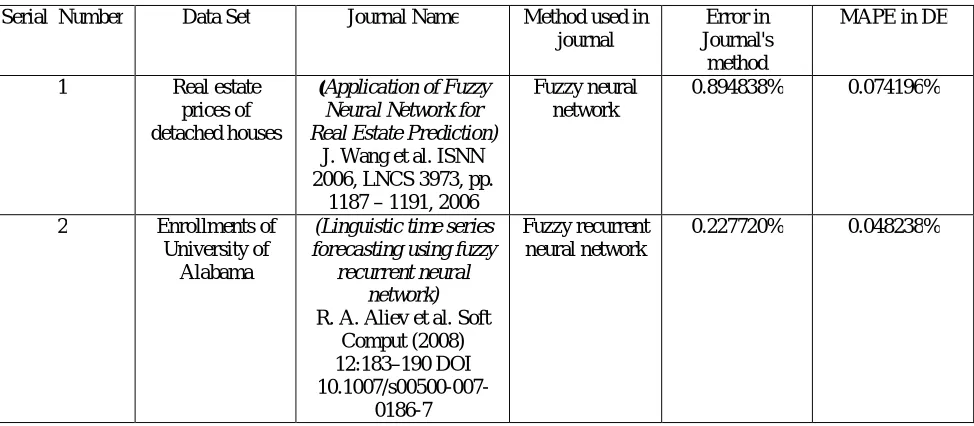
TABLE 6.THE PERFORMANCE COMPARISON OF THE PROPOSED METHOD WITH OTHER PREDICTION METHOD IN DIFFERENT TIME SERIES DATA FROM DIFFERENT JOURNALS.
Serial Number Data Set Journal Name Method used in journal
Error in Journal's
method
MAPE in DE
1 Real estate prices of detached houses
(Application of Fuzzy
Neural Network for Real Estate Prediction)
J. Wang et al. ISNN 2006, LNCS 3973, pp.
1187 – 1191, 2006
Fuzzy neural network
0.894838% 0.074196%
2 Enrollments of University of
Alabama
(Linguistic time series forecasting using fuzzy
recurrent neural network)
R. A. Aliev et al. Soft Comput (2008) 12:183–190 DOI
10.1007/s00500-007-0186-7
Fuzzy recurrent neural network
ISSN(Online): 2319-8753 ISSN (Print) : 2347-6710
I
nternational
J
ournal of
I
nnovative
R
esearch in
S
cience,
E
ngineering and
T
echnology
(An ISO 3297: 2007 Certified Organization)
Vol. 5, Special Issue 13, October 2016
3 LCD TV demand
(Forecasting analysis by using fuzzy grey regression model for
solving limited time series data ) Ruey-ChynTsaur.SoftComput DOI 10.1007/s00500-008-0278-z Fuzzy grey regression model
3.071154% 0.042545%
4 Adsorption of cadmium by
hematit
(Prediction of Cadmium Removal Using an Artificial Neural Network and a
Neuro-Fuzzy Technique)
Singh et al Mine Water and the Environment (2006) 25: 214–219 ©
IMWA Springer-Verlag 2006
adapted neural fuzzy model
1.128380% 0.021023 %
5 Forecasting engine system
reliability
(Application of neural networks in forecasting
engine systems reliability)
K. Xu et al.Engineering Driver 2, 117576
RBF neural network for time series prediction
0.419024% 0.021231%
6 Education capital in China
(A new method of soft computing to estimate
the economic contribution rate of education in China) H.
Guo et al.China University of Geosciences, 430074 Fuzzy Neural Network algorithm FNN2
41.555765% 2.457342 %
7 Dollar/Euro Exchange Rate
(Time Series Prediction of Dollar\Euro Exchange Rate Index)
Mike P. Hanias& Panayiotis G. Curtis.International Research Journal of Finance and Economics
ISSN 1450-2887 Issue 15 (2008)
ISSN(Online): 2319-8753 ISSN (Print) : 2347-6710
I
nternational
J
ournal of
I
nnovative
R
esearch in
S
cience,
E
ngineering and
T
echnology
(An ISO 3297: 2007 Certified Organization)
Vol. 5, Special Issue 13, October 2016
8 Initial shoot length of Ken
type mustard plant
(A framework for development of Suitable Method to find
Shoot Length at Maturity of Mustard
Plant Using Soft Computing Model)
SatyendraNathMandal, J. Pal Choudhury, Dilip
De & S. R. Bhadrachaudhuri International journal of Computer Science and Engineering Vol. 2,
No. 3, pp113-120
Fuzzy soft computing model
0.8527% 0.168998 %
9 Tourism Demand in
Taiwan
(Forecasting Tourism Demand Using Time Series, Artificial Neural
Networks and Multivariate Adaptive
Regression Splines: Evidence from Taiwan)
Chang-Jui Lin, Hsueh-Fang Chen, Tian-Shyug
Lee
International Journal of Business Administration Vol. 2,
No. 2; May 2011 ISSN 1923-4007
E-ISSN 1923-4015
ARIMA 0.28% 0.050054 %
VII.CONCLUSION & FUTURE WORK
It has been observed that the proposed algorithm has given better output as compare to others. The algorithm has been also tested on different time series data published in different International journals. The values of parameters of DE have been collected from different published journals. A multithreaded version of this method may be proposed in future to explore the search space efficiently and quickly and a more efficient mutation operator may be proposed for saving the algorithm from premature convergence for finding global optimum value of the underlying problem
REFERENCES
[1] PuspanjaliMohapatra, Alok Raj, Indian Stock Market Prediction Using Differential Evolutionary Neural Network Model, International Journal of Electronics Communication and Computer Technology (IJECCT). Volume 2 Issue 4 (July 2012).
ISSN(Online): 2319-8753 ISSN (Print) : 2347-6710
I
nternational
J
ournal of
I
nnovative
R
esearch in
S
cience,
E
ngineering and
T
echnology
(An ISO 3297: 2007 Certified Organization)
Vol. 5, Special Issue 13, October 2016
[4] Ching-Wei Chien, Zhan-Rong Hsu, Wei-Ping Lee, Improving the Performance of Differential Evolution Algorithm with Modified Mutation Factor, 2009International Conference on Machine Learning and Computing IPCSIT .vol.3 (2011) © (2011) IACSIT Press, Singapore.
[5] Cheng-Jian Lin1, Chi-Feng Wu and Chi-Yung Lee, Design of a Recurrent Functional Neural Fuzzy Network using Modified Differential Evolution, International Journal of Innovative Computing, Information and Control. Volume 7, Number 2, February 2011.
[6] Fuqing Zhao, MingmingHuo , WeijunMa,AMemetic Differential Evolution Algorithm with Adaptive Mutation Operator, Research Journal of Applied Sciences, Engineering and Technology 4(19): 3687-3691, 2012.
[7]NasimulNoman , Hitoshi Iba, Accelerating Differential Evolution Using an Adaptive Local Search, IEEE Transactions On Evolutionary Computation.VOL. 12, NO. 1, FEBRUARY 2008.
[8]Rahib H. Abiyev, VasifHidayatAbiyev,Differential Evaluation Learning of Fuzzy Wavelet Neural Networks for Stock Price Prediction,Journal of Information and Computing Science .Vol. 7, No. 2, 2012, pp. 121-130.
[9] Derviskaraboga,SelçukÖkdem,A Simple and Global Optimization Algorithm for Engineering Problems: Differential Evolution Algorithm, Turk J Elec Engin.VOL.12, NO.1 2004.