Traffic Management Using Distributed
Video Streaming
S.Raja shree
1, P. Ramya
*2Assistant Professor, Dept. of CSE, Jerusalem College of Engineering, Chennai, Tamil Nadu, India1
Lecturer, Dept. of CSE, Bharath University, Chennai, Tamil Nadu, India2
*Corresponding Author
ABSTRACT : Streaming applications will rapidly develop and contribute a significant amount of traffic in the near future. A problem, scarcely addressed so far, is how to distribute video streaming traffic from one source to all nodes in an urban vehicular network. This problem significantly differs from previous work on broadcast and multicast in ad hoc networks because of the highly dynamic topology of vehicular networks and the strict delay requirements of streaming applications. In this project the solution for inter vehicular communications, Called Streaming Urban Video (SUV). 1) Fully distributed and dynamically adapts to topology changes, and 2) leverages the characteristics of streaming applications to yield a highly efficient, cross-layer solution.
Vehicular Ad Hoc Networks (VANETs) are ill-suited to support streaming media traffic. Low bandwidth, fleeting connectivity, and highly dynamic, unpredictable topology are the main shortcomings hindering the support of multimedia applications. The network characteristics, along with the variable bit rate(VBR) nature of the traffic and the strict delay constraints, making no allowance for store-and-forward, pose a different problem from the ones previously addressed in ad hoc networks we propose a fully distributed solution called Streaming Urban Video (SUV) that efficiently disseminates streaming video to all vehicles in a city VANET.
KEYWORDS: video streaming, Streaming Urban Video, VANET
I. INTRODUCTION
The main aim of this project is to highly efficient video streaming application from one source to all nodes in an urban vehicular network using inter-vehicular communications.
Streaming applications will rapidly develop and contribute a significant amount of traffic in the near future. A problem, scarcely addressed so far, is how to distribute video streaming traffic from one source to all nodes in an urban vehicular network. This problem significantly differs from previous work on broadcast and multicast in ad hoc networks because of the highly dynamic topology of vehicular networks and the strict delay requirements of streaming applications. We present a solution for inter-vehicular communications, Called Streaming Urban Video (SUV). 1) Fully distributed and dynamically adapts to topology changes, and 2) leverages the characteristics of streaming applications to yield a highly efficient, cross-layer solution.
In SUV, each relay node not only forwards the streaming traffic but also exploits a built in positional device (e.g., a GPS) and the received power level, to dynamically select its next-hop relays. SUV nodes are capable of 1) detecting a collision by means of passive acknowledgments at the MAC layer, 2) reclaiming part of the wasted bandwidth to solve the contention
II. RELATED WORKS
the support of multimedia applications. The network characteristics, along with the variable bit rate(VBR) nature of the traffic and the strict delay constraints, making no allowance for store-and-forward method
JOSIANE NZOUONTA( 2009 vol:58, pg.no:7) study the “VANET routing on city roads using real-time vehicular traffic information” IEEE transaction on vehicular technology. VANET Routing on City Roads Using Real-Time Vehicular Traffic Information[1] presents a class of routing protocols called road-based using vehicular traffic (RBVT) routing, which outperforms existing routing protocols in city-based vehicular ad hoc networks (VANETs). RBVT protocols leverage real-time vehicular traffic information to create road-based paths consisting of successions of road intersections ,with high probability, network connectivity among them[1][2]. Geographical forwarding is used to transfer packets between intersections on the path, reducing the path’s sensitivity to individual node movements. For dense networks with high contention, we optimize the forwarding using a distributed receiver-based election of next hops based on a multi-criterion prioritization function that takes non-uniform radio propagation into account. We designed and implemented a reactive protocol RBVT-R and a proactive protocol RBVT-P and compared them with protocols representative of mobile ad hoc networks and VANETs. In terms of average delay, RBVT-P performs best, with as much asan 85% decrease compared with the other protocols[8][9].
WENGING WANG 2009 vol:58, pg.no:9 investigate the “Large scale routing in vehicular ad hoc network.” IEEE transactions on vechicular technology, Small-Scale and Large-Scale Routing in Vehicular Ad Hoc Networks[3] propose a vehicular mobility model that reflects real-world vehicle movement and study the performance of packet-routing protocols.in this we study the routing in small-scale VANETs and propose two routing schemes that are connection-based restricted forwarding (CBRF) and connectionless geographic forwarding (CLGF). we consider routing in large-scale VANETs. Since road complexity and traffic variety may cause many potential problems that existing routing protocols cannot address, in this we have two-phase routing protocol (TOPO) that incorporates road map information. The proposed protocol defines an overlay graph with roads of high vehicular density and access graphs that are connected to the overlay. While in the overlay, packets are forwarded along a pre-calculated path. As far as access, routing is concerned, we use CBRF and CLGF schemes and send packets to the overlay or handle packets delivered from the overlay[10]. We argue that the TOPO can serve as a framework that integrates existing VANET routing protocols. We also consider data diversity in VANETs and design the TOPO as an intelligent transportation system (ITS)-friendly protocol. To validate our design philosophy and the routing protocol, we use different areas in the city of Orlando, FL, and generate vehicular mobility traces, following our mobility models. We feed the traces to network simulators and study the routing behavior. Simulation results the performance and effectiveness of the proposed routing protocols for large-scale VANET scenarios[4]-[7].
MATE BOBAN 2009,vol:13, pg.no:12 study the “Unicast Communication In Vehicular Ad hoc Network” IEEE transaction on vehicular communication .Unicast Communication in Vehicular Ad Hoc Networks[3] provides the unicast performance available to applications in infra-structure less vehicular ad hoc networks (VANETs) in terms of connection duration, packet delivery ratio, end-to-end delay, and jitter in both highway and urban VANET environments. in this we determine the level of Quality of Service (QoS) that will be available in VANETs. In order to determine achievable QoS performance in VANETs for a defined set of parameters, we implement a simulation model with the following characteristics first, realistic implementation of PHY and MAC layers of the Dedicated Short Range communications (DSRC) technology. second, a unicast routing scheme that exhibits optimal performance, the underlying restrictions of the PHY and MAC layers of the DSRC standard and the dynamic nature of VANETs and third carefully modeled urban and highway scenarios based on real maps, vehicle densities, and speed distributions.
Hypotheses
For studying the superiority of streaming, we test the following hypotheses:
H1: Each newly selected relay repeats the procedure until either a relay node cannot find any schedulable neighbors or the relay is asked to forward slot content with a video frame sequence number that is smaller or equal to the one previously received.
H2: Each video frame is segmented (if needed) and formatted into a packet that will cover up to
H3: The relay node then will try and start a contention procedure to claim the slot
III. RESEARCH METHOD
We propose a fully distributed solution called Streaming Urban Video (SUV) that efficiently disseminates streaming video to all vehicles in a city VANET. SUV completely relies on inter-vehicular communication: a video stream, generated in a point in space (e.g., at a roadside access point), is fed to SUV nodes and disseminated across the VANET through a distribution structure, which is laid over the physical topology of mobile nodes. We refer to the nodes that belong to the distribution structure and are responsible for the forwarding of the streaming video as relay nodes. Consider a VANET deployed in an urban environment[11]. We make no assumptions on the vehicle density since; SUV can achieve a good performance even with spotty, volatile vehicular connectivity. We assume that one or more gateway nodes, either fixed or mobile, provide streaming video to car passengers.
Hypotheses Testing
Testing Dynamic Node Selection (H1)
Fig 4.1
In this every packet generated at the MAC (Media access control) layer, the gateway undertakes a set of actions with the purpose of identifying up to four relay nodes[12]. Each newly selected relay repeats the procedure until either a relay node cannot find any schedulable neighbors, or the relay is asked to forward slot content with a video frame sequence number that is smaller or equal to the one previously received. It will describe the children selection procedure taking on the point of view of a generic relay node. Refer to the relay node scheduling the tagged relay node and feeding traffic to it as parent node, while we will refer to the relay nodes being scheduled and fed traffic by the tagged relay node as children nodes. The parent node and children nodes are expected to behave as described for the tagged relay node in their own turn. In this parent and children node selection dynamically selected based on mobility. RAP (Roadside Access Point) controlled all parent and child nodes.
Test the Video Segmentation(H2)
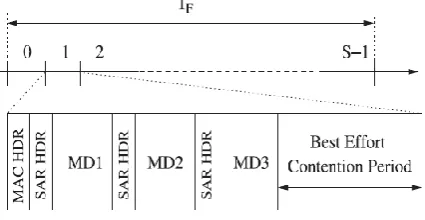
In this Streaming video and best-effort traffic (music or video clips) are transmitted over a data channel; the data channel is structured in fixed length time frames of duration TF. Each time frame is further divided into S identical slots, where the values of S, as well as the subset of relay nodes that transmit in each time slots. Each descriptor is composed of several video frames (e.g., I, B, or P) of different size. The node protocol stack includes a Segmentation and Reassembly (SAR) layer, such that, at the transmitter, each video frame is segmented (if needed) and formatted into a packet that will cover up to one third of a MAC payload of maximum size[13][14].
Test the Video Streaming
Multimedia content is assumed to be a video sequence. Note that various video coding techniques have been defined to allow streaming video to withstand the potentially harsh conditions of wireless networks the video to be encoded into three descriptors although other techniques could be considered as well. In other words, every transmitting within its allocated slot, the relay node appends the following information to the MAC-layer header: 1. Number of bits of each descriptor,
2. Identity of the three (or fewer) children, 3. Slot number in which each child is scheduled.
No explicit acknowledgment (ACK) is expected from children. Rather, a passive ACK is obtained at the relay node by monitoring transmissions in the slots where its children are supposed to be relaying the content. If children transmissions, relaying the correct content, are heard, the traffic relaying is considered to be successful a relay node does not hear one of its children using the slot where it was scheduled for transmission. Likely, a node close to the silent child has collided with the relay node transmission. The relay node then will try and start a contention procedure to claim the slot and, at the same time, to salvage its latest transmission by sending one or two out of the three (parts of the) multiple-description video frames[15].
IV. COPE OF THE RESEARCH
In this research , The network characteristics, along with the variable bit rate (VBR) nature of the traffic and the strict delay constraints, making no allowance for store-and-forward, pose a different problem from the ones previously addressed in ad hoc networks.The parent node coverage area was not determined so the received power level iso-tropically decreases with the distance in to source to destination.Due to collisions stemming from non ideal grid selection, the scheduling algorithm may sometimes fail and result in bandwidth waste.
Making assumption on the nodes density and define a distance-k coloring, with k being any positive integer, which is optimal and has the same asymptotic complexity as the algorithm.
We propose a fully distributed solution called Streaming Urban Video (SUV) that efficiently disseminates streaming video to all vehicles in a city VANET. SUV completely relies on inter-vehicular communication: a video stream, generated in a point in space (e.g., at a roadside access point), is fed to SUV nodes and disseminated across the VANET through a distribution structure, which is laid over the physical topology of mobile nodes. We refer to the nodes that belong to the distribution structure and are responsible for the forwarding of the streaming video as relay nodes. Consider a VANET deployed in an urban environment. We make no assumptions on the vehicle density since; SUV can achieve a good performance even with spotty, volatile vehicular connectivity. We assume that one or more gateway nodes, either fixed or mobile, provide streaming video to car passengers.
V. TECHNOLOGIES USED
will be interested in the Java FX Script Programming Language Reference and Application Programming Interface (API) documentation. These reference documents provide a lower-level discussion of the syntax, semantics, and supported libraries of the Java FX Script programming language and SDK.
The Java FX Script programming language is an object-oriented language. But what does that mean? What exactly is an object? Simply put, an object is a discrete software bundle that consists of state and behavior. To better understand software objects, it helps to step outside of software for a minute and think about concepts that you're already are familiar with. Your television set, for example, is an object. It has both state (current channel, current volume, on, off) and behavior (change channels, adjust volume, turn on, turn off). Tend to think of a television as a single object, but in reality, a television is actually composed of many other objects (the buttons and knobs on its face are all objects, as are the various components inside the television). In many cases, these smaller objects are also made up of... you guessed it... other objects. We can break down a television's components until we reach a point where we can go no further (a screw, for example, really is just a single object, it's not composed of anything else). If you've ever bought a piece of exercise gear, or anything else with "some assembly required", you've probably seen an exploded diagram in its documentation showing every single object in its construction. At a glance you can understand how many objects there are, and how those objects all fit together. The same is true of .fx source files: you can easily see how a script's objects all fit together to form a full application.
VI. SAMPLE
We select s set of parent nodes so as to maximize the coverage area, and include RAP. The system will communicated several RAP nodes. Here we took the Contention-based access for best-effort traffic.
Summary and Concluding Remarks
On-board live video streaming in VANETs is provided with a solution SUV.The content distribution is achieved through a fully distributed, dynamic selection of forwarders which, in turn, perform local broadcasting.Whenever a collision occurs, SUV leverages the properties of video coding to design a collision-resolution mechanism and the characteristics of VBR traffic to efficiently exploit radio resources.
REFERENCES
1. Josiane nzouonta, “ VANET routing on city roads using real-time vehicular traffic information” IEEE transaction on vehicular technology, 2009 vol:58,pg.no:7
2. Sathyanarayana H.P., Premkumar S., Manjula W.S., "Assessment of maximum voluntary bite force in adults with normal occlusion and different types of malocclusions", Journal of Contemporary Dental Practice, ISSN : 1526-3711, 13(4) (2012) pp.534-538.
3. Wenging wang, “Large scale routing in vehicular adhoc network.” IEEE transactions on vechicular technology, 2009 vol:58, pg.no:9 4. Selva Kumar S., Ram Krishna Rao M., Deepak Kumar R., Panwar S., Prasad C.S., "Biocontrol by plant growth promoting rhizobacteria
against black scurf and stem canker disease of potato caused by Rhizoctonia solani", Archives of Phytopathology and Plant Protection, ISSN : 0323-5408, 46(4) (2013) pp.487-502.
5. Mate boban, “Unicast Communication In Vehicular Adhoc Network” IEEE transaction on vehicular communication 2009,vol:13,pg.no:12. 6. Subha Palaneeswari M., Abraham Sam Rajan P.M., Silambanan S., Jothimalar, "Blood lead in end-stage renal disease (ESRD) patients who were on maintainence haemodialysis", Journal of Clinical and Diagnostic Research, ISSN : 0973 - 709X, 6(10) (2012) pp.1633-1635. 7. F.J. Ros, P.M. Ruiz, and I. Stojmenovic, “Reliable and Efficient Broadcasting inVehicular AdHoc Networks,” Proc. IEEE Vehicular
Technology Conf. (VTC) Spring 2009, pp. 1-5, Apr. 2009.
8. Sukumaran V.G., Bharadwaj N., "Ceramics in dental applications", Trends in Biomaterials and Artificial Organs, ISSN : 0971-1198, 20(1) (2006) pp.7-11.
9. W. Chen, R.K. Guha, T.J. Kwon, J. Lee, and Y.- Y. H. Wirel, “A Survey and Challenges i Routing and Data Dissemination in Vehicular Ad Hoc Networks,” Wireless Communication and Mobile Computing, Oct. 2009.
10. Selva Kumar S., Ram Krishna Rao M., Balasubramanian M.P., "Chemopreventive effects of Indigofera aspalathoides on 20-methylcholanthrene induced fibrosarcoma in rats", International Journal of Cancer Research, ISSN : ISSN: 1811-9727, 7(2) (2011) pp.144-151.
11. M. Guo, M.H. Ammar, and E.W. Zegura, “V3: A Vehicle-to- Vehicle Live Video Streaming Architecture,” Proc. IEEE Int’l Conf. Pervasive Computing and Comm. (PerCom), pp. 171-180,Mar. 2005.
12. M. Bonuccelli, G. Giunta, F. Lonetti, and F. Martelli, “Real-Time Video Transmission in Vehicular Networks,” Proc. IEEE Mobile Networking for Vehicular Environments (MOVE Workshop), pp. 115- 120, May 2007.
14. F. Soldo, C. Casetti, C.-F. Chiasserini, and P.Chaparro, “SUV: Related Work and Performanc Evaluation,” technical report, Politecnico di Torino, available at
15. X. Bai, D. Xuan, Z. Yun, T.H. Lai, and W. Jia, “Complete Optimal Deployment Patterns for Full-Coverage and k-Connectivity (k _ 6) Wireless Sensor Networks,” Proc. ACM MobiHoc, pp. 401- 410, May 2008.
16. Dr.K.P.Kaliyamurthie, D.Parameswari, Load Balancing in Structured Peer to Peer Systems, International Journal of Innovative Research in Computer and Communication Engineering, ISSN: 2249-2615,pp 22-26, Volume1 Issue 1 Number2-Aug 2011
17. Dr.R.Udayakumar, Addressing the Contract Issue,Standardisation for QOS, International Journal of Innovative Research in Computer and Communication Engineering, ISSN (Online): 2320 – 9801,pp 536-541, Vol. 1, Issue 3, May 2013
18. Dr.R.Udayakumar, Computational Modeling of the StrengthEvolution During Processing And Service Of9-12% Cr Steels, International Journal of Innovative Research in Computer and Communication Engineering, ISSN(Online): 2320-9801,pp 3295-3302, Vol. 2, Issue 3, March 2014
19. P.Gayathri, Assorted Periodic Patterns Intime Series Database Usingmining, International Journal of Innovative Research in Computer and Communication Engineering, ISSN(Online): 2320-9801, pp 5046- 5051, Vol. 2, Issue 7, July 2014.