Analytical Solution of Machine Foundation as
per IS: 2974(Part-1) ByVC++ Application
Software
Kalpak Vora
Lecturer, Dept. of Applied mechanics, Government Polytechnic for Girls, Ahmedabad, Gujarat, India
ABSTRACT: Today all analytical solutions are done by latest software in civil engineering. In this work, I have developed application software to analyse the behaviour of machine foundations by various methods available. Using this software, we can easily get the analytical solutions by giving input values for block type machine foundations. This application is developed by latest VC++ tools. In my work, block type machine foundations are analysing. Detailed report can be done in this software. Various numerical examples are selected from different books to obtain the analysis results using this application.
KEYWORDS: VC++, Machine foundation, IS: 2974 (Part-1)
I. INTRODUCTION
Vibrations of machine foundation are harmful to the operation of the machines themselves. Vibrations induced by the machine may cause poor performance of machine bearings. Vibrations and shocks also have a harmful effect on the foundation themselves. It may lead to the considerable non-uniform settlements, which may necessitate periodic adjustments and gauging of machines.A foundation is subjected to vibrations becomes a source of waves propagated through the soil which have a harmful effect on structures and people within them. These waves are largely depending on the elastic properties of the soil.
These vibrations also affect the bearing capacity of the soil. The main aim of the designer is to see that the resonance does not occur between the frequencies of the operating machine and the natural frequency of the foundation-soil system, also to check the amplitudes of vibrations does not exceed the safe limits.
The process of analysis and design becomes easier with the non-stop development of new computer hardware and software. As on today varieties of programming tools are available such as C, C++, Visual C++, Visual basic, Java etc.
Among the all component of visual studio, Visual C++ is found to be the best option, which enables all interfaces for any type of application development. My work is on analytical solutions for block type machine foundations and to provide all possible checks as per IS: 2974 (Part-1) provisions. This application is also used to obtain the natural frequency of the system and amplitudes in various modes of vibration of machine foundation. In this work three methods are selected namely, Empirical, Elastic half- space and Pauw&Balakrishna method. One example is selected in each method to get the analytical solution.
II. RELATEDWORK
EXAMPLE 1 By Empirical method:
The foundation for a gas-engine with a vertical cylinder & vertically oscillating parts has the following data: 1. Total mass of engine = 5000 kg
5. Size of block: 2m x 2m x 2m 6. Damping of the system = 5%
7. Coefficient of uniform compression (Cu) = 40000 kN/m3
8. Density of concrete = 25 kN/m3
Determine the natural frequency of the system and its maximum amplitude.
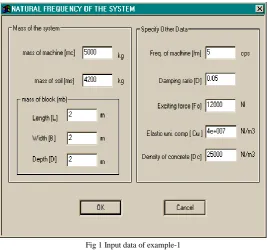
SOLUTION: Enter the data as shown in Fig 1
Fig 1 Input data of example-1
Above Fig 1 shows the input data for empirical method. Enter the respective information as shown in Fig 1. One can easily understand the value and unit of machine foundation.Make sure that all the input data are correct. After entering all data in dialog, click on “OK”.
Above Fig 2 shows the analytical results of foundation for a gas-engine. This dialog represents the results of example-1 by empirical method. This dialog also represents the natural frequency and maximum amplitude. It also represents equivalent model as shown in Fig 2.
ANALYSIS RESULTS:
[1] Mass of Block = 20387.4 kg [2] Total mass of the system = 29587.4 kg [3] Mass ratio = 5.91747 [4] Frequency of machine = 5 cps [5] Natural frequency of system = 11.7038 cps [6] Frequency ratio = 0.427213 [7] Magnification factor = 1.22159 [8] Force trans. to foundation = 14672.5 N [9] Stiffness of the system = 1.6e+008 N/m [10] Static deflection = 0.075 mm [11] Max. Deflection of the system = 0.0916193 mm
EXAMPLE 2 By Elastic half space method:
A block of size 1.5m x 0.75m x 0.7m shall be cast at site at a particular depth, where the machine foundation is to be laid. A mechanical oscillator should be mounted on the block. Experiment gives the following results:
[1] Distance between two geophones = 3.4m [2] Frequency of oscillator = 3 cps
[3] Density of soil = 18 KN/m3 [4] Poisson’s ratio = 0.35
It is required to find the value of modulus of elasticity and shear modulus of soil.
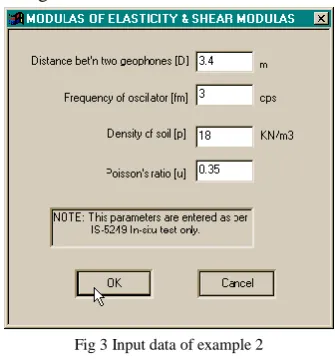
SOLUTION: Enter the data as shown in Fig 3
Fig 3 Input data of example 2
ANALYSIS RESULTS:
Fig 4 Results of example 2
In this way, we can obtain the value of modulus of elasticity and shear modulus of soil using above experiment results. Above Fig 4 also shows the experiment set up as per IS: 5249 code provisions. Above results shows the value of modulus of elasticity and shear modulus of soil. It also shows the experimental set up as per IS:5249.
EXAMPLE 3 Bypauw&Balakrishna method:
Determine the natural frequency of a machine foundation by Pauw and Balakrishna’s method having following data: [1] Mass of engine = 5000 kg
[2] Total mass of foundation = 10000 kg [3] Mass of participating soil = 1500 kg [4] Stiffness of the system = 160000 kN/m
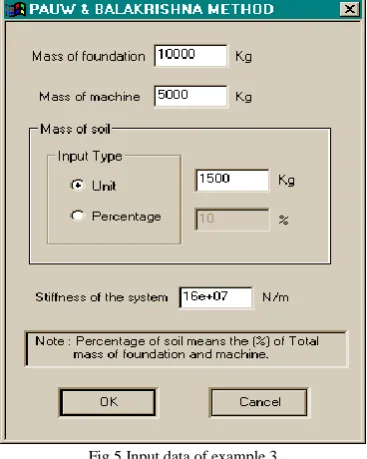
SOLUTION: Enter the data as shown in Fig 5
Above Fig 5 shows the input data for pauw and balakrishna method. One can enter mass of soil as unit or percentage of total mass. Enter the respective information as shown in Fig 5. Make sure that all the input data are correct. After entering all data in dialog, click on “OK”.
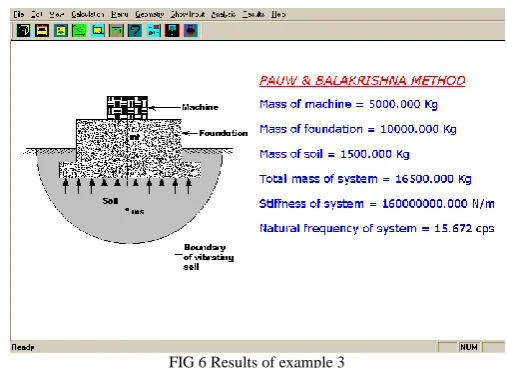
ANALYSIS RESULTS:
FIG 6 Results of example 3
Above Fig 6 shows the natural frequency of the whole system. However, this method is not well developed, because evaluation of mass of participating soil under vibration is more difficult and complex in real behaviour of machine foundation.
III. CONCLUSION
Following conclusions are some advantages of the application package:
This package is user friendly for dynamic analysis of block foundation problems.
The package can be used as a tool to prepare academic problems related to machine foundation. This software is a powerful tool, which can display colorful geometry and c.g. diagram. It covers almost all types of input data and gives all types of inertia and dynamic forces.
This package can analyze the block-type foundation dynamically using various methods, like Elastic-half-space, Alpan, Pauw and Balakrishna.
This application can be used to find out natural frequency and amplitude of machine foundation subjected to dynamic forces.
REFERENCES
[1] P.Srinivasulu and Vaidyanathan, “Hand Book of Machine Foundation”, Tata McGraw-Hill, New Delhi,1976.
IS: 2974-part-1,“Code of practice for design and construction of machine foundation”,Foundation for reciprocating machines,1982.
[2] Richart, F.E.,“Foundations Vibrations”, Tran. ACSE, Vol 127, Part-1,1962.
[3] Richart, F.E., Jr., J.R. Hall Jr., and R.D.Woods , “Vibrations of soil and foundations”, Prentice Hall, Englewood Cliff, N.J.,1970.
[4] K.R.Arora: “Soil Mechanics And Foundation Engineering”, Standard Publishers Distributors,2000.
[5] Pauw. A: “A Dynamic Analogy for foundation soil system”,ASTM Spec.Tech. Publication, STP, page 3-34,1953.
[6] Bowles.J.E.: “ Foundation analysis and design”, McGraw-Hill, New York, 1982.
[7] Whitman.R.C. and Richart, F. E., Jr. “Design procedures for dynamically loaded foundations”, J. Soil Mech.Found. Div., ASCE., 93, SM-6,
page 169-193,1967.
[8] Davis.Chapman: “Teach Yourself Visual C++ 6 in 21 Days”, Techmedia, 1998.
[10] Dhir. O. P, “Design of reciprocating compressor foundation”, Journal of Institution of Engg. (India).,Vol-45, No.3, Part C-12, page 249-257,1964.
[11] Goyal. S. C. and Singh. A., “Soil engineering aspect of design of machine foundation”, Bulletin of Indian National Society of soil mechanics
and foundation engineering, No.6, 1960.
[12] BalakrishnaRao, H. A.,“Foundation for reciprocating type of machine”, Journal of institution of engineers, (India), Vol-42, No.11, C-16, July, page 545-555, 1962.
[13] BalakrishnaRao, H. A. and Nagaraj C. N., “A new method for predicting the natural frequency of soilFoundation systems”, Structural