ABSTRACT
PAZHAYAVEETIL, ULLAS CHANDRASEKHAR. Hardware Implementation of a Low Power Speech Recognition System. (Under the direction of Dr. Paul Franzon.)
Speech is envisioned as becoming an important mode of communication and interaction
with computing devices and systems in the future. The potential for speech recognition
applications both in our living environment as well as our workplace is well understood,
and is driving the shift from current command and control applications to full fledged
speech recognition systems. While these systems would be especially useful in future
mobile embedded domains, the real-time performance requirements of such systems
cannot be met by current embedded processors. Even modern high performance
microprocessors are barely able to keep up with the real time requirements of
sophisticated speech recognition applications often straining the resources of the host
processor while incurring a power consumption that is prohibitive in the embedded space.
Custom ASIC solutions in the past have focused on faster clock rates and logic speeds,
and have largely ignored the power reduction aspect of the problem. In this dissertation,
we approach the speech recognition problem by a) designing a custom ASIC that is
flexible enough to adapt to evolutionary improvements in the design and take advantage
of these improvements at the algorithmic level to achieve low power operation, and b)
restructuring the memory and adapting a lexical style dictionary along with an innovative
Our Gaussian Estimator achieves real-time performance while reducing power
consumption by 2 orders of magnitude over a software implementation running on a
Pentium 4 processor, and by 43% over the best previous comparable ASIC design. Our
design also achieves 3 orders of magnitude improvement in energy consumption over the
Pentium 4 and 35% improvement in energy consumption over the previous ASIC design.
Similarly our Viterbi Decode unit performs real-time speech recognition while
achieving an improvement of 3 orders of magnitude over the Pentium 4 and 1 order of
magnitude improvement over the previous design – the perception processor – in both
power and energy savings.
Our final design achieves real-time recognition over a vocabulary that is 6-12
HARDWARE IMPLEMENTATION OF A LOW POWER SPEECH RECOGNITION SYSTEM
by
ULLAS CHANDRASEKHAR PAZHAYAVEETIL
A dissertation submitted to the Graduate Faculty of North Carolina State University
in partial fulfillment of the requirements for the Degree of
Doctor of Philosophy
ELECTRICAL ENGINEERING
Raleigh, North Carolina
2007
APPROVED BY:
_________________________ _________________________
Dr. Suleyman Sair Dr. Min Kang
__________________________ _________________________
Dr. Paul Franzon Dr. W. Rhett Davis
DEDICATION
Two very special people have been responsible for helping me complete this work, and
their contribution began far before I even joined this project. They are the two greatest
people I know and whom I have the privilege of proudly calling my parents – Mr.
Chandra Sekhar and Mrs. Rajalakshmi Chandra Sekhar. This dissertation is a testament to
their foresight, love, support and their willingness to sacrifice so that I never had to. None
BIOGRAPHY
Ullas Chandra Sekhar received his Bachelor of Technology in Electrical Engineering
from the Indian Institute of Technology, Madras in 2001. He was also awarded the Dr.
Ing Dieter Kind Prize for the best B.Tech project in Electrical Engineering for 2001. He
received his Master of Science in Electrical Engineering in 2003 from the University of
Texas at Arlington. During his MS program, he worked as a research assistant at the
Automation and Robotics Research Institute. He joined North Carolina State University
in 2003, where he worked both as a research assistant and a teaching assistant while
working towards his Ph.D. His research interests are primarily hardware and ASIC
ACKNOWLEDGEMENTS
I would like to thank my advisor, Dr. Paul Franzon, for his patient mentoring and
guidance through out this research. He managed to maintain the perfect balance between
giving me a free hand in exploring research ideas, and steering me towards focusing on
the core goals of the project. His confidence in this fledgling project during rough patches
and roadblocks, and his support both in matters relating to this research as well as outside
of it, have been two of the greatest assets to this research dissertation. I would also like to
thank the rest of my committee – Dr. Rhett Davis, Dr. Suleyman Sair, and Dr. Min Kang
– for their generous advice and help, especially in finding solutions to practical issues
that came up during the course of this research. Their open-door policy has been
extremely reassuring. I would like to thank my friends for providing a balance to my
lifestyle, which would otherwise have been ‘a graduate student’s life’. Last, but certainly
not the least, I would like to thank my family – my father Mr. Chandra Sekhar and my
mother Mrs. Rajalakshmi Chandra Sekhar, for their love, support and sacrifice, my
brother Unmesh who could not have cared less about the details of what I did, but
listened to me nevertheless just because it was important to me, and finally my fiancé
Gayathri for getting me through this last year, and lifting my spirits when things looked
TABLE OF CONTENTS
Page
LIST OF TABLES ...………...…… viii
LIST OF FIGURES ...……….... ix
1. INTRODUCTION ………... 1
1.1 The Problem ……….. 2
1.2 The Solution ……….. 5
1.3 Organization of the Dissertation ……… 7
2. BACKGROUND ………. 8
2.1 Acoustic Modeling ……… 8
2.1.1 A brief overview of speech recognition and HMMs. 8 2.1.2 Phones & Triphones ……….. 14
2.2 Language Modelling ……… 18
3. RELATED WORK ……… 24
3.1 Commercially Available Systems ………... 24
3.2 Research Systems ……… 27
3.3 Implementations on general-purpose processors ……… 28
3.4 Hardware Solutions ………. 30
3.5 Digital Signal Processing Solutions ……… 35
4. SYSTEM ARCHITECTURE ……… 36
4.1 Front-end ………. 38
5. GAUSSIAN ESTIMATOR ………..……….. 42
5.1 Baseline Gaussian Estimator ………... 43
5.2 Flexible Gaussian Estimator ……… 46
5.2.1 Layer Categorization ………. 47
5.2.1.1 Frame-Layer Algorithms ……… 47
5.2.1.2 GMM-Layer algorithms ……….. 49
5.2.1.3 Gaussian-Layer algorithms …………. 49
6. VITERBI DECODER ………... 56
6.1 Implementation of the Viterbi Decoder (Flat Dictionary) …... 58
6.1.1 State-Update-Stage ……… 59
6.1.1.1 Viterbi Decoder Memory Elements … 59 6.1.1.2 The Viterbi Decode Process ………... 64
6.1.2 Word-Update-Stage ……….. 66
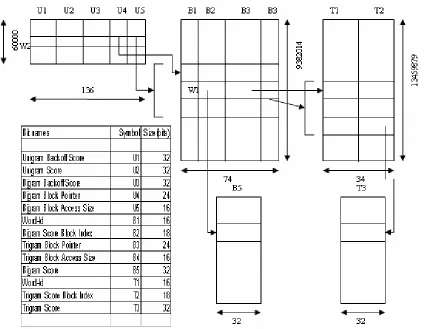
6.1.2.1 Language Model Memory Blocks ….. 66
6.1.2.2 Language Model Search ………. 68
6.1.3 Analysis ………. 71
6.2 Improvements to the initial design ……….. 79
6.2.1 Switching to the lexical tree structure …………... 79
6.2.2 Implementing the tree structure ……… 80
6.2.2.1 Handling within word transitions – Memory structure for the lexicon tree ……… 81
6.2.2.2Handling word to word transitions – Timestamps ….………. 83
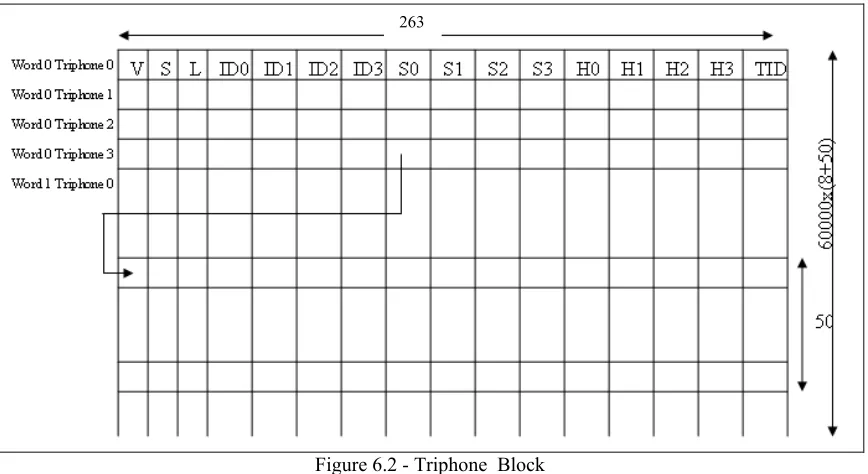
6.2.3 Modified Triphone_block ………. 87
6.2.4 Memory Savings ………... 88
6.2.5 Implications of new implementation ……...……. 88
6.3 Implementation of the Viterbi Decoder (Lexical Tree Dictionary) ……… 92
6.3.1 Overview of the implementation ………... 93
6.3.2 Accessing the Memory ……… 101
6.3.3 DRAM Interface ………. 103
6.3.4 Functional Units ………... 104
6.3.4.1 Viterbi Update Unit-1 ………... 104
6.3.4.2 Final 50 Initiator Unit ………... 108
6.3.4.3 Viterbi Update Unit-2 ………... 113
6.3.4.4 Deselect Unit ………..…... 113
6.3.4.5 Language Model Unit ………... 116
7. EVALUATION ………... 118
7.1 Gaussian Estimator ……… 121
7.2 Viterbi Decoder ………...……….. 125
8. CONCLUSION ………... 132
8.1 Summary ………... 134
8.1.1 Real time performance & area ……… 134
8.1.2 Memory Requirement ………. 135
8.1.3 Memory Bandwidth requirement ……… 135
REFERENCES ………... 138
LIST OF TABLES
Page
Table 5.1 - SRAM and DRAM specifications ………. 45
Table 6.1 - Contents of Triphone_Block ………. 60
Table 6.2 - Viterbi Decoder Memory Element Sizes ………... 71
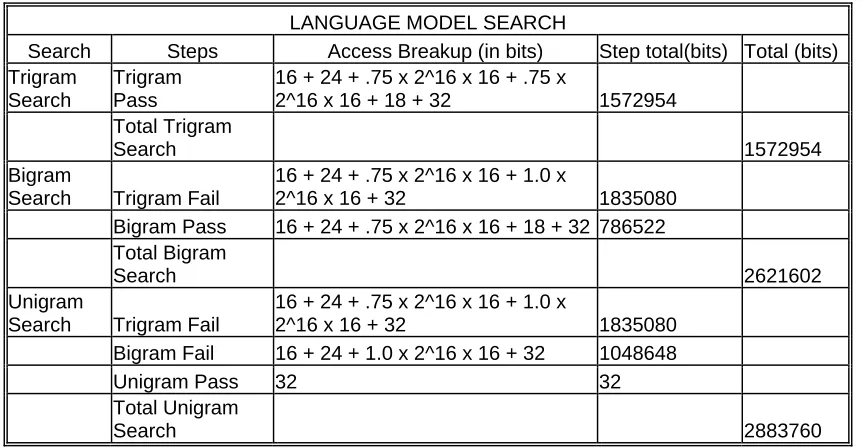
Table 6.3 - Language Model Search Access Breakup ………. 76
Table 6.4 - Triphone_block row bits (old and new) ……….... 81
Table 6.5 - Signals in the Viterbi Update Unit –1 ………. 106
Table 6.6 - Signals in the Initiator ………. 109
Table 6.7 - Signals in the MEM_Allocator ……….... 113
Table 6.8 - Signals in the Viterbi Update Unit –2 ………. 114
Table 7.1 - Memory Requirement Breakup comparison ………... 126
Table 7.2 - Memory access breakup for single frame ……… 128
LIST OF FIGURES
Page
Figure 1.1 - Performance of SPHINX 3 on Intel Pentium 3
and later processors (900MHz to 3GHz) ……… 3
Figure 1.2 - Performance and power considerations for speech recognition on modern architectures ……….. 4
Figure 2.1 - Schematics of an LVR (Large Vocabulary Recognition) system ……….. 9
Figure 2.2 - Hidden Markov Model ………. 10
Figure 2.3 - Block diagram of node representing state j ……….. 12
Figure 2.4 - Decoder structure showing forward computation and backtracking ….... 13
Figure 2.5 - HMM for word ‘HI’ ………. 17
Figure 2.6 - State-tying ……… 17
Figure 2.7 - Use of Language model …….………. 21
Figure 4.1 - System Overview ………. 36
Figure 4.2 - System Implementation Overview ………... 38
Figure 4.3 - Front-End ………. 39
Figure 5.1 - Baseline Gaussian Estimator ……….... 44
Figure 5.2 - Reduced Calculation Gaussian Estimator ……….... 46
Figure 5.3 - Gaussian Estimator Interfacing ……… 51
Figure 5.4 - Gaussian Estimator ……….. 53
Figure 6.1 - Flat vs. Lexical Dictionary .……….. 57
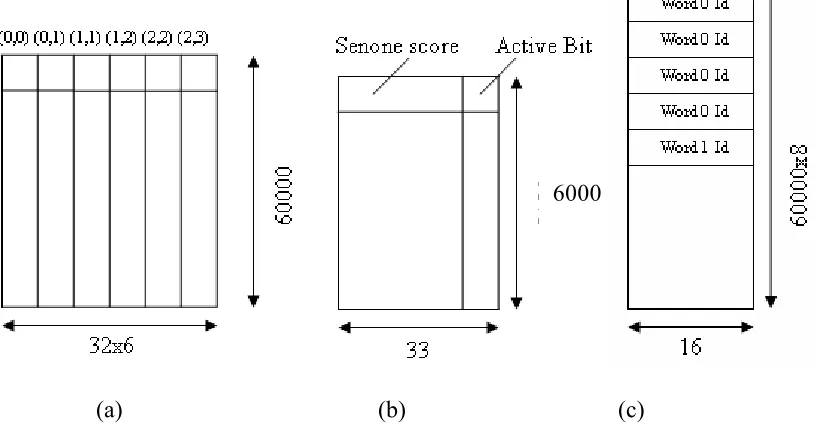
Figure 6.3 - (a) Transition_Block (b) Senone_Score (c) Word_Lookup …………... 62
Figure 6.4 - (a) Identified_Words (b) Last_Phone_Score ………. 63
Figure 6.5 - Update Unit ……….. 65
Figure 6.6 - Language Model Memory Blocks ……….... 69
Figure 6.7 - Memory access per frame ……….... 77
Figure 6.8 - Triphone_block row (old and new) ……….. 81
Figure 6.9 - Within-word transition example ……….. 82
Figure 6.10 - (a) temp_list (b) Identified_words ……….. 85
Figure 6.11 - Final 50 initialization ………. 87
Figure 6.12 - Viterbi Decoder and its interfacing ……… 92
Figure 6.13 - Phase 1 ……… 94
Figure 6.14 - Checking the Availability List and allocating space in Triphone_Block_Type_B ………. 96
Figure 6.15 - Phase 2 ……… 98
Figure 6.16 - Phase 3 ………... 99
Figure 6.17 - Phase 4 ……….. 100
Figure 6.18 - Senone Score Updating ……… 102
Figure 6.19 - DRAM Interfacing ………... 103
Figure 6.20 - The Viterbi Update Unit –1 ……….. 106
Figure 6.21 - Final 50 Initiator Unit – Initiator ……….. 109
Figure 6.22 - Initializing and updating Triphone_Block_Type_B ………. 111
Figure 6.23 - Final 50 Initiator Unit – MEM_Allocator ……… 112
Figure 6.26 - Language Model Unit ……….. 117
Figure 7.1 - GE Real Time Performance (speed) ……….. 122
Figure 7.2 - GE Power Consumption ………. 123
Figure 7.3 - Power Consumption across systems – Benchmark 1 ………. 124
Figure 7.4 - Process Normalized Energy Consumption across systems – Benchmark 1 ……… 124
Figure 7.5 - Final Implementation Memory Breakup ……… 126
Figure 7.6 - Initial Implementation Memory Breakup ………... 127
Figure 7.7 - Power Consumption across systems – Benchmark 2 ………. 130
CHAPTER 1
Introduction
Speech recognition has been an area of active research for more than 40 years [1],
maturing from an area of pure academic research to one with growing use in the
marketplace. Opportunities for application of speech recognition are immense and
diverse. The trend of a constantly increasing number of computing devices, both in our
living environment, as well as our workplace, calls for a better way of interacting with
them. Speech is already an established mode of communication in many mobile
embedded environments, and the value of speech recognition applications in such
environments is immeasurable. When compared to other forms of communication, speech
has some attractive advantages. A person can speak about 3-4 times faster than they can
type, allowing for greater communication efficiency. It is ideal for multi-modal tasks
since the hands and eyes are free to do other tasks. Speech accessories are cheap, easily
available and small, creating mobile capacity. Thus this hands-free, user friendly nature
of speech coupled with improvements in processor speeds and trends of ubiquitous
computing, promise to make speech a primary human/machine interface in the near
1.1
The Problem
A variety of software packages for speech recognition are available in the mass market
today, such as Dragon Systems' Dragon Naturally Speaking, IBM's ViaVoice, Lernout &
Hauspie's Voice Xpress, and Philips FreeSpeech98[2]. Vocabularies in commercial
systems today range from 20,000 to 150,000 words. Recognition accuracies have been
steadily improving as well, though current systems are still not sufficiently accurate to
easily take dictation without straining the resources of the microprocessor. The CMU
‘Speech in Silicon’[3] is another project that is working at developing a hardware
solution to speech recognition.
A successful design of a speech recognition system involves achieving accuracy
levels of >95% while being fast enough to be able to process speech in real time. The
system should be able to achieve speaker-independent speech recognition for multiple
languages. (i.e. the system must be deployed with base training (speaker independent
models) with update and training facilities). The system should be flexible enough to
handle different dialects and speech model parameters with minimal effort to change
dialects, ideally requiring only a download of a new model. Power savings have also
come to be of significant importance during the designing of such systems due to their
application in the embedded domain.
Even modern high performance microprocessors are barely able to keep up with
the real time requirements of sophisticated speech recognition applications. The run times
[4] for a 29.3 sec segment of speech over the SPHINX III speech recognition system is
shown in Figure 1.1. The theoretical run times are based on ideal scaling of performance
does not scale ideally. In theory a 2.4 GHz processor should achieve real time
performance. In practice a processor frequency of approximately 2.9 GHz is required to
satisfy real time requirements.
Figure 1.1 - Performance of SPHINX 3 on Intel Pentium 3 and later processors (900MHz to 3GHz)
This performance gap suggests that when moving to more complex future speech
recognition workloads higher frequencies alone are not the solution, fundamental
architectural improvements are called for. The speech recognition system also severely
limits the processor’s availability for other task. The results clearly show that speech
applications stress the performance limits of high-end processors.
By their very nature, applications such as speech are likely to be most useful in
mobile embedded systems. A fundamental problem that plagues these applications is that
they require significantly more performance than current embedded processors can
featured speech recognizer. The energy consumption that accompanies the required
performance level is often orders of magnitude beyond typical embedded power budgets.
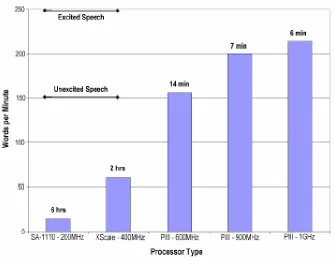
Figure 1.2 provides a rough estimate of the speech recognition rate achievable on various
modern computing systems [5]. Annotated above each bar is the time each processor
class would operate on a single “AA” rechargeable battery (1600 mA·Hr). It is clear that,
while high-end systems are within the performance range necessary for real-time speech
recognition, they far exceed the power budget of portable devices.
Figure 1.2 - Performance and power considerations for speech recognition on modern architectures
Another problem that these systems face especially in the mobile domain is that
with new and emerging techniques in speech recognition, it is more attractive to find a
solution that can readily adapt to most if not all of the developments and techniques.
Often many of these new techniques prove to be useful in more than one domain. As an
reduce both processing and power consumption as well as required memory bandwidth. It
is prudent to look into finding a way to incorporate these into our own system.
1.2 The Solution
The problem can now be redefined as finding a solution that provides high accuracy
speech recognition at speeds high enough for real time processing while consuming
minimum power and also being able to incorporate a degree of flexibility to new and
emerging techniques. These problems are easily dealt with by a custom ASIC
coprocessor with some flexibility built into it. Speech and security interfaces are by
nature always on. Stressing the host processor with the speech recognition task limits its
availability for other tasks. Thus a speech coprocessor can help free-up resources so that
the host processor can focus on other tasks. An ASIC can also help achieve high-end
speech recognition within the power budget of embedded processors. Similar to video
cards in a standard PC, speech on a chip has the ability to perform better than a speech
recognition system in software running on a processor.
While an ASIC solution is attractive, it limits the flexibility and level of generality
offered. Speech is a rapidly growing field and the techniques used to process and
recognize speech improve constantly. These improvements reflect not only such factors
such as accuracy and speed, but also on the reduction in power consumption and a
general improvement of the process as a whole. In this dissertation, one of our strategies
was to preserve a level of flexibility in the architecture that we developed. The advantage
to this was two-fold. Firstly, new and emerging techniques may become a standard for
adapt to these techniques, we ensure that our design remains competitive. Secondly, our
design will be able to take advantage of the performance improvements offered by these
new techniques to achieve even better performance numbers.
A bottleneck that has been commonly identified in speech recognition designs is
the memory bandwidth required by this application especially when trying to perform
real-time recognition. The total amount of data that is needed to support and perform an
application such as speech recognition is quite large. A large training set, complex
acoustic and language models, and a very large parameter set is usually required to
support the complex nature of the application. Having a larger parameter set and
better-trained models also contribute to the performance of the application in terms of accuracy
and recognized vocabulary size. However the tradeoff is speed and power.
While the total amount of data required for speech recognition is large, not all of
this data is used all the time. By controlling and manipulating the amount of data
accessed each time frame, it is possible to maximize the use of data accessed, while at the
same time minimizing or eliminating unnecessary accesses.
Keeping this in mind, we restructured how the data is arranged and accessed,
switching from a flat vocabulary structure to a lexical structure. By coupling this with our
innovative ‘Timestamp’ technique and dynamic memory allocation, we eliminated
redundancies and reduced the total data that needed to be processed every time frame.
This led to a design that provided immediate savings in terms of memory bandwidth,
1.3 Organization of the Dissertation
Chapter 2 will provide an introduction to the basics of speech recognition. Chapter 3 will
describe previous research and related work. Chapter 4 will provide an overview of the
system design and also discuss the front end in some detail. Chapter 5 presents the
design(s) of the Gaussian Estimation unit. Chapter 6 presents the Viterbi Decoder Unit
with emphasis on the design issues and advantages of switching from a flat tree structure
to a lexical tree structure. The performance of these designs is analyzed in Chapter 7.
Chapter 8 draws conclusions and highlights important points in the design
CHAPTER 2
Background
2.1 Acoustic Modeling
2.1.1 A brief overview of speech recognition and HMMs [1, 4, 6, 7, 8, 9]
The front-end converts an unknown speech waveform into a sequence of acoustic vectors
Y=y1,y2,y3…each representing a short time (10 ms) speech spectrum of the speech signal.
This is also known as the observation sequence. This sequence may correspond to a
number of actual word sequences W= w1,w2,w3…(It should noted that W actually refers
to a sequence of representative models which could be words, but usually are sub word
units). The basic speech recognition task is to determine the most probable word
sequence Wp =w1,w2,w3…, given the observed acoustic signal Y:
Wp =
w
max
arg P(W|Y) =
w
max
arg ((P(W)P(Y|W)/P(Y)) (2.1)
The first term P(W) is the probability of observing W independent of the observed signal
(sequence) Y, which is determined by a language model. The probability P(Y|W) is
determined by an acoustic model. Figure 2.1 shows the computation of the probabilities
of a postulated word sequence W = "This is speech". Each word is converted into a
sequence of phones applying a pronouncing dictionary, and for each phone there is a
HMMs (representing the postulated utterance) are concatenated to form a single
composite model. The probability of that model generating the observed signal Y is
calculated, yielding the wanted probability P(Y|W). This decoding process may be
repeated for all possible word sequences, and the most likely sequence is selected for the
recognizer output as the ‘recognized speech’.
Figure 2.1 - Schematics of an LVR (Large Vocabulary Recognition) system. It
shows the computation of the probabilities of a postulated word sequence
W = "This is speech" [7]
An N-state Markov Model is completely defined by a set of N states forming a finite state
machine, and an NxN stochastic matrix defining transitions between states, whose
elements aij represent the probability of transitioning from state i to j at time t; these are
the transition probabilities. With a Hidden Markov Model, each state additionally has
that state j emits a particular observation Yt at time t (the model is “hidden” because any
state could have emitted the current observation). The probability density function (p.d.f).
can be continuous or discrete; accordingly the pre-processed speech data can be a
multi-dimensional vector or a single quantized value. The quantity bj(yt) is known as the
observation probability. Such a model can only generate an observation sequence
Y=y1,y2,y3…yT via a state sequence of length T, as a state only emits one observation at
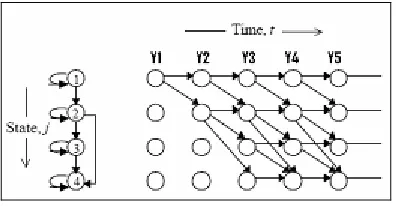
each time t. The set of all such state sequences can be represented as routes through the
state-time trellis shown in Figure 2.2. The (j,t)th node (a state within the trellis) corresponds to the hypothesis that observation Yt was generated by state j. Two nodes
(i,t-1) and (j,t) are connected if and only if aij > 0.
Figure 2.2 - Hidden Markov Model showing the finite state machine for the HMM (left), the Observation sequence (top),and all possible routes through the trellis
As described above, we compute P(W|Y) by first computing P(Y|W). Given a state
sequence Q=q1 q2…qT, where the state at time t is qt, the joint probability, given a model
W, of state sequence Q and observation sequence Y is given by:
P(Y,Q|W) = b1(y1)
∏
= T t 2
aqt-1qtbqt(yt) (2.2)
Assuming the HMM is in state 1 at time t = 1, P(Y,Q|W) is the sum of all possible routes
P(Y|W) =
∑
allQ
P(Y,Q|W) (2.3)
In practice, the probability P(Y|W) is approximated by the probability associated with the
state sequence which maximizes P(Y,Q|W). This probability is computed efficiently
using Viterbi decoding. Firstly, we define the value δt (j), which is the maximum
probability that the HMM is in state j at time t. It is equal to the probability of the most
likely partial state sequence Q=q1 q2…. qt, which emits observation sequence
Y=y1,y2,y3…, and which ends in state j:
δt(j) =
qt q
q1max, 2... P(q1,q2…qt ; qt = j ; y1,y2…yt|W) (2.4)
It follows from Equation 2.2 and 2.4 that the value of δt(j) can be computed recursively as
follows:
δt(j) =
N i≤ ≤
1
max [ δt-1(i)aij].bj(yt) (2.5)
where i is the previous state (i.e. at time t-1). This value determines the most likely
predecessor state ψ t(j), for the current state j at time t, given by:
ψt(j) =
N i≤ ≤
1
max
arg [ δt-1(i)aij] (2.6)
At the end of the observation sequence, we backtrack through the most likely predecessor
states in order to find the most likely state sequence. Each utterance has an HMM
representing it, and so this sequence not only describes the most likely route through a
particular HMM, but by concatenation provides the most likely sequence of HMMs, and
hence the most likely sequence of words or sub-word units uttered.
Each node in the trellis must evaluate Equation 2.5 and Equation 2.6. This
observation probability bj(yt) to produce the result. After a number of stages of
multiplying probabilities in this way, the result is likely to be very small. In addition,
without some scaling method, it demands a large dynamic range of floating point
numbers, and implementing floating point multiplication requires more resources than for
fixed point. A convenient alternative is therefore to perform all calculations in the log
domain[10]. This converts all multiplications to additions, and narrows the dynamic
range. Hence Equation 2.5 becomes
δt(j) =
N i≤ ≤
1
max [ δt-1(i) +log aij] +log [bj(yt)] (2.7)
The result of these changes means that a node can have the structure shown in Figure 2.3.
The figure highlights the fact that each node is dependent only on the outputs of nodes at
time t-1, hence all nodes in all HMMs at time t can perform their calculations in parallel.
The way in which this can be implemented is to deal with an entire column of nodes of
the trellis in parallel.
Figure 2.4 - Decoder structure showing forward computation and backtracking
As the speech data comes in as a stream, we can only deal with one observation vector at
a time, and so we only need to implement one column of the trellis (In actuality,
implementing the entire trellis is area heavy and unnecessary as will be seen later. Instead
an optimum number of ‘node units’ are designed so that each unit will update a set
number of nodes). The new data values (observation vector yt and maximal path
probabilities δt-1(j)) pass through the column, and the resulting δt values are latched, ready
to be used as the new inputs to the column when the next observation data appears.
Each node outputs its most likely predecessor state yt(j), which is stored in a
sequential buffer external to the nodes. When the current observation sequence reaches
its end at time T, a sequencer module reads the most likely final state from the buffer,
chosen according to the highest value of δT(j). It then uses this as a pointer to the
collection of penultimate states to find the most likely state at time T-1, and continues
with backtracking in this way until the start of the buffer is reached. As the resulting state
sequence will be produced in reverse, it is stored in a sequencer until the backtracking is
complete, before being output. This state sequence reveals which HMMs have been
traversed, and hence which words or sub-word units have been uttered. This information
2.1.2 Phones & Triphones[11,12,13,14]
Equation 2.1 needs the quantity P(Y|W), the probability of an acoustic vector sequence Y
given a word sequence W to find the most probable word sequence. A simplistic
approach to achieve this would be to obtain several samples of each possible word
sequence, convert each sample to the corresponding acoustic vector sequence and
compute a statistical similarity metric for the given acoustic vector sequence Y to the set
of known samples. For large vocabulary speech recognition this is not feasible because
the set of possible word sequences is very large. Instead words may be represented as
sequences of basic sounds. Knowing the statistical correspondence between the basic
sounds and acoustic vectors, the required probability can be computed. The basic sounds
from which word pronunciations can be composed are known as phones or phonemes.
Approximately 50 phones may be used to pronounce any word in the English language.
For example, the sentence ‘This is speech’ is represented as ‘th ih s ih z s p iy ch’.
While phones are an excellent means of encoding word pronunciation, they are
less than ideal for recognizing speech. The mechanical limits of the human vocal
apparatus leads to co-articulation effects where the beginning and end of a phone are
modified by the preceding and succeeding phones. Recognizing multiple phone units in
context tends to be more accurate than recognizing individual phones. Current speech
recognition systems deal with three-tuples of phones called triphones. It is customary to
denote triphones as left context-current phone+right context. For example ‘th-ih+s’ is a
triphone that represents the context of the ‘ih’ phone in the word ‘this’. The final ‘ch’
phone in dissertation can be modeled with a cross-word triphone whose right context is
phone that denotes silence. Though there are approximately 50x50x50 = 125000 possible
triphones, only about 60,000 actually occur in English.
The front-end processes every 10ms data input and extracts relevant features that
will enable the recognition process. This involves converting every 10ms of speech into a
39-element vector, that has statistical information about itself (each element having
means, variances, mixture weights and scale factors). This then needs to be compared
using some distance measure to every triphone phone model and the observation output
probability for this input was obtained.
Initial HMM recognizers used discrete OPFs and sub-vector quantized (VQ)
models, which are easy to compute. The acquired acoustic vector was replaced by the
index of the closest codebook vector, and OPFs were just look-up tables containing the
VQ index probabilities. While this is computationally efficient, the discretization of
observation probability leads to excessive quantization error and thereby poor recognition
accuracy. To obtain better accuracy, modern systems use a continuous probability density
function and the common choice is a multivariate mixture Gaussian in which case the
computation may be represented as [8]:
∑
∑
∏
= = = ⎟ ⎟ ⎠ ⎞ ⎜ ⎜ ⎝ ⎛ − − = M m N n jm jm t N n jm D m t j n n n y n w y b1 1 2
2 1 2 2 / [ ] ]) [ ] [ ( 2 1 exp ] [ ) 2 ( ) ( σ µ σ π (2.8)
Here yt is the input vector, µjm and σjm represent the mean and standard deviation of the
multivariate Gaussian, wm is the mixture weight, m is the no. of mixtures and n is the no.
of feature vectors. The term before the exponent does not depend on the input and can be
2.8 and reduces the exponent calculation to simple multiplications. Performing these
modifications, Equation 2.8 reduces to
∑ ∑
= = × − = M m N n im jm t im tj y c y n n V n
b
1 1
2 [ ]
]) [ ] [ ( ) (
log µ (2.9)
Cim being the final mixture weight and Vim being the variance. The HUB4 speech
database which was considered for this research chose the values of M and N to be 8 and
39 respectively. The outer term represents an addition in the log domain. Every triphone
model would require pre-training which means that the number of parameters to be
estimated is about 60000 x (39x8x2+8) = 11.37 million parameters. The training data
usually available is insufficient to estimate so many parameters. The usual solution is to
cluster together HMM states and share a probability density function among several
states (Figure 2.6). Systems using such clustered probability density functions are called
semi-continuous or tied-mixture systems. Groups of states that are tied together are called
‘senones’. The total number of senones in the English Language ranges between 4000
and 6000.
The utterance hierarchy for the word ‘HI’ is shown in Figure 2.5. Each triphone is
represented by a 4 state HMM. Only the first 3 states are emitting states (i.e., they can
produce an observation vector yt). The last state is a null state. The overall effect is that of
combining all the triphone HMMs by adding null transitions between the final states of
one triphone HMM to the initial state of its successor. To model continuous speech, null
sil-hh+ay hh-ay+sil
Figure 2.5 - HMM for word ‘HI’, with phones ‘hh’&’ay, and triphones ‘sil-hh+ay’&‘hh-ay+sil’. Each HMM has 3 emitting senone states (striped oval) and one nullstate (plain oval).
Figure 2.6 - State-tying[7]
The viterbi search is modeled as a lexical tree search[15,16]. The roots of the tree
correspond to the set of all triphones that start any word in the dictionary. Each node in
the tree points to the next triphone in the expanded pronunciation of a word etc.
Triphones that occur at the end of a word are specially marked so that a language model
may be consulted at those points. Thus the lexical tree is a multi-rooted tree where each
node points to an HMM and a successor node. In the case of word exit triphones there are b1(yt) bb2(yt) 3(yt)
a00
a01 a11
a12 a22
a23
b1(yt) bb2(yt) 3(yt) a00
a01 a11
a12 a22
applied successively to the HMMs and the probability that the HMM generated that
vector is noted. Transitions are made in each step to successor nodes. On reaching a word
exit triphone, the state sequence history is consulted to find the word that has been
recognized. The last n words (usually n=3) are checked against a language model for
further analysis. Acoustic vectors are evaluated successively and on evaluating an HMM
for the current vector, if the HMM generates a probability above a certain threshold, the
successors of the HMM will be evaluated in the next time step. Thus there is always a list
of currently active HMMs/lexical tree nodes and a list of nodes that will be active next.
This combination of the Viterbi search combined with pruning techniques (comparing
with threshold) is known as the Viterbi Beam Search[17-20]. Pruning prevents
uncontrolled generation and maintenance of nodes with time by deactivating
low-probability paths.
2.2 Language modeling
The introduction of a language model to the speech recognition unit increases accuracy of
the recognition hypothesis [21-23]. It helps introduce additional biases to the several
alternate similar words that the acoustic model recognizes and cannot choose between.
This also helps in the quick pruning of improbable paths and the unnecessary explosion
of node generation. All state-of-the-art speech recognition systems implement a language
model in one form or the other, and so it is necessary to study the language model in
order to build a system that is commercially competitive.
N-gram models [24,25] that predict the probability of a word sequence (in other
and common approach. They encode simultaneously the syntax, semantics and
pragmatics and they concentrate on local dependencies. They are thus extremely effective
for languages like English in which word order is important and the strongest contextual
effects come from near neighbors. They also have the distinct advantage of being easy to
train. N-grams can be trained automatically from a large corpus of text.
The complexity of the modeling increases logarithmically with the size of the
vocabulary V (the complexity for an N-gram vocabulary will be V^N). Large values of N
lead to complexities both in the viterbi decoding stage as well as the training stage, where
sparse training data leads to incorrect parameter estimation. This may even have a
deteriorating effect on the recognition accuracy. Thus a modest value of 3 is chosen, and
this has proven to be sufficient in systems like Sphinx and HTK. Such models are called
trigrams. A trigram model may be trained using the following equation [26]:
) 2 , 1 ( ) 3 , 2 , 1 ( ) 2 , 1 | 3 ( w w F w w w F w w w
P = (2.10)
Here, F(w1,w2,w3) refers to the frequency of occurrence of the trigram (w1,w2,w3) in the
training text and F(w1,w2) refers to the frequency of occurrence of the bigram (w1,w2).
In practice, for a large vocabulary all possible trigrams will not be present in the training
corpus. In that case bigram or unigram probabilities are used in the place of trigram
probabilities after reducing the probability by a back-off weight, which accounts for the
fact that the next higher N-gram has not been seen and therefore has a lower chance of
occurring [27].
A typical example of the use of a language model is shown in Figure 2.7. The
contention in recognizing the phrase ‘I the’, instead of the actual phrase ‘I need the’.
With the language model, the improbable paths are pruned out leading to a good
Figure 2.7 - Use of Language model
(a) Shows the four words ‘I’,’Need’,’The’ and ‘on’, on the y-axis and the paths that the different hypotheses take as the input phones ‘aa n iy dh ax’ come in.
(b) Shows the word models for the 4 words.
(c) Shows the Bigram Probabilities obtained from the Brown Switchboard Corpus (d) Shows the path probabilities without the use of the language model.
(a) (b)
Bigram Probabilities
# Need 0.00018
# The 0.016
# On 0.00077
# I 0.079
I need 0.0016
I the 0.00018
I on 0.000047
I I 0.039
on need 0.000055
on the 0.094
on on 0.0031
on I 0.00085
need need 0.000047
need the 0.012
need on 0.000047
need I 0.000016
the need 0.00051
the the 0.0099
the on 0.00022
the I 0.00051
(d) (e) aa ay aa n dh n iy ax n iy d I on the need
aa n iy dh ax
2.6e-6x1=2.6e-6 .20x.079=.0016 .0016x.0016=2.6e-6 2.6e-6x.012x.92=2.9e-8 2.9e-8x.77=2.2e-8 .20x.079=.0016 .0016x.00018x.08=2.3e-8 2.3e-8x.12=2.8e-9 1x.00077=.00077 .00077x1=.00077 .00077x0=0 2.8e-9x0=0 aa ay aa n dh n iy ax n iy d I on the need
aa n iy dh ax
CHAPTER 3
Related Work
Several speech recognition applications have been developed in the industry and sold as
commercial products. Several speech applications and training kits are also available
from universities that are mainly oriented at speech research. Speech Recognition is
inherently a computationally demanding task and hence software solutions running on a
general-purpose processor are not good at real-time speech recognition. These systems
are not particularly designed keeping underlying architecture in mind and hence end up
squeezing all available resources of the processor. Some of the systems available are
discussed below.
3.1 Commercially Available Systems
Commercially available software systems are IBM’s ViaVoice and Dragon Systems
Dragon Naturally Speaking, claim to be able to support between 10k and 150k
vocabulary sizes. They are speaker independent though some amount of training is
encouraged. The systems can support multiple languages and report a >95% accuracy.
They are however slow and sensitive requiring the user to speak slowly and
output. These also take up a large amount of the CPU processing power effectively
blocking it from doing other tasks and also consume a large amount of power.
Considering the ‘always on’ nature of speech, these software at best work as a
‘speech-to-text’ solution used for small periods of time for very specialized functions, and are not
the best step towards making speech a general user interface.
Since a lot of the research has been done with a product in mind, the systems used
at Dragon [28-30] usually require a lot less resources than other research systems. For
instance, while most systems were using a 10ms frame size, Dragon decided to use a
coarser sampling of 20ms frame sizes. While most systems use 32-bit floating point
formats for their input features, Dragon used 8-bit fixed-point parameters. To reduce the
resource requirements even more, the commercial version applies automatic vocabulary
switching to restrict the search space.
The IBM speech recognition system differs form other competing systems by the
early use of a rank-based approach for the computation of observation probabilities that
allows avoiding certain search problems related to extreme probability values. The search
strategy is a combination of an A*[31,32] with a time-synchronous Viterbi search (the so
called ‘envelope search’) and is therefore difficult to compare to the fully
time-synchronous search of other systems. Other features that made this system substantially
different from its competitors include that during the first recognition pass the usual
mixture of Gaussian probabilities were replaced by a probability derived from the rank of
the models score [33-36]. The system has a recognition vocabulary of 65,000 words.
A version of ViaVoice is also available for embedded processors and mobile
on template recognition rather than speech processing. It has a maximum of 16k
vocabulary and maintains a dynamically swappable 4,000 word phonetic flat list. It is
speaker independent but has small database support. This system requires several minutes
of read speech to adapt to a new user.
The AT&T Watson speech recognition engine [27,37-39] is a software
implementation of the AT&T voice processing technology. It uses a gender based
triphone model and a 5-gram language model. The recognition takes place in 2 phases –
the first pass does the phone recognition, word recognition and builds the word lattice;
the second pass rescores the word graph.
Microsoft’s Whisper [31,40,41] is an adaptation of CMU’s SPHINX and
incorporates speaker adaptation and noise cancellation. The acoustic models are
compressed and hence Whisper claims to be memory efficient. The software supports a
60,000-word vocabulary with the ability to add new words. It works with any Windows
application and has two specialized applications for use in Windows - "Dictation Pad"
provides enhanced dictation features while "IntelliSense" converts spoken numbers and
times automatically.
SRI’s DECIPHER [42-44] is another HMM-based system that uses multi-pass
time synchronous Viterbi decoding. A first forward-backward pass generates
word-lattices using a 60,000-word bigram language model and context-dependent hidden
Markov models. Only within-word context dependent models were used in the first pass.
The Gaussian computation was sped up using vector quantization and Gaussian shortlists.
The second pass performed a forward-backward N-best search on the word-lattices using
expensive acoustic and language models. Most of the development effort went into the
reduction of the error rate, and only little research was reported on means for achieving
real time recognition.
SRI‘s ‘Phraselator’ [45] is a template based phrase recognition and translation
system. The Phraselator is a handheld, wireless computer used to translate more than
1,000 spoken English phrases into languages such as Arabic and Pashto. This is again a
lookup engine rather than a recognition engine.
Several smaller companies have developed IC’s for small end applications like
voice-responsive toys and voice dialers [46-50].
3.2 Research Systems
SPHINX speech recognition systems [4,13,20,51-56] are CMU’s state-of-the-art large
vocabulary speech recognition systems. They are semi continuous HMM based [13]
systems and use state-tied triphone models. It uses scaled integer observation probability
computation. Decoding is done in 2 phases with a first pass viterbi decoding done to
reduce the search space and a second pass A* algorithm to combine the results of the first
pass and the language models. Beam searches and various pruning strategies ate used to
reduce the computations and prune paths quickly. However the CMU-SPHINX system
uses an extraordinary amount of power while running on desktops and the power required
is prohibitive for mobile applications. The SPHINX–IV system is CMU’s speech
recognition system for the mobile domain. It however supports a much lower vocabulary
Cambridge University’s ABBOT system differs significantly from other systems
by being the only neural net driven system used in large-scale evaluations [57-59]. It is
also among the few systems to use a stack decoder rather than a time synchronous Viterbi
algorithm for the search process. The ABBOT system supports a 65,000-word
vocabulary. The recognition speed for this system in the evaluation was estimated to
about 60 times slower than real time on a 170MHz UltraSparc.
Cambridge University’s HTK system was the best recognizer in the 1994 LVCSR
evaluation with a word error rate of only 10.5% [60,61]. All promising algorithms such
as quinphone models, cross-word models, 4-gram language models and unsupervised
speaker adaptation were applied to this system. Considerable effort was also invested in
the pronunciation dictionaries. The commercial cousin of this system ‘Entropics’ is more
stable and more toolkit-oriented.
SONIC [62] is a toolkit for enabling research and development of new algorithms
for continuous speech recognition. The system uses HMM acoustic models and a
two-pass search strategy. Model-based adaptation methods such as Maximum Likelihood
Linear Regression (MLLR), Structured MAP Linear Regressions as well as
feature-based adaptation methods such as Vocal Tract Length Normalization, cepstral mean &
variance normalization, and Constrained MLLR are implemented [63].
3.3 Implementations on general-purpose processors
Several approaches have been taken towards finding solutions to the problems of speed,
accuracy and power consumption. Research has been traditionally geared towards
largely ignored. Even the yearly HUB speech recognition evaluation reports typically
emphasize improvements in recognition accuracy and mention improvements in
performance as a multiple of “slow down over real-time” [64, 65].
Binu [4] used rapid semi-automatic generation of low-power high performance
VLIW processors for the perception domain. Energy efficiency was primarily achieved
by minimizing communication and activity using complier-controlled fine-grain clock
gating. Ravishanker’s research improved the performance of the Sphinx speech
recognition system by trading off accuracy in a computationally intensive phase for faster
run time and then recovered the lost accuracy by doing additional processing in a
computationally cheaper phase of the application [52]. This research also reduced the
memory footprint of speech recognition by using a disk based language model cached in
memory by the software. Agram, Burger and Keckler characterized the Sphinx II speech
recognition system in a manner useful for computer architects [66]. They focused on ILP
as well as memory system characteristics including cache hit rates and block sizes and
concluded that available ILP was low. They compared the characteristics of the Sphinx II
system with those of Spec benchmarks and also hinted at the possibilities and problems
associated with exploiting thread level parallelism.
Intel ICRC lab researchers executed the Intel speech recognition system on
several versions of the x86 processor [67]. The study focused on the run time and size of
the working set, and the language was Mandarin Chinese. They reported a decrease in
ILP with increased clock rate. IPC decreased from between 1 and 1.2 at 500MHz to .4 at
1.5 GHz. Obviously increasing clock rate is not the solution to improving speech
but a detailed explanation was not provided. The ICRC speech system is not publicly
available, and details of the ICRC workload are not available.
3.4 Hardware solutions
A common approach to finding a solution to the problems of speed, accuracy and power
consumption is to build hardware accelerators to speed up parts of the speech recognition
process or build a complete hardware speech recognition system.
An earlier attempt to accelerate speech recognition may be found in the work of
Anantharaman and Bisiani [68], who presented a multi-processor architecture as well as a
custom architecture for improving the beam search algorithm used in the CMU
distributed speech recognition system. The paper also describes the design process of the
custom architectures and presents a number of ideas on the automatic design of custom
systems for data dependent computations.
Researchers at the Norwegian University of Science and Technology designed a
custom probability density function (PDF) coprocessor in a 0.8µ CMOS process that
could accelerate the computation of Gaussian observation probabilities in a hidden
Markov model based speech recognizer [69]. This research concluded that memory
bandwidth was a limiting factor for Gaussian computation. They approached the memory
bandwidth problem by using a new fixed point representation called dynamical circular
fixed-point format which reduced the memory bandwidth in half. The PDF coprocessor
could evaluate 40,000 39-element Gaussian components in real time using this format at
154 MHz consuming 853 mW of power. The workload has worsened by a factor of 15.3
current systems that fixed point does not meet the required range of generated
probabilities necessary for high accuracy speech recognition.
Sergiu.et.al[70] implemented a low power speech recognition system that
performs real-time speech recognition. This is a complete design that has its own
language and acoustic model. It exploits parallelism existing in speech recognition
algorithm with multiple Processing Elements (PE). Parallel execution helps in reducing
clock frequency resulting in reduced power usage. Dynamic loading of speech models is
used for changing language grammar and retraining, while reprogramming is used to
support evolution of recognition algorithms. The focus on small sets of words (at one
time) reduces the complexity, cost and power consumption. The recognizer is extremely
flexible and can support multiple languages or dialects with speaker-independent
recognition. The average power dissipation for the logic part of the decoder was about
5.125mW in the 0.18µm process, and area of the design was about 2.5mm2. Evaluations demonstrate an order of magnitude improvement in power compared with optimized
recognition software running on a low-power embedded general-purpose processor of the
same technology and of similar capabilities. The design however is only good for a very
small vocabulary and is phoneme based, therefore it is not good for real life use.
Binu [71] improved memory bandwidth on the SPHINX –III systems by using a
blocking scheme whereby a single retrieved set of variances, means, weights and scales
were used to calculate the observation probabilities for 10 frames. A special-purpose
accelerator for the dominant Gaussian probability phase was developed for a 0.25µ
CMOS process. Area, power and bandwidth efficiency are achieved by reducing the
restructuring the computation, and sharing memory bandwidth. The accelerator improves
performance of aPentium 4 (.13µ) system running the SPHINX – III system by a factor
of 2, while simultaneously improving on the energy consumption by 2 orders of
magnitude. The Gaussian accelerator consumed 1.8 watts while the Pentium 4 consumed
52.3 watts during Gaussian computation, representing an improvement of 29 fold.
Researchers at the Tsinghua University developed a single chip speech
recognition system based on an 8051 microcontroller core [72]. The chip was designed
based on the SOC (system on chip) philosophy and an 8-bit MCU, RAM, ROM,
ADC/DAC, PWM, I/O ports and other peripheral circuits were all embedded in it.
Software modules including control/communication, speech coding and speech
recognition algorithms were implemented in an 8051 compatible microcontroller core,
resulting in the extremely low cost of the chip. The speech recognition adopted the
template matching technique, and recognized up to 20 phrases with an average length of
1 second and a recognition accuracy reaching more than 95% with the background SNR
above 10 dB. The design operated at 40 MHz and consumed 60mW of power.
Borgatti et.al [73] developed a low-power, low-voltage speech processing
intended to be used in remote speech recognition applications where feature extraction is
performed on terminal and high-complexity recognition tasks are moved to a remote
server accessed through a radio link. Power optimization of portable terminals featuring
speech recognition was pursued by partitioning speech recognition complexity between
on-terminal circuitry and remote hosts. The proposed system was based on a CMOS
feature extraction chip for speech recognition that computed 15 cepstrum parameters,
achieved. Processing relied on a novel feature extraction algorithm using 1-bit A/D
conversion of the input speech signal. The chip was implemented as a gate array in a
standard 0.5-µm, three-metal CMOS technology. Recognition rates above 98% were
achieved in isolated-word speech recognition tasks.
LOGOS [74] is a real time hardware speech recognition system that uses both
parallel and pipelined processing techniques, matching up to several hundred words from
a previously stored vocabulary of whole word "templates" in real time. An efficient
single pass dynamic programming algorithm is used to find the sequence of templates
that best represents the input. Continuous recognition is achieved using a trace back
technique on partial recognition results. Vargas et.al [75] proposed a novel HW/SW
co-design with redundancy techniques to implement a speech recognition system. Special
attention needs to be taken when partitioning digital signal processing algorithms into
hardware and software parts. The design methodology in this work partitions the HW and
SW parts in such a way as to boost system performance while maintaining low area
overhead. The proposed approach is called the "speech recognition-oriented HW/SW
partitioning and fault-tolerant design" approach (or simply SCORPION approach). Other
VLSI-based designs[76,77] for HMM speech recognition also exist.
The most recent research effort towards a hardware solution to the speech
recognition problem is CMU’s ‘Moving Speech Recognition from Software to Silicon:
the In Silico Vox’ research project [3,78]. The project is looking at both an FPGA
approach as well as an ASIC solution to building massively parallel, energy efficient
speech chips that will attain high performance. The FPGA approach plans to use a Xilinx
design will operate about 2.3 times slower than real-time due to memory bandwidth
constraints. The ASIC implementation will be designed to recognize about 5000 words,
operating at about 6 times faster than real time requirements. The overall size of the chip
is estimated to be about 10mm2. The latest publication [79] from this group indicates successful design of an ASIC implementation that recognizes speech at .6xRT (real time),
and runs at 125MHz. Hardware prototyping on a Xilinx XC2VP30 FPGA, using a Xilinx
XUP development board has also been completed. The prototype recognizes about 1000
words at roughly 2xRT. No power readings were reported.
The use of reconfigurable logic and FPGA devices is another common approach
to the speech recognition problem [6, 80]. Techniques vary from power aware mapping
of designs onto commercially available FPGA devices to hybrid methods where
specialized function blocks are embedded into a reconfigurable logic array [81,82]. The
inherent reconfigurability of FPGAs provides a level of specialization while retaining
significant generality. FPGAs, however, have a significant disadvantage both in
performance and power when compared to either ASIC or CPU logic functions.
Melnikoff et. tried to exploit the parallel nature of the algorithm to implement the
decoder part of the speech recognition system onto an FPGA[83]. The question of how to
deal with limited resources, by reconfiguration or otherwise, was also addressed. A later
publication [84] indicated that the design was implemented on a Xilinx Virtex XCV1000
FPGA, sitting on Celoxica’s RC1000-PP development board. The design occupied 5,590
of the XCV1000’s slices, equal to 45%, and ran at 44 MHz. The correctness values (less
than 60%) are clearly much lower than those found in commercial speech recognition
Vargas et a.[85] used a new approach by which the Viterbi algorithm is built in
with the HMM structure. The probabilistic state machines run as parallel processes and
the entire system is built as a hardware/software co-design. The design is intended for
isolated word recognition, and runs 500 faster than classic implementations.
3.5 Digital Signal Processing solutions
It is common practice to use special DSP techniques to try to reduce the number of
operations performed and speed up the algorithm. Bocchieri [86] used vector quantization
of the input vector to identify a subset of gaussian neighbors so that only a smaller subset
of likelihood computations needed to be calculated with only a small loss in accuracy.
In [87], the authors reduced the word error rate for speaker-independent continuous
speech recognition by modeling subphonetic events with HMM states and treating the
state in phonetic hidden Markov models as the basic subphonetic unit. Lee et al [88]
used context-independent models for selection and back off of corresponding triphone
models. Another study [89] used lookahead HMMs and frame skipping to skip the
gaussian calculation for frames that do not show significant change from the previous
frame(s). Much effort has been spent on optimizing the computation of likelihood for all
tied triphone states [90-94]. The authors in [95] categorize the different schemes into 4
layers, and described how the different layers can interact with each other and
compliment each other. These techniques and their relevance are discussed further in
CHAPTER 4
System Architecture
The Speech Recognition System can be separated into 3 separate units – the Front-End,
the Gaussian Estimator, and finally, the Viterbi Decoder. Figure 4.1 shows the overview
of the system. The Front end processes the spoken input and provides mel-frequency
cepstral coefficients (MFCCs) of the input data to the Gaussian Estimator. The Gaussian
Estimator then uses this input along with the acoustic models to provide the
phone/senone scores. The Viterbi Decoder uses this information along with the language
models to calculate the state transitions and word-to-word transition probabilities and
search for the most likely sequence of words.
Figure 4.1 - System Overview
Profiling of the speech recognition process shows that system spends approximately
.89%, 49.8% and 49.3% [4] of its compute cycles in the Front-End, Gaussian Estimation Front
End
Phone Decode Stage (Gaussian Estimator)
Acoustic Models
Language Model Word Decode
Stage (Viterbi Decoder) Phone
Lattice Feature
Vectors Spoken
and Viterbi Decoding Stages respectively. Fortunately, both the compute heavy stages are
extremely parallelizable, making them ideal candidates for translation into hardware.
In our implementation we used a 4 state HMM model that was the most common
choice among speech recognition systems. The Gaussian Estimator unit was modeled as a
32-bit unit though 20-bit implementations have proven to be sufficient [101]. This was so
that we would be able to work with standard 32-bit acoustic scores, and optimize down
once the initial implementation was complete.
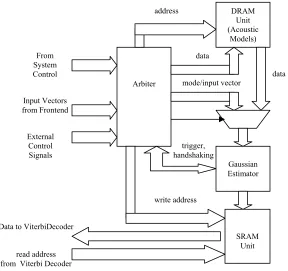
Figure 4.2 shows the overview of the implementation of the complete system. The
system consists of a ‘Gaussian Estimator’, a ‘Viterbi Decoder’, a ‘System Control’, an
‘Arbiter’, three DRAMS and an SRAM. The system acts like a co-processor that
interfaces with a host processor. The front-end will be implemented on the host processor
providing inputs to our co-processor at 16kbps. The Arbiter acts as control to the
Gaussian Estimator and also directs the inputs from the front-end to it. Initially it was
envisioned that the Arbiter would be used to control any feedback from the Viterbi
Decoder that we may implement. The final system does not contain feedback. The
Arbiter is also responsible for initializing the DRAM Unit (with the Acoustic Models).
The Gaussian Estimator updates and places the phone/senone scores in the SRAM every
frame. The Viterbi Decoder accesses these scores as well as other data in the two DRAM
units to complete the process, and place the outputs in the form of a sequence of word
indexes on the ‘output’ bus. The Viterbi Decoder is an extremely self-sufficient unit
requiring minimal external control. System Control acts as control unit for the entire
system and is also responsible for initializing DRAM UNIT –1 and DRAM UNIT –2
Figure 4.2 - System Implementation Overview
The different parts of the system are discussed in detail in the following chapters. We use
this chapter to also briefly describe the Front End. This part of the system is not
implemented in hardware as it is responsible for less that 1% of the total computation
workload and can easily be done by a host processor
4.1 Front-End
Even though the front end only occupies less than 1% of the compute time on speech
systems, it is very important for two reasons – (a) The front-end is responsible for
generating a good smooth spectral estimate of the incoming speech waveform and is
directly responsible for obtaining good output observation probability estimates (b)
Understanding acoustic vectors is a crucial prerequisite to understanding the operation of
the acoustic model. The Front-End is not dealt with in detail in this research, and the
implementation (which is almost standardized at this point) is obtained from [102]. The
overview is shown in Figure 4.3.
Viterbi Decoder DRAM UNIT - 1
SRAM UNIT
Gaussian Estimator
DRAM UNIT Acoustic
Models Arbiter
System Control
DRAM UNIT - 2
Input Vectors from Front End Control
Signals Control
Figure 4.3 - Front-End [102]
The human vocal apparatus has mechanical limitations that prevent rapid changes to
sound generated by the vocal tract. Thus, speech signal are considered to be
quasi-stationary, i.e., stationary in short time intervals (typically 5-20 ms), during which the
spectral characteristics are relative constant. DSP techniques may be used to summarize
the spectral characteristics of a speech signal into a sequence of acoustic observation
vectors, with a single vector representing about 10 ms of speech.
The front-end segments the signal into blocks and makes a smooth spectral
estimate for each block. The (constant) length of the blocks is typically chosen to be 10
ms, and the blocks are overlapped in time to give a longer analysis window of 25 ms