ISSN(Online): 2320-9801
ISSN (Print): 2320-9798
I
nternational
J
ournal of
I
nnovative
R
esearch in
C
omputer
and
C
ommunication
E
ngineering
(An ISO 3297: 2007 Certified Organization)
Vol. 3, Issue 6, June 2015
Simultaneous Control of Artificial Limbs
Based On Hybrid Extreme Learning Machine
Algorithm
Daniel C
1, Aruna R
2Assistant Professor, Department of MCA, Hindusthan College of Arts and Science , Coimbatore, India1 Assistant Professor, Department of Computer Science Engineering, Sasurie Academy, Coimbatore, India2
ABSTRACT: Highly developed artificial limb prostheses able of actuating many degrees of freedom (DOF) at the present open access obtainable. Pattern identification based algorithms with the purpose of make use of surface electromyography (EMG) signals calculated beginning residual muscles demonstrate huge assure as multi-DOF controllers. Unfortunately, existing pattern recognition scheme is restricted to sequential manage of every DOF. The prediction of instantaneous limb movement is an extremely attractive feature designed to manage of synthetic limbs. In this work, we proposed novel Hybrid Extreme Learning Machine (HELM) classification methods for the prediction of the limb movement and control them for individual through myoelectric signals. The HELM pattern recognition methods create a hybrid kernel function through fully mingle local kernel function forecast of the limb group. HELM pattern recognition suggests with the purpose of whichever classifier be able to be potentially working in the calculation of instantaneous actions if prearranged in a distributed topology. In another way the proposed pattern recognition classifiers essentially able of simultaneous predictions, such as the HELM, were found to be present technique more cost efficient, as they are able to be successfully working in their simplest form. The high accuracy of the HELM method suggests with the intention of pattern recognition techniques is able to be extensive to allow simultaneous control, life-like actions, finally increasing their feature of life.
KEYWORDS: Artificial limbs, Pattern recognition, Prosthetic limbs, Simultaneous Pattern Recognition, Extreme Learning Machine (ELM) , Kernel Function, Hybrid Kernel Function.
I. INTRODUCTION
Myoelectric prostheses, which make use of facade electromyography (EMG) signals in the direction of manage mutual group, are frequently second-hand in the direction of efficiently pleasure upperlimb deduction. In the direction of reinstate the type and functionality of the arm, such prostheses should be presented trivial, vigorous, anthropomorphic, and able of replicating the purpose of the missing limb. Constant straightforward actions of everyday livelihood, such as opportunity a door, necessitate instantaneous relationship of numerous degrees of freedom (DOF). In recent times several number of multifunction prosthetic hands [1-2] and highly developed arm scheme prototypes explained in the literature [3-4] suggest the automatic means in the direction of re-establish such function scheme development are essential to capture complete benefit of these devices.
ISSN(Online): 2320-9801
ISSN (Print): 2320-9798
I
nternational
J
ournal of
I
nnovative
R
esearch in
C
omputer
and
C
ommunication
E
ngineering
(An ISO 3297: 2007 Certified Organization)
Vol. 3, Issue 6, June 2015
whichever collective wrist actions or collective manipulate actions however a small amount of examine collective wrist/hand action with the intention of regularly second-hand throughout actions of everyday living.
Pattern recognition distinguishes compound EMG signal patterns addicted to a distinct amount of classes. Several numbers of feature selection and classification methods have been shown greatest pattern recognition [8] results for instantaneous movements of patients. At present, simply single class might be selected designed for a known classifier, forcing users to make use of a grouping of chronological DOF actions to control the prosthesis to achieve a corresponding task. Such sequential control appends a cognitive burden connected through movement development. Moreover, it prevents the user beginning building fluid, lifelike actions toward successfully control highly developed computerized prostheses.
Different classification methods have been proposed in recent work to recognize and identify the patterns in online dataset by the use of surface EMG [10], as well as in real-time [11]. Extended this work to include classification approach based on the procedure of artificial neural network especially we apply hybrid extreme leaning machine (HELM) for pattern recognition to identify the motion of limbs and compare with existing topologies. The proposed HELM work well than benchmark topologies methods since it is performed based on the machine learning approach. The definitive objective of this paper is to examine the correctness of simultaneous over sequential control approach rely on myoelectric pattern identification. In this paper is varied from existing methods since the proposed work combines the results of various classifiers to allow instantaneous predictions. As compared to existing methods the prediction accuracy is measured between proposed HELM classifier and existing classification method for prerecorded dataset samples the Motion Test [12-13]. The target achievement control (TAC) test is also measured between the proposed HELM classifier and existing classification methods with a quantitative assessment of controllability. When compare to existing classification methods the proposed HELM methods combines the procedure of various kernel functions for motion capture systems. On the other hand, merely surface EMG is necessary in the approach presented here, consequently creation them regularly suitable intended for one-sided or two-sided amputees. This also outcome in a simplify setup that is more suitable designed for clinical application.
II. RELATED WORK
Supervised [14] and un-supervised algorithms [15] have been introduced, examined and experimented. Through the use of supervised and un-supervised schemas, the association among the EMG channels is determined for pattern recognition. This feature, along with the capability of SPC, creates the response throughout online experimentation extremely perceptive and useful. For instance, a little miss-activation of wrist flexion determination not influence the capability of the user to perform preferred function (flexion) and it is straightforward to accurate through vaguely make active supination concurrently through flexion. As methods presently begin to emerge in the literature extremely lately, this approach is still in its untimely phase of growth. As capable as it is, its experimental significance is up till now to exist recognized.
The parallel classification approaches make use of one LDA classifier designed for each DOF, wherever the result of every classifier is considered separately. Each LDA classifier includes of three motion classes. Each and every motion class of the data is trained and tested based on LDA procedure. The manage system subsequently yield collective motion actions while both of the parallel classifiers contain dynamic motion classes as results. The parallel classification approaches make use of one LDA classifier is particularly diverse than formerly reported [16].
ISSN(Online): 2320-9801
ISSN (Print): 2320-9798
I
nternational
J
ournal of
I
nnovative
R
esearch in
C
omputer
and
C
ommunication
E
ngineering
(An ISO 3297: 2007 Certified Organization)
Vol. 3, Issue 6, June 2015
BioPatRec [19] permit a seamless execution of a diversity of algorithms is experimented and applied to variety of the applications such as signal processing, Feature selection, Pattern recognition; and Real-time control. Additionally, because the platform is extremely modular and customizable, researchers beginning diverse fields be able to effortlessly standard their algorithms through be appropriate them in prosthetic manage, without essentially meaningful how to attain and development bioelectric signals to calculate actually significant outputs.
Hargrove et al [20] proposed a pattern recognition based on classifier and it is compared with six pattern recognition myoelectric controllers which make use of multi-channel facade MES as inputs. The experimentation work is conducted throughout which surface and intramuscular MES were composed concurrently designed for 10 diverse classes of isometric reduction. There was no important differentiation in classification accurateness as a outcome of by means of the intramuscular MES quantity method when compare to existing surface MES quantity system. Proposed classifier achieves 97% by means of optimally choose simply three channels of facade MES.
Qu et al [21] introduced and developed a novel multi-label Bayes' Theorem based classification for pattern recognition. In the proposed work the multi-label Bayes' Theorem follows two major schemas such as Pair-Dependency and Complete-Dependency, so it is named as PDMLBC, CDMLBC. In the initial stage of the work take the advantage of label dependency among every two labels. CDMLBC regard as the dependency between positions of labels. Experimentation work is conducted on real medical data two bayes theorem such as PDMLBC and CDMLBC which is outperform than the existing bayes theorem.
III. PROPOSED HYBRID EXTREME LEARNING MACHINE ALGORITHM METHODOLOGY
Extended this work to include classification approach based on the procedure of artificial neural network especially we apply hybrid extreme leaning machine (HELM) for pattern recognition to identify the motion of limbs and compare with existing topologies. The proposed HELM work well than benchmark topologies methods since it is performed based on the machine learning approach. The definitive objective of this paper is to examine the correctness of simultaneous over sequential control approach rely on myoelectric pattern identification. In this paper is varied from existing methods since the proposed work combines the results of various classifiers to allow instantaneous predictions. To perform the proposed HELM methods in this work the data is collected between the 200 ms starts and improved between 50 ms time and four important features such as mean absolute value, zero crossings, slope sign changes, and wave length were extracted from input samples. Extracted four different features 11 different classes such as hand open/close, wrist flexion/extension, pro/supination, side grip, fine grip, agree or thumb up, pointer or index extension, and rest were identified and pattern recognized
HELM for pattern recognition to identify the motion of limbs combines different kernel functions which improves the learning results of motion of limbs .The proposed HELM has a better pattern recognition results for motion of limbs with the combined kernel function. HELM, hybrid the kernel function combines different kernel function procedure to improve pattern recognition results for motion of limbs which is described as follows. Consider as dataset samples which is collected from electrode 𝑥𝑖, 𝑡𝑖 where 𝑥𝑖 be the extracted features for motion of limbs and 𝑡𝑖 denotes the number of classes (11) classes which is defined based on the HELM objective function ,
𝛽𝑖 𝑁0
𝑖=1
𝑓𝑖 𝑥𝑗 = 𝛽𝑖 𝑁0
𝑖=1
𝑓𝑖 𝑎𝑖. 𝑥𝑗+ 𝑏𝑗
( (1)
𝑎𝑖=
𝑎𝑖1
𝑎𝑖2. 𝐾
⋮ 𝑎𝑖𝑛
( (2)
ISSN(Online): 2320-9801
ISSN (Print): 2320-9798
I
nternational
J
ournal of
I
nnovative
R
esearch in
C
omputer
and
C
ommunication
E
ngineering
(An ISO 3297: 2007 Certified Organization)
Vol. 3, Issue 6, June 2015
𝛽𝑖 =
𝛽𝑖1
𝛽𝑖2. 𝐾
⋮ 𝛽𝑖𝑛
(3)
The output layer of HELM for pattern recognition to identify the motion of limbs is represented and determined based on the multiplication of 𝛽𝑖𝑎𝑖 from the hidden layer is specified as ,
𝐻𝛽𝑖 = 𝑇 (4)
Where H is denotes as the hidden layer output matrix for pattern recognition of the i th nodes [22]. In HELM methods the objective function is determined based on the determination of the kernel function , ai the weight vector for feature vectors and it is connected to input nodes samples , bj is the predetermined threshold value, furthermore, at the same time as the training procedure for pattern recognition it be able to estimated whichever continuous purpose. When the input aiweights and hidden layer bj bias are calculated for input motion samples accordance through the indiscriminate to find final pattern recognition H results is as follows,
𝐻 𝑎1, 𝐾, 𝑎2, 𝑘 … 𝑏1, 𝐾, . . 𝑏𝑁, 𝐾 𝛽𝑖− 𝑇
= 𝑚𝑖𝑛
𝛽𝑖 𝐻 𝑎1, 𝐾, 𝑎2, 𝑘 … 𝑏1, 𝐾, . . 𝑏𝑁, 𝐾 𝛽𝑖− 𝑇
(5)
The equation is rewritten as ,
𝛽 𝑖 = 𝐻∗𝑇 (6)
Where H∗ is denoted as Moore-Penrose [23] generalized opposite of the hidden layer output matrix H. Kernel function method is defined between the feature vector of the motion limbs samples with n dimensional vector space mapped F ∶ x →Φ ( x ) ∈ F and be able to attain a high pattern recognition results for motion estimation of limbs Some of the kernel functions is described as follows to perform the pattern recognition task for limbs :
Polynomial kernel function
𝐾 𝑥, 𝑥𝑖 = 𝛾 𝑥, 𝑥𝑖 + 𝑟 𝑑, 𝛾 > 0 (7)
Perceptron kernel function
𝐾 𝑥, 𝑥𝑖 = 𝑡𝑎𝑛 ℎ 𝑣 𝑥, 𝑥𝑖 + 𝑐 𝑑, 𝛾 > 0 (8)
Gauss RBF kernel function
𝐾 𝑥, 𝑥𝑖 = 𝑒𝑥𝑝
𝑥 − 𝑥𝑖 2
2𝜎2
(9)
Sigmoid kernel function
𝐾 𝑥 = 1
1 + 𝑒𝑥𝑝(𝑥)
( (10) Combined kernel function
𝐾 𝑥, 𝑧 = 𝐾1 𝑋𝑍 𝐾2(𝑋𝑍) (11)
IV. EXPERIMENTATION RESULTS
ISSN(Online): 2320-9801
ISSN (Print): 2320-9798
I
nternational
J
ournal of
I
nnovative
R
esearch in
C
omputer
and
C
ommunication
E
ngineering
(An ISO 3297: 2007 Certified Organization)
Vol. 3, Issue 6, June 2015
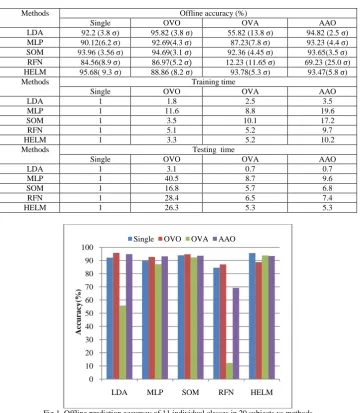
Table 1. Offline Results for Individual Movements
Methods Offline accuracy (%)
Single OVO OVA AAO
LDA 92.2 (3.8 σ) 95.82 (3.8 σ) 55.82 (13.8 σ) 94.82 (2.5 σ) MLP 90.12(6.2 σ) 92.69(4.3 σ) 87.23(7.8 σ) 93.23 (4.4 σ) SOM 93.96 (3.56 σ) 94.69(3.1 σ) 92.36 (4.45 σ) 93.65(3.5 σ) RFN 84.56(8.9 σ) 86.97(5.2 σ) 12.23 (11.65 σ) 69.23 (25.0 σ) HELM 95.68( 9.3 σ) 88.86 (8.2 σ) 93.78(5.3 σ) 93.47(5.8 σ)
Methods Training time
Single OVO OVA AAO
LDA 1 1.8 2.5 3.5
MLP 1 11.6 8.8 19.6
SOM 1 3.5 10.1 17.2
RFN 1 5.1 5.2 9.7
HELM 1 3.3 5.2 10.2
Methods Testing time
Single OVO OVA AAO
LDA 1 3.1 0.7 0.7
MLP 1 40.5 8.7 9.6
SOM 1 16.8 5.7 6.8
RFN 1 28.4 6.5 7.4
HELM 1 26.3 5.3 5.3
Fig.1. Offline prediction accuracy of 11 individual classes in 20 subjects vs methods
The experimentation results designed for entity movements (11 classes, 20 subjects) be summarize in Table 1, and the results of the various classifier offline accuracy is illustrated in Fig. 1. The formation of various classifiers and the rearrangement of contribution in a row distinguish the system; crash not only the classification accurateness however also the training and forecast rapidity. Because the absolute rapidity values are extremely rely on the handing out to the particular topology with various classifier such as LDA, MLP, SOM, and RFN, respectively.
0 10 20 30 40 50 60 70 80 90 100
LDA MLP SOM RFN HELM
A
cc
u
ra
cy
(%
)
ISSN(Online): 2320-9801
ISSN (Print): 2320-9798
I
nternational
J
ournal of
I
nnovative
R
esearch in
C
omputer
and
C
ommunication
E
ngineering
(An ISO 3297: 2007 Certified Organization)
Vol. 3, Issue 6, June 2015
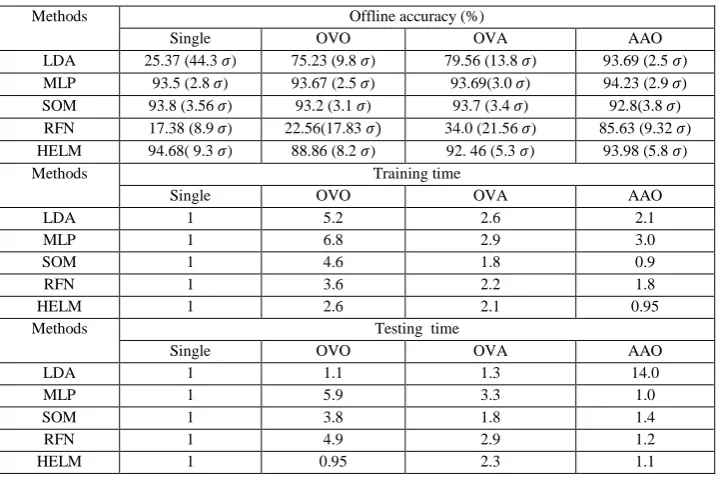
Fig.2. Offline prediction accuracy of simultaneous movement’s vs methods
The experimentation results designed for simultaneous movements are summarizing in Table 2 and the results of the various classifier offline accuracy is illustrated in Fig. 2. The formation of various classifiers and the rearrangement of contribution in a row distinguish the system; crash not only the classification accurateness however also the training and forecast rapidity. Because the absolute rapidity values are extremely rely on the handing out to the particular topology with various classifier such as LDA, MLP, SOM, and RFN, respectively.
Table 2. Offline Results For Simultaneous Movements
Methods Offline accuracy (%)
Single OVO OVA AAO
LDA 25.37 (44.3 𝜎) 75.23 (9.8 𝜎) 79.56 (13.8 𝜎) 93.69 (2.5 𝜎) MLP 93.5 (2.8 𝜎) 93.67 (2.5 𝜎) 93.69(3.0 𝜎) 94.23 (2.9 𝜎) SOM 93.8 (3.56 𝜎) 93.2 (3.1 𝜎) 93.7 (3.4 𝜎) 92.8(3.8 𝜎) RFN 17.38 (8.9 𝜎) 22.56(17.83 𝜎) 34.0 (21.56 𝜎) 85.63 (9.32 𝜎) HELM 94.68( 9.3 𝜎) 88.86 (8.2 𝜎) 92. 46 (5.3 𝜎) 93.98 (5.8 𝜎)
Methods Training time
Single OVO OVA AAO
LDA 1 5.2 2.6 2.1
MLP 1 6.8 2.9 3.0
SOM 1 4.6 1.8 0.9
RFN 1 3.6 2.2 1.8
HELM 1 2.6 2.1 0.95
Methods Testing time
Single OVO OVA AAO
LDA 1 1.1 1.3 14.0
MLP 1 5.9 3.3 1.0
SOM 1 3.8 1.8 1.4
RFN 1 4.9 2.9 1.2
HELM 1 0.95 2.3 1.1
V. CONCLUSION AND FUTURE WORK
The make use of pattern recognition-based controllers have been clinically restricted due because of several number of issues such as mostly qualified to surface recordings of EMG ,DOF from signal which is recorded from electrodes. These issues is solved and addressed by several number of electronic devices but still it is not practically applicable to more number of devices ,since is not always equally restricted such as compliant desiccated facade electrodes and
0 10 20 30 40 50 60 70 80 90 100
LDA MLP SOM RFN HELM
A
cc
u
ra
cy
(%
)
ISSN(Online): 2320-9801
ISSN (Print): 2320-9798
I
nternational
J
ournal of
I
nnovative
R
esearch in
C
omputer
and
C
ommunication
E
ngineering
(An ISO 3297: 2007 Certified Organization)
Vol. 3, Issue 6, June 2015
TMR .In order to solve this problem in this work presents a classification based pattern recognition methods with the intention of simultaneous control should be considered, as it enhances the overall controllability not including a significant increase in difficulty. A novel classification methods based pattern recognition algorithm is proposed in this paper designed for the surface electromyogram (EMG) to extract feature of simultaneous and comparative manage information used for many DOFs. The proposed HELM classification based pattern recognition approach is performed based on the surface recordings EMG. In addition, simultaneous manage is a necessary feature designed for a further natural manage of artificial limbs. But the existing HELM methods is not easily applicable to recognition the subjects’ skills, experience, consequently recompense when benchmarking outcome beginning diverse studies. In order to solve this problem and improve the results proposed a foster more improvement is applied to BioPatRec dataset to recognize subjects’ skills, experience
REFERENCES
1. C. Medynski and B. Rattray, "Bebionic Prosthetic Design”, in 2011 MyoElectric Controls/Powered Prosthetics Symposium, Fredericton, New Brunswick, Canada, 2011.
2. S. Schulz, “First Experiences With The Vincent Hand”, in 2011MyoElectric Controls/Powered Prosthetics Symposium, Fredericton, New Brunswick, Canada, 2011.
3. A. Harris, et al., "Revolutionizing Prosthetics software technology”, in 2011 IEEE International Conference on Systems, Man, and Cybernetics, Anchorage, AK, pp. 2877-2884, 2011.
4. P. Kyberd, et al., "Two-degree-of-freedom powered prosthetic wrist”, Journal of rehabilitation research and development, vol. 48, p. 609, 2011.
5. T. A. Kuiken, et al., “The use of targeted muscle reinnervation for improved myoelectric prosthesis control in a bilateral shoulder disarticulation amputee”, Prosthetics and Orthotics International, Vol. 28, pp. 245-53, 2004.
6. S. Muceli, et al., "Multichannel Surface EMG Based Estimation of Bilateral Hand Kinematics during Movements at Multiple Degrees of Freedom”, in 2010 Annual International Conference of the IEEE Engineering in Medicine and Biology Society, Buenos Aires, Argentina, pp. 6066-6069, 2010.
7. J. L. G. Nielsen, et al., “Simultaneous and Proportional Force Estimation for Multifunction Myoelectric Prostheses Using Mirrored Bilateral Training”, IEEE Transactions on Biomedical Engineering, Vol. 58, pp. 681-688, 2011.
8. C. Choi and J. Kim, “Development of a Myoelectric Joystick: a Preliminary Study”, in 2010 3rd IEEE RAS and EMBS International Conference on Biomedical Robotics and Biomechatronics, Tokyo, pp. 173-178,2010.
9. E. Scheme and K. Englehart, “EMG Pattern Recognition for the Control of Powered Upper Limb Prostheses: State-of-the-Art and Challenges for Clinical Use”, Journal of Rehabilitation Research and Development, vol. in Submission, 2010.
10. E. J. Scheme, K. B. Englehart, and B. S. Hudgins, “Selective classification for improved robustness of myoelectric control under nonideal conditions”, IEEE Trans. Biomed. Eng., Vol. 58, Issue no. 6, pp. 1698–1705, 2011.
11. P. Zhou, M. M. Lowery, K. B. Englehart, H. Huang, G. Li, L. Hargrove, J. Dewald, and T. Kuiken, “Decoding a new neural machine interface for control of artificial limbs”, J. Neurophysiol., Vol. 98,Issue No. 5, pp. 2974–2982, 2007.
12. T. Kuiken, G. Li, B. A. Lock, R. D. Lipschutz, L. A. Miller, K. A. Stubblefield, and K. B. Englehart, “Targeted muscle reinnervation for real-timemyoelectric control of multifunction artificial arms,”, J. Amer. Med. Assoc., Vol. 301, Issue no. 6, pp. 619–628, 2009.
13. B. A. Lock, K. Englehart, and B. Hudgins, “Real-time myoelectric control in a virtual environment to relate usability vs. accuracy”, in Proc. MyoElectric Controls/Powered Prosthetics Symp., Fredericton, Canada, 2005
14. J. M. Hahne, F. Biessmann, N. Jiang, H. Rehbaum, D. Farina, F. C. Meinecke, K.-R. Muller, and L. C. Parra, “Linear and nonlinear regression techniques for simultaneous and proportional myoelectric control”, IEEE Trans. neural Syst. Rehabil. Eng., Vol. 22, Issue No. 2, pp. 269–79, 2014.
15. N. Jiang, H. Rehbaum, I. Vujaklija, B. Graimann, and D. Farina, “Intuitive, Online, Simultaneous and Proportional Myoelectric Control Over Two Degrees of Freedom in Upper Limb Amputees”, IEEE Trans. neural Syst. Rehabil. Eng., Vol. 22, Issue No. 3, pp. 501–510, 2014
16. Young, A. J., Smith, L. H., Rouse, E. J., & Hargrove, L. J , “ A new hierarchical approach for simultaneous control of multi-joint powered prostheses”, IEEE RAS & EMBS International Conference on Biomedical Robotics and Biomechatronics (BioRob), 4th. pp.514-520, 2012.
17. K. Davidge, “Multifunction Myoelectric Control Using a Linear Electrode Array”, Masters of Science in Engineering, Electrical and Computer Engineering, University of New Brunswick, Fredericton, New Brunswick, Canada, 1999.
18. J. J. Baker, et al., “Continuous detection and decoding ofdexterous finger flexions with implantable myoelectric sensors”, IEEE Transactions on Neural Systems and Rehabilitation Engineering, Vol. 18, pp. 424-432, 2010.
19. M. Ortiz-Catalan, R. Brånemark, and B. Håkansson, “BioPatRec: A modular research platform for the control of artificial limbs based on pattern recognition algorithms,” Source Code Biol. Med., Vol. 8, Issue No. 11, 2013.
20. L. J. Hargrove, K. Englehart, and B. Hudgins, “A comparison of surface and intramuscular myoelectric signal classification,” IEEE Trans. Biomed. Eng., Vol. 54, Issue No. 5, pp. 847–853, 2007.
21. G. Qu, H. Zhang, and C. Hartrick, “Multi-label classification with Bayes’ theorem”, in Proc. 4th Int. Conf. Biomedical Engineering and Informatics (BMEI), pp. 2281–2285,2011.
22. G.B. Huang. Learning capability and storage capacity of two-hidden-layer feed forward network. IEEE Transactions on Neural Networks, Vol.14,Issue No.2,pp.274-281,2003.