INVESTIGATION
A Hyperactive Transposase of the Maize
Transposable Element
Activator
(
Ac
)
Katina Lazarow,* My-Linh Du,* Ruth Weimer,†,1and Reinhard Kunze*,2
*Dahlem Centre of Plant Sciences, Freie Universität Berlin, 14195 Berlin, Germany, and†Institute of Genetics and Microbiology, Ludwig-Maximilians-Universität München, 82152 Martinsried, Germany
ABSTRACT Activator/Dissociation(Ac/Ds) transposable elements from maize are widely used as insertional mutagenesis and gene isolation tools in plants and more recently also in medaka and zebrafish. They are particularly valuable for plant species that are transformation-recalcitrant and have long generation cycles or large genomes with low gene densities.Ac/Dstransposition frequencies vary widely, however, and in some species they are too low for large-scale mutagenesis. We discovered a hyperactiveActransposase derivative,AcTPase4x, that catalyzes in the yeastSaccharomyces cerevisiae100-fold more frequentDs excisions than the wild-type
transposase, whereas the reintegration frequency of excised Dselements is unchanged (57%). Comparable to the wild-type trans-posase in plants,AcTPase4xcatalyzesDs insertion preferentially into coding regions and to genetically linked sites, but the mutant
protein apparently has lost the weak bias of the wild-type protein for insertion sites with elevated guanine–cytosine content and nonrandom protein-DNA twist. AcTPase4xexhibits hyperactivity also in Arabidopsis thaliana where it effects a more than sixfold
increase in Ds excision relative to wild-type AcTPase and thus may be useful to facilitate Ac/Ds-based insertion mutagenesis approaches.
D
NA transposons are widely used in plants and animals as functional genomics tools and gene transfer vehicles. In plants, transposable elements are particularly valuable when large-scale T-DNA insertion mutagenesis is not feasi-ble, e.g., for transformation-recalcitrant species or plants with long generation cycles. The success of transposon in-sertion mutagenesis strategies depends on high forward mutagenesis rates and a favorable distribution of novel in-sertions. As forward mutagenesis rates are frequently lim-ited by transposase activity, attempts were made to find hyperactive transposase mutants. For some transposons, such mutants were fortuitously found; in other instances, systematic screening approaches and molecular evolution were successful (Goryshin and Reznikoff 1998; Beall et al.2002; Baus et al. 2005; Keravalaet al. 2006; Mates et al. 2009).
The maize Activator/Dissociation (Ac/Ds) transposable elements have been widely used in plants for gene tagging and functional genomics approaches because they are active in numerous plant species, integrate preferentially into or near to coding regions, and frequently transpose to geneti-cally linked sites, enabling local saturation mutagenesis approaches (reviewed in Kunze and Weil 2002). The suc-cessful introduction of Ac/Ds elements into yeast revealed that application of these elements is not restricted to plants (Weil and Kunze 2000). Their recent adoption as tools for transgenesis and the generation of gene trap lines in the teleost fishes zebrafish and medaka further emphasized the wide range functionality ofAc/Dselements (Emelyanov et al. 2006; Boon Ng and Gong 2011; Froschauer et al. 2012).
An impediment for a universal application is the variabil-ity of Ac/Ds transposition frequency in different plant spe-cies. In tobacco,Actransposition frequency is similar as that in maize, with the majority of plants showing between 1 and 5% germinal excisions (Joneset al.1990). In tomato and the monocot crops rice and barley, transposition frequencies range from 2 to 40% with a strong variance in individual lines (Belzile et al. 1989; Enoki et al.1999; Koprek et al. Copyright © 2012 by the Genetics Society of America
doi: 10.1534/genetics.112.139642
Manuscript received February 14, 2012; accepted for publication April 25, 2012 Supporting information is available online at http://www.genetics.org/content/ suppl/2012/05/04/genetics.112.139642.DC1.
Sequence data from this article have been deposited with the EMBL/GenBank Data Libraries under accession nos. Ac, P08770.2; Hermes, AAC37217.1; Hobo, PIR: A39652, GI 85002; Tag2, AAD24567.1; Tam3, CAA38906.1; Herves, AAS21248.1; Restless, CAA93759.1; and Tol2, BAA87039.
1Present address: Lehárstrasse 3, 81243 München, Germany.
2000; Lazarow and Lütticke 2009). In contrast, germinal transposition frequencies in Arabidopsis typically are low, ranging from 0.07 to 5.7% (Schmidt and Willmitzer 1989; Deanet al.1992). The varying transposition frequencies re-sult from the complex regulation of Ac activity, including epigenetic inactivation by the host plant. The DNA methyl-ation state affects the Ac promoter activity (Kunze et al. 1988) and the binding of the AcTPase to the subterminal binding sites (Wanget al.1996; Wang and Kunze 1998; Ros and Kunze 2001). Moreover, there is no linear relationship between AcTPase levels and transposition frequency. McClintock (1951) has noted already that an increase of Ac copy number can result in developmentally delayed transposition and an overall decrease in transposition fre-quency (“inverse dose effect”). TheAcTPase is active only in a limited concentration range because with increasing ex-pression the protein aggregates into large, filament-like structures that are transpositionally inactive (Heinlein et al. 1994). The tight regulation of Ac transposition may be an evolutionary beneficial mechanism to protect the host against harmful transposition frequencies; however, for transposon tagging, it is a drawback.
Acbelongs to the eukaryotichATtransposon superfamily (Kempken and Windhofer 2001; Kunze and Weil 2002) that had long been thought to be unique (Capy et al. 1997). Recently, it was suggested that the transposase catalytic centers of all eukaryotic transposon superfamilies, including the hAT elements, share a conserved aspartate-aspartate-glutamate (DDE) catalytic triad in an RNaseH-like fold with prokaryotic transposons like Tn5 and retroviral integrases (Kulkosky et al. 1992; Yuan and Wessler 2011). To this end, however, among thehATelements, the basic necessity of the DDE motif was proven only for Hermes(Zhouet al. 2004).
In this work, we studied several mutant derivatives of the maize Activatortransposase. We showed that the putative AcTPase DDE motif residues are essential for transposase activity. We found four amino acid substitutions that result in enhancedAcTPase activity. Their combination in the qua-druple mutant AcTPase4xleads in yeast cells to a 100-fold
increase in Dselement excision compared to the unaltered AcTPase. In stably transformedArabidopsisplants,AcTPase4x
also triggers an elevatedDsexcision activity, suggesting that this protein might be suitable to improveAc/Ds transposon-based insertion mutagenesis approaches.
Materials and Methods
Generation of AcTPase mutants
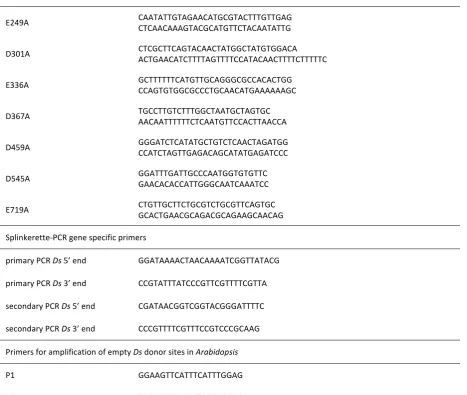
Amino acid substitutions were introduced into theAcTPase ORF by site-directed mutagenesis of plasmid pWL80 (Weil and Kunze 2000). Mutagenesis primer sequences are listed in the Supporting Information, Table S3. Double mutants were generated from the single mutants by inserting aSpeI/ PflMI fragment from pWL80-E249A into pWL80-E336A and an EcoRI fragment from pWL80-D545A into pWL80-D459A,
re-spectively. For construction of theAcTPase4Xexpression vector,
a NarI/NheI AcTPase fragment from pWL80-E249A/E336A was inserted into pWL80-D459A/D545A.
Transposition assay in yeast
CWY1 yeast cells (ade2:Ds1; Weil and Kunze 2000) were transformed with the wild-type and mutantAcTPase expres-sion vectors. Growth of yeast cells, selection of Ade+ rever-tants, and amplification ofDsexcision sites were performed according to Weil and Kunze (2000).
DNA gel-blot analyses of Ds transposition in yeast
Genomic DNA from yeast was prepared with the E.Z.N.A. yeast DNA kit (Omega Bio-tek) according to the manufac-turer’s instructions. For DNA gel-blot analysis, 1 mg yeast genomic DNA was digested with PvuI, fractionated by gel electrophoresis, and transferred to Amersham Hybond-NX membrane (GE Healthcare).Dselements were detected by hybridization with a 404-bp DNA probe labeled with DIG-11-dUTP (Roche Diagnostics GmbH).
Analysis of Ds insertion sites in yeast
Splinkerette-PCR was performed according to Uren et al. (2009) with minor modifications. Thefirst base (cytosine) of the Splink 1 primer and the long-strand adaptor were omitted. Gene-specific primer sequences are listed inTable S3. For amplification of Ds insertion sites, 300 ng yeast genomic DNA was digested with Sau3AI. Following adap-tor ligation, the DNA was purified and used in the primary PCR.
Plant material and transformation
Arabidopsis thalianaCol-0 plants were transformed with the Ds donor construct by the floral-dip method (Clough and Bent 1998). Transgenic plants were selected on solid half-strength MS medium supplemented with 50 mg/ml kana-mycin. Two independentDs-transgenic lines, Ds5 and Ds24, were transformed with constructs carrying AcTPase and AcTPase4X expression cassettes. AcTPase and Dstransgenic
plants were selected on half-strength MS medium supple-mented with 50 mg/ml kanamycin and 25mg/ml hygrom-ycin B.
Construction of binary vectors
The 3-kb Dselement from pD16 was excised withPstI and PauI, blunted with T4-DNA-Polymerase (Fermentas), and inserted into theSmaI restriction site of pPGTKan3 (Kasaras and Kunze 2010). pD16 was derived from pKU4 (Bakeret al. 1987) by insertion of theDselement into theBamHI restric-tion site of pUC19.AcTPase expression constructs were gen-erated by inserting the transposase expression cassette containing the AcTPase103–807cDNA from pcATG10 (Kunze
et al. 1993) into pCAMBIA1200, resulting in pCAM10ATG. MutantAcTPase4Xexpression constructs were generated by
D545A and subsequent transfer as a BamHI fragment into pCAM10ATG.
Analysis of Ds excision sites in Arabidopsis
For analysis ofDsexcision sites, 10 ng genomic DNA were amplified with primers P1 and P2, followed by a nested PCR with primers P3 and P2 (Figure 6A; Table S3). PCR products were fractionated by gel electrophoresis, and amplificates approximating the size of emptyDsdonor sites (687 bp) were purified and sequenced either directly or after subcloning.
Results
Substitution of the putative DDE motif residues abolishes AcTPase activity
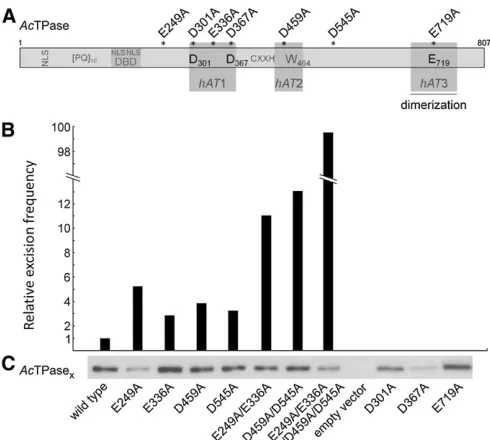
The amino acid sequence alignment of theAcTPase with the Hermestransposase and six otherhATelement transposases from plants, insects, fungi, andfish suggests that the highly conservedAcTPase residues D301, D367, and E719, located in the conserved hAT1 and hAT3 regions, form the DDE motif in the catalytic center of the protein (Figure 1 and Figure 2A). We substituted each of these residues by alanine in the N-terminally truncatedAcTPase103–807(subsequently
referred to as AcTPase) (Kunzeet al.1993) and expressed the mutant proteins in the yeast (Saccharomyces cerevisiae) strain CWY1, which carries a nonautonomousDselement in the yeastADE2gene (Weil and Kunze 2000). The activity of AcTPase derivatives was measured by the number of Ade+
revertants. NoDsexcision events were detected among 1011
cells for any of the three transposase mutantsAcTPaseD301A,
AcTPaseD367A, andAcTPaseE719A(Figure 2B). Proper
expres-sion and integrity of the AcTPase derivatives was verified by protein blot analysis (Figure 2C). The complete loss of AcTPase activity demonstrates that the residues D301, D367, and E719 are essential forAcTPase catalytic function and supports the notion that these residues form the DDE motif of theAcTPase. Mutation of any of the catalytic DDE residues should completely abolish transposase activity as has been shown for retroviral integrases, bacterial and Tc1/marinersuperfamily transposases, and thehATelement Hermes transposase (reviewed in Haren et al. 1999; Zhou et al.2004).
Quadruple mutant AcTPase4xis hyperactive in yeast
In the course of functional analyses of theAcTPase, we have generated various mutant AcTPase proteins with single amino acid substitutions and screened their excision activi-ties in the yeast transposition assay (Figure 2). Of these, the fourAcTPase derivatives E249A, E336A, D459A, and D545A induced three- tofivefold increases inDsexcision frequency when compared to the native AcTPase (Figure 2B). To in-vestigate if the combination of these mutations leads to a further enhancement, wefirst constructed the two double mutants AcTPaseE249A/E336A and AcTPaseD459A/D545A. With
11- and 13-fold increases in Ds excision frequency, both
double mutants exhibit a more-than-additive rise in activity (Figure 2B). Subsequently, we generated the quadruple mu-tant AcTPaseE249A/E336A/D459A/D545A (AcTPase4x). The
ex-pression of this protein resulted in a 10-fold increase inDs excisions relative to the two double mutants and an almost 100-fold increase compared to wild-typeAcTPase (Figure 2B), indicating a strong synergistic effect of the mutations. The transposase amounts in the yeast cells expressing AcTPase4x
and AcTPaseE249Aare slightly reduced (Figure 2C). Although
AcTPase is subject to overexpression inhibition (Heinleinet al. 1994; Weil and Kunze 2000), this slightly reduced transposase level is unlikely to account for the significant increase in Ds mobilization activity ofAcTPase4x.
To investigate if the enhanced AcTPase4x activity is
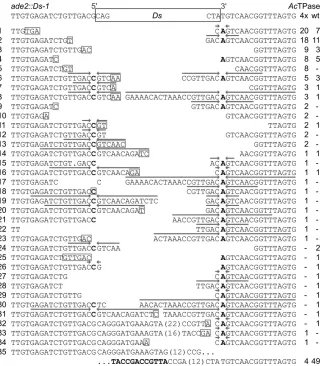
ac-companied by altered processing of theDsexcision site, we analyzed the empty donor sequences in 93 and 100 Ade+
revertants generated byAcTPase andAcTPase4x, respectively
(Figure 3). In 43AcTPase- and 92AcTPase4x-derived Ade+
revertants, theDsexcision site sequences are consistent with the DNA hairpin model for Dsfootprint formation (Kunze and Weil 2002). Two footprints formed by AcTPase4x
(Fig-ure 3, rows 15 and 17) and one formed byAcTPase (Figure 3, row 30) conflict with this model. We cannot distinguish if these sequences result from aberrant DNA repair after Ds excision or from PCR errors. In three other Ade+revertants,
two generated byAcTPase4xand one by the unmutatedAc
T-Pase, 11–42 bases from the transposon 59end are left be-hind at the excision site (Figure 3, rows 32–34), whereas the 39end has been processed according to the hairpin model. In these revertants, no reintegration of Ds was detected, suggesting that they result from abortive excision events. In the remaining 4 AcTPase4x- and 49 AcTPase-generated
Ade+ revertants, Dswas only partially lost (Figure 3, row
35). In all these “type 35” revertants, the same 42 bases from theDs59end and 19 bases from theDs39end, includ-ing both terminal inverted repeats, are left behind. These revertants could result from homologous recombination at the 12-bp direct repeat TACCGACCGTTA present in theDs 59and 39subterminal regions. Consistent with this assump-tion, no reintegration of Ds was observed in any of these revertants. The wild-type AcTPase apparently gave rise to 12-fold more type 35 revertants than the AcTPase4x.
Al-though the overall number of the 93 AcTPase-generated Ade+ revertants were isolated from seven independent
experiments with, on average, 16 revertants per culture, we cannot exclude that the high number of type 35 rever-tants partially results from clonal propagation of early events after induction of transposase expression in the yeast culture.
Not counting the type 35 revertants, in AcTPase4x- and
AcTPase-expressing cells, 25 and 19 different Ds excision footprint sequences were isolated. Both transposases gener-ate the same two predominant footprint types accounting for 40% (n = 96) of the footprints formed by AcTPase4x
not differ fromAcTPase in the biochemistry ofDsexcision. Moreover, at most Ds excision sites, generated by either version of the transposase, the chromosome breaks seem to have been resolved by microhomology-dependent end-joining (Yuet al.2004) (Figure 3).
Ds reintegration rate affected by AcTPase4x
is unchanged in yeast
Although the two DNA single-strand cleavage steps at the transposon donor site and the strand-transfer step to the target DNA in nonreplicative transposition are catalyzed by the same active center of the transposase, they can be uncoupled in transposase mutants (Bolland and Kleckner 1996). We therefore compared the reintegration frequency ofDselements in Ade+revertants obtained withAcTPase or
AcTPase4x. DNA gel-blot analysis revealed that AcTPase4x
catalyzesDsreintegration as efficiently as the wild-type pro-tein: ignoring the type 35 revertants, 57% (n= 44) of the excision events conducted by the native AcTPase and 57% (n= 88) of the events induced byAcTPase4xwere followed
by reintegration of Ds into a new genomic position. In all cases, a single reintegrated Ds copy was observed (Figure 4A). Consequently, not only Dsexcisions but also the total number of Ds reintegrations per yeast cell effected by the AcTPase4xprotein is100-fold higher than with theAcTPase.
AcTPase4xexhibits an altered Ds insertion
sequence preference
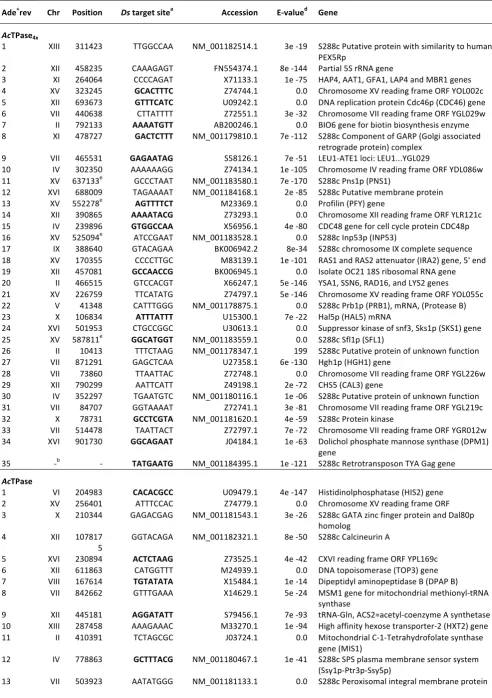
Upon integration at new genomic positions, hAT transpos-able elements generate 8-bp target site duplications (TSD). By sequencing theflanking genomic DNA on both sides of 14 Ds reinsertions formed by AcTPase4x and 7 reinsertions
formed by wild-typeAcTPase, we confirmed that in all cases
the expected TSD was created (Table S1), indicating that the architecture of the transpososome is not or is only mar-ginally altered with the AcTPase4xprotein.
Recently, in maize a preference forDsinsertions into DNA target sites with an elevated guanine–cytosine (GC) content and highly nonrandom protein–DNA twist values was de-tected (Vollbrechtet al.2010). The average GC content of the 18 and 35, 8-bp target sites chosen by AcTPase and AcTPase4x is 42.4 and 38.9%, respectively (Table S1). The
GC content in a 400-bp window centered on the 18 Ds in-sertion sites chosen byAcTPase is 40.2% and that for the 35 Dsreinsertions promoted byAcTPase4xis 38.9%. Thus, the
GC content of 8-bpDsinsertion sites and the chromosomal vicinity targeted by wild-typeAcTPase is slightly higher than that of theAcTPase4x landing regions, which closely match
the average yeast genomic GC content of 39%. We then analyzed the 8-bp Ds insertion site sequences 620 bp on either side for protein DNA-twist prediction (Olson et al. 1998). The insertion sites chosen by the AcTPase display a pattern of alternating protein–DNA twist values with a two-fold symmetry about the center of the target site that is highly similar to the pattern observed in maize. Interest-ingly, the target sites chosen by theAcTPase4xdo not exhibit
such a pattern (Figure 5).
Preference for linked transposition and insertion into genes is conserved for AcTPase4x
Mapping of the Ds reinsertion sites on the yeast chromo-somes indicates for both transposases a weak preference for linked transposition (Figure 4B). Seven of the 34 map-pedAcTPase4X-drivenDstranspositions (21%) reinserted on
chromosome XV, 4 of them ,72 kb distant from the Ds launch pad in theade2locus (Figure 4B;Table S1andTable Figure 1 Alignment of eight
S2). WhenDswas mobilized by the wild-typeAcTPase, 3 of 17 reintegrations (18%) occurred on chromosome XV, one of them at a distance of only 20 kb (Figure 4B;Table S1and
Table S2). Accordingly, both transposases deployed twice as many Ds insertions into the chromosomal vicinity than expected for random distribution in the genome (Table S2). Even though the yeast genome with 70% open reading frames has a much higher fraction of coding sequences than plants, it is conspicuous that 33 (94%) of the 35 analyzed AcTPase4X-promoted and 17 (94%) of the 18Ac
TPase-pro-moted Ds insertions occurred in annotated genes or pre-dicted open reading frames. Each transposase produced one insertion into moderately repeated sequences, yeast ret-rotransposon TYA, and the long terminal repeat of TY3, respectively.
Hyperactive AcTPase4Xinduces more frequent Ds
excision in planta
To investigate whether AcTPase4X is also hyperactive in
plants, we generated two independent A. thaliana starter lines that carry a 3-kbDselementflanked by short, GC-rich
sequences from the original wx-m7 maize locus including the TSD. TheDsstarter lines were transformed with expres-sion cassettes for eitherAcTPase orAcTPase4xunder control
of the Agrobacterium tumefaciensTR-octopine DNA 29 pro-moter. One to two rosette leaves from 382 individual Arabi-dopsis plants containing both the Ds element and the AcTPase or AcTPase4x expression construct were analyzed
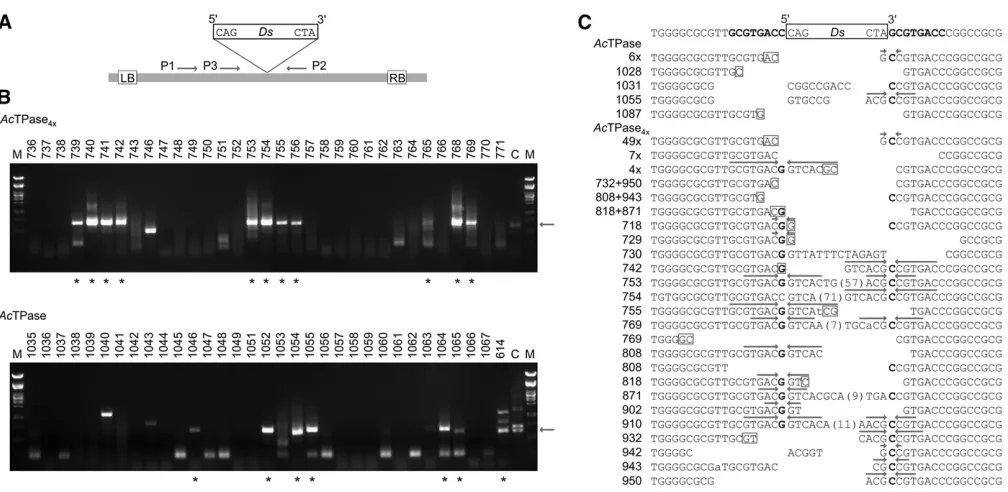
for somatic excision ofDs(Table 1 and Figure 6).
From 10 (6%) of the 170AcTPase-expressing plants,Ds footprints could be amplified and sequenced (Table 1). These samples were all derived from progeny of parental plant no. 20. In progeny from parental lines no. 30 and 31, no empty donor sites could be amplified although they expressed AcTPase. In contrast, from 70 (33%) of the 212 descendants of the three independentAcTPase4x-expressing
parental plants, empty donor sites were amplified (Table 1). From 15 of these plants, two to five differentDs excision products were recovered, indicating that multiple indepen-dent somatic Ds excisions had occurred in the leaves. Ten empty donor-site amplificates from AcTPase4x-expressing
plants could not be sequenced across the Ds excision site because several sequences were superimposed distal to it. However, all 10 sequence reads, starting from primer P2 in the 39-flanking DNA (Figure 6A), terminate at the formerDs position with a cytosine that is the complement of the gua-nine immediately flanking the Ds39 end. This cytosine is generated during hairpin resolution and thus proves that transposase-promoted Ds excision had occurred at these sites. Taken together, we detected a more than sixfold higher somatic Dsexcision frequency in Arabidopsisplants expressing AcTPase4x compared to plants expressing the
unmutated protein, indicating that theAcTPase4xis also
hy-peractive in plants.
Both transposases give rise to the same predominant“gc” footprint (Table 1 and Figure 6C). It was detected in 60% of theAcTPase-generatedDsexcision sites and in 52% of the AcTPase4x-generated Ds excision sites (49 of 95 sequence
reads including those with superimposed sequences behind the Ds). These frequencies closely match the results from a recent deep-sequencing survey ofAc/Dsexcision from a do-nor locus flanked by the identical 8-bp TSD inArabidopsis, where the same predominant gc footprint was found to ac-count for 55% of all reads (Huefneret al.2011).
UniqueDsexcision footprints were detected in fourAc TPase-and in 21AcTPase4x-expressing plants, including 13 plants with
multiple excision events (Figure 6C). The generation of the gc footprint and the majority of unique footprints can be ex-plained by the hairpin model in conjunction with the micro-homology-dependent nonhomologous end-joining (NHEJ) model for DNA break repair (Figure 6C) (Yu et al. 2004). The residual nine footprints (plant nos. 1031, 1055, 730, 753, 754, 769, 871, 910, and 942) consist of segments de-rived by processing of the flanking DNA hairpin and addi-tional nonpalindromic nucleotides that originate neither from the Dsnor from the flanking DNA. Ds excision sites from plant nos. 753 and 754 (Figure 6C) contain insertions Figure 2 Dsexcision activities ofAcTPase mutants. (A) Schematic of the
Actransposase. The three amino acid sequence regionshAT1 (aa 293– 376),hAT2 (aa 442–490) andhAT3 (aa 678–759) are conserved inhAT
transposases. ThehAT3 region is a dimerization domain. Residues D301, D367, and E719 presumably form the catalytic triad, and tryptophan W464 is supposedly involved in hairpin formation. NLS, nuclear localiza-tion signals. DBD, DNA-binding domain. (PQ)10, dipeptide repeat essential
for AcTPase function. (B) Relative Dsexcision frequencies triggered by
AcTPase derivatives in yeast. The values are the median of nine indepen-dent experiments for the wild-typeAcTPase and the quadrupleAcTPase mutant and offive independent experiments for the otherAcTPase deriv-atives. For the relative values,Dsexcision frequency induced by wild-type
AcTPase was set to 1. The absolute median excision frequency promoted by wild-typeAcTPase was 2.9·1025Ade+cells/total living cells and for
the quadruple mutant 288·1025Ade+cells/total cells. (C) Protein
of 57 and 71 bases, respectively, which partially match Arabidopsis genomic sequences. In 7 AcTPase4x plants
(7.4% of the 95 sequence reads), we detected excision sites where theDselement and one copy of the duplicated target site were precisely eliminated, resulting in restora-tion of the original target-site sequence (“restoring exci-sion”; Figure 6C).
Discussion
The efficiency of transposon insertional mutagenesis ap-proaches is frequently hampered by low transposase activity, which may have evolved to protect the host genome against unfavorably high mutation frequencies. Consistent with this idea, various hyperactive transposases were identified by mu-tagenesis in prokaryotic and animal transposons (Weinreich et al.1994; Lampeet al.1999; Beallet al.2002; Bauset al. 2005; Mateset al.2009; Yusaet al.2011). The maize Activa-tortransposase mutants reported here are thefirst examples of a hyperactive plant transposase. The alignment of eight hATelement transposases, most of which were shown to be active, illustrates that none of the amino acids substituted in the hyperactive AcTPase4xare in highly conserved positions
(Figure 1). The hyperactive mutations act synergistically as
their combination into a quadruple mutantAcTPase4xresults
in a 100-fold higherDsexcision activity in yeast. Synergistic enhancement of hyperactivity following the combination of two to nine single amino acid substitutions has also been observed for Tn5,piggyBac,Himar1, andSleeping Beauty transposases (Weinreichet al.1994; Lampeet al.1999; Baus et al.2005; Yusaet al.2011).
Except for Tn5, little is known about the biochemical mechanisms of transposase hyperactivity. In the case of SB100X, it is hypothesized that the mutations alter the fold-ing properties of the transposase (Mateset al.2009). As the four amino acid substitutions in AcTPase4x are located in
a region that is assumed to contain a multimerization inter-face (Esserset al.2000) and with increasing concentration the AcTPase activity is limited by progressive aggregation into nonfunctional complexes (Heinlein et al. 1994), we tested whether AcTPase4x has altered aggregation
proper-ties. However, upon expression in Escherichia coli, yeast, and petunia protoplasts, we did not detect any difference in the wild-typeAcTPase (our unpublished results). The hy-peractive mutation D459A is only two amino acids apart from a tryptophan residue that is highly conserved among hAT transposases (Figure 1; Zhou et al. 2004). In Hermes andpiggyBactransposases, this tryptophan supposedly acts Figure 3 Dsexcision footprints formed byAcTPase andAcTPase4x in yeast. The top row shows the
sequence at the Ds insertion site in the yeast
ADE2gene. Rows 1–35 show the recovered Ds
excision footprints and at the right their incidence in independent Ade+ revertants from wild-type
AcTPase (wt) or hyperactiveAcTPase4X(4x)
in DNA hairpin formation and base flipping (Zhou et al. 2004; Mitraet al.2008).
AcTPase4x is also hyperactive in Arabidopsis, although
apparently not as pronounced as in yeast. However, the
comparative quantification of AcTPase activity in sporo-phytic plant tissue by amplification of Ds excision sites is inherently imprecise and underestimates the excision fre-quency, as excisions in single cells and very small tissue
Figure 5 Predicted twist-angle torsion at Ds insertion sites in yeast. Average values for pro-tein-DNA twist (y axis) are plot-ted for each nucleotide position against the sequence of the 8-bp
Dsinsertion sites620 bp adjoin-ing sequence (x-axis) from 35
AcTPase4x-generatedDsinsertions
(top) and 18 AcTPase-generated
Dsinsertions (bottom). The borders of the 8-bpDstarget sites are in-dicated by the vertical lines. Figure 4 Reintegration ofDselements in yeast. (A) Examples for reintegratedDselements fromAcTPase4x-promoted transposition. DNA gel blot with
PvuI-digested genomic DNA from yeast strains BY4723, CWY1, and nine individual Ade+revertants, hybridized with aDs-specific probe. The gray
arrowhead marks theDsdonor site in theade2locus of yeast strain CWY1. (B) Distribution ofDsinsertion sites in the yeast genome. The 16 yeast chromosomes are drawn to scale as gray bars with the centromere for each chromosome indicated by a dot. The gray triangle marks the initial position of theDselement in theade2locus on yeast chromosome XV. Red triangles indicate reintegration of theDselement promoted by the hyperactive
sectors may remain undetected and multiple independent excisions generating the same (predominant) footprint are counted as one event. On the other hand, it is also possible that hyperactivity is unequally expressed in different host systems. Of 18 piggyBactransposase mutants showing
hy-peractivity in yeast, only five exhibited hyperactivity in mammalian cells (Yusaet al.2011). Similarly, hyperactivity of Sleeping Beauty transposase SB10 in HeLa cells was stronger than in mice (Bauset al.2005).
DNA hairpin formation, resolution, repair, and end joining at the empty donor site, first suggested by Coen et al. (1986) for the snapdragonTam3element, is the uni-versal excision site processing pathway forhATtransposons (Coen et al. 1986; Kunze and Weil 2002; Yuet al. 2004). This mechanism results in footprints with short deletions and palindromes at the repaired DNA joint centered around the complement of the base adjacent to the transposon ends. The vast majority (90%) of footprints, including the pre-dominant ones, generated by AcTPase4x and AcTPase in
yeast and in Arabidopsis, can be explained by this model. Fifteen of the 22 distinct footprint types that had been re-ported by Yuet al.(2004) using the wild-typeAcTPase were also recovered from wild-type AcTPase- and AcTPase4x
-expressing yeast cells in this study, suggesting that the basic excision mechanism remains unaffected by the four amino acid substitutions in AcTPase4x. This conclusion is
corrobo-rated by the Ds excision footprint spectrum in planta. The frequency of the predominant gc footprint generated by the quadruple mutant AcTPase4x, the low frequency of 4%
Figure 6 Analysis ofDsexcision sites inArabidopsis. (A) Schematic of the T-DNA in pCAM10ATG. LB, left T-DNA borders. RB, right T-DNA borders.Ds, 3-kbDselement. P1–P3, primers used for amplification of emptyDsdonor sites. (B) Screen for somaticDsexcision events. For each transposase, a representative agarose gel for screening and recovery ofDsexcision sites from individualArabidopsisplants is shown. Arrows at the right indicate the expected size for emptyDsdonor-site amplificates of687 bp. Asterisks indicate PCR products from individual plants that approximate this size and were subjected to sequence analysis. (C)Dsexcision footprints formed byAcTPase andAcTPase4xinArabidopsis. The top line shows the sequence at the
Dsdonor site. Letters in boldfaceflanking theDsindicate the 8-bp target-site duplication. The lines below show transposon footprints in individual plants afterDsexcision byAcTPase orAcTPase4x. The predominant footprint gc was detected in 6AcTPase (“6·”) and in 49AcTPase4xindividuals
(“49·”). A“restoring”excision product was recovered from sevenAcTPase4xplants (“7·”). Four individualAcTPase4xplants share the same footprint
(“4·”). From plant nos. 769, 818, 871, 943, and 950 two and from plant no. 808 three distinct footprints were isolated, respectively. Bases with weak signal strength in the sequence reads are indicated in lowercase. Putative microhomologies at flanking DNA fusion sites are indicated as boxed nucleotides. Arrows above sequences highlight inverted repeats centered around the complementary bases G and C of the nucleotides bordering theDselement that result from resolution of intermediate hairpin structures formed at theDs-flanking host DNA during excision.
Table 1 Dsexcision inArabidopsis
Dsexcision sitea
Transposase Lineb Plantsc Excisionsd A B C D
AcTPase 30 54 — — — — —
31 50 — — — — —
20 66 10 6 4 — —
Se 170 10 6 4 — —
AcTPase4x 29 68 21 7 5 6 3
42 72 21 13 — 5 3
41 72 28 17 3 4 4
S 212 70 37 8 15 10
aClassification of individual plants according to theDsexcision sites isolated. A:
number of plants with“gc”footprint. B: number of plants showing unique foot-prints including“restoring”excision products. C: number of plants with multiple footprints. D: sequence was unreadable distal to theDsexcision site.
bThe three independent plant lines analyzed for each transposase are, with the
exception of 29 (Ds5), all derived fromDsstarter line Ds24.
cNumber of plants analyzed for excision ofDs. dNumber of individual plants with emptyDsdonor sites.
restoringDsexcisions, and the occurrence of excision prod-ucts with short sequence insertions, suggesting that trans-poson excision-induced double-strand break repair is not strictly dependent on the canonical NHEJ pathway factors Ku70 and DNA ligase IV (Lig4), are concordant with the results from a recent deep sequencing survey of somatic Ds excision catalyzed by the wild-type Ac transposase in Arabidopsis(Huefneret al.2011).
Among the Ade+ revertants from AcTPase
4x and, more
frequently, from AcTPase-expressing cells, we detected the same type of apparently incomplete Ds excision products (Figure 3, row 35) that had also been found by Yu et al. (2004). This product could emerge either from a homolo-gous recombination event between two perfect 12-bp direct repeats in both transposon ends or from gene conversion and microhomology-dependent NHEJ after excision of Ds during replication from one daughter chromatid. As this product was never obtained in the absence of transposase, we speculate that its formation is promoted by the trans-posase in a similar way as in plants, where the presence of an active Ac element can greatly enhance intramolecular homologous recombination between direct repeat sequences in maize and Arabidopsis(Athma and Peterson 1991; Xiao et al.2000). In the transpososome, theAcTPase synapses the transposon ends, which might stimulate recombination be-tween directly repeated sequences in theflanking host DNA and possibly also within the transposon ends.
Consistent with other Ac/Ds transposition studies in plants and yeast, we do not recognize a target sequence preference for theDsinsertion site selection with theAcTPase or AcTPase4x. The analysis of 1741 Ds insertion sites in
maize revealed, however, that the elements have a prefer-ence for insertion into sequprefer-ences with a high GC content and that the insertion sites exhibit a pattern of alternating nu-cleotide pairs with more and less than average DNA deform-ability, respectively (Vollbrecht et al. 2010). This suggests thatAc/Ds insertion is guided by structural features of the DNA rather than by the primary DNA sequence. Interest-ingly, for the wild-typeAcTPase, we observe in yeast, similar to that in maize, a slightly elevated GC content at the in-sertion sites and a periodicity in the protein-DNA twist, whereas the hyperactive AcTPase4x apparently has largely
lost the preference for target sites with these features. In plants, 50–80% of excisedAc/Dselements reinsert into the genome (reviewed in Kunzeet al.1997; Kunze and Weil 2002). The hyperactiveAcTPase4xinduces the same
reinte-gration frequency as the wild-type protein, suggesting that excision and reintegration activities are effected by different amino acids. Similarly, in a hyperactive piggyBac transpo-sase, the excision reaction was enhanced, whereas the in-tegration reaction remained unchanged (Yusaet al.2011).
In plants, the propensity ofAcandDselements to trans-pose to genetically linked sites and to insert into coding regions and the lack of insertion-site specificity have proven to be advantageous. In this study, wefind that these prop-erties are largely conserved in yeast. In comparison, the
transposase of the insect transposon Hermes directs only 40 to 45% of insertions into ORFs of the Saccharomyces genome (Gangadharan et al. 2010). Although it has not been shown yet whether theAcTPase4xexcision and
reinte-gration properties are quantitatively similar in plants, the protein is a promising candidate to improve transposon mu-tagenesis and gene-tagging efficiencies.
Acknowledgments
We thank Anne Herrmann for excellent technical support. This work was supported by Deutsche Forschungsgemein-schaft grant KU-715/9.
Literature Cited
Athma, P., and T. Peterson, 1991 Ac induces homologous recom-bination at the maize P locus. Genetics 128: 163–173. Baker, B., G. Coupland, N. V. Fedoroff, P. Starlinger, and J. Schell,
1987 Phenotypic assay for excision of the maize controlling element Ac in tobacco. EMBO J. 6: 1547–1554.
Baus, J., L. Liu, A. D. Heggestad, S. Sanz, and B. S. Fletcher, 2005 Hyperactive transposase mutants of the Sleeping Beauty transposon. Mol. Ther. 12: 1148–1156.
Beall, E. L., M. B. Mahoney, and D. C. Rio, 2002 Identification and analysis of a hyperactive mutant form of DrosophilaP-element transposase. Genetics 162: 217–227.
Belzile, F., M. W. Lassner, Y. Tong, R. Khush, and J. I. Yoder, 1989 Sexual transmission of transposed Activator elements in transgenic tomatoes. Genetics 123: 181–189.
Bolland, S., and N. Kleckner, 1996 The three chemical steps of Tn10/IS10transposition involve repeated utilization of a single active site. Cell 84: 223–233.
Boon Ng, G. H., and Z. Gong, 2011 Maize Ac/Ds transposon sys-tem leads to highly efficient germline transmission of transgenes in medaka (Oryzias latipes). Biochimie 93: 1858–1864. Capy, P., T. Langin, D. Higuet, P. Maurer, and C. Bazin, 1997 Do
the integrases of LTR-retrotransposons and class II element transposases have a common ancestor? Genetica 100: 63–72. Clough, S. J., and A. F. Bent, 1998 Floral dip: a simplified method for
Agrobacterium-mediated transformation of Arabidopsis thaliana. Plant J. 16: 735–743.
Coen, E. S., R. Carpenter, and C. Martin, 1986 Transposable ele-ments generate novel spatial patterns of gene expression in
Antirrhinum majus. Cell 47: 285–296.
Dean, C., C. Sjodin, T. Page, J. D. G. Jones, and C. Lister, 1992 Behavior of the maize transposable element Ac in Arabi-dopsis thaliana. Plant J. 2: 69–81.
Emelyanov, A., Y. Gao, N. I. Naqvi, and S. Parinov, 2006 Trans-kingdom transposition of the maize Dissociation element. Ge-netics 174: 1095–1104.
Enoki, H., T. Izawa, M. Kawahara, M. Komatsu, S. Koh et al., 1999 Ac as a tool for the functional genomics of rice. Plant J. 19: 605–613.
Essers, L., R. H. Adolphs, and R. Kunze, 2000 A highly conserved domain of the maizeActivatortransposase is involved in dimer-ization. Plant Cell 12: 211–224.
Froschauer, A., D. Sprott, F. Gerwien, Y. Henker, F. Rudolphet al., 2012 Effective generation of transgenic reporter and gene trap lines of the medaka (Oryzias latipes) using the Ac/Ds transpo-son system. Transgenic Res. 21: 149–162.
nucleosome-free regions in vivo. Proc. Natl. Acad. Sci. USA 107: 21966–21972.
Goryshin, I. Y., and W. S. Reznikoff, 1998 Tn5 in vitro transposi-tion. J. Biol. Chem. 273: 7367–7374.
Haren, L., B. Ton-Hoang, and M. Chandler, 1999 Integrating DNA: transposases and retroviral integrases. Annu. Rev. Micro-biol. 53: 245–281.
Heinlein, M., T. Brattig, and R. Kunze, 1994 In vivo aggregation of maize Activator (Ac) transposase in nuclei of maize endo-sperm and Petunia protoplasts. Plant J. 5: 705–714.
Huefner, N. D., Y. Mizuno, C. F. Weil, I. Korf, and A. B. Britt, 2011 Breadth by depth: expanding our understanding of the repair of transposon-induced DNA double strand breaks via deep-sequencing. DNA Repair (Amst.) 10: 1023–1033. Jones, J. D. G., F. Carland, L. Harper, E. Lim, and H. Dooner,
1990 Genetic Properties of the Maize Transposon Activator
(Ac) in Tobacco, pp. 59–64 inPlant Gene Transfer - UCLA Sym-posia on Molecular and Cellular Biology, New Series, Vol. 129, edited by C. J. Lamb and R. N. Beachy. Wiley-Liss Inc., New York.
Kasaras, A., and R. Kunze, 2010 Expression, localisation and phy-logeny of a novel family of plant-specific membrane proteins. Plant Biol (Stuttg) 12(Suppl. 1): 140–152.
Kempken, F., and F. Windhofer, 2001 The hAT family: a versatile transposon group common to plants, fungi, animals, and man. Chromosoma 110: 1–9.
Keravala, A., D. Liu, E. R. Lechman, D. Wolfe, J. A. Nash et al., 2006 Hyperactive Himar1 transposase mediates transposition in cell culture and enhances gene expression in vivo. Hum. Gene Ther. 17: 1006–1018.
Koprek, T., D. McElroy, J. Louwerse, R. Williams-Carrier, and P. G. Lemaux, 2000 An efficient method for dispersing Ds elements in the barley genome as a tool for determining gene function. Plant J. 24: 253–263.
Kulkosky, J., K. S. Jones, R. A. Katz, J. P. G. Mack, and A. M. Skalka, 1992 Residues critical for retrovirus integrative recombination in a region that is highly conserved among retroviral/retrotrans-poson integrases and bacterial insertion sequence transposases. Mol. Cell. Biol. 12: 2331–2338.
Kunze, R., and C. F. Weil, 2002 The hAT and CACTA superfami-lies of plant transposons, pp. 565–610 inMobile DNA II, edited by N. L. Craig, R. Craigie, M. Gellert, and A. M. Lambowitz. ASM Press, Washington, D.C.
Kunze, R., P. Starlinger, and D. Schwartz, 1988 DNA methylation of the maize transposable element Acinterferes with its tran-scription. Mol. Gen. Genet. 214: 325–327.
Kunze, R., U. Behrens, U. Courage-Franzkowiak, S. Feldmar, S. Kühn et al., 1993 Dominant transposition-deficient mutants of maizeActivator(Ac) transposase. Proc. Natl. Acad. Sci. USA 90: 7094–7098.
Kunze, R., H. Saedler, and W.-E. Lönnig, 1997 Plant transposable elements, pp. 331–470 inAdvances in Botanical Research, Vol. 27, edited by J. A. Callow. Academic Press, San Diego. Lampe, D. J., B. J. Akerley, E. J. Rubin, J. J. Mekalanos, and H. M.
Robertson, 1999 Hyperactive transposase mutants of the Himar1 mariner transposon. Proc. Natl. Acad. Sci. USA 96: 11428–11433. Lazarow, K., and S. Lütticke, 2009 An Ac/Ds-mediated gene trap system for functional genomics in barley. BMC Genomics 10: 55.
Mates, L., M. K. Chuah, E. Belay, B. Jerchow, N. Manoj et al., 2009 Molecular evolution of a novel hyperactive Sleeping Beauty transposase enables robust stable gene transfer in verte-brates. Nat. Genet. 41: 753–761.
McClintock, B., 1951 Chromosome organization and genic ex-pression. Cold Spring Harb. Symp. Quant. Biol. 16: 13–47. Mitra, R., J. Fain-Thornton, and N. L. Craig, 2008 piggyBac can
bypass DNA synthesis during cut and paste transposition. EMBO J. 27: 1097–1109.
Olson, W. K., A. A. Gorin, X. J. Lu, L. M. Hock, and V. B. Zhurkin, 1998 DNA sequence-dependent deformability deduced from protein-DNA crystal complexes. Proc. Natl. Acad. Sci. USA 95: 11163–11168.
Ros, F., and R. Kunze, 2001 Regulation of Activator/Dissociation transposition by replication and DNA methylation. Genetics 157: 1723–1733.
Schmidt, R., and L. Willmitzer, 1989 The maize autonomous ele-ment Activator (Ac) shows a minimal germinal excision fre-quency of 0.2%–0.5% in transgenic Arabidopsis thaliana plants. Mol. Gen. Genet. 220: 17–24.
Uren, A. G., H. Mikkers, J. Kool, L. van der Weyden, A. H. Lund
et al., 2009 A high-throughput splinkerette-PCR method for the isolation and sequencing of retroviral insertion sites. Nat. Protoc. 4: 789–798.
Vollbrecht, E., J. Duvick, J. P. Schares, K. R. Ahern, P. Deewatthanawong et al., 2010 Genome-wide distribution of transposed Dissociation elements in maize. Plant Cell 22: 1667– 1685.
Wang, L., and R. Kunze, 1998 Transposase binding site methyla-tion in the epigenetically inactivated Ac derivative Ds-cy. Plant J. 13: 577–582.
Wang, L., M. Heinlein, and R. Kunze, 1996 Methylation pattern of Activator (Ac) transposase binding sites in maize endosperm. Plant Cell 8: 747–758.
Weil, C. F., and R. Kunze, 2000 Transposition of maize Ac/Ds transposable elements in the yeast Saccharomyces cerevisiae. Nat. Genet. 26: 187–190.
Weinreich, M. D., A. Gasch, and W. S. Reznikoff, 1994 Evidence that thecispreference of the Tn5transposase is caused by non-productive multimerization. Genes Dev. 8: 2363–2374. Xiao, Y. L., X. Li, and T. Peterson, 2000 Ac insertion site affects
the frequency of transposon-induced homologous recombina-tion at the maize p1 locus. Genetics 156: 2007–2017.
Yu, J., K. Marshall, M. Yamaguchi, J. E. Haber, and C. F. Weil, 2004 Microhomology-dependent end joining and repair of transposon-induced DNA hairpins by host factors in Saccharo-myces cerevisiae. Mol. Cell. Biol. 24: 1351–1364.
Yuan, Y. W., and S. R. Wessler, 2011 The catalytic domain of all eukaryotic cut-and-paste transposase superfamilies. Proc. Natl. Acad. Sci. USA 108: 7884–7889.
Yusa, K., L. Zhou, M. A. Li, A. Bradley, and N. L. Craig, 2011 A hyperactive piggyBac transposase for mammalian applications. Proc. Natl. Acad. Sci. USA 108: 1531–1536.
Zhou, L., R. Mitra, P. W. Atkinson, A. B. Hickman, F. Dydaet al., 2004 Transposition of hAT elements links transposable ele-ments and V(D)J recombination. Nature 432: 995–1001.
GENETICS
Supporting Information
http://www.genetics.org/content/suppl/2012/05/04/genetics.112.139642.DC1
A Hyperactive Transposase of the Maize
Transposable Element
Activator
(
Ac
)
Katina Lazarow, My-Linh Du, Ruth Weimer, and Reinhard Kunze
Table S1 Ds insertion sites in yeast
Ade+rev Chr Position Ds target sitea Accession E-‐valued Gene
AcTPase4x
1 XIII 311423 TTGGCCAA NM_001182514.1 3e -‐19 S288c Putative protein with similarity to human PEX5Rp
2 XII 458235 CAAAGAGT FN554374.1 8e -‐144 Partial 5S rRNA gene
3 XI 264064 CCCCAGAT X71133.1 1e -‐75 HAP4, AAT1, GFA1, LAP4 and MBR1 genes 4 XV 323245 GCACTTTC Z74744.1 0.0 Chromosome XV reading frame ORF YOL002c 5 XII 693673 GTTTCATC U09242.1 0.0 DNA replication protein Cdc46p (CDC46) gene 6 VII 440638 CTTATTTT Z72551.1 3e -‐32 Chromosome VII reading frame ORF YGL029w 7 II 792133 AAAATGTT AB200246.1 0.0 BIO6 gene for biotin biosynthesis enzyme 8 XI 478727 GACTCTTT NM_001179810.1 7e -‐112 S288c Component of GARP (Golgi associated
retrograde protein) complex 9 VII 465531 GAGAATAG S58126.1 7e -‐51 LEU1-‐ATE1 loci: LEU1...YGL029
10 IV 302350 AAAAAAGG Z74134.1 1e -‐105 Chromosome IV reading frame ORF YDL086w 11 XV 637133e GCCCTAAT NM_001183580.1 7e -‐170 S288c Pns1p (PNS1)
12 XVI 688009 TAGAAAAT NM_001184168.1 2e -‐85 S288c Putative membrane protein 13 XV 552278e AGTTTTCT M23369.1 0.0 Profilin (PFY) gene
14 XII 390865 AAAATACG Z73293.1 0.0 Chromosome XII reading frame ORF YLR121c 15 IV 239896 GTGGCCAA X56956.1 4e -‐80 CDC48 gene for cell cycle protein CDC48p 16 XV 525094e ATCCGAAT NM_001183528.1 0.0 S288c Inp53p (INP53)
17 IX 388640 GTACAGAA BK006942.2 8e-‐34 S288c chromosome IX complete sequence 18 XV 170355 CCCCTTGC M83139.1 1e -‐101 RAS1 and RAS2 attenuator (IRA2) gene, 5' end 19 XII 457081 GCCAACCG BK006945.1 0.0 Isolate OC21 18S ribosomal RNA gene 20 II 466515 GTCCACGT X66247.1 5e -‐146 YSA1, SSN6, RAD16, and LYS2 genes
21 XV 226759 TTCATATG Z74797.1 5e -‐146 Chromosome XV reading frame ORF YOL055c 22 V 41348 CATTTGGG NM_001178875.1 0.0 S288c Prb1p (PRB1), mRNA, (Protease B) 23 X 106834 ATTTATTT U15300.1 7e -‐22 Hal5p (HAL5) mRNA
24 XVI 501953 CTGCCGGC U30613.1 0.0 Suppressor kinase of snf3, Sks1p (SKS1) gene 25 XV 587811e GGCATGGT NM_001183559.1 0.0 S288c Sfl1p (SFL1)
26 II 10413 TTTCTAAG NM_001178347.1 199 S288c Putative protein of unknown function 27 VII 871291 GAGCTCAA U27358.1 6e -‐130 Hgh1p (HGH1) gene
28 VII 73860 TTAATTAC Z72748.1 0.0 Chromosome VII reading frame ORF YGL226w 29 XII 790299 AATTCATT Z49198.1 2e -‐72 CHS5 (CAL3) gene
30 IV 352297 TGAATGTC NM_001180116.1 1e -‐06 S288c Putative protein of unknown function 31 VII 84707 GGTAAAAT Z72741.1 3e -‐81 Chromosome VII reading frame ORF YGL219c 32 X 78731 GCCTCGTA NM_001181620.1 4e -‐59 S288c Protein kinase
33 VII 514478 TAATTACT Z72797.1 7e -‐72 Chromosome VII reading frame ORF YGR012w
34 XVI 901730 GGCAGAAT J04184.1 1e -‐63 Dolichol phosphate mannose synthase (DPM1) gene
35 -‐b -‐ TATGAATG NM_001184395.1 1e -‐121 S288c Retrotransposon TYA Gag gene
AcTPase
1 VI 204983 CACACGCC U09479.1 4e -‐147 Histidinolphosphatase (HIS2) gene 2 XV 256401 ATTTCCAC Z74779.1 0.0 Chromosome XV reading frame ORF 3 X 210344 GAGACGAG NM_001181543.1 3e -‐26 S288c GATA zinc finger protein and Dal80p
homolog
4 XII 107817
5
GGTACAGA NM_001182321.1 8e -‐50 S288c Calcineurin A
5 XVI 230894 ACTCTAAG Z73525.1 4e -‐42 CXVI reading frame ORF YPL169c 6 XII 611863 CATGGTTT M24939.1 0.0 DNA topoisomerase (TOP3) gene 7 VIII 167614 TGTATATA X15484.1 1e -‐14 Dipeptidyl aminopeptidase B (DPAP B) 8 VII 842662 GTTTGAAA X14629.1 5e -‐24 MSM1 gene for mitochondrial methionyl-‐tRNA
synthase
9 XII 445181 AGGATATT S79456.1 7e -‐93 tRNA-‐Gln, ACS2=acetyl-‐coenzyme A synthetase 2 10 XIII 287458 AAAGAAAC M33270.1 1e -‐94 High affinity hexose transporter-‐2 (HXT2) gene 11 II 410391 TCTAGCGC J03724.1 0.0 Mitochondrial C-‐1-‐Tetrahydrofolate synthase
gene (MIS1)
12 IV 778863 GCTTTACG NM_001180467.1 1e -‐41 S288c SPS plasma membrane sensor system (Ssy1p-‐Ptr3p-‐Ssy5p)
14 XV 369772 CGACCCAT NM_001183438.1 9e -‐92 S288c Protein of unknown function 15 XI 354898 TACATATC X71621.1 0.0 Genes ELM1 and PRI2
16 VII 757585 AATGTGTC X65470.1 7e -‐40 PAS2 gene
17 XV 586815e GCCACAGT Z75047.1 9e -‐87 Chromosome XV reading frame ORF YOR139c 18 -‐c -‐ TGAACGTT M18354.1 2e -‐35 Sigma repetitive element (TY3)
a Ds insertion sites where 5’ and 3’ flanking sequences were isolated are bold typed.
b In case of insertion into TYA retrotransposon the exact chromosomal localization is not possible (XVI, XV,XII, XVII, V, IV or I).
c In case of insertion into yeast sigma repetitive element (TY3) the exact chromosomal localization is not possible (XIV, XI, IX, VII or
I).
d Sequences were BLASTed against GenBank (All GenBank+EMBL+DDBJ+PDB sequences but no EST, STS, GSS,environmental
samples or phase 0, 1 or 2 HTGS sequences)
e Short range transposition; Ds reintegration occurred on the same chromosome in a maximal distance of 72 kb from the donor
Table S2 Distribution of Ds insertions on yeast chromosomes
Yeast chromosome Ds insertions
% of AcTPase4x AcTPase Total
No. Size in kb genome Observed Expectedb Observed Expectedb Observed Expectedb
I 230 1.9 -‐ 0.6 -‐ 0.3 -‐ 1
II 813 6.7 3 2.3 1 1.1 4 3
III 315 2.6 -‐ 0.9 -‐ 0.4 -‐ 1
IV 1522 12.6 3 4.3 1 2.1 4 6
V 575 4.8 1 1.6 -‐ 0.8 1 2
VI 270 2.2 -‐ 0.8 1 0.4 1 1
VII 1091 9.0 6 3.1 3 1.5 9 5
VIII 562 4.7 -‐ 1.6 1 0.8 1 3
IX 440 3.7 1 1.2 -‐ 0.6 1 2
X 745 6.2 2 2.1 1 1.0 3 3
XI 666 5.5 2 1.9 1 0.9 3 3
XII 1078 8.9 5 3.0 3 1.5 8 5
XIII 924 7.7 1 2.6 1 1.3 2 4
XIV 784 6.5 -‐ 2.2 -‐ 1.1 -‐ 3
XVa 1091 9.1 7 3.1 3 1.5 10 5
XVI 948 7.9 3 1.3 1 1.3 3 4
Σ 12057 100 34 34 17 17 51 51
a Yeast chromosome with Ds launch pad in ade2 locus.
b Number of expected insertions was calculated based on the size of each chromosome.
Table S3 Primer sequences (5’ to 3’)
Primers for site directed mutagenesis
E249A CAATATTGTAGAACATGCGTACTTTGTTGAG
CTCAACAAAGTACGCATGTTCTACAATATTG
D301A CTCGCTTCAGTACAACTATGGCTATGTGGACA
ACTGAACATCTTTTAGTTTTCCATACAACTTTTCTTTTTC
E336A GCTTTTTTCATGTTGCAGGGCGCCACACTGG CCAGTGTGGCGCCCTGCAACATGAAAAAAGC
D367A TGCCTTGTCTTTGGCTAATGCTAGTGC AACAATTTTTTCTCAATGTTCCACTTAACCA
D459A GGGATCTCATATGCTGTCTCAACTAGATGG CCATCTAGTTGAGACAGCATATGAGATCCC
D545A GGATTTGATTGCCCAATGGTGTGTTC
GAACACACCATTGGGCAATCAAATCC
E719A CTGTTGCTTCTGCGTCTGCGTTCAGTGC
GCACTGAACGCAGACGCAGAAGCAACAG
Splinkerette-‐PCR gene specific primers
primary PCR Ds 5’ end GGATAAAACTAACAAAATCGGTTATACG
primary PCR Ds 3’ end CCGTATTTATCCCGTTCGTTTTCGTTA
secondary PCR Ds 5’ end CGATAACGGTCGGTACGGGATTTTC
secondary PCR Ds 3’ end CCCGTTTTCGTTTCCGTCCCGCAAG
Primers for amplification of empty Ds donor sites in Arabidopsis
P1 GGAAGTTCATTTCATTTGGAG
P2 TCGCCCTCGCCCTCGCCGGAC
P3 GATCTCGGTGACGGGCAGGAC