| INVESTIGATION
Hybrid Sterility in Rice (
Oryza sativa
L.) Involves the
Tetratricopeptide Repeat Domain
Containing Protein
Yang Yu,*,1Zhigang Zhao,*,1Yanrong Shi,* Hua Tian,* Linglong Liu,* Xiaofeng Bian,* Yang Xu,* Xiaoming Zheng,†Lu Gan,†Yumin Shen,* Chaolong Wang,* Xiaowen Yu,* Chunming Wang,* Xin Zhang,† Xiuping Guo,†Jiulin Wang,†Hiroshi Ikehashi,‡Ling Jiang,* and Jianmin Wan*,†,2 *State Key Laboratory for Crop Genetics and Germplasm Enhancement, Jiangsu Plant Gene Engineering Research Center, Nanjing Agricultural University, Nanjing 210095, China,†National Key Facility for Crop Gene Resources and Genetic Improvement, Institute of Crop Science, Chinese Academy of Agricultural Sciences, Beijing 100081, China, and‡Department of Plant and Resources College of Bioresources, Nihon University, Fujisawa, Kanagawa 252-8510, Japan
ABSTRACT Intersubspecific hybrid sterility is a common form of reproductive isolation in rice (Oryza sativaL.), which significantly hampers the utilization of heterosis betweenindicaandjaponicavarieties. Here, we elucidated the mechanism ofS7, which specially causes Aus-japonica/indicahybrid female sterility, through cytological and genetic analysis, map-based cloning, and transformation experiments. Abnormal positioning of polar nuclei and smaller embryo sac were observed in F1compared with male and female parents. Female gametes carryingS7cpandS7iwere aborted inS7ai/S7cpandS7ai/S7i, respectively, whereas they were normal in both N22 and Dular possessing a neutral allele,S7n.S7wasfine mapped to a 139-kb region in the centromere region on chromosome 7, where the recombination was remarkably suppressed due to aggregation of retrotransposons. Among 16 putative open reading frames (ORFs) localized in the mapping region, ORF3 encoding a tetratricopeptide repeat domain containing protein was highly expressed in the pistil. Transformation experiments demonstrated that ORF3 is the candidate gene: downregulated expression of ORF3restored spikelet fertility and eliminated absolutely preferential transmission ofS7aiin heterozygoteS7ai/S7cp; sterility occurred in the transformants Cpslo17-S7ai. Our results may provide implications for overcoming hybrid embryo sac sterility in intersubspecific hybrid rice and utilization of hybrid heterosis for cultivated rice improvement.
KEYWORDShybrid sterility; female gamete; tetratricopeptide repeat (TPR); transgenic; rice (Oryza sativaL.)
H
YBRIDIZATION between two different species can leadto a distinct phenotype, which can also befitter than the parental lineage. However, reproductive isolation maintains the integrity of a species over time, reducing or directly impeding geneflow between individuals of different species (Mayr 1942; Grant 1981; Coyne and Orr 2004; Widmeret al.
2009; Baack et al.2015). The mechanisms of reproductive
isolation were classified into two broad categories: prezygotic and postzygotic isolation mechanisms (Mayr 1963; Levin 1978; Sweigart and Willis 2012; Chenet al.2014). According to the classical Dobzhansky–Muller model, postzygotic isola-tion results from a deleterious interacisola-tion between funcisola-tion- function-ally diverged genes from the hybridizing species (Dobzhansky 1937; Tinget al.1998; Barbashet al.2003; Presgraveset al.
2003; Brideauet al.2006; Bayes and Malik 2009; Ferree and Barbash 2009; Phadnis and Orr 2009; Tang and Presgraves 2009; Whiteet al.2011). Genes for hybrid sterility, a common pattern of postzygotic isolation, have been reported in several organisms, including fungi, animals, and plants (Brideauet al.
2006; Lee et al.2008; Bikard et al. 2009; De Vienneet al.
2009).
Major progress has been made in rice and the interspecific and intersubspecific hybrid sterilities are perhaps the best known examples (Chenet al.2008; Longet al.2008; Mizuta
Copyright © 2016 by the Genetics Society of America doi: 10.1534/genetics.115.183848
Manuscript received October 20, 2015; accepted for publication April 20, 2016; published Early Online May 4, 2016.
Supplemental material is available online atwww.genetics.org/lookup/suppl/doi:10. 1534/genetics.115.183848/-/DC1.
1These authors contributed equally to this work.
2Corresponding author: State Key Laboratory for Crop Genetics and Germplasm
Enhancement, Jiangsu Plant Gene Engineering Research Center, Nanjing Agricultural University, Nanjing 210095, China. National Key Facility for Crop Gene Resources and Genetic Improvement, Institute of Crop Science, Chinese Academy of Agricultural Sciences, Beijing 100081, China. E-mail: [email protected], [email protected].
et al. 2010; Yamagataet al. 2010; Yang et al. 2012). The evolutionary history of rice is complex, but recent work has shed light on the genetics of the transition from wild rice (Oryza rufipogon and O. nivara) to domesticated rice (O. sativa), which comprises two species, Asian rice (O. sativa
L.) and African rice (O. glaberrima Steud) (Sweeney and McCouch 2007). The Asian cultivated rice consists of two major types or subspecies,indicaandjaponica, which are also referred to as“hsien”and“keng,”respectively, since the Han Dynasty (2000 years ago) in China (Ting 1957). Recently, a large numbers of loci causing interspecific or intersubspecific hybrid sterility have been identified, including embryo sac abortion (Wan et al.1993, 1996; Wan and Ikehashi 1995; Zhuet al.2005; Liet al.2007; Zhaoet al.2007; Chenet al.2008, 2012; Yanget al.2012), pollen sterility (Chenet al.2006; Jing
et al.2007; Kuboet al.2008, 2011; Longet al.2008; Zhanget al.
2011; Zhaoet al.2011), and both in a few cases (Koideet al.
2008, 2012). TheS7locus wasfirst identified causing hybrid sterility between an Aus variety“Ingra”and somejavanica va-rieties by Ikehashi and Araki (1987). Thereafter,S7was located betweenRc(brown pericarp and seed coat) andEst-9on chro-mosome 7 (Yanagiharaet al.1992). So far, information is still limited about the molecular mechanism of controlling hybrid embryo sac sterility in rice withS7locus.
The tetratricopeptide repeat (TPR) motif is a 34 amino acid consensus sequence, commonly found in multiple copies in the same protein. TPR-containing proteins from bacteria to humans have been reported participating in diverse processes such as cell cycle, protein folding, protein kinase inhibition, and hormone regulation (Wanget al.2004; Sheet al.2010; Zeytuni and Zarivach 2012; Li et al. 2015; Masuda et al.
2015). Some TPR-containing proteins, such as FKBP52, TRD-1, and SlTPR1, play important roles in regulation of re-productive development (Tranguch et al.2005; Yanget al.
2006; Linet al.2008; Hugheset al.2014). In rice, a mutant related to TPR-containing protein (OsAPC6), showed abnor-mal central cell development during megagametogenesis, leading to failure of endosperm development and reduced seed set (Kumaret al.2010; Awasthiet al.2012). However, whether the TPR-containing proteins are involved in hybrid sterility has not been reported.
In this study, we showed thatS7encodes a TPR-containing protein and controls Aus-japonica/indicahybrid female ste-rility by sporogametophyte allelic interaction. These results are helpful for understanding reproductive isolation and het-erosis utilization in rice breeding.
Materials and Methods
Plant materials and growth condition
Ingra with red pericarp belongs to the Aus variety, whereas Cpslo17, possessing a neutral allele atS5locus, is ajavanica
variety (Ji et al.2010) and IR36 is a typical indicavariety (Wan and Ikehashi 1996). All plants and populations used for cytological analysis, genetic analysis,fine mapping, and
neutral allele identification were planted at the Food Crop Institute, Jiangsu Academy of Agricultural Sciences. Each material was planted with spacing of 16.5316.5 cm. A wide row spacing of 23.5 cm was set between the plots. The plants were managed following normal commercial practices.
Fertility evaluation of pollen, embryo sac, and spikelet
Ten individuals from each parent and F1hybrid were
exam-ined to determine the pollen fertility. Sixflorets from three panicles of each plant were collected 1–2 days beforefl ower-ing. One anther perfloret per plant was mixed and stained with 1% iodine potassium iodide (I2-KI) solution, and four
views were observed by light microscope. The affinity be-tween pollen and stigma was examined by observing the behavior of the pollen grains on the stigma after pollination. Twentyflorets were collected at.30 min afterflowering to examine the adherence of pollen on stigmata, pollen germi-nation, and elongation of the pollen tube by confocal laser scanning microscopy (Leica TCS SP5). The in vitro pollen germination was tested according to the method of Schreiber and Dresselhaus (2003).
To observe the embryo sac development of the parents and F1hybrids, spikelets at various development stages were
ex-cised andfixed in FAAfluid [containing an 18:1:1 (by vol-ume) mixture of formalin and 70% ethanol and acetic acid]. Before staining, the samples were transferred to 70% etha-nol, removing lemma and palea to expose the ovaries. The tissue was then processed through an ethanol series (50, 30, and 15%) andfinally transferred into distilled water (20 min each). The whole ovary was incubated in 1 mol/L21
hydro-chloric acid for 15 min, then held in eosin Y water solution for 8 hr, and then in citric acid-disodium hydrogen phosphate buffer (0.1 mol/L21, pH 5.0) for another 8 hr after washing
with distilled water. The ovaries were dyed with 20mg/ml21
H33342 (Hoechest stain) for 24 hr at 25°in the dark, washed with distilled water three or four times, and then dehydrated by passing through an ethanol series (15, 30, 50, 70, 85, and 95%) (20 min each) and absolute ethyl alcohol three times (2 hr each), transitted to a mixture of absolute ethyl alcohol and methyl salicylate (1:1) for 1 hr, and cleared in methyl salicylate three times (2 hr each in the previous two steps, and last step
.15 hr) (Daiet al.2006). Fertility of embryo sacs was examined by confocal laser scanning microscopy (Leica TCS SP5).
Spikelet fertility of each plant was determined by counting fertile and sterile spikelets on the upper half of three panicles after maturation as described by Wanet al.(1996).
Transmission ratio distortion and recombination rate
The transmission ratio distortion (TRD) system was measured by the method of Koideet al.(2008). Based on this system, the degree of TRD was calculated in terms of akvalue, vary-ing from 0.5 (Mendelian segregation) to 1.0 (complete elim-ination of its allelic alternative). Thekmandkfstood for the
proportion of progeny that received the allele exhibiting the preferential transmission through male and female gametes, which were estimated fromNs/(Nf+Ns) backcrossing data
using heterozygotes as male and female parents, respectively. WhileNsrepresents the number of semisterile plants
(hetero-zygotes Ingra/Cpslo17,S7ai/S7cpor Ingra/IR36,S7ai/S7i),N
f
represents fertile plants (homozygotesS7cp/S7cporS7i/S7i).
Recombination frequency in units of physical distance was defined as the recombination rate for each interval and esti-mated as (recombination frequency)/(total length of region), where recombination frequency = 100 3(total number of recombinants)/(number of plants) (Lienet al.2000).
Vector construction and assay of transgenic plants
The construct pCUbi1390-4FAD2 (inserting ubiquitin pro-moter and a FAD2 intron into pCAMBIA1390) was used as an RNA interference (RNAi) vector (Stoutjesdijket al.2002; Liet al.2013). Both antisense and sense versions of a specific 468-bp fragment from the coding region ofopen reading frame 3(ORF3) were amplified (primer pairs RNAi-A and TPR-RNAi-S; Supplemental Material, Table S1) and successively inserted into pCUbi1390-4FAD2, to form the RNAi construct pUbi-dsRNAiTPR, which was then transformed into parents and heterozygote S7ai/S7cp. The transformation was
con-ducted according to a published method (Hieiet al.1994). A fragment containing the whole specific 468-bp fragment and part vector sequence were amplified by using primers RNAi-A (607 bp) and RNAi-S (851 bp) for assay of transgenic positive plants. For background analysis, the transgenic plants were tested with PCR aiming to amplify the S7-containing region with primers TI15 and TI53 (Table S1).
A 2856-bp complementary DNA (cDNA) fragment contain-ing the entireORF3coding region and a 1719-bp upstream genomic region were amplified (primer pairs TPRai and TPRai-P) from Ingra; meanwhile, a 2859-bp cDNA fragment and a 1610-bp upstream genomic region were amplified (primer pairs TPRcp and TPRcp-P) from Cpslo17. The PCR products from Ingra and Cpslo17 were inserted into the bi-nary vector pCAMBIA1305, respectively, and then trans-formed into Cpslo17 and Ingra accordingly. Two primer pairs (P1-F and P2; P3 and P1-R) were used for assay of transgenic positive plants (Table S1).
All transgenic plants were grown either in a nursery in the summer growing season in Beijing or in a greenhouse in winter.
RT-PCR analysis
Total RNA was extracted from the leaf, stem, and root at the seedling stage or from the pistil, lemma, palea, stamen, and panicle at the mature stage using an RNA Prep Pure Plant kit (Tiangen, Beijing) and then reverse transcribed using a SuperScript II kit (TaKaRa). Real-time PCR was performed using a SYBR Premix Ex Taq kit (TaKaRa) on an ABI Prism 7900 Real-Time PCR System. The 2-44CTmethod was used
to analyze relative changes in gene expression (Livak and Schmittgen 2001). Primers forORF3and other two candidate genes (ORF15andORF16) were named as 27180-3, 27310-3, and 27320-1. The rice ubiquitin gene (Os03g0234200) was used as a reference in the experiment (primer pair Ubq) (Table S1).
Bioinformatics analysis
Gene prediction was performed using the Rice Genome An-notation Project database (RGAP; http://rice.plantbiology.
msu.edu/). Homologous sequences of ORF3 were identified
using the Blastp search program of the National Center for Biotechnology Information (NCBI; http://www.ncbi.nlm.
nih.gov/). Molecular phylogenetic analysis was constructed
by maximum likelihood method using MEGA6 (Tamuraet al.
2013). Multiple sequence alignments were conducted with BioEdit software. Prediction of the 3D structure was carried out using phyre2 (http://www.sbg.bio.ic.ac.uk/phyre2/).
Transient expression analysis in Nicotiana benthamiana
The coding sequence ofORF3from Ingra was amplified and fused to the N terminus of GFP under control of the CaMV
35S promoter in the transient expression vector pCAM-BIA1305-GFP, referred to as ORF3-GFP. The cDNA fragment was PCR amplified by the corresponding primer pair (TPR-GFP) (Table S1). Transient expression construct was intro-duced into theAgrobacteriumstrain EHA105 and then used to infiltrate N. benthamianaleaves as described previously (Waadt and Kudla 2008). N.benthamianaprotoplasts were isolated using the same method as Arabidopsis(Park et al.
2005). Confocal imaging analysis was performed using a Leica TCS SP5 laser scanning confocal microscope.
Data availability
The authors state that all data necessary for confirming the conclusions presented in the article are represented fully within the article.
Results
Cytological observation of pollen and embryo sacs in parents and F1hybrids
Pollen grains of the three parents and their F1’s were plump
and stainable by I2-KI, suggesting pollen fertility of all
geno-types was normal (Figure 1, A and B and Table 1). However, spikelet fertility of hybrid F1’s (Ingra/IR36 and Ingra/
Cpslo17) showed typically semisterility, compare 49.2 6 0.1 and 59.661.1% of seed setting rates, respectively, against with normal spikelet fertility of their parents ($80% of seed setting rates, Figure 1C and Table 1).
To deeply investigate cytological mechanism of hybrid sterility in F1hybrids, we examined thein vitrogermination
of pollen grains from parents and their F1’s, which showed
that the pollen grains from all plants could germinate effi -ciently (Figure 1, D and E and Table 2). Furthermore, no distinction was observed between F1’s and their parents
when examining the number of pollen grains that adhered to stigmata and pollen tube elongation (Figure 1, F–I). How-ever, the fertilization rate of ovaries measured at 2 days after flowering was lower in F1hybrids (Table 2). In addition, the
spikelet fertility of F1 hybrids was not restored to normal
levels after hand pollination with pollen from each parent
(Table 2). It suggested that the sterility of F1hybrids might be
mainly due to defects in the female reproductive organs rather than pollen sterility or the frustration of fertilization.
Observation of the embryo sacs from mononucleate stage to mature embryo sac stage showed that abnormal embryo sacs occurred at the eight-nucleate embryo sac developing stage, of which two polar nuclei located in the central cavity with horizontal arrangement instead of vertical one (Figure 2, A–J). There were mainly two different types of abnormalities observed in the mature embryo sacs of the F1hybrids,
in-cluding embryo sacs with abnormal polar nuclei positioning
and smaller embryo sacs. In the first type, the polar nuclei located either above the egg apparatus with vertical arrange-ment or near the wall of embryo sac (Figure 2, K–M). In the second type, embryo sacs were smaller, in which abnormal positioning of polar nuclei was found occasionally (Figure 2N). Analysis of histological sections of mature embryo sacs revealed that frequency of abnormal embryo sacs in F1
hy-brids was significantly higher than that in parental controls (Figure 2O). Additionally, embryo sac fertility of Ingra/ Cpslo17 and Ingra/IR36 F1 corresponded to their spikelet
fertility separately (Table 2).
Taken together, these results suggested that the partial abortive embryo sac caused hybrid sterility. Meanwhile, the failure of normal fertilization in hybrids was mainly caused by abnormal development from the eight-nucleate embryo sac developing stage, which totally induced the occurrence of smaller-sized embryo sacs and embryo sacs with abnormal positioning of polar nuclei, consequently.
Genetic mechanism and neutral allele identification of S7
A framework linkage map was constructed based on a pop-ulation of 272 F1 plants derived from a three-way cross,
Ingra/IR36//Cpslo17, where the average pollen fertility was 90.4611.9% but the spikelet fertility showed significant bimodal distribution with an apparent valley between70 and 80% (Figure S1andFile S1). The locus showed a tight linkage with Rc (Sweeney et al. 2006) on chromosome 7
(Figure S2andFile S1), which was demonstrated by the fact
that nearly all hybrids F2of both Ingra/Cpslo17 and Ingra/
IR36 showed red pericarp inherited from their female parent Ingra (Figure S3). These results confirmed that the locus found in our study is theS7reported by Yanagiharaet al.(1992).
Reciprocal crosses (Ingra/Cpslo17 and Cpslo17; and Ingra/ IR36 and IR36) were conducted separately to reveal the
Figure 1 Phenotype of Ingra and Ingra/Cpslo17 F1. Pollen I2-KI staining of Ingra (A) and F1(B). Spikelet of Ingra (left) and F1(right), the arrow indicates the shriveled grain (C).In vitropollen germination (D and E), germination of pollen on stigma (F and G), and pollen tube elongation in ovary (H and I) showed no difference between Ingra (D, F, and H) and F1(E, G, and I). Bars: (A, B, D, and E) 50mm; (C) 1 cm; and (F–I) 500mm.
Table 1 The pollen and spikelet fertility of three parents and their F1hybrids
Parents and crosses
Fertility of pollen (%)
Fertility of spikelet (%)
Ingra 94.262.0 95.760.8
IR36 94.962.0 84.865.2
Cpslo17 94.861.4 86.166.2
Ingra/IR36 99.160.8 49.260.1***
IR36/Ingra 88.263.3 46.860.0***
Ingra/Cpslo17 89.263.5 59.661.1***
Cpslo17/Ingra 97.460.6 54.360.4***
Ingra/Nipponbare 80.860.8 74.460.6 Nipponbare/IR36 66.861.6 50.966.7
Ingra/9311 99.760.3 50.262.3
9311/Cpslo17 97.561.7 84.166.6
Ingra/Dular 98.461.6 87.162.0
Cpslo17/Dular 97.660.8 86.767.6
IR36/Dular 97.960.5 92.362.4
Ingra/IR24 97.661.2 44.464.2
Cpslo17/IR24 96.461.4 92.462.7
IR36/IR24 95.161.3 89.962.7
Ingra/N22 99.060.7 91.961.2
Cpslo17/N22 99.160.3 87.866.8
N22/IR36 73.463.5 83.163.3
***Statistically significant difference with respect to their parents;P,0.001.
genetic mechanism of S7. The segregation of genotypes in progeny was not fit well to Mendel’s law when pollinating Ingra/Cpslo17 and Ingra/IR36 with Cpslo17 and IR36 pollen grains, respectively, of which the number of individuals with homozygote genotype obviously decreased. Since the male and female gametes could be affected differently, two param-eters,kmandkf, were estimated for TRD. The parameterskm
ofS7cpandS7ialleles, transmitted efficiently through male
gametes, were 0.49 and 0.48, respectively. Nevertheless, fe-male gametes were significantly blocked, and the parameters
kfof S7cpand S7ialleles were 0.97 and 0.94, respectively.
These results indicated the S7aiallele exhibited absolutely
preferential transmission by promoting the elimination of
S7cp and S7i to their progeny, mostly through the female
gamete (Table 3).
Based on the model of allelic interaction (Ikehashi and Araki 1984), for three given varieties, A, B, and N, if a hybrid A/B shows gamete abortion, but N/A and N/B do not, the variety N possesses a neutral allele at this locus. To identify the neutral allele ofS7, 13 crosses were constructed between
the three parents and cultivars includingindicaandjaponica. While the typical sterility was shown in both Ingra/IR36 and Ingra/Cpslo17 F1hybrids, spikelet fertility was normal when
Dular and N22 were crossed with Ingra, IR36, and Cpslo17, which suggested that Dular and N22 probably possess the neutral allele,S7n, at theS7locus (Table 1).
Fine mapping of S7
A single, significant QTL was identified on chromosome 7 from the three-way cross Ingra/IR36//Cpslo17 F1population,
sug-gesting hybrid embryo sac sterility in Ingra/Cpslo17 and Ingra/IR36 was mainly controlled by S7 (Figure 3A). The peak of QTL appeared at molecular marker RM5543 where the LOD score was 80.0.S7wasflanked byRcand RM445 including the centromere.
Two populations were used to narrow down the genomic region containing theS7locus. We initially chose plants car-ryingS7ai/S7cpbetween markers Rc and RM445 with a seed
setting rate,55% from Ingra/IR36//Cpslo17 F1and Ingra/
Cpslo17 F2to generate high-resolution mapping populations. Table 2 The fertility-related traits of three parents and their F1hybrids
Fertility-related traits (%) Ingra Cpslo17 IR36 Ingra/IR36 Ingra/Cpslo17
In vitropollen germination rate 77.562.1 77.861.8 79.660.1 77.561.7 88.161.1
Normal embryo sac 95.161.9 85.362.4 81.460.7 47.865.1 50.864.4
Fertilized ovaries 89.464.1 82.661.6 92.461.6 48.262.5 55.664.3 Open seed-setting rate 95.760.8 86.166.2 86.664.7 49.262.2 59.668.6
Supplementary pollination with parents — — — 44.367.5 49.664.1
Figure 2 Observation of embryo sac de-velopment. (A and F) Mononucleate em-bryo sac stage. (B and G) Binucleate embryo sac stage. (C and H) Tetranu-cleate embryo sac stage. (D and I) Eight-nucleate embryo sac stage. (E and J) Eight-nucleate embryo sac developing stage. (A–E) Ingra. (F–J) Ingra/Cpslo17 F1. (K–N) Embryo sac matured stage, (K) normal embryo sac; (L and M) abnormal positioning of polar nuclei; and (N) small embryo sac. The arrow indicates the polar nuclei. (O) Statistics of different types of embryo sac in mature embryo sac. NES, normal embryo sac; APPN, abnormal po-sitioning of polar nuclei; other, other ab-normal embryo sacs; SES, small embryo sac. Bars: (A–J) 50mm and (K–N) 100mm.
Additional markers, including insertion–deletion (InDel) and derived cleaved amplified polymorphic sequences (dCAPSs) were developed in the Rc–RM445 interval. By analyzing
recombinants from 12,000 Ingra/Cpslo17 F2:3 plants, the S7 locus was delimited to the interval flanked by Y6 and TI53 with two recombinant events between Y6 andS7and
Table 3 Genetic analysis ofS7
Progeny genotypes
Female genotype Male genotype S7ai/S7ai S7ai/S7cp S7cp/S7cp S7ai/S7i S7i/S7i P TRD
Reciprocal crosses S7ai/S7cp S7cp/S7cp — 10 309 — — 6.6e-63 k
f= 0.97
S7cp/S7cp S7ai/S7cp — 209 198 — — 0.59 k
m= 0.49
S7ai/S7i S7i/S7i — — — 19 293 2.9e-54 k
f= 0.94
S7i/S7i S7ai/S7i — — — 202 187 0.45 k
m= 0.48
Ingra/Cpslo17- ORF3 RNAi 27-6 30 50 15 — — 0.08
18-5 9 20 5 — — 0.37
13-3 33 56 22 — — 0.33
P-value obtained using the chi-squared test under the hypothesis of Mendelian segregation.
Figure 3 Fine mapping ofS7. (A) QTL analysis ofS7. (B) The physical map ofS7.S7-containing region determined by Ingra/Cpslo17 F2:3(partial key recombinants were shown from 10–38 to 10–163) and Ingra/IR36//Cpslo17 F2(partial key recombinants were shown from 08-N12 to 08-N1) pop-ulation. (C) The overlapped 139 kb included 16 ORFs, of which 8 encode retrotransposon proteins (black boxes), three encode expressed or hypothetical proteins (blue boxes), and the otherfive have functional annotations (green boxes).
five between TI53 andS7. Meanwhile, the results from 6999 Ingra/IR36//Cpslo17 F2 populations showed that S7 was
delimited to the interval between TH15 and TI44 with three recombinant events on either end (Figure 3B andFile S1). The overlapping fragment of 139 kb in the two mapping results included eight ORFs without retrotransposons (RTs) (Figure 3C andTable S2).
Recombination rate
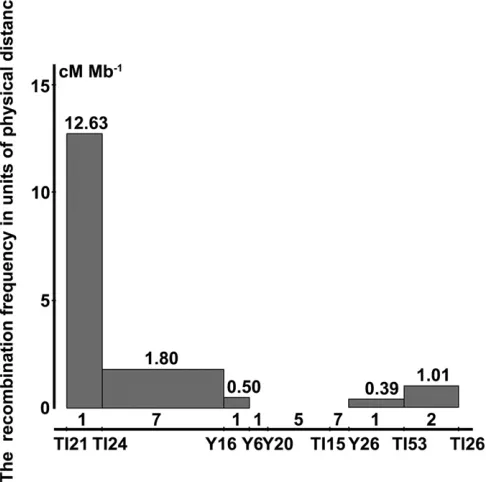
A significant repression of recombination was observed across the primary mapping region of 754 kb (TI21–TI26, Figure 3B) in the centromeric region. The evaluation of 12,000 plants from Ingra/Cpslo17 F2:3 for recombination allowed us to
identify recombination frequency in units of physical dis-tance across this region. The most recombinogenic inter-val was a 66-kb region on the left defined by markers TI21 and TI24. Within this interval, the recombination rate was 12.63 cM/Mb21, which was significantly higher than that of
the 241-kb interval just downstream (TI24 to Y16) and the following 50 kb (Y16 to Y6). A similar case occurred on the right but to a lesser degree, which showed the interval be-tween Y26 and TI53 had a lower recombination rate compared with its downstream 1.01 cM/Mb21. Besides, the 184-kb
interval from Y6 to Y26 had no detectable recombination (Figure 4 andFile S1).
While the whole region is rich in RTs, we analyzed the number of RTs in each of the divided regions according to the calculation of recombination rate. Interestingly, in the regions where recombination rate drops sharply, a surge of RTs was also found (Figure 4). Considering the location in the centro-mere region, it was likely that fewer occurrences of recombi-nation events in Ingra/Cpslo17 F2:3populations were mainly
caused by aggregation of RTs in the target region.
Analysis of candidate genes
To define candidate gene forS7, wefirst sequenced the ge-nome of five ORFs (ORF1,3, and14–16), which had func-tional annotations from varieties including parents, Dular (N22), and Ketan Nangka (K.N., possessing theS7knallele)
(Yanagihara et al. 1992). Since amino acid sequences of
ORF1 andORF14had shown no obvious difference among those varieties, we excludedORF1andORF14as candidate genes (Figure S4andFile S2). Besides, in contrast toORF15
andORF16, which were predominantly expressed in mature panicles,ORF3was mostly expressed in the pistil (Figure 5A
andFigure S5).
The genomic sequence ofORF3(LOC_Os07g27180) spans 17,504 bp and contains 19 introns and 20 exons. It encodes a protein of 898 aa with a conserved TPR domain. Compared with others, Ingra showed more specific amino acid sites. Moreover, a variant amino acid was detected at amino acid 119 in Dular and N22 that has a Met (M) instead of a Leu (L) in Ingra, Cpslo17, and K.N. (Figure S6). Based on higher expression in mature pistils and unique differences in amino acid sequence,ORF3was selected as the candidate gene for
S7tentatively.
S7 encodes a TPR-containing protein
To investigate function ofORF3, we knocked downORF3in parents and heterozygote S7ai/S7cpby RNAi. A total of 26
Ingra-ORF3 RNAi, 33 Cpslo17-ORF3 RNAi, and 53 Ingra/ Cpslo17-ORF3 RNAi transgenic-positive T0 plants were
obtained by background detection and transgenic PCR assay
(Figure S7andFigure S8). The pollen grains in allORF3RNAi
plants showed no obvious abortion compared with those in transgenic-negative plants, while embryo sacs with abnormal positioning of polar nuclei and small embryo sacs were sig-nificantly reduced in Ingra/Cpslo17-ORF3 RNAi plants (Fig-ure 5, B–E). ORF3 RNAi transgenic positive plants had no effect on spikelet fertility of both Ingra and Cpslo17. How-ever, significantly restored spikelet fertility was observed in Ingra/Cpslo17-ORF3 RNAi-positive plants (Table 4).
In order to verify the correlation between relative expression of ORF3 and spikelet fertility, eight families with different spikelet fertility levels from Ingra-ORF3 RNAi, Cpslo17-ORF3 RNAi, and Ingra/Cpslo17-ORF3 RNAi plants were randomly selected, respectively. Gene expression in mature pistils was examined by RT-RCR. In parental transgenic plants, correla-tion between relative expression ofORF3and spikelet fertility was not obvious. However, the extent of downregulation was consistent with the restored level of spikelet fertility in Ingra/ Cpslo17-ORF3 RNAi-positive plants. Strong interference plants (such as 27-6, 18-5, and 13-3) exhibited a high fertility rate, whereas weak interference plants (such as 21-1 and 14-4) were associated with a low fertility rate (Figure 5F).
Figure 4 Evaluation of recombination rate across the primary mapping region (754 kb). Thex-axis is positioned along the markers used infine mapping, and they-axis shows the number of recombination rate, that is the recombination frequency in units of physical distance (cM/Mb21). The number of retrotransposons is shown above the markers.
To test the hypothesis that the restored spikelet fertility of theORF3RNAi plants might be mainly due to normal devel-opment of the embryo sac, we selected three strong interfer-ence plants (27-6, 18-5, and 13-3) as representative ORF3
RNAi plants for further analysis. The rate of embryo sac abor-tion in representative plants ranged from 6.13 to 15.04%, which was significantly lower than 51.46% detected in the negative plants. Correspondingly, the frequency of normal embryo sacs in the representative plants increased substan-tially (Figure 5G). These data were in accordance with the spikelet fertility in the RNAi positive and negative plants. The offspring of the eight RNAi transgenic positive plants showed a similar phenotype of restored spikelet fertility from the T1
to T2generation (Figure 6 andTable S3). Additionally,
seg-regation ratio in T2generation of those three representative ORF3 RNAi families conformed to Mendel’s law (Table 3). These results demonstrated that ORF3 RNAi could restore spikelet fertility of heterozygoteS7ai/S7cpand eliminate
ab-solutely the preferential transmission ofS7ai.
In addition, complementation tests were performed to confirm the function ofORF3. The strategy that we adopted was to transform the S7aiallele into Cpslo17 and theS7cp
allele into Ingra, respectively. Through PCR assay, a series of transgenic-positive T0 plants was obtained (Figure S9).
Examination of the spikelet fertility showed that there was no statistically significant difference between the transgenic-positive and -negative plants of Ingra-S7cp. By contrast,
trans-genic-positive and -negative plants of the Cpslo17-S7ai
Figure 5 Functional analysis ofORF3. (A) Expression pattern ofORF3. (B–E) Cytological observation of RNAi transgenic plants: negative control (B and D); positive (C and E). (F) Regression analysis of relative expression ofORF3and spikelet fertility in parent and Ingra/Cpslo17 F1RNAi transgenic plants. (G) Percentage of different types observed in mature embryo sacs of Ingra/Cpslo17-ORF3 RNAi representative and negative plants. APPN, abnormal positioning of polar nuclei; Le, lemma; MP, mature panicle; NES, normal embryo sac; other, other abnormal embryo sacs; Pa, palea; Pi, pistil; SES, small embryo sac; St, stamen; YL, young leaf; YR, young root; YS, young stem. Bars, 50mm.
showed a highly significant difference in spikelet fertil-ity; the average spikelet fertility of the positive plants (49.00%) was much lower than that of the negative plants (82.19%) (Table 4). Considering the S7ai allele
exhibi-ted absolute preferential transmission by promoting the
elimination ofS7cp, we thus concluded thatORF3is the
can-didate gene.
Expression and subcellular location of ORF3
Phylogenetic tree analysis showed that ORF3 exists in not only Asian rice (O. sativaL.) but also wild rice. Cpslo17 is closely related to theindicatype and distanced from Ingra, confirming the similarity with IR36, which could not transmit their female gamete to their progeny in hybrid F1’s crossed with Ingra.
Homologous proteins of ORF3 were identified in other plants, all of which belong to the grass family (Figure S10). Further-more, protein sequence alignment suggested that ORF3 exhibited 76.0–79.7% identity with its homologous proteins, indicating that the ORF3 is specific to monocots (Figure S11).
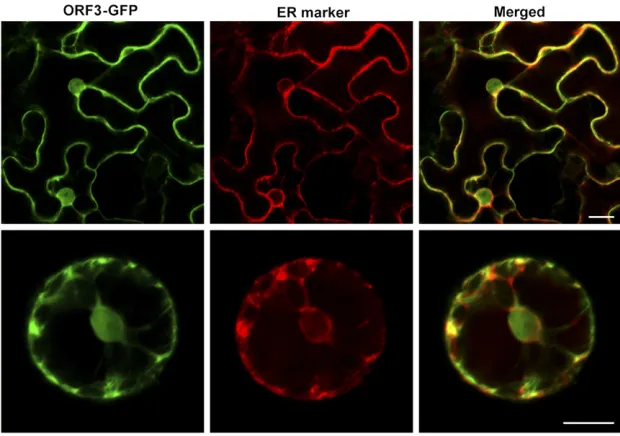
To determine experimentally subcellular localization, a fusion protein, ORF3-GFP, was generated and expressed transiently under the control of the35Spromoter in tobacco (N. benthamiana) mesophyll protoplasts. As shown in Figure 7, ORF3-GFP was detected in the ER and nuclei.
Discussion
Rice is one of the main crops providing staple food for more than half the global population. Utilization of strong heterosis in intersubspecific crosses of rice has long been difficult due to semisterility of panicles in the hybrids between indica
and japonicacultivars. One of the genes involved in this
Table 4 Spikelet fertility of transgenic T0plants
Receptor Types No. of plants
Spikelet fertility (%)
Ingra-ORF3 RNAi Positive 26 92.03
Negative 12 92.37
t 2.03
P 0.84
Cpslo17-ORF3 RNAi Positive 33 93.54
Negative 13 92.17
t 2.12
P 0.15
Ingra/Cpslo17-ORF3 RNAi Positive 53 77.00
Negative 19 48.04
t 2.00
P 0.00
Cpslo17-S7ai Positive 11 49.00
Negative 6 82.19
t 2.18
P 0.00
Ingra-S7cp Positive 7 90.03
Negative 12 93.56
t 2.11
P 0.08
Figure 6 Distribution of spikelet fertility of Ingra/Cpslo17-ORF3 RNAi from T1to T2generation.
phenomenon isS7, which has been isolated here through a positional cloning approach. We demonstrate that a TPR-containing protein plays a significant role in hybrid female sterility, which is particularly important for understanding the molecular mechanism of intersubspecific hybrid steril-ity in rice.
Evidence from the current study suggests that the function ofS7is centered on functional female gametophyte forma-tion. Abnormal female gametophyte of hybrid F1appears at
the eight-nucleate embryo sac developing stage, when polar nuclei start their migration to the upward side of the egg apparatus and the embryo sac begins to enlarge (Figure 2). In addition, the abnormal embryo sac caused byS7led to the semisterility of spikelets directly (Table 2), which was con-sistent with a previous report that most of the smaller embryo sacs and abnormal polar nuclei positioning embryo sacs could not succeed in fertilization, even with a normal female germ unit (Zeng et al.2009). It was reported that orientation of polar nuclei always occurred not only during development of female gametophyte but also after fertilization, when one sperm cell nucleus moved toward the central cell (Ding
et al. 2009). Observation on the distribution and structural organization of the microtubule during megagametogenesis suggested that some new organizational patterns of microtu-bules surrounding the central cell might be associated with the probable movement and positioning of the polar nuclei (Xuet al.2001). Furthermore, an involvement of F-actin in gamete nuclear migration had been suggested that F-actin disorganization in the central cell could disrupt the polarized nuclear location and the presence of intact F-actin cables in the central cell was correlated with successful karyogamy regardless of the central cell nuclear position (Kawashima
et al. 2014; Ohnishi et al. 2014; Kawashima and Berger 2015). Therefore, we speculate that some cytoskeleton or sig-nal molecules, involved in the migration of polar nuclei, were disorganized during the development of the embryo sac and
led to incorrect guidance of polar nuclei fertilization eventually in both Ingra/IR36 and Ingra/Cpslo17 hybrids.
Analysis of recombination rate revealed that a large num-ber of RTs, especially Ty3-gypsy, were aggregated in theS7 -containing region near the centromere (Figure 4). In general, transposable elements (TEs) were found to be enriched in the pericentromeric regions of many plant genomes (Arabidopsis Genome Initiative 2000; International Rice Genome Sequenc-ing Project 2005; Patersonet al.2009; Schnableet al.2009; Schmutzet al.2010; Luoet al.2012). Genes close to the cen-tromere or retrotransposon clusters are less recombinogenic than other genes in a gene-rich region (Copenhaveret al.
1999; Fuet al.2001). Significant recombinational repressions were reported in the mapping regions ofRc/rg7.1(Sweeney
et al. 2006) andGhd7(Xueet al. 2008). Both of the genes located close toS7, demonstrating that the low frequency of recombination in theS7-containing region may be due to its particular location in the centromeric region on chromosome 7. In plants, self-incompatibility genes were found to be recom-binationally suppressed due to their subcentromeric location inPetunia(Coleman and Kao 1992; Entaniet al.1999), Antir-rhinum(Maet al.2003; Yanget al.2007), and the presence of repetitive DNA inNicotiana(Mattonet al.1995). Additionally, the hybrid incompatibility genesLhr,Zhr, andOdsHin Drosoph-ila, were all mapped to recombinationally suppressed pericen-tric and heterochromatic regions with reduced or undetectable levels of recombination (Sawamuraet al.1993; Brideauet al.
2006; Bayes and Malik 2009). Consequently, it is still necessary to validate whether the suppression of recombination plays a role in species conservation.
The TPR domain is one of the most frequently observed amino acid motifs in nature, which can be found in numerous proteins. TPR-containing proteins always serve as interaction modules and multiprotein complex mediators (Blatch and Lassle 1999; Zeytuniet al.2011; Zeytuni and Zarivach 2012; Shin et al. 2014) and regulate diverse biological processes,
Figure 7 Subcellular localization of ORF3 protein in tobacco mesophyll protoplasts. Bars, 20mm.
including reproductive development. In rice, mutation in OsAPC6, one of the TPR-containing anaphase-promoting com-plex/cyclosome (APC/C) subunits, caused a reduced number or complete absent of polar nuclei (Kumaret al.2010; Awasthi
et al.2012). Therefore, protein–protein interaction may pro-vide important clues to reveal the molecular mechanism ofS7. In our study, downregulated expression ofORF3could restore spikelet fertility in the hybrid F1 Ingra/Cpslo17. However,
there was no effect in either Ingra-ORF3 RNAi or Cpslo17-ORF3 RNAi plants (Figure 5 and Table 4). These results sug-gest thatS7may not be essential for growth, development, or reproduction, and hybrid sterility of Ingra/Cpslo17 is probably controlled by allelic interaction betweenS7aiandS7cp.
There-fore, weak allelic interaction in Ingra/Cpslo17-ORF3 RNAi plants could overcome the hybrid sterility. Although trans-formants Cpslo17-S7aiand Ingra-S7cphaveS7aiandS7cp
al-leles, simultaneously, the sterility occurs only inS7ai/S7ai-S7cp
(Table 4). Combined with the results of TRD analysis (Table 3), the S7ai allele exhibits stronger function during female
gametes transferring in heterozygote (S7ai/S7cp) plants. Due
to the fact that the F1hybrids between three parents (Ingra,
IR36, and Cpslo17) and wide-compatibility varieties (WCVs) (Dular and N22) showed normal spikelet fertility (Table 1), Dular and N22 were assumed to carry the neutral alleleS7n
at theS7locus. To confirm the function ofS7n, we sequenced
theS7region in three parents and WCVs and found that a SNP (C/A) caused an amino acid substitution (Leu-119 in parents, Met-119 in Dular and N22) (Figure S6andTable S4). Addi-tionally, a total of 47 varieties includingindica,japonica, and wild rice were compared with the genomic sequence of theS7
region, the result of which indicated that the nucleotide C exists in most varieties (Table S4). However, Leu-119 is con-served not only in various rice species, but also in other plants
(Figure S10). Moreover, predicted 3D structures of ORF3 from
Ingra, Cpslo17, and Dular indicated that amino acid sequence differences may induce their changes in spatial structure di-rectly (Figure S12). Therefore, we speculate that during the formation of female gametophytes in heterozygotesS7ai/S7cp
andS7ai/S7i, gametes carryingS7cpandS7icould not resist the
effect of S7ai from sporophyte, thus leading to embryo sac
abortion. However, theS7aigametes could resolve such
func-tion ofS7cpandS7i, exhibiting preferential transmission.
Ad-ditionally, substitution of Met-119 in S7nmay cause loss of
function of protein–protein interactions in Dular and N22, which results in the failure to produce sterile offspring when crossed with eitherindicaorjaponica(Figure S13). Although how such likely nonfunction is related to hybrid fertility re-mains to be characterized, the discovery and molecular anal-ysis of S7n in this study probably can provide functional
markers for WCG germplasm screening to solve, at least par-tially, hybrid embryo sac sterility in rice breeding.
Acknowledgments
This research was supported by the National Transgenic Science and Technology Program (2013ZX08001004-002
and 2013ZX08009003-003), the Chinese National High Technology Research and Development Program (“863” 2014AA10A604), the Key Research and Development Pro-gram of Jiangsu Province (BE2015363), and grants from the Ministry of Agriculture Key Laboratory of the middle and lower reaches of the Yangtze River japonica rice biology and genetic breeding.
Literature Cited
Arabidopsis Genome Initiative, 2000 Analysis of the genome se-quence of theflowering plantArabidopsis thaliana. Nature 408: 796–815.
Awasthi, A., P. Paul, S. Kumar, S. K. Verma, R. Prasad et al., 2012 Abnormal endosperm development causes female steril-ity in rice insertional mutantOsAPC6. Plant Sci. 183: 167–174. Baack, E., M. C. Melo, L. H. Rieseberg, and D. Ortiz-Barrientos, 2015 The origins of reproductive isolation in plants. New Phy-tol. 207: 968–984.
Barbash, D. A., D. F. Siino, A. M. Tarone, and J. Roote, 2003 A rapidly evolving MYB-related protein causes species isolation in Drosophila. Proc. Natl. Acad. Sci. USA 100: 5302–5307. Bayes, J. J., and H. S. Malik, 2009 Altered heterochromatin
bind-ing by a hybrid sterility protein in Drosophila siblbind-ing species. Science 326: 1538–1541.
Bikard, D., D. Patel, C. Le Mette, V. Giorgi, C. Camilleri et al., 2009 Divergent evolution of duplicate genes leads to genetic incompatibilities withinA. thaliana. Science 323: 623–626. Blatch, G. L., and M. Lassle, 1999 The tetratricopeptide repeat: a
structural motif mediating protein-protein interactions. BioEssays 21: 932–939.
Brideau, N. J., H. A. Flores, J. Wang, S. Maheshwari, X. Wanget al., 2006 Two Dobzhansky-Muller genes interact to cause hybrid lethality inDrosophila. Science 314: 1292–1295.
Chen, J., L. Jiang, C. M. Wang, H. Ikehashi, H. Q. Zhai et al., 2006 Mapping of loci for pollen sterility ofindica-japonica hy-brids in rice (Oryza sativaL.). Acta Agron. Sin. 32: 515–521. Chen, J. J., J. H. Ding, Y. D. Ouyang, H. Y. Du, J. Y. Yanget al.,
2008 A triallelic system of S5is a major regulator of the re-productive barrier and compatibility ofindica-japonicahybrids in rice. Proc. Natl. Acad. Sci. USA 105: 11436–11441. Chen, M. J., Z. G. Zhao, L. Jiang, and J. M. Wan, 2012 A new gene
controlling hybrid sterility in rice (Oryza sativa L.). Euphytica 184: 15–22.
Chen, S., Z. L. Luo, and D. X. Zhang, 2014 P and post-zygotic re-productive isolation between co-occurringMussaenda pubescensvar. albaandM. shikokiana(Rubiaceae). J. Integr. Plant Biol. 56: 411–419. Coleman, C. E., and T. Kao, 1992 Theflanking regions of two Petunia inflata S alleles are heterogeneous and contain repeti-tive sequences. Plant Mol. Biol. 18: 725–737.
Copenhaver, G. P., K. Nickel, T. Kuromori, M. I. Benito, S. Kaul et al., 1999 Genetic definition and sequence analysis of Arab-idopsiscentromeres. Science 286: 2468–2474.
Coyne, J. A., and H. A. Orr, 2004 Speciation, Sinauer Associates, Sunderland, MA.
Dai, X. M., Q. C. Huang, G. Y. Qin, and G. P. Li, 2006 Observation on particular embryo sac of rice using confocal microscopy. J. North China Agriculture 21: 26–29.
De Vienne, D. M., G. Refregier, M. E. Hood, A. Guigue, B. Devier et al., 2009 Hybrid sterility and inviability in the parasitic fungal species complexMicrobotryum. J. Evol. Biol. 22: 683–698. Ding, J. T., J. H. Shen, W. Li, and H. Yang, 2009 Cytological
ob-servation of double fertilization and its duration inOryza sativa. Bull. Bot. 44: 473–483.
Dobzhansky, T., 1937 Genetics and the Origin of Species, Columbia University Press, New York.
Entani, T., M. Iwano, H. Shiba, S. Takayama, K. Fukui et al., 1999 Centromeric localization of an S-RNase gene in Petunia hybrida Vilm. Theor. Appl. Genet. 99: 391–397.
Ferree, P. M., and D. A. Barbash, 2009 Species-specific hetero-chromatin prevents mitotic chromosome segregation to cause hybrid lethality inDrosophila. PLoS Biol. 7: e1000234. Fu, H. H., Z. W. Zheng, and H. K. Dooner, 2001 Recombination
rates between adjacent genic and retrotransposon regions in maize vary by 2 orders of magnitude. Proc. Natl. Acad. Sci. USA 99: 1082–1087.
Grant, V., 1981 Plant Speciation, Columbia University Press, New York.
Hiei, Y., S. Ohta, T. Komari, and T. Kumashiro, 1994 Efficient trans-formation of rice (Oryza sativaL.) mediated by Agrobacterium and sequence analysis of the boundaries of the T-DNA. Plant J. 6: 271–282.
Hughes, S., H. Wilkinson, S. P. Gilbert, M. Kishida, S. S. Dinget al., 2014 TheC. elegansTPR containing protein, TRD-1, regulates cell fate choice in the developing germ line and epidermis. PLoS One 9: e114998.
Ikehashi, H., and H. Araki, 1984 Variety screening of compatibil-ity types revealed in F1fertility of distant cross in rice. Japanese J. Breed. 34: 304–313.
Ikehashi, H., and H. Araki, 1987 Screening and genetic analysis of wide-compatibility in F1hybrids of distant crosses in rice (Oryza
sativaL.). Tech. Bull. Trop. Agric. Res. 23: 1–79.
International Rice Genome Sequencing Project, 2005 The map-based sequence of the rice genome. Nature 436: 793–800.
Ji, Q., J. F. Lu, Q. Chao, Y. Zhang, M. J. Zhanget al., 2010 Two sequence alterations, a 136 bp InDel and an A/C polymor-phic site, in the S5locus are associated with spikelet fertility ofindica-japonicahybrid in rice. J. Genet. Genomics 37: 57–68. Jing, W., W. W. Zhang, L. Jiang, L. M. Chen, H. Q. Zhai et al., 2007 Two novel loci for pollen sterility in hybrids between the weedy strain Ludao and the japonica variety Akihikari of rice (Oryza sativaL.). Theor. Appl. Genet. 114: 915–925. Kawashima, T., and F. Berger, 2015 The central cell nuclear
po-sition at the micropylar end is maintained by the balance of F-actin dynamics, but dispensable for karyogamy inArabidopsis. Plant Reprod. 28: 103–110.
Kawashima, T., D. Maruyama, M. Shagiron, J. Li, Y. Hamamura et al., 2014 Dynamic F-actin movement is essential for fertil-ization inArabidopsis thaliana. eLife 3: e04501.
Koide, Y., K. Onishi, D. Nishimoto, A. R. Baruah, A. Kanazawaet al., 2008 Sex-independent transmission ratio distortion system re-sponsible for reproductive barriers between Asian and African rice species. New Phytol. 179: 888–900.
Koide, Y., Y. Shinya, M. Ikenaga, N. Sawamura, K. Matsubaraet al., 2012 Complex genetic nature of sex-independent transmission ratio distortion in Asian rice species: the involvement of unlinked modifiers and sex-specific mechanisms. Heredity 108: 242–247. Kubo, T., Y. Yamagata, M. Eguchi, and A. Yoshimura, 2008 A
novel epistatic interaction at two loci causing hybrid male ste-rility in an inter-subspecific cross of rice (Oryza sativaL.). Genes Genet. Syst. 83: 443–453.
Kubo, T., A. Yoshimura, and N. Kurata, 2011 Hybrid male sterility in rice is due to epistatic interactions with a pollen killer locus. Genetics 189: 1083–1092.
Kumar, M., O. P. Basha, A. Puri, D. Rajpurohit, G. S. Randhawa et al., 2010 A candidate geneOsAPC6of anaphase-promoting complex of rice identified through T-DNA insertion. Funct. In-tegr. Genomics 10: 349–358.
Lee, H. Y., J. Y. Chou, L. Cheng, N. H. Chang, S. Y. Yanget al., 2008 Incompatibility of nuclear and mitochondrial genomes
causes hybrid sterility between two yeast species. Cell 135: 1065–1073.
Levin, D. A., 1978 The origin of isolating mechanisms inflowering plants. Evol. Biol. 11: 185–317.
Li, D. T., L. M. Chen, L. Jiang, S. S. Zhu, Z. G. Zhao et al., 2007 Fine mapping ofS32(t), a new gene causing hybrid em-bryo sac sterility in a Chinese landrance rice (Oryza sativaL.). Theor. Appl. Genet. 114: 515–524.
Li, H., L. Jiang, J. H. Youn, W. Sun, Z. J. Cheng et al., 2013 A comprehensive genetic study reveals a crucial role ofCYP90D2/ D2in regulating plant architecture in rice (Oryza sativa). New Phytol. 200: 1076–1088.
Li, J., J. Liu, G. Wang, J. Y. Cha, G. Liet al., 2015 A chaperone function of NO CATALASE ACTIVITY1is required to maintain catalase activity and for multiple stress responses inArabidopsis. Plant Cell 27: 908–925.
Lien, S., J. Szyda, B. Schechinger, G. Rappold, and N. Arnheim, 2000 Evidence for heterogeneity in recombination in the human pseudoautosomal region: high resolution analysis by sperm typing and radiation-hybrid mapping. Am. J. Hum. Genet. 66: 557–566. Lin, Z., L. Arciga-Reyes, S. Zhong, L. Alexander, R. Hackettet al.,
2008 SlTPR1, a tomato tetratricopeptide repeat protein, inter-acts with the ethylene receptors NR and LeETR1, modulating ethylene and auxin responses and development. J. Exp. Bot. 59: 4271–4287.
Livak, K. J., and T. D. Schmittgen, 2001 Analysis of relative gene expression data using real-time quantitative PCR and the 2 (-Delta Delta C(T)) method. Methods 25: 402–408.
Long, Y. M., L. F. Zhao, B. X. Niu, J. Su, H. Wuet al., 2008 Hybrid male sterility in rice controlled by interaction between divergent alleles of two adjacent genes. Proc. Natl. Acad. Sci. USA 105: 18871–18876.
Luo, S., J. Mach, B. Abramson, R. Ramirez, R. Schurr et al., 2012 The cotton centromere contains a Ty3-gypsy-like LTR retroelement. PLoS One 7: e35261.
Ma, W. S., J. L. Zhou, Z. Lai, Y. S. Zhang, and Y. B. Xue, 2003 The self-incompatibilty S locus of Antirrhinum resides in a pericen-tromeric region. Acta Bot. Sin. 45: 47–52.
Masuda, K., T. Chiyoda, N. Sugiyama, A. Segura-Cabrera, Y. Kabe et al., 2015 LATS1 and LATS2 phosphorylate CDC26 to mod-ulate assembly of the tetratricopeptide repeat subcomplex of APC/C. PLoS One 10: e0118662.
Matton, D. P., S. L. Mau, S. Okamoto, A. E. Clarke, and E. Newbigin, 1995 TheS-locus ofNicotiana alata: genomic organization and se-quence analysis of twoS-RNase alleles. Plant Mol. Biol. 28: 847–858. Mayr, E., 1942 Systematics and the Origin of Species, Columbia
University Press, New York.
Mayr, E., 1963 Animal Species and Evolution, Harvard University Press, Cambridge, MA.
Mizuta, Y., Y. Harushima, and N. Kurata, 2010 Rice pollen hybrid incompatibility caused by reciprocal gene loss of duplicated genes. Proc. Natl. Acad. Sci. USA 107: 20417–20422.
Ohnishi, Y., R. Hoshino, and T. Okamoto, 2014 Dynamics of male and female chromatin during karyogamy in rice zygotes. Plant Physiol. 165: 1533–1543.
Park, M., D. Lee, G. J. Lee, and I. Hwang, 2005 AtRMR1 functions as a cargo receptor for protein trafficking to the protein storage vacuole. J. Cell Biol. 170: 757–767.
Paterson, A. H., J. E. Bowers, R. Bruggmann, I. Dubchak, J. Grimwood et al., 2009 TheSorghum bicolorgenome and the diversification of grasses. Nature 457: 551–556.
Phadnis, N., and H. A. Orr, 2009 A single gene causes both male sterility and segregation distortion in Drosophila hybrids. Sci-ence 323: 376–379.
Presgraves, D. C., L. Balagopalan, S. M. Abmayr, and H. A. Orr, 2003 Adaptive evolution drives divergence of a hybrid inviability gene between two species ofDrosophila. Nature 423: 715–719.
Sawamura, K., M. T. Yamamoto, and T. K. Watanabe, 1993 Hybrid lethal systems in theDrosophila melanogasterspecies complex. II. TheZygotic hybrid rescue(Zhr) gene ofD. melanogaster. Genetics 133: 307–313.
Schmutz, J., S. B. Cannon, J. Schlueter, J. Ma, T. Mitros et al., 2010 Genome sequence of the palaeopolyploid soybean. Na-ture 463: 178–183.
Schnable, P. S., D. Ware, R. S. Fulton, J. C. Stein, F. Weiet al., 2009 The B73 maize genome: complexity, diversity, and dy-namics. Science 326: 1112–1115.
Schreiber, D. N., and T. Dresselhaus, 2003 In vitro pollen germi-nation and transient transformation ofZea maysand other plant species. Plant Mol. Biol. Report. 21: 31–41.
She, K. C., H. Kusano, K. Koizumi, H. Yamakawa, M. Hakataet al., 2010 A novel factorFLOURY ENDOSPERM2is involved in reg-ulation of rice grain size and starch quality. Plant Cell 22: 3280– 3294.
Shin, S. B., M. Golovkin, and A. S. Reddy, 2014 A pollen-specific calmodulin-binding protein, NPG1, interacts with putative pec-tate lyases. Sci. Rep. 4: 5263.
Stoutjesdijk, P. A., S. P. Singh, Q. Liu, C. J. Hurlstone, P. A. Water-houseet al., 2002 hpRNA-mediated targeting of the Arabidop-sis FAD2gene gives highly efficient and stable silencing. Plant Physiol. 129: 1723–1731.
Sweeney, M., and S. McCouch, 2007 The complex history of the domestication of rice. Ann. Bot. (Lond.) 100: 951–957. Sweeney, M., M. Thomson, B. Pfeil, and S. McCouch, 2006 Caught
red-handed:Rcencodes a basic helix-loop-helix protein condition-ing red pericarp in rice. Plant Cell 18: 283–294.
Sweigart, A. L., and J. H. Willis, 2012 Molecular evolution and genetics of postzygotic reproductive isolation in plants. F1000 Biol. Rep. 4: 23.
Tamura, K., G. Stecher, D. Peterson, A. Filipski, and S. Kumar, 2013 MEGA6: molecular evolutionary genetics analysis ver-sion 6.0. Mol. Biol. Evol. 30: 2725–2729.
Tang, S., and D. C. Presgraves, 2009 Evolution of theDrosophila nuclear pore complex results in multiple hybrid incompatibili-ties. Science 323: 779–782.
Ting, C. T., S. C. Tsaur, M. L. Wu, and C. I. Wu, 1998 A rapidly evolving homeobox at the site of a hybrid sterility gene. Science 282: 1501–1504.
Ting, Y., 1957 The origin and evolution of cultivated rice in China. Acta Bot. Sin. 8: 243–260 (In Chinese).
Tranguch, S., J. Cheung-Flynn, T. Daikoku, V. Prapapanich, M. B. Coxet al., 2005 Cochaperone immunophilin FKBP52 is critical to uterine receptivity for embryo implantation. Proc. Natl. Acad. Sci. USA 102: 14326–14331.
Waadt, R., and J. Kudla, 2008 In planta visualization of protein interactions using bimolecular fluorescence complementation (BiFC). Cold Spring Harb. Protoc. 2008: t4995.
Wan, J. M., and H. Ikehashi, 1995 Identification of a new locus S-16causing hybrid sterility in native rice varieties (Oryza sativa L.) from Tai-hu lake region and Yunnan province, China. Breed. Sci. 45: 161–170.
Wan, J., S. Yanagihara, H. Kato, and H. Ikehashi, 1993 Multiple alleles at a new locus causing hybrid sterility between a Korean indicavariety andjaponicavariety in rice. Japanese J. Breed. 43: 507–516.
Wan, J., Y. Yamaguchi, H. Kato, and H. Ikehashi, 1996 Two new loci for hybrid sterility in cultivated rice (Oryza sativaL.). Theor. Appl. Genet. 92: 183–190.
Wan, J. M., and H. Ikehashi, 1996 Evidence for mutational origin of hybrid sterility genes in rice (Oryza sativaL.). Breed. Sci. 46: 167–172.
Wang, K. L., H. Yoshida, C. Lurin, and J. R. Ecker, 2004 Regulation of ethylene gas biosynthesis by the Arabidopsis ETO1 protein. Nature 428: 945–950.
White, M. A., B. Steffy, T. Wiltshire, and B. A. Payseur, 2011 Genetic dissection of a key reproductive barrier between nascent species of house mice. Genetics 189: 289–304.
Widmer, A., C. Lexer, and S. Cozzolino, 2009 Evolution of repro-ductive isolation in plants. Heredity 102: 31–38.
Xu, S. X., X. D. Liu, H. L. Zhu, and Y. G. Lu, 2001 Further studies on microtubule organizational changes during megagametogen-esis in rice embryo sac. Acta Bot. Sin. 43: 910–917.
Xue, W. Y., Y. Z. Xing, X. Y. Weng, Y. Zhao, W. J. Tang et al., 2008 Natural variation inGhd7 is an important regulator of heading date and yield potential in rice. Nat. Genet. 40: 761–767. Yamagata, Y., E. Yamamoto, K. Aya, K. T. Win, K. Doi et al., 2010 Mitochondrial gene in the nuclear genome induces repro-ductive barrier in rice. Proc. Natl. Acad. Sci. USA 107: 1494–1499. Yanagihara, S., H. Kato, and H. Ikehashi, 1992 A new locus for multiple alleles causing hybrid sterility between an Aus variety and Javanica varieties in rice (Oryza sativaL.). Japanese Journal of Breeding 42: 793–801.
Yang, J. Y., X. B. Zhao, K. Cheng, H. Y. Du, Y. D. Ouyang et al., 2012 A killer-protector system regulates both hybrid sterility and segregation distortion in rice. Science 337: 1336–1340. Yang, Q. Y., D. F. Zhang, Q. Li, Z. K. Cheng, and Y. B. Xue,
2007 Heterochromatic and genetic features are consistent with recombination suppression of the self-incompatibility locus inAntirrhinum. Plant J. 51: 140–151.
Yang, Z., I. M. Wolf, H. Chen, S. Periyasamy, Z. Chen et al., 2006 FK506-binding protein 52 is essential to uterine repro-ductive physiology controlled by the progesterone receptor A isoform. Mol. Endocrinol. 20: 2682–2694.
Zeng, Y. X., C. Y. Hu, Y. G. Lu, J. Q. Li, and X. D. Liu, 2009 Abnormalities occurred during female gametophyte de-velopment result in the diversity of abnormal embryo sacs and lead to the abnormal fertilization inindica/japonicahybrids in rice. J. Integr. Plant Biol. 51: 3–12.
Zeytuni, N., and R. Zarivach, 2012 Structural and functional dis-cussion of the tetra-trico-peptide repeat, a protein interaction module. Structure 20: 397–405.
Zeytuni, N., E. Ozyamak, K. Ben-Harush, G. Davidov, M. Levinet al., 2011 Self-recognition mechanism of MamA, a magnetosome-associated TPR-containing protein, promotes complex assembly. Proc. Natl. Acad. Sci. USA 108: E480–E487.
Zhang, Y. H., Z. G. Zhao, J. W. Zhou, L. Jiang, X. F. Bian et al., 2011 Fine mapping of a gene responsible for pollen semi-sterility in hybrids betweenOryza sativaL. andO. glaberrimaSteud. Mol. Breed. 28: 323–334.
Zhao, Z. G., L. Jiang, W. W. Zhang, C. Y. Yu, S. S. Zhuet al., 2007 Fine mapping ofS31, a gene responsible for hybrid embryo-sac abortion in rice (Oryza sativaL.). Planta 226: 1087–1096.
Zhao, Z. G., S. S. Zhu, Y. H. Zhang, X. F. Bian, Y. Wang et al., 2011 Molecular analysis of an additional case of hybrid steril-ity in rice (Oryza sativaL.). Planta 233: 485–494.
Zhu, S., C. Wang, T. Zheng, Z. Zhao, H. Ikehashiet al., 2005 A new gene located on chromosome 2 causing hybrid sterility in a remote cross of rice. Plant Breed. 124: 440–445.
Communicating editor: J. A. Birchler
GENETICS
Supporting Information
www.genetics.org/lookup/suppl/doi:10.1534/genetics.115.183848/-/DC1
Hybrid Sterility in Rice (
Oryza sativa
L.) Involves the
Tetratricopeptide Repeat Domain
Containing Protein
Yang Yu, Zhigang Zhao, Yanrong Shi, Hua Tian, Linglong Liu, Xiaofeng Bian, Yang Xu, Xiaoming Zheng, Lu Gan, Yumin Shen, Chaolong Wang, Xiaowen Yu, Chunming Wang, Xin Zhang, Xiuping Guo, Jiulin Wang, Hiroshi Ikehashi, Ling Jiang, and Jianmin Wan
Figure S2 Genetic location of S7 on rice chromosome 7. (a) An outline linkage map constructed by 18
SSR markers showed closely linkage with Rc gene. (b) S7 was located close to RM5543 with a distance of
Figure S7 Background detection of RNAi plants in S7-containing region by PCR amplified with primers
TI15 (a) and TI53 (b). 10 represents type 1 using Ingra as template for amplification, and 11 represents
Figure S8 PCR identification of RNAi plants. – represents negative control using non-transgenic DNA as
template for amplification. + represents positive control using constructed RNAi plasmid as template for
Figure S9 Complementary vector construction and primers used for PCR identification of transgenic
Table S1: Primer sequences. (.xlsx, 15 KB)
Available for download as a .xlsx file at:
Table S2: Predicted genes at the S7 locus based on analysis using the online MSU Rice Genome
Annotation (Osa1) Release 7. (.xlsx, 11 KB)
Available for download as a .xlsx file at:
Table S3: Spikelet fertility of Ingra/Cpslo17-ORF3 RNAi offspring. (.xlsx, 11 KB)
Available for download as a .xlsx file at:
Table S4: The SNP analysis of wild species and
O. sativa
cultivars. (.xlsx, 12 KB)
Available for download as a .xlsx file at:
File S1:
Raw data of fine mapping and recombination rate analysis. (.xls, 88 KB)
Available for download as a .xls file at:
cDNA sequence
ORF1 (LOC_Os07g27150) Ingra
TTTTTATAATGGCCGTAGCAGCAATCTACAGCCTTTTCATCATTAACAAATCTGGCGGCCTTATATAC TACAAGGACTATGGCTCAGCAGGGAGGATGGACACCAATGACAGTCTACGCTTGGCAAGTCTTTG
GCATTCCATGCATGCTATCTCCCAGCAGCTGTCCCCTACACCTGGCTGTGAAGGCATTGACCTTCT ACAAGCCCACAACTTTGATCTCCATTGCTTCCAGTCCCTCACAGGGACAAAGTTTTTTGCTGTATG CGAAACTGGTGCTCAAAATATCGAGACTCTACTGAAAGTCATATACGAGCTCTACACGGATTTTGTT
CTGAAAAATCCATTCTACGAGATGGAGATGCCTATTCGTTGTGAGCTTTTTGATCTCAACCTGGCTC AGGTCATTCAGAAGGACCGCGTCACGCTTCTGGGTCGATGAATCATTTAGAAAACATGATGCACCA
TGTCTTTGTATGTGGCTTATATGACATGTATGGTGTCAGTAGGGTACTTGGAATTCAGGCAAGTCAT TACACTGCATCACAAAGTCCATATACAGTGTGCAGTCGATTCCTTCTAGTTCTGAAAATTACTTTATT CCTGAAGTATCATTTGTGGCCATTTAACAA
Cpslo17 (IR36)
TTTTTATAATGGCGTTAGCAGCAATCTACAGCCTTTTCATCATTAACAAATCTGGTGGCCTTATATACT ACAAGGACTATGGCTCAGCAGGGAGGACGGACACCAATGACAGTCTACGCTTGGCAAGTCTTTG GCATTCCATGCATGCTATCTCCCAGCAGCTGTCCCCTACACCTGGCTGTGAAGGCATTGACCTTCT
ACAAGCCCACAACTTTGATCTCCATTGCTTCCAGTCCCTCACAGGGACAAAGTTTTTTGCTGTATG CGAAACTGGTGCTCAAAATATCGAGACTCTACTGAAAGTCATATACGAGCTCTACACGGATTTTGTT
CTGAAAAATCCATTCTACGAGATGGAGATGCCAATTCGTTGTGAGCTTTTTGATCTCAACCTGGCT CAGGTCATTCAGAAGGACCGCGTCACACTTCTGGGTCGATGAATCATTTAGAAAACATGACGCAC CATGTCTTTGTATGTGGCTTATATGACATGTATGGTGTCAGTAGGGTACTTGGAATTCAGGCAAGTC
ATTACACTGCATCACAAAGTCCATATACAGTGTGCAGTCGATTCCTTCTAGTTCTGAAAATTACTTTA TTCCTGAAGTATCATTTGTGGCCATTTAAAAAA
N22
TTAATAAAGGCCGTAGCAGCAATCTACAGCCTTTTCATCATTAACAAATCTGGTGGCCTTATATACTA
CAAGGACTATGGCTCAGCAGGGAGGACGGACACCAATGACAGTCTACGCTTGGCAAGTCTTTGG CATTCCATGCATGCTATCTCCCAGCAGCTGTCCCCTACACCTGGCTGTGAAGGCATTGACCTTCTA
CAAGCCCACAACTTTGATCTCCATTGCTTCCAGTCCCTCACAGGGACAAAGTTTTTTGCTGTATGC GAAACTGGTGCTCAAAATATCGAGACTCTACTGAAAGTCATATACGAGCTCTACACGGATTTTGTTC TGAAAAATCCATTCTACGAGATGGAGATGCCAATTCGTTGTGAGCTTTTTGATCTCAACCTGGCTCA
GGTCATTCAGAAGGACCGCGTCACACTTCTGGGTCGATGAATCATTTAGAAAACATGACGCACCAT GTCTTTGTATGTGGCTTATATGACATGTATGGTGTCAGTAGGGTACTTGGAATTCAGGCAAGTCATT
ACACTGCATCACAAAGTCCATATACAGTGTGCAGTCGATTCCTTCTAGTTCTGAAAATTACTTTATTC CTGAAGTATCATTGTTGGCCATTTAAACAA
K.N.
TTGTGTGATAATGGCGTTAGCAGCAATCTACAGCCTTTTCATCATTAACAAATCTGGCGGCCTTATAT
ACTACAAGGACTATGGCTCAGCAGGGAGGACGGACACCAATGACAGTCTACGCTTGGCAAGTCTT TGGCATTCCATGCATGCTATCTCCCAGCAGCTGTCCCCTACACCTGGCTGTGAAGGCATTGACCTT
TCAGGTCATTCAGAAGGACCGCGTCACACTTCTGGGTCGATGAATCATTTAGAAAACATGACGCAC
CATGTCTTTGTATGTGGCTTATATGACATGTATGGTGTCAGTAGGGTACTTGGAATTCAGGCAAGTC ATTACACTGCATCACAAAGTCCATATACAGTGTGCAGTCGATTCCTTCTAGTTCTGAAAATTACTTTA TTCCTGAAGTATCATTTGTGCCATTTTGGACTTTATATGTTTCCAGTCGCACCAACCAA
ORF3 (LOC_Os07g27180)
Ingra
ATGGCGGCGTCCCCTGACCCTCCCGGCCCTACCTTCCTCCGCGATGTCGAGCTCCGCCTCCTCC GCTGCACGCTTCCCTCCCCGCCCACCCCGCCCTCGCCCTCTCCTCCCCCTCGCCACCCGCTCG
CCCCGGTCGCCGCCTCCGCCGTCGCCGCCGTCGAGGCCGGCGAGTACGCGGCCGCCCTCGCC TCCGCCGCCCCGCACCTCCTCCCTCCCACCGCCACCGCCGCCCCCGGGTCCGCGGCGCGGTT
CTACGGCGACCTCGCCGCCGCCGCCGAGGCGTTCCTGCGCGGGGACGGCGGTGGGGCGGCG GCGGGCGAGGGGCTCGAGTGCAGGTGCGCCGTCGTGCTGTCGGCGGCGGTGGCCGCGATTCT CGCGTTCACGCAGCAGAACGTGACGGGGCCTCCAGGGAAGTATTCCCCTTTCCCTTTCTGGACT
TCATCATTGGATGAAGGATGTTATAGTAATCTTGAAGATGAATGGGATGCATGGGCTTCTGCTCAGT TAGCTTCTATTGGTTCCCATATTCATGGGAAATTCTCACTTATGCAGTTCATTGTCTTTGCAGAACTT
ATGTTAACTTCTATAAAGAGTCTGGACCCCACAGATTGTTGTAGTGTGTCATGGTGGTTGTGTAGAT TATCTATGGTCCGACAGAACATTGTAGACGAGTTATCATCCACTTTGTTTGATCAAGTACAAGAGTA CAAGAATAAGACATTGGCCCACTTTGGTGAACTTGAAAATGTTTTTAGCTACTGGGGTCCTTTGTTG
TGTGATGGAGAAGGCTCATATTTTGTCTCAGCTGCGTTCTTAGAAGCTGGAATTGCGGAATATAAAT ATGGCAGAATTGATCAATCAAGGCTGCATCTGGATAGTGCTCAAGAAGCATGTGGGCTGCATCTCT
CTCTCACAGGGATGCTTGGTTTTCGAACAATACATCAGGTGGATGCGAAGTCCCAAATGGTACTTG TTGCAAACACAAGTGGACCAGCATCTGGTGAGGGACAAGTAACAGAACTCACAGGAACTCAGGAT GATGCTGCTGCTTTAAAAAATGCAAGGAGTTCTGTTCCTGGGGAAAGTGATGAATTTTGTGATATAC
TAAGAATGCCAAGGCTGGTTGAAAATGATAATGATTCGGGTAATGACGAGAAGAAAGATCCAAGCA AAAAGGCAGTACTGACAGCTATGCAACAAGCTGCTGTCCTAGCAGAATGTTTGCATGTGAGCCGA
AGGAGTCGGCGTGATGAAATGTCTGGGTGGGAGATGGCACCGTTCATAGAGTCAATTGATTCTCA GGAGGATTCCTACTTTGTGGTCAGGAGCTTGTGTGATATTCTGCGTATTAGATGGGAGTCCACCCG CAGTCGGACTAAGCAGAGGGCGCTATTGATGATGGAAAATATGGTTGAAGATGTTGGCAATGATTT
CCCTGTGGCTGCACAGAGAGCCAAACTGGTTTTTGGAGTTCAGATGCCAACTATCCCTGCATTAA GAAAAGAATATGGTGAGCTTTTGATAAGCTGTGGTATAGTTGGAGAAGCACTGGATATTTTTAAAGA
CCTTGAATTGTGGGATAATTTAATCTACTGCTATCGATTATTAGGTAAAGTTGCTGATGCCACTAGTC TAATAAATGCTCGAATCTCTGTTACACCCAATGACCCGAGATTATGGTGTTCACTTGGCGATGTTAC TAACAATGATGATCATTACAAAAAAGCATTGGAAGTCTCAAATAACAAATCTGCTCGAGCTCTGCGT
TCACTGGCTCGCAGTGCTTACAACAGGAATGATTTCCATGCATCCAAAATGCTCTGGGAATCTGCA TTGGCGTTGAATTCTTTGTTTCCAGATGGCTGGTTTGCATATGGTACAGTGGCATGGAAGGATAAA
GATCTTGAGAAAGCTGTGGACGCTTTTACTCGTTCTGTGCAGATAGATCCTGAAAATGGAGAAGCA TGGAACAACATAGCCTGCCTGCACATGATTAGAGGAAGGAGCCAAGCAGCAGTCCAAGCATTCAA
AGAAGCTGTAAAGTTCAAGAGGAATAGTTGGGAGGTTTGGGATAATTACAGTAAGGTTCTTTTGGA CACAGGAAGTATTCAACAGACACTAGAGGCTGTCAAAATGGTACTAAACCTATCCTCGAACAAACG TTTCAACATTGATTTGTTGGAAAAGGTGATGGCCATGCTTGAAGAACAACCTACACATCTCTCTGAT
ACTCAAGAAGCTGAATCTTCCAGAAGCACCTCAGATGATGCAAATCAAGAGACCAGGAAGTACAA CCAGTTGTTAGATATAATTGGTGATATCCTTCAGCAGATTGTACGAAGTGGGGGTAGCAATTCGGAG
GAGTTATTTTCAGCTGAGATGCACCTTAAAAGCTCCTTAAAACAGGCTTCAGACTTCTTACATACCC
CTGAGTATAAAGCTCTCGATGACTGCCTTGCAGAAATAAAAAACCTTATTGGCTCTGCCTAG
Cpslo17 (IR36)
ATGGCGGCATCCCCGGCCCCTCCCGGCCCCACCTTCCTCCGCGAGGTCGAGCTCCGCCTCCTC CGCTGCACGCTCCCCTCCCCGGCCACCCTGCCTCCCCCGCCCTCGCCTCCCCCTCGCCACCCG
CTCGCCCCGGTCGCCGCCTCCGCCGTCGCCGCCGTCGAGGCCGGTGACTACGCGGCCGCCCT CGCCTCCGCCGCCCCGCACCTCCTCCCTCCCACCGCCCCCGCCGCGCCGGGGTCCGCGGCGC GGTTCTACGGCGACCTCGCCGCCGCCGCCGAGGAGTTCCTGCGCGGGGACGACGGCGGGGCG
GCGGCGGCTGGCGAGGGGTTCGAGTGCAGGTGCGCCGTCGTTCTGTCGGCGGCGGTGGCCGC GATTCTCGCGTTCACGCAGCAGAACGTGACGGGGCCTCCAGGGAAGTATTCCCCTTTCCCTTTCT
GGACTTCATCATTGGATGAAGGATGTTATAGTAATCTTGAAGATGAATGGGATGCATGGGCTTCTGC TCAGTTAGCTTCTATTGGTTCCCATGTTCATGGGAAATTCTCACTTATGCAGTTCATTGTCTTTGCAG AACTTATGTTAACTTCTATAAAGAGTCTGGACCCCACAGATTGTTGTAGTGTGTCATGGTGGTTGTG
TAGATTATCTATGGTCCGACAGAACATTGTAGACGAGTTATCATCCACTTTGTTTGATCAAGTACAAG AGTACAAGAATAAGACATTGGCCCACTTTGGTGAACTTGAAAATGTTTTTAGCTACTGGGGTCCTTT
GTTGTGTGATGGAGAAGGCTCATATTTTGTCTCAGCTGCTTTCTTAGAAGCTGGAATTGCGGAATAT AAATATGGCAGAATTGATCAATCAAGGCTGCATCTGGATAGTGCTCAAGAAGCATGTGGGCTGCAT CTCTCTCTCACAGGGATGCTTGGTTTTCGAACAATACATCAGGTGGATGCGAAGTCCCAAATGGTA
CTTGTTGCAAACACAAGTGGATCAGCATCTGGTGAGGGACAAGTAACAGAACTCACAGGAACTCA GGATGATGCTGCTGCTTTAAAAAATGCAAGGAGTTCCGTTCCTGGTGAAAGTGATGAATTTTGTGA
TATACTAAGAATGCCAAGGCTGGTTGAAAATGATAATGATTCGGGTAATGACGAGAAGAAAGATCCA AGCAAAAAGGCAGTACTGACGGCTATGCAACAAGCTGCTGTCCTAGCAGAATGTTTGCATGTGAG CCGAAGGAGTCGGCATGATGAAATGTCTGGGTGGGAGATGGCACCGTTCATAGAGTCAATTGATT
CTCAGGAGGATTCCTACTTTGTGGTCAGGAGCTTGTGTGATATTCTGCGTATTAGATGGGAGTCCA CCCGCAATCGGACTAAGCAGAGGGCGCTATTGATGATGGAAAATATGGTTGAAGATGTTGGCAATG
ATTTCCCTGTGGCTGCACAGAGAGCCAAACTGGTTTTTGGAGTTCAGATGCCAACTATCCCTGCAT TAAGAAAAGAATATGGTGAGCTTTTGATAAGCTGTGGTATAGTTGGAGAAGCACTGGATATTTTTAA AGACCTTGAATTGTGGGATAATTTAATCTACTGCTATCGATTATTAGGTAAAGTTGCTGATGCCACTA
GTCTAATAAATGCTCGAATCTCTGTTACACCCAATGACCCGAGATTATGGTGTTCACTTGGCGATGT TACTAACAATGATGATCATTACAAAAAAGCATTGGAAGTCTCAAATAACAAATCTGCTCGAGCTCTG
CGTTCACTGGCTCGCAGTGCTTACAACAGGAATGATTTCCATGCATCCAAAATGCTCTGGGAATCT GCATTGGCGTTGAATTCTTTGTTTCCAGATGGCTGGTTTGCATACGGTACAGTGGCATGGAAGGAT AAAGATCTTGAGAAAGCTGTGGACGCTTTTACTCGTTCTGTGCAGATAGATCCTGAAAATGGAGAA
GCATGGAACAACATAGCCTGCCTGCACATGATTAGAGGAAGGAGCCAAGCAGCAGTCCAAGCATT CAAAGAAGCTGTAAAGTTCAAGAGGAATAGTTGGGAGGTTTGGGATAATTACAGTAAGGTTCTTTT
GGACACAGGAAGTATTCAACAGACACTAGAGGCTGTCAAAATGGTACTAAACCTATCCTCGAACAA ACGTTTCAACATTGATTTGTTGGAAAAGGTGATGGCCATGCTTGAAGAACAACCTACACATCTCTCT
GATACTCAAGAAGCTGAATCTTCCAGAAGCACCTCAGATGATGCAAATCAAGAGACCAGGAAGTAC AACCAGTTGTTAGATATAATTGGTGATATCCTTCAGCAGATTGTACGAAGTGGGGGTAGCAATTCGG AGATATGGGGTTTATATGCGAGGTGGCATAAGACGAAGGGTAACCTTATCGCATGCTCTGAAGCTAT
GTTGAAGCAAGTTCGGTCTCTCCAGGGTTCTGGACTATGGCATGACCAGACGAAGTTCACTAAGT ATGCTCAAGCTTCCCTGCAGCTTTGCAAGGTCTATATGGAAATTTCTTCTTCGACTGGAAGCCAAA