Electric Vehicle
Sagar Bodkhe1, VishakhaJogdand2 ,Pruthviraj Chavan3, Sanket Rathod4, Ajay Awchar5, Ravindra Totare6
U.G. Student, Department of Electrical Engineering, CSMSS, Engineering College, Aurangabad, Maharashtra, India1
Assistant Professor, Department of Electrical Engineering, CSMSS, Engineering College, Aurangabad,
Maharashtra, India2
ABSTRACT: Electrifying vehicles is seen by many as a possible solution to reduce environmental emissions and the dependence on fossil fuel. Unluckily most environmentally friendly energy storage systems, such as batteries, have less energy density compared to fossil fuel, which will have a negative impact on the vehicle range. A battery with enough capacity for long distance transports will therefore often imply a substantial increase in cost and weight, and reduced transport volume. An alternative would be to continuously transfer energy from the road to the vehicle both for propulsion and charging. A development of an electric vehicle would mean that the vehicle run on electricity using batteries to optimized for routes.
The final objective is to evaluate the technology to conductively transfer energy from the road to the vehicle based on cost, efficiency and feasibility.
KEYWORDS: Electric vehicle (EV), FAME [Faster Adaption and Manufacture of (Hybrid and) Electric Vehicles] Government of India.
I. INTRODUCTION
The era is, however, special in another optional area, namely the vehicle’s type of fuel. The classical, conventional gasoline and diesel-powered cars are no longer the only consumer’s options, while picking up a car on the market and the electricity is more in the game than ever before. It is certainly a nice gesture from an environmental perspective to decide for an eco-friendly driving machine, however, how expensive does it become to drive sustainably is another question. The consumers have the option of choosing fully electric zero tail-pipe emission vehicles, hybrid or even plug-in hybrid cars. Each mentioned one has then its own bright side, but there are dark sides as well.
An Electric vehicle is a battery operated vehicle that is very economical with low maintenance cost and free from pollution. Electric vehicle use the electrical technology of rechargeable battery that converts the electrical energy into mechanical energy. The battery of an electric vehicle can be charged easily using a power connection. An electric power-assist system may be added to almost any electric vehicle using chain drive, belt drive, hub motors or friction drive. India will have better progress on electric buses electric, rickshaws and two-wheelers over the next 10 years.The report believes that by 2040, EVs will constitute only 40 per cent of the total passenger vehicle fleet in India.
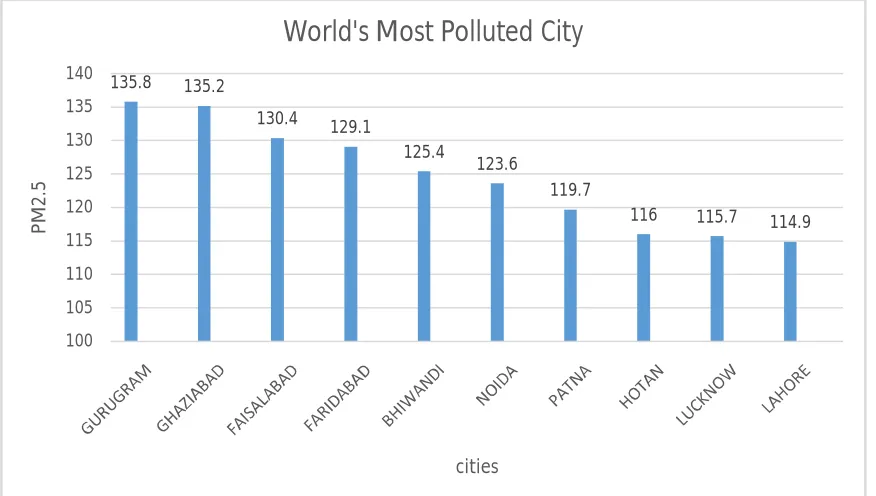
If we use electrical vehicle they also having some social impacts as we know that in world’s top 20 polluted city India having 14 city these is serious reason to shift EV.EVs are known as zero emissions vehicles (ZEVs) and are much environment friendly than gasoline- or LPG-powered vehicles. As EVs have fewer moving parts maintenance is also minimal. There are no oil changes because no engine there, tune-ups, or timing and there is no exhaust. EVs are also high energy efficient than gasoline engines and they are very quiet in operation. EV can also reduce operating cost of vehicle, which is very beneficial to developing country, we know that India having very big import bill in which petroleum product measure source. For overcome all this India should shift EV. Some of accessories use in electric vehicle are motor, battery and controller.
II. FUTURE SCOPE
Transportation accounts for about 11 per cent of India's carbon emissions and is a major source of air pollution in several cities nationwide. As we know that, 14 of the world’s top 20 most-polluted cities are in India, according to a 2018 World Health Organization (WHO) report. In terms of percentage, vehicular pollution contributes about 20-25 per cent of overall air pollution during winters in Delhi. In 2017, India sold about 900,000 EVs, 4 per cent of the volume of diesel and petrol vehicles sold. The government of India had a plant of converting the entire fleet of vehicles to fully electric by 2030, which it sort of scrapped.
Prime Minister Narendra Modi was expected to launch a policy on 'Faster Adoption and Manufacturing of Hybrid and Electric vehicles' (FAME-II), much-anticipated policy for the Indian EV industry, the first phase of which (FAME-I) was released in 2015. In India future of electric vehicles is public transport and electric two wheelers. The report according to Bloomberg New Energy Finance (BNEF) says that India will have better progress on electric two wheelers, rickshaws and electric buses over the next decade.
The report believes that by 2040, EVs will constitute only 40 per cent of the total passenger vehicle fleet in India At the end of 2017, there were just 6,000 highway-capable electric cars plying on Indian roads, which is a minuscule number when compared to the overall numbers of total cars on Indian roads.
The BNEF study says that the annual sales of EVs will reach 30,000 units in 2022 as opposed to 2,000 units in 2017 And if the sale of EVs grows as the study has predicted, they will constitute about 6.6 per cent of annual vehicle sales by 2030 and go up to 27 percent by 2040 Also, by 2040, about 13 percent of the passenger vehicle plying on Indian road will be electric by 2040.
Back in September 2018, NitiAyog CEO Amitabh Kant pointed out that two-wheelers account for 76 per cent of vehicles in the country and they consume 64 percent of the fuel sold in India. According to information government also indicated that the government will be more comfortable to offer incentives for two wheelers, apart from three wheelers and public transport.
III.PROBLEM STATEMENT
1. Cost:
In a now day electric vehicles cost somewhat high, but various government scheme are available from this scheme consumers get subsidy.
2. Making EVs economically viable:Broadly speaking, approaches exist to reduce battery costs reducing the number of batteries that an electric vehicle needs and making batteries cheaper on a per kilowatt-hour basis.
3. Charging infrastructure: The scheme proposes for establishing charging infrastructure and for this about 2700 charging stations will be established in metros, other million plus cities, smart cities and cities of Hilly states across the country. Objective is to create at least one charging station in a grid of 3 km x 3 km. Similarly, establishment of charging stations are also proposed on major highways connecting major city clusters.
Phase I of FAME: Phase I of the FAME India Scheme was inaugurated on April 1st, 2015 and extended to March 31, 2019. Its original time period was two year. The scheme was implemented with an outlay of Rs 895 crore. Almost 2,18,625 Electric Vehicle were ‘promoted’ by FAME I till July 2018.
The mother programme of FAME- the National Electric Mobility Mission Plan (NEMMP) 2020 was launched in 2013 to achieve sales of six-seven million units of electric vehicles and we can saving fossil fuel of 2.2 to 2.5 million tonnes. Promotion of electric vehicles will help to lower vehicular emissions and decrease in carbon dioxide emissions by up to 1.5% by 2020.
In early 2018, the Ministry of Power Government of India launched the new National Electric Mobility Programme with broad objectives. Here, the focus is for establishing the electric charging infrastructure and a policy framework to set realise more than 30% electric vehicles by 2030.
4. Providing charging infrastructure: The limiting factor of batteries on driving range may be addressed by developing an ecosystem of fast-charging or swapping of batteries, by creating an infrastructure, maybe even every kilometre, in dense areas. A small size battery will have lower costs by reducing the total weight of the vehicle, resulting in higher energy efficiency and improved ability to upgrade as the technology evolves.
5. Increasing efficiency of vehicles: Incentivising developments to increase vehicle efficiency, thereby reducing energy consumption, can enable to a vehicle to travel the same distance on a smaller battery pack. Energy efficiency can be enhanced by using more efficient electric motors using better tyres, enhancing the aero dynamics of the vehicles and reducing its weight.:
a.Selecting appropriate battery chemistry: As batteries dominate costs of electric vehicles, the strategy would be to use battery chemistry with optimized cost and performance at Indian temperatures. India should encourage and give some funds manufacturing of such battery cells in India. India is also making already battery packs (cell to pack).
b.Exploring new battery chemistries: Focussing on materials like lithium, manganese, nickel, cobalt and graphite that are used in batteries and determine its costs. While it is important to secure such mines in which produce these materials, India must also obtain these battery materials through recycling of used batteries and should aim to become the capital of “urban mining” of already used batteries.
Beyond reducing battery costs, India can also explore potential avenues of fiscal support for EVs rapidly adoption. The standard approach in other countries to providing fiscal support to EVs has been direct subsidization. For example, EVs in USA, Europe and China have up to 40% “all-in” subsidies. Those subsidies are given direct federal or state subsidy to buyers, mandates to manufacturers, utility subsidies or subsidy in the form of fee bates where vehicles are taxed based on their CO2 emissions, whereas EV receives support. As costs decline and the share of EVs in total vehicles increases, most nations plan to taper off such subsidies.
For India, however, those paths are not viable; the elimination of direct subsidy will be the policy basis. That’s why India has to be creative to make electric vehicles and its infrastructure economically viable from the very early stages. Its policy and strategy have to be fundamentally set up to enable EVs to make business sense. Direct financial demand-incentives or subsidies could be replaced by Tradable Auto-Emission Coupons or credits based on CO2 emissions per km as well as on a sliding scale for vehicle efficiency. This will give motivation to the market to build efficient vehicles with lower emissions per km. If while vehicle manufacturers exceeding CO2 emissions targets would have to purchase coupons or credits, the manufacturers meeting the targets would be rewarded with coupons. Market will decide the prices of these coupons. This will give incentive for EVs and low emission vehicles as well as energy-efficient vehicles.
IV.GOVERNMENT POLICY
Central government is making a fresh policy for promotion of electric vehicle which will be rolled out initially on a smaller scale to ensure smoother transfer and better cooperation from the automobile sector, a government official said.
begin creating favourable ecosystems in nine polluted cities with a population of over four million and generally move to cities with populations of one million plus, the official said. Also in busy corridors such as Mumbai-Pune and Delhi-Chandigarh are being identified.
“However, a new policy to create favourable ecosystem for transition to electric vehicles is silently being worked upon. The government is started consultations with industries bodies, including the Confederation of Indian Industries, FICCI and auto makers on five aspects” the official said. These include challenges and support required for electric vehicles manufacturing, battery manufacturing, and setting up charging infrastructure, promoting electric vehicles in commercial fleet and the most role of renewable energy in electric mobility.
“The government is changing the direction, other than spreading it to a pan India basis, the government is concentrate on creating pilot projects in highly populated and polluted cities that have a large vehicle on the basis of easy transition. Also, the programme needs for give time to automakers” said a source privy to the development. The aim is to shift one-third of the petrol and diesel vehicle to electric upto 2030.
FAME India [Faster Adaption and Manufacture of Electric Vehicle] Scheme is an incentive scheme for the promotion of electric and hybrid vehicle in the country. Final objective of the scheme is to promote electric mobility and the scheme gives financial incentive for enhancing electric vehicle production and creation of electric transportation infrastructure.
FAME India is under the part of National Electric Mobility Mission Plan. The main purpose of FAME is to encourage electric vehicles by providing subsidies. Under the NEMMP scheme, the government aimed to invest Rs 14000 crore in creating infrastructure and promoting the use of electric vehicles.
V. SOCIAL IMPACT OF ELECTRIC VEHICLES
World taking interest in climate change and there causes, its effects on the environment and society more broadly, is probably at an all-time high, Countries around the world.
Fig 1: World's Most Polluted City.
135.8 135.2
130.4 129.1
125.4
123.6
119.7
116 115.7 114.9
100 105 110 115 120 125 130 135 140
P
M
2
.5
cities
The fig1.implies that World's Most Polluted City, a number of studies have been conducted to examine the economic impacts of the electric vehicle industry. As with any change, the transition to a transportation sector powered by electricity will have both winners and losers. Widespread adoption of EVs will result in job losses in the oil industry, at gas stations, and possibly in the auto maintenance and mechanic industry (EVs need far less maintenance than conventional gasoline and diesel vehicles). However, direct jobs will be created in the auto industry in manufacturing, research and development, and battery manufacturing. Indirect jobs will result from installation and maintenance of electric vehicle supply equipment (EVSE).
Fig 2:Purchasing chart of electric vehicle vs diesel vehicle.
Fig 2 gives us information about the purchasing chart of electric vehicle vs diesel or petrol vehicle, transportation activities involving noise pollution, air pollution, and traffic congestion, which current city planning strategies hardly take into account. According to various report published in the world that the transport sector accounted for more than a 25% of world energy consumption, and producing energy increases air contamination, these extended must be considered to ensure the sustainable growth of transportation worldwide. Conventional transportation systems having some problem that noise, air pollution, infrastructure wear, visual intrusion, flow congestion, traffic accidents, and so on. But there main concern about environmental studies are performed on the noise and air pollution caused by transportation, due to the fact that they are very well-known externalities.
In effect, there is a great divergence in the cost estimation of externalities, external costs of transportation activities account for about 8.5% of the GDP in regions such as the European Union. These activities represent one of the largest sources of CO2 emission and there is a strong interest in mitigating their effect. All this problem, we can overcome by using electric vehicle.
VI.ECONOMIC DEVELOPMENT
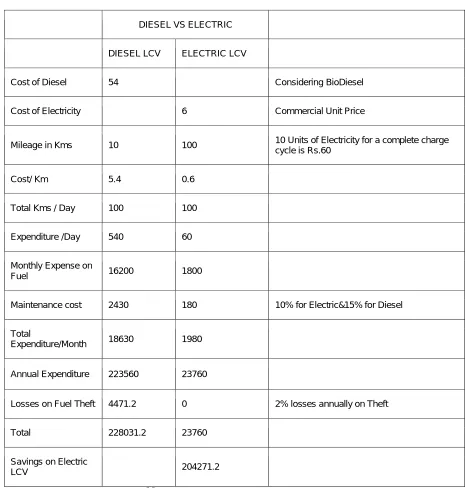
Cost Economics of an electric truck:Let`s understand the cost benefits of Electric truck. An electric truck can do about 100kms in a single charge and with a carrying capacity of 1.2 Tonne, our Electric Truck conversion kits are priced very competitively. Below comparison chart shows the savings that can be made by having an Electric Truck.
23000
54800
2000 1200
0 10000 20000 30000 40000 50000 60000
2016-17 2017-18
n
o
. o
f
ve
h
ic
le
Year
Purchasing chart
Table 1: Comparison of diesel vs electric vehicle.
Table 1 gives information about the comparison of diesel vs electric vehicle, transportation cost reduce, product will get at cheaper rate to consumers.
DIESEL VS ELECTRIC
DIESEL LCV ELECTRIC LCV
Cost of Diesel 54 Considering BioDiesel
Cost of Electricity 6 Commercial Unit Price
Mileage in Kms 10 100 10 Units of Electricity for a complete charge cycle is Rs.60
Cost/ Km 5.4 0.6
Total Kms / Day 100 100
Expenditure /Day 540 60
Monthly Expense on
Fuel 16200 1800
Maintenance cost 2430 180 10% for Electric&15% for Diesel
Total
Expenditure/Month 18630 1980
Annual Expenditure 223560 23760
Losses on Fuel Theft 4471.2 0 2% losses annually on Theft
Total 228031.2 23760
Savings on Electric
VII. ACCESSORIES
Accessories Specification of accessories use in Hardware Motor Motor are used to generate mechanical power in vehicle
instead of IC Engine. There are several type of motor which are used in electrical vehicle those are BLDC, Servo, Induction motor etc.
Brushed DC Motor.
Permanent Magnet Brushless DC Motor (BLDC). Permanent Magnet Synchronous Motor (PMSM). Induction Motor (IM).
Switched Reluctance Motor (SRM). Synchronous Reluctance Motor (Syn. RM). PM Assisted Synchronous Reluctance Motor.
Axial Flux Ironless Permanent Magnet Motor. Fig 3:Specification: BLDC motor.
BLDC motor
350 watt, 48 volt, 7.86 Ah Battery Most electric vehicles use lithium ion batteries. Lithium ion
batteries have higher energy density, longer life span and higher power density then most other practical battery. Lithium ion batteries should be used within safe temperature and voltage ranges in order to operate safely and efficiently. Lead-acid.
NiMH (Nickel-Metal Hydride). Li-Ion (Lithium-Ion).
Ni-Zn (Nickel-Zinc).
Ni-Cd (Nickel-Cadmium). Fig 4: Battery. Specification:
48 volt ,7.5 Ah
Controller Motor controller is a device that improves the performance of an electric motor in specific manner. Motor controller can include and automatic a manual means for starting/stoping the motor, choosing forward/reverse rotation, selecting and controlling the speed.
PID Controllers. Proportional Controllers. Integral Controllers. Arduino controller. Fuzzy logic controller.
Fig 5: PID controller. Charger Charger is required for charging of battery.
AC Charging.
DC Charging. Wireless Charging.
Fig 6: Block diagram of electric vehicle.
Fig 6 shows the following blocks in electric vehicle. Motor is use for generate mechanical power, controller gives us facility to control speed, battery bank work as a power supplier.
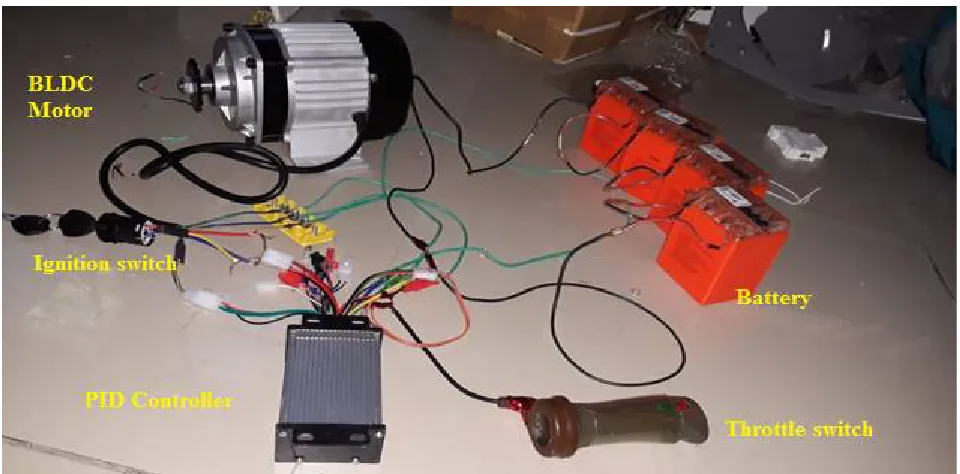
Figure 7 shows hardware model diagram of electrical vehicle. When input supply of 48volt from battery of 7.5 Ah is given to motor of 350 watt, 48 volt, it will run at a speed of 2800 rpm. In hardware model we will see that PID controller, which is used to control action of all electric vehicle. Throttle is use for easily speed control.
VIII. CONCLUSION
With the increasing consumption of natural resources of petrol, diesel it is time to shift our way towards other resources like the Electric vehicle and others because it is necessary to find out new way of transport. Electric vehicle is a modification of the existing vehicle by using electric energy and also solar energy if solar panels are provided, that would sum up to increase in energy production. Since it have quality to high energy efficient, electric vehicle running cost is cheaper and affordable to anyone.
REFERENCES
[1] Ramesh Bansal “Electrical Vehicle”, Birala institute ot technology and science,pilani,india.
[2] Dr.ChokriMahmoudi, A. Flah, and P. Sabita, “An overview of electric vehicle concept and power management stratergies.”, . [3] Joeri Van Mierlo, “The World Electric Vehicle journal ,The Open Access Journal for the e-Mobility Scene ”, 2018. [4] M.J. Riezenman, “Electric vehicles — pursuing efficiency,” IEEE Spectrum, Vol. 29, No. 11,November 1992, pp. 22–24, 93.
[5] 1. F. Tahami, R. Kazemi, and S. Farhanghi, “A novel driver assist stability system for all-wheel-drive electric vehicles,” IEEE Trans. Vehicular Technology, Vol. 52, No. 3, May 2003,pp. 683–692.
[6] A.G Simpson and G.R. Walker, “Life-cycle costs of ultracapacitors in electric vehicle applications,” Proc. IEEE 33rd Annual Power Electronics Specialists Conf. (PESC 02),Vol. 2, 23–27 June 2002, pp. 1015–1020.
[7] C.C. Chan, “The state of the art of electric and hybrid vehicles,” Proc. IEEE, Vol. 90, No. 2, February 2002, pp. 247–275.
[8] H. Xiaoling and J.W. Hodgson, “Modeling and simulation for hybrid electric vehicles. I.Modeling,” IEEE Trans. Intelligent Transportation Systems, Vol. 3, No. 4, December 2002,pp. 235–243.