
University of Windsor University of Windsor
Scholarship at UWindsor
Scholarship at UWindsor
Electronic Theses and Dissertations Theses, Dissertations, and Major Papers
1-1-2019
Emergency Evacuation Software Model For Simulation Of
Emergency Evacuation Software Model For Simulation Of
Physical Changes
Physical Changes
Rachit Tomar University of Windsor
Follow this and additional works at: https://scholar.uwindsor.ca/etd
Recommended Citation Recommended Citation
Tomar, Rachit, "Emergency Evacuation Software Model For Simulation Of Physical Changes" (2019). Electronic Theses and Dissertations. 8184.
https://scholar.uwindsor.ca/etd/8184
This online database contains the full-text of PhD dissertations and Masters’ theses of University of Windsor students from 1954 forward. These documents are made available for personal study and research purposes only, in accordance with the Canadian Copyright Act and the Creative Commons license—CC BY-NC-ND (Attribution, Non-Commercial, No Derivative Works). Under this license, works must always be attributed to the copyright holder (original author), cannot be used for any commercial purposes, and may not be altered. Any other use would require the permission of the copyright holder. Students may inquire about withdrawing their dissertation and/or thesis from this database. For additional inquiries, please contact the repository administrator via email
EMERGENCY EVACUATION SOFTWARE MODEL FOR SIMULATION OF PHYSICAL CHANGES
By
Rachit Tomar
A Thesis
Submitted to the Faculty of Graduate Studies through the School of Computer Science in Partial Fulfillment of the Requirements for
the Degree of Master of Science at the University of Windsor
Windsor, Ontario, Canada
2019
EMERGENCY EVACUATION SOFTWARE MODEL FOR SIMULATION OF PHYSICAL CHANGES
by
Rachit Tomar
APPROVED BY:
______________________________________________ F.Ghrib
Department of Civil and Environmental Engineering
______________________________________________ J.Lu
School of Computer Science
______________________________________________ D.Wu, Co-Advisor
School of Computer Science
______________________________________________ I.Ahmad, Co-Advisor
School of Computer Science
DECLARATION OF ORIGINALITY
I hereby certify that I am the sole author of this thesis and that no part of this thesis has been published or submitted for publication.
I certify that, to the best of my knowledge, my thesis does not infringe upon anyone’s copyright nor violate any proprietary rights. Any ideas, techniques,
quotations, or any other material from the work of other people included in my thesis, published or otherwise, are fully acknowledged in accordance with the standard referencing practices. Furthermore, to the extent that I have included copyrighted material that surpasses the bounds of fair dealing within the meaning of the Canada Copyright Act, I certify that I have obtained a written permission from the copyright owner(s) to include such material(s) in my thesis and have included
copies of such copyright clearances to my appendix.
ABSTRACT
Public space such as schools, cinemas, shopping malls, etc. must have an emergency evacuation system in place. Such places are also required to follow certain regulations and protocols for emergency evacuation to assure the safety of their occupants inside from any unpredictable incident. For nearly two decades, companies/organizations are using simulation models/software for evacuation planning. Researchers are working on these software models to improve the efficiency using latest algorithms. This thesis focuses on creating a base software model of evacuation systems for 3D indoor environments to simulate physical changes such as retractable chairs, movable walls etc., to evaluate their effectiveness before committing to those changes. This research tries to address various flaws and shortcomings of previous software. We are using tools like Unity 3D and Autodesk Maya to simulate suggested changes. It provides planners as well as researchers a
DEDICATION
ACKNOWLEDGMENTS
I owe a debt of gratitude to Dr. Wu and Dr. Ahmad, for the vision and foresight, which inspired me to conceive this thesis work. As my teacher and mentor, they have taught me more than I could ever give them credit for. I am also thankful to my
thesis committee members, Dr. Lu, and Dr. Ghrib, for providing me extensive professional and personal guidance, which helped me learn a great deal about both scientific research and life in general.
TABLE OF CONTENTS.
DECLARATION OF ORIGINALITY ... iii
ABSTRACT ... iv
DEDICATION ... v
ACKNOWLEDGMENTS ... vi
LIST OF TABLES ... ix
LIST OF ABBREVIATIONS/SYMBOLS ... x
LIST OF FIGURES ... xi
CHAPTER 1 INTRODUCTION ... 1
1.1 Overview ... 1
1.2 Thesis motivation ... 4
1.3 Thesis objectives and contributions ... 4
1.4 Thesis organization ... 6
CHAPTER 2 RELATED WORKS ... 7
2.1 Fire Incidents ... 7
2.2 Related Software Models ... 9
2.3 Parameter list for software model comparison ... 18
2.4 Crowd Simulation : Literature Review ... 19
CHAPTER 3 PROPOSED METHODOLOGY ... 31
3.1 Existing Software Models ... 31
3.2 Proposed Methodology ... 40
3.2.1 Modelling in Autodesk Maya ... 43
3.2.2 Modeling in Unity ... 44
3.2.3 Dynamic Navigation Mesh ... 49
3.2.4 Implementing Features missing from other models ... 50
3.2.5 Scripting of Navmesh Agent ... 51
3.2.7 Results and Analysis ... 57
3.3 Experimental Setup: Parameter Accessibility in Unity ... 57
CHAPTER 4 RESULTS ... 60
4.1 Physical Changes considered for simulation ... 60
4.1.1 Retractable chairs ... 60
4.1.2 Priority given to children and physically challenged people ... 61
4.1.3 Extra emergency exits ... 62
4.1.4 Doors with panic bars ... 62
4.1.5 Extra staff ... 62
4.1.6 Glow in the dark paint ... 63
4.1.7 Movable walls... 63
4.2 Hardware and Software configurations ... 66
4.3 Experiments and Results ... 66
CHAPTER 5 CONCLUSION AND FUTURE WORK ... 87
5.1 Conclusion ... 87
5.2 Future work ... 88
REFERENCES/BIBLIOGRAPHY... 89
LIST OF TABLES
Table 1: Main feature comparison...………36
Table 2: Special feature comparison………39
Table 3: Main feature comparison with our approach……….54
Table 4: Special feature comparison with our approach.……….55
Table 5: Time and Efficiency results of scenario 1……….77
LIST OF ABBREVIATIONS/SYMBOLS
3D 3-dimensional
2D 2-dimensional
FDS Fire Dynamics Simulator
CFD Computational Fluid Dynamics
DXF Drawing Exchange Format
DWG Drawing Format
SFPE The Society of Fire Protection Engineers
SGEM Spatial-Grid Evacuation Model
CAD Computer Aided Design
ACS Agent Crowd Simulation
LED Light Emitting Diode
EDS Explosive Detection System
CO Carbon Monoxide
DIFM Dynamic Indoor Field Model
ABM Agent Based Modelling
ABS Agent Based Simulation
UC User’s Choice
ID Inter-Personal Distance
CA Cellular Automata
MEL Maya Embedded Language
API Application Programming Interface
RVO Reciprocal Velocity
CPU Central Processing Unit
LIST OF FIGURES
Figure 1: Essential forces for the agent's direction……….….21
Figure 2: General flocking behaviors………..…...…… 23
Figure 3: Venue setting in concert and stadium……….………… 27
Figure 4: Flowchart of methodology ………..……….41
Figure 5: Pseudocode for simulating the physical changes ……….42
Figure 6: Cinema hall model in Autodesk Maya 2019………..……..43
Figure 7: Rigidbody component values ………..……….46
Figure 8: Capsule collider values ..………...…47
Figure 9: Walkable areas………...…49
Figure 10: Agent pathfinding……….……….……51
Figure 11: Destination tracing……….………52
Figure 12: Multi-directional tracing to destination………..………52
Figure 13: Parameter accessibility pane in unity……….57
Figure 14: Retractable seats……….61
Figure 15: Assisting staff………..………...…62
Figure 16: Glow in the dark paint……….…63
Figure 17: Movable walls………...….64
Figure 18: St. Denis arena and walkable mesh between chairs………65
Figure 19: Walkable and non-walkable mesh in full scale St. Denis arena……..….65
Figure 20: Default cinema halls setting in unity………..67
Figure 21: Default timing result for evacuation (No Emergency)………68
Figure 22: Parameter accessibility pane in unity……….69
Figure 23: Simulation depicting similarities with Uphaar Cinema………. 71
Figure 24: Results for default scenario without an electrical short-circuit (scenario 1) ………..………...71
Figure 25: Simulation using Retractable seats....……….…73
Figure 26: Comparison of (a) results of simulation using retractable seats with (b)results of scenario 1 ……….…………...………....…………....73
Figure 28: Comparison of (a) results of simulation using movable walls with (b) results of scenario 1 ……….……...75
Figure 29: Simulation using both Retractable seats and movable walls working….76 Figure 30: Comparison of (a) results of simulation using both retractable seats and movable walls with (b) results of scenario 1……….76 Figure 31: Simulation depicting similarities with Uphaar Cinema in case of electrical short-circuit...………...………... 78 Figure 32: Results for default scenario with electrical short-circuit (scenario 2)……….………...…………..…79
CHAPTER 1
INTRODUCTION
1.1Overview
computer simulated environment. However, most of the software models available work with the 3D environment that is predefined inside the software package. None of these software models provide a method/process to incorporate any possible physical changes in an indoor environment. Thus, in this thesis we develop a software model of evacuation systems for an indoor environment that can incorporate any possible physical change before they are actually constructed or built. Our software model helps in evaluation of the physical changes to check their effectiveness in case of an emergency for various scenarios based on incidents that happened in the past. Also, we can implement any possible physical changes in 3D indoor environment that might come in future using Autodesk maya and Unity game development engine.
Nevertheless, no one can predict incidents which can possibly happen anytime and anywhere. Thus, governments nowadays have strictly mandated all the indoor public places (i.e. schools, cinema halls, auditoriums, etc.) to have practice drills to avert harm in case of a fire. Also, they need to implement an emergency evacuation system to help everyone trapped inside to get out or at least protect themselves from any injury. Most reported incidents throughout the world are caused due to fire. Few of these incidents are presented in Chapter 2.
However, there are specific steps that are recommended in cases of a fire incident, which includes:
• Rescue
• Alert
• Alarm
• Extinguish
• Evacuate
• Gather at one point
Despite all these efforts, various fire incidents result in stampedes and human crushes. These incidents can be prevented by using some physical changes that we discuss in detail in subsequent chapters, such as:
• Priority (Children and Physically challenged individuals).
• Extra emergency exits.
• Doors with panic bars.
• Extra staff for indoor environments.
• Glow in the dark paint.
• Movable walls.
Fire drills and other ‘mock evacuation exercises’ generally fail to accurately prepare for life-threatening actual evacuation scenarios since people tend to often ignore the danger or fail to access the situation all together [7]. Over the years many different software models have been developed to provide designers with ways of forecasting evacuation times for any type of indoor environment such as multi-storey buildings, concert venues, etc. A large number of software models for pedestrian simulation have been developed in many disciplines, such as robotics, computer graphics, evacuation dynamics, etc., that can be used to study various situations [8]. However, using computer graphics to simulate this general phenomenon is still a difficult job. Natural crowd is generally collective because a 'common purpose' or 'mutual destination' is shared by many individuals or animals [9]. These subconscious choices, however, are complicated to compute. However, a simulation generally costs substantial computational resources. Due to constraints such as computational costs, some early software models tend to concentrate on a crowd as one whole dynamic method rather than its movements.
increasing the simulation performances such as the scalability, flexibility, and realism have remained in high demand in the area of agent-based crowd simulation.
For nearly two decades, companies are using simulation models/software for evacuation planning. Researchers are working on these software’s to improve their efficiency using the latest algorithms. They are also working on building new software with various conditional parameters.
1.2Thesis motivation
Even after application of various safety measures, failures in evacuations continue to occur. There are still hundreds of casualties due to stampedes and fires. In the year 2019 alone, 12 such events, consisting of fire and stampedes have been recorded around the world. We consider a wide range of software models that can provide evacuation timings as well as efficiencies. However, the existing software models have a major disadvantage of working with just the set of 3D environments available inside that software model. Furthermore, the possible physical changes that are not yet built or those changes that might come in the
future, cannot be integrated in these software models. Hence, we anticipate reducing human casualties by a significant number by developing a software model incorporating any possible physical change inside an indoor environment before they are actually constructed/built or that might come in future, to simulate any real-world evacuation scenario.
1.3Thesis objectives and contributions
The main objective behind this research is to create a base software model of evacuation systems for an indoor environment incorporating some possible physical changes before they are actually constructed or built using unity game development engine and Autodesk Maya. This base software model can be used for emergency planning and management as well as future research.
• We can import any file of .fbx format1 incorporating a 3D indoor environment to our software model for simulation.
• The software model provides placement of animated agents such as men, women, children as well as wheelchair for physically challenged/slow moving agents.
• It also provides options to accommodate certain parameters that may be needed to run the simulation such as simulation start time, frame rate and running speed for agents.
• We can create customized parameters for any number of features to enable or disable them at specific times during the simulation for results and analysis.
• The software model also provides a navigation path to the nearest exit regardless of the number of exits available in the environment.
• We can simulate other features that provide a realistic simulation such as fire effects, smoke effects, exit blockage and counter-flow.
Other software models available to public incorporate few of these features and parameters. However, there is no single software model that can provide all of these features and parameters together. Apart from this, another disadvantage is that none of these software models provide a method/process to incorporate any possible physical changes in an indoor environment that might be added in future. Our software model helps in evaluation of the physical changes to check their effectiveness in case of an emergency for various scenarios based on incidents that happened in the past.
Thus, our software model can simulate any 3D indoor environment with any possible physical change, any number of exits and any number of seating. It provides an edge to engineers involved in planning and designing a new prototype of physical changes. Our software model provides a unique perspective to simulate a real-world evacuation scenario incorporating possible physical changes that can come in the future.
In this thesis we demonstrate a process to simulate certain number of features/physical changes that are new or missing from the existing software models that are used throughout the world. Examples for such changes include accommodation for physically
challenged/slow moving agents, crowd distribution, counter-flow, simulation of any type of building, retractable seats, movable walls, extra staff and glow in the dark paint. These features are further described in detail in Chapter 3 and Chapter 4.
1.4Thesis organization
CHAPTER 2
RELATED WORKS
In this section, first we look at some of the incidents that happened in the past in section 2.1. After that, we provide a critical review of some of the most pertinent related works.
2.1Fire Incidents
Most reported incidents throughout the world are mainly due to fire. These incidents mostly happened as the safety policies were not followed carefully while constructing these indoor places. Below are some of the examples of these unfortunate incidents:
• The 1994 Karamay fire (literally Karamay Big Fire) is considered to be one of the gravest civilian fires in the People's Republic of China. A fire broke out in a theatre hosting 1,000 children and teachers in Karamay on December 8, 1994. Students and teachers were asked to remain seated during the fire incident to allow Communist Party officials to walk out first. Furthermore, there were not enough doors for the crowd to move out. This resulted in deaths of 325 people, including 288 school children [2].
• The Kiss nightclub fire took place in Santa Maria, Rio Grande do Soul resulted in deaths of 242 people and leaving at least 630 others injured. This incident happened on January 27, 2013. Reasons for the high death toll include the shortage of emergency
exits, and the front door was the only way out of the building. Additionally, the number of individuals inside exceeded the maximum capacity by hundreds [3]. Approximately 90 percent of the victims died of choking due to excessive smoke. Many individuals died as they attempted to hide in the toilets out of panic. At least 180 corpses were removed from the toilets. The crush at the front gate and the rapid accumulation of smoke in the nightclub wounded more than 150 people.
stampede led to a crush on the narrow hallway leading to that exit which quickly blocked the exit entirely and resulted in numerous deaths and injuries among the
patrons and staff [4].
• The Fire of Uphaar Cinema, one of the worst fire tragedies in recent Indian history,
took place at the Uphaar Cinema, Green Park, Delhi, on June 13, 1997. Fifty-nine individuals died by being trapped inside, mostly due to suffocation, and in the ensuing stampede 103 were severely wounded [5].
• Garment factories of Karachi and Lahore caught fire on September 11, 2012, killing 289 people and seriously injuring more than 600. When the blaze erupted, there were 1500 employees inside both the plants (Karachi and Lahore). Officials said all of the factory's exit gates were locked and many of the windows were covered with iron bars. It made hard for the employees to flee at the moment of the fire, killing many of them as a result of suffocation [6].
In order to reduce the number of casualties similar to the incidents discussed, many commercial entities or individuals around the world are using simulation models, to study and analyze evacuation timings and efficiencies during emergency. These software models provide a wide variety of features to simulate the required effects during emergencies and can be classified on the basis of techniques as: (1) flow-based models, (2) agent-based models, (3) activity-based models.
(1) Flow-based models:
Flow-based models focus on the entire crowd as a single unit, rather than on its components. This model is primarily used to estimate the movement flow of a large and dense crowd in a given environment [51].
(2) Agent-based models:
technique is SIMCity computer game in which people or other entities interact with each other and/or their environment. This thesis mainly focuses on implementing a software model for evacuation using agent-based modelling technique, in which scenarios consist of different identities depicting several behavior.
(3) Activity-based models:
Activity-based models are based on people's daily pattern of activities. Activity based modeling predicts when, where, for how long, for and with whom each activity will be performed [51].
As we discussed, software models are classified on the basis of techniques. Also, these software models can be classified on the basis of availability for public use. For this thesis we consider 14 software models out of 28 available models, which we discuss in detail in section 2.2.
2.2Related Software Models
In this section, we discuss various commercial and freely available software models for crowd simulation and the features/parameters that these models incorporate. These software models have various benefits as well as drawbacks. However, the major drawback of all these software models is that they can only work with the set of 3D environments available inside the software model. Also, none of these software models provide a method/process to incorporate any possible physical changes in an indoor environment before they are actually constructed/built or that might come in future.
EXODUS:
Since EXODUS is mainly an agent-based model, the movement of individuals in it is established by a fixed set of motion rules. The model as a whole is comprised of five interacting sub models: movement, behavior, passenger (agent), hazard, and toxicity. For instance, the hazard model generates values that correspond to a particular configuration of threat across the simulated environment. The toxicity model determines levels of exposure to toxic substances, which then affects the values of the variables associated with agent behavior, which in turn influences the calculations of the movement model. EXODUS is one of a group of models that have accumulated an impressive constellation of factors that inform more realistic evacuation scenarios. Even after so many sophistications, EXODUS doesn't provide simulation for physically challenged/slow-moving agents, which creates a significant problem in today's world [16].
WAYOUT:
WAYOUT is a freely available public domain program that has been developed to calculate traffic flow of building in emergencies from a multi-room and, possibly, multi-storey building. Only merging traffic flows are considered. The model considers several non-linear interactions of flows from different rooms, and it is based on movement speed - density dependence. Flows of only healthy people are considered. Psychological factors have not been included. Program WAYOUT considers up to 200 rooms connected in a merging network towards a single exit. The restriction in the room numbers has been introduced arbitrarily, to limit computer memory requirements, and can be extended if necessary, thus limiting the model to a merging network. This changes the problem from a probabilistic one to a deterministic one. WAYOUT considers its flows from door to door [17].
Program WAYOUT was used in Australia for several years and was applied in practical engineering situations to such cases as multi-storey buildings, stadiums, and malls, as well as miscellaneous more straightforward cases.
PEDROUTE:
simulates station queue accumulation and its decay, and the blocking back effects of queues on adjacent regions. The model includes various methods of passenger assignment that can be used to simulate distinct situations of behavioral and physical layout. The techniques range from user-defined fixed paths to dynamic assignments using equilibrium or stochastic assignment algorithms. The model's route decisions consider the passenger's origins and destinations, available to him in the station, typically road entrances and platforms. The user defines these locations, as are the linkages between these locations. PEDROUTE takes into account walking speeds and delays for travelers during the process of simulating passenger demands through the station and summarizes the location of people during user-defined periods. The flow from one region to another relies on the number of individuals in that region and how long it takes to move through it. The model assumes that the time taken is a function of the density of passengers in that area [18]. PEDROUTE allows the user to look at levels of service and service factors for each area of the station layout, as well as the number of passengers present in each area during a given time.
SIMULEX:
FDS+EVAC:
FDS+Evac is a freely available public domain software model that simulates fire and evacuation processes simultaneously. It can also be used to only simulate the process of human egress without any fire impacts, such as a fire drill. FDS+Evac treats each evacuee as a distinct entity or 'agent' having their personal properties and methods of escape. The agents' movement is simulated using two-dimensional planes that represent building floors. The fundamental algorithm behind the egress movement resolves an equation of motion in a continuous 2D space and time for each agent, i.e., FDS+Evac performs some artificial molecular dynamics for the agents [20]. Fire Dynamics Simulator (FDS), the underlying fire simulation program, is a computational fluid dynamics (CFD) model of fire-driven fluid flow. FDS is published in the programming language of Fortran 90. It is written in C / OpenGL programming languages, along with the use of a companion program Smokeview, which represents the simulation outcomes graphically [21].
SIMWALK:
LEGION:
Legion is a freely available public domain software that is developed by Legion International Ltd., UK. This software has gone through years of studies on crowd movement and behavior. The software can simulate hundreds of pedestrians on a single PC, and it can be used for both evacuation scenarios and standard non-emergency studies. It can specify entrance, exits, and routes of movements. In Legion, individual pedestrians decide, based on their objectives and may possess a different level of knowledge, experience, and objectives. They also have a perception of their surrounding environment. This model uses a continuous “least effort path” algorithm for the simulation of movements. Throughout data, local density levels, congested areas, time taken for individuals to the destination, raw movement data output, video, and pictures are among the outputs that the software can provide [23].
MASSMOTION:
MassMotion is a freely available public domain simulation software model that is developed to enable design and planning professionals to rapidly test and analyze the movement of people in many kinds of environments. It does by providing users with a suite of tools for creating and modifying 3D environments, defining operational scenarios, executing dynamic simulations, and developing robust analyses [24].
MassMotion models real-world spaces by breaking those spaces down into parts and classifying the parts according to function. People in a MassMotion simulation know to walk around an obstruction because it has been marked as a barrier. Speed of movement is reduced when walking up a surface because that surface has been marked as a stair. The way in which classified objects are arranged can have a significant impact on how people navigate a space, affecting their speed, their movement patterns, and their route choices. The essential elements of a scene are the floor, link, stair, ramp, escalator, path, portal, and barrier [25].
PATHFINDER:
Pathfinder is a commercial simulator for emergency egress with an embedded user interface and animated 3D results. It enables faster evaluation of evacuation models and more realistic graphics to be produced than with other simulators. Pathfinder supports the import of DXF and DWG files in AutoCAD format. The Pathfinder’s floor extraction tool enables the imported geometry to be used rapidly to define the occupant walking space for the mode of evacuation. To represent the model geometry, Pathfinder utilizes a triangulated 3D mesh. As a consequence, Pathfinder can represent geometric information and curves accurately [26].
Pathfinder supports two simulation modes. In steering mode, agents, while avoiding other occupants and barriers, continue independently to their goal. Door flow rates are not defined but are the consequence of occupants’ interaction with each other and with borders. Agents use behaviors that follow SFPE rules, in SFPE mode, with walking speeds depending on density and flow limits to doors. SFPE outcomes provide a crucial baseline for comparison with other outcomes, but SFPE calculations do not prevent multiple persons occupying the same space [27].
ALLSAFE:
CRISP:
CRISP is a commercial model of allfire scenarios from Monte Carlo. The sub-models of CRISP represent physical objects such as rooms, doors, windows, alarms and detectors, furniture products, etc., layers of warm smoke, and individuals. The randomized elements include starting circumstances such as various open or closed windows and doors, number, type, and location of individuals within the building, fireplace, and type of burning product. CRISP's fundamental design is a two-layer zone model of smoke flow for various rooms combined with a comprehensive model of human behavior and movement. The Monte Carlo controller supervises all the physical objects, which makes each one performs for each timestep. The controller also manages all the input and output, initialization for each run, and each run starts automatically. Functions are included from any distribution to produce random numbers. Iteratively, calculations are performed for each run, with variable time intervals to ensure the effectiveness, precision, and stability of the program. People are assumed to adopt distinct behavioral roles, either naturally or due to training. Depending on the state of the environment, their conduct can be defined in terms of actions that can be abandoned and substituted by fresh ones. Rational decisions are made based on current knowledge (which may be limited and/or incorrect) [29,30].
EGRESS2002:
cell according to a weighted die throw. The method is intrinsic to the use of cells with a dimension equivalent to the minimum region that an individual occupies [31].
EGRESS has been intended as a simple and effective means of enhancing our understanding of and improving evacuation arrangements. It is ideally suited to modeling evacuation from a large office complex, shopping mall, underground station, airport terminal, or other complex building containing large numbers of people. It offers useful data for building designers, owners, occupiers, and emergency services, in simulating the evacuation process [32].
SGEM:
such as the influence of other peoples, the geometry of the paths, the behavioral reaction, etc. The spatial location of each individual can be represented by his/ her relative coordinates in the system. The records of the coordinates at various points of the time describe the movement trajectories of the people [34].
The SGEM can be used to predict the movement trajectory of each individual during evacuation. The basic principle is that it takes the geometry of a building and divides the setting into planar grids [34].
EXIT89:
EXIT89 is a commercial model that has shortcomings such as social interaction and emergent group response similar to SIMULEX. EXIT89 includes individual bodily dimensions (American, Soviet, or Austrian) and allows the specification of the number of physically challenged occupants, yet it does not incorporate bodily actions and gestures [35]. It also considers the counter-response of evacuees whose path during egress is blocked by smoke accumulation near an exit. The model determines travel time as a function of density and speed within a constructed network of nodes and arcs. The "shortest route" algorithm is combined with an individual perspective for each evacuee to track the path and progress of individual evacuees. However, all the occupants of a specific node initially traverse the same user-specified path, or shortest known path, to an exit. Moreover, the user is also able to set the percentage of occupants who are assigned a delay time. These dual functions (a particular path for an entire group and delay) implicitly mimic group behavior [36].
A significant drawback persists is that each individual evacuee exhibits particular physical characteristics which affect the flow of evacuation; however, these characteristics are devoid of interactive social characteristics such as monitoring others, directing, collective evaluation and collective agreement on the appropriate response [36].
Every software model discussed has its benefits as well as drawbacks on crowd simulation. However, all these software models have a major disadvantage of working with just the set of 3D environments available inside that software model. Furthermore, any possible
cannot be integrated in these software models. Also, external files cannot be imported to these software models to add a new 3D environment for simulation. We consider a set of parameters/features for thorough comparison of these software models. We discuss these parameters/features in section 2.2.
2.3Parameter list for software model comparison
The parameters/features that we consider for comparison can be classified into two: main features and special features.
The main features for the model are the mandatory parameters that can define the working of a simulation. Below are the main features that we consider for comparison of software models:
• Availability to the public
• Visualization of the model
• Purpose
• Movement of agents
• Incorporation of fire data
• Computer-aided design (CAD)
The special features for the model are the optional parameters that the model can or cannot have. However, these features increase the level of scenarios or possibilities in a specific model.
Below are the special features that we consider for comparison of software models:
• Counter-flow
• Exit blocked
• Toxicity of the agents
• Disabled/slow-moving agents
• Effect of fire conditions on agents
research papers from various authors working in the field of agent-based modelling for crowd simulation. We discuss some of these works in section 2.3. All these research papers
contain methods to evaluate the time results and efficiencies of evacuation.
2.4Crowd Simulation : Literature Review
Several authors have proposed models for agent-based crowd simulation. Helbling et al. 's Social force model [13] settles the fundamental idea about how to apply the agent-based approach to a crowd simulation. In this model, authors apply the repulsion and tangential forces on each agent; therefore, the steering agent can avoid obstacles and other moving agents. However, the main downside of this method is that every agent shares the same attributes without individual identity; also, agents are navigated under the same moving speed unlike a real human crowd, which has individual differences regarding mobility. Besides, when Helbling's moving method is applied on a 3D model, the agents tend to 'shake' and 'vibrate' unpredictably with increasing density and non-priority rule applied. Overall, Helbing's model has introduced the fundamental conception of the agent-crowd simulation (ACS) study, and his research inspired us enormously.
A. Zavin, et al. [37] proposed an intelligent automated fire exit guidance system using A* search algorithm, where along with guiding the affected people through the safest optimal path, the system calculates least crowded and shortest path considering distance, endangered node, and crowd distribution mechanism. It also detects if any path is already compromised with fire and dynamically suggests the second optimal path to the fire exit. In the proposed system, a portion of a floor plan is given and represented by a unidirectional
weighted graph. The weighted graph is represented as a grid where each grid cell is a square of unit cost. In the grid representation, some grid cells are considered as fire exits, and some are walls, whereas others are considered as rooms/hallways. Experimental results showed the proposed system executed accurately and effectively by handling distance and safety-related challenges to ensure minimum life and resource causalities.
among fire-affected people, which might tamper the environment as well. Thus, as a future extension of this paper, a prototype developed based on the proposed system where the
real-world factors are considered and implemented. Multiple fire exits, backup power supply, LED floor tiling system to show optimal paths, etc. are required to design such a fire-exit guidance system. Moreover, to implement the system for each floor of a building, sufficient sensors like smoke and temperature sensors, motion sensors and other facilities connected to central control.
S. Wong, et al. [38] proposed an idea to assist in the rapid evacuation. They presented an algorithm to calculate the optimum route for each local area with the idea to reduce congestion and maximize the number of evacuees arriving at exits in each time span. Their system considers crowd distribution, exit locations, and corridor widths when determining optimal routes. It also simulates crowd movements during route optimization. As a basis, they expect that neighboring crowds who take different evacuation routes should arrive at respective exits at nearly the same time. If this is not the case, their system brings up to date the routes or paths of the slower crowds. Since crowd simulation is non-linear, the optimum route is calculated iteratively. The system repeats until an optimum state is reached. The system permits the structure of the situation to be decomposed and determines the routes in a hierarchical way in relation to directly calculating optimum routes for a situation. Not only does this approach reduce computational costs, but it also allows crowds
in distinct areas to evacuate with distinct priorities. This system can deal with different structures for the situation and obstacle positions in order to provide an optimal path. They
used a mix and match strategy to provide results for various situation. They used various algorithms such as Djikstra’s, A*, etc. on various environments such as a theme park, stadiums, etc. various crowd parameters are considered such as walking speed, the radius of an agent, etc. This system, however, lacks in 3d visualization and simulation of
physically challenged or slower-moving agents.
agent-based model that can be used by engineering in planning and designing efforts to estimate the evacuation performance of heterogeneous populations from airports. The model groups
the environment according to accessibility characteristics, including various conditions that have a separate impact on the conduct of people with disabilities during an evacuation. The model architecture consists of four logical components: (a) environment, (b) population, (c) visualization, and (d) simulation. Also, an agent’s direction choice is influenced by
three essential forces: (a) attraction, (b) repulsion, and (c) friction (see Figure 1)
Figure 1: Essential forces for the agent’s direction [39]
The objective of the simulation experiment is to estimate the impact of bomb placement on evacuation times for individuals with and without disabilities. The experiment is conducted using the map of an international airport from the intermountain west region of the United States. The airport complex is a two-story structure consisting of three terminals and five concourses patterned after the pier terminal design. Four simulation scenarios are specified based on the presence and location of the bomb. Scenario 1 is conducted without a bomb to establish a baseline for subsequent comparisons. Scenarios 2, 3, and 4 simulated a bomb discovery in one of the Explosive Detection System (EDS) devices found in Terminals 1, 2, and 3, respectively. Fifty simulations are conducted for each scenario.
considered multiple fire exits or different kinds of agents such as children or overweight people.
Evacuation simulation in the airport domain needs additional characteristics beyond most simulations, including the distinctive behaviors of first-time visitors with incomplete area understanding and families who do not necessarily conform to frequently assumed pedestrian habits. Evacuation simulations that are not customized for the airport domain do not integrate the factors that are essential to it, resulting in inaccuracies when applied to it. J. Tsai, et al. [7] proposed ESCAPES - a simulation tool for multi-agent evacuation that includes four main features: (i) distinct kinds of agents; (ii) emotional interactions; (iii) informational interactions; (iv) behavioral interactions. Their simulator reproduces phenomena that have been observed during evacuation and the features that they integrate significantly impact escape time. They used ESCAPES to model the Los Angeles International Airport (LAX) International Terminal and obtain high commendation from safety authorities.
They discuss the multi-agent evacuation simulation system, ESCAPES, in two parts: individual agent types and agent interactions. ESCAPES include regular travelers, authority/security figures, and families, as these have been documented as having the most impact in an airport evacuation. ESCAPES agent interactions include three separate phenomena: the spread of knowledge, emotional contagion, and social comparison. The ESCAPES system is a two-part system consisting of a 2D, OpenGL environment based on the open-source project OpenSteer and a 3D visualization component using Massive
Simulation of building evacuation provides designers with an effective manner to test a building's safety before construction. In a variety of fields (computer graphics, robotics,
evacuation dynamics, etc.), a significant number of models are developed. N. Pelenchano, et al. [8] provide a review of models of crowd simulation and selected commercial software tools for simulation of elevated construction evacuation. The selected business tools (STEPS and EXODUS) are grid-based simulations that enable effective execution but introduce artifacts in the outcomes. They focus on describing the primary difficulties and limitation of these tools, in addition to explaining the importance of integrating human psychological and physiological factors into the models.
The basic model is to simulate generic flocking behavior consist of three simple rules which describe how individual boid maneuvers based on the positions and velocities of its nearby flockmates (see Figure 2):
• Separation: steering to prevent crowding local flockmates
• Alignment: steering towards the average heading of local flockmates
• Cohesion: steering towards the average position of local flockmates
Figure 2: Generic flocking behaviors [8]
The paper concludes an overview of the basics that should be implemented to simulate human movement. In this simulation flow rates, densities and speeds of human is not a
predefined value, however it changes dynamically for a limited grid size. One of the major drawbacks is that the system have not considered the factors resulting in crowd distribution, thus significantly reducing the escape time.
Evaluating the evacuation capacity of the metro station under emergencies such as fires, as well as improving the emergency protection capability of the rail transit system is an integral part of the rail transit operation management. On the basis of analysis of the impact of different factors on passenger's behavior under fire evacuation in metro station, the study by X. Zhang, et al. [40] models the facilities in metro station including gates, stairs, passageways, entrances and exits, and simulates the process of fire spread and the passenger evacuation scenarios by the model of cellular automata. A case study is brought out to illustrate the impact of different factors on evacuation capacity and evaluate the rationality of the station layout.
The study simulates a 2D visualization of the passenger evacuation process in a metro station, analyzes the main bottlenecks. It also stimulates the process of fire spread and the passenger evacuation scenarios by the model of cellular automata. Finally, they propose corresponding improvement measures. a) The model uses the concept of fire value, which represents a degree of danger during the process of fire evacuation simulation and in the path selection model of passengers, b) The simulation finds that the Cellular automata model has good practicality for evacuation process modeling of the underground building
with a double-layer structure. Using computer simulations, the entire evacuation process of evacuees is visualized, and the distribution of evacuees at a different time is available so that the bottlenecks in a metro station which are not conducive to evacuation can be found out. The simulation result can provide a basis for a reconstruction of station facilities and layout design of the station.
of individual entities ; (ii) ABM describes a system with natural description which makes the model seem closer to reality; and (iii) ABM is versatile as it is easy to add more agents
to it. It is evident, however, that what drives the other benefits is ABM's capacity to cope with emerging events.
Using real-world applications, its four application areas are addressed:
• Flow simulation: ABM seems ideally suited to provide valuable insights into the mechanisms of and preconditions for panic and jamming by incoordination. ABM captures that emerging phenomenon in a natural manner.
• Organizational simulation: It is feasible to model in a particular context or at a certain level of description the emerging collective conduct of an organization or part of an organization. At the very least, the simulation design process creates valuable qualitative insights. However, in some instances, semi-quantitative insights can also be generated. An excellent example of this is an agent-based model of operational risk.
• Market simulation: The dynamics of the stock market results from the conduct of many interacting agents, resulting in emergent phenomena that are best understood by using a bottom-up approach-ABM. To assess the impact of tick-size reduction, an agent-based model has been used by NASDAQ that simulates the effect of regulatory changes on the financial market under various circumstances. The model permits regulators to test and predict the results of different strategies, observe the conduct of agents in answer to changes, and monitor progress, providing warning of unintended consequences of newly executed regulations quicker than real-time and without risking early tests in the real marketplace.
• Diffusion simulation: ABM applies to cases where people are influenced by their social context; that is, what others around them do.
They had also discussed how ABM could bring significant benefits when applied to human systems. It is best to use ABM in the following contingencies:
• When space is essential, and the positions of agents are not fixed. Example: theme park, supermarket, traffic, fire escape.
• When the population is heterogeneous, where each person is (potentially) different.
• When the interaction topology is heterogeneous and complicated. Example: when interactions are homogeneous and mix worldwide, there is no need for agent-based simulation, but social networks are rarely homogeneous, clustered, leading to deviations from normal behavior.
• When the agents display complex conduct, including learning and adaptation. Example: NASDAQ, ISPs.
ABM is not 100 percent effective at all times and has certain drawbacks. A general-purpose model cannot work thus the model must be constructed at the correct level of description, with just the correct amount of detail to serve its purpose. Another problem is the very characteristic of the systems one models with ABM in the social sciences: they most often require human agents, with potentially unreasonable behavior, subjective decisions, and complicated psychology— that is, soft factors, hard to quantify, calibrate, and sometimes justified.
The last practical problem in ABM persists that should not be ignored. By definition, ABM
looks at a system at the level of its component units, not at the aggregate level. While computing power continues to rise at an impressive rate, ABM's high computational requirements persist as an issue in modeling large systems.
The prototype is unique in the present literature as it is specifically intended to simulate a concert site setting such as a stadium or auditorium (see Figure 3) and is extremely
configurable to allow user definition of concert venues with any arrangement of seats, routes, phases, exits and individuals.
Figure 3: Venue setting in concert and stadium [42]
The ABS system described in this paper is a of-concept system. As with any proof-of-concept prototype, several improvements can be made to the system, and several issues must be addressed to translate the system into a viable commercial system. The system could be improved by incorporating a more complex model of a person's decision-making process into each person agent. Another enhancement that could be made is in the area of fire dynamics. More accurate physical models of fire could include weather-related factors
such as temperature, humidity, air pressure, and wind as well as topographical and fuel-related factors. Relevant topographical factors include the size, shape, and contour of the environment while fuel factors include the type of materials present in the environment.
Another research by N. Pelachano, et al. [43] considers animating the evacuation of crowd from complicated buildings who may not understand the connectivity of the structure or
who may accidentally find routes blocked. It requires simulated crowd behavior into consideration under two circumstances: agents communicate the understanding of building route, and agents take on distinct roles such as qualified staff, leaders, and supporters. Maces, without a centralized controller, is a distributed multiagent system. Each agent has its conduct based on natural variables of personality representing real psychological factors. The movement of agents is calculated at two levels. The high level corresponds to the process of finding a room sequence, whereas the low-level parallels to the local motion within a room. the input characteristics of the maze-like atmosphere are considered which are dimensions, number of exits, and number of hazards and the parameters required for simulation such as number of agents, percentage of trained agents, and percentage of leaders. Whenever two or more agents meet in a room, they share two pieces of data: locations of some of the risks that block routes, and sections of the building that other agents have thoroughly explored and found no available exit.
This evaluation has shown a significant improvement in evacuation rates when using inter-agent communication. They also observed the grouping behavior that emerges when the crowd contains a large proportion of dependent agents. The best evacuation rates are provided by only a comparatively smaller proportion of trained leaders. These results can
be visualized in real-time with either 2D or 3D viewer.
Areas where there is room for improvement, including adding individualism into Helbing's
model is that agents would have different local motions depending on their roles. The high-level wayfinding must be modified because people should be less likely to enter a full room when there are other possible paths available.
explore the specific influence of such spatial change on the efficiency of evacuation. L. Tan et al. [44] presented an agent-based building evacuation model in which the knowledge
of the evacuee is considered, including both the spatial understanding of the stable environment during a typical scenario and the knowledge of the events of the predictable spatial change for firefighting purposes. Furthermore, when considering fire safety facilities, a semantic representation of a building environment is created to depict the alterable connectivity structure. Using the suggested model, during three specific fire situations, a series of evacuation simulations were conducted for groups of evacuees with different levels of knowledge.
To simulate the individualized route selection under the influence of a potentially changed connectivity structure, the evacuees' knowledge of the spatial environment, including the knowledge of the stationary spatial features and the awareness of the activated fire safety facilities, are considered. Each agent selects their escape route based on the assumed spatial accessibility. When congestion occurs, or the route is blocked, the agent updates its knowledge and adjust the escape route if there is another alternative route. To simulate the evacuees' local movement within each internal space, the building environment is geometrically represented as a grid consisting of small cells. In the proposed model, the building environment is represented by a semantic model at the macro level, where the connectivity relationship between the internal spaces, such as rooms and corridors, is
updated according to the state of the fire safety facilities. At the micro-level, a grid-based representation is adopted to facilitate the simulation of the evacuees' movement within the
internal space.
It is vital to note that the proposed model mainly concentrates on the influence of the predictable change in the spatial accessibility and does not include all of the factors that have or might affect the spatial accessibility of the building environment such as fire smoke, toxic gasses, etc.
computational efficiency. The cell size may influence the simulation results. The sensitivity of simulation results to the cell dimension needs to be investigated. Besides, when
modeling the evacuees' movement at the micro-level, they have made simplifications, and some factors were not fully considered, such as the representation of the human body and the effect of sufficient dynamic width of exit. Given these facts, the model presented here is a prototype. More efforts are in need to validate the model and make it more applicable in the future.
In summary, there are large numbers of research modules on the subject of agent-based crowd simulation which have always tried to improve the existing software models and techniques. Still, none of these software models provide a method/process to incorporate any possible physical changes in an indoor environment before they are actually constructed/built or that might come in future. Also, external files cannot be imported to these software models to add a new 3D environment for simulation. However, our software model can simulate any 3D indoor environment with any possible physical change, any number of exits and any number of seating.Our software model helps in evaluation of the physical changes to check their effectiveness in case of an emergency for various scenarios based on incidents that happened in the past. It also proposes a vast range of parameters such as speed of agents, frame rate, etc., that can be used as a group or as an independent entity to simulate various sets of scenarios for multiple environments with multiple agents
CHAPTER 3
PROPOSED METHODOLOGY
In Section 2.1, we discussed 14 software models which we consider for comparison. Every software model has benefits and drawbacks. Previously, we only explained all these software models in detail. However, in order to explain the software model that we are designing, we need to compare existing software models also. These software models are compared on the basis of some parameters/features which we explain in detail in section 3.1. Then, we implement those missing features from every software model into our software model.
In beginning of this chapter, we compare 14 software models for simulation of emergency evacuation and later we discuss our method of designing a software model.
3.1Existing Software Models
The 14 software models can be divided into 2 types according to their method of
availability: available to the public and those available on a consultancy basis. In table 1 and table 2 software models are separated with a bold black line according to their method of availability. The models no longer in use are not considered for comparison.
Models available to the public:
• WAYOUT
• PEDROUTE
• Simulex
• FDS+Evac
• SimWalk
• BuildingEXODUS
• Legion
Models available on a consultancy basis:
• PathFinder
• ALLSAFE
• CRISP
• EGRESS 2002
• SGEM
• EXIT89
we consider a set of parameters/features for thorough comparison of these software models.
The parameters/features that we consider for comparison can be classified into two: main features and special features.
The main features for the model are the mandatory parameters that can define the working of a simulation. Below are the main features that we consider for comparison of software models:
• Availability to the public
• Visualization of the model
• Purpose
• Movement of agents
• Incorporation of fire data
• Computer-aided design (CAD)
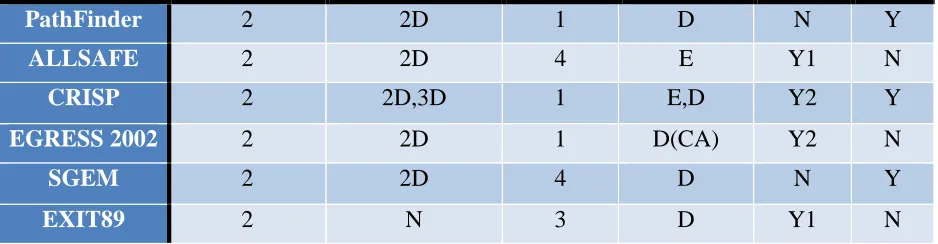
Each main feature described here represents a column in Table 1. we compare 14 software models on the basis of main features in table 1.
Below are the special features that we consider for comparison of software models:
• Counter-flow
• Exit blocked
• Toxicity of the agents
• Disabled/slow-moving agents
• Effect of fire conditions on agents
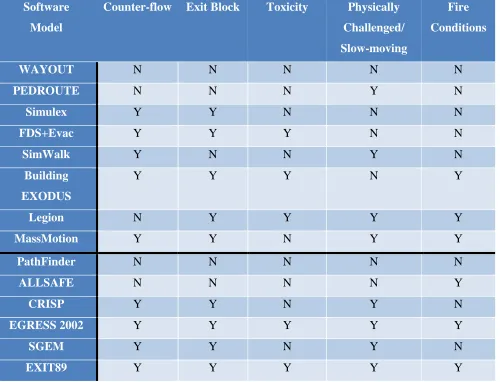
Each special feature described here represents a column in Table 2. we compare 14 software models on the basis of special features in table 2.
Before the comparison, we explain every feature and label related to them in the table. Below, we explain each main feature in detail and label related to them.
Availability
Although the software models included in this study appeared in peer-reviewed journals, there are variations in how these models are made publicly accessible. In order to differentiate software model’s availability, we separate them into two group. In the first group, software models are available for free in some cases. The second group includes models to be used on a consultancy basis by the development business. The consultancy firm uses the models in this group, and only the outcomes are provided to the user. In Table 1, software models that are available to the public for free are labeled with a "1," models that are available only through the development company which are paid are labeled with a "2".
Visualization
software models that provide 3-D visualization are labeled with “3D,” and models which don’t have any visualization capabilities are labeled with “N”.
Purpose
Purpose defines the software model's use as it refers to particular kinds of buildings as determined by the developers of the model. Some of the software models emphasize a specific kind of building, and others can be used for many construction types. The main aim of using this as a feature is to know whether the model is meant to simulate the building design selected by the user. The software models as described in Table 1, include models that can simulate any building which are labeled with “1,” residential-specific models are labeled with “2,” government transport station-specific models are labeled with “3,” and models that only simulate 1-route/exit of the building are labeled with “4”.
Movement of Agents
The Movement of Agents relates to how the software models move occupants throughout the building. For most models, the user or modeling program generally assigns a particular unimpeded (low density) velocity to occupants. The more significant differences in the models occur when the occupants get closer, leading in queuing and congestion within the construction. Here are the various methods in which models that represent occupant motion and limited flow throughout the construction:
• Density correlation (D): The model assigns speed and flow depending on space density to people or populations.
• User's choice (UC): The user assigns values of speed, flow, and density to particular construction fields.
• Inter-person distance (ID): A 360 ° "bubble," surrounds each individual, requiring a minimum distance from other occupants, barriers, and construction elements (walls, angles, handrails, etc.).
• Conditional (C): Movement throughout the building depends on environmental circumstances, structure, other evacuees, and/or fire condition with conditional models. Not much emphasis is put on congestion within the room for this designation alone.
• Cellular automata (CA): In this model, the occupants move through the simulated throw of a weighted die from cell/grid room to another cell. In this, all the agents behave as a single unit, e.g., if one agent dies, the others die due to the same effects such as a fire.
In table 1, various methods of agent’s movement are labeled as follows: Density Correlation as “D,” User’s choice as “UC,” Inter-person Distance as “ID,” Emptiness of next grid cell as “E,” Conditional as “C,” and Cellular automata as “CA”.
Fire Data
The fire data describes whether the model enables the user to integrate the fire impacts into the simulation of evacuation. The model can integrate fire information in the following ways: import fire data/results from another model, enabling the user to enter fire data throughout the evacuation at certain times, or the model can have its fire model running simultaneously with the evacuation model. If the model cannot integrate fire data, it runs all simulations in non-fire mode. The aim of evacuation models to include such information is to evaluate occupants' security, who move through degraded circumstances and to see how their conduct can be altered. In table 1, the software models that can import fire data are labeled as “Y1,” the software models that has its fire element running simultaneously with evacuation are labeled as “Y2,” and the model that runs all the simulations in non-fire mode are labeled as “N”.
Computer-Aided Design (CAD) drawings
feature of importing the CAD model, label (Y) is used for those specific models in Table 1. On the other hand, when the model does not have that capacity, the label of (N) is used. Below we mentioned every label that is used in the table 1:
Availability:
• 1: Free
• 2: Paid
Visualization:
• 2D : 2-D visualization
• 3D : 3-D visualization
• N : No visualization
Purpose:
• 1 : Simulate any type of building
• 2 : Only specializes in residences
• 3 : Specialize in public transport stations
• 4 : Only simulate 1-route/exit building
Movement:
• D : Density
• UC : User’s choice
• ID : Inter-person Distance
• E : Emptiness of next grid cell
• C : Conditional
• CA : Cellular Automata
Fire Data:
• N : Model cannot incorporate fire data
• Y1 : Model can import fire data
• Y2 : Model has its own simultaneous fire element
CAD:
• N : Does not allow importation of CAD files
• Y : Does allow importation of CAD files
Software Model
Availability to Public
Visualization Purpose Movement Fire Data
CAD
WAYOUT 1 2D 4 D N N
PEDROUTE 2 2D,3D 3 D N Y
Simulex 1 2D 1 ID N Y
FDS+Evac 2 2D,3D 1 ID Y2 N
SimWalk 2 2D,3D 3 D N N
Building EXODUS
1 2D,3D 1 E Y1 N
Legion 1,2 2D,3D 4 ID,C Y1 Y
PathFinder 2 2D 1 D N Y
ALLSAFE 2 2D 4 E Y1 N
CRISP 2 2D,3D 1 E,D Y2 Y
EGRESS 2002 2 2D 1 D(CA) Y2 N
SGEM 2 2D 4 D N Y
EXIT89 2 N 3 D Y1 N
Table 1: Main feature comparison
Table 2 is included in a manner to describe the more particular capabilities of each model. This table is included for users who want to simulate particular evacuation situations and/or for users to understand the variations in the sophistication of the software model. It can be seen that as the level of sophistication rises, the number of distinctive characteristics simulated by the model rises. The particular special feature included in the evaluation are as follows, many of which can be enabled or disabled by the user:
• Counterflow
• Exit block/obstacles
• Fire conditions affect Behavior
• Toxicity of the occupants
• Physically Challenged/slow-moving agents
Below, we explain each special feature in detail and label related to them in Table 2. Counter-flow
Exit Block
For many purposes, exit gates can be blocked. Exit block defines the models that enable the user to block exits to be used by simulated occupants. A software model’s user could be interested in scenarios where not all paths can be used. Exit block identifies those models that allow the user to block exits from the use by simulated occupants in the scenariothat have this capacity either allow the users to manually block the exit gate form use before or even during the situation, or the model blocks the exit from use, owing to certain circumstances (e.g., a falling debris from the roof can block the exit). Users should know how the occupants view the blocked exit and whether the exit can be blocked at a given time or only at the simulation start.
Fire Conditions affect Behavior
In a building fire, it is likely that the environmental conditions produced by the fire can affect the nearby occupants. Some software models that incorporate fire circumstances (see Table 1) have the ability to alter occupant conduct depending on these fire circumstances, including the following simulated situations: occupants selecting another exit because of a large fire and might get hurt by fire, occupants turning back and turning away from the fire. Fire conditions defines whether the model of evacuation is capable of changing occupant behavior owing to fire circumstances.
Toxicity
Material burning generates poisonous gases (narcotic and irritant gases), aerosols for smoking, and heat. Fires can spread smoke and warm gasses throughout a construction, presenting occupants with toxic gasses that can trigger symptoms of slight headaches, potentially leading to lower rates of motion, disability (i.e., where the occupants stop moving without help), or even death. Toxicity defines those models that mimic occupants’ disability or death owing to toxic products from fire circumstances contained in smoke.
Physically Challenged/Slow moving Occupants
![Figure 1: Essential forces for the agent’s direction [39]](https://thumb-us.123doks.com/thumbv2/123dok_us/1499415.1183588/34.612.235.413.230.321/figure-essential-forces-agent-s-direction.webp)
![Figure 3: Venue setting in concert and stadium [42]](https://thumb-us.123doks.com/thumbv2/123dok_us/1499415.1183588/40.612.111.541.163.292/figure-venue-setting-in-concert-and-stadium.webp)


![Figure 10: Agent pathfinding [45]](https://thumb-us.123doks.com/thumbv2/123dok_us/1499415.1183588/64.612.252.413.363.476/figure-agent-pathfinding.webp)

![Figure 15: Assisting staff [47]](https://thumb-us.123doks.com/thumbv2/123dok_us/1499415.1183588/75.612.243.446.485.671/figure-assisting-staff.webp)
![Figure 16: Glow in the dark paint [48]](https://thumb-us.123doks.com/thumbv2/123dok_us/1499415.1183588/76.612.173.517.261.519/figure-glow-dark-paint.webp)
