Flood Disaster Management System using IOT
Priti Khaire1, Priti Subramanium2
M. Tech Scholar, Dept. of CSE, SSGBCOET, Bhusawal, India1 Asst. Professor, Dept. of CSE, SSGBCOET, Bhusawal, India2
ABSTRACT: One of the main issues faced by the community is where they are not aware of flood happenings around them. A more efficient flood management system is proposed to better manage flash flood disasters. By leveraging the technology of Internet of Things, realtime updates and notifications for flash flood events can be delivered directly to the community. Early warnings can help mitigate potential disasters as well as assist involved authorities in managing such disasters. The user can get realtime information on monitoring flooded roads over SMS based service. Flood limiting water level (FLWL) is an effective and value approach to provide safeguards the people from flood caused suddenly without any intimation. The proposed system acts as an alert to people when the water level increases from the normal capacity. Advanced sensors are used to identify the level of water presented in dams, lakes and heavy water storage areas.
KEYWORDS:component; flood; internet of things; real time, sensor
I. INTRODUCTION
Nowadays, Internet of Things (IoT) has a crucial role in all parts of our regular lives. It focuses on several different fields such as entertaining, homes, automobiles, healthcare, industrial applications, sports and many different things. The ubiquity of IoT facilities some ordinary activities, improves the way people interact with the surroundings, and enlarges our social communications with other people and objects.It is very challenging to create systems for the IoT for the following causes:[1] (i) distributed computing complexity , (ii) the absence of common guidelines or outlines that handle low level communication and make it easy for high level implementation, (iii) several programming languages, and (iv) many protocols of communications. Developers are involved to handle the infrastructure and manage both hardware and software layers for all preserving functional and nonfunctional software requirements. [2].The main idea of IoT refers to network technology that allows information transfer between sensor devices. Recently, advances in technology supports many features such as adaptability, real-time monitoring, and traceability. The applications of IoT can be observed in number of areas such as kitchen, agriculture, health, and so on. Generally these are prefixed by the word “smart”, Ex. Smart Kitchen. [8]
The use of IoT increases with the increased complexity in actuation, sensing, control and communications in extracting knowledge from huge amount of data. This will effect on the quality of different life styles currently.
IoT is leading us toward the concept of smart systems, such as smart homes where various electronic appliances are connected with each other with high-quality full-duplex channels for multimedia services. People are controlling their home appliances from remote location. Recently, researchers have done extensive efforts on the smart home technology. Correspondingly, the clue of the smart home is also drawn-out toward the smart community where assistance to humanity is offered by aggregating home, service and community domains. For that system, where a large number of objects are connecting with each other through the internet, producing a huge amount of data, called big data. [8].
the union and cooperation of Internet of Content to promote the creation and consumption of media content of any type and volume, the Internet of Services to demonstrate the scenarios of services creation and the operation in the internet and Internet of Things (IoT) to link the physical and virtual objects through communication capabilities. The “Internet of Things” paradigm aims at providing models and mechanisms enabling the creation of networks of “smart things” on a large scale by means of RFID, wireless sensor and actuator networks, where embedded devices are distributed in the physical environment IoT represents a system in which the various tech-nologies like ubiquitous computing, pervasive computing, internet protocol, sensor networks, em-bedded systems and communication technologies are merged together and where the real and digital world will meet and interact. The smart objects are considered to be the basic building block of IoT. By putting intelligence into the day to day things we see they are turning into smart objects and through internet they are able to interact, coordinate, ex-change data and information with the physical world [9].
Collecting and sharing disaster information about damaged area is the most important activity to support decisionmaking in rescue processes The parameters includes temperature, humidity, angle in analog value and also the vibration. The reason of using these parameters is, in case of earthquake occurrence these parameters tend to increase drastically. Hence the monitoring of those will be important. They can be measured using corresponding sensors. The sensors are connected to raspberry pi ( version 3) and the data will be collected via sensor activation. A web page is created using HTML and those data will be transferred to the user through the mail using internet or through SMS using GSM module[1]. The data will be continuously monitored and when they exceed threshold, appropriate preventive steps can be taken by the user.
Sometimes an image may contain text embedded on to it.Detecting and recognizing these characters can be very important, and removing these is important in the context of removing indirect advertisements, and for aesthetic reasons.
II. LITERATURE REVIEW
i. Application of Internet of Things in Urban Flooding Prevention Management System
The Survey has analyzed the security architecture and security requirement of IOT technology. The paper describes the demand of urban waterlogging prevention management system with the help of IOT. The basic model urban waterlogging prevention has described in this article [14].
ii. Urban flooding in recent decades in four mega cities of India
People are migrating from rural to urban area due to unemployment and other reasons. The population count is increasing day by day and due to that cities are facing many new challenges. Flooding condition is one of the big challenges increased due to uncontrolled growth of mega cities. The article describe the population count and death rate due to flooding in four mega cities in India
Flood Control Operation Mode with forecast information (FCOMFI) is an important base for risk analysis of the reservoirsDIAO YanFang& WANG BenDe have analyzed the four uncertainties that is hydraulic, hydrological, stage-storage uncertainty and time-delay uncertainty, and also their probability distributions. This proposed model was estimate by Monte Carlo simulation, based on Latin hypercube sampling. The major potential risks are includes in two methods i. Risk of reservoir ii. Risk of lower reach. Monte Carlo simulation is a statistical sampling technique that generates random variables that preserve the distributional properties and provide numerical evaluations of the probabilistic features of the system response. The risk analysis of FCOMFI aims at the safety of the reservoir and the effective utilization of the flood water resources.
by the several multiple duration limited water levels such as monthly duration limited water levels or weekly duration limited water levels.
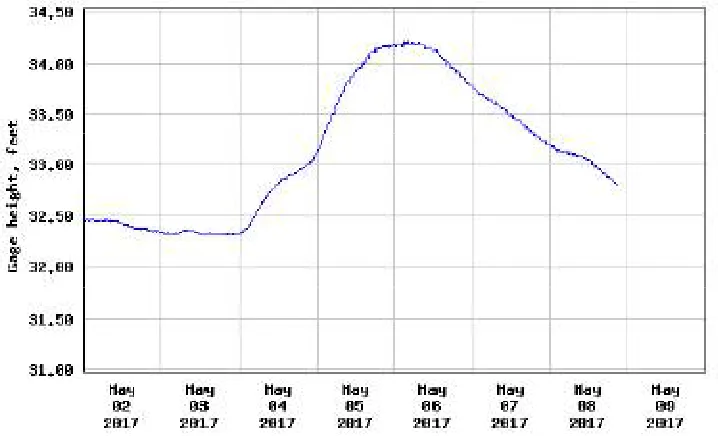
Fig. 1 Survey for Flood Level based on Year
Flood disaster mitigation based on a comprehensive assessment of the flood risk. ‘‘German Research Network Natural Disasters’’ project, the working group on ‘‘Flood Risk Analysis’’ searching complete flood disaster chain from the triggering event down to its various consequences. The ‘‘Flood Risk Analysis’’ group developed complex, spatially distributed models. It represent the relevant hydrological, hydraulic, meteorological, geo-technical, and socio-economic processes. The flood disaster chain represents the two way approaches (simple probabilistic and complex deterministic). This approach allows the various number of simulation runs in a Monte Carlo framework and provides the support for a probabilistic risk assessment. The proposed model is useful to integrated assessment of flood risk in flood prone area.[13] Applying this concept, it is the most important failure mechanism for new river levees. The breach criterion is scope as the difference between the actual overflow and the critical overflow.All modules are combined in a Monte Carlo framework. First, a discharge value was randomly chosen from the composite flood frequency. Second flood type was randomly chosen.
The risk analysis of a flood control system is presenting a method, to estimate the probability of generated hydrological scenarios. Using copulas bivariate probability analyses of different flood variables are applied univariate probability to overcome that analysis may lead to an over- or underestimation of the hydrological risk. Which consists
of two reservoirs located downstream of the main tributaries and flood polders. The joint probability of the inflow peaks at the two reservoirs are analysed the spatial distribution of flood events within the river basin. Risk analysis of the individual flood detention structures are use in second application copulas.
III. OBJECTIVES
3.1 Existing System
Disaster flood alert system using GSM and ultrasonic frequency sensors is one of the important technology which is useful to make the people alert from disaster flood, in this project ultrasonic transducers are used to find out the water level of the flood . And then information given to the controller and GSM, this system continuously send the messages towards control room about the level of the flood when water level will change.[12]
3.2 Proposed System
The existing system in terms of efficiency, a test was conducted by recording the time delay of the detection of the water level to be transmitted updated in the website .Through this system, the information could be available to anyone who could access the internet once the website will be given a domain and can be broadcasted live in the internet. Aside from the people near the river who would be alarmed once the water level will be of critical level, those who are away will also be informed of the current situation. With that, necessary preparations and safety measures can be done. It could be a help to prevent or lessen the damages that flood may bring. The flood warning system should be carried a step further in notifying the public. Since social networking is at the moment one of the popular medium of communication, sending an alert through it would hence reach a larger audience. A prototype of the proposed system is discussed in this paper and the result of the testing phase is also elaborated. The architecture of the system can be expanded further to a fully functioning system in alerting the public of an impending disaster caused by flood.
IV. SYSTEM REVIEW
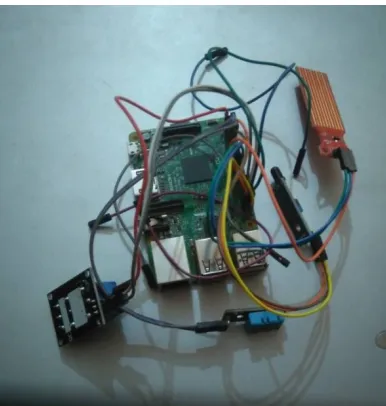
The main hardware components are Raspberry Pi, Temperature Sensor, Waterlevel Sensor, and IoT
The full specs for the Raspberry Pi 3 include:
CPU: Raspberry pi. 16GB. USB Port.
Video outputs: VNC (optional)
Network: 2G, 3G, 4G, Wireless Lan
Power source: 5 V
Weight: 450g
Temperature Sensor: A temperature sensor perceives the hotness and the coldness of the environment. The recognizing of the
temperature can be done with the straight contact or an indirect contact. DHT/Temp sensor.
Level Sensor: Level sensors are used for the measurement of the water level. Such substances can be liquids like water, oil, slurries
as well as solids which can flow jack.
Rainfall Sensor: The rainfall sensor detects the amount and intensity of rain in the environment. A rain sensor or rain switch is an
exchanging gadget initiated by precipitation.
Fig. Block diagram of the flood disaster management system[7]
Fan
Raspberry pi
Water
level
sensors
V. METHODOLOGY
System consists of following things:
RASPBERRY Pi
DHT/ TEMP SENSOR
WATERLEVEL SENSOR
5.1 Problem Background
Malaysia has experienced numerous floods and the results were devastating. Monsoonal floods account for a significant amount of damage for the past few decades. As a matter of fact, Malaysia is among the countries with the heaviest rainfall, averaging 2,500 mm of rainfall throughout the country in 2010. Overemphasizing developments and economic aspects has led to human activities such as deforestation. The ignorance portrayed by the nation in handling and managing flood hazards resulted in high flooding magnitudes. Rapid rate of change in water yield is poorly handled as natural systems cannot adapt to sudden changes [1]. Highly urbanized areas such as Kuala Lumpur and Georgetown are often flooded due to over-development. Recent sightings on flash floods in Johor Bahru had brought disturbance to the public. A flash flood management system was proposed specifically for Majlis Perbandaran Johor Bahru Tengah (MPJBT), namely Majlis Perbandaran Johor Bahru Tengah Flash Flood Management System (MPJBTFMS). The system will focus on monitoring flood levels in the city of Johor Bahru as well as feature the ability to monitor up-to-date flood levels and provide real-time alerts of flash flood events. All in all, the system will benefit the citizens of Johor Bahru tremendously.[15]
a. Studies On Existing Flood Management Systems
A study was conducted to research existing flood management systems and identify strengths and weakness of each individual system. A total of 5 existing flood management systems were studied; wireless sensor networks for flood detection in Honduras, rainfall monitoring network in Xicheng District, Beijing, flood monitoring and forecasting in the Rambla del Albujon Watershed, flash flood monitoring and warnings in Iowa, and flash flood early warning system in Korchar Haor, Bangladesh. Key strengths that were identified from the above study are as follows:
i. Real-time data logging
ii. Usage of multiple types of sensors iii. Alerts and notifications
iv. Data security
v. Transmission of data over Internet vi. Data stored for future usage
b. IoT
The technology of IoT has been rapidly expanding throughout the years. In general, IoT is a network of interconnected devices. These devices are capable of assisting us in our daily lives [4]. Sectors such as manufacturing, security, healthcare and education has benefited immensely through the implementation of IoT and the number of interconnected devices is expected to grow up to 26 billion in 2020. The Arduino is a microcontroller which contains several components onboard such as the processor, inputs and outputs, memory and peripherals. Paired together with sensors and actuators, the Arduino is a wonderful device that opens up new possibilities in the
world of IoT. The main philosophy behind the development of the Arduino lies in prototyping. Due to its nature, the Arduino provides a platform for the audience to develop a diverse range of projects. The invention of the Arduino has eased the hardware prototyping process with the high
VI. RASPBERRYPI
The Raspberry Pi is used to overcome some of the disadvantages of cloud computing. The downtime, security and privacy, vulnerability to attack and the cost can also be reduced with the use of raspberry pi.
Raspberry pi board contains a processor, graphics chip, memory and various interfaces and connectors for external devices. Some of these devices are essential, others are optional. It operates in the same way as a standard pc, requiring a keyboard for command entry, a display unit and a power supply. Instead we will use an SD memory card normally used in digital cameras. Rpi will ‘boot’ from this card in the same way as a pc ‘boots up’ into windows from its hard disk. The memory size of SD card used in Raspberry Pi is 1 GB. The Processor speed will be up to 700 MHZ and the languages used is also limitless. Any language will be supported in raspberry pi. The number of GPIO pins is 40 pins and their pin configuration is shown in fig.6. The SD card slot is present. The quad-core Raspberry Pi 3 is both faster and more capable than its predecessor, the Raspberry Pi 2. For those interested in benchmarks, the Pi 3's CPU--the board's main processor--has roughly 50-60 percent better performance in 32-bit mode than that of the Pi 2, and is 10x faster than the original single-core Raspberry Pi (based on a multi- threaded CPU benchmark in Sys Bench)[4][5][6].
VII. EXPERIMENTAL RESULTS
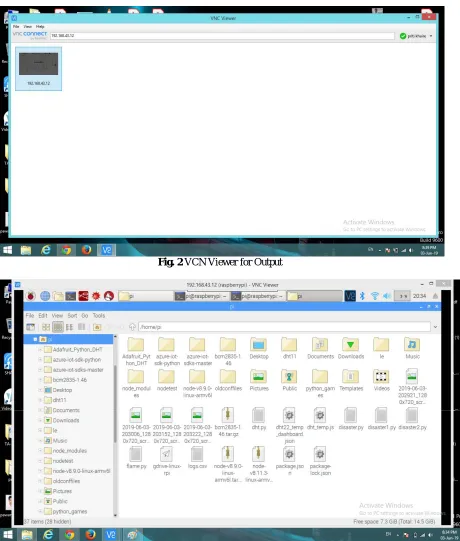
Fig. 2 VCN Viewer for Output
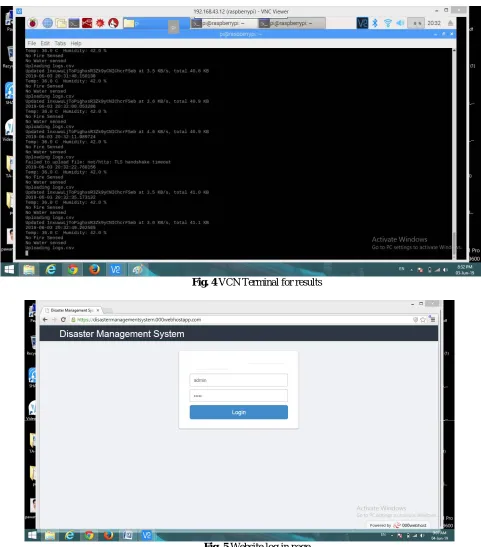
Fig. 4 VCN Terminal for results
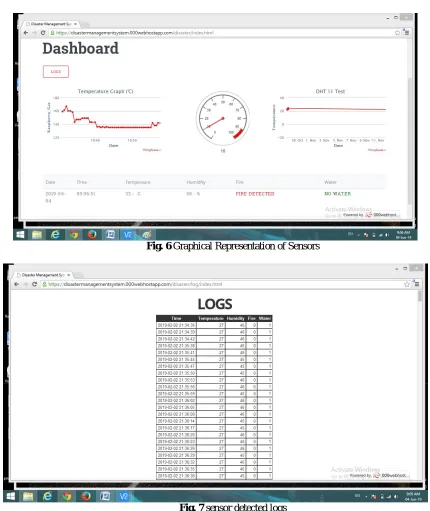
Fig. 6 Graphical Representation of Sensors
Fig. 7 sensor detected logs
VII. CONCLUSION
formulation of public policies and strategies that either minimize the causes of disasters or their effects on individuals and infrastructure. The research presented in this paper proposes an innovative IoT based solution to provide real time information about disaster hit area so as to facilitate immediate and effective decisions regarding the rescue efforts. The main objective of this research is to investigate the fitness of the proposed IoT based solution in achieving the tasks required for immediate relief operation after any natural calamity has taken place.
ACKNOWLEDGEMENT
I feel great pleasure in submitting this Special Study report on “Flood Disaster management system Using IOT”. I wish to thank my Principal Dr. R. P. Singh, Academic Dean Dr. R. B. Barjibhe and H.O.D., Prof. D. D. Patil for opening the doors of knowledge towards the realization of this Special Study.
I wish to express true sense of gratitude towards my teacher and guide, Prof. Priti Subramanium who at every discrete step in study of this Project Stage I contributed her valuable guidance and help me to solve every problem that arose.
Most likely I would like to express my sincere gratitude towards my family and friends for always being there when I needed them the most.
With all respect and gratitude, I would like to thank all authors listed and not listed in references whose concepts are studied and used by me whenever required. I owe my all success to them.
REFERENCES
[1] Muthukumar S, Dr.Krishnan .N, Pasupathi.P, Deepa. S, “Analysis of Image Inpainting Techniques with Exemplar, Poisson, Successive Elimination and 8 Pixel Neighborhood Methods”, International Journal of Computer Applications (0975 – 8887), Volume 9, No.11, 2010 [2] Dr. R. Muthamma1, Gayathri A2, Madhumitha.J3, Janet.R.K4 “Analysis and monitoring of disaster using Raspberrypi”,
International Journal of Scientific Research and Review ISSN NO: 2279-543X, Volume 7, Issue 4, 2018.
[3] “Disaster Management Projects using Wireless Sensor Networks: An Overview” 2014 28th International Conference on Advanced Information Networking and Applications Workshops.
[4] Shabnam Shadroo a , Amir Masoud Rahmani “ Systematic survey of big data and data mining in internet of things”, Computer Networks 139 (2018).
[5] 1Mr. Sagar.D.Kharde, 2Mr.Chanaky Kumar 1M.E. Student, 2M.E, Ph.D (Pursuing) MIEEE, MISI,MM2M,MAIT 1S.V.C.E.T, Rajuri, 2S.V.C.E.T, Rajuri, “ Natural Disasters Alert System Using Wireless Sensor Network”, 2015 IJEDR | Volume 3, Issue 4 | ISSN: 2321-9939. [6] 1Soubhagyalaxmi D B, 2Sushma L Bhosle, 3Swetha T, 4Veena P D, 5Chetan B V “Disaster Management System Using IOT”© 2018 IJRTI |
Volume 3, Issue 6 | ISSN: 2456-3315.
[7] M Chaitra1, Dr. B Sivakumar2, “Cloud Based Disaster Detection & Management System using WSN”, International Research Journal of Engineering and Technology (IRJET), Volume: 04 Issue: 05 | May -2017.
[8] 1Soubhagyalaxmi D B, 2Sushma L Bhosle, 3Swetha T, 4Veena P D, 5Chetan B V, “Disaster Management System Using IOT”,© 2018 IJRTI | Volume 3, Issue 6 | ISSN: 2456-3315
[9] 1Mr. Sagar.D.Kharde, 2Mr.Chanaky Kumar 1M.E. Student, 2M.E, Ph.D (Pursuing) MIEEE, MISI,MM2M,MAIT 1S.V.C.E.T, Rajuri, 2S.V.C.E.T, Rajuri, “ Natural Disasters Alert System Using Wireless Sensor Network”, © 2015 IJEDR | Volume 3, Issue 4 | ISSN: 2321-9939 [10] Senthil Murugan Balakrishnan1*, Arun Kumar Sangaiah2*,” Aspect Oriented Middleware for Internet of Things: A State-of-the Art Survey of
Service Discovery Approaches”, International Journal of Intelligent Engineering and Systems, Vol.8, No.4, 2015
[11] Dhafer Ben Arbia 1,2,* ID , Muhammad Mahtab Alam 3 ID , Abdullah Kadri 1, Elyes Ben Hamida 1 and Rabah Attia 2, “Enhanced IoT-Based End-To-End Emergency and Disaster Relief System”, Received: 30 June 2017; Accepted: 9 August 2017; Published: 21 August 2017 [12] Mahendra Salunke, Nilesh Korade Assistant Professor, Pimpri Chinchwad College of Engineering and Research, Ravet, Pune, Maharshatra,
India,” Survey on Flooding Detection System using Internet of Things”, International Journal of Computer Applications (0975 – 8887) Volume 165 – No.13, May 2017.
[13] Jagadeesh Babu Mallisetty1 and Chandrasekhar V2, “Internet of Things Based Real Time Flood Monitoring and Alert Management system”, International Journal of Pure and Applied Mathematics Volume 118 No. 17 2018, 859-868 ISSN: 1311-8080 (printed version); ISSN: 1314-3395.
[14] M.Madhumathi, R.Kingsy Grace PG Scholar, Dept. of Computer Science and Engineering, Sri Ramakrishna Engineering College, Coimbatore, India Associate Professor, Dept. of Computer Science and Engineering, Sri Ramakrishna Engineering College, Coimbatore, India,” Flood Alert Management System Using IoT and Microcontroller”, International Journal of Innovative Research in Computer and Communication Engineering (An ISO 3297: 2007 Certified Organization) Website: www.ijircce.com Vol. 5, Issue 4, April 2017.
![Fig. Block diagram of the flood disaster management system[7]](https://thumb-us.123doks.com/thumbv2/123dok_us/1551720.1190474/4.595.87.459.596.763/fig-block-diagram-flood-disaster-management.webp)