A Meta-heuristically Approach of the Spatial Assignment
Problem of Human Resources in Multi-sites Enterprise
.
ABSTRACT
The aim of this work is to present a meta-heuristically ap-proach of the spatial assignment problem of human resources in multi-sites enterprise. Usually, this problem consists to move employees from one site to another based on one or more criteria. Our goal in this new approach is to improve the quality of service and performance of all sites with maximizing an objective function under some managers imposed constraints. The formulation presented here of this problem coincides perfectly with a Combinatorial Optimization Problem (COP) which is in the most cases NP-hard to solve optimally. To avoid this difficulty, we have opted to use a meta-heuristic popular method, which is the genetic algorithm, to solve this problem in concrete cases. The results obtained have shown the effectiveness of our approach, which remains until now very costly in time. But the reduction of the time can be obtained by different ways that we plan to do in the next work.
Keywords
Human Resources, Spatial Assignment Problem, Meta-heuristic Method, Genetic Algorithms, NP-hard Problem.
1.
INTRODUCTION
The human resource management is one of the most critical problems and more costly for the majority of companies [5], and their problems occupy a place in company policies (pub-lic or private). The efficient and effective management of staff assignments is a key axis in the management of resources. It also imposes an essential tool to enhance profit-ability, increase productivity and improve business per-formance. Today, the real indicator to evaluate performance of these companies is no longer its financial availability but rather its ability to mobilize effective human resources, to assume the responsibilities and tasks assigned to them. For this fact, companies seeking more and more a perfor-mance affirmed in a competitive environment, and they need more qualified human resources. However, the reassign-ment of certain skilled employees by the mobility process (spatial assignment process) to other places in the same company may be a key factor in the transfer of skills to the team that provides this site.
This leads to improve the overall performance of the company [14].
Generally, the assignments of human resources can be set in two modes: Assignment for execute an activity without changing the workplace and assignment for execute an activi-ty with changing workplace. This assignment mode requires an important tool for the optimization of human resources and remains a primary means to provide the adequacy among the requirements and resources, especially in large multi-site enterprises [9].
In this work, we define geographical mobility or movement of an employee to another location of the workspace by spatial mobility or spatial assignment that employee performs the same activity in the new workplace. This spatial mobility is designed in a rational approach and employees gradually binding decisions and accepts the changes necessary for the functioning of the company.
Many works have been developed in the field of human resource assignments in companies without addressing the problems of changing workplace in the same company. These studies have focused on the problems that primarily affect the human entity (assignment, planning and schedul-ing) in relation to the tasks to be executed and the constraints imposed by management. Among these works, we cite the work of Hachicha [15] proposed an approach to solve the problem of resource allocation with consideration of com-petence and preferences to constitute a system of corre-spondence between the achievements of an employee, the requirements of a task and the satisfaction of the perform-ance of employers.The work of Bennour [5,6] was focused to propose method for optimizing the assignmentof human resources in a enterprise, taking into account the perfor-mance and competenciesin enterprise processes. The work of Campbell [7] proposes a model for maximizing the use of human resource skills for interdepartmental assignment and Hlaoitinun [14] proposed a method to support the formation of teams for coupling structuring project and piloting skills and other. Trojet work [22] has been focused on the planning of resources in a productive multi-site business, and pro-posed model as a problem of dynamic constraint satisfaction. In this work, we focus on studying a problem of spatial as-signment in multi-sites enterprise in order to control and maximize the performance of sites. These types of companies are composed on Central office and Network of sites.
*
Tkatek Said
LaRIT, Faculty of Sciences, Ibn Tofail University
Kenitra, Morocco
Abdoun Otman
Polydisciplinary Faculty, Abdelmalk Essaadi University,
Larache, Morocco
Abouchabaka Jaafar
LaRIT, Faculty of Sciences, IbnTofail University
Kenitra, Morocco
Rafalia Najat
LaRIT, Faculty of Sciences, IbnTofail University
Kenitra, Morocco
If the candidate i of site is assigned to site
Otherwise This paper is organized as follows: At first, we present a
generalization of staff assignments by spatial mobility pro-cess with explaining the relationship between mobility and performance variation (overall performance caused by the spatial assignments or the spatial mobility). Subsequently, we present firstly the overall formulation of the problem. To avoid this difficulty, we have opted to use a meta-heuristic popular method, which is the genetic algorithm, to solve this problem in concrete cases. In the end, before the conclusion, we comment on and compare the results obtained by using summary tables and graphical results.
2.
ASSIGNMENTS OF HUMAN
RESOURCES BY SPATIAL MOBILITY
2.1
Definition of Spatial Mobility
Spatial mobility overlaps a rather broad dimension during the prospect of a change of assignment. This is one of the levers of human resources policy. The large multi-sites companies see the spatial mobility as a way to remove their human resources between the different sites by mobilizing their employees to different geographical locations to improve their competitiveness on the one hand and on the other hand their customer service [9].
2.2
Processes of Spatial Mobility
Usually spatial mobility involves managing the business movement between sites of a company by a given process: Assignment, reassignment or redeployment.
The Assignment process: is the set of consecutive procedures of recruiting, and then assign an employee belonging to a category and having a specialty. The employee must be qualified, competent and dedicated to assign it to a com-pany site.
The reassignment process: is the set of consecutive proce-dures of moving an employee within the company to assum-ing the role of an operational position to complete a task.
The redeployment process: is the set of consecutive proce-dures of moving an employee to another site in order to provide quality human resources, able to cover the needs voiced in this site.
So this problem is to mobilize, between different sites, em-ployees belonging to a class of staff and having a specialty with one of the processes described above. The two parame-ters require that the employee perform a well-defined activi-ty. This type of assignment has a choice destination site, evaluation criteria and constraints imposed by managers.
Choice of destination site: is that an employee of a category and a specialty chooses one or more allocation sites to per-form the same activity.
Evaluation criteria: have been the characteristics from which managers can evaluate the behavior of an employee as professional competence, performance, efficiency, effective-ness.
We call the value associated with human characteristics by performance. In this work, we combine the value of this performance in one parameter noted the weight W.
The overall weight is calculated, by using an employee eval-uation function noted W(X)=∑αlwl(X), with αlis a weighting
These criteria have professional nature (seniority in the post), social (nearby), productive (productivity and profitability).
3.
POSITIONING,
FORMULATION
AND
COMPLEXITY OF THE PROBLEM
3.1
Position of the Problem
In the problem of assignment of human resources through spatial mobility we concentrate primarily on the following criteria:
Candidates are in the same professional class;
Candidates in the same business;
Candidates can choose only one destination site. Taking into account these criteria, we are interested in for-malizing the problem by determining the objective function. The latter will be maximized in terms of total weight while satisfying some constraints.
3.2
Formulation
of
the
Assignment
Problem by Spatial Mobility
In general, this problem can be stated as follows:
We have NS sites (sub-departments, subsidiaries, sites)
A1,.., Aj, .., Ak.,, ANS contain candidates. The problem is how to
choose candidates located in site Aj and wanting to move
to site with (j ≠ k) to maximize the total weight (quality of service or overall performance) induced by spatial mobil-ity of candidates, while respecting all the constraints imposed by manager. To answer to this question, we will present the formalism governing all assignments candi-dates by spatial mobility under these constraints.
For this, we first reorder the elements of the set using the weight function W(X) as follows: with
is the number of candidates of site Aj wishing to mobilize to
site , we have : (j, k) [1, NS]2 , with : is the weight measured of the candidate ilocated in site Aj and wanting to move to site .
Let a decision variable such that:
So, the number of candidates who will be mobilized to site
is given by:
Let the total weight induced during displacement
can-didates having an individual weight , this total weight is
given by:
We construct a matrix such that :
With:
The Site Aj is represented by a column vector j.
The candidate i located in site Aj is represented by a
row.
is the element of matrix .
Similarly, we construct a binary matrix such that:
Global matrix weight and global assignment X are respec-tively formed by the sub matrix and :
,
The optimization problem assignments spatial mobility of candidates likely to be mobilized to sites is to determine the different decisions leading to the maximization of the overall weight. The objective function associated to this problem can be written as:
If we set
This objective function is optimized as follows:
3.3
Constraints of the Problem
3.3.1.
Constraints of capacity
This constraint denote that the number of candidates who will be moved to the destination site must be equal to one expressed by the leaders.
So the overall weight matrix β and the assignment matrix X are formed respectively by sub matrix .
3.3.2.
Global formulation of the problem
From equations (4), (5), (6) and (7) we deduce the global formulation of the problem of spatial mobility assignments which can be written as:
3.3.3.
Complexity of the problem
The complexity of this problem is very important and classi-fied as NP-hard problems because the formulation presented coincides perfectly with a combinatorial optimization prob-lem (COP), and also seen as a dynamic probprob-lem. Therefore, we turned to a heuristic method using an iterative local search. The complexities of the search space and function to maximize use methods lead to radically different resolutions [21, 23]. In most cases, an optimization problem is natu-rally divided into two phases: research feasible solutions and to search for the optimal solution among these solutions. Depending on the method used, this division is more or less apparent in the resolution. The use of a genetic algorithm [10, 14] is suitable for rapid and comprehensive exploration of a large space search and is able to provide several solutions and choose the best among these solutions.
4.
GENETIC ALGORITHM
The genetic algorithm is a one of the family of evolutionary algorithms. The population of a genetic algorithm evolves by using genetic operators inspired by the evolutionary in biolo-gy[1].
In Genetic Algorithm, a population of potential solutions termed as chromosomes and individuals are evolved over successive generations using a set of genetic operators called selection, crossover and mutation. First of all, based on some criteria, every chromosome is assigned a fitness value and then the selection operator is applied to choose relatively fit chromosomes to be part of the reproduction process. In reproduction process new individuals are created through application of operators. Large number of operators has been developed for improving the performance of GA, because the performance of algorithm depends on the ability of these operators [2]. The mutation and crossover operator is used to maintain adequate diversity in the population of chromosomes and avoid premature convergence.
Fig 1: Flowchart of optimization with a genetic algorithm [3]
4.1
Advantages
Compared to the classical optimization algorithms, the genet-ic algorithm has several advantages as [1]:
Use only the evaluation of the objective function regard-less of its nature. In fact we do not require any special property of the function to be optimized (continuity, dif-ferentiability, connectedness, ..), which gives it more flexibility and a wide range of applications;
Generation has a parallel form by working on several points at once (population of size N) instead of a single iteration in the classical algorithms;
The use of probabilistic transition rules (crossover and mutation probability), as opposed to deterministic algo-rithms where the transition between two individuals is required by the structure and nature of the algorithm.
4.2
Principles and Functioning
The genetic algorithms are based on six principles [1, 3]:
Each treated problem has a specific way to encode the individuals of the genetic population. A chromosome (a particular solution) has different ways of being coded: numeric, symbolic, or alphanumeric;
Creation of an initial population formed by a finite num-ber of solutions;
Definition of an evaluation function (fitness) to evaluate a solution;
Selection mechanism to generate new solutions, used to identify individuals in a population that could be crossed, there are several methods in the literature, citing the method of selection by rank, roulette, by tournament, random selection, etc.;
Reproduce the new individuals by using Genetic opera-tors:
i. Crossover operator: is a genetic operator that com-bines two chromosomes (parents) to produce a new chromosome (children) with crossover probability
Px ;
ii. Mutation operator: it avoids establishing it avoids population unable to evolve. This operator used to
modify the genes of a chromosome selected with a mutation probability Pm;
Insertion mechanism: to decide who should stay and who
Stopping test: to make sure about the optimality of the solution obtained by the genetic algorithm.
In the following, we apply a genetic resolution in a typical example in order to obtain an optimal solution from several solutions generated verifying the objective function of the overall weight induced and the values of the constraints imposed.
5.
RESULTS AND ANALYSIS
5.1
Description of a Sample Test
To carry out this study and evaluate this work, we deal with an example of medium size. We believe that a company is formed by three sites A1, A2 and A3. The brings in a total
number of candidates equal to 29 candidates, each of these candidates has a Wi weight that characterizes his
pro-fessional assessment (competence, productivity, profitability ...) wishing to affect or move by spatial mobility to another site.
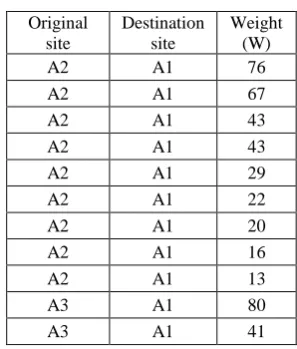
Tables 1, 2 and 3 summarize the values of the weights of the candidates as well as sites of origin and destination Aj and
[image:4.595.365.514.335.510.2]A(k).
[image:4.595.359.502.544.707.2]Table 1. Destination individuals to A1 (k = 1)
Table 2. Destination individuals to A2 (k = 2)
Original site
Destination site
Weight (W)
A2 A1 76
A2 A1 67
A2 A1 43
A2 A1 43
A2 A1 29
A2 A1 22
A2 A1 20
A2 A1 16
A2 A1 13
A3 A1 80
A3 A1 41
Original site
Destination site
Weight (W)
A1 A2 83
A1 A2 78
A1 A2 76
A1 A2 69
A1 A2 58
A1 A2 21
A1 A2 9
A3 A2 86
A3 A2 74
A3 A2 60
A3 A2 57
A3 A2 39
Initialize population
Evaluate Cost
Crossover
Mutation Selection
Converge? Yes Solution
Table 3. Destination individuals to A3 (k = 3)
Table 4. The constraint values of Ck
5.2
Synthetic Table of Results
In this section, we present a concrete example of this meta-heuristic approach proposed. The code for solve the problem of spatial mobility in this test has been developed by the C++ language.
In this example, the initial population contains 30 individuals and the stop condition depending on the convergence to the optimal solution of this problem. The results are summarized in Table 5, they were obtained on a Pentium 4 at 2 GHz with 1GB of RAM.
The global weight matrix β used in this test is given by:
With :
The solution X of the problem is obtained as a matrix. This matrix is called global assignment matrix that is written as:
5.3
Generating
all
Solutions
of
the
Problem
The global assignment matrix with the process of spatial mobility is a binary matrix; the value 1 indicates that the candidate is assigned. The value 0 indicates that the candi-date is not affected or mobilized.
This decision variable (j ≠ k) is assigned to i-th candidate of site Aj wanted to mobilize to site . This candidate is
[image:5.595.302.555.108.552.2]identified by ( j ≠ k).
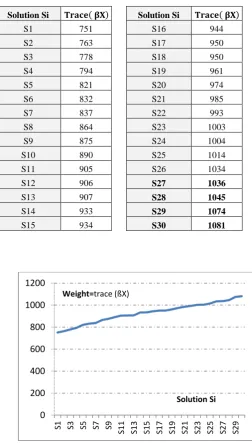
[image:5.595.295.547.112.340.2]Table 5. Solutions depending on the values of
Fig 2: The global weight induced depending on solutions obtained
We have 30 different solutions obtained by performing 30 iterations, these solutions are ranked from 1 to 30 according to a decreasing order of the value associated with F (X) = Trace (ßX).
0 200 400 600 800 1000 1200
S1 S3 S5 S7 S9 S11 S13 S15 S17 S19 S21 S23 S25 S27 S29 Weight=trace (ßX)
Solution Si
Original site
Destination site
Weight (W)
A1 A3 64
A1 A3 27
A1 A3 7
A2 A3 67
A2 A3 11
A2 A3 4
Ck Constraint
Ck(k=1) Ck ( k=2) Ck ( k=3)
7 7 5
Solution Si Solution Si
S1 751 S16 944
S2 763 S17 950
S3 778 S18 950
S4 794 S19 961
S5 821 S20 974
S6 832 S21 985
S7 837 S22 993
S8 864 S23 1003
S9 875 S24 1004
S10 890 S25 1014
S11 905 S26 1034
S12 906 S27 1036
S13 907 S28 1045
S14 933 S29 1074
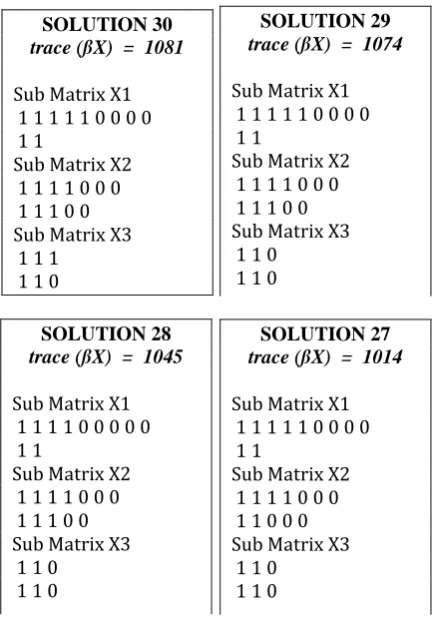
[image:5.595.55.268.417.572.2]Fig 3: Example of first solutions, depending on the value descendent of trace(ßX)
5.4
Selection of the Optimum Solution
In the 30 solutions generated by this approach, we choose the solution that maximizes the objective function while satisfy-ing all the constraints. The optimal solution corresponds to the maximization of the objective function of the total weight F (X) = Trace (ßX) = 1081.
With :
The global matrix X assignment of spatial mobility contains three sub-matrix X1, X2 and X3, the values of one sub matrix Xi (i = 1, 2 or 3) shows all possible as-signments of candidates produced by spatial mobility for the best overall weight induced by these assignments. By analyzing these, we deduce the following:
The sub matrix X1, we have 5 candidates in the site A2 are
assigned to the site A1 (row 1) and 2 candidates from the site A3 are assigned to the site A1 (row 2). In addition, the number
The following table 6 summarizes all of the assignments made by the spatial mobility:
Table 6. Summary of all possible assignments by spatial mobility
[image:6.595.332.531.125.260.2]
From the assignment matrix obtained, if we remove the various possible transpositions between candidates mobilized we find that three of candidates still where each is belongs to a site. These three nodes A1, A2 and A3 sites are formed a closed cycle.
Fig 4: Directed graph contains a closed cycle
6.
CONCLUSION
We have presented and evaluated in this paper a problem of assignment by the spatial mobility of human resources in a multi-sites enterprise. Firstly, we have presented global formulation of the optimization problem by including several quantitative and qualitative constraints (capacity, priority anduniqueness).Secondly; we used genetic algorithms to find solution of this problem. The results of test showed the im-portance of this work to control and improve service quality and performance of multi-site enterprises by reallocation of candidates by using spatial mobility.
7.
REFERENCES
[1] Abdoun,O. , Abouchabaka,J. and Tajani, C. “Analyzing The Performance Of Mutation Operators To Solve The Traveling Salesman Problem”. International Journal Of Emerging Sciences (IJES). Vol. 2. No.1. 2012.
[2] Abdoun,O. , Abouchabaka,J. and Tajani, C. “ Hybridiz-Site Aj Site A(k)
Number of candidates assigned to
A(k)
Number of candidates out from
A(k) A2 A(1) 5
7 A3 A(1) 2
A1 A(2) 4
7 A3 A(2) 3
A1 A(3) 3
5 A2 A(3) 2
SOLUTION 30
trace (ßX) = 1081
Sub Matrix X1 1 1 1 1 1 0 0 0 0 1 1
Sub Matrix X2 1 1 1 1 0 0 0 1 1 1 0 0 Sub Matrix X3 1 1 1
1 1 0
SOLUTION 29
trace (ßX) = 1074
Sub Matrix X1 1 1 1 1 1 0 0 0 0 1 1
Sub Matrix X2 1 1 1 1 0 0 0 1 1 1 0 0 Sub Matrix X3 1 1 0
1 1 0
SOLUTION 28
trace (ßX) = 1045
Sub Matrix X1 1 1 1 1 0 0 0 0 0 1 1
Sub Matrix X2 1 1 1 1 0 0 0 1 1 1 0 0 Sub Matrix X3 1 1 0
1 1 0
SOLUTION 27
trace (ßX) = 1014
Sub Matrix X1 1 1 1 1 1 0 0 0 0 1 1
Sub Matrix X2 1 1 1 1 0 0 0 1 1 0 0 0 Sub Matrix X3 1 1 0
[image:6.595.321.560.348.509.2]lem”. International Journal Of Computer Science Issues (IJCSI), Vol. 9, No. 1, 2012
[3] Abdoun,O. and Abouchabaka,J. "A Comparative Study Of Adaptive Crossover Operators For Genetic Algo-rithms To Resolve The Travelling Salesman Prob-lem". International Journal Of Computer Applications (IJCA), Vol.31, N. 11, 2011.
[4] Barnier, N. and Brisset, P.: “ Optimisation par algo-rithme génétique sous Contraintes “, Technique et science informatiques. Volume 18 - n°1/1999, page 1 à 29. 2010
[5] Bennour,M. Crestani,D., and Crespo,O. "Une méthode d’affectation des ressources humaines aux processus industriels" Journal Européen des Systèmes Automatisés 42, 5 (2008) 541-577.
[6] Bennour,M . , Crestani,D., Crespo,O and Prunet, F “Evaluation d'une approche d'affectation des ressources humaines aux processus d'entreprises”, MOSIM'04 – 2004 – Nantes (France).
[7] Garey, M .and Johnson, D. “Computers and intractabil-ity: a guide to the theory of NP-completeness” W.H. Freeman and Company, New York, 1979
[8] GALINIER, P and HAO, J.K., “Tabu search for maxi-mal constraint satisfaction problems” Lecture Notesin Computer Science 1330 : 196-208, Springer-Verlag,1997
[9] Hlaoittinun , O."Contribution à la constitution des équipes couplant la structuration du projet et pilotage des compétences", thesis 2009, Université de Franche-Comté
[10] Hachicha M. and Dafaoui E-M., A. El, "Approche de résolution du problème d’affectation sous contraintes de compétences et préférences". 9ème Congrès Internatio-nal de Génie Industriel-CIGI Saint Sauveur, Québec, 12 -14, octobre 2011 Haut du formulaire
[11] Campbell,M. and Diaby,,M. "Development and evalua-tion of an assignment heuristic for allocating cross-trained workers" European Journal of Operational Research, vol 138, pp 9-20,2002
[12] D.Orvosh. D, Cox. A, and Qiu, Y. “A Genetic Algo-rithm for Survivable Network Design”, ICGA 1993; 408-415
[13] Maclouf, E. and Wierzbicki, B. “Is Geographical
mobil-ity a tool to optimize public management of human re-sources?”. Vol 26/2 | 2008 p. 53-74
[14] Tempier,G.“Les solutions de collaborations au ser-vices de l’entreprise multi sites“, l'Economie demain 2009
[15] Goldberg, D. “Genetic Algorithm in Search, Optimiza-tion, and Machine Learning”, Addison Wesley, 1989.
[16] Goldman,L , Nagel ,N. and Preiss, K , “Agile competi-tors and Virtual Organizations. Strategies for enriching the Customer” Van Nostrand Reinhold, 1995.
[17] Hao.JK, “Méta heuristiques pour l’optimisationcombinatoire et l’affectation sous con-traintes”. Revue d’Intelligence Artificielle Vol : No. 1999
[19] Pentico,W “Assignment problems: Agolden anniversary
survey”. European Journal of Operational Research, 176 (2), pp. 774-779. 2007
[20] Oliver. I, Smith., and Holland. J. “A study of permuta-tion crossover operators on the traveling salesman prob-lem”. In Proc. of the second international conference on genetic algorithms (ICGA’87) Cambridge, MA:Massachusetts Institute of Technology; 1987
[21] Özbakir L, ,Baykasoglu,.A and Tapkan ,A." Bees algo-rithm for generalized assignment problem " Applied Mathematics and Computation, 215(11), pp.3782-3795 (2010)
[22] Ouzineb, M, M.Nourel and, Gendreau, M. “An efficient
heuristic for reliability design optimization problems”. Computers & Operations Research 37 (2010) 223 - 235
[23] Trojet,M. H'mida,F , Lopez P and Esquirol P. ”Planifi-cation multi-site : Modélisation sous forme d’un pro-blème de satisfaction de contraintes dynamiques”. MOSIM’ 2012