Bridging the Performance Gap between Manual and
Automatic Compilers with Intent-based Compilation
Waseem Ahmed
College of Computer Science King Khalid University, Abha, Saudi Arabia
ABSTRACT
In spite of years of research in automatic parallelization, progress has been slow in terms of tools that can consistently generate scal-able, portable and efficient code for multiple architectures. More-over, a substantial difference in efficiency exists between code gen-erated automatically and code gengen-erated by an expert programmer. Although the fact that the best sequential algorithm for a problem can be very different from the best parallel algorithm is well known, the feature of algorithm substitution is absent from most tools avail-able today. However, automatically identifying an algorithm used in code is not trivial considering the nuances in programming style, algorithmic representations and expressions. This paper presents a novel Intent Based Compilation approach that uses a rule-based Expert System Engine to identify the intent of the algorithm used in the code based on fine- and coarse-grained features extracted from code. Using this information, the most optimized algorithm for the target architecture is then substituted. Results obtained by using Amoeba, a framework that incorporates this methodol-ogy, on codes obtained from the public domain are presented.
General Terms:
Automatic Parallelization, Parallelization Tools
Keywords:
Intent-based compilation, automation, code-to-code transformers, parallelization, parallel compilers
1. INTRODUCTION
With the increased pervasiveness of massively parallel GPUs, ac-celerators and FPGAs on general-purpose commodity computers, parallel computing is no longer restricted to elitist machines [1]. The popularity of clusters made with off-the-shelf components, the increasing ratio of number of cores per processor die and the pres-ence of multiple processors on single machines, will have a large impact on the parallel programming community. Parallel program-ming that was once restricted to the HPC community, will soon involve the mainstream programmers in fields as diverse as Em-bedded Systems, Browser development, Game Programming and Operating Systems for smart phones, tablets, netbooks and game consoles. The next sub sections highlight the effects of these trends on automatic parallelization.
1.1 Software and Software compiler Requirements
In the past, each generation of hardware brought increased perfor-mance for existing applications and a code rewrite was not needed [2]. With the pervasiveness of diverse and specialized computing architectures in HPC, high-end servers, Multi-processor System-on-Chips (MPSoCs), Laptops and mobile platforms, code porta-bility will soon become a major challenge. The responsiporta-bility of ensuring scalable, portable and efficient parallel programming for these specialized architectures will rest on the application develop-ers and on the suite of tools available.
The HPC community relies on a large base of legacy sequential code for its scientific computation. Parallelizing such applications for even a single architecture is a complex exercise that incorpo-rates both domain expertise and sophisticated programming skills. In many cases, these applications are executed on various platforms during their lifetime. This makes the task of debugging, testing, porting, maintenance and versioning of code for these applications challenging.
1.2 Automatic versus manual parallelization
In spite of decades of research in parallel development tools (au-tomatic compilers, code-to-code transformers, parallel debuggers, auto tuners and parallel development environments collectively re-ferred to as parallel tools or parallel development environments in the rest of this paper) manual parallelization still continues. One main reason is that the automatically generated code, in the gen-eral case, can never be as efficiently optimized for execution on a particular architecture as hand-programmed code [3].
Indeed, the ability of a specialized human programmer to make complex code transformations judiciously by intuition and experi-ence clearly defines the path that future parallel tools should take. Thisintelligenthuman-factor is seldom incorporated in automatic compilers.
1.3 Loops and algorithms
The choice of algorithms used in a program heavily influences the efficiency of the final application. To illustrate, consider two sequential algorithms A1 and A2 that consists of O(n3) and
O(n2logn) operations, respectively, available to solve a
con-sidered, although parallelizingA1 may result in a better parallel
time complexity. In manual hand-parallelization this is invariably considered.
This paper presents a novel Intent Based Compilation (IBC) methodology that incorporates human intelligence and expertise into the parallel development environment. This research advances the field in the following novel ways
—the use of an Expert System Engine in the parallelization process. —supports for algorithmic replacements, when needed.
The rest of the paper is organized as follows. The next sections re-views the literature on which this work is based. Section three de-scribes the IBC methodology. Section four explains the structure of the Amoeba framework that is used to implement the IBC method-ology. Results are presented in the following section. Section seven concludes the paper.
2. RELATED WORK
The past few decades has seen a lot of research on automatic com-pilers, auto tuners and code-to-code transformers and the wide per-formance gap between manual parallelization and that achieved by an automatic compiler has continued to narrow. However, and con-sidering the acute need for such tools in many areas today, a lot of research is further needed. A programming framework is needed to allow the large developer community to develop code for emerg-ing heterogeneous architectures and develop parallel code that is at least as correct as the sequential codes written today [2]. To start with, a look at the shortcomings in such existing frameworks, tools and approaches is essential so that these shortcomings can be min-imized or eliminated.
Traditional automatic compilers have continued to focus primarily on loops which, in general, happen to be the performance bottle-necks and the most compute intensive portions of sequential code. To correctly analyze such loops, the tools discourage the use of dynamic aliasing (where many pointers point to the same memory location) and complex and hybrid data types [3]. In addition, iter-ative versions of algorithms are preferred over recursive functions for easier analysis. Existing code that use recursive functions may need to be rewritten to enable efficient parallelization by automatic tools.
Automatic parallelization tools have continued to place restrictions on the sequential programmer. [2] and [3] have listed such sugges-tions, but they constrict the creativity of the sequential program-mers. Moreover, these restrictions cannot be applied to the exist-ing legacy sequential applications code base popularly used by the HPC and the Embedded System community.
Existing programming paradigms and models like CUDA, PThreads OpenMP, MPI and OpenCL require the programmer to extensively modify existing code with parallel constructs while si-multaneously ensuring the correctness of parallel execution. For example, the unstructured nature of PThreads constructs has made the development of correct and maintainable programs difficult [1]. These languages do not provide safety guarantees that significantly reduces opportunities for hard-to-track bugs while improving de-veloper productivity [2]. These features exist in some serial guages like Java and C#. Also, no currently available parallel lan-guage, methodology or programming framework can completely ensure a deterministic-by-default result [4]. As there is an increas-ing trend towards heterogeneous computincreas-ing, application developers have to contend with multiple, sometimes incompatible program-ming models (OpenMP, MPI, PThreads, CUDA, OpenCL, etc.) and development environments [2]. As the degree of heterogeneity in
architectures increases, the development of software for these hy-brid architectures becomes all the more complex. Furthermore, the multilevel deep memory hierarchies in massively threaded GPUs further exacerbate this case.
Autotuners help to an extent in alleviating the problem by gener-ating a set of alternative implementations for blocks of code [5]. But exploring these various combinations to select the best imple-mentation takes time, especially in cases when the search space is not smooth and consists of many local minima or maxima [5]. Also, autotuners and many code-to-code transformers insert tool-specific compiler directives and profiling statements within code. For large evolving codes, this poses an additional burden during program maintenance, evolution and porting.
A solution to this, proposed in [2], suggests using a two-tier soft-ware framework that uses domain specific languages at one layer and programmer expertise at the other. This is based on the predic-tion that programming paradigms in the future will employ domain specific languages at the abstraction level of MATLAB or SQL. While this may be applicable while developing new applications, this is not applicable for the large legacy software set that is avail-able.
Another suggestion is to use highly parallelized and optimized li-braries like BLAS, LAPACK, MKL, ATLAS, FFTW and OSKI [6, 7, 8] but the code description of these libraries is need for au-tomatic parallelization when porting to a new hybrid architecture. Moreover, production of these carefully tuned parallel libraries will involve performance coding and domain experts [2].
binary executable format. This leaves very little for the parallel de-veloper to work on in case additional parallelization could be man-ually extracted. The work presented in this paper closely reflects that in [17]. The major difference is that IBC does not require the application developer to learn a new language nor is application developer intervention required before the autotuning stage. Intent-based compilation (IBC) presented in this paper addresses many of the above mentioned shortcomings.
3. INTENT BASED COMPILATION
Intent-based Compilation (IBC) is a novel approach incorporates human decision making into the compilation process. The human expertise that is involved in manual parallelization of sequential code generates, in most cases, parallel code that has a substantial speedup when compared to parallel code obtained with automatic parallelization.
The approach adopted by most automatic compilers and source-to-source translators is a mechanical identification of nested loops and inserting appropriate pragmas or parallel directives around them. Some tools employ static or dynamic profiling of code to aid this process. However, no attempt to identify the algorithm used in the code is made nor is the replacement of the algorithm with a more suitable one is considered.
IBC, similar to a programming expert in manual parallelization, considers both these issues. Statements, blocks of code or entire al-gorithms are considered for replacement if better alternatives exist and are available. These replacements of algorithms, in most cases, result in improvements in the time complexity [18, 19, 17]. To correctly emulate the manual process, the stages that a manual hand-coded parallelization passes through are identified. The next subsection explains these steps in the manual parallelization stage. The next subsection explains the manual analysis and transforma-tion process.
3.1 Manual Parallelization
The following questions are considered by an expert programmer before parallelizing the sequential code
(1) Where are the performance bottlenecks?
(2) What problem is this bottleneck trying to solve (or which al-gorithm is the programmer trying to use)?
(3) About the sequential algorithm itself
-(a) Can this sequential algorithm be easily parallelized? If not,
(b) Is a better parallel algorithm already available that can solve this problem? or
(c) Is there another sequential algorithm that can both be eas-ily parallelized and yield better performance on being par-allelized?
The first question can be easily answered by using static or dy-namic profiling. The second and third require expertise in the do-main. Once definite answers to these are obtained, the programmer then proceeds to parallelize this bottleneck specifically and not ev-ery loop block.
3.2 Algorithm Identification in IBC
Algorithms that commonly recur in the fields of HPC and Embed-ded Systems, referred to as kernels, algorithmic species, dwarfs, motifs or patterns, have been thoroughly studied and classified in literature [20, 21, 22], These classifications are uses as a basis by
IBC to identify bottlenecks in code. The identified bottlenecks are at the loop-block level of granularity. The appropriateslices[14] are then replaced, if possible, by known versions of more efficient and parallelizable solutions. This is further explained in section 3.4. Algorithm can be implemented in different ways which makes this step challenging. Consider the code snippets in Listing??for dense matrix-matrix multiplicationobtained from the public domain on the Internet. Listings??(a) and (b) follow the naive text book de-scription of the matrix-matrix multiplicationalgorithm taught in elementary programming courses and one that is commonly used. Matrices are defined as two-dimensional arrays of elements. This implementation is easily parallelized using automatic compilers and easily transformed into parallel code using code-to-code trans-lators. The implementation of the algorithm using arrays is simple, encouraged [3] and makes the code readable, portable and main-tainable.
Another implementation of the same algorithm is given in Listing ?? (c). This uses a dynamically allocated pointer-to-pointer rep-resentation with rows stored in contiguous memory space. To ac-cess any particular element, a calculation involving the number of columns and rows is used. For an expert sequential programmer, this may be the preferred way of implementation, although it makes the code less readable, less portable and less maintainable. Since this version uses pointers, it makes automatic parallelization diffi-cult. Most parallel tools discourage the use of pointers and cannot easily parallelize this version [3].
Even when using the same language for implementation, differ-ences in implementations will exist for the same algorithm. For expert and experienced programmers, these patterns in code are easily evident. For example, given any of the implementations of the previous example, the dense matrix-matrix multiplication pat-tern can easily be recognized. He can then easily parallelize this. This feature of identification of an algorithm based on patterns is built into IBC.
Using this feature, many of the passes made by source-to-source translators and automatic parallelizers can be avoided. For exam-ple, IBC avoids the detailed array section analysis and data de-pendency analysis used by Cetus [9]. Instead, patterns are used to match complete algorithm blocks. Hard-wired heuristics used by traditional compilers [16] are re-framed as flexible Expert System rules. This methodology gives IBC the added ability to correctly and easily handle recursive functions, pointers, variations in imple-mentations, and complex and recursive data structures like linked lists and trees - features not commonly found in source-to-source transformers and other automatic parallelization tools.
3.3 Focused Identification
In traditional approaches,profitableloops are prioritized for paral-lelization. To correctly identify them, static and dynamic profiling of code is necessary. In IBC, on the other hand, such loops are di-rectly identified by scanning the code for pattern matches. Features extracted from the code are matched against a collection of pat-terns of HPC kernels, represented asrulesin a knowledge base in theExpert System Engine(ESE). These rules encapsulate an expert programmers skills and a domain expert’s expertise in the ESE. A rule for analgorithmic patternis placed on the agenda only if all thefactsthat satisfy the rule are found in the code. When aruleis fired, allactionscorresponding to the rule on the agenda are exe-cuted [23].
perform addition operations on vectors and two-dimensional ma-trices do not significantly affect the performance of the application and can be safely ignored. This feature of IBC substantially reduces the profiling time.
3.4 Loop Block Transformation
In manual parallelization, loop transformations may involve com-plete algorithmic replacements. To further illustrate this, consider dense two-dimensional matrix-matrix multiplication as an exam-ple. Various algorithms with different time complexities exist to achieve this - the na¨ıve three-nested-loop matrix multiplication with a sequential time complexity ofO(n3); Strassen’s algorithm
with a sequential time complexity ofO(n2.81); and other
improve-ments to these algorithms with sequential time complexities as low asO(n2.376)[18]. Although some of these are complex to
imple-ment, the performance improvements obtained for large values of nmakes the effort worthwhile. Similarly, many parallel algorithms exist along with their sequential counterparts to solve problems, differing widely in implementation complexity, ease of paralleliza-tion, and scalability [24, 19, 18, 25, 26]. Additionally, libraries op-timized to implement algorithms for particular architectures like BLAS, ATLAS, FFTW and OSKI [6, 7, 8] have also been imple-mented.
The identification and subsequent ’intelligent’ replacement of algo-rithms, although common practice in manual parallelization, is sel-dom considered by automatic parallelization tools while paralleliz-ing sequential code. This feature is made available in IBC whereby an entire block of code and the relevant slices if necessary, if nec-essary, are substituted by a better algorithm.
4. DESCRIPTION OF AMOEBA
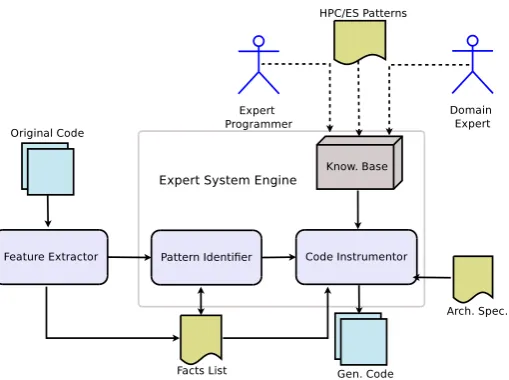
The IBC approach has been implemented in Amoeba, an auto-matic compiler framework. It consists of three main components as shown in Figure 1.
(1) Feature Extractor (FE) (2) Pattern Identifier (PI) (3) Code Instrumentor (CI)
The Pattern Identifier and the Code Instrumentor components to-gether comprise the Embedded System Engine (ESE). A detailed explanation of the components is given in the next subsections.
4.1 Feature Extractor
TheFeature Extractoris the lexical analyzer component in IBC that extracts specific features present in input code. These features in code uniquely and collectively identify a block(s) of code as an al-gorithmic pattern and are used to distinguish one HPC pattern from another. Features are extracted at five different levels of granularity - at thefunctionlevel,loop-blocklevel,looplevel, thestatement level and thevariablelevel. Features at thefunctionlevel include the number and type of parameters, whether or not the function is recursively called, whether the function uses loops, etc. Features at theloop-blocklevel include the nesting depth (number of loops), etc. Features at thelooplevel include details about the loop indices, the values of loop increments, the initial and termination values, nature of the statements within each loop, etc. Features for each statementwithin the loop include the type of expression, type of parameters on the LHS and RHS of the operator, the main operator, sub operators, etc. Features for thevariableinclude the dimension of variable, its indices, lower and upper bound, etc. The extracted
features in code are stored as facts in afact listfor subsequent anal-ysis by the ESE.
The Feature Extractor has been implemented usingflexand C. The output of the Feature Extractor is a facts list that follows the CLIPS [23] format. For every feature extracted, adeftemplate fact is as-serted (added) to thefactlist. As CLIPS is a non-procedural pro-gramming language, the sequence of facts in the fact list is not im-portant.
4.2 Pattern Identifier
ThePattern Identifier(PI) is part of the Expert System Engine. This component captures the expertise of both the expert programmer and the domain expert asrulesin the ESE’s knowledge base.Rules describe algorithms and their variations based on the presence or absence offactsin the facts list. They help the ESE to easily lo-cate and identify matches in the fact list. Separate set of rules are needed for each kernel classified in [20, 21]. The input to the Pat-tern Identifieris thefact list generated by thePattern Extractor. On execution, arulefor a kernel pattern is fired on the presence or absence offactsin thefactfile.
To further illustrate, consider two-dimensional dense matrix-matrix multiplication. The2D-dense-matrix-matrix-multiplication rule needs about ninefactsto be fired. On the presence of all of these ninefacts in the facts list, the rule is activated and a new factasserted into thefacts listindicating the presence of the 2D-dense-matrix-matrix-multiplicationpattern in code along with its location specific details in code. Additional rules exist to eliminate unneeded and irrelevant facts (for example, statements within a sin-gle nested loop), and to concatenate multiple facts into sinsin-gle facts. This substantially prunes the facts list.
These newfactsin thefacts listserve as input to the next component of Amoeba.
4.3 Code Instrumentor
The Code Instrumentor (CI) is the third main component of Amoeba. The inputs to the CI are the modifiedfacts listfrom the Pattern Identifier, the original input file and the specification of the target architecture. Based on the facts list, the CI is responsible for the following
(1) Correctly locate the loop blocks to be instrumented in the orig-inal input file
(2) Identify the pertinent slices [14] related to the loop blocks for replacement
(3) Identify the best existing algorithmic variant for replacement based on the specification of the target architecture (if neces-sary)
(4) Replace the loop blocks and the slices in the original code with the relevant algorithmic implementation
(5) Judiciously insert compiler directives (OpenMP, MPI, CUDA, OpenCL or a mix) based on the target specification.
Step four is an optional step used only when a better algorithmic implementation is available. If used, the replaced algorithm should have an improved time complexity compared to the one that ex-isted in the original code. Step five ensures that the generated code is suitable for the target architecture. For an architecture that uses an NVidia GPU, the CI should generate code with CUDA-specific statements. For a shared memory system, code with OpenMP di-rectives is to be generated.
Fig. 1. Components in Amoeba
5. EXPERIMENTS AND RESULTS
A small test input set was used to demonstrate the efficacy of the IBC methodology. As the approach closely models manual paral-lelization, the results for all other cases should be similar, or nearly similar, to those obtained using manual parallelization.
5.1 Test Input Set
The test input set used in this research consisted of code in C obtained from the public domain. Standard benchmarks were not used for reasons explained earlier in section 2. Code for dense 2D matrix-matrix multiplication (MM) and 1-D and 2-D Jacobi itera-tion (JI) with contrastingly different implementaitera-tions were used as the test input set. Only minor cosmetic changes were made to these representations to preserve their originality.
For the MM test set, the first code used the standard text-book im-plementation. The three matrices (A=B×C) were represented using dynamically allocated two-dimensional arrays, where an el-ement in rowxand columnyof matrixAwas accessed using the formA[x][y]as represented in Listing??(a) and (b) . The program consisted of seven loop blocks; three loop blocks (nesting depth = 1) for pointer initialization for rows of each matrix, three sep-arate loop blocks (nesting depth = 2) to initialize the elements of each matrix and a loop block (nesting depth = 3) for the matrix-matrix multiplication. All seven loop blocks were located in the same function.
The second code used the pointers-of-pointers representation to store the matrices, where an element in rowxand column yof matrixAwas accessed using the formA[x·N+y], as represented in Listing??(c), whereNindicated the number of rows in matrix A. The code consisted of two loop blocks; one loop block (nesting depth = 1) to initialize the elements of all three matrices and a loop block (nesting depth = 3) for the matrix-matrix multiplication. The matrix multiplication block in this program was defined in a sep-arate function, with all matrices being passed as reference to the function.
The data type of the matrix elements wasdoublein both the pro-gram codes.
The JI test set consisted of both C and C++ implementations also obtained from the test domain. One code consisted of a 1-D Jacobi
iteration and the remaining were 2-D. Some consisted of a fixed number of iterations and the others iterated till an error threshold was satisfied. Similar to the MM test set, the 2-D matrices were represented in some codes using the formA[x][y]and in some as A[x·N+y].
All the codes compiled and executed correctly using the gcc com-piler in Linux.
5.2 Experiments
To validate the effectiveness of the presented methodology, a com-parison with Cetus [9] was performed.
First, the sequential programs in the test set were compiled as-is and executables obtained (Exec-set #1). Next, the programs were analyzed using the Amoeba framework. ThePattern Extractorwas used to generatefacts. These facts, combined with the pre-defined expertrules,were loaded into thePattern Identifier,the environ-ment impleenviron-mented usingCLIPSversion 6.24. The Pattern Identifier correctly identified the two-dimensional matrix-matrix multiplica-tion pattern which activated the2D-matrix-multiplicationrule and placed it on the agenda. For theExpertise Injector’spre-defined expert rule for two-dimensional matrix-matrix multiplication, an OpenMP representation obtained from the public domain was used. Only one loop block was doctored for each of the programs in the test set and OpenMP directives inserted for only the outer loop of the matrix multiplication loop block. The other loops blocks were ignored.
Next, the Cetus GUI was used with the default optimization flags to transform the programs to their respective OpenMP implementa-tions. For both the programs in the test set, Cetus inserted OpenMP directives for each of the loops, twelve for the first and four for the second.
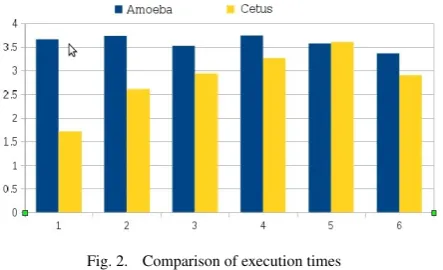
Fig. 2. Comparison of execution times
existing tools were made in this case for reasons cited in the next section.
5.3 Observations
It was observed that the programs obtained using the Amoeba framework performed faster than those obtained using Cetus. As noted in [16], this result was expected as Amoeba’s generated pro-grams more closely resembled hand-coded propro-grams than those obtained with Cetus. The speedups in the former case could have been more if rules in theExpertise Injectormodeled a specialist programmer’s optimized transformation instead of those obtained from the public domain.
Also, it was observed that one of the programs transformed using Cetus had run-time errors (error in computed result). The exact rea-son for the error has not been looked into. As such, the results for this code program were was not used in the speedup comparison. The amount of speedup obtained clearly depends on the code to be inserted - the better the code, the higher the speedup. This in turn depends on the quality of rules fed into the CI and the replacement blocks that have been made available.
6. CONCLUSION
As stated in [2], few domain experts have the time to develop per-formance programming skills and few computer scientists have the time to develop domain expertise. This paper attempts to capture both their expertise in a rule-based Expert System Engine. A novel Intent Based Compilation approach has been presented to further advance the field of automatic parallelization. The Amoeba frame-work, that implements the methodology was used to parallelize codes obtained from the public domain. As expected, performance gains obtained were close to those obtained with manual paral-lelization.
The Amoeba tool framework, at present, is still evolving and re-lies on code obtained from the Internet to frame expert rules for different architectures. Specialized rules are needed for optimized algorithmic replacement to further improve the performance of the results. As highlighted in [reference blinded], creating rules for the entire set in [21, 22, 20] and their variations is a dedicated and time consuming exercise. As future work, we plan to incorporate more variations of the patterns in the knowledge base targeting the average mainstream programmers rather than well structured and efficient benchmarks.
7. ACKNOWLEDGEMENTS
This work was supported by a grant from King Khalid University (KKU S270 33).
8. REFERENCES
[1] Javier Diaz, Camelia Mu˜noz-Caro, and Alfonso Ni˜no. A sur-vey of parallel programming models and tools in the multi and many-core era. Parallel and Distributed Systems, IEEE Transactions on, 23(8), 2012.
[2] Bryan Catanzaro, Armando Fox, Kurt Keutzer, David Patter-son, Bor-Yiing Su, Marc Snir, Kunle Olukotun, Pat Hanra-han, and Hassan Chafi. Ubiquitous parallel computing from Berkeley, Illinois, and Stanford. Micro, IEEE, 30(2), 2010. [3] Mehdi Amini, Ronan Keryell, Beatrice Creusillet, Corinne
Ancourt, and Fran ˜A§ois Irigoin. Program sequentially, care-fully, and benefit from compiler advances for parallel het-erogeneous computing. Technical report, MINES-ParisTech CRI, 2012.
[4] John Cavazos. Intelligent compilers. Inin Proceedings of the IEEE Int. Conf. on Cluster Computing, 2008.
[5] Ananta Tiwari, Chun Chen, Jacqueline Chame, Mary Hall, and Jeffrey K Hollingsworth. A scalable auto-tuning frame-work for compiler optimization. InParallel & Distributed Processing, 2009. IPDPS 2009. IEEE International Sympo-sium on, 2009.
[6] M. Frigo. A fast Fourier transform compiler. InProceedings of ACM SIGPLAN Conference on Programming Language Design and Implementation, May 1999.
[7] R. C. Whaley and Jack Dongarra. Automatically tuned linear algebra software. InProceedings of Supercomputing, Nov. 1998.
[8] R. Vuduc, , J. W. Demmel, and K. A. Yelick. Oski: A li-brary of automatically tuned sparse matrix kernels. Journal of Physics: Conference Series, 16:521–530, 2005.
[9] Chirag Dave, Hansang Bae, Seung-Jai Min, Seyong Lee, Rudolf Eigenmann, and Smauel Midkiff. Cetus: A source-to-source compiler infrastructure for multicores. IEEE Com-puter, December 2009.
[10] Matthew J. Bridges, Neil Vachharajani, Yun Zhang, Thomas Jablin, and David I. August. Revisiting the sequential progamming model for the multicore era. IEEE Micro, Jan-uary/February 2008.
[11] Christian Bienia, Sanjeev Kumar, Jaswinder Pal Singh, and Kai Li. The PARSEC benchmark suite: Characterization and architectural implications. InProceedings of PACT’08, 2008. [12] J. Ceng, J. Castrillon, W. Sheng, H. Scharwachter, R. Leu-pers, G. Ascheid, H Meyr, T. Isshiki, and H. Kunieda. MAPS : An integrated framework for MPSoC application paralleliza-tion. Inin Proceedings of the Design Automation Conference (DAC), 2008.
[13] Anja Guzzi, Lile Hattori, Michele Lanza, Martin Pinzger, and Arie van Deursen. Collective code bookmarks for program comprehension. InProceedings of the IEEE 19th Int. Conf. on Program Comprehension (ICPC), 2011.
[14] Shih-Wei Liao.Suif Explorer: An Interactive and Interproce-dural Parallelizer. PhD thesis, Stanford, 2000.
[16] Georgios Tournavitis, Zheng Wang, Bj¨orn Franke, and Michael FP O’Boyle. Towards a holistic approach to auto-parallelization: integrating profile-driven parallelism detec-tion and machine-learning based mapping. InProceedings of PLDI’09, volume 44, pages 177–187, 2009.
[17] Jason Ansel. Petabricks: a language and compiler for algo-rithmic choice. Master’s thesis, MIT, 2009.
[18] Barry Wilkinson and Michael Allen. Parallel Programming - Techniques and Applications using Networked Workstations and Parallel Computers. Pearson Education, 2 edition, 2005. [19] Michael J. Quinn. Parallel Programming in C with MPI and
OpenMP. Tata McGraw-Hill, 2003.
[20] Krste Asanovic, Ras Bodik, Bryan Christopher Catanzaro, Joseph James Gebis, Parry Husbands, Kurt Keutzer, David A. Patterson, William Lester Plishker, John Shalf, Samuel Webb Williams, and Katherine A. Yelick. The landscape of parallel computing research: A view from Berkeley. Technical Re-port UCB/EECS-2006-183, EECS Department, University of California, Berkeley, Dec 2006.
[21] Pieter Custers. Algorithmic species: Classifying program code for parallel computing. Master’s thesis, Eindhoven Uni-versity of Technology, 2012.
[22] Cedric Nugteren, Pieter Custers, and Henk Corporaal. Algo-rithmic species: A classification of affine loop nests for par-allel programming. ACM Transactions on Architecture and Code Optimization (TACO), 9, 2013.
[23] Joseph C. Giarratano and Gary D. Riley. Expert Systems -Principles and Programming. Thomson, 2005.
[24] Ian Foster.Designing and Building Parallel Programs: Con-cepts and tools for parallel software engineering. Reading, MA: Addison-Wesley, 1995.
[25] S. G. Akl. Parallel Sorting Algorithms. Orlando FL: Aca-demic Press, 1985.
[26] W. J. Camp, S. J. Plimpton, B. A. Hendrikson, and R. W. Le-land. Massively parallel methods for engineering and science problems.Communications of the ACM, 37(4):30–41, 1994. [27] Chirag Dave and Rudolf Eigenmann. Automatically tuning
parallel and parallelized programs.Languages and Compilers for Parallel Computing, pages 126–139, 2010.