Munich Personal RePEc Archive
Real Nominal Foreign Exchange
Volatility Effects on Exports – The
Importance of Timing
Cotter, John
2006
Online at
https://mpra.ub.uni-muenchen.de/3494/
Real & Nominal Foreign Exchange Volatility
Effects on Exports – The Importance of Timing
By
Don Bredin
University College Dublin
and
John Cotter∗
University College Dublin
Abstract
This paper compares real and nominal foreign exchange
volatility effects on exports. Using a flexible lag version of the
Goldstein-Khan two-country imperfect substitutes model for
bilateral trade, we identify the overall effect into both a timing
as well as a size impact. We find that the size impact of
forecasted foreign exchange volatility does not vary according
to the measure used in terms of magnitude and direction.
However, there are very different timing effects, when we
compare real and nominal foreign exchange rate volatility.
JEL Classification: C32, F31
Keywords: Exports, Volatility, Real & Nominal effects
∗ Address for correspondence: John Cotter, Centre for Financial Markets, Graduate School of Business,
1. Introduction
Mixed findings have been reported for the impact of foreign exchange volatility on
exports.1 A number of possible reasons for the lack of consistency are put forward including the models utilised, the sample period analysed, the countries selected, and
the volatility measures chosen. This paper readdresses this latter issue by
decomposing the overall impact of foreign exchange volatility and compares the
timing and size effects of real versus nominal forecasted exchange rate volatility for a
small developing economy. Two questions are addressed separately. Firstly, is the
size impact of foreign exchange volatility dependent on the use of real and nominal
measures? Secondly, is the timing of any likely impact dependent on these measures?
The evidence whilst suggesting that consistent results for the size effect are found
using either real or nominal measures of foreign exchange rate volatility (see, Thursby
and Thursby (1987)), there is no evidence thus far on the timing effect. One of the
main motivations for adopting real rather than nominal exchange rate volatility is the
observation that fluctuations in prices and incomes may be a determining influence
and may offset such uncertainty (see Gotur, 1985). Given the ambiguity of the point
estimate results (size effect) to date, a timing based approach as adopted here is likely
to shed greater light on the importance of the two alternatives. In this note, we
document that the use of real and nominal foreign exchange forecasted volatility does
not influence the size effect, however consistent with the Gotur argument, there is
evidence of adjustment accounted by the differential timing effect.
The modelling procedure uses the Goldstein and Khan (1985) two-country imperfect
substitutes model for bilateral trade that treats domestic exports and goods produced
abroad as imperfect substitutes. We incorporate a flexible lag structure in the model
that allows for a non-contemporaneous relationship between exports and the export
decision. The application of the model is to a small open developing economy, Ireland
that faces a high degree of uncertainty from foreign exchange rate risk.2 Both Baum et
1
For example, Koray and Lastrapes (1989) and Fountas and Aristotelous (1999) find a negative relationship, Baum et al (2004) find a positive relationship and Klaassen (2004) finds an insignificant relationship.
2
al (2004) and Klaassen (2004) highlight the over reliance on empirical evidence from
fully developed markets, and in contrast, this note introduces some evidence for a
rapidly developing economy. As volatility is latent and unobservable we retest the
model for robustness using a number of volatility forecasts.
The remainder of the paper is organized as follows. Section 2 examines the export
model applied to our small open economy. Section 3 provides a description of the
volatility measures and their estimation. The empirical findings and their implications
are outlined in section 4. Finally, conclusions are offered in section 5.
2. Export model
Our export model adopts the Goldstein and Kahn (1985) two-country imperfect
substitutes model for bilateral trade between Ireland and the UK and the US. The
model is forward looking at time t-l with traders interested in the exchange rate at
time t. To incorporate this feature, the model is augmented with a flexible lag
structure (Poisson) to describe the dynamics of a non-contemporaneous relationship
between exporters trade decisions and real export delivery and payment. Our model
is:
])
[
],
[
(
t l, t l t s,t l tt
x
y
E
s
s
x
=
− −σ
− (1)where real exports are dependent on real foreign income (y), the expected real foreign
exchange level (s) and exchange rate volatility (σs). The model is run using a forecast
of both real and nominal exchange rate volatility for time t that is unknown to them at
time t-l to determine if their respective influences vary.
The adopted model allows us the examine the timing impact of exchange rate
volatility by having a flexible lag structure that uses l lags ranging from the export
decision to payment at time t. We expect that real foreign income will have a positive
effect and real foreign exchange level a negative effect.3 There is a large amount of empirical work that has investigated the impact of foreign exchange volatility using
either real or nominal measures (see McKenzie (1999) for a review). The vast
majority of recent studies have found a positive relationship between foreign
exchange volatility and exports. Franke (1991) follows a real options based approach
to explain the positive effect of volatility. The real options approach finds that once
the expected cash flows from exporting as a result of volatility are greater than the
entry and exit costs, then there is likely to be a positive relationship.
However, with the exception of some recent studies, all of the empirical papers
investigating the impact of foreign exchange volatility effects on exports have only
investigated the direct (size) impact of volatility. Here, we also take account of the
likely timing effects and so investigate whether the adoption of real or nominal
foreign exchange rate volatility forecasts has any implications on when impact occurs.
Our real exports model will have the following form;
(2)
]
[
30 1 , 3 2 * 1 0 = − − −+
+
+
=
l l t s l t l t l l t lt
y
E
s
x
β
β
β
β
σ
In order to model the impact using a flexible lag approach, we adopt a Poisson lag
structure (see Baum et al (2004) and Klassens (2002)). Alternative, but more
restrictive, approach's include the geometric and the polynomial lag specification. For
example the geometric approach implies that l is decreasing as the lag increases.4
The Poisson lag approach is derived from the Poisson probability distribution;
(3)
)]
1
(
exp[
)!
1
(
)
1
(
.
1−
−
−
−
=
− k l k k kll
λ
λ
β
β
3Consistent with previous studies, we find that Irish exports are cointegrated with real foreign income and real exchange rates. Results are available upon request.
4
for k 1 and k = y*, s, s and is the lag at which the maximum effect occurs. One
important advantage of the Poisson lag approach is the number of parameters to be
estimated is minimized, 2k + 1, where k is the number of independent variables. As
can be seen the parameters 1, …, k enter into the equation in a non-linear fashion. In
order to calculate the parameters 1, …, k , we use the simulated annealing
optimization technique (see, Goffe et al. 1994).5 Once the parameters, 1, …, k , have
been obtained from the non-linear optimization technique, the estimated coefficients,
1, …, k, are calculated using OLS.
3. Volatility measures
Recently much work has concentrated on modelling (foreign exchange) volatility that
is directly unobservable. The literature relies on many types of volatility measures
(McKenzie, 1999). In contrast to exchange rates that are available
contemporaneously, exchange rate volatility is modelled ex-post leading to a major
research agenda in modelling volatility through analysis of its distributional and
dynamic characteristics. Our model is run with the three forecasts of volatility to
determine their explanatory power for multi-period or l lags. Our GARCH forecast of
volatility is computed recursively following Engle and Bollerslev (1986). We also
recursively fit an AR(1) model to the aggregated squared and absolute returns to
obtain non-constant forecasts of these measures for l periods. Major developments
have been made in modelling the time-variation of volatility and its persistence and
we incorporate three of these models. In addition, to ensure that robustness occurs for
assessing the effects of foreign exchange volatility the separate separate choices for
the volatility proxy are examined. These include Absolute and Squared based
measures of volatility from the microstructure literature and the more general
time-varying GARCH type process.
5
Specifically, the Absolute and Squared measures are model free that aggregate daily
associated realisations over monthly intervals that capture many features of the
dynamics of financial time series (see Andersen et al, 2001). The estimates are
underpinned by the theory of power variation that requires aggregation from high to
low frequency observations has been advocated with many illustrations for volatility
modelling (see references in Andersen et al, 2003). The practical implementation of
the theory simplifies into constructing volatility estimators using aggregated squared
or absolute exchange rate changes and their variants for any month t with m daily
intervals. The most common approach suggests the use of aggregated squared
exchange rate changes over a period, say for example, aggregating daily realisations
to obtain monthly estimates instead of using a single estimate from the monthly
exchange rate changes (see Baum et al, 2004; Klaessens, 2002). This estimate is
closely associated with the variance. We also analyse aggregated absolute realisations
that evolves from the same theoretical framework, known as realized power variation
(see Barndorff-Nielsen and Shephard, 2003), as exchange rate changes have the
stylized property of exhibiting fat-tails due to excessive large-scale movements and
modelling with absolute realisations is more robust in the presence of this property
(Davidian and Carroll, 1987).
Turning to the theoretical framework we illustrate for aggregate absolute realisations
by defining the price process that is underpinned by realised power variation.
Volatility of this price process defined as integrated volatility is said to be
unobservable. The framework incorporates the popularly used quadratic variation that
details the use of aggregated squared realisations and absolute power variation using
aggregated absolute realisations. We analyse the price process that has m evenly
spaced compounded returns per month (approximately 20). Importantly, realised
power variation that incorporates realised absolute variation, namely the sum of
absolute realisations, equate with integrated volatility, making volatility of the price
process observable.
The GARCH measures uses the APARCH specification fitted at monthly intervals
that is flexible to allow for many stylized features of exchange rate series including
asymmetric effects and nests seven separate GARCH models (see Ding et al, 1993 for
that they adequately capture volatility clusters in the data (Bollerslev et al, 1994). As
well as encompassing three ARCH specifications (ARCH, Non-linear ARCH and
Log-ARCH), two specifications of the GARCH model (using standard deviation and
variance of returns), it also details two asymmetric models (both ARCH and GARCH
versions). A Box-Cox allows for different specifications of the residuals process
encompassing the different GARCH models. As well as describing the time-variation
in exchange rate changes, it also allows for the possibility of leverage effects, by
letting the autoregressive term of the conditional volatility process be represented as
asymmetric absolute residuals. The model is fitted with a conditional student-t
distribution thereby allowing for fat tails.
3. Empirical findings and discussion
We estimate our export model from May 1979 through December 2002 at monthly
intervals.6 The export model is run using forecasted volatility with a Poisson lag structure for 3 separate measures of real and nominal volatility for each country pair.7 The flexible lag structure allows for an investigation of the overall impact of
exchange rate volatility broken into an examination of the size impact as well as the
likely timing of such impacts. Details of the lag structure (panel A) and model
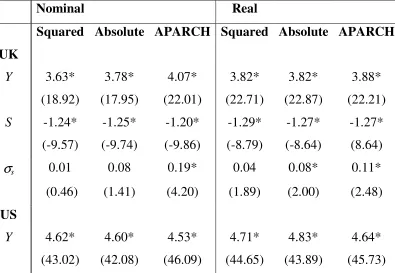
coefficients (panel B) are given in table 1. The size and sign of the coefficients on
foreign income and the real exchange rate are consistent with previous results from
the international literature.
Specifically addressing the two questions raised in this note we find that there is a
timing effect between real and nominal foreign exchange forecasted volatility
although it does not feed into the size effect. If we consider the lag structure (panel
A), we see there is a substantial difference for foreign exchange volatility between
adopting real versus nominal measures, regardless of the proxy employed. In
6
We use exports deflated by export unit value for real exports, UK and US industrial production at constant prices for income, and foreign currency per unit of Euro adjusted for relative prices for exchange rates.
7
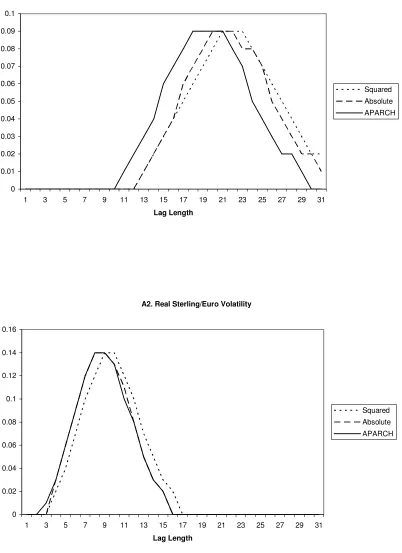
particular this result emerges for exports to the UK as evidenced in the lag structure
plot in figure 1. Here, we find that although the pattern of the distributed lag appears
reasonably similar, the largest effect varies from using real and nominal volatility
measures. For instance for the UK, in terms of the nominal measure of foreign
exchange rate volatility, the maximum effect occurs only after 19-20 months, while
the affect using real foreign exchange rate volatility occurs within the year. A positive
relationship between foreign exchange rate volatility and exports is found. This is
consistent across the various measures of volatility adopted and real versus nominal
measures. The positive relationship is also consistent with both the theoretical and
empirical evidence in the literature.8 Given the different volatility measures chosen, there is considerable variation in the size effects. Although there is consistency in the
sign of the effect, the timing impact indicates differences between adopting real
versus nominal measures. The positive benefits on exports from higher exchange rate
volatility occur with greater speed for the real measure of exchange rate volatility.
The results imply that when the real measure is adopted, the positive benefits of
volatility are intensified by the movements in income and prices. The results reported
here do infer that the variation in prices and income as highlighted by Gotur (1985) is
likely to have an influence, although our results indicate that it is likely to be a timing
influence rather than a size influence.
5. Conclusions
This paper studies the timing and overall effects of real versus nominal exchange rate
forecasted volatility for a small developing economy. The vast majority of previous
work assumes the former remains constant and focuses on exports from fully
developed markets. Two questions are addressed separately. Firstly, is the size
impact of foreign exchange volatility dependent on the use of real and nominal
measures? Secondly, is the timing of any likely impact dependent on these measures?
We find that the size impact of foreign exchange rate forecasted volatility is not
affected by the use of either real or nominal measures of foreign exchange rate
8
volatility. However, there is a substantial difference, when we move to the timing
results and in particular for exports to the UK. We find that the positive benefits on
exports from higher exchange rate volatility occur with greater speed for the real
measure of exchange rate volatility. The results imply that the fluctuations between
the foreign exchange rate and prices lead to a faster impact when the real measure is
References:
Andersen, T.G., T. Bollerslev, F.X. Diebold and P. Labys (2001), ‘Modeling and
Forecasting Realized Volatility,” NBER Working Paper No. 8160.
Andersen, T. G., T. Bollerslev, and F. X. Diebold (2003), ‘Parametric and
nonparametric measurement of volatility’, In Y. Ait-Sahalia and L. P. Hansen (Eds.):
Handbook of Financial Econometrics, North Holland.
Barndorff-Nielsen, O. E. and N. Shephard (2003), ‘Realised power variation and
stochastic volatility’, Bernoulli 9, pp. 243-265.
Baum, C. F., M. Caglayan, and N. Ozkan (2004), ‘Nonlinear Effects of Exchange
Rate Volatility on the Volume of Bilateral Exports’, Journal of Applied Econometrics,
19, 1-23.
Bollerselv, T., R.F. Engle and D.B. Nelson (1994), ‘ARCH Model’, pp. 2959-3038, In
R.F. Engle and D.C. McFadden (eds.) Handbook of Econometrics, Amsterdam:
Elsevier Science.
Davidian, M., & Carroll, R. J. (1987), ‘Variance Function Estimation’, Journal of the
American Statistical Association, 82, pp. 1079-1091.
Ding, Z., C. Granger, C. W. J., and R. F. Engle (1993), ‘A Long Memory Property of
Stock Returns’, Journal of Empirical Finance, 1, 83-106.
Engle and Bollerslev (1986) Engle, R.F. and T. Bollerslev (1986), ‘Modeling the
Persistence of Conditional Variances,’ Econometric Reviews, 5, 1-50.
Fountas, S. and Aristotelous, K. (1999), ‘Has the European Monetary System Led to
More Exports? Evidence From Four European Union Countries’, Economic Letters,
Franke, G. (1991), ‘Exchange Rate Volatility and International Trading Strategy’,
Journal of International Money and Finance, 10, 3-29.
Goldstein, M. and M.S. Khan, (1985), ‘Income and Price Effects in Foreign Trade’, in
Handbook of International Economics, Volume II, R. W. Jones and P. B. Kenen, eds,
North-Holland.
Goffe, W. W., G. D. Ferrier and J. Rogers, (1994), ‘Global Optimisation of Statistical
Functions with Simulated Annealing’, Journal of Econometrics, 60, 65-100.
Gotur, P. (1985), ‘Effect of Exchange Rate Volatility on Trade: Some Further
Evidence’, IMF Staff Papers.
Klaassen, F. (2004), ‘Why is it so Difficult to Find an Effect of Exchange Rate Risk
on Trade?’, Journal of International Money and Finance, Forthcoming.
Koray, F. and W. D. Lastrapes, (1989), ‘Real Exchange Rate Volatility and U.S.
Bilateral Trade: A VAR Approach’, Review of Economics and Statistics, 71, 708-712.
McKenzie, M.D. (1999), ‘The Impact of Exchange Rate Volatility on International
Trade Flows’, Journal of Economic Surveys, 13, 71-106.
Thursby, J. & Thursby, M. (1987), ‘Bilateral Trade Flows, the Linder Hypothesis and
Table 1. Export model for UK and US
Panel A. Lag structure
Nominal
Real
UK
Squared Absolute APARCH Squared Absolute APARCH
Y
12.05
11.77
12.16
15.07
15.07
16.15
S
1.91
1.56
1.37
8.94
8.89
9.26
σ
s21.35
20.74
18.67
8.89
8.12
8.07
US
Y
0.99
1.03
0.46
0.87
0.27
0.63
S
0.02
0.00
0.00
0.09
0.04
0.15
σ
s13.75
12.34
7.41
14.49
13.75
10.91
Panel B. Model coefficients
Nominal
Real
UK
Squared Absolute APARCH Squared Absolute APARCH
Y
3.63*
3.78*
4.07*
3.82*
3.82*
3.88*
(18.92)
(17.95)
(22.01)
(22.71)
(22.87)
(22.21)
S
-1.24*
-1.25*
-1.20*
-1.29*
-1.27*
-1.27*
(-9.57)
(-9.74)
(-9.86)
(-8.79)
(-8.64)
(8.64)
σ
s0.01
0.08
0.19*
0.04
0.08*
0.11*
(0.46)
(1.41)
(4.20)
(1.89)
(2.00)
(2.48)
US
Y
4.62*
4.60*
4.53*
4.71*
4.83*
4.64*
S
-0.95*
-0.90*
-0.83*
-1.03*
-1.05*
-1.01*
(-16.60)
(-14.83)
(-13.16)
(-18.80)
(-19.39)
(-18.05)
σ
s0.09*
0.15*
0.08*
0.16*
0.41*
0.12*
(4.42)
(3.85)
(5.10)
(6.02)
(7.04)
(5.95)
Note: this table gives the lag structure (Panel A) and model coefficients (Panel B)
from our export model run using real and nominal foreign exchange forecasted
volatility as described in the text. Significant model coefficients are given by * with
Figure 1. Lag structure of real and nominal exchange rate forecasted volatility
A1. Nominal Sterling/Euro Volatility
0 0.01 0.02 0.03 0.04 0.05 0.06 0.07 0.08 0.09 0.1
1 3 5 7 9 11 13 15 17 19 21 23 25 27 29 31
Lag Length
Squared Absolute APARCH
A2. Real Sterling/Euro Volatility
0 0.02 0.04 0.06 0.08 0.1 0.12 0.14 0.16
1 3 5 7 9 11 13 15 17 19 21 23 25 27 29 31
Lag Length
A3. Nominal Dollar/Euro Volatility
0 0.02 0.04 0.06 0.08 0.1 0.12 0.14 0.16
1 3 5 7 9 11 13 15 17 19 21 23 25 27 29 31
Lag Length
Squared Absolute APARCH
A4. Real Dollar/Euro Volatility
0 0.02 0.04 0.06 0.08 0.1 0.12 0.14
1 3 5 7 9 11 13 15 17 19 21 23 25 27 29 31
Lag Length