On Generalized d-Closed Sets
H. Jude Immaculate
Research Scholar Nirmala College for Women
Coimbatore.
I. Arockiarani
Department of Mathematics Nirmala College for Women
Coimbatore.
ABSTRACT
In this paper we present a new class of sets and functions namely gd-closed sets, gd-irresolute functions in the light of d-open sets in topological spaces. Further some of their characterizations are investigated with counter examples.
Keywords
gd-closed sets, gd-continuous functions, gd-irresolute functions.
1.
INTRODUCTION
Many different forms of continuous functions have been introduced over years. Most of them involve the concept of g-closed sets, -open sets, semiopen sets, sg-open sets, etc. In 1987, Bhattacharya and Lahiri [5] introduced the class of semi-generalized closed sets. In 1990, Arya and Nour[3]defined generalized semiclosed sets. The concept of generalized closed sets was first initiated by Levine in 1970[12]. The notion of b-open sets was defined by D. Andrijevic in 1996[2].In this paper a new class of sets called gd-closed sets has been introduced using the concept of d-closed sets by I.Arockiarani et al[10]. Further we study the basic properties of gd-closed sets. Using this new concept of sets we have introduced new class of functions called gd-continuous and gd-irresolute functions. Some of its basic properties and composition of functions is also discussed here.
Preliminaries
: We present here relevant preliminaries required for the progress of this paperDefinition 1.1: A subset A of a topological space (X,
) is called1. Preclosed set[15] if cl(int(A))
A, preopen set if A
int(cl(A))2.
-open set [17] if A
int(cl(int(A))),
-closed set if cl(int(cl(A)))
A.3. Regular open set[19] if A=int(cl(A)), regular closed set if A=cl(int(A)))
4. Semiopen set [11] if A
cl(int(A)), semiclosed set if int(cl(A)
A.5. Semi-pre-open set[1] if A
cl(int(cl(A))), semi-pre-closed set if int(cl(int(A)))
A.6. d-open set[10] if A
scl(int(A))
sint(cl(A))Definition 1.2: A subset A of a topological space (X,
) is called1. A generalized closed set[12] (briefly g-closed) set if cl(A)
U whenever A
U and U is open.2. A generalized semiclosed set[3] (briefly gs-closed if
𝑠cl(A)
U whenever A
U and U is open.3. A -generalized closed set [13](briefly g-closed) if
cl(A)
U whenever A
U and U is open. 4. A generalized preclosed set [14](briefly gp-closed) ifpcl(A)
U whenever A
U and U is open.5. A generalized pre regular closed set[9] (briefly gpr-closed) if pcl(A)
U whenever A
U and U is regular open6. A -regular generalized closed set[12] (briefly gr –closed) if cl(A)
U whenever A
U and U is regular open7. A regular generalized closed set [18](briefly rg-closed) if cl(A)
U whenever A
U and U is regular-open.2.
GENERALIZED D-CLOSED SETS
Definition 2.1: A subset A of a space X is called Generalized d-closed set if dcl(A)
U whenever A
U and U is open. The class of all generalized d-closed sets is denoted by GDC(X).Definition 2.2:
i. The gd-closure of a subset A of X is denoted by gdcl(A) is the smallest gd-closed set containing A. ii. The gd-interior of a subset A of X is denoted by
gdint(A) is the largest gd-open set contained in A.
Proposition 2.3[9]: The intersection of a open set and d-open set is d-open set.
Proposition 2.4:
i. Every closed set is gd-closed set.
Proof:
i. Let A be closed set such that A
U where U is open in (X,
). Since A is closed cl(A)=A
U. But every closed set is d-closed. Hence A is gd-closed.ii. Let A be d-closed set such that A
U where U is open in (X,
). Since A is d-closed dcl(A)=A
U. Hence A is gd-closed. The converse of the above result need not be true may seen by the following example.Example 2.5: Let X= {a, b, c},
= {X,
, {a}, {a, b}}.A= {a, c} is gd-closed but not d-closed or closed.
Proposition 2.6: Every -closed set is gd-closed set. Proof: Let A be -closed set such that A
U where U isopen in (X,
). Since A is -closed cl(A)=A
U. But every -closed set is d-closed. Hence A is gd-closed. The converse of the above result need not be true may seen by the following example.Example 2.7: Let X= {a, b, c},
= {X,
, {a}, {b, c}}.A= {b} is gd-closed but not -closed.
Proposition 2.8: Every preclosed set is gd-closed set. Proof: Let A be preclosed set such that A
U where U isopen in (X,
). Since A is preclosed set pcl(A)=A
U. But every preclosed set is d-closed set. Hence A is gd-closed. The converse of the above result need not be true may seen by the following example.Example 2.9: Let X= {a, b, c},
= {X,
, {a}, {a, b}}.A= {a, c} is gd-closed set but not preclosed set.
Proposition 2.10: Every semiclosed set is gd-closed set. Proof: Let A be a semiclosed set such that A
U where U isopen in (X,
). Since A is semiclosed set scl(A)=A
U. But every semiclosed set is d-closed set. Hence A is gd-closed. The converse of the above result need not be true may seen by the following example.Example 2.11: Let X= {a, b, c},
= {X,
, {a}, {b, c }}.A= {b} is gd-closed set but not semiclosed set.
Proposition 2.12: Every g-closed set is gd-closed set. Proof: Let A be a g-closed set then cl(A)
U whenever A
U and U is open in (X,
). Since every closed set is d-closed set we have dcl(A)
cl(A)
U. Hence A is gd-closed. The converse of the above result need not be true may seen by the following example.Example 2.13: Let X= {a, b, c},
= {X,
, {a}, {a, b}}. A= {b} is gd-closed set but not g-closed set.Proposition 2.14: Every g-closed set is gd-closed set. Proof: Let A be a g-closed set then cl(A)
U wheneverA
U and U is open in (X, ). Since every -closed set is d-closed set we have dcl(A)
cl(A)
U. Hence A is d-closed. The converse of the above result need not be true mayExample 2.15: Let X= {a, b, c},
= {X,
, {b, c}}. A= {b} is gd-closed set but not
g-closed set.Proposition 2.16: Every gp-closed set is gd-closed set. Proof: Let A be a gp-closed set then pcl(A)
U whenever A
U and U is open in (X,
). Since every pre closed set is d-closed set we have dcl(A)
pcl(A)
U. Hence A is gd-closed. The converse of the above result need not be true may seen by the following example.Example2.17: Let X= {a, b, c},
= {X,
, {a}, {b}, {a, b}}. A= {a} is gd-closed set but not gp-closed set.Proposition2.18: Every gpr-closed set is gd-closed set. Proof: Let A be a gpr-closed set then pcl(A)
U wheneverA
U and U is regular open in (X,
). Every regular open is open hence A
U and U is open. Since every pre closed set is d-closed set we have dcl(A)
pcl(A)
U. Hence A is gd-closed. The converse of the above result need not be true may seen by the following example.Example 2.19: Let X= {a, b, c},
= {X,
, {a}, {b}, {a, b}}. A= {a} is gd-closed set but not gpr-closed set.Proposition 2.20: Every gr-closed set is gd-closed set. Proof: Let A be a gr-closed set then cl(A)
Uwhenever A
U and U is regular open in (X,
). Every regular open is open hence A
U and U is open. Since every
-closed set is d-closed set we have dcl(A)
cl(A) U. Hence A is gd-closed. The converse of the above result need not be true may seen by the following example.Example2.21: Let X= {a, b, c},
= {X,
, {a}, {b}, {a, b}}. A= {a} is gd-closed set but not
gr-closed set.Proposition 2.22: Every rg-closed set is gd-closed set. Proof: Let A be a rg-closed set then cl(A)
U whenever A
U and U is regular open in (X,
). Every regular open is open hence A
U and U is open. Since every closed set is d-closed set we have dcl(A)
cl(A)
U. Hence A is gd-closed. The converse of the above result need not be true may seen by the following example.Example 2.23: Let X= {a, b, c},
= {X,
, {a}, {b}, {a, b}}. A= {a} is gd-closed set but not rg-closed set.Proposition 2.24: Every gs-closed set is gd-closed set.
Proof: Let A be a gs-closed set then scl(A)
U whenever A
U and U is open in (X,
). Since every semiclosed set is d-closed set we have dcl(A)
scl(A)
U. Hence A is gd-closed. The converse of the above result need not be true may seen by the following example.
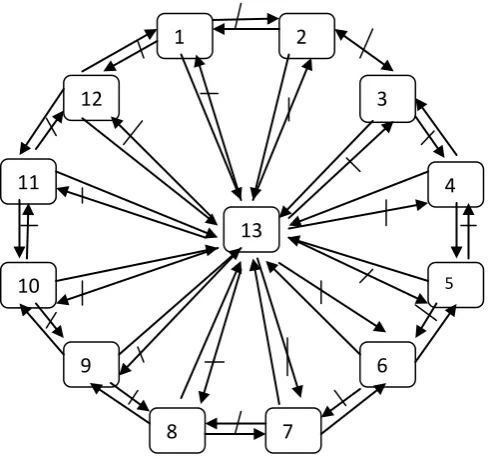
From the above examples we have the following diagram
[image:3.595.150.395.192.424.2]
Figure. 1 Relation between generalized d-closed set and other existing closed sets 1.gs closed set 2.g closed set 3.
gr closed set 4. rg closed set 5. gpr closed set 6. gp closed set 7.
g-closed set 8.
-closed set 9.semiclosed set 10.d-closed set 11.preclosed set 12.closed set 13.gd-closed set.Lemma 2.26: For a subset A of a space X the following hold a. dcl(A)=A
(sint(cl(A)
scl(int(A))b. dint(A)=A
(scl(int(A)
sint(cl(A)) c. dcl(X-A)=X-dint(A)Theorem2.27: A set A is gd-open if and only if F
dint(A) whenever F is closed and F
A.Proof: Let A be gd-open and suppose that F
A and F is closed. Then X-A is gd-closed set. Thus gdcl(X-A)
X-F . But dcl(X-A)=X-dint(A). Thus X-dint(A)
X-F. Hence F
dint(A).Conversely, let F be closed set with F
dint(A) whenever F
A. F
A(X-A)
(X-F). Also F
dint(A). Thus (X-dint(A))=dcl(X-A) X-F where (X-F) is open. Thus A is gd-open.Theorem 2.28: Let A be closed subset of (X,
). Thendcl(A)-A does not contain any non empty closed set. Proof: Let A be generalized d-closed and F be a non empty
closed set such that F
dcl(A)-A. Then F
dcl(A)
F dcl(A) and F
A
c. F
A
cF
c is open. Then dcl(A)
cF
F
(
dcl
(
A
))
c.F
dcl(A)
(
dcl
(
A
))
cF
which is a contradiction. Hence dcl(A)-A contains no non empty closed set.Theorem 2.29: Let A be a gd-closed subset of (X, ) and A
B
dcl(A), then B is gd-closed.Proof: Let A
B
dcl(A) then dcl(A)=dcl(B).Since A is gd-closed, dcl(A)
G where A
G; G is open in X. Let B
G and G is open in X, since A is gd-closed and since dcl(A)=dcl(B), dcl(B)
G. Thus B is gd-closed.1
2
3
12
11
4
10
59
6
13
Theorem 2.30: A gd-closed set A is d-closed if and only if dcl(A)-A is closed
Proof: Let A be gd-closed. If A is d-closed then dcl(A)-A=
is a closed set. Thus dcl(A)-A is closed. Conversely, let dcl(A)-A be closed. .dcl(A)-A is closed subset of itself hence dcl(A)-A contain any non empty closed subset thus dcl(A)-A =
(i.e) A=dcl(A).Hence A is d-closed.Definition 2.31: Let B
A
X, then we say B is gd-closed relative to A ifdcl
A(
B
)
U when B
U and U is open in ATheorem 2.32: Let B
A
X where A is gd-closed and open. Then B is gd-closed relative to A if and only if B isgd-closed. Proof: Let B
A
X, where A is gd-closed and open andlet B is gd-closed relative to A. Since B
A and A is gd-closed and open dcl(A)
A. Thus dcl(B)
dcl(A)
A.)
(
B
dcl
A =A
dcl(B) so dcl(B)=dcl
A(
B
)
A. If B is gd-closed relative to A and U is a open subset of X such that B
U then B=B
A
U
A where U
A is open in A. Thus B is gd-closed relative to A. dcl(B)=dcl
A(
B
)
U
A
U. Thus B is gd-closed in X. Conversely, Let B is gd-closed in X and U is open subset of A such that B
U. Let U=V
A for some open subset V of X.As B
V & B is gd-closed in X ,dcl(B)
V. Thusdcl
A(
B
)
=dcl(B)
A
V
A=U. Hence B is gd-closed relative to A.Corollary 2.33: Let A be a gd-closed set which is also open
then A
F is gd-closed whenever F is d-closed. Proof: Let A be a gd-closed and open then dcl(A)
A. ButA
dcl(A) thus A=dcl(A).Hence A
F is d-closed. Every d-closed is gd-closed. A
F is gd-closed.Remark 2.34: Intersection of two gd-closed sets need not be gd-closed.
Example 2.35: Let X={a, b, c},
={X,
,{a}}. A= {a, b} which is gd-closed set. B= {a, c} which is gd-closed set. But A
B= {a} is not gd-closed.Remark 2.36: Union of two gd-closed sets need not be gd-closed.
Example 2.37: Let X={a, b, c},
={X,
,{a}, {c}, {a, c}},A={a} which is gd-closed set. B={c} which is gd-closed set. But A
B = {a, c} is not gd-closed.3.
gd-Continuous and gd-Irresolute
Functions
Definition 3.1: A function f :(X,
)
(Y,
) is called gd-continuous if the pre image of every closed set of Y is gd-closed in X.Definition 3.2: A function f: (X,
)
(Y,
) is called gd-irresolute if the pre image of every gd-closed set of Y is gd-closed in X.Definition 3.3: A function f: (X,
)
(Y,
) be d-irresolute if the pre image of every d-open set in Y is d-open in X.Definition 3.4: A function f: (X,
)
(Y,
) is called d -continuous if the inverse image of every closed set in Y is d-closed in XTheorem 3.5: Let f:(X,
)
(Y,
) be d-continuous, then f is gd-continuous but not conversely. Proof: Let V be a open set in Y. Since f is d-continuous then)
(
1V
f
is d-open in X. But every d-open set is gd-open in X hencef
1(
V
)
is gd-open in X for VY. Thus f is gd-continuous.Example 3.6: Let X= {a, b, c},
= {X,
, {a}, {a, b}}.Y= {a, b, c},
= {{X,
, {a}, {b}, {a, b}}. Let f:(X,
) (Y,
) be identity map. f is gcontinuous but not d-continuous becausef
1(b)={b}
DO(X).Theorem 3.7: Let f: (X,
)
(Y,
) be a continuous function. If f is gd-continuous then for each point x
X and for each open set V in Y containing f(x), there exists a gd-open set U containing x such that f(U)
VThe proof follows immediately.
Theorem 3.8: If the bijective map f :(X,
)
(Y,
) is d-irresolute and open, then f is gd-irresolute.Proof: Let V be gd-closed in Y and let
f
1(
V
)
U where U is open in X. Hence V
f(U) holds. Since f(U) is open and V is sgd-closed in Y dcl(A)
f(U).Thereforef
1(dcl(V)
U and since f is d-irresolute and dcl(V) is d-closed in Y,1
f
(dcl(V) is d-closed set in X. Thus dcl(f
1(
V
)
)
dcl(f
1(dcl(V))) =f
1(dcl(V) U. Hencef
1(
V
)
is gd-closed and thus f is gd irresolute.
Remark 3.9: The concept of d-irresoluteness and gd-irresoluteness are independent.
Example 3.10: Let X= {a, b, c},
= {X,
, {a}, {a, b}}. Y= {a, b, c},
= {{X,
, {a}}. Let f:(X,
)
(Y,
) be identity map. Here f is d-irresolute but not gd-irresolute since V={c}
GDO(Y) butf
1(c)={c}
GDO(X).Example 3.11: Let X= {a, b, c},
= {X,
, {a}}. Let f:(X,
) (Y,
) be defined by f(a)=f(c)=b, f(b)=c. Here f is gd-irresolute but not d-irresolute, since V={b}
DC(X) but𝑓−1(𝑏)={a, c}D
C(X).Theorem 3.12: Let f:(X,
)
(Y,
) be a map from a topological space (X,
) into a topological space (Y,
), then the following are equivalent.a) f is gd-continuous.
The proof follows immediately from the definition.
Theorem 3.13: Let f:(X,
)
(Y,
) and g: (Y,
)(Z,
) be any two functions then1. gof: (X,
)( Z,
) is gd-continuous if g is continuous and f is gd-continuous.2. gof: (X,
)
( Z,
) is gd-irresolute if g is gd-irresolute and f is gd- irresolute.3. gof: (X,
)
( Z,
) is gd-continuous if g is gd-continuous and f is gd-irresolute.Proof:
1. Let V closed set in (Z,
).g
1(
V
)
is closed in (Y,
), since g is continuous. Thus f1(g
1(
V
)
) is gd-closed in (X,) since f is gd-continuous. Thus gof is gd-continuous.
2. Let V be gd-closed set in (Z,
), sinceg
1(
V
)
is gd-closed in (Y,
).Since f is gd-irresolute, is gd-closed in (X,
). Thus gof is gd-irresolute.3. Let V be closed set in (Z,). Thus
g
1(
V
)
is gd-closed in (Y,
).Since f is gd-irresolute1
f (
g
1(
V
)
) is gd-closed in (X,
). Thus gof is gd-continuous.Definition 3.14: A topological space X is called a
d-2 1
T space
if every gd-closed set is closed.
Definition 3.15 [13]: A topological space X is called a
2 1
T
space if every g-closed sets is closed.
Definition 3.16 [7]: A topological space is called a
T
b space if every
g-closed set is closed.Proposition 3.18: 1. Every
d-2 1
T space is a
2 1
T space
2. Every
d-2 1
T space is a
T
bspace.Example 3.18: Let X={a, b, c},
= {X,
, {a} {b},{a, b}}.Then the collection is2 1
T and
T
bbut notd-2 1
T since
A={b} is gd-closed but not closed.
Theorem 3.19: Let f:(X,
)
(Y,
) be gd-irresolute function then f is irresolute function if X isd-2 1
T space.
Proof: Let V be d-closed set in Y. Since V is gd-closed in Y and f is gd-irresolute,
f
1(
V
)
is gd-closed in x. But X is
d-2 1
T
sof
1(
V
)
is closed in X. Every closed is d-closedhence f is d-irresolute.
Theorem 3.20: Let X and Z be any topological spaces and Y be a
d-2 1
T
space then the composition1. gof: (X,
)
( Z,
) is gd-continuous if g is gd-continuous and f is gd-continuous.2. gof: (X,
)
( Z,
) is d-continuous if g is gd-continuous and f is d-continuous.3. gof: (X,
)
( Z,
) is gd-continuous if g is gd-irresolute and f is gd-continuous.4. gof: (X,
)
( Z,
) is d-continuous if g is gd-irresolute and f is d-continuous.Proof:
1. Let U be closed set in Z, then
g
1(
U
)
is gd-closed in Y. But Y is ad-2 1
T
space thusg
1(
U
)
is closedin Y. Since f is gd-continuous
f
1(g
1(
V
)
) is gd-closed in X. Thus gof is gd-continuous.2. Let U be closed set in Z, then
g
1(
U
)
is gd closed in Y. But Y is ad-2 1
T
space thusg
1(
U
)
is closedin Y. Since f is d-continuous
f
1(g1(V)) is d-closed in X. Thus gof is d-continuous.3. Let U be gd-closed set in Z, then 1
(
)
U
g
is gclosed in Y. But Y is ad-2 1
T
space thus)
(
1U
g
is closed in Y.Since f is gd-continuous1
f
(g1(V)) is closed in X. Thus gof isgd-continuous.
4. Let U be gd-closed in Z, then
g
1(
U
)
is gd-closed in Y. But Y is ad-2 1
T
space thusg
1(
U
)
is closedin Y. Since f is d-continuous
f
1(g1(V)) isd-closed in X. Thus gof is d-continuous in X.
3. CONCLUSION
4. REFERENCES
[1] D.Andrijevic, “Semi-preopen sets”, Mat.
Vesnik,38(1) (1986) 24-32.
[2] D.Andrijevic, “On b-open sets”, Mat Vesnik 48(1996), no 1-2, 59-64.
[3] S.P. Arya and T.M. Nour, “Characterizations of
S-normal spaces”, Indian J. Pure. Appl.
Math.21(1990).no.8, 717-719.
[4] M.E.Abd.El-Monsef, S.N El-Deeb and R.A
Mohmoud,’-open sets and -continuous mapping”, Bull. Fac.Sci.Assuit Univ.12(1983),77-90.
[5] P.Bhattacharyya and B.K.Lahiri,”Semigeneralized closed sets in topology”, Indian [4].J.Math. 29(1987)no.3, 375-382(1988)
[6] M.C.Cueva, “On g-closed sets and g-continuous mappings:,Kyungpook Math.J.vol3,2(1993), 205-209.
[7] R.Devi, K.Balachandran and I.Maki, Generalized
-closed maps and -generalized closed maps. Indian J.Pure.Appl.Math.,29(1)(1998),37-49. [8] J.Dontchev, “On generalizing semi-preopen sets”,
Mem. Fac. Sci. Kochi. Univ. Ser. A. Math. 16(1995), 35-48.
[9] Gnanambal. Y[1997] On generalized pre-regular closed sets in topological spaces. India.J.pure Appl. Math.28(3):351-360.
[10] Jude Immaculate. H and I.Arockiarani,” A note on d-locally closed sets”, International Journal of Mathematical Archive (2014)(Feb)(Accepted ). [11] N. Levine, “Semi-open sets and semi-continuity in
topological spaces”, Amer. Math. Monthly 70(1963), 36-41
[12] N. Levine, ”Generalized closed set in topology”, Rend. Circ. Math. Palermo, 19(2), (1970), 489-96. [13] H.Maki, R. Devi and K. Balachandran,, ”Associated
topologies of generalized -closed sets and
-generalized closed set”,Mem. Fac. Sci. Kochi. Univ. Ser. A. Math 15(1994), 51-63.
[14] H.Maki, J. Umerhara and T. Noiri, “Every topological space is pre𝑇1
2”,Mem.Fac. Sci.
Kochi.Univ. Ser. A. Math 17(1996)33-42.
[15] A.S. Mashhour, Abd El-Monsef, M.E. and S.N.El-Deeb, ”On precontinuous and weak precontinuous functions”, Proc. Math. Phys. Soc. Egypt 51(1982), 47-53.
[16] T.Noiri, A.Al-Omari and M.S. M. Noorani, “Weakly b-open functions”, Mathematica Belkanica 23(2009),Fasc(1-2)1-14
[17] O.Njastad,” On some classes of nearly open sets”, Pacific J.Math 15(1965)961-970.
[18] Palaniappan.N and K.C.Rao(1993) Regular
generalized closed sets. Kyungpook Math. J 33:211- 219.