Combination of Features for Multilingual Speaker
Identification with the Constraint of Limited Data
Nagaraja B.G.
Department of Information Science & Engineering Siddaganga Institute of Technology
Tumkur-572103, Karnataka, India
H.S. Jayanna
Department of Information Science & Engineering Siddaganga Institute of Technology
Tumkur-572103, Karnataka, India
ABSTRACT
In the modern day digital automated world, speaker identification system plays a very important role in the field of fast growing in-ternet based communications/transactions. In this paper, speaker identification in the context of mono, cross and multilingual are demonstrated using the two different feature extraction techniques, i.e., Mel-Frequency Cepstral Coefficients (MFCC) and Linear Pre-dictive Cepstral Coefficients (LPCC) with the constraint of limited data. The languages considered for the study are English (interna-tional language), Hindi (na(interna-tional language) and Kannada (regional language). Since the standard multilingual database is not avail-able, experiments are carried out on our own created database of 30 speakers in the college laboratory environment who can speak the three different languages. In case of limited data condition, ow-ing to less data the existow-ing techniques in each stage may not pro-vide good performance. To alleviate the problem of limited data, the vocal tract feature extracted from MFCC and LPCC techniques are combined. As a result the combination of features gives nearly 30% higher performance compared to the individual features for a set of 30 speakers.
Keywords:
Speaker identification, monolingual, crosslingual, multilingual, MFCC, LPCC, VQ
1. INTRODUCTION
Speaker identification is defined as a task of recognizing speak-ers from their speech [1]. Depending on the mode of opera-tion, speaker identification can be classified as text-dependent identification and independent identification [2]. The text-dependent identification requires the speaker to produce speech for the same text, both during training and testing whereas the text-independent identification does not rely on a specific text be-ing spoken [3]. Text-independent speaker identification systems are more versatile, but their accuracy is considerably lower than that of text-dependent systems [4]. To achieve acceptable results in this case, more speech data is usually necessary for both train-ing and testtrain-ing purposes [4]. Speaker recognition in limited data condition aims at recognizing speaker with the constraint that both training and testing data are limited [5].
In India, more than 50 languages are officially recognized by the Govt. of India and the Indian citizens can speak more than one language fluently. Therefore, the development of multilin-gual speaker Identification system is a challenging task. Crimi-nals often switch over to another language, especially after com-mitting a crime. So, training a person’s voice in one language and identifying him in some other language or in a multilingual
environment is of interesting task especially in the Indian context [6]. As we mentioned earlier, in India people have been trained themselves to speak in many languages, for example, when a per-son from West Bengal comes and settles in Karnataka, he will be knowing English, Hindi, Bengali and Kannada. This advan-tage can be utilized in machine learning to build a robust speaker recognition system. However, nowadays we cannot ask people to give data for a long period of time as the sufficient speaker recognition system expects. Further, due to increase in the use of communication and internet services for speech mode appli-cations, it is desirable to work with limited data. Speaker recog-nition under limited conditions could be used in the following applications [6] [7] :
. Access control and transaction authentication - voice dialing, banking transactions through telephone network, teleshopping, database access service, reservation systems, voice mail, law en-forcement, activity area restriction.
. Criminal investigation and security access control, in forensic application also the data available may be limited which may be recorded during casual conversation or by tapping the telephone channel.
. To locate the segment of given speaker in an audio stream such as teleconference or meetings. Such data segments usually con-tain short utterances whose speaker needs to be identified. . Remote biometric person authentication for electronic transac-tions where speech is the most preferred biometric feature.
The main parameter of the speech recognition system is the speech or the voice data of the speaker. Characteristics in the speech signal can be attributed to the dimensions of the vocal tract system, pitch, sound decibel level, characteristics of excita-tion and the learning habits of the speakers [8]. The most effec-tive features for speaker recognition have been the MFCC and LPCC. These features can accurately characterize the vocal tract configuration of a speaker and can achieve good performance [8]. Combination of different features has been proved to be a good method for improving performance in speaker recognition [9].
Text-dependent multilingual speaker identification for Indian languages using artificial neural networks was carried out by Rajesh Ranjan and his group in [12]. In this work attempt has been made to develop speaker identification system which is used to determine the identity of an unknown speaker among several speakers of known speech characteristics, from a sam-ple of his or her voice. A novel multilingual text independent based speaker identification algorithm was proposed by Geof-frey Duron in [13]. In his paper, he investigated two facets of speaker recognition: cross-language speaker identification and the same language non-native text independent speaker identifi-cation. His results indicated that how speaker identification per-formance would be affected when speakers do not use the same language during the training and testing or when the population is composed of native speakers.
Prateeket al.[14] developed a novel algorithm for multilingual speaker recognition using neural networks with the back prop-agation concepts. They simulated a model of ANN based mul-tilingual speaker recognition system for eight Indian languages (Hindi, English, Assami, Telugu, Punjabi, Rajasthani, Marathi and Bengali) and achieved a success rate of 95%. Bipul Pandey et al.[4] proposed a multilingual speaker recognition scheme using adaptive neuro fuzzy inference scheme (ANFIS) for the identification of the speaker and the words spoken. A robust and sufficiently efficient recognition system was tried by them using the features obtained from several sources including the textual and image sources, which produced excellent results. The exper-imental results show the system to be amply efficient and suc-cessful in the recognition of the tasks that are involved.
Zhi-Yi Liet al.[9] proposed an effective multi-feature combina-tion in speaker recognicombina-tion. In their experiments, they used the popular short-term spectral MFCC and spectro-temporal time frequency cepstrum (TFC) to do feature combination followed by Linear discriminant analysis (LDA) and feature-domain la-tent factor analysis (FDLFA) for channel compensation respec-tively. The experimental results were carried out on the NIST SRE 2008 short2 telephone-short3 telephone test. Danoush Hos-seinzadeh and Sridhar Krishnan [15] combined the Vocal Source and MFCC features for enhanced speaker recognition perfor-mance using GMM’s. In their work, the 7 spectral features were extracted from the speech spectrum and used to enhance the per-formance of MFCC-based features. Experiments were carried out on a TIMIT database using text-independent cohort Gaus-sian mixture model (GMM) speaker Identification system.
Martine Adda Decker discussed the multilingual inter-operability concepts in automatic speech recognition and showed that a large number of languages can be considered in auto-matic speaker identification [16]. Olli Viikkiet al.investigated the technical challenges that are faced when making a transi-tion from the speaker-dependent to speaker independent speech recognition technology in mobile communication devices. Due to globalization as well as the international nature of the markets and the future applications, speaker independence implies the de-velopment and use of language independent automatic speaker recognition to avoid logistic difficulties. Hence, they proposed architecture for embedded multilingual speech recognition sys-tems [17].
Rama Murty and Yegnanarayana [8] combined the evidences from the residual phase and MFCC methods used for speaker recognition and obtained very good results. In their work, the complementary nature of speaker-specific information present in the residual phase in comparison with the information present in the MFCCs was presented.
An attempt was made to recognize multilingual speaker in [7]. In this work, training data of 60 seconds and for different test-ing data of 1, 3, 7, 10 and 15 seconds are considered for mono
and crosslingual experiments. Also, a polynomial classifier of 2ndorder approximation was built for speaker modeling. Re-cently, some attempts have been made to identify the speak-ers under limited data condition using the concept of Univer-sal Background Model (UBM) to mitigate the sparseness, which requires additional speech data to train the Gaussian mixture model-Universal Background Model (GMM-UBM) [2].
In our previous work [18], an attempt was made to identify speaker in the context of mono and crosslingual speaker identifi-cation with the constraint of limited data using MFCC as feature vectors and Vector Quantization (VQ) as modeling technique [18]. We observed that speaker identification system with En-glish language provides good performance in monolingual study. Further, it was observed in crosslingual study that the use of En-glish language either in training or testing gives better identifi-cation performance. In this paper, the significance of two feature extraction techniques MFCC and LPCC are demonstrated in the context of mono, cross and multilingual speaker identification with the constraint of limited data.
State-of-the-art speaker recognition uses more than one minutes of speech data. In the present work, sufficient data is used to symbolize the case of having speech data of few minutes (≥one minute). Alternatively, limited data symbolizes the case of hav-ing speech data of few seconds (≤15 seconds) [18] [19]. Since the amount of data is small in limited data condition, any one feature extraction technique may not provide enough features for modeling and testing [5]. In this work, first, features are extracted using MFCC and LPCC and then these features are combined. The modeling technique used was Vector Quantization (VQ). Fi-nally, the speaker models are tested against the testing data of respective extraction techniques. The general block diagram of the proposed speaker identification system is shown in Fig. 1.
The paper is organized as follows: Section 2 describes the database used for the experiments. Feature extraction of the recorded speech using MFCC and LPCC methods and model-ing usmodel-ing VQ techniques along with the proposed method of the combined combination (MFCC + LPCC) presented in Section 3. In Section 4, monolingual speaker identification is presented. The crosslingual speaker identification is presented in Section 5. In Section 6, multilingual speaker identification scheme is pre-sented. Section 7 gives summary of the present work and scope for the future work.
Training Data
Testing Data
Feature extraction using MFCC
Feature extraction using LPCC
Feature extraction using MFCC
Feature extraction using LPCC
Combining the features
Generate the model
using VQ
Testing with MFCC only
Testing with LPCC only
De
c
ision
Log
ic
Pe
rce
nta
g
e
identific
a
[image:2.595.313.560.551.660.2]tion
Fig. 1: Block diagram of the proposed method.
2. DATABASE FOR THE STUDY
The speakers were asked to read small stories in three different languages. The training and testing data were recorded in differ-ent sessions with a minimum gap of two days. The approximate training and testing data length is two minutes. Recording was done using free downloadable wave surfer 1.8.8p3 software and Beetel Head phone-250 with a frequency range 20-20 kHz. The speech files are stored in.wav format.
3. FEATURE EXTRACTION AND MODELING
Feature extraction is the most important part of speaker recog-nition. The purpose of feature extraction stage is to extract the speaker-specific information in the form of feature vectors at re-duced data rate [2]. MFCC and LPCC based features have proven to be effective for Speaker recognition [8]. In this work, features are extracted using MFCC and LPCC techniques. Speech record-ings were sampled at the rate of 8 kHz. Frame duration of 20 msec and a 10 msec for overlapping durations are considered. After framing, windowing (Hamming) method is carried out to minimize the spectral distortion. Fourier Transform (FFT) is then applied on the windowed frame signal to obtain the magnitude frequency response. The resulting spectrum is passed through a set of triangular band pass filters. We have considered 35 filters. In order to get the cepstral coefficients, Discrete cosine transform (DCT) is applied to the output of the mel filters. In this work, first 13 coefficients are considered as feature vectors. Since the0th coefficient can be regarded as a collection of average energies of each frequency bands, it is unreliable [20].
The LPCC can be easily obtained by Durbin’s recursive proce-dure without computing the Discrete fourier transform (DFT) and the inverse DFT (IDFT), which are computationally com-plex and time consuming processes [21]. The vocal tract system is characterized by maximum of five resonances in the 0-4 kHz range, therefore, an LP order in the range 8-14 seems to be suit-able for a speech signal sampled at 8 kHz [22]. The number of peaks of an all-pole system is determined by order of the LP analysis. In this study, speech is pre-emphasized (factor 0.97) to eliminate the radiation effect at the lips and then hamming windowed. 10 auto-correlation prediction coefficients were com-puted using the popular Levinson-Durbin algorithm and trans-formed into 13 cepstral coefficients.
VQ is a process of mapping vectors from large vector space to finite number of regions in the space. Most of the computa-tion time in VQ-based speaker identificacomputa-tion consists of distance computations between the unknown speaker’s feature vectors and the models of the speakers enrolled in the system database [23]. In this work, the Linde-Buzo-Gray (LBG)-VQ technique is used with a splitting parameter (ε) of 0.05. The initial codebook is obtained by the splitting method and an initial code vector is set as the mean of the entire training data. This code vector is then split into two and the algorithm runs with these two code-books. Later, these two code-books are split into four code-books and the iterative algorithm is repeated until the desired code-book size is achieved. We have generated different codecode-books of sizes 64, 128 and 256.
The following steps are used in speaker identification process:
a) Choose the training data. b) Extract the features using MFCC c) Extract the features using LPCC d) Combine MFCC and LPCC features e) Generate the speaker model using VQ f) Choose the testing data
[image:3.595.315.501.126.215.2]g) Extract the features using MFCC separately h) Extract the features using LPCC separately i) Compare test features with speaker model j) Use the Decision logic to find out the winner.
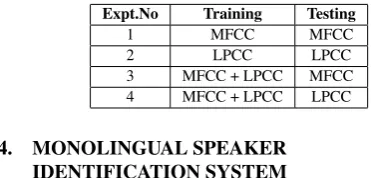
Table 1. : Different feature extraction techniques used for training and testing.
Expt.No Training Testing
1 MFCC MFCC
2 LPCC LPCC
3 MFCC + LPCC MFCC
4 MFCC + LPCC LPCC
4. MONOLINGUAL SPEAKER
IDENTIFICATION SYSTEM
In monolingual speaker identification, training and testing lan-guages are the same for a speaker [6] [18]. Since the data is col-lected in 3 different languages to study the robustness of the sys-tem, the experiments are conducted in three cases with the data of 15 seconds for training and testing. Each case includes four different experiments shown in Table 1.
Note that A/B indicates training with language A and testing with language B, for e.g., E/K indicates training with English language and testing with Kannada language. 3 cases, i.e.,
Case 1 : Training and testing with English language Case 2 : Training and testing with Hindi language Case 3 : Training and testing with Kannada language.
Case 1 : The results in Fig. 2(a) show that the speaker identifi-cation system yields good performance of 100% for codebook sizes of 128 and 256 when trained and tested with English lan-guage using MFCC+LPCC–VQ–LPCC method.
Case 2 : The results in Fig. 2(b) show that the speaker identifi-cation system yields good performance of 96.66 % for codebook sizes of 128 and 256 when trained and tested with Hindi lan-guage using MFCC+LPCC–VQ–LPCC method.
Case 3 : The results in Fig. 2(c) show that the speaker identifi-cation system yields good performance of 96.66% for codebook sizes of 128 and 256 when trained and tested with Kannada lan-guage using MFCC+LPCC–VQ–LPCC method.
5. CROSSLINGUAL SPEAKER
IDENTIFICATION SYSTEM
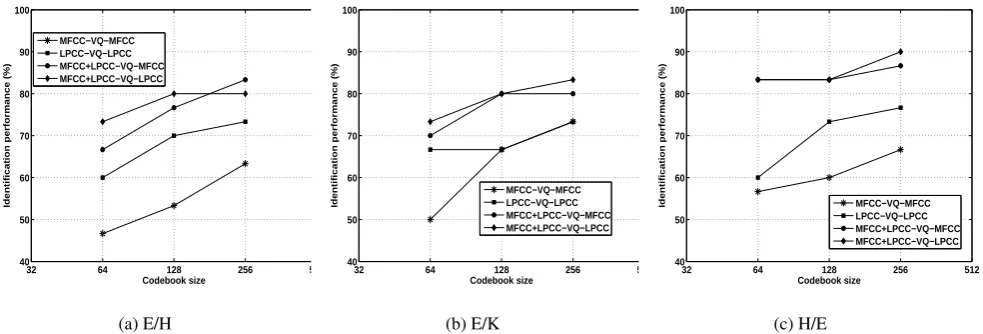
In crosslingual speaker identification (A/B), training is done in one language (say A) and testing is done in another language (say B) [6] [18]. Six different cases are considered in this context, i.e., E/H, E/K, H/E, H/K, K/E and K/H.
Case 1 (E/H) : The results in Fig. 3(a) show that the speaker iden-tification system yields good performance of 83.33% for code-book size of 256 when training is done in English language and testing is done in Hindi language using the MFCC+LPCC–VQ– MFCC method.
Case 2 (E/K) : The results in Fig. 3(b) show that the speaker iden-tification system yields good performance of 83.33% for code-book size of 256 when training is done in English language and testing is done in Kannada language using the MFCC+LPCC– VQ–LPCC method.
Case 3 (H/E) : The results in Fig. 3(c) show that the speaker identification system yields good performance of 90% for code-book size of 256 when training is done in Hindi language and testing is done in English language using MFCC+LPCC–VQ– LPCC method.
32 64 128 256 512 40
50 60 70 80 90 100
Codebook size
Identification performance (%)
MFCC−VQ−MFCC LPCC−VQ−LPCC MFCC+LPCC−VQ−MFCC MFCC+LPCC−VQ−LPCC
(a) E/E
32 64 128 256 512
40 50 60 70 80 90 100
Codebook size
Identification performance (%)
MFCC−VQ−MFCC LPCC−VQ−LPCC MFCC+LPCC−VQ−MFCC MFCC+LPCC−VQ−LPCC
(b) H/H
32 64 128 256 512
40 50 60 70 80 90 100
Codebook size
Identification performance (%)
MFCC−VQ−MFCC LPCC−VQ−LPCC MFCC+LPCC−VQ−MFCC MFCC+LPCC−VQ−LPCC
[image:4.595.64.553.105.269.2](c) K/K
Fig. 2: Performance of monolingual speaker identification.
32 64 128 256 512
40 50 60 70 80 90 100
Codebook size
Identification performance (%)
MFCC−VQ−MFCC LPCC−VQ−LPCC MFCC+LPCC−VQ−MFCC MFCC+LPCC−VQ−LPCC
(a) E/H
32 64 128 256 512
40 50 60 70 80 90 100
Codebook size
Identification performance (%)
MFCC−VQ−MFCC LPCC−VQ−LPCC MFCC+LPCC−VQ−MFCC MFCC+LPCC−VQ−LPCC
(b) E/K
32 64 128 256 512
40 50 60 70 80 90 100
Codebook size
Identification performance (%) MFCC−VQ−MFCC LPCC−VQ−LPCC MFCC+LPCC−VQ−MFCC MFCC+LPCC−VQ−LPCC
(c) H/E
Fig. 3: Performance of crosslingual speaker identification.
testing is done in Kannada language using the MFCC+LPCC– VQ–MFCC method.
Case 5 (K/E) : The results in Fig. 4(b) show that the speaker iden-tification system yields good performance of 90% for codebook size of 256 when training is done in Kannada language and test-ing is done in English language ustest-ing the MFCC+LPCC–VQ– MFCC method.
Case 6 (K/H) : The results in Fig. 4(c) show that the speaker iden-tification system yields good performance of 90% for codebook size of 256 when training is done in Kannada language and test-ing is done in Hindi language ustest-ing the (MFCC+LPCC)–VQ– LPCC and (MFCC+LPCC)–VQ–MFCC methods.
6. MULTILINGUAL SPEAKER
IDENTIFICATION SYSTEM
In multilingual speaker identification, some speakers in database are trained and tested in language A, some speakers are in lan-guage B and so on [6]. Arrangement of database for multilingual experiments is shown in Fig. 5. The speakers and languages are taken in random and there is no hard and fast rules for this ar-rangement.
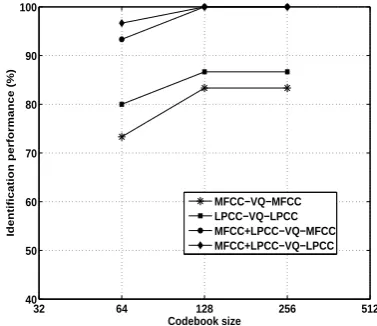
The results in the Fig. 6 show that the multilingual speaker identification system yields good performance of 100% for codebook sizes of 128 and 256 using the MFCC+LPCC–VQ–
LPCC and MFCC+LPCC–VQ–MFCC methods. The combined (MFCC and LPCC) system identifies more number of speakers compared to all indi- vidual techniques and hence improvement in the performance. The improvement in performance is due to the different information provided by each feature.
The combined (MFCC and LPCC) system identifies some of the speakers which are not identified by MFCC and LPCC alone. For e.g., if the speaker 17 shown in the Table 2 is taken, speaker is not identified using MFCC or LPCC alone but is identified using the combined method. Note that if MFCC method is used, only 18 speakers could be identified, if LPCC method is used, then 20 speakers could be identified, but if the combined method is used, then 22 speakers could be identified.
Some of the observations can be made from the results are as follows:
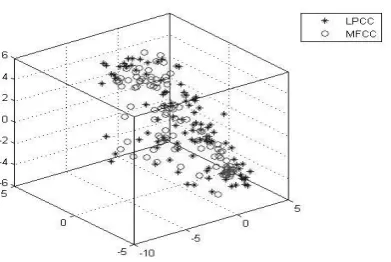
(i) The proposed combination of features perform better in all the speaker identification experiments. This may be due to, different information provided by the MFCC and LPCC features (Fig. 7).
(ii) In comparison with the MFCC features, LPCC features per-form better. This may be due to, LP-based features (LPCC) tract physiological characteristics of the vocal tract properties more effectively than the filter bank-based features [6].
[image:4.595.62.554.311.478.2]drasti-32 64 128 256 512 40
50 60 70 80 90 100
Codebook size
Identification performance (%)
MFCC−VQ−MFCC LPCC−VQ−LPCC MFCC+LPCC−VQ−MFCC MFCC+LPCC−VQ−LPCC
(a) H/K
32 64 128 256 512
40 50 60 70 80 90 100
Codebook size
Identification performance (%)
MFCC−VQ−MFCC LPCC−VQ−LPCC MFCC+LPCC−VQ−MFCC MFCC+LPCC−VQ−LPCC
(b) K/E
32 64 128 256 512
40 50 60 70 80 90 100
Codebook size
Identification performance (%)
MFCC−VQ−MFCC LPCC−VQ−LPCC MFCC+LPCC−VQ−MFCC MFCC+LPCC−VQ−LPCC
[image:5.595.65.553.105.273.2](c) K/H
Fig. 4: Performance of crosslingual speaker identification.
Table 2. : Number of speakers identified by the MFCC-VQ-MFCC, LPCC-VQ-LPCC and MFCC+LPCC-VQ-LPCC systems for 30 speakers (√identified ; x not identified).
Speakers 1 2 3 4 5 6 7 8 9 10 11 12 13 14 15 16 17 18 19 20 21 22 23 24 25 26 27 28 29 30 No MFCC √ √ X X X X X √ √ √ √ X X X X √ X √ √ √ X √ √ √ √ √ √ X √ √ 18
LPCC √ √ √ √ X X X √ √ √ √ √ √ X X √ X √ √ X X √ √ √ √ √ √ X √ X 20
[image:5.595.81.233.385.609.2]Combined √ √ √ √ X X √ √ √ √ √ X √ X X √ √ √ √ X X √ √ √ √ √ √ X √ √ 22
Fig. 5: Multilingual Speaker Identification System Setup.
cally. This may be due to the variation in fluency and word stress when same speaker speaks different languages and also due to different phonetic and prosodic patterns of the languages [13].
(iv) The multilingual results are better than the crosslingual speaker identification experiments. This may be due to the better discrimination between the trained models and testing features (multiple languages) in multilingual scenario.
7. CONCLUSIONS
This work presented the task of mono, cross and multilingual speaker identification with the constraint of limited data con-dition using the combination of MFCC and LPCC features. 3
32 64 128 256 512
40 50 60 70 80 90 100
Codebook size
Identification performance (%)
[image:5.595.330.519.407.570.2]MFCC−VQ−MFCC LPCC−VQ−LPCC MFCC+LPCC−VQ−MFCC MFCC+LPCC−VQ−LPCC
Fig. 6: Performance of multilingual speaker identification system.
dimensional view confirm that the two feature extraction tech-niques namely MFCC and LPCC extract different information from the speech signal and hence can be fused so as to obtain a more robust speaker recognition system. The proposed combi-nation of features perform better in all the speaker identification experiments. The results indicate that combination of features (MFCC+LPCC) can be used for improving the speaker identifi-cation performance in multilingual with the constraint of limited data. In order to study the robustness of the system needs to be verified with different languages (more than 3), different data sizes and more number of speakers.
8. ACKNOWLEDGMENT
Fig. 7: The first 100 Features of a speaker for 15 secs speech data using MFCC and LPCC techniques in 3-Dimensional view.
9. REFERENCES
[1] B. S. Atal, “Automatic recognition of speakers from their voices,” Proc. IEEE, vol. 64(4), pp. 460475, Apr. 1976. [2] H. S. Jayanna and S. R. Mahadeva Prasanna, “Analysis,
Feature extraction, modeling and Testing techniques for Speaker Recognition,” IETE Technical Review, vol. 26, pp. 181190, 2009.
[3] J. P. Campbell, Jr.,“Speaker recognition: A tutorial,” Proc. IEEE, vol. 85(9), pp. 14371462, Sep. 1997.
[4] Bipul Pandey, Alok ranjan, Rajeev Kumar and Anupam Shukla, “Multilingual Speaker Recognition Using AN-FIS,” in Proc. IEEE Int. Conf. Signal Processing Systems (ICSPS), (Dalian), pp. 714718, 2010.
[5] H. S. Jayanna, Limited data speaker recognition. PhD the-sis, Indian Institute of Technology Guwahati, Dept. of Electronics and Communication Engg., Guwahati, India, Nov. 2009.
[6] P. H. Arjun, Speaker recognition in Indian languages: A feature based approach. PhD thesis, Indian Institute of Technology Kharagpur, Dept. of Electrical Engg., Kharagpur, India, Jul. 2005.
[7] Hemant A Patil, Sunayana Sitaram and Esha Sharma, “DA-IICT Crosslingual and Multilingual Corpora for Speaker Recognition,” Proc. IEEE, Advances in Pattern Recognition, (Kolkata), pp. 187190, 2009.
[8] Rama Murty and Yegnanarayana, “Combining Evidence from residual phase and MFCC features for Speaker Recognmition,” IEEE Signal Processing Letters., vol. 13(1), pp. 5255, Jan. 2006.
[9] Zhi-Yi LI, Liang HE,Wei-Qiang ZHANG and Jia LIU, “Multi-Feature Combination for Speaker Recognition,” Proc. IEEE, Chinese Spoken Language processing, (Tainan), pp. 318321, Dec. 2010.
[10] Xia Wang, Yang Cao, Feng Ding and Yuezhong Tang, “An embedded Multilingual speech recognition system
for Mandarin, Cantonese, and English,” Proc. IEEE, Chi-nese Spoken Language processing, (Beijing, China), pp. 758764, Oct. 2003.
[11] Ulrike Halsband, “Bilingual and multilingual language processing,” Elseviers Journal of Physiology, (Paris), pp. 355369, 2006.
[12] Rajesh Ranjan, Sanjay Kumar Singh, Anupam Shukla and Ritu Tiwari, “Text-Dependent Multilingual Speaker Identification for Indian Languages using Artificial Neu-ral Network,” Proc. Third International Conference on Emerging Trends in Engg. and Tech., (Goa), pp. 632 635, 2010.
[13] Geoffrey Durou, “Multilingual text-independent speaker identification,” Proc. MIST99 Workshop, (Leusden, Netherlands), pp. 115118, 1999.
[14] Prateek Agrawal, Anupam Shukla and Ritu Tiwari, “Mul-tilingual speaker recognition using Artificial Neural net-work,” Advances in Intelligent and Soft Computing, vol. 116, pp. 19, 2009.
[15] Danoush Hosseinzadeh and Sridhar Krishnan, “Combin-ing Vocal Source and MFCC Features for Enhanced Speaker Recognition Performance Using GMMs,” Proc. IEEE, MMSP-2007, (Crete), pp. 365368, Oct. 2007. [16] Martine Adda Decker, “Towards the Multilingual
inter-operability concepts in automatic speech recognition,” El-seviers Speech communications, vol. 35, pp. 520, 2001. [17] Olli Viikki, Imre Kiss and Jilei Tian, “speaker- and
lan-guageindependent speech recognition in Mobile commu-nication systems,” Proc. IEEE, ICASSP01, vol. 1, (Salt Lake City, UT), pp. 58, 2001.
[18] Nagaraja B. G. and H. S. Jayanna, “Mono and Cross Lin-gual Speaker Identification with the constraint of Limited data,” Proc. IEEE, PRIME-2012, (Salem), pp. 439443, 2012.
[19] H. S. Jayanna and S. R. M. Prasanna, “Variable segmen-tal analysis based speaker recognition in limited data con-ditions,” IEEE-Int. Conf. Signal, Image Process., vol. 2, (Karnataka, India), Dec. 2006.
[20] Picone J.W., “Signal modeling techniques in speech recognition,” Proc. IEEE, vol. 81(9), pp. 12151247, 1993. [21] A comparison of speech recognition ability between LPCC and MFCC. Proc. of the National Systems Con-ference, NSC 95-2221-E-451-014.
[22] S. R. M. Prasanna, C. S. Gupta and B. Yegnanarayana, “Extraction of speaker-specific excitation information from linear prediction residual of speech,” Speech Com-munication, vol. 48, pp. 12431261, 2006.