Implementing computer aided design in small businesses
CLEGG, David Edward
Available from Sheffield Hallam University Research Archive (SHURA) at:
http://shura.shu.ac.uk/19477/
This document is the author deposited version. You are advised to consult the publisher's version if you wish to cite from it.
Published version
CLEGG, David Edward (1992). Implementing computer aided design in small businesses. Doctoral, Sheffield Hallam University (United Kingdom)..
Copyright and re-use policy
2.1 D ec
I
(o
S'n
S -
0 £ S '- ^
Sheffield Hallam University
ProQuest N um ber: 10694359
All rights reserved
INFORMATION TO ALL USERS
The qu ality of this repro d u ctio n is d e p e n d e n t upon the q u ality of the copy subm itted.
In the unlikely e v e n t that the a u th o r did not send a c o m p le te m anuscript and there are missing pages, these will be note d . Also, if m aterial had to be rem oved,
a n o te will in d ica te the deletion.
uest
ProQuest 10694359
Published by ProQuest LLC(2017). C op yrig ht of the Dissertation is held by the Author.
All rights reserved.
This work is protected against unauthorized copying under Title 17, United States C o d e M icroform Edition © ProQuest LLC.
ProQuest LLC.
789 East Eisenhower Parkway P.O. Box 1346
IM PLEM ENTING COMPUTER AIDED DESIGN
IN
SMALL BUSINESSES
by
David Edward Clegg
A thesis subm itted to the Council for N ational Academic Awards in p artia l
fulfilm ent of the requirem ents for the degree of Doctor of Philosophy.
Sponsoring Establishm ent Sheffield Business School
Sheffield City Polytechnic
ABSTRACT
The lack of real and speedy success in the im plem entation of Com puter Aided Design (CAD) in small firms has been a cause for concern for the author for some years. W hilst much has been written about the im plem entation of M anagem ent Inform ation Systems and about Advanced Manufacturing Technology in large firms, the literature on small firms is very sparse, and the im plem enter has nowhere to go for guidance.
This research looks at the im plem entation of CAD in six small firms against the background of the current literature in associated areas. It focusses on the aspects of im plem entation most commonly featured in the im plem entation texts, developing some 32 Propositions on the basis of the six cases.
A review of the propositions suggests a parallel between their sequence and what may be regarded as a "traditional" business plan, which addresses the questions:
- w here are we now? '
- w here do we want to go? - how do we plan to get there? - what steps must we take?
- how will we know when we get there?
T he link betw een the propositions and the structure is strong, and the consequence is clear. If the propositions indicate a structure, then a structure developed specifically to incorporate the propositions should result in a methodology for implem entation.
T he framework for this methodology is developed, based upon five phases or stages:
- strategy
- company audit - design
- action - review
T he framework has been tested and amended, and the inputs to the phases have b een identified. Sources for these inputs have also been specified w here necessary.
T he framework provides a significant step forward in the understanding of Com puter A ided Design im plem entation in small firms. In particular:
- it is constructed using "hard" data
- it provides guidance on a "best" way of im plem enting - it forms the basis of an implem entation "toolkit"
ACKNOWLEDGEMENTS
A docum ent such as this is rarely if ever the result of the efforts of a single person,
and grateful acknowledgements m ust go to the following people and organisations.
To T E K M anagem ent Consultants Limited, my employer. Firstly for their kind
perm ission to use data collected in the course of the work done by m e under their
auspices. Secondly for their sponsorship and for freely providing typing and other
facilities. - ^
To the six unnam ed companies who allowed their cases to be used and who provided
unstinting help in the preparation of those cases.
To D r. H S (John) Gill for his advice throughout and for his forbearance,
understanding and support when things w ere tough.
To Professor David Tranfield for his invaluable guidance, for being a source of sound
advice and for providing inspiration.
To my three colleagues referred to in the text as A H , SM and PC who, although
CONTENTS
1.0 INTRODUCTION
2.0 IMPLEMENTATION OF TECHNOLOGY - THE CURRENT LITERATURE
2.1 System Justification ' 7
2.2 System Integration 19
2.3 O rganisation and M anagem ent Changes 23
2.4 The System Champion 30
2.5 M easuring Implem entation Effectiveness 33 2.6 Significant Problem Areas 41 2.7 System vs Implementation Success 51
2.8 Summary 54
2.9 Research Focus 59
RESEARCH METHODOLOGY 63
3.1 Induction vs Deduction 65 3.2 Definition and Description of
Case Studies 70
3.3 Theory Building 73
3.4 Methodological Approach 74
3.5 Methodological Process 79
3.6 Case Selection and Validity 86 3.7 Case Analysis and Evaluation 91
CASE STUDIES 93
OUTCOMES AND PROPOSITIONS 148
5.1 Case Study Outcomes 148
5.1.1 Level of Integration 148 5.1.2 Computer Knowledge Base 154 5.1.3 Expectations of the System 156 5.1.4 Prior Justification 163 5.1.5 M anagement and Organisation 169 5.1.6 Management "Ownership" ‘ 188 5.1.7 Commitment to the System 207 5.1.8 Level of Satisfaction 218 5.1.9 Implementation Planning 222 5.1.10 Vendor Relationships and Training 226
5.2 Propositions 231
DEVELOPMENT OF A FRAMEWORK FO R *
A METHODOLOGY 251
6.1 Initial Framework 252
6.1.1 Phase 1: Strategy 255 6.1.2 Phase 2: Company Audit 257
6.1.3 Phase 3: Design 260
6.1.4 Phase 4: Action 264
6.1.5 Phase 5: Review 267
6.2 Prim ary Validation 273
6.3 Amended Framework 284
6.4 Source M aterial for the Model 287
6.4.1 Strategy 287
6.4.2 Company Audit 290
6.4.3 Design 295
6.4.4 Action 299
6.4.5 Review 302
6.4.6 O ther Inputs 305
6.5 Conclusions 307
APPENDICES
PAGES
APPENDIX 1 INTERVIEW SCHEDULE 27
APPENDIX 2 SATISFACTION CURVES 1
1.0 INTRODUCTION
The A uthor is a D irector of a managem ent consultancy company
based in the North of England and providing a wide range of
services to manufacturing companies predominantly throughout the
UK. Operationally, the A uthor is responsible for two Divisions of
the Company. O ne of these, the Technology Division, has a high
profile in the field of Computer Aided Design (CAD).
A typical project for a company would involve a num ber of days on
site, learning about the products, their design param eters, the types
of design and draughting work normally carried out, the organisation
of the drawing office and its relationships with other departm ents.
In particular, the relationships between design, manufacturing and
planning departm ents would normally be of interest, since CAD is
often seen as a bridge between these departm ents.
Over the years the A uthor has becom e aware of a num ber of
In particular, he has been concerned at the low level of systems
integration tackled and achieved by these companies, as some of the
texts discussed later seek to dem onstrate that higher levels of
integration lead to greater benefits.
As a consultant, the A uthor’s role usually ceases once the system has
been specified, benchm ark dem onstrations have b een com pleted and
quotations have been obtained.
Feedback on success or failure is therefore not often available.
Indeed, when following up on projects after some months have
elapsed, it is often clear that many of the benefits have not been
obtained, yet those responsible for the system are reluctant to admit
it.
As will be seen in Section 2.2, integration can be regarded as a
multi-stage process. O f the 20 projects carried out by the author in a
two year period, only two had developed to a high level of
integration with any success. T en of the systems had achieved
satisfactory perform ance at low levels of integration. T hat is to say
the im plem entation team had reached the targets they had set
themselves of achieving linked systems. Some of the ten companies
had gone further to produce non-graphical inform ation from the
Of the remainder, two w ere experiencing problems with achieving
the higher levels, five w ere having problems with low levels and one
had been abandoned as a total im plem entation failure. Some of
these projects are discussed in a later section.
This was a far from encouraging picture, and clearly something was
going wrong between the selection of a technically com petent system
and its final im plem entation. It was against this background that the
case m aterial was developed which forms the basis of this work.
* ^
The am ount of literature on the im plem entation of integrated CAD
systems in small businesses is very small indeed, although some work
has been carried out on integration in larger firms. T herefore it was
decided that an appropriate way forward would be to carry out a
Whilst CAD integration per se had been neglected, Com puter Aided
Production M anagem ent (CAPM), Inform ation Technology (IT),
Advanced M anufacturing Technology (AMT), Flexible
Manufacturing Systems (FMS) and M aterials R equirem ent Planning
(MRP) im plem entation were well documented in larger firms, if not
in small ones (i.e. less than about 200 employees), and parallels were
therefore sought betw een these, which are in essence integrating
technologies, and CAD.
Integration is discussed further in Section 2.2, but it is wofth
examining briefly at this stage what is m eant by integration. Any
system which crosses traditional functional boundaries can be
regarded as potentially integrating. For instance IT pervades a
num ber of functional areas, CAPM as a minimum involves Sales,
Planning, M anufacturing, Stores and Purchasing. Both of these are
integrating technologies.
CAD qualifies as an integrating technology once it grows beyond the
Electronic Drawing Board stage, and takes in Design, Developm ent,
The structure of this work is as follows:
Chapter two reviews the literature on im plem entation of
technologies of all types, but concentrates on the integrating
technologies. In doing this it demonstrates how this work will extend
the knowledge and in what areas.
Chapter three defines and defends the methodology used in the
work, and in particular the principle of moving from a relatively
small base of case m aterial to theory. It also examines* t h ^
alternative methodologies available.
Chapter four consists of a num ber of case studies, one p e r company,
selected to show a broad spectrum of problem areas and
dem onstrating a common need for an integrated system.
Chapter five develops a num ber of propositions from the data
gathered in the preparation of the case studies. It looks a t such
areas as organisation structure and familiarisation with high
technology.
Chapter six develops a structure for a methodology for the
2.0 IMPLEMENTATION OF TECHNOLOGY - THE CURRENT
LITERATURE
Literature on the im plem entation of Com puter Aided Design and
integrated systems tends to be somewhat sparse, and it has therefore
been necessary to look for parallels in similar technologies. In
particular, the field of Inform ation Technology (IT) has proved to be
well documented, and appears to be very similar so far as the
complexity and m ajor im plem entation issues are concerned.
W hen we come to im plem entation and integration of systems in
small businesses the literature is minimal, and a much wider sweep is
needed, to encompass such integrating technologies as Flexible
Manufacturing Systems, M aterials Requirem ents Planning, Advanced
Manufacturing Technology and the like as well as the literature on
technological innovation.
Whilst there may be dangers in translating experience in one
technological field to another, there would seem to be some aspects
of im plem entation which are technology independent. For example,
the training aspects of im plementation, and the planning for change.
It is these aspects which m ake a wide sweep of the literature
So far as possible, the search has concentrated on literature no more
than about ten years old, ie post 1980, on the assumption that
technological change may well have invalidated some aspects of the
work done prior to this.
2.1 System Justification
In the author’s experience, companies rarely if ever implement
systems or purchase items of capital equipment without first
justifying the expenditure. ^
With a piece of machinery, the justification is often very simple - it
produces items at a particular rate, allowing the Company to cut
costs or to m eet a particular schedule.
Systems, however are never quite so simple, and much research has
been done into the justification of systems investment. However, the
literature on justification for investment in Com puter A ided Design
is sparse, and it is therefore necessaiy also to look to the
m icroelectronics and inform ation technology fields, w here empirical
Bessant reports on a variety of case studies carried out for the
D epartm ent of T rade and Industry, Anglo-Germ an Foundation,
Policy Studies Institute and the United Nations (in Winch (ed)
1983a ppl4ff), and describes 12 common motives for the adoption of
I.T. based m anufacturing innovations. Many of these would ap p ear
to be directly relevant to CAD implementation. These include:
* savings on direct labour costs
* savings on skilled labour (coping with skill
shortages by using the capacity of I.T. to ^
embody skills within the software)
* savings on indirect labour (through improved
reliability, easier m aintenance, outline
m onitoring etc.)
* im provem ents in machine operation - greater
accuracy, flexibility etc.
* reduced cycle times
T he remaining six factors which are of less relevance are:
* shorter set-up
* improved reliability, easier m aintenance
* improved production control, better information
availability
* energy savings
* m aterial savings
* improvements in process safety
It is, of course, possible to find close parallels even for these six
points
Gerwin and Tarondeau (1982) in Gerwin (1988 p90) found from
their studies of com puter integrated manufacturing systems th at half
the firms adopted computerised systems in a bid to reduce
production related uncertainty. Bessant and Dixon (1982) note that
manufacturing innovation produces an overall trend towards
increasing operation controllability, but stop short of claiming this as
Hage (1980) and Z altm an et. al. (1973) both em phasise the
relationship between a perform ance gap and motivation for
innovation. A perform ance gap is the perceived difference between
aspiration and achievem ent resulting from an increase in aspirations
or a reduction in perform ance.
Gerwin (1984) found evidence of both these factors in computerised
manufacturing technology, but does not claim th at the resultant
perform ance gap has been a prim e motivator.
In terms of Com puter Aided Design justification, Prim rose et. al.
(1985 pp 293,294) have listed the benefits which may be derived
from a successful im plementation, and whilst this may enable a
company to identify the areas of potential saving, no specific claim
has been m ade that any of these factors have been or would be used
for justification.
Senker (1984b pl38) emphasises the benefits of integration of CAD
with manufacturing processes, and reductions in design lead times.
H e claims that several existing users are likely to expand their
systems because they have found significant benefits in
competitiveness, including substantially shortened ten d er
H e also notes that knowledge of successful applications is spreading
rapidly through the industry via personal contacts, journals,
exhibitions, conferences and through the efforts of the system
suppliers.
Carnall and Medland (1984 p52) cite a survey by Coopers and
Lybrand which discusses the use of the Productivity R atio as a
justification factor. The Productivity R atio is defined as the time
required to complete a task using CAD com pared with manual
methods. The report notes th at productivity claims s u d T a s ^ il for
detail draughting are rarely supported by good evidence. Carnall
and Medland argue that the benefits of CA D are too complex and
interdependent to make justification purely on the basis of
Arnold and Senker (1982a) in Carnall & M edland (1984 p53) report
four main areas of benefit:
* increased productivity within the design and
drawing function
* improved design quality
* improved links between design and m anufacture
* indirect benefits flowing from the process of
introducing computers, leading to a review of
design systems, improvements in access to data * ^
and so on.
However, they claim that most of the C A D systems investigated by
them had been cost-justified on the basis o f saving draughting
labour, despite the lack of evidence of this being the most productive
use of CAD, but perhaps because of th e ease o f quantification.
They argue that this narrow justification could inhibit the reaping of
other benefits.
In their paper for the EITB, Arnold and Senker (1982b) in Arnold
(1983 p36) list four motivations for the involvem ent in CAD, by
industrial sector.
The largest positive identified m otivator (eight out of twenty six
cases) related to lead times and threats to viability. Some distance
behind (five cases) related to flexibility of design and complexity.
T he third factor (four cases) was a need to reduce dependence on
contract draughtsman or to m eet a skill shortage. However, the
largest group (nine cases) covered the category including
experimental implementations or w here the m otivation was unclear.
Arnold (1983 p36) has his own list of benefits, which may or may not
be related to motivation, and which includes: *
* increased productivity reduces design cost, speeds docum entation
and reduces lead times
* high productivity allows firms to tender for m ore jobs
* accuracy and presentation of tenders is im proved and m ore design
work is possible at the tender stage, impressing potential
customers
* CAD installations are perceived as "high technology"
Kaplinsky (1982) points out that users cannot calculate the exact
benefits likely to arise from a CAD im plem entation because the
available benefit will relate to the efficiency of the newly organised
design process and cannot therefore be assessed. This issue is dealt
Technological justification, then, appears to be a minefield, where
system proponents are, in many cases, pushed into claiming savings
in draughting labour time - a moot point amongst most researchers.
W hen it comes to financial justification, hackles are raised by the
need to use "traditional" accounting procedures. Prim rose et. al.
(1985 pp92,93) hint at the potential problem of justification by
criticising companies who do not take a company-wide look at the
costs and benefits. They claim those who invest in m ajor capital
projects without a detailed financial appraisal run a num ber of risks.
The first is that they may invest in a project which is incapable of
generating an adequate return on capital. The second is th at they
might invest in a project which does not represent the best potential
application, failing to identify the project offering the greatest return.
The final risk is that they may refrain from investing in a project,
even though such an investment would be m ore advantageous than
continuing with current practice.
In order to identify the company wide benefits they have identified
16 cost factors for CAD and 29 areas of potential benefit. They
claim that the costs and benefits can be quantified with sufficient
certainty - and with a sufficiently low level of uncertainty - to enable
They note that non-discounting m ethods such as payback and
accounting rate of return are inappropriate because of the protracted
nature of the benefits, and suggest the use of Discounted Cash Flow
(DCF) techniques, measuring N et Present V alue (NPV) or Internal
R ate of Return (IRR), which are
"...acceptable to accountants...".
Senker (1984a p228) takes a similar line on the use of payback for
CAD justification, but also criticises the use of D C F as being an
inadequate method. DCF, he states, encourages projects* which yield
quick returns, since anticipated profits for future years are heavily
discounted. This may happen regardless of w hether the project is
vital to the future of the Company.
H e also criticises the emphasis on profit-centre control, which may
reduce cooperation between divisions with the subsequent tendency
to discourage managers from prom oting projects which depress
short-term profitability. This despite the potential long-term
Hayes and Abernathy (1980 pl64), similarly argue that short-term
financial m easurem ents and ’m anagem ent by num bers’ have been a
feature of m anagem ent in the US in recent years. T he use of the
profit centre as a primary unit of m anagerial responsibility has led to
a greater dependence upon short-term financial m easurem ents such
as R eturn on Investment (RO I) for the evaluation of m anagers’
perform ance. This in turn has caused m anagers to m ake financially
’safe’ investment decisions at the expense of projects with larger but
longer term payoffs.
Gerwin (1988 p91) notes that:
"since short run quantifiable factors will be em phasised by
strategic managem ent in making capital investm ent decisions,
com puterised technology will be discounted. Its prim ary
advantage of flexibility is a long- run intangible consideration".
M eredith and Hill (1987 p58) argue th at justification techniques
appropriate for low-level systems are inadequate for higher-level
systems, because they do not m easure critically the prim ary use for
which the technology is being considered.
They suggest that financial techniques cannot reasonably b e used to
justify a strategic investment, which a fully integrated system
Figure 2.1 shows Meredith and Hill’s justification "model".
Level of Integration of Manufacturing Systems
Techniques Examples
Economic Portfolio Analytic Strategic Payback ROI NPV Cashflow Programming Models Scoring Models Growth Options Value Analysis Risk Analysis Technical Importance Business Objectives Competitive Advantage R & D
Level 1
Stand-Level 2 Cells
Level 3 Linked
Level 4 Full
Islands Integration
alone
USEFUL
MOST APPROPRIATE
LARGELY \
UNNECESSARY
Figure 2.1
According to the literature, then, we have three types or systems of
justification. The first is the technological justification, based upon
technological need regardless of the financial implications, or at least
[image:26.613.99.498.50.468.2]It concentrates on benefits related to productivity, efficiency and
quality, and whilst it is largely ignored by accountants it can have
implications for revenue m easures, e.g. cash flow.
The second type of justification is a short-term financial viewpoint,
perhaps based on Discounted Cash Flow or Internal R ate of R eturn
methods, and occasionally on payback.
The third type is the long-term viewpoint, and while several writers
suggest that this is the "correct" means of justification, therb seems to
be little evidence th at it is commonly used.
M eredith’s consolidation of the three justification m ethods has some
attraction in that it relates the three m ethods to their most
appropriate application. W hat is clear, however, is the im portance
of the initial justification m ethod, since this will provide the yardstick
against which the im plem entation is eventually m easured. It will
also determ ine - in a somewhat arbitrary manner, according to the
2.2 Systems Integration
A C om puter Aided Design system must be considered as p art of,
and not necessarily a m ajor part of, the manufacturing inform ation
system, which itself is part of the company’s overall m anagem ent
inform ation system. It is clear, therefore, that systems integration
will be an im portant factor in the im plem entation of CAD.
Carrie and B annerjee (1984 p252) identify trends towards both
horizontal and vertical integration of systems, with horizontal
integration crossing the horizontal boundaries between functions and
vertical integration linking different managerial levels. They see
these trends as fundam ental in leading away from a corporate
m ainfram e concept to distributed turnkey systems. This is a bold
concept for 1984, when data transfer protocols and standards w ere in
their infancy. It is particularly bold when faced with the evidence of
Arnold and Senker (1982 p5) that:
"Most CAD Systems we saw are primarily used as draughting
systems and w ere cost-justified on the basis of saving draughting
A t around the sam e tim e Carnall and Medland (1984 p56) touch on
the need for integration, but concentrate on the discrete
design/draughting system. It is clear that in the early 1980s systems
integration was something of a pipe-dream, certainly on the level
that we would consider today.
Winch (1983b p62) describes CA D /CA M as an
"integrating technology which requires stronger organisational
linkages for its effective use".
However, whilst he sees true integration of CAD and CAM through
a common data base he regards this as a technological island, which
requires organisational changes to enable it to be integrated into the
other systems.
By 1987 integration was taking on a much broader meaning. A n
integrated C A D /C A M system incorporated design, draughting,
engineering m achine tools and manufacturing docum entation
systems, referred to as Com puter Integrated M anufacture (CIM).
(A dler and Helleloid, 1987 plO l). They note:
"The competitive significance of a CIM environment derives less
from the power of the com ponent technologies and m ore from
This emphasis on synergy still remains with us in the 1990s.
O ne interesting proposition raised by A dler and H elleloid (1987
p l0 4 ) is that computerised inform ation systems m ust be well
developed in the various functional areas before integration can take
place. T he argum ent for this is that integration is m ore problem atic
in terms of acceptance than in technological terms. Technological
Integration is the easy bit. The hypothesis supports the
top-dow n/bottom -up approach to advanced technology. T he two -
stage im plem entation starts with the top-down p aram eter setting to
ensure systems have compatibility followed by bottom -up system
choice and implementation.
T he case studies will show th at several of the com panies investigated
took a modified version of this approach.
A num ber of the writers including A dler (1988 pp44ff) have
commented on the "people" differences betw een im plem enting
discrete systems and implementing integrated systems.
The form er may be approached by skills developm ent w hereas the
latter requires significant organisational and procedure changes.
W aterlow and M onniot (1986) in their State of the A rt study of
C om puter Aided Production M anagement (CAPM) identified four
levels of CAPM integration, which they qualified as follows:
LE V E L
0 No CAPM
1 No integration
2 Partial integration
3 Full integration
4 Integration of
manufacturing systems
D E FIN IT IO N ,
No CAPM or installing now
Several functions
com puterised b u t without
regard to integration
Several functions linked via
common files and
co-ordinated controls
All CAPM functions using
common databases
CAPM systems designed in
conjunction with m aterial
conversion, handling and
quality systems against
m anufacturing strategy
objectives.
This classification is of limited value for C A D /C A PM integration,
2.3 Organisation and Management Changes
O ne of the best documented facets of the introduction of
Information Technology and Advanced M anufacturing Technology is
that relating to people issues. In particular, the changes in
organisation and management structure has attracted much attention.
Whilst, as in other areas, the literature specific to C om puter Aided
Design is sparse, there would appear to be a num ber of parallels
worthy of investigation.
Collins and King (1988 p i 82) in their investigations at R & M
Corporation look at - amongst other factors - the m anagem ent of the
CAD implementation. They conclude th at draughters whose work
involves more routine technology may derive m ore motivational
benefits from CAD than those whose w ork is inherently complex.
Managers should therefore anticipate changes in jo b design among
those users employing highly routine technology, and should resist
the tem ptation to manage CAD users in the sam e m anner as
non-users. They should develop im plem entation plans calling for
m ore training, longer payback periods and th e im plem entation of
CAD in those areas where greatest im provem ents in perform ance
Winch (1983a), as described earlier, notes that C A D /C A M is an
integrating technology, which requires stronger organisational
linkages for its effective use. Whilst the change is only a shift of
emphasis, it is of such a magnitude as to generate considerable
organisation stress. This occurs when the "mutually incompatible"
organisation structures for CAD and CAM come into the conflict.
Mintzberg (1979a) and Galbraith (1977) suggest the use of matrix
organisation to resolve the problem. However, Winch argues that
this is only one solution.
"If the environment is such that engineering can be functionally
o rg an ised then there is no need for organisational change. If,
on the other hand, the technology is such that the econom ies of
scale in manufacturing allow the abandonm ent of functional
organisation, there is again no need for matrix organisation."
Haywood and Bessant (1987) studied eight small to m edium sized
firms which had adopted flexible manufacturing systems. They claim
that it is clear that organisation change is im portant for the
successful implementation of new technology, but th at th ere is no
clear "best" pattern. Each organisation needs to seek th e m ost
Five of the eight companies had experienced organisational problems
during the implem entation. They were convinced that companies of
their size could not operate without the collapsing of boundaries
between previously traditional operations. However, resistance to
such change was common amongst managers, particularly middle
managers.
Also, M archrzak et.al. (1987 pl60ff) acknowledge the need to
develop new organisational structures for enhancing communication
among parties within the CAD design function and external to it. A
management system is required which reduces the barriers to the
engineering/m anufacturing interface. However, they offer no ways
of achieving such a structure.
Arnold (1983 p37) makes the interesting point that re-organisation is
often forced on a company to enable it to cope with a com puter.
This in turn leads the company to think about its systems, procedures
and standards for the first tim e in years. As a consequence,
improvements are brought about in the m anagem ent and efficiency
of the design process which could have been obtained without the
im plementation of CAD. T he suggestion in this is that most
companies change their organisation as a reaction to im plem entation
Adler (1988 pp34ff) takes a different approach to the common
reorganisation philosophy. H e accepts th at the m ore sophisticated
technical changes require changes of procedure and of structure. He
goes further, to suggest that the m ore m ajor changes require changes
in strategy and culture. However, at th at stage he appears to back
away from organisational change, suggesting that:
"A key challenge .... is, therefore, to adapt (sic) organisational
cultures to maximise spontaneous cooperation".
This is a "softly-softly" approach com pared with the structural
changes preferred by M intzberg, G albraith et.al.
Tranfield and Smith (1987/1990) suggest th at successful
implementation of technological change:
"... requires a revolution in m anagem ent thinking in many
companies".
Major technological change will have an influence on and will be
influenced by the business strategy o f the Company, and may impact
This is evidenced by the num ber of companies in which the
m anagem ent has failed to take a strategic view of the whole
design/production system, and which have "islands" of autom ation.
W here C A D /C A M is used as an integrative technology,
im plem entation problems are often due to:
" the failure to recognise that new organisational realignm ents
are needed".
In their study of 13 Advanced Manufacturing Technology (AMT)
applications, Tranfield and Smith note that the most significant issue
raised was that:
"exploitation required a radical change in how m anagem ent think
and organise manufacturing".
Those companies which had regarded AM T im plem entation as a
step function change, and changed the organisation accordingly w ere
m ore likely to succeed. This requires, in their terms, a m orphogenic
change, based upon a clear vision of the planning horizon, rath er
than the conventional morphostatic change associated with
It is clear, from the implications of morphogenic change, why
managers are reluctant to take this approach, and that the impetus
must come from the top of the organisation tree.
The research identifies nine elements of a methodology for f
successful A M T implementation, seven of which have direct or
indirect implications for the organisation structure or m anagerial
style.
It is interesting to look at the wider issues of organisational change
suggested by Delbeke (1983), Perez (1983) and Perez and Freem an
(1988). Tranfield and Smith (1990 p51), following Perez and
Freem an (1988) argue that the present trends in technology
represent part of a paradigm shift in manufacturing. T he paradigm
being discussed is the set of rules which govern the workings of
society and set the pattern of best practice. It is argued th at the
paradigm persists for an extended period of time, becom ing
increasingly inappropriate, until eventually it shifts and a new one
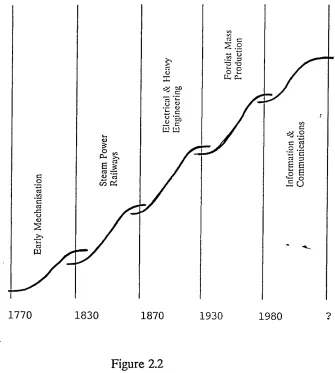
emerges. Tranfield and Smith, building on the work o f Bessant
represent this as a series of ’S’ curves and suggest th at the current
position is as jumping from the fourth to the fifth curve. This is
1770 1830 1870 1930 1980 ?
Figure 2.2
The consequence, or corollaiy of such a shift is that organisational
form is changing in many companies, and whilst the "old" form is
clear, the shape of the "new" form is not, and companies are
experimenting in an attem pt to define "best practice".
The im plication o f this thinking for organisations undergoing m ajor
change, particularly where it involves information technology and
[image:38.617.139.474.17.390.2]Whilst it may be clear that im plem entation of CA D /C A M involves
increased organisational integration, the "best" form for that
integration may not be identified for some years.
In addition to the organisational change brought about by the
im plem entation of an integrating technology, there are several other
interesting ’hum an’ changes which may take place. Multi-skilling has
already been hinted at earlier in the section, but Bessant et al.
(1992) suggest that the skill life itself may be shortened, and may
indeed be shorter than the employee (working) life.
Accountability was another feature noted by Bessant et al. (op. cit.),
whereby individuals would be form ed into "cells" with devolved
authority, and be responsible to those cells. In terms of m anagement,
these cells tend to be supervisor supported rather than supervisor
controlled. M anagement has effectively been devolved to the "shop
floor" units which then have more autonomy.
These changes are not, of course, limited to drawing/design offices,
but are now commonplace throughout the manufacturing units of
2.4 The System Champion
The need for top m anagem ent to be involved at the early stages of
systems strategy formulation has been docum ented for many years.
As far back as 1973, Ettlie (1973 p36) found that m anagem ent’s
com m itm ent to:
"...the philosophy of the new approach to manufacturing..."
to be second only to degree of workflow integration in correlation
with utilisation rate (tape time) on NC tools.
Carrie and Bannerjee (1984 pp251ff) and others working in th e sam e
era note th at the "top-down., bottom up" approach as described
earlier is necessary in implementing a manufacturing inform ation
system. This implies that senior m anagem ent will be involved at the
specification stage.
The role of the "Project Champion" comes into the literature in the
early 1980s (see for example Altschuler et al. (1984), Twiss (1984)
p. 16). The prerequisite of such a "champion" is that he or she shall
be influential in the m anagement structure and shall work closely
Such a person will have the authority to cross boundaries betw een
departm ents, reducing inter-departm ental conflict. H e will also have
the ability to m ake the necessary changes to the organisation. ,
Haywood and Bessant (1987), looking at Flexible M anufacturing
Systems (FMS) in small to medium sized companies found th at
seven of the eight companies they studied deem ed the project
champion to be very im portant or even vital to m aintaining process
efficiency. T he role was often fulfilled by the Managing D irector, as
may be expected in small enterprises, or by the Production or
Technical Director.
The research of Tranfield and Smith (1988) supports the top-down
philosophy and in particular the senior m anagem ent "champion".
They take the concept further by involving all levels of m anagem ent
in a "cascade" of ideas generated by the top team.
If these are handled correctly, perhaps in a series of workshops,
useful feedback can be obtained on the effectiveness or otherwise of
the strategic decisions. There is nothing particularly innovative
about this process, which underlies the communications philosophy
of many successful firms. However, its express use in Advanced
M anufacturing Technology (AMT) im plem entation is not well
documented. Its m ain strength is, of course, in developing
Gerwin (1988 p93) picks up on the same sorts of concepts, giving the
technical task force, including the new technology champion, the
responsibility of recommending hardware, software and vendors.
T he task force is not, however, a decision making body, and the final
decisions on the recommendations are taken by the Com pany’s
strategic managem ent. Gerwin notes that this has a num ber of
inherent problems. The greater the technical complexity of the
recom m endation, the less likely is the strategic m anagem ent to
question it. U nable to judge the future effectiveness and benefits, or
even compatibility with its needs, strategic m anagem ent is faced with
a great deal of uncertainty and may make uninform ed decisions.
The models described by Tranfield and Smith and G erw in would not
appear to be uncommon nor need they be mutually exclusive,
particularly in the small firm where the technical task force and the
strategic m anagem ent team have at least some common m em bers,
including the "champion".
2.5 M easuring Implem entation Effectiveness
T he m easurem ent of the effectiveness or success of an
im plem entation has been discussed by many writers against an
It is logical to look back at the initial justification for purchase, but
where this is related to survival or some elem ent of "me too", this is
not particularly helpful.
In any case, it is reasonable to suppose that, particularly in
companies which are implementing AM T for the first time,
expectations will change as the implementation proceeds. In other
words, the definition of success, even where it is quite specific in the
case for justification, may be inappropriate as a true m easure.
Several writers have addressed the thorny problem of defining
success in im plem entation, and these fall into three categories. T he
first is the proposition that success is measured by the extent th at the
organisation uses the technology. This was first propounded by
Bikson et. al. (1981 p226) and referred to as "’degree’ of
implementation". N ote that the focus is on the organisational use,
and not on the use by the individual.
The com fortable factor in this definition is the ease of m easurem ent,
since total machine usage time can be used as a broad-brush
indicator. W hat is not so easily defined is the yardstick against
The second category, as supported by Johnson et. al. (1985) is the
definition of success as depending on the sophisticated use of
technology. This has a number of attractive features, not least of
which is its appropriateness for CAD im plem entation.
Whilst the success of a word processor can possibly b e m easured by
the am ount of use it gets, the same cannot be said for CAD. A
simple m easure of usage time is hardly a satisfactory m easure of its
use to the Company. By identifying several levels of sophistication, a
m ore precise measure is achieved.
They define the lowest level as "low integration" - use of the word
processor (their target system) as a typewriter. This may correspond
to using a CAD system as an electronic pencil. T heir second
"clockwork system" level relies on the developm ent of procedures to
speed up the process and reduce keystrokes. T he analogy here may
be the use of symbols, macros or param etric programs.
T he third level of sophistication they called "expander systems". At
this level, centres of expertise are developed to handle all word
processing. The analogy is wearing a little thin, b ut the use of a
The fourth and highest level was known as "system-wide
adaptation", with decentralised systems and operators responsible
for their creative use. A t this stage the analogy falls down
totally, since such a move in CAD terms would be retrograde. A
m ore meaningful fourth step for CAD would be a fully
integrated system of CAD workstations. Unlike the word
processor situation, this would leave several more levels of
sophistication available for CA D /C A M systems.
This is a m ore meaningful definition of success than the first, but it
leaves open the question of the aspiration level of the
im plem entation team at the start of the project.
D ifferent companies will certainly seek differing levels of
sophistication, and the success must be m easured against this
sub-optimal (in most cases) satisficing level.
The third category of definitions contains what Bikson et. al. (1981
p227) refer to as the "fidelity of implementation". This relates to the
extent to which the technology is exploited rather than the extent to
which it is utilised. There may be situations where CA D is th e only
way of carrying out a particular design exercise. This would satisfy
this im plem entation criterion even if the usage were low. This
definition is, then, more to do with design innovation th an with
These three categories of m easurem ent can be classed broadly as
"business success" categories. Voss (1988b) highlights another series
of categories involved with technical success. He, of course, is
looking at the problem from an A M T viewpoint, where success can
in principle be m easured in technical terms. H e quotes several
measures of success and failure, including:
Success = % uptim e
= use in actual production
= has b een in use for a year ^
Failure = Limited num ber of parts actually
m ade on the system
H e also refers (Voss (1988b p58) to the work of Ettlie (1984), who
found that manufacturing organisations....
" would seem to believe th at they have successfully im plem ented
new operating technology when two conditions are met. Firstly,
when all the bugs have b een ironed out and it is working
technically. Second, when the operation is working reliably and
there is little downtime, a n d /o r the new technology has a high
This is very similar to the definition of success which Bikson evolved
for IT.
Finally Voss develops his own definition of im plem entation as:
"the user process th at leads to the successful adoption of an
innovation of new technology".
Whilst it is difficult to fault this as a definition of the im plem entation
process, it does not further the search for a measure of success.
Wainwright and Bowker (1988 p396) take up Voss’s definition of
im plementation and expand it to incorporate problem definition and
perform ance evaluation of w hat constitutes success. T heir definition
is:
"The user process that spans problem awareness through
contextual criteria, which directs the adoption and subsequent
development of the requisite process technology".
Smith and Tranfield, in discussions with W ainwright and Bowker
(Wainwright & Bowker 1988 p396) suggest the following four
dimensions for the interpretation of the im plem entation process:
1) Business validity which represents essentially an exam ination of
the exploitation problem eg Was it worth it?
2) Technical validity an examination of the installation problem eg
Did it work?
3) Organisational validity an examination of the change problem or
in other words eg Can we cope with it?
4) U ser validity asks the question did the operators use it?, in
essence an examination of the introduction problem.
This analytical tool has a great deal to recom m end it, and comments
on three of the four dimensions will generally be elicited from
different people within the organisation. As Clegg (1988) points out
in his tongue-in-cheek review of CAD personalities, the influential
Luddite may take a totally different view o f im plem entation success
from that of his colleagues, dem onstrating th at truth may not be
O ne aspect of what Wainwright & Bowker refer to as the "business
dimension" which merits a good deal of discussion in the texts is the
potential for financial benefits.
As was argued earlier, it would appear th at many strategic
investment decisions are taken on a short or m edium term financial
basis. W here this is the case the m easurem ent of success or failure
is relatively simple, provided that the financial controls are
sufficiently good to isolate the effects of the investment.
Hayes and Abernathy (1980 pl64) point out the disadvantages of
reliance on this method of justification, which produces an
environment where no-one can afford failure or a reduction in
profitability. Nevertheless, the simplicity of the m ethod seem s to be
attractive. Senker (1984a p226) suggests one reason for this in CAD
implementations is that most CAD suppliers in the past have
attem pted to sell their systems based upon savings in draughtsm en’s
labour time. This would seem to be flawed, in that labour costs are
normally a very small percentage of a company’s to tal costs.
Haywood and Bessant (1987 p8) found th at in the eight com panies
they studied the wage costs were only 20 percent o f to tal costs. In
the USA, Senker (1984b) suggested that this figure was g reater than
If this is the case, then a company turning over £10 million at 10
percent net profit will have labour costs of £900,000, and design costs
(at 10 percent) of no m ore than £90,000. A cost saving of 20 percent
will therefore yield only £18,000 - a very small sum for a drawing
office with say, eight draughtsmen.
Success on this criterion is therefore going to be hard to
dem onstrate.
2.6 Significant Problem Areas ^
T he problems associated with implementing high technology systems
are covered widely in the texts. They centre around the two basic
issues of people and systems. The people issue revolves around such
factors as organisation, skills, resistance to change and commitment,
whilst the systems issue includes the "hard" factors of system quality,
development, im plem entation and integration.
2.6.1 O rganisation and People Issues
By far the greatest incidence of problems noted in th e texts is
associated with people, either in terms of m anagem ent, in resistance
Keen (1981 p361) looks towards a strategy for the im plem entation of
M anagement Information Systems (MIS), of which C A D /C A M can
be regarded as a subset, based upon the prem ise th at the
organisation is the major issue.
H e looks closely at the problem of "social inertia", and the hum an
aspects which cause it, supporting this with a tactical approach to
dealing with it.
Keen also looks at the issue of "counter-implementation" - a' political
approach to causing im plem entation failure, which includes diversion
of resources, deflection of goals and dissipation of energies.
Again, he looks at some tactical m ethods of coping with
counter-implementation. Com pare this with Clegg’s (1988)
"Influential Luddite", who has the power and m otivation to take this
sort of action.
Eason (1982 p58ff) also looks at the organisational end of
implementation, taking as a starting point the "traditional"
consequences of implementing com puter systems which pervaded the
texts at that time; job losses, changes in job content, health
problems, retraining, increase in formality, changes in pow er and
influence and industrial relations changes, all of which are social
H e expresses strongly the desirability of user involvement during the
whole of the selection and im plem entation period, but argues that
there is, in practice, a rather narrow window of tim e in which
effective contribution can be made. This is bounded by the level of
understanding or learning at the bottom end and the need for system
finalisation at the upper end.
His methodology for systems developm ent seeks to keep
organisational learning about technology ahead of system
development so that the form er can inform the latter.
Eason’s approach is "bottom-up" and "user-led", which has certain
merit. For instance, it is particularly good for gaining the
commitment of users and others at low levels in the organisation to
the change about to take place.
It does not guarantee commitment, b u t it increases the probability.
However, it leads to m orphostatic change rath er than morphogenic
change, and it is particularly poor w here a system needs to be
reconfigured strategically. It takes little account of the need, if any,
for major, system-wide change. It could, indeed, lead to a situation
where functions are autom ated which may have no place in the
The author has observed this frequently in organisations which have
computerised discrete functions to provide "islands of automation"
rather than looking at the overall need for integrated systems. The
result has been on occasions th at the "islands" have been subsumed
at a later date, rendering the equipm ent redundant.
In a study of eight FM S/FM C implem entations, Haywood and
Bessant (1987) found that five of them stressed th at it was
organisational problems which presented the major interfacing
problems and contributed to excessive timescales. M anagers were
m ore likely to resist change than the shopfloor workforce, and being
in a more influential position they could have a greater effect on the
implementation. In particular, they could influence the attitudes to
training, which was considered as an essential adjunct to FMS
introduction.
Haywood and Bessant also noted that the change in skills needs led
to a problem of recruitment of a satisfactory level of people. It is
usually assumed that existing personnel can be retrained to cope with
the new technologies. This may be so in the majority of cases, but
the training in itself makes the staff m arketable, and a m ore rapid
staff turnover may be the result. H ence the need for continuing
A dler (1988 p43) quotes a McKinsey & Co survey of C A D /C A M
im plem entation ("Forging C A D /C A M into a strategic weapon".
January 1984) which claims that the benefits of C A D /C A M could be
tripled in terms of reduced cycle tim e were it not for the lack of
m anagerial commitment.
A dler further suggests that labour requirem ents are amongst the
least well managed of all the implem entation issues. H e claims that
the skills impact of new technology is low priority com pared to the
technical capabilities and cost savings. Similarly, when the*'"
equipm ent arrives, training comes second to debugging the system
and getting production rolling again. The result is that the attention
to optional skills mix tends to be a firefighting exercise brought on
by a need to absorb displaced people or to deal with job
classification grievances.
Haywood-Farmer and Hill (1989 pp71ff) in their survey of CAD
implem entation in the Canadian consulting engineering industry
found a general acceptance amongst users that CAD dem ands m ore
m anagem ent skills. However, they also found that half the
respondents who accepted this felt that their senior staff were not
prepared for CAD systems to be a success. U nfortunately the
This work is interesting, in that it is the only recent work which looks
at the m anagerial skills level in actual implementations despite the
wealth of theoretical writing on the topic. All other im plem entation
studies involving skills reporting concentrate on the skills of the users
- designers, engineers o r draughtsmen - rather than the management.
We have to go back alm ost a decade to Arnold and Senker (1982) to
find further em pirical evidence of the shortfall in m anagerial skills.
A num ber of examples of the failings of managem ent serves to
highlight the need for training prior to implementation. THe authors
go as far as to suggest government promotion of the raising of skill
standards in m anagem ent in the short term and in influencing the
long term education and training of managers. It could be claimed
that this need is still present ten years on.
In summary, there is a consensus that organisation and people issues
feature strongly in system implementation, whether the
im plem entation involves morphostatic or morphogenic change.
It is interesting to note the apparent general shift in emphasis from
user resistance in th e early 1980s to m anagem ent resistance in the
late 1980s.
The one exception cited is Arnold and Senker (1982) who were
The reason for the apparent shift has not been investigated or
assessed, but it could have something to do with the decline in
organised labour over the period since about 1979. It is probable
that the texts of the early 1980s reflect the needs of the day to take
operators into account, particularly in the larger businesses such as
the automotive industries where advanced m anufacturing technology
was being implem ented and trades union were very strong.
Later in the decade, as managers were given the authority to
manage, and as the technologies becam e m ore complex, the need for
skilled implementers at managerial level appears to have becom e
m ore acute.
2.6.2 Technical Issues
N ot all writers consider the technical issues to be a vital area of
study. Indeed Wainwright and Bowker (1988 pp395ff) attack the
traditional approach to im plem entation of advanced m anufacturing
technology in general for its concentration on m echanistic issues
without regard for the organisation and m anagem ent dimensions of
the process. This is quite a switch from the situation only six years
They build on the work of Tranfield and Smith (1987) to create a
m ulti-dimensional im plem entation model. This model suggests m erit
in looking to four im portant factors - technical, organisational,
business/strategic and user issues.
A dler and H elleloid (1987 pl04) expand upon the technical issues of
im plem entation and integration, which would appear to be
particularly relevant in terms of CAD/CAM .
They suggest that:
"Computerised information systems must be well developed
individually in both engineering and production functions before
integration can occur. In other words, system effectiveness will be
greater when all potential users of the system have already
developed their own computer capabilities before the integrated
system is developed".
However, they go on to suggest that the most difficult task is not the
integration of software but the acceptance of the tools, which will b e
m ore acceptable if they are well designed. This supports the
hypothesis propounded by Lucas (1985) discussed earlier. They
further suggest that this can be better achieved if the users are able
to take an active p art in the development, again supporting work of
Peccei and G uest (1984 pp84ff) take a totally different perspective
on the problems of im plementation effectiveness. They suggest,
quite reasonably, that the m easurem ent of effectiveness depends
upon the definition of success. W hat may be regarded as successful
in one company may be inappropriate in another. G oals may be
vague, ambiguous or simply unrealistic, and therefore may not
provide a sound basis for assessment.
Goals may also be different across the various interest groups, and
Voss (1988) notes that the goals may well change during the
implementation.
These factors are clearly going to be im portant w hen attem pting to
define the problems associated with im plem entation. Peccei and
G uest (1984 p95) have therefore developed a new fram ew ork for
evaluation which focuses on three areas; the outcom e/effectiveness
of change, the nature and quality of the change process and the ratio
of inputs to outputs in the change process. They use the fram ew ork