Munich Personal RePEc Archive
An exploration of the factors affecting
the diffusion of Advanced Costing
techniques: a comparative analysis of two
surveys (1996-2005)
Cinquini, Lino and Collini, Paolo and Marelli, Alessandro
and Tenucci, Andrea
Sant’Anna School of Advanced Studies and University of Pisa,
University of Trento, University of Trento
2008
1
The 31st Annual Congress of the European Accounting Association Campus of the Erasmus University
Rotterdam (NL) April, 23rd to 25th 2008
An exploration of the factors affecting the diffusion of Advanced Costing techniques: a comparative analysis of two surveys (1996-2005)
(Preliminary draft)
by
Lino Cinquini* Paolo Collini# Alessandro Marelli§
Andrea Tenucci*
Abstract
The issue of cost calculation has been largely debated in the last years under the pressure of the perceived lost of relevance of the so called "traditional cost accounting approaches". The enthusiasm for new management accounting techniques has often driven most of attention towards technical or theoretical aspects of the proposed new cost models. In particular, Activity-Based Costing (ABC) implementation literature pinpoints a large number of studies that have looked at technical and organizational/behavioral factors that influence effective implementation.
Recently a great attention has been paid by researchers on the contingent factors affecting the adoption of advanced management accounting techniques and the influence of the variables that drive towards higher levels of cost system sophistication. The need is felt for insightful studies regarding processes and contingent variables working through time in relation with these changes. Improved analysis can be obtained by undertaking replication studies based on larger number of responses and/or across geographic and cultural borders. Whitin the boundaries of a contingent framework analysis, this paper has provided additional insights into areas relating to factors influencing the level of sophistication of product cost systems in Italy.
The paper presents the comparison of two survey results carried on in a ten years distance on the same sample of Italian largest companies. These two long-distance surveys provide the opportunity to assess the changes occurred in the companies that in 1996 declared the adoption of (or the interest in adopting) ABC and Target costing (Cinquini et al., 1999).Moreover, the time elapsed could allow the perception about adopters’ behavior, along different stages of the diffusion process of advanced costing techniques. The research findings pinpoint that only “importance of cost information” and “cost structure”, among the contextual variables considered in the more recent survey responses, are positive and significant in relation with increasing in implementation of advanced costing techniques. This outcome could open to further studies to assess whether or not adopters are moving from a “fad and fashion” behavior of the early stages, to a more rational approach in which the matching between management needs and tools potentiality is maximized.
Keywords
Management accounting innovations, Activity-Based Costing, Target costing, Product costing design, Cost system sophistication, Contingent factors
* Scuola Superiore Sant’Anna of Pisa (Italy): [email protected], [email protected] (corresponding authors) #
University of Trento (Italy): [email protected] §
2
An exploration of the factors affecting the diffusion of Advanced Costing techniques: a comparative analysis of two surveys (1996-2005)
Introduction
A great deal of attention has been devoted in the last two decades to the diffusion of new management accounting techniques. Many of these studies have been based on contingency approaches (Chenhall, 2003; Chenhall and Langfield-Smith, 1998; Gosselin, 1997), in the search for a relation between some “firms’s characteristics or contextual factors” - such as “product variety, business complexity, strategy” – when others focus on managers attitude towards management innovation (Ifinedo and Nahar 2006) or on the relation between the adoption of advanced Cost accounting techniques and firms’ performance (Cagwin and Bouwman, 2002). This paper aims at contributing in this field of management accounting research, applying a contingency model based on information provided by two surveys conducted in a length of ten years. The research is carried on by the comparison of respondents at both the surveys in a way that allows the assessment of intervened change during the length of time.
Propositions concerning the factor affecting introduction and diffusion of advances in cost management techniques are drawn from recent (1990s) literature on factors influencing choices and design of product costing systems and from literature on innovation and diffusion in management accounting. The paper provides support to the idea that “potential” contextual factors influence the characteristics and the level of sophistication of product cost systems in Italian companies.
In addition, the paper tries to understand the diffusion of advances in cost management techniques and it highlights that innovative cost information diffusion is a process that requires time and it is influenced by rational and non-rational factors difficult to embrace adopting only a contingent approach.
The paper has six sections. The first section presents a literature review. The second discusses the employed research method. The third section presents the results of the two surveys comparison. The fourth explains the contingent research model, the hypotheses formulation and the variable measurement. The fifth presents the findings of the analysis and the final section provides discussion and considerations.
1. Literature
Alfred Chandler (1962) written fundamental pages on how and why management techniques evolve under the unavoidable pressure of poor financial performance, driven by a variety of new internal and external competitive challenges. Following such an approach, many studies appear to assume, either explicitly or implicitly, that the main force driving the adoption of new management techniques is the need for facing and solving new and more complex decision problems.
Coherently with Cyert and March (1992), managers tend to stick with decision rules that have proven to be effective, until they face poor performance. Consequently, the search for new management techniques, like cost analysis approaches, is a consequence of bad decision making as a result of misleading cost information. Regarding the “modern cost management movement” there are no doubts that it was started and propelled by the lack of performance of US manufacturing industry (Johnson and Kaplan, 1987; Cooper, 1989; Nanni et al.,
1992; Johnson, 1992, Askarany et al., 2007). Most of these problems were seen as related to the increase in competition worldwide, and more specifically to the transition from a fordistic economy, based on mass production of standardized products, to lean, technical adapted, high-flexible quality “massproduction of tailored products”. Particularly, cost accounting appeared to fail on measuring product cost under the new manufacturing paradigm (Miller and Vollmann, 1985), taking into account the high product variety combined with a flexible manufacturing system (Kaplan, 1988; Shank and Govindarajan, 1988), and in more general terms, to represent correctly the linkages between resources consumption and value creation (Porter, 1985). Accordingly with the Chandler’s idea that problems drive the search for new solution, most of studies have been searching for evidence of a relation between the adoption of new management techniques and financial performance, and, in a broader approach, between the degree of awareness of the emerging business challenges (manufacturing approaches, product customization and variety, customers’ orientation, strategic choices, TQM) and the adoption of “new techniques”.
relation with ABC adoption, but only cost structure was found to be statistically significant. Gosselin (1997) found significant the influence of strategy and organizational structure on the adoption of ABC. Cagwin and Bouwman (2002) explored the relation between ABC use and the conditions under which it results associated with performance improvement.
Instead of using only the “adoption or non-adoption of ABC systems” as a measure of innovative product cost system design, recently a new pathway of research tried to identify different measures of cost system sophistication to capture the attributes of the product costing systems. This has opened to a more robust process of testing out the relations among the predictor variables and cost system sophistication. Three recent studies are used to classify product cost systems by characteristics other than by the discrete alternatives of traditional and ABC systems. The first by Abernethy et al. (2001) adopted an interactive approach to fit. Based on case study research they classified product costing systems by the level of sophistication using data collected from five divisions within two firms in Australia. Four divisions had a low level of sophistication but there was a reasonable level of satisfaction with the information provided by the costing systems at three of the four divisions. The authors attributed this to the ‘fit’ between the levels of sophistication of the costing system and the contextual factors of cost structure and product diversity. The second study that adopted a broader perspective to classify costing systems was a survey undertaken by Drury and Tayles (2005). The measure of cost system complexity represented the dependent variable. Four variables were statistically significant – product diversity, degree of customization, size and corporate sector (the financial and service sectors). The third study by Al-Omiri and Drury (2007), adopted four different proxy measures of cost system sophistication to capture the characteristics of the product costing systems. This choice gave more effectiveness in testing the relations among the predictor variables and cost system sophistication. The results showed that higher levels of cost system sophistication were positively associated with the importance of cost information, extent of use of other innovative management accounting techniques, intensity of the competitive environment, size, extent of the use of JIT/lean production techniques and the type of business sector. Recently, Abdel-Kader and Luther (2008) have examined the impact of a range (10) of potentially contingent variables on a broad set of management accounting practices in a sample of companies selected from the UK’s largest industry sector. The results, derived from a large scale questionnaire survey, indicate that differences in MA sophistication are significantly explained by environmental uncertainty, customer power, decentralisation, size, Advanced Manufacturing Techniques, TQM and JIT. In exploring the issue of diffusion, very rarely a dynamic concept of diffusion has have been included. Malmi (1999) took the search for the driving forces of diffusion to include time in terms of different stages in the diffusion process, but most of empirical studies focus on the correlation between a set of variables at a given time and the degree of development of management techniques and they do not include the time effect that is quite natural in any propagation process. Diffusion has been observed has static phenomenon in which managers adopt new techniques as soon as the needs become apparent. Managerial theories of innovations (Abrahamson, 1991), that overcome the efficient-choice perspective and consider the impact of “fad and fashions” in the dynamic of the diffusion of management innovations among companies, could become relevant in the explanation of the process of diffusion in a non-static perspective of research.
2. Research method in surveys comparison
The research is based on the comparison of the results provided by the respondents of a survey carried on in 1996 on large Italian manufacturing firms and reported in Cinquini et al. (1999), with the respondents of a second survey, conducted in 2005, based on the same questionnaire and addressed to the respondents of the 1996 survey.
The 1996 research was mainly aimed at providing a study of management and cost accounting practices in Italy comparable with others undertaken in other European countries during the nineties (Drury and Tayles, 1994; Innes and Mitchell, 1995; Lukka and Granlund, 1996; Bjornenak, 1997). These studies aimed at describing the state of the art of cost and management accounting practices in national population of firm, assessing the degree of consistency of findings with textbook theory, particularly on topics like cost structures, the purposes of costing, the type of product costing system, the allocation procedures used, and the diffusion in the implementation and use of advanced management accounting techniques. The 1996 research explored also various aspects of the employment of modern techniques in the firms in order to assess the level of implementation and development of modern cost management approaches in Italy, to compare the results with other similar European studies.
adopted ABC systems and these percentage rose up to 23,5% when firms with ABC “under consideration” were considered1.
A second survey was performed during 2005. Differently from a similar research based on survey comparison (Innes, Mitchell and Sinclair, 2000) the design of the subsequent survey has focused on the subset of the respondents of 1996 survey, in order to explore the changes intervened in those settings in a decade and to provide the same hypotheses testing samples for the two periods. Under this approach, the studies do not only explore the evolution of the phenomenon (i.e. modern cost management diffusion and popularity), but also the behviour of individual firms along the pathway of adoption. Observing a panel of firms along a decade, allows seeing how firms react to the same stimuli at different times. Over time firms should evolve from a “try and error” approach, due to a lack of knowledge about the characteristics of new tools and the future needs, to a more rational approach in which, thanks to a better understanding of the new tools potential contribution, they are adopted when actually needed. Observing changes in both attitude and behavior of individual firms allow to catch the evolution from one stage to another.
In re-contacting the 132 respondents of the previous survey, a number of dropped out firms were identified (6). After a first phone contact, a questionnaire was sent by fax and a second phone contact was realized in order to assess the filling of the questionnaire and to solve problems in interpretation. Finally we had 84 usable responses.
The comparison with the two sets of respondents is shown in the following table 1.
Table 1 -Survey response analysis
1996 2005
N % N %
Population 1,194 126*
Usable responses 132 11.6 84 66.67
* 1996 survived respondents
The same questions of the previous survey were reintroduced in 2005 questionnaire, i.e. manufacturing profile (kind of manufacturing system: job, batch, process), structure and use of cost information; use of cost pools and allocation bases; innovative trends in costing to investigate the behavior of the company in respect of innovative cost management tools like ABC/M or Target Costing.
The following results of comparison are related to the 84 companies who responded in both the 1996 and 2005 surveys2.
3. Results of 1996-2005 surveys comparison
In this section, some main categories of findings coming from the survey response analysis are highlighted in order to give an assessment of the changes occurred in the 84 respondent companies over a recent 10-year period. The analysis of findings and the comparative information are focused on the changes in advanced costing techniques adoption and on the factors that have been recognized in literature as useful to interpret the diffusion of new and/or more sophisticated cost accounting techniques: importance of cost information, cost structure, product diversity (Abernethy et al., 2001; Drury and Tayles, 2005; Al-Omiri and Drury, 2007).
1
This conclusion could be explained by the low effect in Italy of the phenomena (market competition, globalization, ecc.) that have driven most of management innovation in North America in the 1980s. However, an alternative interpretation of results might use the well known Italian neglect of any emphasis on formal management control systems as another explanation. Most of the Italian firms, indeed, are of medium size, family owned and managed. In this scenario, either cost accounting system and management control systems have often have not reached a high degree of development. During the period the research was carried out (1996-1997), cost techniques were viewed by respondents as more sophisticated techniques for product costing.
2
Changes in advanced costing techniques adoption and use: ABC and TC
Considering the decade 1996-2005, tables 2 and 3 indicate an increase in use of Activity-Based Costing and Target Costing in the responding companies: 6 more companies have implemented ABC (+7.1%) and TC (+7.1%). TC presents more appealing than ABC, considering that the amount of companies declaring a TC adoption is higher than that declaring and ABC adoption, both in 1996 (12 TC vs 9 ABC) and in 2005 (18 TC vs 15 ABC).
The increasing interest in the panel towards these two advanced costing techniques finds confirmation by the fall in numbers of companies “not considering” at all ABC/TC (-8.3% ABC; -17.9% TC). The assessment of these cost management tools has been carried out with different outcomes: TC appears as most appreciated than ABC considering the variation 1996-2005 in “positive attitude” responses (favorable/intentioned to introduce: TC +7.2%; ABC – 7.1%) and in “decision not to introduce” (TC +6.0%; ABC +8.3%).
Table 2 - ABC diffusion
1996 2005
n % n %
Never considered 38 45.2% 31 36.9%
Decision not to introduce
ABC 10 11.9% 17 20.2%
Favorable to introduce ABC 15 17.9% 15 17.9%
Intentioned to introduce ABC 11 13.1% 5 6.0%
ABC implemented 9 10.7% 15 17.9%
No answer 1 1.2% 1 1.2%
Total 84 100.0% 84 100.0%
Table 3 –Target Costing (TC) diffusion
1996 2005
n % n %
Never considered 60 71.4% 45 53.6%
Decision not to introduce
TC 2 2.4% 7 8.3%
Favorable to introduce TC 6 7.1% 10 11.9%
Intentioned to introduce TC 2 2.4% 4 4.8%
TC implemented 12 14.3% 18 21.4%
No answer 2 2.4% 0 0.0%
Total 84 100.0% 84 100.0%
An insight on the subset of the 2005 companies adopting ABC and TC allows making some considerations about the intervened changes in the use of these cost management tools.
Table 4 - Past response of ABC/TC 2005 users
1996 No. ABC No. TC
Never considered 2 9
Decision not to introduce 3 1
Implemented 5 6
Favorable to introduce 4 1
Intentioned to introduce 1 1
No answer 0 0
Total users (2005) 15 18
Remarkably, a strong interest on TC seems to have been rising in the decade, due to its implementation by 9 companies that did not consider it in 1996.
Use of cost information
The importance of cost information is captured in the question related to the purposes of cost information, i.e. the supported decision in the organization. Revealing the purposes of gathering cost information, cost accounting system practices can indirectly pinpoint the characteristics of the variable “importance of cost information”. The relevance of more accurate cost information has been highlighted in researches on the impact of more sophisticated costing systems for decision making processes on business performance (Kennedy and Affleck-Graves, 2001; Cagwin and Bouman, 2002). The rising in importance of cost information finds confirmation in the enlargement of those purposes and objects that requires more accurate cost information.
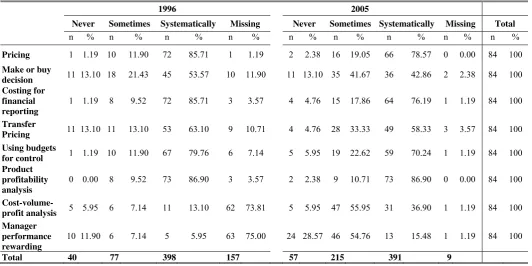
Comparing 2005 and 1996 survey results, the following table 5 reveals only two important increases in the purposes of using cost information systematically for decision making: cost- volume-profit analysis (from 13% to 37%) and measuring and rewarding the performance of managers (from 6% to 15%).
Other purposes report a significant decrease in systematically use, we consider important to mention the reduction of cost information use in: pricing (from 86% to 79%), make or buy decisions (from 52% to 43%), transfer pricing (from 63% to 58%).
However, we can observe a substantial increase in using cost information for decision making and control, if considering the increase in response of companies that in 2005 do not systematically consider cost information in all the different purposes in rows comparing with 1996.
Table 5 - Use of cost information
1996 2005
Never Sometimes Systematically Missing Never Sometimes Systematically Missing Total
n % n % n % n % n % n % n % n % n %
Pricing 1 1.19 10 11.90 72 85.71 1 1.19 2 2.38 16 19.05 66 78.57 0 0.00 84 100
Make or buy
decision 11 13.10 18 21.43 45 53.57 10 11.90 11 13.10 35 41.67 36 42.86 2 2.38 84 100 Costing for
financial reporting
1 1.19 8 9.52 72 85.71 3 3.57 4 4.76 15 17.86 64 76.19 1 1.19 84 100
Transfer
Pricing 11 13.10 11 13.10 53 63.10 9 10.71 4 4.76 28 33.33 49 58.33 3 3.57 84 100 Using budgets
for control 1 1.19 10 11.90 67 79.76 6 7.14 5 5.95 19 22.62 59 70.24 1 1.19 84 100 Product
profitability analysis
0 0.00 8 9.52 73 86.90 3 3.57 2 2.38 9 10.71 73 86.90 0 0.00 84 100
Cost-volume-profit analysis 5 5.95 6 7.14 11 13.10 62 73.81 5 5.95 47 55.95 31 36.90 1 1.19 84 100 Manager
performance rewarding
10 11.90 6 7.14 5 5.95 63 75.00 24 28.57 46 54.76 13 15.48 1 1.19 84 100
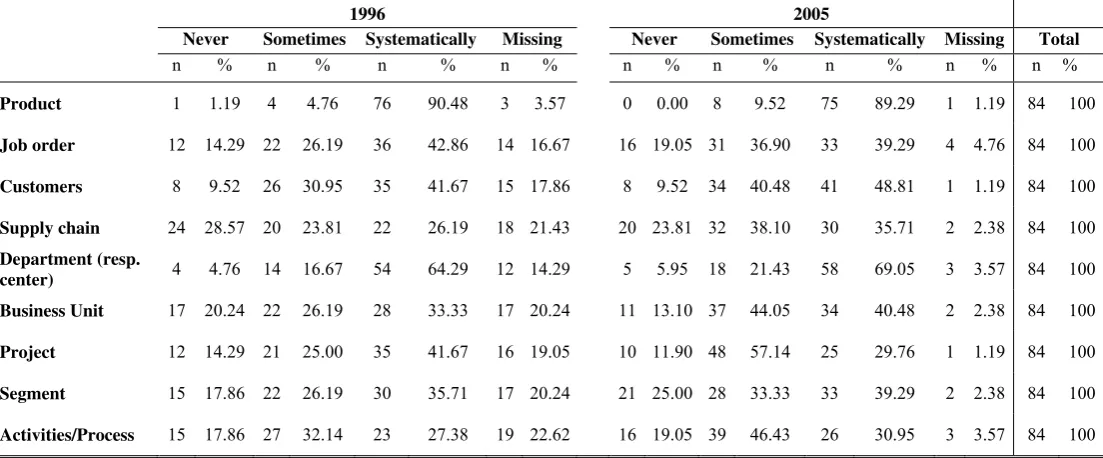
[image:7.595.33.566.493.759.2]This finding is confirmed by responses to the question about the object of cost analysis. Table 6 shows “product” as the principal cost object systematically used (from 90% to 89%), but also reveals the increase of importance of “department” (from 64.29% to 69.05%), “customer”, (from 41.67 % to 48.81%), “business unit” (from 33.33% to 40.48%), “supply chain” (from 26.19% to 35.71%), “activity/process” (from 27.38% to 30.95%). The results highlight the development of management analysis towards customization and diversification of company products and/or services issues, which requires a more complex process of definition and design of cost accounting systems.
Table 6 - Cost objects
1996 2005
Never Sometimes Systematically Missing Never Sometimes Systematically Missing Total
n % n % n % n % n % n % n % n % n %
Product 1 1.19 4 4.76 76 90.48 3 3.57 0 0.00 8 9.52 75 89.29 1 1.19 84 100
Job order 12 14.29 22 26.19 36 42.86 14 16.67 16 19.05 31 36.90 33 39.29 4 4.76 84 100
Customers 8 9.52 26 30.95 35 41.67 15 17.86 8 9.52 34 40.48 41 48.81 1 1.19 84 100
Supply chain 24 28.57 20 23.81 22 26.19 18 21.43 20 23.81 32 38.10 30 35.71 2 2.38 84 100
Department (resp.
center) 4 4.76 14 16.67 54 64.29 12 14.29 5 5.95 18 21.43 58 69.05 3 3.57 84 100 Business Unit 17 20.24 22 26.19 28 33.33 17 20.24 11 13.10 37 44.05 34 40.48 2 2.38 84 100
Project 12 14.29 21 25.00 35 41.67 16 19.05 10 11.90 48 57.14 25 29.76 1 1.19 84 100
Segment 15 17.86 22 26.19 30 35.71 17 20.24 21 25.00 28 33.33 33 39.29 2 2.38 84 100
Activities/Process 15 17.86 27 32.14 23 27.38 19 22.62 16 19.05 39 46.43 26 30.95 3 3.57 84 100
Considering the evolution in the use of more sophisticated costing systems such as ABC and TC emerging from the surveys comparison, a first outcome concerns the change in number of cost drivers used in ABC system. As acknowledged in ABC literature (Cooper, 1989; Atkinson et al., 2001) a contained number of cost drivers allows a good implementation and manageability of an ABC system and avoids the risk of abandonment due to excess of system complexity and cost. Table 7 shows the responses to the question about the number of cost drivers used in the system by users in the two surveys: in 2005 13 out of 14 ABC adopters have a number of drivers ranging from 4 to 10; comparing with the 1996 survey data, where 4 out of 9 ABC users declared to manage more than 10 drivers, it seems the implemented ABC systems present a more rational and simple design.
Table 7 -ABC Cost drivers
N. Cost Drivers 1996 2005
n % N %
1-3 0 0.0% 1 6.7%
4-6 4 40.0% 6 40.0%
7-10 1 10.0% 7 46.7%
11-20 2 20.0% 0 0.0%
More than 20 2 20.0% 1 6.7%
Missing 1 10.0% 0 0.0%
Total 10 100.0% 15 100.0%
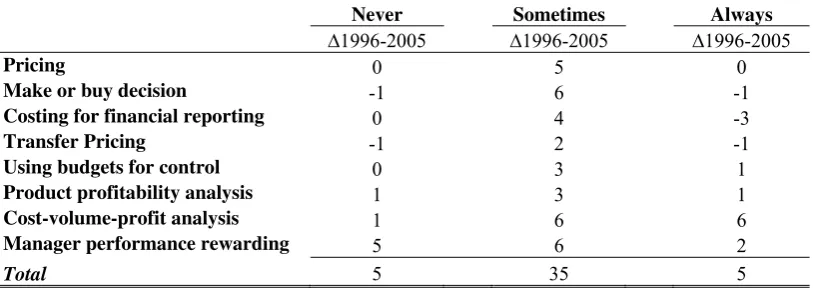
[image:8.595.138.456.565.686.2]making and control purposes respectively in ABC new adopters and TC new adopters, utilizations that were not declared in previous 1996 survey.
Table 8 -Use of cost information by ABC new adopters
Never Sometimes Always
∆1996-2005 ∆1996-2005 ∆1996-2005
Pricing 0 0 0
Make or buy decision 0 3 -3
Costing for financial reporting 1 2 -3
Transfer Pricing 0 1 -2
Using budgets for control 0 2 -2
Product profitability analysis 0 1 -1
Cost-volume-profit analysis 0 4 6
Manager performance rewarding 2 4 4
Total 3 17 -1
Table 9 -Use of cost information by TC new adopters
Never Sometimes Always
∆1996-2005 ∆1996-2005 ∆1996-2005
Pricing 0 5 0
Make or buy decision -1 6 -1
Costing for financial reporting 0 4 -3
Transfer Pricing -1 2 -1
Using budgets for control 0 3 1
Product profitability analysis 1 3 1
Cost-volume-profit analysis 1 6 6
Manager performance rewarding 5 6 2
Total 5 35 5
Remarkably, new adopters present sensitivity toward the systematic use of cost information to support planning (BEP) and motivation of personnel. More broadly, in these companies the results provide evidence for a growth of cost information consciousness and extension in its use for supporting business decisions.
Cost Structure
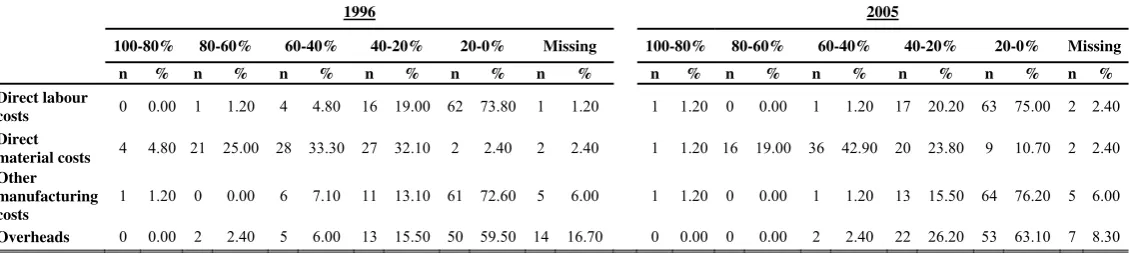
The company cost structure is an important factor affecting the choice of costing method (Lukka & Granlund, 1996; Brierly et al., 2001). Considering the decade 1996-2005, table 10 pinpoints an increase in consciousness about overheads costs: the number of missing answers on this response decrease from 16,7 % to 8.3% (7 companies). The increase of responses in the classes “20%-0%” (from 59.5% to 63.1%) and in the level “40%-20%” (from 15,5% to 26.2%) in the overhead incidence range reveals the growing relevance of overheads; however other (indirect) manufacturing costs shows a significant reduction in the level “60%-40%” from 7.1% answers in the 1996 to only 1.2% answers in 2005, revealing an increasing ability in tracing indirect manufacturing costs.
[image:9.595.96.503.333.477.2]Table 10 - Cost structure
1996 2005
100-80% 80-60% 60-40% 40-20% 20-0% Missing 100-80% 80-60% 60-40% 40-20% 20-0% Missing n % n % n % n % n % n % n % n % n % n % n % n % Direct labour
costs 0 0.00 1 1.20 4 4.80 16 19.00 62 73.80 1 1.20 1 1.20 0 0.00 1 1.20 17 20.20 63 75.00 2 2.40 Direct
material costs 4 4.80 21 25.00 28 33.30 27 32.10 2 2.40 2 2.40 1 1.20 16 19.00 36 42.90 20 23.80 9 10.70 2 2.40 Other
manufacturing costs
1 1.20 0 0.00 6 7.10 11 13.10 61 72.60 5 6.00 1 1.20 0 0.00 1 1.20 13 15.50 64 76.20 5 6.00
Overheads 0 0.00 2 2.40 5 6.00 13 15.50 50 59.50 14 16.70 0 0.00 0 0.00 2 2.40 22 26.20 53 63.10 7 8.30
Manufacturing systems and product diversity
[image:10.595.165.431.362.468.2]In order to understand changes in cost and management accounting systems it is relevant to consider the features affecting manufacturing system (Abernethy et al., 2001). Four manufacturing profiles were considered in the two surveys: Just-in-Time (JIT), Small batches, Large batches, Process system. The answers in 2005 report an important increase of manufacturing systems based on “order approach” (JIT and Small batches). In particular Table 11 shows that “Just in Time” increases from 11.3% to 14.9% and “Small batches” from 24.2% to 28.6%. At the same time the “Process systems” report a drop from 36.1% to 27.4%. It is important to highlight the changes also in “Large batch” answer, where findings show an increase from 21.2% to 26.8%.
Table 11 - Manufacturing system profiles (1996-2005)
1996 2005
n % n %
Just-in-Time (JIT) 9.50 11.3 12.5 14.9
Small batches 20.33 24.2 24.0 28.6
Large batches 17.83 21.2 22.5 26.8
Process system 30.33 36.1 23.0 27.4
Missing 6.00 7.1 2.0 2.4
Total 84.00 100.0 84.0 100.0
[image:10.595.188.408.584.680.2]The results can also be interpreted considering the responses to the question about the belonging of the company to one of the two macro-classes: “working to order” and “working for stock”. Table 12 pinpoints the predominance of companies working for stock not only in the first survey, but also in the second one (respectively 57.3% in 1996 and 54.2% in 2005), but the percentage is declining. In general, the trend towards more customized-demand pull manufacturing processes finds confirmation from the comparison of the two surveys.
Table 12 - Manufacturing system profiles (macro classes) (1996-2005)
1996 2005
% %
Working to order 35.5 43.5
Working for stock 57.3 54.2
Missing 7.1 2.4
Total 100.0 100.0
4. Research model and hypotheses formulation
contextual variables such as product diversity, environmental uncertainty, customer power, decentralisation, cost structure, size, level of competition, importance of cost information, competitive strategy and business sector. Given the contingency theory used, the main purpose in these studies was to find significant correlations between the factors and costing sophistication in a specific time. Some of them considered accounting sophistication in terms of “ABC adoption/non adoption” (Bjornenak, 1997; Malmi, 1999; Hoque, 2000), whereas others widened to other costing characteristics (Gosselin, 1997; Baird et al., 2004; Drury and Tayles, 2005; Al-Omiri and Drury, 2007; Abdel-Kader and Luther, 2008).
This paper tries to extend previous results in a time-based perspective by the comparison of two surveys carried out in a 10 year range of time and by a widened consideration of cost management techniques, namely Activity-Based Costing and Target Costing. Therefore the main objective of the paper regards the exploration for reasons of the adoption of “sophisticated” costing systems/techniques in the last decade through the two surveys conducted in 1996 and 2005. The variables were selected according with the possibility of their measurement on the base of the original structure and informative contents of the 1996 and the 2005 questionnaires, aimed at providing a study of management and cost accounting practices in Italy to compare it with others undertaken in Europe.
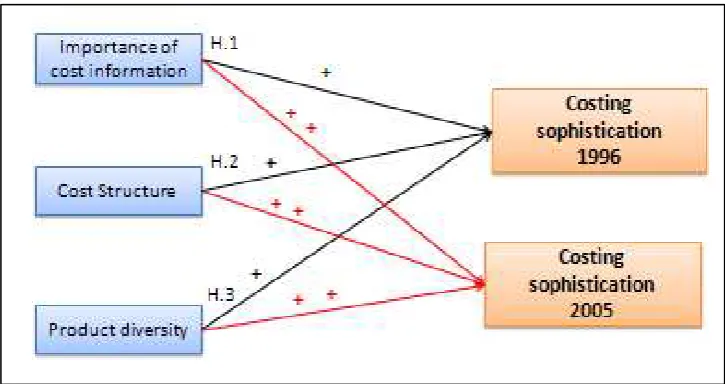
[image:11.595.116.479.299.491.2]According to this, the research model considers four variables: costing sophistication as dependent upon importance of cost information, product diversity and cost structure, as depicted in figure 1.
Figure 1-The research model
The following hypotheses were formulated.
Importance of cost information
Cost information is generally recognize as crucial in decision making process. A distortion in cost information caused by a simplistic costing system could generate dangerous manager decisions such as encouraging sales of unprofitable product or service. In this sense Kaplan and Cooper (1998) assert that companies using cost information for inventory evaluation more than for decision making could rely on cost information based on a more simplistic costing system. Al-Omiri and Drury (2007) found a positive relation between the importance of cost information and the level of cost system sophistication; also Baird et al. (2004) found that higher decision usefulness of cost information is related to the adoption of ABC. We could also expect that such knowledge in using cost information for decision making will cause an higher level of sophisticated costing systems adoption today than ten years ago. Independently from the general level of importance of cost information of the sample in the two years, we could expect that in 2005 a stronger relationship between the importance of cost information and the level of accounting sophistication respect to 1996 exists. In other words we expect a higher consciousness in the use of sophisticated costing systems in 2005 than in 1996 due to the learning process. As acknowledged in the research on technology innovation, technologies become effective only through gradual, careful and sustained implementation processes that provide organizations with tacit knowledge and the skills adequate to implement these technologies efficiently (Polanyi, 1967; Teece, 1977; Abrahamson, 1991).
For these reasons the following hypotheses are postulated:
H.1b: The relationship between importance of cost information and costing sophistication is positively higher in 2005 than in 1996.
Cost structure
In any company the costing system (simplistic or sophisticated) is used to assign indirect cost to cost object in the more accurate/satisfactory way. Greater is the portion of indirect costs and more important will be the role of the costing system in calculating accurate cost of cost objects. In this way Brierley et al. (2001) found that it is useless to investigate for sophisticated accounting methods of indirect cost allocation in sectors where the portion of indirect costs is low; moreover Bjornenak (1997) found a positive correlation between cost structure and ABC adoption. Furthermore several studies (Cooper, 1988a; Bromwich and Bhimani, 1994) demonstrated that the portion of indirect costs has increased over the years – as confirmed by the comparison in cost structure 1996-2005 - and this would lead the companies to adopt a more sophisticated costing system in 2005 than in 1996. In this sense the following hypotheses are formulated:
H.2a: In companies with a prevalence of indirect costs the costing sophistication is higher than in companies with a prevalence of direct costs (positive relation between the variables both in 1996 and 2005).
H.2b: The relation between cost structure and costing sophistication is positively higher in 2005 than in 1996.
Product diversity
Product diversity is conceived here as volume diversity (Cooper, 1988b; Estrin et al., 1994); this means that products are manufactured in different batches of different size and this causes a more complex production process. Malmi (1999) found that the higher is the number of products and the higher is ABC adoption, concluding that more complex is the production process and more complex is the costing system. Also Drury and Tayles (2005) found a positive relation between product diversity and cost system complexity. Furthermore, considering the increasing level of product customization developed in the last decade and the shifting toward a more customized-demand pull manufacturing processes emerging from the comparison of the two surveys, we could expect a higher use of sophisticated costing systems in 2005 than in 1996. So the following hypotheses are postulated:
H.3a: The higher is the level of product diversity (process complexity), the higher is the costing system sophistication (positive relation between the variables both in 1996 and 2005).
H.3b: The relation between product diversity and costing sophistication is more positive in 2005 than in 1996.
Variable measurement
The four variables of the model were measured in the following way through the 1996-2005 questionnaires’ items :
The variable “level of costing sophistication” was included widening the unique consideration of ABC adoption; in addition to ABC we considered TC implementation. Two questions addressed the investigation of ABC and TC usage in the questionnaires with five possible answers (never considered, decision not to introduce ABC/TC, favorable to introduce ABC/TC, intentioned to introduce ABC/TC and ABC/TC implemented). The contingent variable was measured using a Likert scale where 1 means “neither ABC nor TC adopted”, 2 means “ABC or TC adopted” and 3 means “both ABC and TC adopted”.
The variable importance of cost information was built on a question of the 1996-2005 questionnaires about the purposes for the use of cost information in decision making process. Four specific answers were considered that imply a more advanced/strategic use of cost information among the predetermined answers to the “use of cost information” question: price setting, make or buy decision, transfer pricing and manager performance rewarding. Each answer values one, so that the final value of the variable range from 0 (cost information is not used for none of the addressed purposes) to 4 (cost information is used for all the addressed purposes).
Regarding the variable cost structure, previous studies (Drury and Tayles, 2005; Al-Omiri and Drury, 2007) measured it as a percentage of total cost. In this research we used dummy variable, assigning value 0 when direct costs prevail on total costs and 1 when indirect costs prevail on total costs.
As earlier recalled, product diversity concerns the production process complexity. The specific question made to understand the production process of the respondents in terms of JIT, small batches, large batches or process system was used. JIT and small batches identifies a more complex production process and implies a higher level of product differentiation compared to large batches and process system. We employed a dummy variable to measure product diversity sets equal to 0 if large batches or process system (low complexity) and 1 if JIT or small batches (high complexity).
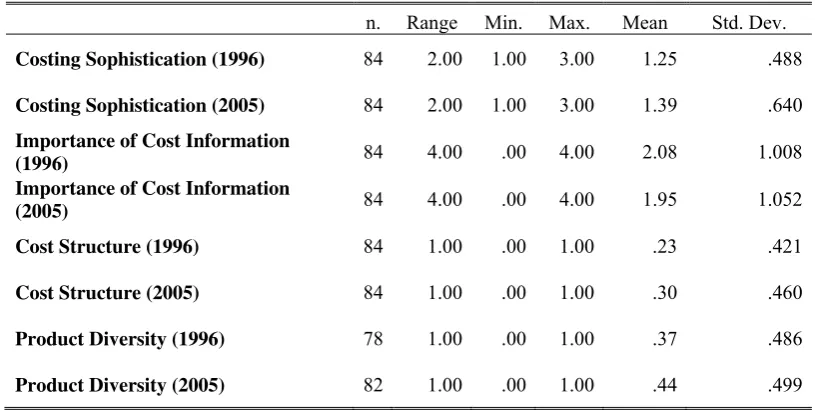
Table 13 –Descriptive statistics of the variables
n. Range Min. Max. Mean Std. Dev.
Costing Sophistication (1996) 84 2.00 1.00 3.00 1.25 .488
Costing Sophistication (2005) 84 2.00 1.00 3.00 1.39 .640
Importance of Cost Information
(1996) 84 4.00 .00 4.00 2.08 1.008
Importance of Cost Information
(2005) 84 4.00 .00 4.00 1.95 1.052
Cost Structure (1996) 84 1.00 .00 1.00 .23 .421
Cost Structure (2005) 84 1.00 .00 1.00 .30 .460
Product Diversity (1996) 78 1.00 .00 1.00 .37 .486
Product Diversity (2005) 82 1.00 .00 1.00 .44 .499
5. Findings
[image:13.595.159.438.436.545.2]The correlation matrixes of the four variables for each 1996 and 2005 survey are presented, respectively, in tables 14 and 15. Importance of cost information finds significantly correlated with costing sophistication in 1996 matrix and with product diversity in 2005 matrix. As assumed by Drury and Tayles (2005) the non significant correlations between the independent variables (except the mentioned) suggest that multicollinearity is unlikely to be an issue.
Table 14 –Correlation matrix of 1996 survey
1. 2. 3. 4.
1. Costing sophistication 1
2. Importance of Cost
Information .227(*) 1 3. Cost Structure -.103 -.045 1
4. Product Diversity .064 -.023 -.128 1
*. Correlation is significant at the 0.05 level (2-tailed).
Table 15 –Correlation matrix of 2005 survey
1. 2. 3. 4.
1. Costing sophistication 1
2. Importance of Cost
Information .189 1
3. Cost Structure .171 -.095 1
4. Product Diversity -.002 .225(*) .079 1
In order to test the hypotheses the following multiple regression was run two times (for 1996 and 2005): Y = a + b1 COSTIMP + b2 COSTSTR + b3 PRODDIV + e
where:
Y = Costing sophistication
COSTIMP = Importance of cost information
COSTSTR = Cost structure PRODDIV = Product diversity a, b1, b2,b3 = regression coefficients
e = error
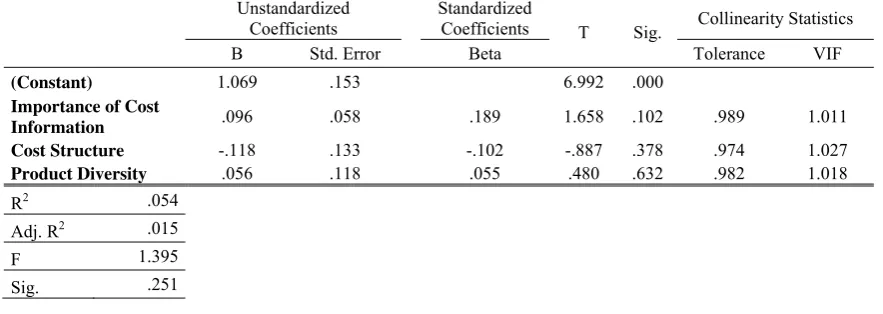
[image:14.595.73.515.264.421.2]Tables 16 and 17 provide the results of the regressions (respectively of 1996 and 2005). The choice of multiple regression was driven by the designed research method3.
Table 16 –Multiple regression output of 1996 survey
Unstandardized Coefficients
Standardized
Coefficients T Sig. Collinearity Statistics
B Std. Error Beta Tolerance VIF
(Constant) 1.069 .153 6.992 .000
Importance of Cost
Information .096 .058 .189 1.658 .102 .989 1.011
Cost Structure -.118 .133 -.102 -.887 .378 .974 1.027
Product Diversity .056 .118 .055 .480 .632 .982 1.018
R2 .054
Adj. R2 .015
F 1.395
Sig. .251
Table 17 –Multiple regression output of 2005 survey
Unstandardized Coefficients
Standardized
Coefficients T Sig. Collinearity Statistics
B Std. Error Beta Tolerance VIF
(Constant) 1.065 .162 6.570 .000
Importance of Cost
Information .139 .069 .223 1.999 .049 .941 1.062
Cost Structure .303 .153 .215 1.975 .052 .986 1.015
Product Diversity -.089 .144 -.069 -.619 .538 .940 1.064
R2 .085
Adj. R2 .050
F 2.414
Sig. .073
Multicollinearity doesn’t seem to represent a threat to the results; Variance Inflation Factor (VIF) values are well below the critical value of 10, and Tolerance value is close to 1 (indicating high independence among the variables). Cohen (1988, p.412) suggests that all adjusted R2 in excess of 0.02 should be considered as
non-
3 Using Gerdin and Greve (2004) classification, the model finds in
trivial. Thus, with the 2005 model 5% of the variation in costing sophistication is explained by the importance of cost information, cost structure and product diversity. The same cannot be asserted for 1996 model.
Given the research model, the attention to test the hypotheses is focussed on the regression coefficients (Gerdin and Greve, 2007: p.8). It was expected to find positive and statistical significant b1, b2 and b3 regressors both in 1996 and 2005. Out of the two regressions, only 2005 finds significant and positive results; they relates to the variables “importance of cost information” (B = 0.139; p = 0.049) and “cost structure” (B = 0.303; p = 0.052). It means that hypotheses 1a and 2a are accepted for 2005. For the hypotheses b it was expected to find statistical significant and more positive b1, b2 and b3 regressors for 2005 than 1996. The shift from non significant to significant results from 1996 to 2005 for the two variables (“importance of cost information” and “cost structure”) can be interpreted as confirmation of hypotheses 1b and 2b. The lack of significance of b3 regressor both for 1996 and 2005 lead us to reject Hypotheses 3a and 3b.
6. Discussion and conclusions
The peculiarity of this research is the adoption a broader perspective than previous studies, through the examination of changes in costing systems sophistication by two surveys conducted in a length of ten years (1996 and 2005) instead of a single one. The comparison was based on the same set of respondents and on the same set of questions, with a high degree of reliability of the dataset between the two surveys. This allows to overcome the limitations of the comparison among two or more different surveys conducted by different scholars in the past.
A first finding of the research relates to the change in the use of advanced and more sophisticated costing techniques (Activity-Based Costing and Target Costing). An increase from 1996 to 2005 in the use of both ABC and TC is provided here. This outcome supports the hypotesis of a higher maturity of the observerd companies in terms of advanced costing techniques consciousness, especially if linked to the increase in the use of cost information for different scopes.
The variables employed in the contingent model are the most used drawn from previous studies (Bjornenak, 1997; Gosselin, 1997; Malmi, 1999; Hoque, 2000; Baird et al., 2004; Drury and Tayles, 2005; Al-Omiri and Drury, 2007): importance of cost information, cost structure and product diversity. Whereas not significant relations are found in 1996 data, importance of cost information and cost structure are found to be positive and statistically significant associated with costing sophistication in 2005. This suggests that the more is the importance recognized in cost information and the higher is the level of costing sophistication. Such finding appears to be coherent with Baird et al. (2004) and Al-Omiri and Drury (2007) study, even though Drury and Tayles (2005) did not find significant results to support this hypothesis. Secondly, it means that the higher is the portion of indirect costs on total costs and the higher is the level of costing sophistication. Even though literature suggests that companies with high indirect costs should implement ABC (or a more sophisticated costing system), none of the previous empirical research found significant results in that sense except Bjornenak (1997). Even though an attempt to proxy the variables in the most suitable way was done, doubts and critics can rise: in fact contextual variables such as technology, size and organizational-related have been excluded from the analysis, due to the limitations in the two surveys original questionnaire content. Such variables are commonly used in contingency theory (Chenhall, 2003) and could provide a wider framework of the research. Also the selection of the dependent and independent variables of the contingent model has been affected by the research design and information of the original 1996 survey and consequently of the 2005 updating survey.
Some final considerations can be proposed with regard to the result of the presence of significant relations (regressors) in 2005 and not in 1996.
This circumstance leads us to think that increasing consciousness in the design of more sophisticated costing systems may derive from the increase in knowledge developed along time, a circumstance that could constitute a path for further research starting from this study. In fact, this consideration can introduce to at least two correlated time effects that should be taken into consideration in studying and explaining the diffusion of new techniques::
process takes place, we expect to see a higher degree of rationality (i.e., coherence with the recognised business need and increase in rationality in information usage) in the design of the cost management system. b) A fashion effect (Abrahamson, 1991 and 1996) is likely to influence the adoption with a stronger effect in
the early stages of the diffusion process when the small direct experience, and the lack of a social process of selection of knowledge, leave fashion setters like consulting firms, business gurus, business schools, business mass-media publications lead a diffusion of perception on the new techniques. Malmi (1999) stressed the importance of this “fashion and fade” phenomenon and the key role of Abrahamson’s fashion setters in the early stage of the diffusion process (Abrahamson, 1991). Under these circumstances, the diffusion of innovation is likely to take place “in waves” instead that follow a linear trends; in the early stages, adoption is not directly related to firms’ need for more coherent decision making support tools.
References
Abdel-Kader, M., Luther, R. (2008). The impact of firm characteristics on management accounting practices: A UK-based empirical analysis. The British Accounting Review, 40, 2-27.
Abrahamson, E. (1991). Managerial fads and fashions: the diffusion and rejection of innovations. Academy of Management Review,16 (3), 586-612.
Abrahamson, E. (1996). Management fashion. Academy of Management Review,21, 254-285.
Al-Omiri, M., Drury, C. (2007). A survey of factors influencing the choice of product costing systems in UK organizations. Management Accounting Research,18 (4), 399-424.
Anderson, S.H., Hesford, J.W., Young, S.M. (2002). Factors influencing the performance of activity based costing teams: a field study of ABC model development time in the automobile industry. Accounting, Organizations and Society,27, 195–211.
Askarany, D. (2005). Diffusion of innovations in organizations. In M. Khosrow-Pour, Encyclopedia of Information Science and Technology. New York: IDEA Group Publishing.
Askarany, D., Smith, M., Yazdifar, H. (2007). Attributes of innovation and the implementation of managerial tools: an activity-based management technique. International Journal of Business and Systems Research, 1 (1), 98-114.
Atkinson, A.A., Banker, R.D., Kaplan, R.S., Young, S.M. (2001). Management Accounting. 3rd ed., New York: Prentice Hall.
Baird, K.M., Harrison, G.L., Reeve, R.C. (2004). Adoption of activity management practices: a note on the extent of adoption and the influence of organizational and cultural factors. Management Accounting Research,15 (4), 383-399.
Bjørnenak, T. (1997). Diffusion and accounting: the case of ABC in Norway. Management Accounting Research,8 (1), 3-17.
Brierley, J.A., Cowton, C.J., Drury, C. (2001). Research into product costing practice: a European perspective.
European Accounting Review,10 (2), 215 - 256.
Bromwich, M., Bhimani, A. (1994). Management Accounting: Pathways to progress. London: CIMA publishing.
Cagwin, D., Bouwman, M.J. (2002). The association between activity-based costing and impovement in financial performance. Management Accounting Research,13 (1), 1-39.
Chandler, A. (1962). Strategy and Structure. Cambridge, MA: MIT Press.
Chenhall, R.H., Langfield-Smith, K. (1998). The relationship between strategic priorities, management techniques and management accounting: an empirical investigation using a system approach. Accounting, Organizations and Society,23 (3), 243-264.
Chenhall, R.H. (2003). Management Control System design within its organizational context: findings from contingency-based research and directions for future. Accounting, Organizations and Society, 28, 123-168.
Cinquini, L., Collini, P., Marelli, A., Quagli, A., Silvi, R. (1999). A survey on cost accounting practices in Italian large and medium size manufacturing firms. 22th Annual Congress of the European Accounting Association. May 5-7, Bordeaux.
Cohen, J. (1988). Statistical Power Analysis for Behavioural Sciences. Hillsdale: Lawrence Erlbaum Associates. Cooper, R. (1988a). The rise of Activity-Based Costing - Part One: What is an Activity-Based Cost System?
Journal of Cost Management,Summer, 45-54.
Cooper, R. (1988b). The rise of Activity-Based Costing - Part Two: When do I need an Activity-Based Cost System? Journal of Cost Management,Fall, 41-48.
Cooper, R. (1989). The rise of Activity-Based Costing - Part Three: How many cost drivers do you need and how do you select them? Journal of Cost Management,Winter, 34-45.
Cyert, R.M., March, J.G. (1992). A Behavioral Theory of the Firm. 2nd ed., Englewood Cliffs, NJ: Prentice Hall. Drazin, R., Van de Ven, A. H. (1985). Alternative forms of fit in contingency theory. Administrative Science
Quarterly,30 (4), 514-539.
Drury, C., Tayles, M. (1994). Product costing in UK manufacturing organizations. European Accounting Review,3 (3), 443 - 470.
Drury, C., Tayles, M. (2005). Explicating the design of overhead absorption procedures in UK organizations.
The British Accounting Review,37(1), 47-84.
Estrin, T.L., Kantor, J., Albers, D. (1994). Is ABC Suitable for Your Company? Management Accounting,April, 40 - 45.
Gerdin, J., Greve, J. (2004). Forms of contingency fit in management accounting research—a critical review.
Accounting, Organizations and Society,29(3-4), 303-326.
management accounting research. Accounting, Organizations and Society,doi:10.1016/j.aos.2007.07.003. Gosselin, M. (1997). The effect of strategy and organizational structure on the adoption and implementation of
activity-based costing. Accounting, Organizations and Society,22 (2), 105-122.
Hoque, Z. (2000). Just-in-time production, automation, cost allocation practices and importance of cost information: an empirical investigation in new zealand-based manufacturing organizations. The British Accounting Review,32 (2), 133-159.
Ifinedo, P., Nahar, N. (2006). Do top- and mid-level managers view Enterprise Resource Planning (ERP) systems success measures differently? International Journal of Management and Enterprise Development,3 (6), 618 - 635.
Innes, J., Mitchell, F. (1995). A survey of activity-based costing in the U.K.'s largest companies. Management Accounting Research,6 (2), 137-153.
Innes, J., Mitchell, F., Sinclair, D. (2000). Activity-based costing in the U.K.’s largest companies: a comparison of 1994 and 1999 survey results. Management Accounting Research,11 (3), 349-362.
Johnson, H.T., Kaplan, R.S. (1987). Relevance Lost: The Rise and Fall of Management Accounting. Boston: Harvard Business School Press.
Johnson, H.T. (1992). Relevance Regained: From Top-down control to Bottom-up empowerment. New York: The Free Press.
Jones, T.C., Dugdale, D. (2001). The concept of an accounting regime. Critical Perspectives on Accounting,12 (1), 35-63.
Kaplan, R.S. (1988). One Cost System Isn't Enough. Harvard Business Review,January-February, 61-66. Kaplan, R.S., Cooper, R. (1998). Cost & Effect. Boston: Harvard Business School Press.
Kennedy, T., Affleck-Graves, J. (2001). The Impact of Activity-Based Costing on Firm Performance. Journal of Management Accounting Research,13 (1), 19-45.
Luft, J., Shields, M.D. (2003). Mapping management accounting: Graphics and guidelines for theory-consistent empirical research. Accounting, Organizations and Society,28(2-3), 169-249.
Lukka, K., Granlund, M. (1996). Cost accounting in Finland: current practice and trends of development.
European Accounting Review,5 (1), 1 - 28.
Malmi, T. (1999). Activity-based costing diffusion across organizations: an exploratory empirical analysis of Finnish firms. Accounting, Organizations and Society,22 (8), 649-672.
Miller, J., Vollman, T. (1985). The Hidden Factory. Harvard Business Review,63 (5), 142-150.
Nanni, A.J., Dixon, J.R., Vollman, T.E. (1992). Integrated Performance Measurement: Management Accounting to support the new manufacturing realities. Journal of Management Accounting Research,4 (Fall), 1-19. Polanyi, M. (1967). The tacit dimension. New York: Doubleday.
Porter, M. (1985). Competitive Advantage. New York: The Free Press.
Shank, J.K., Govindarajan, V. (1988). The Perils of Cost Allocation Based on Production Volumes. Accounting Horizons, 58-62.