The role of molybdenum in reducing temper embrittlement
in steels.
MOTLEY, Michael.
Available from Sheffield Hallam University Research Archive (SHURA) at:
http://shura.shu.ac.uk/20093/
This document is the author deposited version. You are advised to consult the
publisher's version if you wish to cite from it.
Published version
MOTLEY, Michael. (1984). The role of molybdenum in reducing temper
embrittlement in steels. Doctoral, Sheffield Hallam University (United Kingdom)..
Copyright and re-use policy
See
http://shura.shu.ac.uk/information.html
Sheffield Hallam University Research Archive
t:
S H E F F IE L D S I P O N D S T R E E T 1W B I793442701 8 TELEPEN
lllllllllllllll
Sheffield City Polytechnic Library
ProQuest Number: 10697400
All rights reserved
INFORMATION TO ALL USERS
The quality of this reproduction is dependent upon the quality of the copy submitted.
In the unlikely event that the author did not send a com plete manuscript and there are missing pages, these will be noted. Also, if material had to be removed,
a note will indicate the deletion.
uest
ProQuest 10697400
Published by ProQuest LLC(2017). Copyright of the Dissertation is held by the Author.
All rights reserved.
This work is protected against unauthorized copying under Title 17, United States C ode Microform Edition © ProQuest LLC.
ProQuest LLC.
789 East Eisenhower Parkway P.O. Box 1346
THE ROLE OF MOLYBDENUM IN
REDUCING TEMPER EMBRITTLEMENT IN STEELS
BY
' MICHAEL MOTLEY BSc (HONS) MET.
A THESIS SUBMITTED TO THE COUNCIL FOR NATIONAL
ACADEMIC AWARDS FOR THE DEGREE OF DOCTOR OF PHILOSOPHY
Sponsoring Establishment:
Department of Metallurgy
Sheffield City Polytechnic
Collaborating Establishment: Atomic Energy Establishment,
Harwell
ppcm
M O
PREFACE
This thesis is submitted to the Council for National Academic
Awards for the degree of Doctor of Philosophy.
The research work was carried out during the period November
1978 to September 1981 at the Department of Metallurgy, Sheffield
City Polytechnic. A number of post-graduate courses were attended
at the Sheffield City Polytechnic during the above period and
included:-1. High-Strength Steels.
2. Statistics.
The author has attended a conference on "Hot Working and
Forming Processes" held at Sheffield University July 1979.
The author would like to express his appreciation to the
Atomic Energy Research Establishment, Harwell for the provision of
financial support, supply of the alloys used in the investigation
and the use of various pieces of instrumentation and equipment.
Grateful thanks are expressed to Dr. E.A. Wilson for his
interest, guidance and constant encouragement throughout the course
of this work. Also, grateful acknowledgement is made to Dr. B.C.
Edwards, Industrial Supervisor,and Dr. F.B. Pickering for numerous
helpful discussions, and to the staff of the Electron Metallography
section of the Applied Physics Department at the Polytechnic for
provision of X-ray and Electron Microscopy facilities.
Thanks also to technicians, administrative staff and lecturing
staff of the Department of Metallurgy, Sheffield City Polytechnic,
especially Dr. G. Briggs, whose role as Research Tutor was invaluable
I am also indebted to Major M. Wilkinson of Princess Marina
Finally, I would like to pay tribute to my wife, Hilary,
whose patience, support and constant encouragement played a large
part in the production of the thesis. She also typed the text.
The results obtained and the theories developed are, to the
best of my knowledge, original except where reference is made to
the work of others. No part of this thesis has been submitted
for a degree at any other university or college.
DEPARTMENT OF METALLURGY
EMBRITTLEMENT IN FERRITIC ALLOYS
by
MICHAEL MOTLEY
Synopsis
The effect of two additions of molybdenum (2.5% and 5%) on the
brittleness of an alloy based on Fe-8%Mn has been investigated. The
intergranular brittleness exhibited by the as-quenched base alloy
was eliminated by the addition of 2.5Mo possibly due to the interaction
of molybdenum with embrittling agents Mn and N and the subsequent
increase in solid solubility of these elements. A further addition
of molybdenum did not significantly increase the toughness of the
as-quenched Fe-8Mn-2.5Mo alloy in accordance with the theory of a
limiting amount of molybdenum that may combat embrittlement.
Aging quenched alloys at 450°C gave rise to an increase in
DBTT and a change in brittle fracture mode to intergranular. The
effect was most severe in the alloy with higher molybdenum (5%)
due to precipitation of second phase particles both increasing the
hardness of the matrix dramatically and denuding the matrix of
molybdenum that would otherwise be free to combat embrittlement. A
build up of Mn and N at prior austenite grain boundaries was detected
by AES, another factor contributing to embrittlement on aging.
Aging quenched alloys at 525°C led to a more rapid change
from cleavage to intergranular fracture for both molybdenum additions
but toughening of the alloy containing the lower molybdenum content
(2.5%). Although grain boundary segregation in this alloy meant that
the preferred crack path for brittle fracture changed from transgranular
to intergranular on aging, the build up of reverted austenite at prior
propagation and thus increasing overall toughness. Embrittlement in
the alloy containing 5% Mo was very severe due to more rapid
precipitation.
An investigation was also carried out on the aging of a commercial
alloy based on 0.25C, 1.4Mn, 0.5Mo, 0.6Ni, 0.3Si doped with 0.4%Cu in
one instance and 0.04%P in another. Phosphorus was seen to
characteristically induce embrittlement on aging at 450°C and 525°C
with an increase in the DBTT and a change in the brittle fracture
mode from cleavage to intergranular. Aging of the base alloy at
450°C was also seen to be an embrittling treatment but the effects
were not as severe as in the alloy containing phosphorus. The
addition of copper is seen to retard this embrittlement on aging
CONTENTS
Section Page
1. Introduction 1
1. 1 Identification of Problem, Cause and Effect 1
1.2 Commercial Aspects 1
1.3 The Aims of the Programme 3
2. Review of Literature 4
2.1 The Embrittlement Phenomena.in Steels 4
2.2 Physical and Chemical Factors Affecting Embrittlement 5
2.2.1 Chemical Considerations 5
2.2.1.1 Residuals 5
2.2.1.2 Nitrogen 9
2.2.1.3 Alloys and Alloy-Impurity Interactions 10
2.2.1.3.1 Embrittlement Enhancers 10
2.2.1.3.2 Embrittlers . 13
2.2.1.3.3 Embrittlement Retarders 14
2.2.1.3.4 Carbon 17
2.2.2 Effects of Solid Solution Treatment Temperature 22
2.2.3 Effect of Tempering Temperature 25
2.2.4 Environmental Aspects 27
2.3 Segregation - Theories and Effects 28
2.3.1 Adsorption Theories Used in the Theoretical
Understanding of Segregation 29
2.3.1.1 Dislocation Atmospheres 30
2.3.1.2 Langmuir Type Adsorption 31
2.3.1.3 The McLean Model 31
2.3.1.4 The Truncated BET Model 32
2.3.1.6 Segregation in Multicomponent Systems I 34
2.3.1.7 The Fowler Theory 35
2.3.1.8 Segregation in Multicomponent Systems II 35
2.3.2 Segregation and the Strength of Grain Boundaries 37
2.3.2.1 Effect of Segregation on the Ductile to Brittle
Transition Temperature and on Grain Boundary
Brittle Fracture Stress 39
2.4 Phenomenological Considerations 41
2.4.1 Kinetics and Thermodynamics 41
2.4.1.1 Binary Systems 41
2.4.1.2 Ternary Systems 43
2.5 Experimental Techniques Used to Study the
Segregation Involved in Embrittlement 44
2.5.1 Indirect Methods 44
2.5.1.1 Metallographic Techniques 44
2.5.1.2 Fractographic Techniques 45
2.5.1.3 X-Ray Techniques 45
2.5.1.4 Surface and Grain Boundary Energy Measurements 46
2.5.1.5 Microhardness 48
2.5.1.6 Electrical Properties. 49
2.5.2 Direct Methods 50
2.5.2.1 Chemical Etching 50
2.5.2.2 Autoradiography 50
2.5.2.3 X-Ray Techniques 51
2.5.3 Surface Analysis Techniques 52
2.5.3.1 Auger Electron Spectroscopy 53
2.5.3.1.1 The Physics of the Process 54
2.5.3.1.3 Escape Depth of the Auger Electrons
2.5.3.1.4 Composition Profiling
2.6 Controlling Methods Used to Combat Detrimental
Effects of Grain Boundary Segregation on
Embrittlement
2.6.1 Fixation Reactions
2.6.2 Increasing the Solid Solubility of Embrittling
Species
2.6.3 Reducing the Kinetics of .Embrittling Species
2.6.4 The Reduction of the Concentration of Embrittling
Species along Interfaces
2.6.5 Slip Dispersal
2.6.6 Competitive Segregation
2.6.7 Remedial Segregants
3. Experimental Details
3.1 Alloy Preparation
3.2 Heat Treatment
3.3 Optical Metallographic Examination
3.3.1 Grain Size Measurement
3.4 Impact Toughness Testing
3.5 Hardness Measurement
3.6 Tensile Testing
3.7 X-Ray Diffraction Analysis
3.7.1 Method for X-Ray Analysis and Quantification
3.8 Electron Microscopy
3.9 Scanning Electron Microscopy
3.10 Auger Electron Emission Analysis
3.10.1 Quantification of Spectra
4. Experimental Results 75
4.1 Chemical Composition 75
4.2 Series I Alloys 75
4.2.1 Metallography and X-Ray Examination of Alloys in
the Solution Treated Condition 75
4.2.2 Impact Toughness of the Solution Treated Alloys 76
4.2.3 Hardness Data for the Solution Treated Alloys 77
4.2.4 Fracture Surface Examination of the Solution
Treated Impact Specimens 78
4.2.5 Hardness of Alloys on Isothermal Aging at 450°C
and 525°C 79
4.2.6 X-Ray Diffraction Analysis of Aged Alloys 81
4.2.7 Metallographic Examination of Aged Alloys 83
4.2.8 Impact Toughness Data for the Aged Alloys 84
4.2.9 Fracture Surface Examination of the Aged Alloys 88
4.2.10 Auger Electron Emission Analysis of the As Fractured
Surfaces 90
4.2.11 Auger Electron Emission Analysis after Ion
Bombardment of the Fracture Surfaces 91
4.3 Series II Alloys 93
4.3.1 Metallography of the Quenched and Tempered Alloys 93
4.3.2 Impact Toughness Data of the Quenched and Tempered
Alloys 93
4.3.3 Hardness Data of the Quenched and Tempered Alloys 95
4.3.4 Fracture Surface Examination of Alloys after Charpy
Impact Testing in the Quenched and Tempered States 96
4.3.5 Age Hardening Characteristics on Aging at 450°C and
4.3.6 Impact Toughness Data of the Alloys After Aging
at 450°C and 525°C
4.3.7 Fracture Surface Appearance of the Impact Tested
Alloys after Aging at 450°C and 525°C
5. Discussion of Results
5.1 Composition
5.2 The Effect of Molybdenum Content on the Impact
Transition of the As Quenched Fe-8Mn Alloys
5.2.1 Optical Metallography of the As Quenched Alloys
5.2.2 General Discussion of the Effect of Molybdenum
on the As Quenched Properties of the Fe-8Mn Alloy
5.3 The Embrittlement of the Fe-Mn-Mo Alloys on Aging
5.3.1 Hardness of the Alloys
5.3.2 The Effect of Aging on the Impact Transition
Behaviour of Alloys K1526 and K1527
5.3.3 The Effect of Aging Time, Temperature and
Molybdenum Content on the Microstructure of the
Aged Alloys K1526 and K1527
5.3.4 The Effect of Molybdenum Content, Age Time and
Temperature on the Fracture Appearance of the
Broken Impact Specimens
5.3.5 X-Ray Diffraction of the Aged Alloys K1526 and K1527
5.3.6 Effect of Aging on Grain Boundary Chemistry - AES
5.3.7 Summary of the Embrittlement of the Fe-Mn-Mo Alloys
on Aging
5.4. Series II Alloys
5.4.1 Properties of the Quenched and Tempered Alloys
5.4.2 Properties of the Aged Alloys
99
102
104
104
105
108
109
113
113
116
120
123
128
130
133
135
135
5.4.2.1 Hardness on Aging at 450°C 136
5.4.2.2 Ductile to Brittle Transition Temperatures 137
5.4.2.3 Fracture Appearance 139
6. Conclusions 140
7. Recommendations for Further Work 144
Further Work of General Relevance 145
References 146
LIST OF PLATES
FIGURE NUMBER
21
36
38
57
68
69
70
71
73
74
75
TITLE
The effect of embrittlement on the brittle
fracture mode of ferrite steel.
Carbide-ferrite interface cracks in Fe-Sb, 58 Fe-Sn and Fe-As. Tested at 77 k, 800x.
Typical examples of splitting along the
carbide-ferrite interface in embrittled
Fe-0.4% C doped with Sb tested in tension at 77
110 k.
Fractographs of alloy K1525 (Fe-8Mn) after an
austenitizing treatment of 1000°C for 1 hour
followed by water quenching (WQ).
Fractography of alloy K1526 (Fe-8Mn-2.5Mo) after 309
a solution treatment of 1000°C for 1 hour + WQ.
Fractographs of K1526 after a solution treatment 311
of 1300°C for 1 hour + WQ.
Fractographs of K1526 after 1300°C for 1 hour + WQ 313
and then 1000°C for 1 hour + WQ.
Fractographs of K1526 after 1300°C for 1 hour + WQ 315
and then 850°C for 1 hour + WQ.
Fractographs of alloy K1527 (Fe-8Mn-5Mo) after 319
1000°C for 1 hour + WQ.
Fractographs of K1527 after 1300°C for 1 hour + WQ 321
Fractographs of K1527 after 1300°C for 1 hour + WQ 323
and then 1000°C for 1 hour + WQ.
PAGE NUMBER
219
247
251
76
84
85
86
87
88
89
92
93
94
95
96
97
98
99
109
110
111
Fractographs of K1527 after 1300°C for 1 hour + 325
WQ and then 850°C for 1 hour + WQ.
Electron micrographs of K1527 in the as-quenched 341
condition and in the aged condition.
Electron micrograph, diffraction pattern + 343
solution of the matrix of K1527 in the as-
quenched condition.
Diffraction pattern + solution of the matrix of 345
K1527 in the aged condition.
Electron micrograph showing precipitation in the 347
aged K1527.
Dark field of Figure 87. 349
Diffraction pattern of precipitates in K1527 351
shown in Figure 87. Two possible solutions.
Fractographs of K1527 aged for 17 hours at 450°C. 357
I I " K1526 I I 480 I I I I 359
I I " K1526 I I 17 If 525°C. 361
I I I I I I I I 480 11 I I 363
I I " K1527 II 17 II 450°C. 365
I I 11 I I 11 480 I I I I 367
I I I I I I I I 17 11 525°C. 369
I I I I I I 11 480 11 I I 371
Optical micrographs of etched K1526 after 1 hour 389
at 1000 °C.
Optical micrographs of etched K1526 after 1 hour 391
at 1300 °C.
Optical micrographs of etched K1526 after 1 hour 393
112
113
114
115
116
117
118
119
126
127
131
132
133
135
136
Optical micrographs of etched K1527 after 1 hour 395
at 1000°C + WQ
Optical micrographs of etched K1527 after 1 hour 397
at 1300°C + WQ.
Optical micrographs of etched K1527 after 1 hour 399
at 1300°C + WQ and then 1 hour at 1000°C + WQ.
SEM micrograph of inclusion in K1526 and K1527 401
showing X-ray mapping for oxygen and sulphur.
Optical micrograph of unetch'ed K1526 after 1 hour 403
at 1000°C + WQ.
Optical micrograph of unetched K1526 after 1 hour 405
at 1300°C + WQ and then 1 hour at 1000°C + WQ.
Optical micrograph of unetched K1527 after 1 hour 407
at 1000°C + WQ.
Optical micrograph of unetched K1527 after 1 hour 409
at 1300°C + WQ and then 1 hour at 1000°C + WQ
Electron micrographs of K1526 and K1527 in the 423
solution treated condition after 1 hour at 1000°C
+ WQ.
Electron micrograph of K1526 solution treated at 425
1000°C for 1 hour + WQ and then aged for 193^ hours
at 450°C + WQ.
Optical micrographs of etched A217 in the quenched 433
and quenched and tempered condition.
.. n .. i. ii A317 H H .. 435
ii ii ii ii ii A417 " " " 437
Fractographs of A217 in quenched and tempered 441
condition.
142 Fractographs of A217 after 10 hours aging at 450°C 455
143 I I IV A217 " 168 " " " 525°C 457
144 I I II A317 " 10 " " " 450°C 459
145 II II A317 " 168 " " " 525°C 461
146 I t II A317 " II II I I II II 463
147 II II A417 " 10 " " " 450°C 465
148 II II A417 " 168 " " " 525°C 467
149 II IT II II II II II VI II 469
150 Micrographs showing propagation of cracks along 471
austenite grain boundaries below the intergranular
fracture surface in alloy K1526 after aging at
525°C for 480 hours.
151(a) Interlath fracture shown on the intergranular 473
" (b) facets of alloy K1527 after aging at 450°C for 475
1. Introduction
1.1 Identification of Problem, Cause and Effect
A difficulty faces the users of the high strength martensitic
steels when the optimum combinations of strength, ductility and
toughness are achieved by heat treatment. This problem is that
the very heat treatment used to attain these superior qualities
in the steel may cause embrittlement.
The embrittlement is seen to be a loss of toughness primarily
as a result of either holding in or slow cooling through a
temperature range 350°C - 550°C after tempering at a higher
temperature, 600°C (classical temper embrittlement) or slow
cooling as quenched alloy steels in the range 250°C - 450°C
(tempered martensitic embrittlement).
The main cause of embrittlement is segregation of elements
to the prior austenite grain boundaries with the effect of a
reduction of grain boundary cohesive strength.
The embrittlement is manifest as an increase in the ductile/
brittle transition temperature together with a change in the
low temperature fracture mode from cleavage to intergranular. t
1.2. Commercial Aspects
Pressure vessel and cryogenic facilities have for a long
time now been two of the many fields of use for ferritic steels.
While manganese is an accepted constituent of these steels, the
problem it and other elements cause, due to the phenomenon of
embrittlement, is well known.
This problem arises in pressure vessel steels by virtue of
their high hardenability because,to attain through-section
they are often used in the quenched and tempered condition.
These susceptible steels, when operated for long times at
temperatures around 450°C, may severely embrittle, causing the
temperature at which the material undergoes the ductile to
brittle transition to increase dramatically. While this
transition temperature is well below the material's operating
temperature, in such applications it is possible that the
embrittlement could be so severe that cooling to ambient would
involve passing through the transition temperature. A load
imposed on an embrittled pressure vessel, at or below this
temperature, could be catastrophic.
4
The same problem has also faced the workers, in recent
years, who have tried to devise a new cryogenic steel based on the
iron-manganese system as an alternative to the more expensive but
accepted iron-nickel system. Whether the iron-manganese system
can lend itself as a basis for cryogenic high strength steels
depends on the mechanical properties, in particular low temperature
toughness, that can be achieved.
The advantages of the iron-manganese system in this application
are economy, similar austenite ferrite transformation products to
the iron-nickel system, tensile properties and greater solid-
solution strengthening. But,unfortunately, the iron-manganese
systems have been shown to exhibit poor impact properties
7 characterised by a low temperature intergranular fracture mode.
The embrittlement behaviour is analogous to that of temper
embrittled steels, with the fracture propagating along the prior
austenite grain boundaries,and is enhanced on tempering within
the temperature range 400°C - 500°C.
-1.3 The Aims of the Programme
The characteristics of embrittlement in ferritic steels
have been well documented over the past twenty years but still
little is understood of its mechanisms. This programme of work
sets out to investigate these embrittlement phenomena in ferritic
steels, with particular reference to the cryogenic and pressure
vessel applications.
The basis of the cryogenic alloy studied was the iron-8%
manganese alloy developed in the department over the last few 8 9
years. ' Molybdenum has for a long time been known to inhibit
embrittlement when it is present in steels in certain amounts.
Therefore, its addition to the iron-8% manganese system would seem
a useful if not obvious aspect for investigation.
Of particular interest to UKAEA Harwell, the sponsors of this
work, was embrittlement of pressure vessel steels. The phase
composition of the type of steel investigated here was 0. 25C,
1.4Mn, 0.5Mo, 0.57Ni, 0.3Si. The effects of embrittling elements Mn,
P, and Cu and de-embrittlers C and Mo were to be studied separately
and together on changes in mechanical properties and microstructure
of the steels after various heat treatments.
Regarding the investigation of the pressure vessel types of
alloys, the elements carbon, manganese, molybdenum, phosphorus and
copper involved in the embrittlement problem form the basis of a
series of permutations for alloys to be investigated.
Changes in mechanical properties, microstructure and internal
chemistry are to be under investigation following a series of heat
2. Review of Literature
2.1 The Embrittlement Phenomena in Steels
Embrittlement is confined mainly to tempered alloy steels,
showing up most strongly when the steels are in the martensitic
condition. The temperature range for the development of
embrittlement is about 350°C-650°C At the low end of this
range, the ratesof the embrittlement processes are low but the
maximum achievable amount of embrittlement is higher than at the
higher temperatures when the rate is higher.
Embrittlement is manifest as an increase in ductile to brittle
12
transition temperature , Fig. 20, and a change in brittle fracture
mode from transgranular cleavage to intergranular, Fig. 21.
1 3 Work on chemical analysis of these intergranular fractures
using modern surface analysis techniques has shown embrittlement to
be associated with segregation of elements to prior austenite grain
boundaries, Fig. 22. 14
Ferrell summarised temper embrittlement, as seen m Table 7*
Although this does not cover all types of embrittlement, it shows
the basic trends. Another type of embrittlement is tempered
martensite embrittlement, which occurs when high temperature 1 5
tempering, m certain alloys, has not been carried out and is
16 concurrent with inter^lath Fe*C precipitation
-2.2 Physical and Chemical Factors Affecting Embrittlement
2.2.1. Chemical Considerations (Alloys and Residuals)
2.2.1.1. Residuals
A turning point in the understanding of embrittlement in
steels was the demonstration that embrittlement in steels was
only possible if certain impurities were present and so was 17 18
only peculiar to commercial steels. 1 In this work, steels
were made from high purity elements in combinations corresponding
with well known alloy steel types that would normally be susceptible
to temper embrittlement. The high purity steels were tested for
embrittlement by slow cooling after tempering as well as by
prolonged reheating at the temperature of maximum sensitivity.
Transition temperatures remained unchanged and brittle fractures
transgranular, Fig. 23.
The outcome of this work then was to associate the presence
Of residual impurities with susceptibility to temper embrittlement.
Probably the most important of these impurities, not necessarily
because of severity of effect but because of its ever prominent
presence in low alloy steels, is phosphorus. It is a hard tramp
element to eliminate wholly.
1 9
Work on a 1.5Mn-Mo steel with 0.06%P showed that in both
fully and partially hardened and tempered steels, rises in impact
transition temperature were encountered with rises in phosphorus
content of the steel. This may be compared to no effect in steels
free from phosphorus.
How phosphorus has a major effect on embrittlement can be
explained by the fact that surface analysis of fractures by
auger electron spectroscopy has linked embrittlement with phosphorus
20
phosphorus is favoured by the phosphorus atones poor fit in the
21 .
iron based centred cubic lattice, i.e. although the phosphorus 22
atom is substitutional m the^C-iron lattice it is smaller than
the substitutional site it is presumed to occupy. Hence, it would
contract the parent lattice. This gives a driving force for
phosphorus diffusion to grain boundaries. Also, phosphorus has . . 23
a high diffusion mobility . For example, this diffusion
mobility is three times higher at annealing temperatures than
that of alloys, giving rise to rapid phosphorus redistribution,
24 25
Fig. 24 . Figs. 25, 26 show temperature dependence of
diffusion coefficient of P for and oC-ivon respectively.
Phosphorus has been shown to reduce the surface energy of
26
iron , Fig. 27. A monolayer of phosphorus on a grain boundary
can lead to intergranular fracture paths because of greatly reduced
surface energy requirements. For brittle materials, this is
reflected as a decrease in the fracture stress, in the Griffiths
27 28
equation . The Gibbs adsorption theory predicted that
phosphorus would lower the surface energy of iron.
The segregation of phosphorus to surfaces of iron is seen to 29 30
be equilibrium segregation, not precipitation 1
The phosphorus segregation and increase in ductile to brittle
transformation temperature are greater the lower the age temperature 31
and the higher the bulk concentration of phosphorus, another
verification of the Gibbsean segregation model.
At what stage phosphorus segregates and causes this effect is
a question that has been in some dispute. It is generally thought
that phosphorus segregation occurs during solution treatment in the
32 33 34
austenite range, 1 although some would challenge this . The
conclusion so far then is that phosphorus segregation in the $
range depends on certain factors such as solution treatment
-temperature, quench rate, structure, composition and grain
boundary area: phosphorus concentration ratio. Generally,
phosphorus is seen only to segregate in the austenite region with
large grain sizes. The majority of phosphorus segregation, then,
is thought to occur during the ageing process.
The increase in intergranular grain boundary phosphorus
concentration with ageing time and temperature is shown in Fig.
28. At high tempering temperatures, the acquisition of steady
state is more rapid but total phosphorus build up is lower
compared to lower ageing temperatures. 35
Some workers have suggested that phosphorus promotes
embrittlement by the formation of voids on grain boundaries
during stress relaxation, thus reducing ductility. But the
effect of phosphorus attracting the largest interest is the change
induced on grain boundary energy. Grain boundary energy has been
studied with respect to phosphorus segregation by observing triple 36
points. It was found that phosphorus segregation varies from
one grain boundary to another. At coherent twin boundaries no
phosphorus segregation was seen to occur; at incoherent twin
boundaries, segregation of phosphorus was seen to occur.
Therefore, phosphorus segregation does not just depend on grain
boundary energy considerations per se but also on coherency or free
volume. The atomic structure of the grain boundary is seen to be
an important factor then in phosphorus segregation - the coherent
boundary has associated Free energy but no free volume which can
accommodate misfitting atoms of solute.
Other impurities such as arsenic, tin and antimony also cause 38
37
rate of diffusion in the G^-iron lattice. Effects of other
39
residuals depends on the amount of phosphorus present and it
has also been observed that the mechanism of segregation of 40
phosphorus is very different to other impurities.
-2.2.1.2 Nitrogen
The tramp elements so far mentioned are seen as a problem
but their amounts can be controlled in steel to a certain extent
by the choice of materials for steelmaking. Nitrogen poses a
different kind of problem in that pick up from the atmosphere
during steelmaking is a.real possibility.
As regards the embrittlement phenomenon, nitrogen has been
32 40 seen to segregate during both austenitising and ageing treatments *
causing one step temper embrittlement. In a tempered martensite 32 structure, it has also been seen to segregate to dislocations.
Usually, nitrogen is tied up within the matrix by elements
such as Al. But in cases when sufficient nitrogen is released and
untrapped at austenitising, it will segregate to grain boundaries
. . . 41
2.2.1.3 Alloys and Alloy-Impurity Interaction
In plain carbon steels, with no major alloying additions,
temper embrittlement due to the presence of metalloid elements
42 . .
does not occur. The addition of alloying elements to these
steels promotes rapid embrittlement.
The major alloys involved in embrittlement are Nickel,
Chromium, Manganese and Molybdenum. These can be split into
three categories; embrittlement enhancers, embrittlers,
embrittlement retarders.
2.2.1.3.1 Embrittlement Enhancers
This category involves alloying elements which will promote
embrittlement processes but in themselves are probably not
embrittlers in their own right.
40,31 41
It has been reported that nickel and chromium
segregate to prior austenite grain boundaries in the ferrite range
during aging but not during solution treatment in the austenite
phase field. Figures 29 and 30 show the build-up of nickel at grain
boundaries during the aging of an En30A steel. Removal of nickel
and chromium from alloy steels decreases the amount of shift in
transformation temperatures produced by step cooling in the temper 53
embrittlement range. Work on Fe-C and Fe-C-P alloys produced no
embrittlement on tempering, whereas Fe-Cr-C-P and Fe-Mn-C-P alloys 44
were susceptible to temper embrittlement.
The way in which alloying elements effect this phenomenon is a
question under much debate. Chromium is known to increase matrix
hardness, so enhancing hardenability and resistance to softening
during tempering. This action would produce a tendency for steel 31
containing chromium to temper embrittle. Nickel is seen to increase
-the segregation of phosphorus to grain boundaries by a factor of
10-100 when compared to an Fe-P alloy at 500°C.^ Nickel has no
solid solubility in carbides, so it would tend to build up at
the carbide-ferrite interfaces, lowering the chemical potential
of impurities in grain boundaries and so promoting impurity 46
diffusion to gram boundaries. Interfacial combinations of
47 49 48
alloys and impurities, e.g. Sb-Ni , Sb-Mn , P-Ni are seen
to be stable in accordance with Gibbsean equilibrium segregation.
The reason that alloys segregate in the ferrite phase field
is thought to be due to an alloy-impurity interaction. Double
11
segregation was at one time thought to be involved but has
. . . 51
now been dismissed as a possibility.
An example of this interaction is Sn-Ni which is expected
from the effect of nickel in lowering the solubility of tin in 50
Ot -iron. This is due to a stronger mutual attraction and a
tendency to form intermetallics between Ni-Sn than between Fe-Sn. 50
Chromium also depresses the solubility of tin in d^-iron. 53
Low et al obtained the earliest evidence for major
element-impurity interaction and they suggested strong interactions of the
Cr-P and Ni-Sn types but a weak one for Ni-P. The latter point
was expanded on when it was found that phosphorus segregates 14
whether nickel is present or not.
Guttmann used a thermodynamic approach to assess the relative
strength of any possible alloy-residual interaction by assuming
equilibrium segregation of both types of solute in the & -phase.
He used a ternary solution as a model and the matrix and the grain
boundaries were treated as separate phases. His calculations reveal
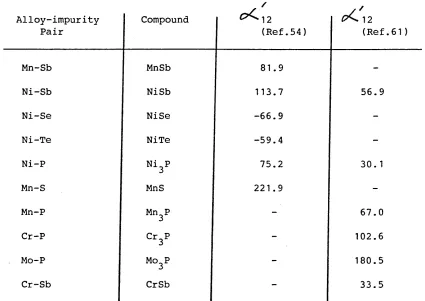
that interactions for the couples Ni-Sn, Ni-Sb and Ni-P should be
many others. No direct evidence of these phases has been found
as yet, although, indirectly from auger analysis for Sn< 6 atomic^ §
55 the Ni:Sn ratio at the boundary approximates to that of Ni^Sn^.
-2.2.1.3.2 Embrittlers
Generally, alloys are not seen as embrittlers in their own
right but merely enhance the embrittling behaviour of metalloid
elements. Manganese though is seen to be an exception to this
rule.
An increase in the degree of temper embrittlement is seen 43
with increase m manganese content of a steel and manganese
is seen to segregate to austenite grain boundaries in the ferrite
phase.
41’56-18 The first reports of manganese as an embrittling agent
met with a degree of sceptisism due to the fact that a Group
VIIA element should act like a metal, not a metalloid, and being
a7 stabilizer, manganese has effects on phase equilibria in iron
different to any other embrittling agent. The other metalloid
elements are all ferrite stabilizers or If• loop formers. Hence,
they are likely to be rejected from the austenite matrix during 58 solution treatment and end up on the austenite grain boundaries.
Manganese is not a loop element and on this basis should
be unlikely to segregate during austenizing. However, nickel is
not a 7 - loop element either, yet segregation of this element has 59
been found at brittle mtergranular surfaces. It is therefore
likely that when manganese is present in sufficient amount segregation
to grain boundaries will occur. Indeed, manganese segregation per
se has been blamed for temper embrittlement in a high purity Fe-Ni-Mn
alloy ^ but nitrogen is present in the Auger s i g n a l . I t has
also been stated that it is a more severe embrittler than tin, . 3 8
antimony or arsenic.
embrittlement is concerned, as little as 0.7% Mn has been found 18 to induce temper embrittlement when added to Ni-Cr steel.
It has also been suggested that manganese acts like chromium 57
in enhancing the embrittling effect of phosphorus. Manganese
23
weakens the atomic bonds of phosphorus in ferrite giving a
drop in diffusion activation energy of phosphorus in ferrite.
This would make the transfer of phosphorus in ferrite more
favourable giving grain boundary enrichment of this impurity.
Manganese has also been reported as an enhancer of the embrittling
effects of tin, antimony and arsenic as well,due to some interaction,
making these elements more effective at lower levels within the
steel. Phosphorus has been seen to segregate to grain boundaries
after manganese has segregated, presumably due to a Mn-P 61
interaction.
The kinetics of the build up of manganese and phosphorus on 62
grain boundaries in Fe-8.0Mn alloys has been studied
The conclusion of this work was that the diffusion coefficients
of manganese and phosphorus are consistent with bulk lattice
diffusion values of manganese and phosphorus in ferrite.
Some chemical interaction of manganese and phosphorus during
austenitising may contribute to the driving force for manganese 51
segregation m ferrite.
2.2.1.3.3 Embrittlement Retarders
The addition of certain alloying elements to steels is seen
to retard embrittlement. This action is thought to be caused by
these elements somehow slowing down or halting the diffusion of
the embrittling agent in the iron matrix.
The most widely reported in this class of alloying elements is
the effect of molybdenum on phosphorus-induced embrittlement of steels.
-The ductile to brittle transition temperature and the amount
of intergranular fracture are seen to decrease with an increase in 63
molybdenum content of a steel. This is only true, though, up to
a certain concentration of molybdenum. Too much of it is seen to
actually be detrimental in that it will enhance embrittlement.
Fig. 31 utilises a calculated temper embrittlement susceptibility
factor to show the effect of molybdenum concentration. Fig. 32
measures the improvement in impact transition temperature with
molybdenum concentration and shows an improvement only up to a
critical molybdenum level, after which there is seen to be a
deterioration in this property. Molybdenum also affects other
mechanical properties in steel, as shown in Fig. 33.
It is generally believed that molybdenum retards embrittlement
by its influence on solubility and consequently segregation of
impurities.^ With particular reference to the embrittling
element phosphorus, molybdenum is seen to increase the activation
energy for phosphorus diffusion and also the binding energy of
66
phosphorus in the 0 -iron lattice. Evidence of this can be
seen where molybdenum increases the activation energy for phosphorus 23
diffusion in a Ni-Cr steel which could lead to a slower diffusion
and a lower concentration of embrittling elements at the grain
boundaries.
Molybdenum increases the solubility of impurities, then, in
steel but only as long as it is in solid solution. When it
precipitates out, the solubility of impurities decreases and they 46
can then diffuse to gram boundaries.
Fig. 34 shows the excess solute, , at grain boundaries
as a function of temperature indicating how step cooling combines
higher chemical driving forces at lower temperatures. If
molybdenum shifts the f vs T curve to lower temperatures, the
first stage of the step cooling process may not contribute
significantly to the embrittling process, resulting in no apparent
embrittlement.
44
Early workers deduced that molybdenum decreased the
equilibrium degree of embrittlement rather than the rate at which
equilibrium is achieved.
64 Other elements, including tungsten, niobium and titanium
67
as well as some rare earths, are seen to retard embrittlement.
Titanium has a particular effect on phosphorus by the formation
of stable phosphides in the iron matrix thus lowering the phosphorus 24
concentration m solution. This is due to the higher affinity
than iron that titanium has for phosphorus. The rare earths,
lanthium and cerium also form stable microcompounds with phosphorus
and have a higher affinity for it compared to iron, Fig. 35. In
this way, then, they too retard embrittlement.
The retarding effect of these alloys mentioned is however
affected by the level of carbon present in the steel. For instance,
if molybdenum were to be precipitated in the steel by carbon,
temper embrittlement would occur more readily. This effect is more
pronounced with increasing age temperature and increasing carbon
content. If the Mo:P ratio is high, molybdenum is not precipitated
out by carbon and the molybdenum scavenges phosphorus. This is 54
explained by Guttmann's analysis dealing with the attraction of
two solutes in a ternary system. He showed that in a ternary solution
in which the attraction of the two solutes for each other is stronger
than that of either for the solvent, then the solutes would tend to
-segregate to the grain boundary. As the intensity of mutual
attraction of the solutes increases, the tendency towards
segregation should become stronger. However, at some point
the attraction can become so strong that the solutes immobilize
each other, either by precipitation or by the formation of some
relatively immobile complex. Molybdenum is a strong carbide
former negating the scavenging effect on phosphorus. So the
ability of molybdenum to suppress phosphorus embrittlement depends
on C:Mo and P:Mo ratios.^
As well as slowing down phosphorus diffusion in two phase
& + $ regions, molybdenum also slows down the diffusion of this
23 metalloid in Fe^C.
Manganese has also a response, as the metalloid embrittling
• •
57
agents have, to molybdenum additions.
The effects of carbon on the retardation of embrittlement
by titanium is similar to molybdenum, in that at high carbon 24
contents titanium is competed for by carbon.
2.2.1.3.4 Carbon
Carbon, especially in the form of carbides, has been seen
to contribute quite an amount towards understanding the full
picture of the embrittlement problem in commercial steels.
Commercial steels inevitably contain carbon and, if tempered at
some stage or other, will more than likely contain carbides.
These carbides are seen to contribute to embrittlement (a)
mechanically and (b) chemically, (a) Mechanically they are seen
as barriers of dislocation movement, so helping to initiate 32
intergranular cracks. A second factor is associated with the
degree of carbon supersaturation produced on quenching from 650°C
effect on the flow stress. While age hardening that occurs
within the temper embrittlement range does not by itself result
in intergranular fracture it can make a significant contribution 52
to the shift in DBTT.
(b) Chemically, carbides can be rejectors of impurities, so
enriching grain boundaries with them.
Changes in brittle fracture mode from transgranular to
intergranular havebeen associated with the transformation of 70
£-carbide to fine, plate-like cementi±e. But embrittlement was
found not to occur in carbon steels of high purity i.e. containing 33 71 72
no residual impurities. 1 1
58
It has been postulated that the reasons why the prior
austenite grain boundaries are the preferred fracture paths are
that they are the locus of the highest embrittling element
concentration and they represent a continuous internal surface
on which carbide precipitation has occurred. In the absence of
embrittling elements, this carbide precipitation is of little
consequence, but if the cohesive strength of the carbide-ferrite
interface is lowered by impurity segregation, then an especially
fragile situation develops. This is because the interface between
a hard, brittle particle and a plastic matrix is much easier to
separate (during shear in the matrix) than is the interface between
two plastic grains. In the latter case accommodation by plastic
flow is possible, in the former case it is not. 73
It has been shown that if antimony is allowed to segregate,
in a Ni-Cr steel, to carbide-ferrite interfaces in a high carbon
ferrite, the interfaces can be made to split open in tension at
low temperatures, whereas reheating to a higher (de-segregating)
-temperature and quenching restores the normal high tenacity of these
interfaces. This effect has also been shown in a Fe-C-Sb ferrite and
other heats containing arsenic and tin. Figure 36.
It has been possible to obtain very large variations in inter
granular strength in ferrite ( * 23ppm 0%, ^ 46 ppm C) by varying
the amount of segregated carbon through the selection of temperature
from which the solution treated ferrite is quenched prior to low 74
temperature testing. Figure 37 shows this variation and its
correlation with the amount of intergranular fracture. The lack of
ductility to the right of the peak is due to carbon insufficiency at
grain boundaries, caused by a low amount of equilibrium segregation
of carbon at high temperatures. The low ductility to the left of the
peak is caused by carbide-initiated cleavage fracture. The ductility
maximum occurs when sufficient carbon has segregated to scavenge the
residual oxygen, but when the formation of carbides larger than
^ I^m thickness has not yet occurred.
Because impurities segregation and carbide transformation have
both coincided with the onset of temper embrittlement, a
carbide-impurity interaction has long been postulated. Indeed, adjustments in
carbide composition occur in alloy steels after precipitation has 75
occurred i.e. partitioning occurs such that, for example in a Cr-steel, 76
the chromium content of the cementite increases with time and it would
be expected that other elements such as silicon and phosphorus would be
expelled into the ferrite matrix where their chemical potential would be
lower.
77
Rellick used an Fe-C alloy doped with impurities to show these
effects. The resultant splitting along carbide-ferrite interfaces is
and the ferrite matrix were severely embrittled during a furnace cool to o
room temperature from 925 C for materials containing Sb, Sn or As, but
not for one containing P. This mode of embrittlement could be reversed
by reheating to 650°C for h hour and quenching but the original carbide-
ferrite interfaces could not be re-embrittled by holding at 480°C for
up to 74 days. Instead, a new mode of weakness accompanied the
o reprecipitation of fine cementite at ferrite grain boundaries at 480 C
in all materials with embrittling elements added, including the P-doped
alloy. None of these manifestations of interface weakness was found in
similar Fe-C alloys free of added embrittling elements.
It is assumed that embrittling metalloid elements have negligible
solubility in Fe^C; a precipitating carbide would tend to reject such
foreign atoms. Indeed,these elements and carbon are reported to have no 78
measurable mutual solubility, and they do not form carbides. The
impurities would tend to build up in the ferrite alongside the
carbide-ferrite interface. The subsequent series of events are shown
diagramatically in figure 39.
Figure 40 shows that precipitate can only grow as fast as the
rejected solute diffuses away in the ferrite matrix resulting in a solute
concentration gradient ahead of an advancing interface. A Zener analysis
applied to this diffusion controlled growth gives figure 41 showing the
carbide being cored with respect to impurity content.
Eventually, impurity concentration at carbide-ferrite interfaces is
high enough to diffuse into the matrix giving a decrease in temper 46 embrittlement or the phenomenon, sometimes called overaging.
This type of embrittlement is due to non-equilibrium segregation
although it does not preclude equilibrium segregation, and the two types
could exist together.
-Grain boundary phosphorus decreases when carbon atoms dissolved in 79
ferrite decreases, supporting this idea of a non-equilibrium theory of
2.2.2 Effects of solution treatment temperature.
The main effect is the variation in grain size with temperature
-the higher -the austenitizing temperature before quenching, -the larger
the grain size. It has been well established that a small grain size
can be utilised to strengthen a material and also improve the toughness. 83
Hall and Petch gave the strength/grain size relationship of
engineering materials as ;
0 g = ^ + d^Ky
where
oif - yield stress
0 = lattice friction stress
2d = grain diameter
Ky = constant - a measure of the difficulty of spreading yielding
from grain to grain.
A decrease in grain size gives an increase in toughness and so a
decrease in ductile to brittle transition temperature. In the case of
brittle cleavage fracture, grain boundaries act as barriers to the
propagation of brittle cracks and thus a finer grain size, giving more
grain boundaries per unit area, produces greater toughness. Although
austenite grain size is less effective than ferrite grain size-on 80
improving fracture toughness. Therefore, solution treatment temperature
is seen to indirectly affect temper embrittlement by the fact that
increasing the austenitizing temperatures increases grain size giving an
21 87 69
increase in ductile to brittle transition temperature. ' ' This is
seen to be a particular problem in the heat affected zones of welds in 38 susceptible steels, where the grain size is often uncontrollably large.
The grain size will affect the fracture path such that, with a large
grain size, there are less frequent deflections in the fracture path so a
-21
subsequent lower fracture energy associated with it.
There is some question as to whether impurities segregate during
austenitization or not.
Often, with very large grain sizes (250 - 50^*m) evidence of
phosphorus segregation to prior austenite grain boundaries has been 51 57
obtained during solution treatment. ' But the extent of enhanced
concentration of phosphorus during austenitizing depends on a combination
of parameters such as austenitizing temperature, quench rate, structure,
composition and the ratio of phosphorus : grain boundary area. Without
considering all of these some workers have concluded that no segregation . . . 40 .
occurs during austenitizing; with increasing gram size (increasing
austenitizing temperature) there is a small decrease in phosphorus
32 36 “1 41
concentration ' hence giving a T relationship; while others have
found phosphorus segregation to be unaffected by austenitizing treatment
and grain size.
31 21
Mulford graphically represented work by Capus , given in figure
42, to show the grain size effect on ductile to brittle transition
temperature to be magnified by the addition of embrittling agents. 81
Guttmann postulated that although there has been no segregation
found (of Sb) to prior austenite grain boundaries on quenching after short
austenitizing treatments near or well above it should be possible
to obtain segregation after prolonged heat treatment. This is because
a longer treatment at a lower temperature is more likely to induce a
phenomenon supposedly controlled by a Langmuir-type isotherm. But, up
to date, no segregation of Sb has been proven at these sort of temperatures.
Recently, studies of microcracking in plate martensite in Fe-C steels 82
have been carried out. Microcracks are seen to form on two sites
(b) Intragranularly at points of impingement of martensite plates.
With a fine grained steel, the onset of one step temper embrittlement
is seen to coincide with the formation of isolated intergranular microcracks
acting as nuclei for cleavage cracks. With a coarse grained material,
intergranular microcracks are larger and more readily connected.
Therefore, the energy trough is produced and the whole energy curve is
shifted downwards.
-2.2.3 Effect of Tempering Temperature
The embrittlement problem arises when the material is slowly
cooled through a critical temperature range (typically 350 - 600°C)
This is especially a problem for large components, for example heavy
forgings, etc., which must, because of the masses involved, be cooled
down very slowly from heat treatment temperatures.
84 Embrittlement has been found to occur up to the Ae^ temperature
in nickel-chromium steels. Isothermal embrittlement was examined in 85
SAE 3140 steel and was found to occur in two separate regions. The
lower nose or reversible embrittlement range extends downwards from
600°C being most rapid in the range 550 - 490°C and carries on to low
temperatures where the rate of embrittlement is slow. The upper nose or
irreversible embrittlement range starts at Ae^ where it occurs rapidly
and continues downwards, overlapping the lower range, the rate decreasing
with decreasing temperature. These results were obtained by the use of
the embrittlement diagram whose ordinate is temperature and abscissa
is a plot of log time at temperature. The curves produced (e.g. figure
43) are then temperature against time resulting in the same ductile to
brittle transformation temperature i.e. similar amounts of embrittlement. o
Step cooling from around 590 C can produce as much embrittlement as
86
much longer isothermal treatments at maximum embrittling temperatures.
This effect can be rationalised on the C-curve in that the initial
embrittlement is the highest rate at high tempering temperatures whereas
the actual maximum amount of embrittlement can only be achieved at lower
temperatures. Step cooling treatments attempt to optimise the effects
of the whole embrittlement range.
Figure 44 shows the typical toughness "trough" which exists during
temper embrittlement region. Many suggestions for the trough have 87
subsequently been put forward; the theory of Irani suggests that the
temperature range is both high enough for coarse carbide formation and
yet too low for dislocation recovery.
88
Using the isoembrittlement curves, Seah has taken vertical
sections about one time (200h) to predict segregation of phosphorus
at a function of isothermal holding temperature and compared it with
89 .
the experimental data of Carr et al, showing a good correlation in
figure 45.
Historically, research into temper embrittlement has been divided
into two. One type of embrittlement occurs in steels with very high
yield strengths. Here, the martensite has been tempered for short
times at low temperatures. Because this state of embrittlement has
occurred after a single tempering treatment of the martensite, it has
been referred to as one-step temper embrittlement.
The other type occurs in steels with a lower yield strength. This
is the result of a high-temperature tempering of the martensite at
* 600°C which may allow the martensite-^ferrite + cementite reaction
to near completion. The embrittlement occurs when the steel is
subjected to an additional thermal age near 500°C, whether it be
isothermal or slow cooling. This is two-step temper embrittlement. The
schematic representation in figure 46 clearly demonstrates the basis on
which these nomenclatures have been chosen.
-2.2.4. Environmental Aspects
These must be briefly mentioned because the presence of an
aggressive environment often induces intergranular brittleness in
steels which may otherwise be ductile. The environment may be 90
gaseous such as hydrogen or hydrogen sulphide, etc. , an aqueous -91
solution such as NOj or OH or even a liquid metal e.g. Cadmium,
4- 92 mercury, etc.
If the fracture is caused by hydrogen, then the process is often
referred to as hydrogen embrittlement or hydrogen-assisted cracking.
The fact that hydrogen induces intergranular failure in steel has been
used in auger analysis to help measure segregation to grain boundaries
in steels before they actually embrittle normally e.g. in the austenite 40
field. It is a useful tool in steels that would not normally fail
by intergranular fracture.
If the fracture is caused by oxidation and dissolution of metal
ions, it is called corrosion. If the corrosion failure is exacerbated
by the simultaneous presence of a tensile stress (applied or residual)
then it is regarded as stress corrosion cracking.
If liquid metal is involved then it is called liquid metal
embrittlement.
Neutron irradiation may also be regarded as an aggressive
2.3. Segregation - Theories and Effects
As mentioned earlier, the segregation of residuals and alloying
elements in both austenite and ferrite phases plays an important
part in the development of embrittlement in steels. Therefore,
the following review attempts to outline theories which have been
proposed to predict the amount of grain boundary segregation occurring.
The effect of this segregation on the strength of grain boundaries
is then reviewed concentrating, on its effect on the ductile to
brittle transition temperature and on the grain boundary brittle
fracture stress.
-2.3.1. Adsorption Theories Used in the Theoretical Understanding
of Segregation
The initial development of these theories involves the fixing
of a number of interacting sites. They then develop into an
unlimited number of sites, mutual interactions and interactions
2.3.1.1. Dislocation Atmospheres
An early development of segregation theory was to consider
solute/dislocation atmospheres. Strain energy is released when a
solute atom segregates to a dislocation and this is a measure of the
binding energy. If sufficient time is allowed for the necessary
atomic migration to occur, the dislocation will become surrounded
by solute atoms, whose composition at any point is given by the
Maxwell-Boltzmann law;
C = Co exp (Ed/RT)
where
Co = average composition
Ed = solute/dislocation binding energy.
High concentrations of carbon and nitrogen are thought to
accumulate around dislocations in this way, causing them to be
pinned, so increasing the yield stress.
The expression could be used for any interface but more
accurate expressions are now available.
-2.3.1.2. Langmuir Type Adsorption
This is the simplest type of adsorption theory obeyed. It
employs a single layer, a single adsorbate and no site-to-site
interaction; it is assumed that there is only one element segregating
to the interface, and this interface has a fixed number of identical
sites at which the segregating element will be preferentially located,
and that filling any particular one does not alter the probability of
filling the others. This theory was first evaluated by McLean for
grain boundaries.^^
2.3.1.3. The McLean Model^11
For this model, the following are defined:-
N undistorted lattice sites, P solute atoms among them.
distorted interface sites, yb solute atoms among them.
Suppose; molar distortion energy of a solute atom in one of the N
initially undistorted sites is E and one in one of the 1\ initially
distorted sites is e. The free energy,G, due to the solute atom is
G = ybe + PE - RT At- tO
RT 6vfc> is the configuration entropy caused by the solutes. The
minimum G occurs
when:-= P exp r E - e
— p N - P
Re-expressed in the usual
form:-Xb = Xc exp , E% .
Xbo - Xb 1 - Xc RT J
Where
Xbo = saturation value of Xb
E | = free energy of adsorption at grain boundary.
This is the same relationship as described by the Langmuir
The last equation shows segregation rising as the solute content
rises or as the temperature falls. Because there is a fixed number
of adsorption sites, saturation at Xbo is reached ( ^ one monolayer). - 1
A plot of log [Xb/(Xbo - Xb)] vs T should give a straight line
and many workers have found this.
The main difficulty of this theory is when it is needed to
calculate or predict large free energies of segregation,as it is
difficult to calculate . To some extent, this is overcome by the
use of an alternative Langmuir-type adsorption called the truncated
Brunauer, Emmett, Teller (BET) theory.
2.3.1.4. The Truncated BET Model^^ ^
This uses the same boundary conditions as before. The result
of the theory, using statistical mechanics, is;
Xb = Xc exp , _E .
Xbo - Xb Xco 1 RT J
where*
E = energy term of segretation.
Xco = solute molar fraction at the solubility limit.
The introduction of Xco is important and
Xco = exp (-E /RT) for slightly soluble substances
Xj
where
E = free energy of solution.
Xj
This is similar to McLean's result but E = (E^ - El) which is
the difference between free energy of adsorption of the first layer
and free energy of condensation of successive layers.
It gives insight into the magnitude of E^ and role of Xco.
-113
2.3.1.5. Multilayer Adsorption: the BET Theory
This theory uses many layers, a single adsorbate and no
site-to-site interaction.
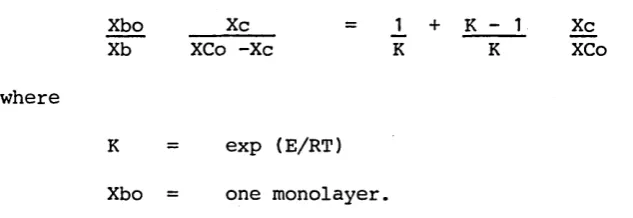
Xbo Xc = 1 + K ~ 1 Xc
Xb XCo -Xc K K XCo
where
K = exp (E/RT)
Xbo = one monolayer.
It is assumed that atoms adsorbing in the first monatomic layer
have a free energy of adsorption E, those in successive layers have
E . No lateral interaction; one monolayer does not have to beXj
completed before the next one is started.
At dilute levels;
Xb 1 = exp (E/RT)
Xbo Xc Xco
enrichment ration,
A
Figure 4^7 shows the relationship between enrichment ratio and atomic
solid solubility from interfacial energy and AES approaches.
Generally = (1 — > 10)
Xco 114
A modification of this theory allowed for the free energy
of adsorption of the second layer to be different from E^ and E^. In
the dilute limit;
= e*p Qy/RT) = exp [AH - T (Svib + San + Rlno< )] /RT
J
where
Svib = change in vibrational entropy of the system per
mole of segregant.
San = entropy change produced by the anharmonicity
arising from lack of perodicity at the interface.
[image:52.613.70.387.97.206.2]Surface Grain Boundary
Svib 3.5R 3.3R
San 0.0012RT 0.00085RT
1 2 (Substitional adsorbates can
register with either of the two grains)
The temperature dependence of A G for segregation were calculated
below 910°C;
2
(grain boundary) = -13100 - 4.0RT - 0.00085RT J/mol
Because of lack of numerical values for temperature dependent
free energies,4 G is often referred to in this case merely as heat
of segregation.
2.3.1.6. Segregation in Multi-Component Systems
This is a multilayer, multicomponent form of segregation, in
which there is no site-to-site interaction. The only case of this
type of system with strong site competition is the interaction of tin, 115
sulphur and calcium at grain boundaries in iron. At the free
surface of iron, S has a high heat of adsorption and displaces Sn. With
the preceding theories as a framework, the adsorption of S merely
reduces Xbo for tin segregation. So, the observed level of tin
segregation becomes;
Sn = Sneq (1 —s) Sneq ^ 1
Adsorption of tin is inhibited in the second layer because of
the presence of S in the first. After consideration of this the
following expression
Sn = (1 —s) + (Sneq - 1) (1- 4.5s)
,__ . 116.
(Ref )
Sneq 1, S ^ 0.222
is describing the competition for adsorption in the range 1 ^ Sneq £ 2.
-2.3.1.7. The Fowler Theory
This theory employs a single layer, single adsorbate and site- 115
to-site interaction. In the Langmuir theory it is assumed that a
filled site does not affect the probability of an adjoining site from
being filled. In this theory, though, interaction energy, u? , is
introduced. The equation is similar to McLean's;
r E - CW (Xb/Xbo) .
Xb = Xc exp [ _J_________ _____ ]
Xbo - Xb RT
where
C = coordination number in the .filled layer.
With W = 0, no interation so the equation becomes the form given by
McLean.
With W +ve, the adsorped atoms are mutually repulsive.
With W -ve, the temperature dependence of segregation deviates from
that given by McLean by showing sharper rises in segregation as the
temperature falls.
2.3.1.8. Segregation in Multicomponent Systems 77
In these systems there is element-element interaction. The
equation = ^ to ^^/Xco and Fig. 47 are valid for
alloy steels as long as the correct solubility is known. The effect of
alloying elements is merely to shift the point in Fig. 47 diagonally
within the scatter band.
An alternative approach, though, develops a specific theory
allowing for interaction energies of alloys and impurities instead of
incorporating them in Xco. Such a theory has been developed by 54
Guttmann. The equation below deals with a ternary (e.g. Fe-alloy-
impurity);