International Journal of Emerging Technology and Advanced Engineering
Website: www.ijetae.com (ISSN 2250-2459,ISO 9001:2008 Certified Journal, Volume 3, Issue 1, January 2013)
680
Relevant Words Extraction Method for Recommendation
System
Naw Naw1, Ei Ei Hlaing
1
University of Technology (Yatanarpon Cyber City)
2
University of Computer Studies (Taung Ngu)
1
[email protected] 2[email protected]
Abstract—Nowadays, E-commerce is very popular because of information explosion. Text mining is also important for information extraction. Users are more preferable to use the convenience system from many sources such as through web pages, email, social network and so on. This system proposed the relevant words extraction method for car recommendation system from user email. In relevant words extraction, this system proposed the Rule-based approach in Compiling Technique. Context- free grammar is the most suitable for relevant words extraction. Recommendation System (RS) is a most popular tool that helps users to recommend according to
their interests. This system implements efficient
recommendation system by using proposed key extraction algorithm, Content-based Filtering (CBF) method and Jaccard Coefficient that will help the users who want to buy the car by providing relevant car information.
Keywords—relevant words extraction, rule-based, compiling technique, recommendation system, content- based filtering, Jaccard Coefficient
I. INTRODUCTION
Most E-commerce sites compelled to get the customers in various ways. Some used the information retrieval system. But this can only provide the information for user by matching with user’s input. There are many constraints in information retrieval system that users have the little chance to select their desires. So the ecommerce sites should let the users to input with free text as they like. The users do not need to worry about the structures and grammars. Most researches tried to develop the autonomous system which recognizes the user's desires. But, there are some problems in grabbing of user input. To solve this problem, one efficient way is to use text mining techniques. Text mining uncovers the underlying themes or concepts that are contained in large document collections.
Text mining applications have two phases: exploring the textual data for its content and then using discovered information to improve the existing processes. Both are important and can be referred to as descriptive mining and predictive mining. Descriptive mining involves discovering the themes and concepts that exist in a textual collection. Predictive modeling involves examining past data to predict future results [9]. In Descriptive mining, the unstructured texts are difficult to extract the useful data because of the richness and ambiguity of natural language. So this system proposed the relevant words extraction method based on context-free grammar. In predictive mining, this system implements the content-based recommender system by using the output keys of relevant words extraction method.
II. RECOMMENDATION SYSTEM
A. Text Mining
International Journal of Emerging Technology and Advanced Engineering
Website: www.ijetae.com (ISSN 2250-2459,ISO 9001:2008 Certified Journal, Volume 3, Issue 1, January 2013)
681
The context-free methods are powerful enough to describe almost all of the so-called syntactic features of programming languages. Indeed context-free grammars are often used in language manuals [19]. The output of the relevant words extraction method can be applied to the recommendation system.
B. Content Based Filtering
Recommender systems help customers to find what they really want. So this meets the requirements of customers in a short time. It helps users to find information, products, or by aggregating and analyzing suggestions from other users’ activities. CBF techniques are developed for information retrieval and information filtering research [14]. In the CBF system, each user can operate independently and will be recommended the most closely information of the items according to their request.
C. Similarity Measuring
It is needed to manipulate the similarity between the contents. There are many similarity methods used in content-based recommender system. But Jaccard Coefficient is most proper method for this proposed system. The Jaccard Coefficient is a similarity measure which ranges between 0 and 1. Similarity value 1 means the two objects are the same and 0 means they are completely different. The nearer to 1 is, the more similar between two objects. Jaccard can resolve their various similarity values in different similarity level.
S jaccard = MKey /T (1)
where,
MKey = Match keys between key pairs and total
attributes T = Total Attributes
This proposed system intend to save time in extracting information from web application by promoting the performance of e-commence. Nowadays, the Myanmar’s citizens interested to buy cars. This system tried to satisfy the customers dealing with finding product that they desired. The main purpose of the system is to provide the relevant words extraction method which can enhance the content based filtering.
III. RELATED WORK
Latha.K, Kalimuthu.S, Dr.Rajaram.R proposed Information Extraction from Biomedical Literature using Text Mining Framework. There are three steps in this paper. Text gathering: The documents are collected from the existing biomedical databases. Thousand-sample sets of documents are collected from various biological domains and these documents are analyzed and given as the input to the second stage. Text preprocessing: The above documents are preprocessed for decreasing the workload in the Data analysis stage. Data analysis: This phase focuses on analyzing the documents of the previous phase by using support vector machine (SVM). But this research wasted the time to recognized the every terms that are not concerned with biomedical information [13].
Ashwini Madane proposed Identifying Keywords and Key Phrases. A new algorithm (Kea) is used for automatically extracting key phrases from text. Step 1 (Preprocessing): stop word removing, tokenization. Step 2 (Candidate Identification): Kea then considers all the subsequences in each line and determines which of these suitable candidate phrases are. Step 3 (Determining Candidate Phrases): Use stemming method (Lovins). Step 4 (Feature Calculation): Kea builds a document frequency file. Use TF-IDF technique. But it takes too much time in candidate identification [1].
IAN H. WITTE proposed the key phrase extraction method by using machine learning approach. To explore the phrase is ―key phrase‖ or ―non-key phrase‖; there are two attributes to be considered. The first is the distance into the document of the phrase’s first appearance. The second, and more influential, is the ―term frequency times inverse document frequency,‖ or TF_IDF, score of a phrase. The classifier uses the Naïve Bayes method to calculate the two attributes. This is simple and effective but the training time is a critical factor in this system [16].
International Journal of Emerging Technology and Advanced Engineering
Website: www.ijetae.com (ISSN 2250-2459,ISO 9001:2008 Certified Journal, Volume 3, Issue 1, January 2013)
682
Bernd Ludwig and Stefan Mandl proposed the transformation method from the expert centered knowledge to the user centered knowledge by using TF-IDF approach. That method tried to identify the topic by looking up the words in the document. The results were applied for the TV recommendation system. That method depended on the quality of matrices. To understand in more detail how user opinions influence the parameters. That system has to be trained to be user adaptive [7].
BalaKrishna Kolluru, Sirintra Nakjang, Robert P. Hirt, Anil Wipat, and Sophia Ananiadou proposed a Conditional Random Field (CRF) technique to extract the mention of microorganisms, habitats and the inter-relation between organisms and their habitats. Results indicate a good performance for extraction of microorganisms and the relation extraction aspects of the task (with a precision of over 80%), while habitat recognition is only moderate (a precision of about 65%). There are three principles in the workflow:PDF-to-text convertor, Named entity recognizer, and CRF-component. The disadvantage is pdf-to-text conversion can be quite noisy and this implicitly affects any sentence-based relation extraction algorithms [4].
IV. PROPOSED SYSTEM
A. Proposed System Framework
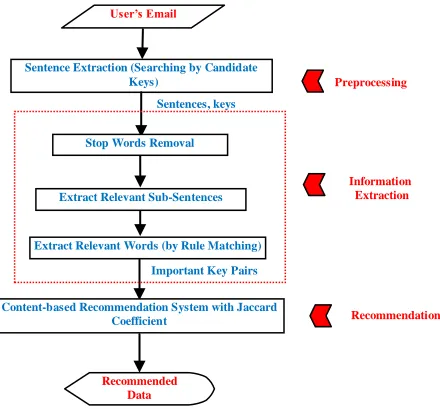
[image:3.612.61.281.486.692.2]There are three main basic stages for recommendation system.
Figure 1. System Framework
Preprocessing: If the user sends the order from email, the system will extract the relevance sentences that concerned with their desired car information such as type of car, model number, amount of money they can afford, year, color, mileage, etc. That will be described detail in section (4.2.1). Not relevance sentences will be ignored in this stage. For example,
How are you? Not relevance Sentences
Like this above sentence will be ignored in preprocessing. After extracting the relevance sentences, we need to look up the main verb to recognize the positive sentence or negative sentence. For example,
I like the white color. Positive Sentence I don’t like the silver color Negative Sentence
After distinguishing the sentences’ positive or negative, the negative sentences will be ignored again.
Information Extraction: Firstly, we need to do is stop words removal. After stop words removing, the system can extract the relevant sub-sentences. The proposed algorithms for these steps will be described detail in following section (4.2.2). The resulted sub-sentences are matched with the proposed rules in section (4.3) that can develop the important key pairs.
Recommendation: After the system gets the important key pairs, content-based filtering approach will implement with Jaccard Coefficient method. Each user’s prefer is different. If the available car is not exactly same with user desire, system needs to recommend the most similar results for the user requirements. This system proposed the weight value of important keys to provide Jaccard Coefficient method for the most similar results. So, defining weight value is very important in this recommendation system. Finally, the system will generate the recommendation list for the users according to their requests.
B. Proposed Algorithms for Information Extraction 1) Sentence Extraction
Input : Email’s content Output : Relevance Sentences Process :
Process For all Sentences
Sentence List Search the relevance sentence by comparing with candidate keys
Sentences, keys
Recommendation Information
Extraction Preprocessing Sentence Extraction (Searching by Candidate
Keys) User’s Email
Important Key Pairs Stop Words Removal
Extract Relevant Sub-Sentences
Extract Relevant Words (by Rule Matching)
Content-based Recommendation System with Jaccard Coefficient
International Journal of Emerging Technology and Advanced Engineering
Website: www.ijetae.com (ISSN 2250-2459,ISO 9001:2008 Certified Journal, Volume 3, Issue 1, January 2013)
683
End For
2) Key Extraction
Input : Sentences List Output : Keys
Process :
Process Sentence-Level Identification For each processed sentence
Keys important-key-finder (sentence, automobile-key)
End For
Important-key-finder (sentence, automobile key)
begin
sub-sentence stop word removal For each sub-sentence
For each RULE
Rule matching process If matched rule then generate key-pair end If
end For end For
return generated key-pair end
C. Rules for Proposed System
The following sample rules will provide the above key-finder algorithm. In this system, there are eight rules to provide important keys for recommendation of Jaccard Coefficient Similarity method.
Rule 1 (< article> | <number>) <typeOf> <article> a | an | one | two | three | four | five |
six | seven | eight | nine | ten <number> 1 | 2 | 3 | 4 | 5 | 6 | 7 | 8 | 9
<typeOf> Alfa | AlfaRomeo | Audi | BMW | Chrysler | Citroen | car | Daihatsu | Fiat | Ford | GM | Hino | Honda | Isuzu | Mazda | MarkII | Matsubishi | Mercedes Benz | Opel | Peugeot |
Renaut | Rover | Nissan | Subaru | Suzuki | Toyota | Volkswagen | Volvo
Rule 2 <preposition> <year> <preposition> at| ago| for| in| since <year> 0 | 1 | 2 | 3 | 4 | 5 | 6 | 7 | 8 | 9
<year> <year>
Rule 3 <number> <notation> <number> 0 | 1 | 2 | 3 | 4 | 5 | 6 | 7 | 8 | 9
<number> <number>
<notation> Lks | l | L | kyats | $ Rule 4 <color>
<color> blue | light blue | dark blue | black| grey | pearl | red | silver | white Rule 5 <mileage>
<mileage> 0 | 1 | 2 | 3 | 4 | 5 | 6 | 7 | 8 | 9
<mileage> <mileage>
Rule 6 <model number>
<model number> 86 | Allex | Allion | Alphard | Altezza | Altezza Wagon | Aqau | Carinaed | Cavalier | Celica| Century | Chaser | Coaster | Corolla | Corolla2 | GRX120 | GX110 | JRX110 | Umax_Toy
Rule 7 <engine>
<engine> 06 | AT | IAT | FA | F6 Rule 8 <equipment>
<equipment> 1500cc | 1800cc | 2000cc | 2500cc
D. Jaccard Coefficient Method
International Journal of Emerging Technology and Advanced Engineering
Website: www.ijetae.com (ISSN 2250-2459,ISO 9001:2008 Certified Journal, Volume 3, Issue 1, January 2013)
684
The basic idea behind this approach is degree of similarity or vibration of user desired keys is calculated for different weight of available selling car. Different weight of similarity value is
S jaccard = MKey /T
In here, calculated different similarity weight value is determined by threshold 0.5. If the threshold values less than 0.5, unrelated recommended lists will be shown to the users. The accuracy of the recommended lists will be higher if the threshold value is greater than or equal 0.5. If it is only greater than 0.5, the sparsity problem will be occurred.
• Key pairs = [MarkII, 130 Lks, Pearl, GRX120] Attributes = [MarkII, 130 Lks, Pearl, GRX120]
MKey = 4
T = 4
S Jaccard = 4/4 = 1 0.5
• Key pairs = [MarkII, 130 Lks, Pearl, GRX120] Attributes = [MarkII, 130 Lks, Silver, GRX120]
MKey = 3
T = 5
S Jaccard = 3/5 = 0.6 0.5
• Key pairs = [MarkII, 130 Lks, Pearl, GRX120] Attributes = [MarkII, 150 Lks, Grey, GRX120]
MKey = 2
T = 6
S Jaccard = 2/6 =0.33 < 0.5
• Key pairs = [MarkII, 130 Lks, Pearl, GRX120] Attributes = [MarkII, 130 Lks, Silver, GX110]
MKey = 3
T = 5
S Jaccard = 3/5 = 0.6 0.5
• Key pairs = [MarkII, 130 Lks, Pearl, GRX120] Attributes = [Nissan, 130 Lks, Black, JRX110]
MKey = 1
T = 7
S Jaccard = 1/7 =0.14 < 0.5
• Key pairs = [MarkII, 130 Lks, Pearl, GRX120] Attributes = [MarkII, 125 Lks, Pearl, GRX120]
MKey = 3
T = 5
S Jaccard = 3/5 = 0.6 0.5
• Key pairs = [MarkII, 130 Lks, Pearl, GRX120] Attributes = [Honda, 80 Lks, Blue, 86]
MKey = 0
T = 8
S Jaccard = 0/8 =0 < 0.5
So, the proposed system generates the recommended list, if the weight of the similarity values is greater than or equal 0.5.
V. EXPERIMENTAL RESULTS
These experiments are evaluated on 682 email letters. This measurement is based on precision and recall that are two most frequent and basic measures for information retrieval effectiveness. Precision (P) is the fraction of retrieved key phrases that are relevant. Recall (R) is the fraction of relevant key phrases that are retrieved [3].
Precision (P) = Tp / (Tp+Fp) (2)
Recall (R) = Tp / (Tp+Fn) (3)
where,
Tp = True positive Fp = False positive Fn = False negative Tn = True negative
Relevant Nonrelevant
Retrieved True positive False positive
Not Retrieved False negative True negative
F1 tries to combine precision and recall into a single
International Journal of Emerging Technology and Advanced Engineering
Website: www.ijetae.com (ISSN 2250-2459,ISO 9001:2008 Certified Journal, Volume 3, Issue 1, January 2013)
685
metrics. The F1 is calculated as the standard harmonic
mean of precision and recall:
[image:6.612.50.287.167.337.2]F1 = 2*P*R / (P+R) (4)
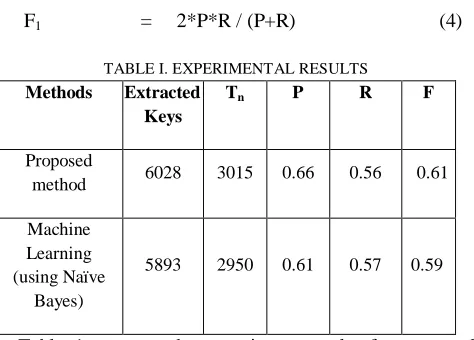
TABLE I. EXPERIMENTAL RESULTS
Methods Extracted
Keys
Tn P R F
Proposed
method 6028 3015 0.66 0.56 0.61
Machine Learning (using Naïve
Bayes)
5893 2950 0.61 0.57 0.59
Table 1 presents the experiment results for proposed relevance key words retrieval and machine learning approach. For each method which corresponding rows in a table, the above information is shown: the total number of extracted key words, relevance extracted key words, precision, recall and F1-measure. This proposed method has the higher precision and less recall than machine learning approach while higher F1-measure than machine learning. Moreover, this method does not require training set as machine learning approach.
VI. CONCLUSION
Today, our government opens the car market. So there are many demands on car. This system helps the user who wants to know the car information from their email and recommends the closely relevant car information such as type of car, model, year, color, price and mileage for the requested user. Most information extraction systems use the machine learning technique. So they are very complex and time consuming. This proposed system can reduce these complexes by using Compiling technique. This system can decrease the preprocessing time with sentence level identification. Recommendation system performance will increase by combining this information extraction system.
References
[1] Ashwini Madane, ―Identifying Keywords and Key Phrases‖, IJSCE, July 2012.
[2] Yize Li, Jiazhong Nie, Yi Zhang, and Bingqing Wang. 2012. Contextual Recommendation based on Text Mining.
[3] Gunnar Schröder, Maik Thiele, and Wolfgang Lehner. 2012. Setting Goals and Choosing Metrics for Recommender System Evaluations. [4] Huda Yasin, Mohsin Mohammad Yasin, and Farah Mohammad
Yasin. ―Automated Multiple Related Documents Summarization via Jaccard’s Coefficient‖, International Journal of Computer Applications, January 2011.
[5] BalaKrishna Kolluru, Sirintra Nakjang, Robert P. Hirt, Anil Wipat, and Sophia Ananiadou, ―Automatic extraction of microorganisms and their habitats from free text using text mining workflows‖,JIB , 2011.
[6] Rares Vernica, Michael J.Carey, and Chan Li. June 2010. Efficient Parallel Set-Similarity Joins Using MapReduce.
[7] Stuart Rose, Dave Engel, Nick Cramer, and Wendy Cowley. 2010. Automatic Keyword Extraction from Individual Documents. [8] Bernd Ludwig, and Stefan Mandl, ―Centering Information Retrieval
to the User‖,RSTI – RIA, 2010.
[9] Raymond J.Mooney, and Razvan Bunescu. 2009. Mining Knowledge from Text Using Information Extraction.
[10] SAS Institute. 2009. Getting Started with SAS® Text Miner 4.1, ISBN 978-1-59994-999-4.
[11] Munyaradzi Chiwara, Mahmoud Al-Ayyoub, Mohammad Sajjad, Hossain, and Rajan Gupta. 2009. CSE 634 – Data Mining: Text Mining.
[12] Hany Mahgoub, Dietmar Rösner, Nabil Ismail, and Fawzy Torkey, ―A Text Mining Technique Using Association Rules Extraction‖,International Journal of Information and Mathematic Sciences ,2008.
[13] Zakaria Elberrichi, Abdelattif Rahmoun, and Mohamed Amine Bentaalah, ―Using WordNet for Text Categorization‖, The International Arab Journal of Information Technology, January 2008.
[14] Latha .K, Kalimuthu.S, and Dr.Rajaram.R, ―Information Extraction from Biomedical Literature using Text Mining Framework‖, IJISE, USA, January 2007.
[15] Francesco Ricci2005. Content-Based Filtering and Hybrid Systems. [16] Sundar Varadarajan, Kas Kasravi, and Ronen Feldman. 2004.
Text-Mining: Application Development Challenges.
[17] IAN H. WITTEN. 2003. Adaptive Text Mining: Inferring Structure from Sequences.
[18] Haralampos Karanikas, Christos Tjortjis, and Babis Theodoulidis. 2001. An Approach to Text Mining using Information Extraction. [19] Damian Fijalkowski, and Radolsaw Zatoka, ―An Architecture of a
Web Recommender System using Social Network User Profiles for E-commerce‖, IEEE, 2001, pp.287-290.