
International Journal of Emerging Technology and Advanced Engineering
Website: www.ijetae.com (ISSN 2250-2459, Volume 2, Issue 10, October 2012)202
State of The Art on Closed Loop Pulsating Heat Pipe
Rahul S. Borkar
1, Pramod R. Pachghare
21M Tech Student, Thermal Engineering, Government College of engineering, Amravati
2Asst. Professor, Department of Mechanical Engineering, Government College of engineering, Amravati
Abstract — The closed loop Pulsating Heat Pipes (CLPHPs) are two-phase passive heat transfer devices that enhances large amount of heat which works on the principle of evaporation and condensation of a working fluid. CLPHP consists of a copper capillary tube bent in many turns, which is firstly evacuated, then partially filled with an appropriate working fluid and finally sealed. At one end heat is absorbed by evaporation and heat rejected through another end by condensation of working fluid. Selection of working fluids are depends on the desired performance from the device and the performance of device depends on the thermo physical properties of working fluids i.e. Saturation temperature, viscosity, surface tension, sensible heat, latent heat etc. Working fluids which having lower saturation temperature, lower latent heat, high specific heat and low dynamic viscosity gives better thermal performance. Different input parameters are internal tube diameter, input heat flux, filling ratio, number of terns, device orientation, size and capacity of condenser and evaporator also important parameters for thermal performance of CLPHP.
Keywords — Pulsating heat pipe, heat transfer, working fluid, saturation temperature, surface tension sensible heat.
I. INTRODUCTION
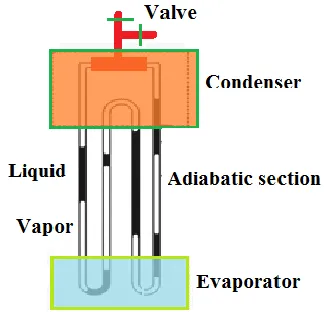
[image:1.612.361.523.212.368.2]In the 1990s, Akachi et al. [1] proposed a new type of heat pipe known as Pulsating Heat Pipe (PHP). As a passive two-phase heat transfer device that has been used for thermal management of electronic devices to remove heat without any electrical power input. Heat pipe is able to dissipate substantial amount of heat with relatively small temperature drop. Closed loop pulsating heat pipe (CLPHP) is made from long capillary tube bent into many U-turns, closed in an endless loop, with the evaporator and adiabatic section is optional depends on the locations of evaporator and condenser [1]. The diameter of the tube must be small enough such that liquid vapor plugs and slugs exist. The unique feature of PHPs compared with the conventional heat pipe is that there is no wick structure to return the condensate to the heating section. Therefore, there is no countercurrent flow between the liquid and vapor [2].
Figure 1: Schematic of Closed Loop Pulsating Heat Pipe
II. WORKING PRINCIPLES OF CLPHP
A. Fluid Dynamic Principle
Initially the tube is evacuated and then filled partially (as per required filling ratio) with working fluid, which distributes itself naturally in the form of liquid vapor plugs and slugs inside the capillary tube. The liquid Plugs are able to completely bridge the tube, because surface tension forces overcome gravitational forces. There is a meniscus region on either end of each slug caused by surface tension at the solid/liquid/
vapor
interface. The slugs are separated by plugs of the working fluid in the vapor phase. The vapor plug is surrounded by a thin liquid film trailing from the slug.B. Thermodynamic Principle
International Journal of Emerging Technology and Advanced Engineering
Website: www.ijetae.com (ISSN 2250-2459, Volume 2, Issue 10, October 2012)203
C. Heat Transfer Principle
This vapor bubbles pushes the liquid column toward the low temperature end (condenser). The temperature and pressure decrease in the condenser due to condensation. Therefore a constant, unsteady internal pressure difference exists in the system which is the driving force. Because of the interconnection of the tubes; motion of liquid slugs and vapor bubbles at one section of the tube toward the condenser also leads to the motion of slugs and bubbles in the next section toward the high temperature end (evaporator), this works as the restoring force.
The inter-play between the driving force and the restoring force leads to oscillation of the vapor bubble and liquid slugs in the axial direction. The frequency and the amplitude of the oscillation are expected to be dependent on the shear flow and mass fraction of the liquid in the tube.
In PHPs, heat is transferred from the evaporator to the condenser through sensible and latent heat transfer, which is a result of the working fluid oscillations and phase changes.
D. Flow Pattern
During the startup period the working fluid oscillate with large amplitude, after this period continuous circulation can in the working fluid occurs. The direction of circulation for working fluid is consistent once circulation is obtained but the direction of circulation can be different for same experimental run [3].
III. INFLUENCE PARAMETERS
From the available literature, following major thermo-mechanical parameters have emerged as the primary design parameters, that affecting on the thermal performance of CLPHP. These include – The internal tube diameter is the
most important geometrical parameter because it
essentially manifests the fundamental definition of CLPHPs. The slug flow pattern inside the tube is a fundamental working condition because pumping force is generated by the growing bubbles in the evaporator and the collapsing bubbles in the condenser area. Such condition is ensured only if the tube inner diameter is smaller than a critical diameter.
[image:2.612.330.553.136.284.2]A. Internal diameter of the CLPHP tube
Figure 2: Thermosyphon mode of operation when D>>Dcri [4]
The critical Bond number (or Eötvös) criterion gives the tentative design rule for the diameter. The theoretical maximum inner diameter of capillary tube can be calculated as-
2
(
l vDcri
g
(1)( ) 0.5
[
g l v]
Bo Dcri
(2)
2
[ ] 4
Eö Bo (3)
If D < Dcri, surface tension forces dominate and stable
liquid plugs are formed. However, if D > Dcri, the surface
tension is reduced and the working fluid will stratify by gravity and oscillations will cease. The CLPHP may operate as an interconnected array of two-phase thermosyphon [4].
International Journal of Emerging Technology and Advanced Engineering
Website: www.ijetae.com (ISSN 2250-2459, Volume 2, Issue 10, October 2012)204
The working fluid employed is water and found that doubling the diameter did not double the performance. At the same internal diameter and evaporator length, the performance is higher with increasing the number of turns. The performance can be increased by increasing the tube inner diameter and/or the number of meandering turns.
The performance of uniform channel CLPHP is more sensitive to inclination especially when the inclination angle is small and it is not functional at a horizontal configuration.
On the other hand, the proposed non-uniform channel CLPHP is functional to all inclinations provided the charge ratio is sufficient (above 50%) [8].
B. Input heat flux.
For a defined CLPHP geometry of the device, the input heat flux is directly responsible for the type of flow pattern which will exist in the channel. The operating heat flux may also affect the level of perturbations inside a CLPHP thereby affecting the thermal performance of the device.
The applied heat flux affects the following:-
1. Internal bubble dynamics, sizes and agglomeration, 2. Breaking patterns,
3. Level of perturbations and flow instabilities, and 4. Flow pattern transition from capillary slug flow to
Semi-annular and Semi-annular.
CLPHPs are inherently suitable for high heat flux operations. Since the input heat provides the pumping power, below a certain level no oscillations commence [9].
Cai Q. et al. [10] presented an experimental investigation of heat transfer characteristics of CLPHP versus operating temperatures. The CLPHP with 12 turns was made of copper and charged with water at three charge ratios: 40%, 55%, and 70% and observed the minimum temperature difference and fluctuation appear at temperatures between 120°C and 160°C.
Low input heat fluxes are not capable of generating enough perturbations and the resulting bubble pumping action is extremely restricted. The bubbles only oscillate with a high frequency and low amplitude. There are periods of “no action” intermission stage followed by some small bulk activity phase. Overall, this scenario results in a poor performance (i.e. very high thermal resistance).
As the heat input is increased, slug flow oscillations commence whose amplitudes increase with increasing heat flux and become comparable to the length of the device. This improves the heat transfer coefficient to a marked degree. As the heat flux is further increased, the oscillating flow tends to take a fixed direction and thermal resistance further reduces [11].
C. Volumetric filling ratio
The filling ratio (FR) of a CLPHP is defined as the ratio of working fluid volume actually present in the device to that of the total volume of the device (say at room temperature). Thus, a given CLPHP has two operational extremities with respect to the filling ratio, an empty device without any working fluid i.e. FR = 0, half filled device i.e. FR = 0.5 and a fully filled device i.e. FR = 1.
Complete stop-over is in the loop occurs more frequently for FR < 50% coupled with low heat input power. Stop-over phenomenon has also been observed for higher filling ratios. The „self-sustained‟ oscillating character is then lost (Fig.3). Such a behavior has never been reported for multi-turn CLPHPs because of alternating periods in which bubble plugs are moving rapidly (activity phase) and „stopping‟ (static phase) [12].
Khandekar S. et al. [13] conducted experiments on a CLPHP made of copper capillary tube of 2.0 mm inner diameter for three different working fluids viz. water, ethanol and R-123. The CLPHP was tested in vertical (bottom heat mode) and horizontal orientation, and found that a 100% filled CLPHP (not working in the pulsating mode but instead as a single-phase buoyancy-induced thermosyphon) is thermally better performing than a partially filled pulsating mode device under certain operating conditions. The CLPHP not operate in the horizontal mode for small number of turns and too low operating pressures.
Pulsating heat pipes are deterministic chaotic systems, not periodic or random systems. Song Y. and Xu J. [14] found that Autocorrelation function coefficients for both FC-72 and water CLPHPs are decreased with respect to time, indicating that the prediction ability of the system is finite and the optimal charge ratios are about 60- 70% for both FC-72 and water CLPHPs with four, six, and nine turns.
PHPs have better thermal performance at such a narrow range of charge ratio. Filling ratio (FR) of 70% has better performance compared with other FRs (30% and 50%) [15].
D. Total number of turns and Inclination Angle
International Journal of Emerging Technology and Advanced Engineering
Website: www.ijetae.com (ISSN 2250-2459, Volume 2, Issue 10, October 2012)205
[image:4.612.97.242.245.440.2]The number of turns in a CLPHP and the associated flow perturbations in each turn may account for a CLPHP‟s ability to function in the horizontal orientation. The number of turns in the CLPHP affect on thermal performance. By increasing the number of turns there are more distinct locations for heat to be applied and more local pressure drops. The higher level of local perturbations helps to avoid vapor phase recoiling in the evaporator and liquid merging in the condenser.
Figure 3: Stop-over phenomenon in the two-phase loop [12]
The uneven distribution of liquid slugs and vapor plugs inside heating and cooling sections is necessary to create differences in pressure at each turn which drives the pulsating flow. If a CLPHP only has a few turns, it may not operate in the horizontal or top heat modes but with many turns it can operate at any orientation because of the perturbations in each turn. If the number of turns is less than a critical value, then there is a possibility of a stop-over phenomenon to occur [14]. In such a condition, all the evaporator U-sections has a vapor bubble and the rest of the PHP has liquid (Fig.3). This condition essentially leads to a dry out and small perturbations cannot amplify to make the system operate self sustained.
E. Size and capacity of evaporator and condenser
These parameters affects on the overall heat transfer of the CLPHP and could change the flow patterns within the heat pipe. Below a particular onset heat flux from the evaporator, the fluid in the tubes will not pulsate. Also, if the condenser cannot dissipate enough heat, it will limit the maximum heat transfer temperature difference between the evaporator and condenser is slightly lower at atmospheric conditions compared to different evacuation levels.
Because of an atmospheric condition, the saturation temperature is higher compared to evacuated situation. Thus more liquid phase exists in the tube with a consequent increase in the heat transfer. Also the temperature difference between the evaporator and the condenser is less for acetone and more for ethanol. This is due to the fact that the saturation temperature of acetone is lower compared to ethanol. This shows that acetone can transfer heat with less temperature difference compared to ethanol. Acetone shows higher heat transfer coefficient values compared to other fluids considered. This is due to the lower values of temperature difference between evaporator and condenser for acetone [16].
IV. WORKING FLUID THERMO-PHYSICAL PROPERTIES Selection of working fluid is directly linked to the properties of the fluid. The properties are going to both affect the ability to transfer heat and the compatibility with tube material. A first consideration in the identification of a suitable working fluid is the operating vapor temperature range. Within the approximate temperature band, several possible working fluids may exist, and a variety of characteristics must be examined in order to determine the most acceptable of these fluids for the application considered. The prime requirements are:
1)Compatibility with wall material 2)Good thermal stability
3)High latent heat 4)High surface tension 5)High thermal conductivity 6)Low liquid and vapor viscosities
7)Vapor pressures not too high or low over the operating temperature range.
[image:4.612.319.566.563.672.2]8)Wettability of wall materials
Table 1
Thermophysical properties of different working fluids at 1 atm [21]
Working fluids
TS CPl ʎl Hfg υl×106 σ
×103
⁰C
KJ/Kg⁰C (20⁰C)
W/m⁰C (20⁰C)
KJ/ Kg
Pa-s (20⁰C)
N/m (20⁰C) methanol 64.7 2.84 0.212 1101 0.60 22.6
ethanol 78.3 2.39 0.172 846 1.15 22.8 acetone 56.2 2.35 0.170 523 0.32 23.7
water 100 4.18 0.599 2252 1.01 72.8
A. Surface tension
International Journal of Emerging Technology and Advanced Engineering
Website: www.ijetae.com (ISSN 2250-2459, Volume 2, Issue 10, October 2012)206
Larger diameter will allow improved performance, but an increased pressure drop will require greater bubble pumping and thus a higher heat input to maintain pulsating flow. The filling ratio (FR) of a CLPHP is defined as the ratio of working fluid volume actually present in the device to that of the total volume of the device.
B. Latent heat
A low latent heat will cause the liquid to evaporate more quickly at a given temperature and a higher vapor pressure; the liquid slug oscillating velocities may be increased and the heat transfer performance of the CLPHP also improved, on the other hand the dry-out phenomenon may occur at lower heat input levels.
C. Specific heat
A high specific heat will increase the amount of sensible heat transferred. Because in most of the cases a great percentage of the total heat transfer in a CLPHP is due to sensible heat, a fluid with a high specific heat is desirable.
D. Latent heat vs. sensible heat transferred
The net heat transfer in a device is a combination of the sensible heat of the liquid plugs and the latent heat of the vapor bubbles. If the internal flow patterns in the liquid plug form then latent heat will not play a dominant role in the overall heat transfer. If transition to annular flow under the imposed thermomechanical boundary conditions then the power of latent heat increases leading to better performance [17, 18].
E. Viscosity
A low dynamic viscosity will reduce shear stress along the wall and will consequently reduce pressure drop in the tube. This will reduce the heat input required to maintain a pulsating flow.
Long vapor plugs are only for the methanol CLPHP, not in the water CLPHP, due to the vapor plug deformation and breakup mechanism observed by J.L. et al. [19]. The bulk circulation flow and the local flow direction switch flow are induced by the combined effects of bubble nucleation, coalescence and condensation and bulk circulation flow sustains longer while the local flow direction switch flow shorter.
The cycle periods and the oscillating amplitudes are increased with increasing the heating powers.
Higher heating powers result in more severe local random oscillating nature with short time periods and small amplitudes superimposed, due to the complicated local flow direction switch process.
No measurable difference has been recorded between the CLPHP running with the azeotropic mixture and the CLPHP running with pure ethanol, in terms of overall thermal resistance [20].
Dadong Wang [21] observed thermal resistance of pure working fluids PHP at different power inputs with the filling ratio of 60% and different power inputs. The thermal resistances have the results of Racetone < Rmethanol < Rethanol <
Rwater. As shown in Table 1, the boiling points and the
latent heat of water are larger more than ethanol, methanol and acetone. Thus, water PHP can boil hardly in low power inputs. Furthermore, the thermal oscillation of water is hard for the large surface tension and dynamic viscosity at the start-up period. Therefore, the evaporation section temperature of water CLPHP is high and the condensation section temperature of water CLPHP is low, and accordingly, the thermal resistances are large.
V. CONCLUSIONS
Saturation temperature of working fluids affect on the temperature difference between evaporator and condenser section and therefore lower saturation temperature working fluids gives better performance.
Low latent heat and high specific heat working fluids are more efficient because of fast evaporation.
Low dynamic viscosity reduces shear stresses along the wall and consequently reduces the pressure drop that reduces required input heat flux for pulsation.
VI. RECOMMENDATIONS
The following general recommendations are made for further research directions:
1.Development of mathematical relations for study the effect of different working fluids property on the thermal performance.
2.Study the effect of vibration, non condensable gases, impurities in working fluids and evaporator internal surface roughness on the thermal performance.
3.Study the effect of sensible and latent heat on the performance and about direction of liquid vapor flow in the tube.
International Journal of Emerging Technology and Advanced Engineering
Website: www.ijetae.com (ISSN 2250-2459, Volume 2, Issue 10, October 2012)207
VII. NOMENCLATURE
Symbol Quantity SI Unit
Bo Bond number
Eö Eötvös number
G Acceleration due to gravity m/s2 Ts Saturation temperature ⁰C
ρ v Vapordensity Kg/m3
ρl Liquiddensity Kg/m
3
Σ Surface tension N/m
P Pressure bar
CPl Specific heat KJ/Kg⁰C
Hfg Latent heat KJ/ Kg
υl Dynamic viscosity Pa-s
Subscripts
Cri Critical
L Liquid
V Vapor
REFERENCES
[1 ] Akachi H., Polasek F. and Stulc P., 1996, Pulsating heat pipes, in: Proceedings of the Fifth International Heat Pipe Symposium, Melbourne, Austria, pp. 208–217.
[2 ] Faghri A., 1995, Heat Pipe Science and Technology, Taylor and Francis, Washington, DC.
[3 ] Tong B.Y., Wong T.N. and Ooi K.T., 2001, Closed Loop Pulsating Heat Pipe, Applied Thermal Engineering, ISSN 1359-4311, Vol. 21/18, pp. 1845-1862.
[4 ] Charoensawan P., Khandekar S. and Groll M., 2004, Closed Loop and Open Loop Pulsating Heat Pipes, 13th International Heat Pipe Conference, Shanghai, China, pp.21-25.
[5 ] Charoensawan P., Khandekar S., Groll M. and Terdtoom P., 2003, Closed Loop Pulsating Heat Pipes Part A: Parametric Experimental Investigations, Applied Thermal Engineering, Vol. 23/16, pp.2009-2020.
[6 ] Charoensawan P., Khandekar S., Groll M. and Terdtoom P., 2003, Closed Loop Pulsating Heat Pipes Part B: Visualization and Semi-empirical Modeling, Applied Thermal Engineering, Vol. 23/16. pp.2021-2033.
[7 ] Khandekar S., Pradipta K. and Bonjour, 2010, Local Hydrodynamics of Flow in a Pulsating Heat Pipe: A Review, Frontiers in Heat Pipes (FHP), 1, 023003, DOI: 10.5098/fhp.vo1.2.300.
[8 ] Chien K.H., Lin Y.T., Chen Y.R., Yang K.S. and Wang C.C., 2012, A Novel Design of Pulsating Heat Pipe with Fewer Turns Applicable to all Orientations, International Journal of Heat and Mass Transfer, Vol.52, pp.2935-2944.
[9 ] Khandekar S.,Dollinger N., and Groll M., 2003,Understanding Operational Regimes of Pulsating Heat Pipes: An Experimental Study, Applied Thermal Engineering, ISSN 1359- 4311, Vol. 23/6, pp. 707-719.
[10 ]Cai Q.,Chen C.L. and Asfia J.F., 2006, Operating Characteristic Investigations in Pulsating Heat Pipes, ASME J. Heat Transfer, Vol.128, pp.1329–1334.
[11 ]Khandekar S.and Groll M., 2003, On the Definition of Pulsating Heat Pipe, Proc. 5th Minsk International Seminar (Heat Pipes, Heat Pumps and Refrigerators), Minsk, Belarus.
[12 ]Groll M. and Khandekar S., 2004, An Insight into Thermo-Hydrodynamic Coupling in Closed Loop Pulsating Heat Pipes, International Journal of Thermal Sciences, Vol.43, pp.13–20. [13 ]Khandekar S.,Dollinger N., and Groll M., 2003, Understanding
Operational Regimes of Closed Loop Pulsating Heat Pipes: An Experimental Study, Applied Thermal Engineering, Vol.23, pp.707-719.
[14 ]Song Y. and Xu J., 2009, Chaotic Behavior of Pulsating Heat Pipes, International Journal of Heat and Mass Transfer, Vol.52, pp.2932– 294.
[15 ]Arab M., Soltanieh M., and Shafii M., 2012, Experimental Investigation of Extra-Long Pulsating Heat Pipe Application in Solar Water Heaters, Experimental Thermal and Fluid Science, doi: 10.1016/ j.expthermflusci.2012.03.006.
[16 ]Narasimha K. R., Sridhara S.N., Rajagopal M.S., and Seetharamu K.N., 2012, Influence of Heat Input, Working Fluid and Evacuation Level on the Performance of Pulsating Heat Pipe, Journal of Applied Fluid Mechanics, Vol. 5/2, pp. 33-42.
[17 ]Groll M., and Khandekar S., 2002, Pulsating Heat Pipes: A Challenge and Still Unsolved Problem in Heat Pipe Science, Archives of Thermodynamics, ISSN 1231-0956, Vol. 23/4, pp. 17-28.
[18 ]Nishio S., Nagata S., Baba S., and Shirakashi R., 2002, Thermal Performance of SEMOS Heat Pipes, Proc. 12th Int. Heat Trans. Conf., Grenoble, France, ISBN 2-84299-307-1, Vol. 4, pp.477-482. [19 ]Xu J.L., Li Y.X. and Wong T.N., 2005, High Speed Flow
Visualization of a Closed Loop Pulsating Heat Pipe, International Journal of Heat and Mass Transfer, Vol.48, pp.3338-3351.
[20 ]Mameli M., Khandekar S. and Marengo M., 2011, An Exploratory Study Of a Pulsating heat pipe Operated With a Two Component Fluid Mixture, Proceedings of the 21st National and 10th, ISHMT-ASME Heat and Mass Transfer conference, December 27-30, IIT Madras, India, Paper ID: ISHMT-IND-16-033.
![Figure 2: Thermosyphon mode of operation when D>>Dcri [4]](https://thumb-us.123doks.com/thumbv2/123dok_us/8743652.890225/2.612.330.553.136.284/figure-thermosyphon-mode-operation-d-dcri.webp)
![Figure 3: Stop-over phenomenon in the two-phase loop [12]](https://thumb-us.123doks.com/thumbv2/123dok_us/8743652.890225/4.612.97.242.245.440/figure-stop-phenomenon-the-two-phase-loop.webp)
