Development and Validation of RP- UHPLC Method for Azithromycin and
Its Related Compounds in Tablet Dosage Form
Santosh Kumar Bhardwaj*
1,2, Dau Dayal Agarwal
1, Vivek Sharma
1and Subodh Kumar Budakoti
21School of Studies in Chemistry, Jiwaji University, Gwalior, India 2Shimadzu Analytical India Pvt Ltd, New Delhi
_____________________________________________________________________________________________
ABSTRACT
The paper reports recent efforts to develop and validate an efficient and rapid fast LC method for determination of azithromycin and its related compounds in its dosage form. The aim of the study is to develop a simple, accurate, precise, sensitive, less expensive and less time consuming RP-HPLC method by using small column with less particle size in pharmaceutical dosage form. The separation was achieved by using a Shim pack XR ODS, 75×3.0mm, 2.2 µm column with a mobile phase -A consisting 0.01 M dibasic sodium phosphate buffer and mobile phase -B consisting 750:250 (v/v) of acetonitrile and methanol .Detection was carried out at 210 nm and the flow rate was1.2 ml/minute. The method was capable of resolving two of the known and three unknown process related impurities. The method was validated for parameters like, specificity, accuracy, linearity, precision, specificity, robustness and system suitability. The column efficiency as determined is not less than 2000 USP plate count and the tailing factor is not more than 2.0. The % relative standard deviation for the peak areas of the six replicate injections is not more than 2.0%. The recovery results indicating that the test method has an acceptable level of accuracy. The correlation coefficient met the acceptance criteria of NLT 0.999. The LOD and LOQ values from the study demonstrate that the method is sensitive. The system suitability parameters found to be within the limits. The method was found to be accurate, precise, linear, specific, sensitive, rugged, robust, and stability-indicating.
Key words: HPLC, Azithromycin, Method development, validation,
_____________________________________________________________________________________________
INTRODUCTION
Azithromycin is a broad spectrum antibiotic derived from erythromycin. It is one of a large number of what are called macrocyclic antibiotics, so named because they contain a large ring as part of their structure. Like many of the macrocyclic antibiotics azithromycin has an incredibly complex structure, and it was an enormous challenge for chemists to determine its structural formula [1]. Azithromycin is an azalide, a subclass of macrolide antibiotics, for oral administration. Azithromycin has the chemical name (2R,3S,4R,5R,8R,10R,11R,12S,13S,14R)-13-[(2,6-dideoxy-3-C-methyl-3-O-methyl-aL-ribo-hexo pyranosyl)oxy]2-ethyl-3,4,10-trihydroxy-3,5,6,8,10,12, 14-hepta methyl-11-[3,4,6-trideoxy-3-(dimethyl amino)-bDxylo-hexopyranosyl]oxy]-1-oxa-6-azacyclo pentadecan-15-one. Its molecular formula is C38H72N2O12, and its molecular weight is 749.00.Azithromycin, as the dihydrate, is a
Azithromycin is used to treat or prevent certain bacterial infections, most often those causing middle ear infections, strep throat, pneumonia, typhoid, bronchitis and sinusitis. In recent years, it has been used primarily to prevent bacterial infections in infants and those with weaker immune systems. It is also effective against certain sexually transmitted infections, such as nongonococcal urethritis, chlamydia, and cervicitis. Recent studies have indicated it also to be effective against late-onset asthma, but these findings are controversial and not widely accepted [3]. Azithromycin is derived from erythromycin; however it differs chemically from erythromycin in that a methyl substituted nitrogen atom is incorporated into the lactone ring and semisynthetic erythromycin derivative. It exhibits a more extensive spectrum of activity, greater acid stability, better oral bioavailability and more favorable pharmacokinetic behaviour than erythromycin. Its unique pharmacokinetic properties include extensive tissue distribution and high drug concentrations within cells. The most innovative feature is the efficacy and safety of a 3- day oral regimen [4-5]. Literature survey revealed that few analytical methods have been developed for the determination of azithromycin [6-10] and in combination with other drugs [11-15]. Hence an attempt has been made to develop a simple, accurate, precise and reproducible fast RPHPLC method for simultaneous estimation of azithromycin and its related substances with validation as per recommendation of ICH guidelines.
EXPERIMENTAL SECTION
Reagents and chemicals: Working standards of azithromycin and its impurities received as gift samples from
Akums drugs Haridwar. Dibasic sodium phosphate buffer, water HPLC grade, methanol (HPLC grade), acetonitrile (HPLC grade)were purchased from Fisher Scientific.
Preparation of Mobile Phase
Mobile Phase-A: Transfer about of 1.8 g dibasic sodium phosphate 1000-mL volumetric flask, and dilute with
water to volume. Pass through a filter having a porosity of 0.45-µm, and degas [16].
Mobile Phase-B: A mixture of acetonitrile and methanol in the ratio of 75:25 was prepared and the mixture was
degassed.
Preparation of diluent: Weigh 17.5 g of dibasic potassium phosphate to a 1000 ml volumetric flask and dilute with
water to volume. Adjust pH 8.0 + 0.05. Prepare a mixture of this solution and acetonitrile (80/20) volume by volume.
Standard preparation: Azithromycin standard stock solution was prepared by weighing 100mg Azithromycin
2.2µm particle size column used for separation and data was recorded using Lab Solution software.
Methodology: Method as per USP was carried out using Phenomenex Luna column 250*4.6mm id, 5µm particle
size with pump flow rate 1.0 ml per minute and detection wavelength 210nm.Column and auto sampler temperature maintained 60°C and 4°C respectively. Chromatograph is programmed for mobile phase as T/%B:0/50, 25/55,30/60,80/75,81/50, 93/50. Fast LC method development was carried out using Shim pack XR ODS-II 75*2.0 mm, 2.2µm particle size column, similar mobile phase used in USP method with flow rate of 1.2 ml per minute. Detection was carried out at 210nm with UHPLC flow cell for UV-Visible detector of 10mm internal diameter. Following gradient program was optimized for best resolution T/%B:0/50,3.2/55,3.9/60, 10.25/75,10.4/50, 12/50.
Fig-1: Diluent Blank Chromatogram as per USP Method
Fig-3: Azithromycin Test (RS) Chromatogram as per USP method
Fig-4: Diluent Blank Chromatogram of Fast LC Method
Fig-7: Azithromycin Test (RS) Chromatogram of fast LC method
Development and validation of HPLC method: Present study was conducted to obtain a new, affordable,
cost-effective convenient and ultra-fast method for HPLC determination of azithromycin in bulk and tablet dosage form. The experiment was carried out according to the official specifications of USP–30, ICH-1996, and Global Quality Guidelines-2003. The method was validated for the parameters like system suitability, selectivity, linearity, accuracy, precision, limit of detection, limit of quantification and robustness.[17]
System suitability tests are an integral part of liquid chromatographic methods. They are used to verify that the detection, sensitivity, resolution and reproducibility of the chromatographic system are adequate for the analysis to be done. Factors, such as the peak resolution, number of theoretical plates, peak tailing and capacity have been measured to determine the suitability of the used method. Generally, an acceptable limit for the peak resolution is ≥
2.0. The number of theoretical plates (N) should be ≥ 2000. The peak tailing factor (TF) can be in the range of 0.5– 2.0. Commonly, the value of a capacity factor (k’) is > 2 [17-18]. The specificity of the method has been evaluated by recording chromatograms of the standard and test samples at the same chromatographic conditions [19].
Specificity demonstrate that the, process impurities and degradants peaks are not interfering with the analyte peak and suitability of analytical method for stability of Azithromycin. To evaluate the interference from degradants force degradation experiment was carried out to ensure that the method used for determination of related substance of Azithromycin is specific[17].
The linearity of an analytical method is its ability to elicit that test results are proportional to the concentration of analyte in samples within a given range. This was determined by means of calibration graph using increasing amount of standard solutions of related substances (0.3µg, LOQ – 3.5 µg mL-1). These standards were tested six times in agreement to the International Conference on Harmonization (ICH). Calibration curves were constructed and the proposed method was evaluated by its correlation coefficient and intercept value, calculated in the corresponding statistical study [17-18].
Limit of detection and limit of quantification were determined based on signal to noise ratio. A signal to noise ratio between 3 or 2:1 is generally considered acceptable for estimating the detection limit and 10:1 for quantitation limit [17].
The precision is a measure of reproducibility of whole analytical method (including sampling, sample preparation and analysis) under normal operating circumstances. To demonstrate method precision related substances solution were injected in six replicates and precision of method was calculated by computing % RSD for peaks [20].
Intermediate precision (also known as ruggedness) expresses within-laboratory variation, as on different days, or with different analysts or equipment within the same laboratory. To demonstrate the ruggedness of the test method, test samples were analyzed by two different analysts on two different columns of the same specifications and on two different days. The ruggedness of the test method is calculated by difference between test results of six measurements and % RSD of standards solution [17].
Accuracy was demonstrated by sample batch spiked with known quantities of impurities in placebo at different levels [18].
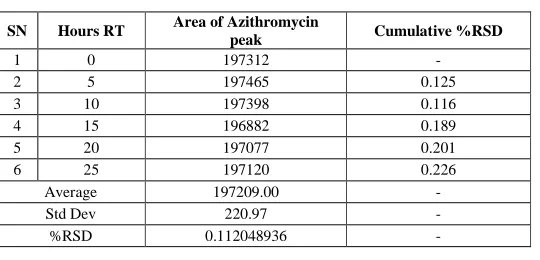
Robustness of the method was investigated by varying the instrumental conditions such as flow rate (+0.1ml/min), organic content in mobile phase (+2 % absolute), wavelength+.2nm for System suitability [19].
RESULTS AND DISCUSSION
All of the analytical validation parameters for the proposed method were determined according to Conference on Harmonization (ICH) guidelines [17].
System Suitability Test: The parameters of system suitability study were presented in table 1. From the typical
chromatogram of azithromycin as shown in figure 6, it was found that the average retention time ± standard deviation for azithromycin was found to be 7.655±0.005 min for five replicate injections. The maximum asymmetry factor was found to be 1.23, which indicated asymmetric nature of the peak. The number of theoretical plates was found to be 5623, which suggested an efficient performance of the column. Resolution between Azithromycin and impurity was 4.60 (NLT 2.0). The absence of additional peaks in the chromatogram confirms system suitability criteria as per ICH guidelines.
Table-1 : System Suitability results
Parameter Results Criteria
Minimum Resolution 4.49 NLT 2.0
%RSD of Area counts 0.40 NMT 2.0
Tailing factor, Azithromycin 1.23 NMT 2.0
Theoretical plate count 5623 NLT2000
Specificity : Specificity experiment showed that there is no interference or overlapping of the peaks due to diluents
and impurities with the main peaks as well as impurity peaks(Table-2).
Table-2 : Specificity results
SN Name of compound Retention time Resolution
1 Placebo 0.355 --
2 Blank 0.747 5.818
3 Blank 1.972 14.712
4 Unknown-1 4.477 22.274
5 Unknown-2 5.769 9.979
6 Imp-A 6.395 4.801
7 Azithromycin 7.656 4.607
8 Imp-B 9.249 5.982
9 Unknown-3 9.861 4.492
10 Blank 10.801 5.229
Limit of detection and limit of quantitation: LOD and LOQ were calculated on the basis of signal to noise ratio
using Lab Solution. The value of LOD and LOQ for Azithromycin were < 0.1µg 1 (0.1ppm) and < 0. 35µg mL-1 with optimized method, these values are better than reported values for Azithromycin and its related substances as API or in bulk formulations with UV-visible and PDA detectors. % RSD was in the range of 1.21-1.82 % (NMT 5.0%) for LOQ precision. These results (table-3) conclude that method confirm LOQ precision criteria mentioned in the ICH.
Table-3: LOD and LOQ results
4 2.25 48702
5 2.75 58533
6 3.5 75311
Fig-8: Linearity curve of Impurity-A Fig-9: Linearity curve of Impurity-B
Method Precision : The % RSD of the area for each impurity (impurity- A,B, and Unknown-1,2 ,3 )was calculated
.The % RSD of six measurement of test sample was 0.26-1.80%(Table-5).
Table-5 : Method Precision Results
Parameter Results Criteria
Resolution between Azithromycin and imp-A 4.60 NLT 2.0
%RSD of Area counts 0.52 NMT 2.0
Tailing factor, Azithromycin 1.16 NMT 2.0
Theoretical plate counts 4789 NLT2000
Table-6 : Intermediate Precision Results
Parameter Results criteria
Exp-1 Exp-2
Resolution between Azithromycin and Impurity-A 4.58 4.62 NLT 2.0
Maximum Tailing factor for all analytes 1.21 1.14 NMT 2.0
Theoretical plate counts 4678 4825 NLT 2000
Intermediate Precision (Ruggedness): The intermediate precision of the method was evaluated using different
analyst and different instrument in the same laboratory. The % RSD of six measurements of test sample of analyst -1 and analyst-2 was 0.32-1.89% and 0.45-1.75 respectively (Table-6).
y = 21449x + 142.34 R² = 0.9997
0 20000 40000 60000 80000
0 1 2 3 4
A
re
a
Concentration (ppm)
Linearity of Impurity-A
y = 15984x + 119.47 R² = 0.9994
0 10000 20000 30000 40000 50000 60000
0 1 2 3 4
A
re
a
Concentration (ppm)
Linearity of Impurity-B
4 2.25 36811
5 2.75 43628
Accuracy : The recovery of impurities A and impurity-B were determined by spiking each impurity at three
different concentration levels of LOQ,100% and 150%ofeach in triplicate at the specified limit. The recovery range of all impurities was found to be between 97.0%- 102.0 %( Table-7A & 7B).
Robustness: The method was found to be robust with respect to flow rate, organic composition in mobile phase and
wavelength without any changes in system suitability parameters such as resolution, tailing factor and theoretical plate. Resolution was 4.29-4.78, tailing factor was 1.23-1.41 and theoretical plate was 6144-7546 (table-8)
Table-7A : Accuracy results of Impurity-A
Accuracy Level Area of Standard Amount Added (ppm) Amount Recovered (ppm) Recovery %
LOQ
4341
0.30
0.29 97.88
4478 0.30 98.95
4237 0.30 101.60
Average 99.48
100% 34589
2.25
2.23 99.16
35610 2.21 98.25
35589 2.23 99.19
Average 98.87
150% 51690
3.50
3.52 100.58
50975 3.57 101.99
51690 3.52 100.57
Average 101.05
Average of % Recovery 99.80
Table-7B : Accuracy results of Impurity-B
Accuracy Level Area Amount Added (ppm) Amount Recovered (ppm) Recovery %
LOQ
5578
0.30
0.30 98.40
5578 0.29 96.77
5578 0.30 100.18
Average 98.45
100% 42917
2.25
2.24 99.53
42917 2.26 100.64
42917 2.28 101.50
Average 100.55
150% 66206
3.50
3.49 99.68
66206 3.54 101.04
66206 3.53 100.87
Average 100.52
Average of % Recovery 99.85
Table-8 : Robustness results
Conditions Resolution Tailing factor Theoretical Plate
Condition -1.1 4.501 1.236 6589
Condition -1.2 4.623 1.293 6144
Condition -2.1 4.432 1.419 7546
Condition- 2.2 4.293 1.269 6281
Condition -3.1 4.546 1.273 6632
Condition -3.2 4.787 1.255 7165
%RSD 0.112048936 -
CONCLUSION
The proposed method was found to be accurate, precise, specific, linear, rugged, robust, and stability indicating for the determination of Azithromicin and its process related substances. The novelty of this method includes short analysis time even in the presence of unreacted materials as well as process impurities.
Acknowledgment
We sincerely thank Shimadzu Analytical India Pvt Ltd New Delhi for using sophisticated analytical instrumentation Facility for analytical method development.
Abbreviations
ACN : Acetonitrile
HPLC : High Performance Liquid Chromatography ICH : International conference on Harmonization G : Gram
Id : Internal Diameter LC : Liquid Chromatography
LCMS : Liquid Chromatography- Mass Spectrometry LOD : Limit of Detection
LOQ : Limit of Quantitation m : Meter
MeOH : Methanol mg : Milligram ml : Mili litre mm : Mili meter nm : Nano meter NLT : Not less than NMT : Not more than ODS : Octyl decyl silane PDA : Photo diode array detector SD : Standard deviation RSD : Relative standard deviation THF : Tetra hydro furan
µg : Microgram µl : Microlitre µm : Micron
[image:9.595.166.436.118.248.2]REFERENCES
[1]FA Bettelheim, WH Brown, MK Campbell, SO Farrell, OJ Torres, Introduction to General Organic and Biochemistry, 10th edition, Wadsworth Publishing Co Inc.,USA, 2010, 507.
[2]L Miguel, C Barbas, J. Pharm. Biomed. Anal., 2003 ,33 211-217.
[3]K Tarkasband, International JournalofBiopharmaceutics.2013,4(2):196-201. [4]N Sharmin, NS Shanta , SC Bachar, J.Pharm.Sci. 201312(2),171-179.
[5]D Debremaeker, D Visky, HK Chepkwony, A Van Schepdael, E Roets ,J Hoogmartens, Rapid Commun. Mass
Spectrom. 2003; 17, 342–35
[6]I Dewan,T Amin, MF Hossain, M Hasan, SF Chowdhury, MGazi,SMA Islam, IJCPR, 2013, 4(1), 282-286. [7]F Al-Rimawi, M Kharoaf, Journal of Chromatographic Science, 2010, 48, 86-90.
[8]T Ghari, F Kobarfard, SA Mortazavi, Iranian Journal of Pharmaceutical Research2013, 12, 57-63.
[9]J Raghuram, N Appalaraju, VK Kumar, Int J Pharm2015, 5(4), 1139-1143.
[10]K Tarkasband, International Journal of Advanced Pharmaceutics, 2013, 3(2), 84-93.
[11]VR Krishna,KBM Krishna, BH Babu, Indian Journal of Pharmaceutical Science & research, 2014, 4(3), 176-186. [12]PD Ghode, SP Pawar, International Journal of Advances in Pharmaceutical Analysis, 2015, 5 (1), 17-22. [13]N Nyola, GS Jeyabalan, J.D.Med. 2012, 4 (2), 27-32.
[14]VKC Aradhya, LR Ranjitha , SK Shetty, M Ahmed, ASM Kumar, IJ Kuppast, World Journal of Pharmacy and
Pharmaceutical Sciences, 2014,4(1), 922-933.
[15]EK Reddy, AR Reddy, Int. Res J Pharm. App Sci., 2013, 3(5), 168-174. [16]United State Pharmacopeia convention, 2010, USP 38 NF, 33.
[17]International Conferences on Harmonization, Draft Revised (2005) ,Q2A(R1). [18]United State Pharmacopeia, 2010, USP 36 NF ,27 (2).
[19]T Sudha, KK Manjeera, International Journal of Biology, Pharmacy and Allied Sciences , 2012, 1(9): 1322-1335