ARBITRARY LAGRANGIAN-EULERIAN FORM OF
FLOWFIELD DEPENDENT VARIATION (ALE-FDV)
METHOD FOR MOVING BOUNDARY PROBLEMS
BY
MOHD FADHLI BIN ZULKAFLI
A thesis submitted in fulfilment of the requirement for the
degree of Doctor of Philosophy
Kulliyyah of Engineering
International Islamic University Malaysia
ABSTRACT
TABLE OF CONTENTS
Abstract ... ii
Abstract in Arabic ... iii
Approval ... iv
Declaration ... v
Copyright ... vi
Acknowledgements ... vii
List of Tables ... x
List of Figures ... xi
List of Symbols ... xiv
List of Abbreviations ... xvii
CHAPTER 1: INTRODUCTION ... 1
1.1 Introduction ... 1
1.2 Problem Statement ... 3
1.3 Research Philosophy ... 4
1.4 Research Objectives ... 5
1.5 Research Methodology ... 5
1.6 Scope of Research ... 8
1.7 Thesis Organization ... 8
CHAPTER 2: LITERATURE REVIEW ... 10
2.1 Introduction ... 10
2.2 Unified CFD Method ... 11
2.3 Flowfield Dependent Variation (FDV) Method ... 14
2.4 Flows with Moving Boundaries ... 18
2.4.1 Arbitrary Lagrangian-Eulerian (ALE) Method ... 19
2.4.2 Immersed Boundary (IB) Method ... 23
2.5 Summary ... 26
CHAPTER 3: METHODOLOGY AND NUMERICAL FORMULATION ... 28
3.1 Introduction ... 28
3.2 Governing Equation ... 28
3.3 Flowfield Dependent Variation (FDV) Method ... 30
3.4 Arbitrary Lagrangian-Eulerian (ALE) Form of FDV Method ... 33
3.4.1 One-dimensional ALE-FDV Formulation ... 36
3.4.2 Two-dimensional ALE-FDV Formulation ... 39
3.4.3 Three-dimensional ALE-FDV Formulation ... 42
3.5 Boundary Conditions ... 44
3.5.1 Wall Boundary Condition ... 45
3.5.2 Inflow Boundary Condition ... 46
3.5.3 Outflow Boundary Condition ... 47
3.5.4 Far Field Boundary Condition ... 47
3.6 Numerical Algorithm ... 47
CHAPTER 4: RESULTS AND DISCUSSIONS ... 54
4.1 Introduction ... 54
4.2 Stability Analysis ... 54
4.3 One-dimensional Cases ... 60
4.3.1 Sod Shock Tube ... 60
4.3.2 Interaction of Two-Blast Shock Waves ... 63
4.3.3 Solution of Half-Riemann Problems ... 66
4.3.4 Gas Confined Between Two Walls ... 69
4.3.5 Sod Shock Tube Coupled with a Rigid Wall ... 72
4.3.6 Sod Shock Interaction with a Fluid Piston ... 74
4.4 Two-dimensional Cases ... 78
4.4.1 Free Stream Preservation Test ... 78
4.4.2 Propagating Isentropic Vortex ... 80
4.4.3 Oscillating NACA 0012 Airfoil ... 84
4.4.4 Rapidly Pitching NACA 0015 Airfoil ... 87
4.4.5 Rotating Cylinder ... 89
4.5 Three-dimensional Cases ... 96
4.5.1 Three-dimensional Free Stream Preservation Test ... 96
4.5.2 Oscillating Rectangular Wing with NACA 0012 Airfoil Section 98 4.5.3 Viscous Flow Over Rotating Sphere ... 102
4.5.4 Simulation of a Flying Sphere ... 105
4.6 Summary ... 110
CHAPTER 5: CONCLUSION AND RECOMMENDATION ... 111
5.1 Conclusion ... 111
5.2 Research Contribution ... 112
5.3 Recommendation for Future Work ... 113
REFERENCES ... 114
RELATED PUBLICATIONS ... 122
APPENDIX A ... 123
LIST OF TABLES
Table No. Page No.
4.1 CPU time per time step for each number of cells 72
4.2 Velocities maximum error norm, L∞(ui) 80
4.3 Summary of unstructured mesh 90
4.4 Velocities maximum error norm for three-dimensional wavy mesh
98
4.5 Comparison of CPU time taken by ALE-FDV and ANSYS Fluent
LIST OF FIGURES
Figure No. Page No.
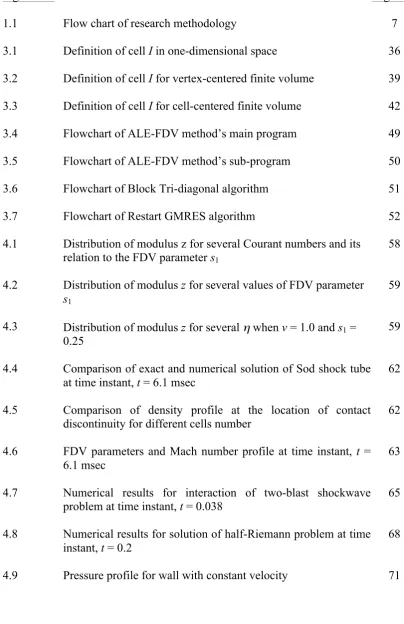
1.1 Flow chart of research methodology 7
3.1 Definition of cell I in one-dimensional space 36
3.2 Definition of cell I for vertex-centered finite volume 39
3.3 Definition of cell I for cell-centered finite volume 42
3.4 Flowchart of ALE-FDV method’s main program 49
3.5 Flowchart of ALE-FDV method’s sub-program 50
3.6 Flowchart of Block Tri-diagonal algorithm 51
3.7 Flowchart of Restart GMRES algorithm 52
4.1 Distribution of modulus z for several Courant numbers and its
relation to the FDV parameter s1 58
4.2 Distribution of modulus z for several values of FDV parameter
s1
59
4.3 Distribution of modulus z for several η when v = 1.0 and s1 = 0.25
59
4.4 Comparison of exact and numerical solution of Sod shock tube at time instant, t = 6.1 msec
62
4.5 Comparison of density profile at the location of contact discontinuity for different cells number 62
4.6 FDV parameters and Mach number profile at time instant, t =
6.1 msec 63
4.7 Numerical results for interaction of two-blast shockwave problem at time instant, t = 0.038 65
4.8 Numerical results for solution of half-Riemann problem at time instant, t = 0.2
4.10 Entropy errors 71
4.11 Pressure profile at several time instants 73
4.12 FDV parameters and local Mach number at several time
instants 74
4.13 Position of the wall 75
4.14 Pressure profile at several time instants 77
4.15 Motion of the deformable mesh 80
4.16 Density contour at time t = 0.1 83
4.17 Comparison between exact solutions and numerical solutions of pressure coefficient along x2 = 0 at t = 0.1
83
4.18 Comparison of density error between deformed and stationary mesh
84
4.19 Pressure contour at several angles of attack (left figures: present, right figures: Murman et al., 2003)
86
4.20 Comparison of lift coefficient 86
4.21 Comparison of lift and drag coefficient 88
4.22 Comparison of vorticity profile at AoA = 44 degrees 89
4.23 ω = 1.0 (left figures: present, right figures: Sen et al., 2013) 91
4.24 ω = 3.0 (left figures: present, right figures: Sen et al., 2013) 92
4.25 Experimental results by Badr et al. (1990) 93
4.26 Flow field at t = 8.0 for case ω = 1.0 94
4.27 Average lift and drag coefficient of each mesh for case ω = 1.0 95
4.28 The wavy mesh for the three-dimensional free stream preservation test
98
4.29 Mach number and parameter s1 profile at different time instants and angle of attacks
100
4.30 Comparison of computed lift and moment coefficient with experimental and numerical data
4.31 Streamline profile of present method (left) and Kim (2009) (right) at different rotation speed
104
4.32 Comparison of flight path 107
4.33 Streamline pattern of anti-clockwise spinning sphere at its initial position
108
LIST OF SYMBOLS
Roman symbols
a Convection Jacobian
b Diffusion Jacobian
c Diffusion gradient Jacobian
E Total energy per unit mass
F Inviscid flux
G Viscous flux
I Vertex/ cell element index number
J Neighbour vertex/ cell element index number
M Mach number
n Normal vector
p Pressure
Pr Prandtl number
Re Reynolds number
sa First-order implicitness parameter
sb Second-order implicitness parameter
s1 First-order convection FDV parameter
s2 Second-order convection FDV parameter
s3 First-order diffusion FDV parameter
s4 Second-order diffusion FDV parameter
t Time
U Conservative variables
vm Mesh velocity
xi Cartesian coordinates
Greek symbols
Δ Changes in time/ space
δij Kronecker delta
ε Internal energy per unit mass
Γ Control surface/ cell boundary
γ Specific heat ratio (Ideal gas = 1.4)
µ Dynamic viscosity coefficient
ρ Density
τij Viscous stress tensor
Ω Control volume/ cell volume
Subscripts
I Cell indices
I(J) Neighbour cell of cell I
i, j, k Spatial direction indices
IC Interior cell
m mesh
n Normal direction
T Total value
w Wall surface
∞ Free stream condition
Superscript
m GMRES iteration
LIST OF ABBREVIATIONS
ALE Arbitrary Lagrangian-Eulerian
ALE-FDV Arbitrary Lagrangian-Eulerian form of Flowfield Dependent Variation AoA Angle of Attack
CFD Computational Fluid Dynamics CFL Courant-Friedrichs-Lewy CBS Character-based Split
DGCL Discrete Geometric Conservation Law
DGFEM Discontinuous Galerkin Finite Element Method et al. (et alia): and others
FDV Flowfield Dependent Variation FDM Finite Difference Method FEM Finite Element Method FVM Finite Volume Method GCL Geometric Conservation Law GMRES General Minimal Residual
GRAFSS General Relativistic Astrophysical Flow And Shock Solver HOC Higher-Order Compact
HOC-FDV Higher-Order Compact Flowfield-Dependent Variation IB Immersed Boundary
i.e. (id est): that is
LSGR Least Square Gradient Reconstruction MFDV Modified Flowfield Dependent Variation
MUSCL Monotone Upwind Schemes for Conservation Law PDE Partial Differential Equation
PISO Pressure Implicit with Splitting of Operators
CHAPTER ONE
INTRODUCTION
1.1 INTRODUCTION
Governing equations in fluid mechanics are a coupled system of nonlinear partial
differential equations, which are difficult to solve analytically and to date except for
some particular problems, there is no general closed-form solution to these equations.
Thus, numerical approach is important in order to study and analyze the problems
involving fluids. In fluid mechanics, the area that studies such an approach is
Computational Fluid Dynamics (CFD), and its development began with the advent of
the computer in the 1950s. CFD is important as a research and design tool today
because the development of modern technologies such as high-speed transportation,
electronics and biotechnologies also rely on the understanding of fluid mechanics.
Major basic techniques used in the solution of partial differential equations in
general and CFD in particular are Finite Difference Methods (FDM), Finite Element
Method (FEM) and Finite Volume Method (FVM). FDM is easy to formulate but
because a structured mesh is required, it has difficulties with multi-dimensional
problems that involve complex geometries. In contrast, complex geometries and
unstructured meshes are easily accommodated by FEM but it uses large computer
memory, thus slow for large problems and not well suited for turbulent flows.
FVM however, has an advantage in memory usage and speed for very large
problems. This method is based on the discretization of the integral form of nonlinear
partial differential equations (PDE) into finite control volumes and control surfaces. It
applicable to unstructured grids and complex geometries. Furthermore, the system of
algebraic equations by finite volume methods enforces the conservation of all
variables across the control surfaces. Therefore, the conservation of mass, momentum
and energy are assured in the formulation itself while variables may not be
continuously differentiable across shock or other discontinuities, which is an
advantage for high-speed flow problems.
In CFD, the problems are usually solved by different techniques depending on
the physical properties of the flows. For example, incompressible flows are analyzed
using the pressure-based formulation but compressible flows are analyzed using the
density-based formulation. In dealing with the domains, which contains flows of all
speed with various physical properties, where the equations of state for compressible
and incompressible flows are different, and where the transitions between laminar and
turbulent are involved, very special and powerful numerical treatments are needed.
The so-called Flowfield Dependent Variation (FDV) theory, which was first
introduced by Chung (1999), has been devised toward resolving these issues. The
theory introduced the so-called FDV parameters, which are dependent on the gradient
of changes between flow variables (e.g. Mach number or Reynolds numbers) of local
adjacent nodal points in the computational domain. Because of these parameters, the
terms containing the fluctuation variables in the FDV equation automatically follow
the current physical phenomena and adequate numerical controls (artificial viscosity)
are automatically activated according to the current flow field physics. The numerical
scheme of the FDV equation itself will then adjust accordingly for every node based
For the numerical simulation and analysis of objects that move within the flow,
the objects usually are made static relative to the flow in the computational domain,
similar to the wind tunnel experiment. However, there are many situations when the
objects are needed to move or deform in the computational domain such as airfoil
oscillations, wing flutter, and rotating propellers problems. This is one of the
important issues in CFD applications, because the simulations of the flow around
moving objects require special interpolation methods to handle the moving
boundaries. Methods for moving computational mesh have been studied actively by
the CFD community because of their engineering importance. One of the most
popular techniques in solving moving boundaries problems is Arbitrary
Lagrangian-Eulerian (ALE), which combines Lagrangian and Lagrangian-Eulerian description of a continuum,
i.e. fluid and solid, in one numerical scheme.
The present research studies the combination of FDV method and ALE method
in finite volume form. The finite volume form would make this method applicable to
complicated geometries of moving bodies and by combining FDV with ALE method,
it would give an accurate prediction of the interactions between fluid and the moving
bodies. Therefore, it is expected that the proposed method will provide a new
technique of resolving accurately the interaction of arbitrary bodies in arbitrary flow
fields.
1.2 PROBLEM STATEMENT
Unified Computational Fluid Dynamics (CFD) method has been the aim of the CFD
community in recent years. The need for a unified method arises because in CFD,
different type of flow problems need different type of method to solve, but in reality
may coexists with high speed flow area such as in the cases of aircraft landing or
take-off configurations where the free stream Mach number is much less than the local
Mach number around the high-lift devices of the aircraft. Flowfield Dependent
Variation (FDV) method has been introduced to resolve these problems, however this
method is currently limited to stationary bodies and has not yet been used to handle
moving boundary problems. This research proposes to combine FDV method with
moving boundary interpolation technique, ALE method for solving moving boundary
problems because in some cases, deformation and motion of the bodies need to be
taken into account in order to get accurate results without ignoring its physical
properties as well as the existence of many different flow regimes within a flow field.
1.3 RESEARCH PHILOSOPHY
The philosophy of this research is to combine the advantages of FDV theory with a
moving body technique, the ALE method, in order to develop a robust and versatile
method, which could be used for the computation of flow fields with moving
boundaries. The philosophy is driven by the need to consider the deformation and/or
movement of bodies in a flow in which to date, the FDV theory has not been applied.
The philosophy is based on obtaining the parameters of the FDV equations from the
current flow field variables at each time step and every grid point which are used to
adjust governing equations in each flow region according to the current flow field
situation. The combination of ALE and FDV method will be used to handle the
problems involving moving boundaries in a flow. Meanwhile, the finite volume
method gives the ALE-FDV formulation, the capability to solve flow problems
1.4 RESEARCH OBJECTIVES
The objectives of this research are as follows.
• To develop a technique which could be used for wide ranges of
compressible-incompressible, viscous-inviscid, laminar-turbulent, and
high-low speed flows for moving boundary problems.
• To combine FDV method and a moving body interpolation technique,
named ALE method for solving flow problems involving moving
boundaries.
• To apply the proposed method to solve three-dimensional inviscid and
viscous flow problems involving moving boundaries by developing an
algorithm and translate it into an efficient computer code.
• To investigate such combinations that will satisfy the stability requirement
as well as guarantee accuracy and efficiency.
1.5 RESEARCH METHODOLOGY
The methodology of this research will focus on the development of the proposed
method based on numerical work. The numerical work will be carried out using
traditional way of CFD, starting with pre-processing, then solving process, and ending
with post-processing. Pre- and post-processing will be performed using commercial
softwares, Gambit as mesh generation software and Paraview as visualization
software. The solving process will be carried out using FORTRAN code on a UNIX
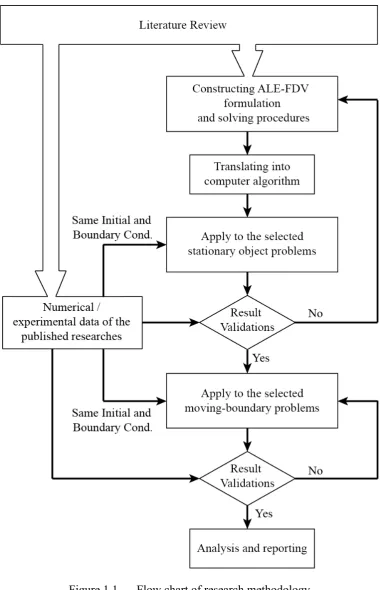
based machine. The steps of algorithm development for the proposed method will be
done as follows:
a) The step begins by expanding conservative variables (i.e. density,
series. This expansion is done with the addition of implicitness parameters
into the first and second time derivatives of that series. Next, the time
derivatives are changed into spatial derivatives by substituting the
Navier-Stokes equations in that series to construct the FDV formulation.
b) The general formulation of ALE-FDV method is derived by combining
ALE technique with the FDV formulation. The formulation is then
discretized using appropriate finite volume method.
c) Strategies to solve the ALE-FDV formulation are then constructed and
translated into computing algorithm. This algorithm is then written in
FORTRAN language as the solver code.
d) Then, selected stationary body in one-dimensional problems flow is
solved using the developed solver and numerical as well as experimental
data available in the literature is used to validate the solver.
e) If the solutions of the stationary body problems are valid, several
one-dimensional moving boundary problems are selected and solved using the
complete solver for the validation and analysis process.
f) Finally, ALE-FDV method is applied to two and three-dimensional flow
problems by repeating steps b to e.
To summarize, the following flow chart shows the overall methodology of this
1.6 SCOPE OF RESEARCH
This study focuses on developing a new numerical scheme that combines the FDV
method and ALE method. The proposed method is spatially discretized using
appropriate finite volume method. A flow solver, called as ALE-FDV solver is
developed by translating the discrete formulation into an algorithm. In order to
validate the scheme, the developed solver is applied to several benchmark one, two
and three-dimensional flow problems. The flow problems involving moving mesh and
fluid-structure interaction in inviscid or viscous fluid are also in the scope of this
work.
1.7 THESIS ORGANIZATION
This thesis is organized by dividing it into five chapters. This chapter, which is the
first chapter, gives an introduction and background of FDV and ALE method as well
as demonstrates the importance of extending FDV method into the application of
moving boundaries and fluid-structure interaction problems. Problem statements,
research philosophy, objectives, methodology and scope of the research are also
explained in the first chapter. Second chapter presents a review of previous studies
and works that are relevant to this research. The review covers past and recent works
related to the FDV and ALE methods as well as other works involving moving
boundaries and fluid-structure interaction applications.
The third chapter explains the derivation of the ALE-FDV method and the
technique to discretize it with finite volume method. The strategies to apply
ALE-FDV method and the algorithm used in this research are also explained in detail in the
numerical results and verification of ALE-FDV method by comparing with previous
relevant works are discussed in the same chapter. Finally, the fifth chapter concludes
this research works and findings, highlights the main contributions of the research and
CHAPTER TWO
LITERATURE REVIEW
2.1 INTRODUCTION
Interaction between a solid and a fluid is a common phenomenon either in nature or
induced by human activities. Such interactions happen in various disciplines and at
different scales, which can be modeled through experiments or simulated using
computational method. In a modern world, computer simulation has become an
important tool because it provides an economical approach as well as additional
insight to the analysis of such fluid interactions.
The numerical approach in fluid mechanics, Computational Fluid Dynamic
(CFD), has been developed in the 1950s and since then has been extended by
researchers in order to allow investigation on various complex fluid interactions. CFD
is being used extensively in many industrial sectors and is advancing rapidly as more
complex fluid interaction become available and simulation on larger scale is more in
demand today.
As the flow simulation become larger and complex, development of more
accurate and efficient numerical scheme has become significant. One of the numerical
approaches called Flowfield Dependent Variation (FDV) method has been developed
towards resolving complex flow interaction problems. In this chapter, a review on the
development and application of FDV method and other similar method will be
presented. At the same time, many fluid and solid interaction problems require
presents an overview on the development and application of such grid interpolation
techniques. This chapter will be ended by a summary of all reviews and conclusion on
the advantages and drawbacks of numerical schemes used in the reviewed literatures.
2.2 UNIFIED CFD METHOD
Compressible flow field solvers use density as their primary unknown variable while
artificial compressibility method (Chorin, 1967) and pressure correction method
(Harlow and Welch, 1965) are the two approaches that have been widely used as
incompressible flow solvers. The problem with compressible flow solver is that some
areas of the flow would be incompressible, thus make it unsuitable for the
compressible flow solver alone to compute the entire flow field. Since the solution of
incompressible flow can be obtained as part of the compressible flow formulation, the
method of extending the function of compressible flow solver has been actively
studied (Wesseling, 2000).
Either explicit or implicit time stepping scheme can be used to solve the
governing equations numerically. However, an explicit scheme needs to satisfy the
stability condition in order to produce solutions of the problems. In particular, the
stability condition, known as Courant-Friedrich-Lewy (CFL) condition dictates the
Courant number (i.e., ratio of physical propagation speed to numerical propagation
speed) must be less than unity (Courant, Friedrichs and Lewy, 1967). In other words,
the time needed for the numerical information to propagate in a spatial distance ∆x
must be smaller than the time of physical information propagation in that same
distance. Moreover, the time needed for the numerical information to propagate will
become much smaller if acoustic effects are present in low-subsonic flow. When this
many small steps to be solved. Moreover, often-wrong results are obtained when a
stiff system of equations are solved by carrying out very large number of small time
steps as reported by Turkel, Fiterman and Van Leer (1993) and Guillard and Viozat
(1999).
In order to resolve the problem, some numerical schemes such as
preconditioning techniques are developed. This scheme alleviates the problem by
modifying the governing equations artificially by multiplication of the time-derivative
with a specific preconditioning matrix. While the scheme resolved stiffness and
accuracy problem for stationary solutions, the time accuracy is lost due to the
modification of time derivatives in the governing equations. Therefore, to compute
unsteady flows, the preconditioning method has been combined with dual time
stepping method in order to restore the accuracy in time (Weiss and Smith, 1995). It
has been shown that dual time stepping is more efficient than physical time stepping
used by the original compressible flow solver. However, because of the large number
of pseudo-time steps required for each physical time step, the efficiency lags behind
incompressible flow solvers (Wesseling, 2000). As remarked by Paillére, Clerc,
Viozat, Toumi, and Magnaud (1998), implicit time stepping scheme must be used if
the explicit time stepping scheme requires a very small time step to satisfy the
stability condition.
A different approach has been taken by Yoon and Chung (1996), where they
introduced the so-called mixed explicit implicit generalized Galerkin spectral element
method (MEI-GG-SEM). Unlike traditional methods, the so-called flow field
dependent parameters detect the physical properties of the fluid and then
flow where mesh refinement were carried out adaptively until shock waves were
resolved in which the traditional turbulence model is no longer needed.
Complexities of fluid phenomena are not only due to the co-existence of
compressible and incompressible flow, it also includes transition to turbulence,
relaminarization, flow separation and transition between viscous and inviscid flow
regions. Instead of focusing only on the incompressible and compressible flow
mixture problems, a new approach called the flow field dependent mixed
explicit-implicit (FDMEI) method has been developed in attempt to resolve the complexities
of fluid phenomena in all speed flow regimes (Chung, 1997a, 1997b; Yoon, Moon,
Garcia, Heard, and Chung, 1998). Based on the flowfield dependent variation (FDV)
theory, this method uses FDV parameters which depend on the change of either Mach
numbers, Reynolds numbers, Peclet numbers, or Damkohler numbers at adjacent
nodal points to detect physical properties of each nodal points. Peclet number or
Damkohler number is used for high speed compressible flow problems such as in
hypersonic flow or chemically reactive flow problems such as in combustion. Peclet
number is defined as the ratio of convective to diffusive strength (Wesseling, 2000)
while Damkohler number defined the relationship between chemical reaction and
flowfield transport phenomena such as convection, diffusion or heat conduction
(Chung, 2002).
Appropriate numerical schemes are provided to each nodal point if necessary
by calculating and updating the values of these parameters at each time step. Yoon et
al. (1998) used FDMEI method to compute flow over a flat plate, supersonic flow on a
compression corner, three-dimensional duct flow, and lid-driven cavity flow. Their
results showed good agreement with experimental and other published numerical
resolve mutual interactions and transition between viscous/ inviscid, compressible/
incompressible, and laminar/ turbulent flows.
2.3 FLOWFIELD DEPENDENT VARIATION (FDV) METHOD
The original idea of FDV theory began from the need to address the physics involved
in shock wave turbulent boundary layer interactions (Chung, 1999). In this situation,
transition and interactions of inviscid/ viscous, compressible/ incompressible, and
laminar/ turbulent flows constitute not only the physical complexities but also
computational difficulties. This is where the very low velocity in the vicinity of the
wall and very high velocity far away from the wall co-exist within the domain of
study. Implicitness parameters were initially introduced in the expansion of
conservative variables in the Taylor series up to the second order time derivatives.
The series are then used in the Navier-Stokes system of equations so that these
parameters could be used in solving the flow field interaction. These parameters are
characterized into two categories, namely first and second order convection/diffusion
parameter. In particular, the first order parameters ensure the solution accuracy and
second order parameters assist in the solution stability, and both serve as physical
parameters to allow the transitions and interactions of different types of flow to be
automatically accommodated.
Moreover, flowfield-dependent variation formulations have been addressed by
Schunk, Canabal, Heard, and Chung (1999) as a strategy toward unification of finite
difference, finite element, and finite volume methods. All the physical phenomena are
taken into account in FDV equations, so that spatial discretization will not dictate the
introduced in FDV equations play significant roles as adjusting the governing
equations (hyperbolic, parabolic, and/or elliptic), resolving various physical
phenomena, and controlling the accuracy and stability of the numerical solution. The
theory is verified by a number of example problems addressing the physical
implications of the variation parameters, which resemble the flow field itself. Using
finite difference method as spatial discretization of FDV equations, Schunk et al.
(1999) showed numerical results of three-dimensional triple shock/boundary layer
interaction matched with experimental results and finite difference calculation using
k-ε model as reported by Garrison, Settles, and Hortsman (1996), thus indicated that
FDV theory was robust enough to adequately model complex flow phenomena.
FDV theory also has been applied in high-energy astrophysics problems,
particularly to those containing shock waves and high-speed flow. Richardson, Chung,
Karr, and Pendleton (2000) proposed the FDV theory as a method to accurately solve
very high-speed flow problems and capturing relativistic shocks. Instead of Mach
number, Lorentz factor, which describe the velocity of an object relative to the speed
of light (Corcoran, 2010), is used to dictate the FDV convection parameters. The
theory has been applied in relativistic hydrodynamic equations to solve relativistic
shock tube problems. Furthermore, they also presented FDV method for solving
general relativistic non-ideal hydrodynamics (Richardson and Chung, 2002a).
Non-ideal flows are where radiation, magnetic forces, viscosities, and turbulence play an
important role. Relativistic effects become pronounced in such cases as jet formation
from black hole magnetized accretion disks, which may lead to the study of
gamma-ray bursts. Richardson and Chung (2002b) implemented the FDV theory to obtain
general relativistic astrophysical flow and shock solver (GRAFSS) which is a
geometries. Richardson, Cassibry, Chung, and Wu (2010) have demonstrated the
capability of the finite element form of FDV method in physical applications that have
widely varying spatial and temporal scales. The use of a finite element formulation
also adds capabilities such as flexible grid geometries and exact enforcement of
Neumann boundary conditions. The author presented the results of
converging/diverging nozzle, which contains both incompressible and compressible
flow in the flow field over a range of subsonic and supersonic regions. The results
showed that the finite element formulation is stable and accurate for a range of both
Mach numbers and Lorentz factors while its accuracy are comparable to other
methods and slightly better than Total Variation Diminishing (TVD) method.
Heard (2007) utilized the FDV parameters for adaptive mesh refinements. FDV
equations were solved using an element-by-element GMRES solver with the elements
grouped together to allow the element operations to be performed in parallel. Besides
dictating the physical properties of the flow field, FDV parameters are used as error
indicators for a solution-adaptive mesh. The finite element grid is refined as dictated
by the magnitude of FDV parameters. This method is comparable to those where the
grid is refined using primitive variable error indicators, and requires less
computational time to generate the grids. The use of parallel processing in performing
some element operations is shown to reduce the wall clock time by approximately 40
percent in going from one to eight processors. The algorithm's ability to solve a flow
field containing various kinds of interactions is demonstrated by solving a variety of
fluid flow conditions ranging from low-speed incompressible flow to compressible
flow containing shock waves, and the refinement of finite element grid to further
FDV parameters were modified by Megahed, El-Mallah, and Girgise (2006) to
improve the understanding of physical meaning of the variation parameters. The
modified method, MFDV method was applied to the Euler equation with standard
Galerkin finite element method as its spatial discretization. Two well-known cases of
supersonic internal flow; shock reflection problem and compression corner problem
were solved and the results were shown to have a good agreement with other
published literature. Furthermore, three other cases of supersonic internal flow; half
wedge in supersonic wind tunnel, extended compression corner problem, and circular
arc problem also has been solved. All of the numerical solutions are comparable with
analytical and numerical solutions obtained by other established methods, thus
showed the ability of the MFDV method to solve problems involving supersonic
internal flow.
FDV theory also has been combined with higher-order compact method (Hirsh,
1975; Lele, 1992; Mawlood, Basri, Asrar, Omar, Mokhtar, and Ahmad, 2006; Elfaghi,
Asrar, and Omar, 2010) which is generally a technique that use fewer number of nodal
points to obtained high order finite difference approximation as opposed to classical
finite difference method. Originally developed by Elfaghi et al. (2010), Higher-Order
Compact Flowfield-Dependent Variation (HOC-FDV) method used implicit fourth
order compact differencing Hermitian (Pade-type) scheme to approximate the spatial
derivatives in FDV equations. HOC-FDV method has been applied to solve up to
two-dimensional problems such as Sod-shock tube problem, interaction of two-blast shock
waves, and flow past NACA0012 airfoil (Elfaghi, Asrar, and Omar, 2009a). The same
method also has been used in solving full Navier-Stokes equations such as nonlinear
viscous Burgers equation and transient Couette flow (Elfaghi, Asrar, and Omar,
operate in various flow regimes without using any special treatments due to the
capability of the FDV method. Moreover, HOC-FDV is more efficient than FDV
method as well as other conventional high-order methods because less stencil points is
required to obtain solutions with the same accuracy.
2.4 FLOWS WITH MOVING BOUNDARIES
Moving boundary problems in CFD applications are the cases where boundaries of the
bodies (or obstacles) in a flow are moving and/or deforming. For example, airfoil
oscillations, wing flutter, accelerated/decelerated aircraft, rotating propellers, fast
turning cars, reciprocating engines, suspension bridges vibration, flapping wings,
pulsating blood vessels, etc. Some movements of these boundaries are relatively small
but when they undergo large displacements, rotations or deformations, the effects of
fluid-body (or fluid-structure) could not be ignored. The need to solve such kind of
flow problems using dynamic mesh (i.e. the moveable/deformable body-conformal
grids system) has attracted many researches to develop various kinds of moving grid
interpolation techniques. One of the body-conformal moving grid interpolation
technique that is widely used in fluid and solid mechanics is Arbitrary
Lagrangian-Eulerian (ALE) method. However, simulation of largely deformable objects using
dynamic mesh is quite unstable and requires costly grid generation methods.
Therefore, such simulations are widely performed using stationary mesh
(non-conformal grid system) with the so-called Immersed Boundary (IB) method (Peskin,
2.4.1 Arbitrary Lagrangian-Eulerian (ALE) Method
Numerical algorithms using ALE method combine two classical kinematic
descriptions of continuum (i.e. fluid and solid) mechanics; Lagrangian and Eulerian
description. Lagrangian algorithms, in which each nodal point in the computational
domain follow the movement of associated structures, are mainly used in solid
mechanics. In contrast, Eulerian algorithms allow the continuum to move with respect
to the fixed computational grids, thus widely used in fluid mechanics. By combining
both algorithms, the computational grid can follow the moving objects in a
Lagrangian way, while the fluid is still seen in an Eulerian manner (Donea, Huerta,
Ponthot, and Rodríguez-Ferran, 2004).
ALE method was originally introduced in finite difference formulation (Hirt,
Amsden, and Cook, 1974), and has been successfully implemented in finite volume
and finite element formulations.Guardone, Isola, and Quaranta (2011) discretized the
ALE formulation of Euler equations with finite volume method. They adopted
edge-swap technique to improve the quality of triangular or tetrahedral cells in the
deformation mesh and thus allow the boundaries to encounter large displacement. The
technique is applied on translating and oscillating NACA 0012 airfoil case in which
the mesh undergo large deformation.
Habchi, Russeil, Bougeard, Harion, Lemenand, Ghanem, Valle, and
Peerhossaini (2013) developed a fluid-structure interaction solver using finite volume
approach. Both governing fluid flow equation and structural displacement equation
are discretized using finite volume method. ALE formulation is used to handle
displacement of fluid-structure interfaces in the deforming mesh. Some benchmark
two-dimensional problems such as lid-driven cavity with flexible bottom edge, elastic
problem have been used to validate the solver. Through the combination of Pressure
Implicit with Splitting of Operators (PISO) algorithm and Semi-implicit Method for
Pressure-Linked Equations (SIMPLE) algorithm to solve fluid governing equation,
they obtained accurate solutions by using large time steps.
Feistauer, Kučera, and Prokopová (2010) discretized the ALE form of
compressible Euler equations using discontinuous Galerkin finite element method
(DGFEM). Semi-implicit time discretization is used to avoid CFL-stability constraint
thus allowing large time step to be taken for low Mach number problem. Then,
Feistauer, Hasnedlová-Prokopová, Horáček, Kosík, and Kučera (2013) extended the
method for viscous flow problems. They employed DGFEM as the discretization
technique on ALE form of compressible Navier-Stokes equations. They showed that
based on the validation of several numerical tests, the method can be applied to the
fluid flow problem involving elastic structures.
Sun, Zhang, and Ren (2012) improved the characteristic-based split (CBS)
scheme in ALE framework by reformulating the previous ALE-CBS scheme.
Standard Galerkin finite element method is used for spatial discretization of governing
flow equation while spring analogy method proposed by Blom (2000) is used in the
moving mesh strategies. The improved ALE-CBS scheme is applied to the broken
dam problem and the flow around oscillating circular cylinder. They found that the
improved ALE-CBS scheme demonstrates better accuracy even using coarse mesh
with large time step and is unaffected by mesh velocities in contrast to the former
existing ALE-CBS scheme.
Implementation of ALE method requires re-meshing formulation to update the
in the stability and accuracy of ALE method, many researches have enforced
Geometric Conservation Law (GCL) when using this method.
The concept of GCL was derived by Thomas and Lombard (1979) in order to
resolve the difficulties with maintaining global and local volume conservation due to
the boundary-conforming coordinate transformation applied on flow computation
involving moving boundaries. During such computation, the magnitude of
transformation Jacobian (used to map variables in Cartesian coordinate system to a
boundary-conforming curvilinear coordinate system) changes as the geometries of the
boundary change in time. They found that, unsatisfying conservation of local volume
due to such changes leads to erroneous solution. Therefore, GCL was addressed as a
way to govern the changes so that it will not violate the local volume conservation.
The concept was further investigated by (Guillard and Farhat, 2000) for solving
time-dependent governing equations on dynamic mesh. They then introduced Discrete GCL
(DGCL) as a useful guideline to evaluate geometric quantities involving grid positions
and velocities. The law states the evaluation of such quantities should be conducted in
a way that the numerical scheme used for integrating the flow equations must preserve
a uniform flow field, independently of the mesh movement.
Since then, many researchers have studied the impact of GCL on solution
accuracy. Thomas and Lombard (1979) implemented the GCL for density-based finite
difference schemes on structured grids while Shyy, Udaykumar, Rao, and Smith
(1996) implemented the GCL for pressure-based finite volume schemes. Lesoinne and
Farhat (1996) developed first order time accurate scheme preserving the GCL using
density-based ALE finite volume and finite element schemes on unstructured grids
ALE finite volume schemes. Most studies show that not satisfying the GCL leads to
wrong solutions or spurious oscillations in the solutions.
Mihara, Matsuno, and Satofuka (1999) presented an iterative finite-volume
approach for unsteady coupled system of fluid and body motion in compressible
flows. Similar to the dual-time or pseudo-time concept, inner iteration was carried out
at every time step in order to satisfy the geometric conservation laws and to ensure
accuracy. Gun-tunnel simulation was carried out using the method and based on the
results, the method always satisfies the conservation laws independent of the CFL
condition. The approach was further improved by using solution-adaptive
moving-grid method (Sato, Matsuno, Nakagawa, and Satofuka, 2001). The improved version
was validated by comparing numerical solutions of cylindrical implosion problem. It
was proven to be more accurate than the solutions of uniform grid. On the other hand,
Yamakawa and Matsuno (2004) presented the iterative finite volume method that
includes algorithm for eliminating and merging cells of unstructured moving grids.
The new method was developed for compressible flows and it was applied to a gun
tunnel problem and two bodies docking and separating in a supersonic flow problem.
Visbal and Gordnier (2000) extended the HOC schemes for the solution of
Navier-Stokes equations on moving grids. The authors used up to sixth order accurate
Pade-type compact finite difference scheme combined with low-pass filtering
technique while carried out time-marching using explicit (fourth order Runge-Kutta)
and implicit (Newton-like sub iterative Beam-Warming scheme) time-integration
method. Transformation Jacobian is evaluated at each time step using GCL in order to
ensure free stream preservation. The extended scheme is applied on two and
pitching NACA 0012 airfoil and the simulation of aeroelastic interaction arising from
viscous flow past over a flexible panel. The simulation of pitching NACA 0012 airfoil
was carried out using rotating (the grid rotates as the airfoil pitched at some angle)
grid and deforming (the grids near airfoil boundaries distorted as the airfoil pitched at
some angle) grid. Good agreement of both results indicated the robustness and
versatility of this method. Furthermore, the resulting pressure field due to interaction
of boundary layer and flexible panel exhibit acoustic radiation while the same
phenomena does not arise in non-interacting case, thus showing the importance of
computing fluid-structure interaction to capture the real physics behind such
phenomena.
Kamakoti and Shyy (2003) state that GCL have been proven to be a key
component of Computational Aeroelasticity problems specifically involving
deforming grids. They developed a computational procedure for performing
three-dimensional aeroelastic computations in a turbulent flow. Semi-implicit Method for
Pressure-Linked Equations (SIMPLE) algorithm is used to solve the flow field, while
the structure of deforming body is modeled by finite element. Multi-block structured
grid with moving grid capability based on master/slave concept and transfinite
interpolation concept was applied on the flow field while GCL is used to satisfy the
conservation of discrete volumes. Simulation of AGARD 445.6 wing configuration in
turbulent flows was performed to validate their method and it was shown that the
results of aerodynamic parameters agree with the theory.
2.4.2 Immersed Boundary (IB) Method
Immersed boundary (IB) methods is a class of methods that simulate flows on
Originally developed by Peskin (1977) to simulate cardiac mechanics associated with
blood flow, the method has gained popularity in solving flow problems with moving
boundaries due to the use of stationary, non deforming Cartesian grid. IB is
represented as a field of force in flow computation, unlike body-conformal grid,
imposing boundary condition is not straightforward. Boundary condition is imposed
indirectly through modification of governing equation by introducing source term (or
forcing function) that will produce the effect of IB. Two kinds of approaches are used
in that modification; continuous forcing and discrete forcing approach. The first
approach is well suited with immersed elastic boundaries but posed accuracy and
stability problems with immersed rigid boundaries, thus widely applied in biological
studies where elastic boundaries abound. The second approach is much more difficult
in terms of implementation of moving boundaries and require large computation grids
for flow with high Reynolds number but enables greater accuracy near IB (Mittal and
Iaccarino, 2005).
IB method has been widely used for incompressible flow simulation due to its
advantages on elastic boundaries and low Reynolds number computation. Kim (2001)
introduced the IB method based on a finite volume approach on a staggered grid and
solved using fractional-step method. They introduced mass source and discrete-time
momentum forcing into continuity and momentum equation of incompressible viscous
flow, respectively. Mass source is applied at cell-center, while momentum forcing is
applied in a staggered fashion on immersed boundaries or inside the body to satisfy
mass continuity and no-slip boundary condition. It is shown that with the mass source
included near immersed boundary, nonphysical solution especially near stagnation
REFERENCES
Anderson, J. D. (1995). Computational Fluid Dynamics: The Basics with Applications
(International edn.). New York: McGraw-Hill.
Arienti, M., Hung, P., Morano, E. & Shepherd, J. (2003). A level set approach to Eulerian-Lagrangian coupling. Journal of Computational Physics185 (1), 213-251.
Badr, H. M., Coutanceau, M., Dennis S. C. R., & Menard, C. (1990). Unsteady flow past a rotating circular cylinder at Reynolds numbers 103 and 104. Journal of Fluid Mechanics220, 459-84.
Blom, F. J. (2000). Considerations on the spring analogy. International Journal for Numerical Methods in Fluids 32 (6), 647-668.
Čada, M. & Torrilhon, M. (2009). Compact third-order limiter functions for finite volume methods. Journal of Computational Physics228 (11), 4118-4145.
Chorin, A. J. (1967). A numerical method for solving incompressible viscous flow problems. Journal of Computational Physics 2 (1), 12-26.
Chung, T. J. (1997a). Flowfield-dependent mixed explicit-implicit (FDMEI) algorithm toward direct numerical simulation in high speed flows (Report No. F49620-95-1-0006).
Chung, T. J. (1997b). A new computational approach with flowfield-dependent implicitness algorithm for applications to supersonic combustion. In G. D. Roy, S. M. Frolov & P. Givi (eds), Advance Computational and Analysis of Combustion (pp. 466-489). Moscow: ENAS Publishers.
Chung, T. J. (1999). Transitions and interactions of inviscid/ viscous, compressible/ incompressible and laminar/ turbulent flows. International Journal for Numerical Methods in Fluids31 (1), 223-246.
Chung, T. J. (2002). Computational Fluid Dynamics. United Kingdom: Cambridge University Press.
Corcorant, A. J. (2010). The Trouble With Zero. Sydney: Palo Pacific Technology Pty Ltd.
Darwish, M. S., & Moukalled, F. (2003). TVD schemes for unstructured grids.
International Journal of Heat and Mass Transfer46 (4), 599-611.
Deng, X. & Maekawa, H. (1997). Compact high-order accurate nonlinear schemes.
Journal of Computational Physics130 (1), 77-91.
Diskin, B., Thomas, J. L., Nielsen, E. J., Nishikawa, H., & White, J. A. (2010). Comparison of Node-Centered and Cell-Centered Unstructured Finite-Volume Discretizations: Viscous Fluxes. AIAA Journal48 (7), 1326–1338.
Donea, J., Huerta, A., Ponthot, J. P., & Rodríguez-Ferran, A. (2004). Arbitrary Lagrangian–Eulerian Methods. In Encyclopedia of Computational Mechanics
(Vol. 1. Chapter 14). John Wiley and Sons.
Elfaghi, M. A., Asrar, W., & Omar, A. A. (2009a). Accurate compact flowfield- dependent variation method for compressible euler equations. Paper presented at International Conference on Applications and Design in Mechanical Engineering, Penang.
Elfaghi, A. M., Asrar, W., & Omar A. A. (2009b). Comparison of High-order Accurate Schemes for Solving the Nonlinear Viscous Burgers Equation.
Australian Journal of Basic and Applied Sciences3 (3), 2536-2543.
Elfaghi, A. M., Asrar, W., & Omar A. A. (2010). Higher order compact-flowfield dependent variation (HOC-FDV) solution of one-dimensional problems.
Engineering Applications of Computational Fluid Mechanics4 (3), 434-440.
Feistauer, M., Kučera, V., & Prokopová, J. (2010). Discontinuous Galerkin solution of compressible flow in time-dependent domains. Mathematics and Computers in Simulation80 (8), 1612-1623.
Feistauer, M., Hasnedlová-Prokopová, J., Horáček, J., Kosík, A., & Kučera, V. (2013). DGFEM for dynamical systems describing interaction of compressible fluid and structures. Journal of Computational and Applied Mathematics 254, 17-30.
Forrer, H. & Berger, M. (1999). Flow simulations on Cartesian grids involving complex moving geometries. International Series of Numerical Mathematics 129, 315-324.
Garrison, T. J., Settles, G. S., & Hortsman, C. C. (1996). Measurements of the triple shock wave/turbulent boundary layer interaction. AIAA Journal 34 (1), 57-64.
Guardone, A., Isola, D., & Quaranta, G. (2011). Arbirary Lagrangian Eulerian formulation for two-dimensional flows using dynamic meshes with edge swapping. Journal of Computational Physics230 (20), 7706-7722.
Guillard, H. & Farhat, C. (2000). On the significance of the geometric conservation law for flow computations on moving meshes. Computer Methods in Applied Mechanics and Engineering 190 (11), 1467-1482.
Guillard, H., & Viozat, C. (1999). On the behaviour of upwind schemes in the low Mach number limit. Computers & Fluids 28 (1), 63-86.
Habchi, C., Russeil, S., Bougeard, D., Harion, J. L., Lemenand, T., Ghanem, A., Valle, D. D., & Peerhossaini, H. (2013). Partitioned solver for strongly coupled fluid-structure interaction. Computers & Fluids71, 306-319.
Harlow, F. H. & Welch, J. E. (1965). Numerical calculation of time-dependent viscous incompressible flow of fluid with free surface. Physics of Fluid 8 (12), 2182-2189.
Heard, G. W. (2007). Flowfield-Dependent Variation (FDV) Method for Compressible, Incompressible, Viscous, and Inviscid Flow Interactions with FDV Adaptive Mesh Refinements and Parallel Processing. Unpublished doctoral dissertation, University of Alabama, Huntsville.
Hirsch, C. (1990). Numerical computation of internal and external flows volume 2: computational methods for inviscid and viscous flows. Chichester: John Wiley & Sons.
Hirsh, R. S. (1975). Higher order accurate difference solutions of fluid mechanics problems by compact differencing technique. Journal of Computational Physics19, 90-109.
Hirt, C. W., Amsden, A. A., & Cook, J. L. (1974). An arbitrary Lagrangian–Eulerian computing method for all flow speeds. Journal of Computational Physics 14
(3), 227-253.
Hoffmann, K. A. & Chiang, S. T. (2000). Computational Fluid Dynamics Volume I
(4th edn.). Wichita: Engineering Education System.
Hu, F. Q., Li, X. D., & Lin, D. K. (2008). Absorbing boundary conditions for nonlinear Euler and Navier–Stokes equations based on the perfectly matched layer technique. Journal of Computational Physics227 (9), 4398-4424.
Kirshman, D. J., & Liu, F. (2006). Flutter prediction by an Euler method on non-moving Cartesian grids with gridless boundary conditions. Computers & Fluids35, 571-586.
Kim, D. (2009). Laminar flow past a sphere rotating in the transverse direction.
Journal of Mechanical Science and Technology23, 578-589.
Kim, D. & Choi, H. (2006). Immersed boundary method for flow around an arbitrarily moving body. Journal of Computational Physics 212 (2), 662-680.
Kim, J. (2001). An immersed-boundary finite-volume method for simulations of flow in complex geometries. Journal of Computational Physics 171 (1), 132-150.
Kim, Y. & Peskin, C. S. (2009). 3-d parachute simulation by the immersed boundary method. Computers & Fluids 38 (6), 1080-1090.
Landon, R. H. (1982). Compendium of unsteady aerodynamic measurements: Data set 3, NACA 0012 Oscillatory and transient pitching (Report No. AGARD-R-702). Advisory Group for Aerospace Research and Development.
Lele, S. (1992). Compact finite difference schemes with spectral-like resolution.
Journal of Computational Physics 103, 16-42.
Lesoinne, M. & Farhat, C. (1996). Geometric conservation laws for flow problems with moving boundaries and deformable meshes, and their impact on aeroelastic computations. Computer Methods in Applied Mechanics and Engineering 134 (1), 71-90.
Lomtev, I., Kirby, R. M., & Karniadakis, G. E. (1999). A discontinuous Galerkin ALE method for compressible viscous flows in moving domains. Journal of Computational Physics155 (1), 128-159.
Mawlood, M. K., Basri, S., Asrar, W., Omar, A. A., Mokhtar, A. S., & Ahmad, M. M. (2006). Solution of navier-stokes equations by fourth-order compact schemes and AUSM flux splitting. International Journal of Numerical Methods for Heat and Fluid Flow 16 (1), 107-120.
Megahed, A. A., El-Mallah, M. W., & Girgise, B. R. (2006). A modified flowfield dependent variation method applied to the compressible euler flow equations. Paper presented at 8th International Congress of Fluid Dynamics and Propulsion, Sinai.
Mihara, K., Matsuno, K., & Satofuka, N. (1999). An iterative finite-volume scheme on a moving grid: 1st report, the fundamental formulation and validation.
Mittal, R., Dong, H., Bozkurttas, M., Najjar, F. M., Vargas, A., & Von Loebbecke, A. (2008). A versatile sharp interface immersed boundary method for incompressible flows with complex boundaries. Journal of Computational Physics 227 (10), 4825-4852.
Mittal, R. & Iaccarino, G. (2005). Immersed boundary method. Annual Review of Fluid Mechanics 37, 239-261.
Mohaghegh, M. R., & Jafarian, M. M. (2010). Unsteady Transonic Aerodynamic Analysis for Oscillatory Airfoils using Time Spectral Method. International Journal of Mechanical and Materials Engineering1 (4), 264-271.
Murman, S. M., Aftosmis, M. J., & Berger, M. J. (2003). Implicit approaches for moving boundaries in a 3-D Cartesian method. Paper presented at 41st AIAA Aerospace Sciences Meeting, Nevada.
Newmark, N. M. (1959). A method of computation for structural dynamics. Journal of the Engineering Mechanics Division 85 (EM3), 67-94.
Nkonga, B. & Guillard, H. (1994). Godunov type method on non-structured meshes for three-dimensional moving boundary problems. Computer Methods in Applied Mechanics and Engineering113 (1), 183-204.
Nonomura, T., Iizuka, N., & Fujii, K. (2010). Freestream and vortex preservation properties of high-order WENO and WCNS on curvilinear grids. Computers & Fluids39 (2), 197-214.
Ou, K., Castonguay, P., & Jameson, A. (2011). Computational sports aerodynamics of a moving sphere: simulating a ping pong ball in free flight. Paper presented at 29th AIAA Applied Aerodynamics Conference, Hawaii.
Paz, M. & Leigh, W. (2006). Structural Dynamics: Theory and Computation (5th edn.). Massachusetts: Kluwer Academic Publishers.
Paillére, H., Clerc, S., Viozat, C., Toumi, I., & Magnaud, J. P. (1998). Numerical methods for low mach number thermal-hydraulic flows. Paper presented at 4th European Computational Fluid Dynamics Conference, Greece.
Persson, P. O., & Peraire, J. (2008). Newton-GMRES preconditioning for discontinuous Galerkin discretizations of the Navier-Stokes equations. SIAM Journal on Scientific Computing30 (6), 2709-2733.
Peskin, C. S. (1977). Numerical analysis of blood flow in the heart. Journal of Computational Physics 25 (3), 220-252.
Richardson, G. A. & Chung, T. J. (2002a). Computational relativistic astrophysics using the flow field-dependent variation theory. The Astrophysical Journal Supplement Series 139, 539-563.
Richardson, G. A. & Chung, T. J. (2002b). General relativistic MHD with the flowfield dependent variation method. Paper presented at American Physical Society, April Meeting, jointly sponsored with the High Energy Astrophysics Division (HEAD) of the American Astronomical Society, New Mexico.
Richardson, G. A., Chung, T. J., Karr, G. R., & Pendleton, G. N. (2000). Flowfield dependent variation method for complex relativistic fluids. Paper presented at Gamma-Ray Bursts: 5th Huntsville Symposium, Alabama.
Richardson, G. A., Cassibry, J. T., Chung, T. J., & Wu, S. T. (2010). Finite element form of FDV for widely varying flowfields. Journal of Computational Physics 229 (1), 145-167.
Saad, Y., & Schultz, M. H. (1986). GMRES: A generalized minimal residual algorithm for solving nonsymmetric linear systems. SIAM Journal on Scientific and Statistical Computing 7 (3), 856-869.
Sato, Y., Matsuno, K., Nakagawa, Y., & Satofuka, N. (2001). An iterative finite-volume scheme on a moving grid: 2nd report, construction of a solution-adaptively moving-grid method for unsteady compressible flows. Transactions of the Japan Society of Mechanical Engineers Series B 67 (653), 23-28.
Schunk, G., Canabal, F., Heard, G., & Chung, T. J. (1999). Unified CFD methods via flowfield-dependent variation theory. Paper presented at 30th AIAA Fluid Dynamics Conference, Virginia.
Schneiders, L., Hartmann, D., Meinke, M., & Schröder, W. (2013). An accurate moving boundary formulation in cut-cell methods. Journal of Computational Physics235, 786-809.
Sen, S., Kalita, J. C., & Gupta, M. M. (2013). A robust implicit compact scheme for two-dimensional unsteady flows with a biharmonic stream function formulation. Computers & Fluids84, 141-163.
Shyy, W., Udaykumar, H. S., Rao, M. M., & Smith, R. W. (1996). Computational Fluid Dynamics with Moving Boundaries. Washington DC: Taylor and Francis.
Sod, G. A. (1978). A survey of several finite difference methods for systems of nonlinear hyperbolic conservation laws. Journal of Computational Physics 27
(1), 1-31.
Sun, X., Zhang, J. Z., & Ren, X. L. (2012). Characteristic-based split (CBS) finite element method for incompressible viscous flow with moving boundaries.
Thomas, P. D., & Lombard, C. K. (1979). Geometric conservation law and its application to flow computations on moving grids. AIAA Journal 17 (10), 1030-1037.
Turkel, E., Fiterman, A., & Van Leer, B. (1993). Preconditioning and the limit to the incompressible flow equations (Report No. ICASE-93-42). Institute for Computer Applications in Science and Engineering.
Van Leer, B. (1979). Towards the ultimate conservative difference scheme. V. A second-order sequel to Godunov's method. Journal of Computational Physics 32 (1), 101-136.
Venkatakrishnan, V., & Mavriplis, D. J. (1996). Implicit method for the computation of unsteady flows on unstructured grids. Journal of Computational Physics127
(2), 380-397.
Versteeg, H. K., & Malalasekera, W. (2007). An Introduction to Computational Fluid Dynamics: The Finite Volume Method (2nd edn.). Harlow: Pearson Education Limited.
Visbal, M. & Gordnier, R. (2000). A high-order flow solver for deforming and moving meshes. Paper presented at Fluids 2000 Conference and Exhibit, Denver.
Visbal, M. R., & Shang, J. S. (1989). Investigation of the flow structure around a rapidly pitching airfoil. AIAA journal27 (8), 1044-1051.
Weiss, J. M. & Smith, W. A. (1995). Preconditioning applied to variable and constant density flows. AIAA Journal33 (11), 2050-2057.
Wesseling, W. (2000). Principles of Computational Fluid Dynamics (1st edn.). Berlin: Springer.
Woodward, P. & Colella, P. (1984). The numerical simulation of two-dimensional fluid flow with strong shocks. Journal of Computational Physics 54 (1), 115-173.
Xia, G., & Lin, C. L. (2008). An unstructured finite volume approach for structural dynamics in response to fluid motions. Computers and Structures 86 (7), 684-701.
Yoon, K. T., & Chung, T. J. (1996). Three-dimensional Mixed Explicit-implicit Generalized Galerkin Spectral Element Methods for High-speed Turbulent Compressible Flows. Computer Methods in Applied Mechanics and Engineering135 (3), 343-367.
Yoon, K. T., Moon, S. Y., Garcia, S. A., Heard, G. W. & Chung, T. J. (1998). Flowfield-dependent Mixed Explicit-implicit (FDMEI) Methods for High and Low Speed and Compressible and Incompressible Flows. Computer Methods in Applied Mechanics and Engineering151 (1), 75-104.