Tracking for avatar eyegaze control
during objectfocused multiparty
interaction in immersive collaborative
virtual environments
Steptoe, W, Oyekoya, O, Murgia, A, Wolff, R, Rae, J, Guimaraes, E, Roberts, DJ and
Steed, A
Title
Tracking for avatar eyegaze control during objectfocused multiparty
interaction in immersive collaborative virtual environments
Authors
Steptoe, W, Oyekoya, O, Murgia, A, Wolff, R, Rae, J, Guimaraes, E,
Roberts, DJ and Steed, A
Type
Conference or Workshop Item
URL
This version is available at: http://usir.salford.ac.uk/18546/
Published Date
2009
USIR is a digital collection of the research output of the University of Salford. Where copyright
permits, full text material held in the repository is made freely available online and can be read,
downloaded and copied for noncommercial private study or research purposes. Please check the
manuscript for any further copyright restrictions.
Eye Tracking for Avatar Eye Gaze Control During Object-Focused
Multiparty Interaction in Immersive Collaborative Virtual Environments
William Steptoe∗1, Oyewole Oyekoya1, Alessio Murgia3, Robin Wolff2,
John Rae4, Estefania Guimaraes4, David Roberts2, Anthony Steed1
1Department of Computer Science, University College London 3Department of Computer Science, University of Reading 2Centre for Virtual Environments, University of Salford 4Department of Psychology, Roehampton University
ABSTRACT
In face-to-face collaboration, eye gaze is used both as a bidirec-tional signal to monitor and indicate focus of attention and action, as well as a resource to manage the interaction. In remote inter-action supported by Immersive Collaborative Virtual Environments (ICVEs), embodied avatars representing and controlled by each par-ticipant share a virtual space. We report on a study designed to eval-uate methods of avatar eye gaze control during an object-focused
puzzle scenario performed between three networked CAVETM-like
systems. We comparetracked gaze, in which avatars’ eyes are
controlled by head-mounted mobile eye trackers worn by
partici-pants, to agaze modelinformed by head orientation for saccade
generation, andstatic gazefeaturing non-moving eyes. We
anal-yse task performance, subjective user experience, and interactional behaviour. While not providing statistically significant benefit over static gaze, tracked gaze is observed as the highest performing con-dition. However, the gaze model resulted in significantly lower task performance and increased error rate.
Keywords: Immersive Collaborative Virtual Environments, Eye Tracking, Avatars, Eye Gaze, Behavioural Realism.
Index Terms: I.3.7 [Computer Graphics]: Three-Dimensional Graphics and Realism—Virtual Reality; H.4.3 [Information
Sys-tems Applications]: Communications Applications—Computer
conferencing, teleconferencing, and videoconferencing; I.3.7
[Computer Graphics]: Three-Dimensional Graphics and Realism— Animation;
1 INTRODUCTION
Immersive Collaborative Virtual Environments (ICVEs) connect re-mote or colocated users of immersive projection technology (IPT)
display systems such as the CAVETMwithin a spatial, social and
in-formational context with the aim of supporting high-quality interac-tion [24]. ICVEs usually represent participants as avatars (a graph-ical representation of a human) in a shared computer-generated vir-tual environment (VE) [4]. Head orientation and pointing gestures are generally animated by head and hand trackers worn by partici-pants, and can significantly contribute toward perception of other’s visual attention and actions [17].
Eye gaze has been identified as a critical aspect of avatar de-sign, and it has been shown that manipulating levels of behavioural and representational fidelity of avatar eyes can significantly impact the perceived quality of communication in ICVEs [12], as well as impacting objective and subjective performance measures during
object identification tasks [21, 30]. Wolff et al. presentedEyeCVE,
a tracked-gaze ICVE platform using mobile eye trackers to drive the gaze of each participant’s virtual avatar [36]. Steptoe et al. detailed trials in which participants took part in three-way
confer-ences between remote CAVE-like IPT systems linked byEyeCVE
[31]. Eye tracking data was used to evaluate interaction, confirming the system’s support for the use of eye gaze as a communicational and management resource in multiparty conversational scenarios. Object-focused tasks were identified as an important application of ICVEs in which tracked eye gaze could benefit remote interaction.
ICVEs were first evaluated in relation to the experience of users in Schroeder et al. [27]. Two participants collaborated to com-plete a simplified Rubik’s cube puzzle over varying technologies including IPTs and standard desktop displays. We take that study as primary inspiration for this paper’s experimental design, which presents a structured three-party scenario, in which the operational importance of eye gaze as a communicational resource is empha-sised. However, we shift the focus from a technology comparison to the investigation of how quality of communication is impacted by varying methods of avatar eye gaze control.
There are several novel elements of this research.EyeCVEis the
first telecommunications system (ICVE, video-based or otherwise) in our judgement that is able to preserve communicational eye gaze [31] while allowing users to move freely (physically in the IPT and virtually in the VE). This paper presents the first investigation of a
task which requires full body movement. In terms of ICVEs,
Eye-CVEis the first example to capture users’ eye gaze for real-time
representation and post-analysis. Finally, although three IPT sys-tems have previously been networked to support object-focused in-teraction [24], this is the first time that inin-teractional analysis has been performed on the experimental sessions with the additional channel of eye gaze. This not only has implications for our experi-mental design, but also for the remote interactions themselves, and subsequent analysis of data which is naturally richer than previous communication captured in ICVEs.
The current study investigates the impact of tracking the eye gaze of ICVE users to drive their avatar’s eyes. We compare tracked gaze (eye and head tracking), a gaze model (gaze simulation and head tracking), and static gaze (head tracking but no gaze animation). The experiment was performed between three people in three net-worked IPTs: two confederates and one participant, in which the confederate pair issued a series of instructions to the participant to-wards solving a simplified Rubik’s cube puzzle. We collected data from multiple sources at all three sites, and have generated a dataset that will be of interest to various research fields. We divide analysis into task performance, user experience and interactional behaviour. For issues of readability, throughout this paper we use the terms “eye gaze” and “gaze” interchangeably. The term “user experience” means how a person perceives and rates their time using the system as opposed to their level of expertise.
2 RELATEDWORK
2.1 Small-Group Interaction in ICVEs
Schroeder et al. [27] did not explicitly analyse interaction, but rather compared task performance over varying display technolo-gies. The authors noted that performance (time to complete the task) in a networked IPT setting was almost as good as in the real world setting, and significantly superior to asymmetric sessions be-tween an IPT and a desktop system. The mean completion time in the ICVE setting was 8.82 minutes, and no structure was imposed on the collaboration. In contrast, we have designed the experiment presented in this paper as a defined sequence of subtasks (thus al-lowing for finer post-analysis of interactional elements), within an involving and cohesive whole, albeit less collaboratively-natural. Hence, our paradigm combines elements of Schroeder et al.’s exper-iment, with the structured interaction seen in Roberts et al.’s study on constructing a virtual Gazebo between networked IPTs [24].
Placing users in a situation closer to the natural setting in which real world collaboration may take place, Steed et al. [29] investi-gated the use of ICVEs to perform various tasks over an extended period of time. Participants were able to collaborate intuitively, and the ICVE lent itself particularly well to highly spatial and inter-active tasks. However, negotiation tasks were difficult due to the avatars’ absence of facial expression, and understanding the inten-tions and activities of other people remained a hindrance. This com-plies with subsequent work by Hindmarsh et al. [15], which noted that although the lack of information about others’ actions is allevi-ated somewhat by the surrounding nature of ICVEs, there are still problems due to the representation of other users. An observation particularly relevant to this work is that actions such as eye gaze are not captured or transmitted by the medium. Indeed, capture of non-verbal behaviour is considered essential in order to support remote interactions that are more similar to those in the real world [28].
2.2 Avatars
User embodiment is a fundamental issue for shared VEs, and is typically maintained using an avatar: a graphical representation of a human [4]. Avatars generally exhibit a humanoid form of varying representational fidelity. This form grants a direct relationship be-tween the natural bodily movement of a user, and the corresponding behaviour of their avatar. This control metaphor becomes critical in multi-user VEs, as participants’ representation is used directly as a communication mediator [8]. Avatar representation in ICVEs has additional function to those defined in single-user VEs [7, 5] in-cluding determining position, identification, visualisation of focus of attention and recognising gesture and actions [33].
Virtual humans are capable of eliciting appropriate responses from observers, and it has been shown that unwritten social norms such as proxemics and unease from close-range mutual eye contact with unknown partners occur in the virtual world similarly to the real world [3, 37]. Avatars exhibiting higher levels of visual and behavioural fidelity can potentially communicate more subtleties of human nonverbal communication, enhancing the perceived au-thenticity of the interaction [35]. The interaction effect between visual and behavioural fidelity indicates that the impact of identi-cal behavioural traits change in relation to the avatar’s appearance: higher visual realism benefits from consistently realistic behaviour, while the lower fidelities also benefit from such consistency [11].
2.3 Eye Gaze Control
Meaningful representation of eye gaze information has long been recognised as a requirement for natural communication in visual remote collaboration and conferencing systems [1]. This is a log-ical extension of Argyle’s conviction that gaze is of central impor-tance in social behaviour and nonverbal communication, where it is used as a bidirectional channel monitoring initiation, maintenance and termination of messages [2]. As the complexity of VEs and avatar behaviour increases, it becomes more difficult to maintain a direct correlation between the user’s wishes and the avatar’s actions
[23]. Many aspects of nonverbal communication are currently too complex and temporal to be directly tracked, and therefore models controlling various behavioural channels have emerged [13].
Gaze models have been developed with the aim of simulating naturalistic eye movement for virtual characters. Parameters rep-resenting behavioural properties such as fixation point and dura-tion, and saccade magnitude and velocity, generally act as input to a broader analytical model. These parameters implement sta-tistical generalisations of human gaze behaviour derived from em-pirical studies of saccades and/or statistical models of eye tracking data [18]. Modifying the input parameters can impact the perceived mental state of an avatar (excited or sleepy [10], dominant or sub-missive [16]). In order for avatars to meaningfully contribute to communication, their animation needs to reflect some aspect of the interaction that is taking place [34]. Likewise, avatars exhibiting gaze behaviour that is directly related to the current interactional state have been shown to significantly improve the perceived qual-ity of communication compared to static or random gaze [19].
Another driving force behind the emergence of behavioural mod-elling is the improved visual realism of virtual humans in computer graphics. As noted, consistency between behavioural and repre-sentational fidelity can benefit the perceived social presence of an avatar. Figure 1 shows the avatars used in Schroeder et al.’s original cubes study and those used in the current work. It is clear that the visual fidelity of the former is unable to support the enhanced be-havioural fidelity of eye gaze, as the eyes are formed by two black
points. In contrast, if the latter avatar doesnotexhibit eye
[image:3.612.331.543.342.414.2]move-ment, observers may consider it “lifeless” [18].
Figure 1: Left: Avatars used in Schroeder et al.’s [27] 2001 study (courtesy of Ralph Schroeder).Right: Avatars used in current study.
The intuitive method for controlling an avatar’s eye gaze is using eye tracking to faithfully replicate a user’s eye movements. Steptoe et al. [31] presented trials performed in such a tracked gaze ICVE
system (EyeCVE) to support three-way conferences between
net-worked IPT systems. DespiteEyeCVE’s support for the use of eye
gaze as a communicational resource, the trials were limited as par-ticipants were required to remain seated, and the interactions were not rigorously analysed due to the small quantity of data. In the current study, we present a multiparty object-focused scenario and multidisciplinary analysis methods to determine the benefit of using tracked gaze over the established (model) and no (static, just head orientation) methods of gaze control.
3 MOTIVATION ANDHYPOTHESIS
Faithful replication of nonverbal behaviour is considered essential in order to facilitate natural avatar-mediated collaboration in shared VEs [28]. Eye gaze is of central importance in social behaviour and nonverbal communication [2]. Therefore, representing partic-ipants’ real-time eye gaze as a behaviour exhibited by their avatars has the potential to enhance remote interaction in ICVEs toward a level more similar to the “gold standard” of face-to-face encounters in the real world. We compare three methods of eye gaze control:
• Static gaze:centred eyes with no gaze control. Thus, eye gaze information may be inferred from head orientation.
• Gaze Model:a simulation of gaze behaviour (section 4.2).
Our hypothesis is that tracked gaze will result in higher qual-ity of communication, as measured by task performance, subjective user experience, and interactional analysis, in comparison to static gaze and our gaze model. Hence, we expect superior task perfor-mance, and participants to rate tracked-gaze avatar communication as more natural and less ambiguous than the static and model con-ditions. Finally, we expect participants to demonstrate more natural behavioural practices and be able to employ repair strategies more efficiently than static and model control.
A fundamental feature of tracked-gaze ICVE systems is the abil-ity for users to move freely (within the IPT) while maintaining meaningful communicational eye gaze, and problems of parallax as experienced in spatially-aligned videoconferencing systems [22] do not occur. ICVEs also grant the ability to share and manipu-late virtual objects in a consistent shared space. These features are yet to be investigated in a tracked-gaze ICVE [31]. Consequently, this study explores the impact of varying eye gaze behaviour on communication in ICVEs during a multiparty object-focused task that requires free movement. We add to existing knowledge regard-ing the role of gaze in ICVEs, and present interactional analysis in which eye gaze data plays a central role.
4 TECHNICALDESCRIPTION
4.1 ICVE Platform:EyeCVE
EyeCVEis built on OpenSGR, and uses RakNetTM
for the network layer. At the universities of Salford and Reading, the system is run
on SGI PrismTMmachines, while UCL uses a WindowsRXP
clus-ter. Salford runs the centralised server, which maintains the state of the virtual world and distributes changes to all clients. Audio
com-munication held over SkypeTMconference calls external toEyeCVE.
For a full technical description see Wolff et al. [36].
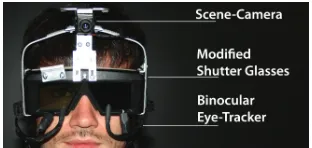
Binocular eye trackers from Arrington Research, Inc. were
mounted on the IPTs’ CrystalEyesR3 shutter glasses as shown in
Figure 2. The eye trackers provided robust data capture under vary-ing lightvary-ing conditions with all subjects and minimal calibration time. Scene cameras were mounted on the modified shutter-glass
frame, providing a very wide 150◦FOV, granting peripheral view
of the scene close to human limitations (generally considered to
approach 180◦ forward-facing [9]). The wearer’s foveal fixation
[image:4.612.95.251.480.554.2]point is overlaid on the scene-camera video, allowing for real-time observation and post-session analysis of gaze behaviour once syn-chronised with the separately recorded audio.
Figure 2: Mobile eye tracker on IPT shutter glasses.
Data from the calibrated eye tracker (2D gaze coordinates) are
streamed to each localEyeCVEclient. Secondary calibration of
the eye tracker within the VE itself updates the eye gaze of each avatar to reflect the wearer’s fixation point in 3D-space. The overall latency from eye tracker to graphical update on remote clients was measured at 150ms over the sites’ standard Internet connections, thus supporting perceptually natural communicational gaze [36].
4.2 Eye Gaze Model
We developed a simple eye gaze model in order to compare against static- and tracked-gaze avatars. In previous studies into dyadic conversational scenarios in ICVEs, using a gaze model that is in-formed by interactional states (i.e. speaking and listening) has been found to significantly improve the perceived quality of the avatar-mediated communication [12, 18]. Therefore, in the current study,
it was important to compare static gaze and the novel tracked gaze to a simulation of gaze behaviour (essentially autonomous eye an-imation). In order to provide meaningful gaze to a given interac-tion, a model should be tailored (or configurable) to the properties of a VE scenario. In this case, the current study presents a mul-tiparty object-focused task including conversation and free move-ment. Hence, we developed a simple gaze model which would take into account an array of objects and avatars in a user’s current FOV (determined by head tracking) to generate gaze behaviour. The ba-sic model developed for this study intends to provide a baseline performance measure for future work into gaze modelling.
The position of the head and the eyes are the two contribut-ing factors in the perception of where a person is lookcontribut-ing [32]. Our gaze model takes head orientation as recorded by the IPT’s head tracker, to determine the controlling participant’s approximate
FOV, defined as 70◦from the head-centric vector. Therefore, the
maximum horizontal and vertical foveal rotation to a fixation point
is 35◦, which is specified as the maximum ideal rotation by Boff
and Lincoln [6]. Saccades and fixations are randomly distributed between targets (cubes and avatars’ eyes) within the current FOV. Thus, as users move their heads, potential targets enter and exit the FOV, and new saccades and fixations will be generated. Fixa-tion duraFixa-tion is therefore dependent on timing and velocity of head movement: reduced activity generates fewer saccades with longer fixations, while rapid motion results in greater numbers of saccades with shorter fixation times. In summary, our gaze model is in-formed by a user’s current FOV inferred from head orientation to generate eye gaze animation throughout an unfolding interaction.
5 EXPERIMENTALDESIGN
The overall goal of our experiment was to determine the differences between varying methods of avatar eye gaze control as measures of task performance, subjective user experience and interactional be-haviour. The conditions were tracked gaze, our gaze model and static gaze. A within-subjects, repeated measures design was con-ducted over the three conditions, which were resequenced to negate learning bias. Twelve normal or corrected-to-normal vision
partic-ipants (no previous IPT experience) were recruited and paid£10 to
perform the study. The experimental design involved two confed-erates and one participant. The same confedconfed-erates performed all experiments, and were male. Therefore, to eliminate experimental bias, we recruited only male participants. Confederates were blind to their own and other avatars’ eye gaze condition, which intended to negate any inter-experimental effects resulting in differing be-haviour. Participants were not informed of the significance of other avatars’ eye movements, nor the ability to communicate during the one tracked-gaze session using their own eyes. The setup procedure preceding each of the three sessions was identical, so that the par-ticipant’s experience would be the same for each condition, and so the confederates would have no information to guess the condition.
For all conditions, the participant was required tofollow a
collaborative task; rather, we aim to determine how the behaviour of avatar eye gaze may influence task performance, user experience and interactional behaviour as metrics of quality of communication.
5.1 Virtual Environment
Three VEs featuring different starting configurations for the three experimental sessions were built. As stated, conditions were rese-quenced to negate learning bias, while the VE order presented to all participants remained constant, in order to negate the impact of any variation in difficulty of the starting configurations. The spa-tial volume of the VEs was approximately equal to that of the IPT (3x3x2.2 metres). This allowed participants and confederates to physically move in the IPT without requiring the use of the wand to navigate. Each VE was populated with a configuration of eight puzzle cubes and five spare cubes. In each VE, three of the puz-zle cubes were initially configured correctly to form the base of the solution, while the remaining five were scattered around the VE. The five spare cubes were also scattered around the VE close to the puzzle cubes. The purpose of the spare cubes was to increase task difficulty, and their positioning and quantity were informed by preparatory pilots. The spare cubes appeared coloured, and thus in-distinguishable from the puzzle cubes in the participant’s IPT, but appeared black in the confederates’ IPTs in order to reduce confu-sion when performing the experiment script.
5.2 Procedure
Upon entering the IPT, participants were greeted by the confederate avatars within one of the three VEs. A short training session on nav-igation (i.e. walking and moving) and grabbing, rotating, and posi-tioning cubes was given by the confederates. Once the participant was comfortable, the confederates explained that they needed help from the participant to finish the semi-completed puzzle. The goal state was defined as forming a larger cube from eight single cubes so that each side (including the bottom) of the completed cube con-sisted of only one colour. It was then made clear to the participant
that they werenotrequired to solve the puzzle themselves; rather,
they would be guided by the confederates over a sequence of in-structions which, if followed correctly, would result in the correct solution to the puzzle.
Confederates then commenced to give a defined sequence of in-structions which naturally varied for each of the three VE configu-rations. Instructions were defined as a pair comprising of one grab instruction and one position instruction for each of the five missing cubes, resulting in a total of ten instructions per session.
• Grab Instructionsrequired the participant to identify and pick up a specific cube from within the assortment of puzzle cubes and spare cubes scattered around the VE.
• Position Instructionsthen required the participant to place the correctly grabbed cube into a specific position in the puzzle.
Confederates took turns to issue a grab instruction and position instruction pair. The confederate at Reading always started the se-quence, and hence issued three instruction pairs per session while the confederate at Salford issued two. During the task, confederates were limited to gesticulation using their eyes and heads, while hand pointing (and consequently grabbing cubes) was not allowed. Con-federates were able to move freely similarly to participants within the IPT, but movement was restricted to periods between giving in-structions. Verbal communication was restricted such that provid-ing information regardprovid-ing the colours of the indicated cubes was not allowed, and only using “this” (rather than “that”, which may infer proximity) was allowed. Hence, all instructions were formed
by variations on the two-part clause ofa) “Pick up this cube”and,
once the participant had grabbed the correct cube,b) “Place the
[image:5.612.330.542.51.397.2]cube here”. Confederates were free to answer questions that did not reveal the indicated cube or position, and would frequently talk between themselves and the participant during the task.
Figure 3: Screenshots of an experimental session taken using replay and analysis tool [20]. Top: The avatars (participant located in the middle) greet each other before commencing the task. The initial base can be seen between two groups of loose cubes including five spare cubes which appeared black to the confederates but coloured to the participants. The puzzle base is located in the centre of the IPT allowing for navigation simply by walking. Middle: The participant responds to a grab instruction by reaching for the indicated cube.
Bottom: The participant responds to the final position instruction by positioning the cube to complete the puzzle.
Therefore, in a typical instruction pair, a confederate issues the grab instruction with a verbal utterance while indicating naturally with eye gaze and head orientation which cube they are intending. The participant responds either by choosing the correct cube or an incorrect cube. If the participant identifies an incorrect cube, the confederate informs him, and continues to target the intended cube as before. Once the correct cube is grabbed, the confederate issues the position instruction. The defined verbal grammar combined with eye gaze and head orientation is similarly employed to indi-cate the correct placement of the cube within the puzzle. Accord-ingly, if the participant incorrectly identifies the cube’s placement, the confederate informs him and continues to indicate the intended position with the defined cues. Once the cube is correctly posi-tioned, the instruction ends and the by-standing confederate begins the next (often following brief talk). This process continues until all five instructional pairs are complete, and the puzzle is solved. Figure 3 illustrates states during an experimental session.
be correlated with the varying behaviour of eye gaze. In future work, we intend to investigate symmetrical collaborative scenarios by introducing eye tracking to the unrestricted use of standard head and hand tracking as communicational resources in ICVEs. In the current study however, it was essential to isolate eye gaze as the central communicational resource in order to investigate the influ-ence of varying methods of eye gaze control.
5.3 Recorded Data
With ethical clearance, we recorded the following data at all sites:
• Video & Audio:recorded from the eye tracker scene cameras worn by the participant and both confederates. The wearer’s eye gaze is overlaid on the video, identifying fixation point.
• Replay Logs: session logs recorded for our replay and anal-ysis tool [20]. The tool provides identical visualisation of experimental sessions, free camera movement, and additional data such as eye gaze heat-maps, and operates in the IPT.
• Eye Tracker Logs:detailed logs of eye gaze behaviour.
• Gaze Model Logs:eye gaze generated by our gaze model. Following each session, the participant completed an oral ques-tionnaire designed to elicit responses regarding subjective experi-ence, copresexperi-ence, and self-performance ratings, on a 1..7 Likert scale. The questionnaire was performed orally due to the lengthy setup and eye tracker calibration procedure and in order to maintain the participant’s position within the IPT. Finally, we performed an informal interview with each participant after the third session. We targeted any general differences they may have noticed between the sessions, and then narrowed the topic down to the behaviour of the avatars and finally the eyes.
6 ANALYSIS
We approach the analysis of the data captured from the
experi-mental sessions from three perspectives: Interactional Analysis,
which explores differences and trends in participant behaviour, fo-cusing particularly on eye gaze patterns, bodily movement, and
re-pair strategies,User Experience, which considers questionnaire
re-sponses and interviews, andTask Performance, of which the
fol-lowing metrics are identified:
• Grab Instruction Errors and Timings: Number of incorrect cube identifications following a grab instruction, and the time
taken from when the instruction is issued until the correct
cube is identified by the participant.
• Position Instruction Errors and Timings: Number of incor-rect cube placements following a position instruction, and the time taken from when the instruction is issued until the cube
is placed in thecorrectposition by the participant.
• Puzzle Completion Time:Time elapsed between the issue of the first grab instruction and the completion of the fifth posi-tion instrucposi-tion.
6.1 Task Performance
Our experimental design subdivided each session into five pairs of grab instructions and position instructions. Hence, the following task performance analysis firstly considers grab instructions, and secondly position instructions, with the associated metrics of errors and time. Finally, puzzle completion time is analysed, together with the impact of training effects as participants become more experi-enced at the task. In this way we are able to quantify performance over the three eye gaze conditions.
6.1.1 Grab Instruction Errors and Timings
Repeated measures two-way analysis of variance (ANOVA) calcu-lations were separately performed for grab instruction errors and timings, with the three eye gaze conditions and the five grab in-structions as factors. Regarding grab instruction errors, a
signifi-cant difference between conditions (F(2,4)=5.30;P<.01) and also
between instructions (F(2,4)=4.91;P<.001) was found. Post-hoc
calculations determined that these differences lay between the gaze
model and the other two classes of static gaze (F(1,4)=7.36;P<.01)
and tracked gaze (F(1,4)=6.84;P=.01). No interaction effect was
found between eye gaze condition and grab instruction.
Similarly, regarding timings, a significant difference between
conditions (F(2,4)=3.67;P<.05), and between grab instructions
(F(2,4)=5.0;P<.001) was found. Likewise, post-hoc calculations
determined that the significant differences lay between the gaze
model and the other classes of static gaze (F(1,4)=4.35;P<.05)
and tracked gaze (F(1,4)=4.5;P<.05), and no interaction effect was
found between eye gaze condition and grab instruction.
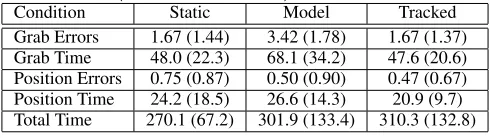
In summary, tracked gaze and static gaze resulted in significantly fewer errors and faster operation time than the gaze model while performing grab instructions. Tracked gaze and static gaze elicited an equal number of errors over all participants, while tracked gaze resulted in slightly faster operation time while performing grab in-structions. Table 1 shows mean grab instruction errors and time per session for all participants.
6.1.2 Position Instruction Errors and Timings
Repeated measures two-way ANOVA calculations were separately performed for position instruction errors and timings, with the three eye gaze conditions and the five position instructions as factors. Regarding position instruction errors, no significant
dif-ference between the conditions (F(2,4)=0.64;P=0.53) was found.
However, a significant difference was found between
instruc-tions (F(2,4)=5.03;P<.0001). No interaction effect was found
between condition and position instruction. Correspondingly,
regarding timings, no significant difference between conditions
(F(2,3)=0.91;P=0.4) was found, but a significant difference
be-tween position instructions was found (F(2,3)=3.94;P<.0.01). No
interaction effect was found between eye gaze condition and posi-tion instrucposi-tion.
[image:6.612.317.562.463.532.2]In summary, no significant differences between conditions were found regarding errors and time while performing position instruc-tions. Table 1 shows slightly superior results of tracked gaze over static and model gaze for position instruction errors and timings.
Table 1: Mean task performance per session innumber of errorsand
time in seconds(and standard deviation) for each condition.
Condition Static Model Tracked
Grab Errors 1.67 (1.44) 3.42 (1.78) 1.67 (1.37)
Grab Time 48.0 (22.3) 68.1 (34.2) 47.6 (20.6)
Position Errors 0.75 (0.87) 0.50 (0.90) 0.47 (0.67)
Position Time 24.2 (18.5) 26.6 (14.3) 20.9 (9.7)
Total Time 270.1 (67.2) 301.9 (133.4) 310.3 (132.8)
6.1.3 Puzzle Completion Time
A one-way ANOVA evaluation of the overall puzzle completion time of each session did not expose any significant difference
be-tween conditions (F(2,33)=0.41;P=0.67), with values shown in
Ta-ble 1. It should be noted here that it is reasonaTa-ble to expect that avatar gaze behaviour is not a major determinant of overall com-pletion time, which was rather dominated by a multitude of fac-tors regarding the participant’s behaviour in the VE as discussed in section 7. Hence, we performed subsequent analysis into how completion time varied with experience. In this case, we performed a one-way ANOVA on each session’s puzzle completion time, but
used sessionorder(first, second, third) as factors (rather than eye
gaze conditions as factors). A significant difference between orders
(F(2,33)=9.06;P<.001) was found. The mean completion times in
made. However, the highly significant difference between session order and lower puzzle completion times suggest that performance improves greatly with experience.
6.2 Subjective User Experience
Questionnaires after each session sought to elicit judgement regard-ing user experience, self-performance ratregard-ings and copresence. Re-peated measures two-way ANOVA taking the three eye gaze con-ditions and the fourteen questions exposed no significant difference
between conditions (F(2,13)=0.24;P<.0.79). Although not
statisti-cally significant, participants generally rated the tracked-gaze ses-sion higher than static gaze and in particular the gaze model. This was supported by the summary interview, in which the tracked-gaze sessions were most commonly identified as the “easiest”, while and sessions under the gaze model were most commonly identified as the “most confusing”. However, under all conditions, the sub-jective judgement of the experience and self-performance ratings were consistently high, indicating the effectiveness of the avatar-mediated remote interactions and high involvement in the task.
6.3 Interactional Analysis
The following section identifies specific behavioural practices and resources that participants are seen to employ during interaction, including repair strategy. The foundation of this analysis has been drawn primarily from performing conversation analysis (CA): an inductive process for analysing how human interaction is organ-ised into sequences of action or systematic practices [26]. Due to space, we are unable to show any CA transcripts, but examples will be made available online. Firstly we present typical cases of how interaction unfolds during correct and incorrect responses to a grab instruction. We then identify general behavioural strategies and resources adopted by participants. Finally, we performing post-hoc analysis on a specific gaze practice used extensively by all par-ticipants as a repair strategy. It should be noted that this section primarily analyses interactional behaviour associated with grab in-structions: analysis of position instructions was not so revealing, being easier (moreso as the puzzle progressed), and with partic-ipants often attempting to identify placement position before the confederate issued an instruction, especially with experience.
6.3.1 Responses to a Grab Instruction
Participants responded to grab instructions either by correctly or in-correctly identifying the target cube. A typical case of a correct and unproblematic response to a grab instruction begins with a confed-erate summoning the participant’s attention and eliciting his gaze. Next the confederate produces a pre-instruction such as “so, my turn”, which prompts the the participant to respond with “OK”, and maintain his focus on the speaker. When the grab instruction is given, the confederate typically turns and looks at the designated cube as the deictic term “this” is uttered (i.e. “Can you pick up
thiscube.”). The participant then follows the confederate’s gaze
to-wards the group of targeted cubes, glancing between the cubes and the confederate (usually focusing on the eyes). Once he has iden-tified which cube he believes is being indicated, he looks straight at that cube and touches it while simultaneously requesting confir-mation and briefly returning his gaze to the instructing avatar. The speaking confederate gives confirms the choice as correct, and the participant completes the instruction by grabbing the cube.
By contrast, cases of grab instructions in which the participant selects an incorrect cube often provide examples of repair strate-gies to identify the correct cube, and occasionally even to recon-firm which avatar is currently issuing an instruction. In such a case,
confederateAissues a grab instruction, but the participant is
un-sure about which avatar is speaking (avatars did not have mouth-movement as discussed in section 7), and looks from confederate
Ato confederate B and back. ConfederateAestablishes that he
is speaking by moving towards and gazing at the participant, and reissues his grab instruction. As he does this, the participant shifts his gaze to the potential cubes. After glancing between the speak-ing avatar and the cubes, the participant chooses a cube and grabs it without confirmation that it is the correct choice. He then gets
feedback from confederateAthat his choice is incorrect. Finally,
the participant moves closer to the confederate avatar to examine his gaze, glancing to and from the potential cubes, before selecting the correct cube on a second attempt.
In summary, we can determine that incorrect responses to in-structions have the potential to significantly reduce the participant’s task performance, in terms of number of errors, time and possibly user experience (judging the interaction as confusing). We also see participants’ strategic use of other avatars’ gaze, following an in-correct identification to attempt to repair the mistake. This clarifies the the need for accurate and unambiguous indication.
6.3.2 Movement as a Resource
Confederates’ proximity to cubes seems very useful to participants when determining which cube to grab. Correspondingly, confed-erates made extensive use of the ability to move freely to position themselves at an appropriate distance and clear angle (vertically and horizontally) to the intended cube. Above we noted how par-ticipants often moved toward the instructing avatar to more clearly determine his direction of gaze. This is one category of a number forms of locomotion that participants engaged in. In many cases, participants look at the avatar’s face and then take up an opposite position behind the cubes in order to identify the target cube. An-other strategy adopted by participants is taking a position similar to the one of the instructing avatar, by standing beside them or look-ing over their shoulder, presumably to see from the confederate’s perspective. In this way, participants made use of several resources provided by the ability to move freely and maintain communica-tional eye gaze to attempt to perform the task more effectively.
6.3.3 Eye Gaze as a Resource
Eye gaze is employed as a general social resource as previously observed [31], and the participant shares their gaze between both confederate avatars during periods of silence and conversation, and when carrying out instructions. Additionally, participants are fre-quently seen to inform their actions on where they perceive the in-structing avatar to be gazing, and estimations are developed after looking at the head, and in particular the eyes of the confederate avatars. The gaze model in particular caused difficulties when re-sponding to instructions, frequently coming to the surface of the in-teraction via participant vocalisation types including questions (i.e. “Are you looking at it now?”), complaints (i.e. “You’re looking up! Not down.”) or accounts (i.e. “It’s a little difficult for me because your eyes keep moving about.”). Such behaviour high-lights the importance of eye gaze in avatar-mediated communica-tion, where it seen to be used as a bidirectional nonverbal communi-cation resource similarly to face-to-face interaction, thus promoting tracked gaze as potentially the most effective means of a controlling an avatar’s eye movement.
6.3.4 Glances Per Grab Instruction
abil-ity of the eye gaze control method to unambiguously and efficiently indicate specific objects without the need for such repair strategies. A repeated measures two-way ANOVA calculation for glances per grab instruction was performed, with the three eye gaze condi-tions and the five grab instruccondi-tions as factors. A significant
dif-ference between conditions (F(2,4)=8.23;P<.0005) and also
be-tween instructions (F(2,4)=4.54;P<.002) was found. As found
when analysing grab instruction errors and timings, post-hoc tests determined that the differences lay between the gaze model and the
other two classes of static gaze (F(1,4)=8.81;P<.005) and tracked
gaze (F(1,4)=10.95;P<.001). No interaction effect was found
be-tween condition and grab instruction. Table 2 shows the mean num-ber of glances performed per grab instruction under each condition. Although not statistically superior to static gaze, tracked gaze is identified as the highest-performing method of eye gaze control.
Table 2: Mean number (and standard deviation) of glances to and from the instructing avatar and target cubes per grab instruction.
Condition Static Model Tracked
# of Glances 2.42 (1.5) 3.58 (2.74) 2.25 (1.57)
7 DISCUSSION
We analysed our experimental data from the perspectives of task performance, user experience and interactional behaviour, as mea-sures of quality of communication. Results calculated in each cat-egory demonstrated high levels of correlation, indicating that our gaze model is significantly outperformed by static gaze and espe-cially by tracked gaze. However, differences between static gaze and tracked gaze were not found to be statistically significant. Thus, we cannot support our initial hypothesis that tracked-gaze avatars are able to enhance the quality of communication when performing object-focused scenarios in ICVEs.
Despite this, metrics of task performance (Table 1) and inter-actional behaviour (Table 2) as well as trends from our informal post-experimental interviews (section 6.2) ranked tracked gaze as the superior method of eye gaze control. Intuitively, this of course should be the case. However, the experimental interactions were highly complex, and responses to grab instructions and position in-structions were informed by an amalgamation of factors aside from how other avatars’ eyes behaved. We now discuss factors influen-tial to the perception and performance of the experimental inter-actions (including paths for future investigation) which are likely to have detracted from the enhanced behavioural fidelity and addi-tional information communicated by tracked-gaze avatars. Finally, we examine the poor performance of our eye gaze model.
7.1 Na¨ıve Users and Task Complexity
The experiment situated inexperienced IPT users at the focal role in an unfamiliar multiparty puzzle scenario mediated by avatars in an ICVE. They were required to communicate with confederates, navigate, make judgements, manipulate objects, and conduct ques-tionnaires over three experimental sessions lasting up to two hours. In this demanding situation, it can be reasonably proposed that there were many factors influencing participant performance and percep-tion, and that eye gaze was not the sole determinant of action. How-ever, while this may be the case, the poor performance during the gaze model sessions confirm that eye gaze can be highly influential to participant action. It appears that head orientation (static gaze) and body positioning provided participants with sufficient nonver-bal information in order to perform the task effectively. While this finding contradicts a previous object-identification test performed in a non-immersive stereo display [21], it is consistent with our par-allel study in which a discussion of the impact of the IPTs’ display properties can also be found [25]. Thus, varying task complexity, and performing the experiment with experienced ICVE users may reveal the potential of using tracked-gaze avatars.
7.2 Avatar Representation
Central to avatar-mediated communication common to ICVEs, is the visual representation of the avatars themselves. In this exper-iment, we used a single avatar model to represent all three partic-ipants, which, while featuring photographic textures, did not have particularly high representational fidelity in terms of geometry and overall realism. Also significant was the lack of eyelid movement and blinking as promoted in [30], causing the sclera to appear very large, and lack of lip-synchronisation, causing difficulty for participants to determine the speaking confederate. Recalling the interaction effect between visual and behavioural fidelity [11], in-vestigation into varying the representation of our avatar models in combination with the behavioural fidelity of eye gaze, may expose significant differences in quality of communication.
7.3 Gaze Model Performance
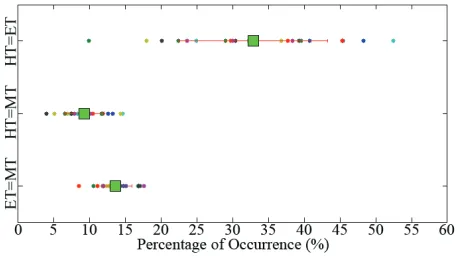
[image:8.612.322.552.422.551.2]Participants performed consistently and significantly worse in the gaze model condition than with static gaze and tracked gaze. This result confirms the interactional-importance of eye gaze in avatar-mediated interaction in ICVEs. Figure 4 reveals why the gaze model underperformed, by comparing the proportion of equality of the actual eye gaze fixation point (eye-target, ET), the forward vec-tor of the head orientation (head-target, HT), and the gaze model fixation point (model-target, MT) over all participants and sessions. The low equalities shown for the model-target demonstrate that the model rarely generated gaze fixation points equal to the actual eye-target (mean 9.2%, SD 2.8%) or the head-eye-target (mean 13.56%, SD 2.32%) of the participant. Hence, while informed by head orienta-tion to select objects within the current FOV, the gaze model usu-ally did not pick targets that were equal to the object actuusu-ally be-ing looked at, makbe-ing target-identification by observers uncertain. Based on this wrong eye gaze information, our analysis showed that participants made more errors, required more time, and relied more on repair strategies during the task. Also interesting to note is the wide variation of gaze behaviour employed by different participants as denoted by each point.
Figure 4: Percentage equality of eye-target (ET), head-target (HT) and model-target (MT) in all sessions. Small points denote individual participants. Square is mean. Range is standard deviation.
8 CONCLUSIONS ANDFUTUREWORK
and performance of the experimental interactions that were likely to have detracted from the enhanced behavioural fidelity and addi-tional information communicated by tracked gaze were discussed, including na¨ıvity of users, task complexity, display properties and avatar representation, and all identified for future work.
Results elicited during the gaze model sessions demonstrate how displaying incorrect eye gaze can be a hindrance during object-focused interaction in ICVEs. This both emphasises the importance of avatar eye gaze, and the tension between animating the eyes so that the avatar looks alive, and confusing the viewer when the gaze target is critical to the task. Hence we view the development of effective and reusable gaze models as an open problem which we will address in future work. Finally, while we cannot fully support our initial hypothesis, our results suggest that the benefit of tracked gaze is likely to be demonstrable with redirected experimental and
avatar design. Videos and CA transcripts of theEyeCVEsessions
can be found at http://www.cs.ucl.ac.uk/staff/W.Steptoe.
ACKNOWLEDGEMENTS
The UK’s EPSRC provides funding for this study which is part of theEye Catchingproject (EP/E007406/1).
REFERENCES
[1] S. Acker and S. Levitt. Designing Videoconference Facilities for Im-proved Eye Contact.J. Broad. & Elec. Media, 31:181, 1987. [2] M. Argyle and M. Cook.Gaze and Mutual Gaze. Cambridge
Univer-sity Press Cambridge, 1976.
[3] J. Bailenson, J. Blascovich, A. Beall, and J. Loomis. Equilibrium The-ory Revisited: Mutual Gaze and Personal Space in Virtual Environ-ments. Presence: Teleoperators & Virtual Environments, 10(6):583– 598, 2001.
[4] S. Benford, J. Bowers, L. Fahl´en, C. Greenhalgh, and D. Snowdon. User embodiment in collaborative virtual environments. Proceedings of the SIGCHI conference on Human factors in computing systems, pages 242–249, 1995.
[5] S. Benford, J. Bowers, L. Fahl´en, C. Greenhalgh, and D. Snowdon. Embodiments, avatars, clones and agents for multi-user, multi-sensory virtual worlds.Multimedia Systems, 5(2):93–104, 1997.
[6] K. Boff and J. Lincoln. User’s Guide Engineering Data Compendium Human Perception and Performance, 1988.
[7] T. Capin, I. Pandzic, H. Noser, N. Magnenat-Thalmann, and D. Thal-mann. Virtual Human Representation and Communication in VLNET Networked Virtual Environments.IEEE Computer Graphics and Ap-plications, 17(2):42–53, 1997.
[8] T. Capin, J. Wiley, and I. Sons.Avatars in Networked Virtual Environ-ments. John Wiley & Sons, 1999.
[9] J. Costella. A Beginner’s Guide to the Human Field of View.School of Physics, The University of Melbourne, November, 1995.
[10] Z. Deng, J. Lewis, and U. Neumann. Automated Eye Motion Using Texture Synthesis. IEEE COMPUTER GRAPHICS AND APPLICA-TIONS, pages 24–30, 2005.
[11] M. Garau. Selective fidelity: Investigating priorities for the creation of expressive avatars. Avatars at work and play: Collaboration and interaction in shared virtual environments, pages 17–38, 2006. [12] M. Garau, M. Slater, V. Vinayagamoorthy, A. Brogni, A. Steed, and
M. Sasse. The impact of avatar realism and eye gaze control on per-ceived quality of communication in a shared immersive virtual envi-ronment.Human factors in computing systems, pages 529–536, 2003. [13] M. Gillies and D. Ballin. Integrating Autonomous Behavior and User Control for Believable Agents. InInternational Conference on Au-tonomous Agents, volume 1, pages 336–343, 2004.
[14] J. Hindmarsh, M. Fraser, C. Heath, S. Benford, and C. Greenhalgh. Fragmented interaction: establishing mutual orientation in virtual en-vironments. Proceedings of the 1998 ACM conference on Computer supported cooperative work, pages 217–226, 1998.
[15] J. Hindmarsh, M. Fraser, C. Heath, S. Benford, and C. Green-halgh. Object-focused interaction in collaborative virtual environ-ments.ACM Transactions on Computer-Human Interaction (TOCHI), 7(4):477–509, 2000.
[16] M. Kipp and P. Gebhard. IGaze: Studying Reactive Gaze Behav-ior in Semi-immersive Human-Avatar Interactions. Intelligent Vir-tual Agents: 8th International Conference, IVA 2008, Tokyo, Japan, September 1-3, 2008, Proceedings, page 191, 2008.
[17] S. Langton, R. Watt, and V. Bruce. Do the eyes have it? Cues to the direction of social attention.Trends in Cog Sci, 4(2):50–59, 2000. [18] S. Lee, J. Badler, and N. Badler. Eyes alive. ACM Transactions on
Graphics (TOG), 21(3):637–644, 2002.
[19] S. Masuko and J. Hoshino. Head-eye Animation Corresponding to a Conversation for CG Characters. InComputer Graphics Forum, volume 26, pages 303–312. Blackwell Synergy, 2007.
[20] A. Murgia, R. Wolff, W. Steptoe, P. Sharkey, D. Roberts, E. Guimaraes, A. Steed, and J. Rae. A Tool For Replay And Anal-ysis of Gaze-Enhanced Multiparty Sessions Captured in Immersive Collaborative Environments.ACM DS-RT, 8, 2008.
[21] N. Murray and D. Roberts. Comparison of head gaze and head and eye gaze within an immersive environment. the 10th IEEE Interna-tional Symposium on Distributed Simulation and Real Time Applica-tions. IEEE Computer Society, Los Alamitos, CA, 2006.
[22] K. Okada, F. Maeda, Y. Ichikawaa, and Y. Matsushita. Multiparty videoconferencing at virtual social distance: MAJIC design. Proceed-ings of the 1994 ACM conference on Computer supported cooperative work, pages 385–393, 1994.
[23] S. Penny, J. Smith, P. Sengers, A. Bernhardt, and J. Schulte. Traces: Embodied Immersive Interaction with Semi-Autonomous Avatars.
Convergence, 7(2):47, 2001.
[24] D. Roberts, R. Wolff, O. Otto, and A. Steed. Constructing a Gazebo: Supporting Teamwork in a Tightly Coupled, Distributed Task in Virtual Reality. Presence: Teleoperators & Virtual Environments, 12(6):644–657, 2003.
[25] D. Roberts, R. Wolff, J. Rae, A. Steed, R. Aspin, M. McIntyre, A. Pena, and W. Steptoe. Communicating Eye-gaze Across a Dis-tance.Virtual Reality Conference, 2009. VR’09. IEEE, 2009. [26] H. Sacks.Lectures on Conversation. Blackwell, 1995.
[27] R. Schroeder, A. Steed, A. Axelsson, I. Heldal, A. Abelin,˚ J. Widestr¨om, A. Nilsson, and M. Slater. Collaborating in networked immersive spaces: as good as being there together? Computers & Graphics, 25(5):781–788, 2001.
[28] A. Steed, D. Roberts, R. Schroeder, and I. Heldal. Interaction between Users of Immersion Projection Technology Systems. HCI Interna-tional 2005, the 11th InternaInterna-tional Conference on Human Computer Interaction, pages 22–27, 2005.
[29] A. Steed, M. Spante, I. Heldal, A. Axelsson, and R. Schroeder. Strangers and friends in caves: an exploratory study of collaboration in networked IPT systems for extended periods of time.Proceedings of the 2003 symposium on Interactive 3D graphics, pages 51–54, 2003. [30] W. Steptoe and A. Steed. High-Fidelity Avatar Eye-Representation.
Virtual Reality Conference, 2008. VR’08. IEEE, pages 111–114, 2008. [31] W. Steptoe, R. Wolff, A. Murgia, E. Guimaraes, J. Rae, P. Sharkey, D. Roberts, and A. Steed. Eye-tracking for avatar eye-gaze and in-teractional analysis in immersive collaborative virtual environments. InProceedings of the ACM 2008 conference on Computer supported cooperative work, pages 197–200. ACM New York, NY, USA, 2008. [32] R. Stiefelhagen and J. Zhu. Head orientation and gaze direction in
meetings. InConference on Human Factors in Computing Systems, pages 858–859. ACM New York, NY, USA, 2002.
[33] D. Thalmann. The Role of Virtual Humans in Virtual Environment Technology and Interfaces. InProceedings of Joint EC-NSF Advanced Research Workshop, Bonas, France, 1999.
[34] H. Vilhj´almsson and J. Cassell. BodyChat: autonomous communica-tive behaviors in avatars.Proceedings of the second international con-ference on Autonomous agents, pages 269–276, 1998.
[35] V. Vinayagamoorthy, A. Steed, and M. Slater. Building Characters: Lessons Drawn from Virtual Environments. Toward Social Mecha-nisms of Android Science: CogSci Workshop, pages 119–126, 2005. [36] R. Wolff, D. Roberts, A. Murgia, N. Murray, J. Rae, W. Steptoe,
A. Steed, and P. Sharkey. Communicating Eye Gaze across a Distance without Rooting Participants to the Spot.ACM DS-RT, 8, 2008. [37] N. Yee and J. Bailenson. The Proteus Effect: Self Transformations in
![Figure 1: Left(courtesy of Ralph Schroeder).: Avatars used in Schroeder et al.’s [27] 2001 study Right: Avatars used in current study.](https://thumb-us.123doks.com/thumbv2/123dok_us/8728660.886150/3.612.331.543.342.414/figure-courtesy-ralph-schroeder-avatars-schroeder-avatars-current.webp)
![Figure 3: Screenshots of an experimental session taken using replayand analysis tool [20].middle) greet each other before commencing the task](https://thumb-us.123doks.com/thumbv2/123dok_us/8728660.886150/5.612.330.542.51.397/figure-screenshots-experimental-session-replayand-analysis-middle-commencing.webp)