Journal of Chemical and Pharmaceutical Research, 2014, 6(5):161-165
Research Article
CODEN(USA) : JCPRC5
ISSN : 0975-7384
Extraction and isolation of
β
-elemene from Eupatorium adenophorum
Wei Hui-Ping
1,2*, Zhao Mu
1,2, Li Yong
1and Liu Weng-Quan
11
Panzhihua University, Panzhihua, China
2
Medicinal Research Center of Panzhihua City, Panzhihua, China
_____________________________________________________________________________________________
ABSTRACT
To extract and isolate β-elemene from worst weed Eupatorium adenophorum Spreng, identify its structure and determine its content. Having obtained volatile oil from E. adenophorum by “water+ glycol” distillation, β-elemene was isolated by column chromatography with HP20 macroporous resin, then the pure product of β-elemene was prepared by HPLC, and its molecular structure was validated by UV, IR, 1H NMR, 13C NMR and HRMS. Through three steps of “water+glycol” distillation, HP20 column chromatography and HPLC preparation, the β-elemene product with 98.6% purity and 36.5% yield could be obtained from E. adenophorum, and it’s molecular structure can be validated. “Water + glycol distillation” is the better way to extraction volatile oil from E. adenophorum than traditional water distillation. HP20 column chromatography is the more efficient way to isolate β-elemene from volatile oil than previous silver ion coordination chromatography.
Key words: β-elemene, Eupatorium adenophorum Spreng, Extraction, Separation
_____________________________________________________________________________________________
INTRODUCTION
Eupatorium adenophorum Spreng is a kind of perennial plant that belongs to the genus Eupatorium of the family Composite. In China, Yunnan, Guangxi, Sichuan, and some other provinces are rich in E. adenophorum resources which are one of the most serious threats to the local ecological security because of being a world-famous worst weed [1-2]. β-elemene, called (1S, 2S, 4R) 1-methyl-1-ethenyl-2,4-diisopropylcyclohexane (Fig.1), is a new anti-tumor drug that is independently developed by China in recent years, which has been indexed by the National List of Essential Drugs and Medical Insurance Drugs [3-4]. Since the drug is mainly extracted from Chinese traditional medicinal herbs such as Rhizoma Curcuma, Mosla chinensis, etc, high production costs limit the widespread use of this drug in clinic [5-6]. According to our previous studies, E. adenophorum is rich in β-elemene that shows regularity in distribution and change[7]. Aiming at opening up a new way for further development, utilization and control of this worst weed, a method is established for extracting and isolating β-elemene from E. adenophorum in this study.
EXPERIMENTAL SECTION
2.1 Materials, instruments and reagents
E. adenophorum samples were collected from the forest margins around Panzhihua airport.
Agilent 1200 high performance liquid chromatographic system(Agilent Technologies Co., Ltd.); XS205DU
electronic balance(Mettler-Toledo Instruments Co., Ltd.); SHZ-85BS double-layer rotary vapour-bathing constant
temperature vibrator (Jiangsu Jintan Automation Instrument Factory); RE52-2 rotary evaporator (Shanghai Huxi
Analysis Instrument Factory); LC-20 A high performance liquid chromatographic system (Shimadzu Corporation);
Bruker-AC-P500 nuclear magnetic resonance (NMR) (Bruker Corporation, German). HP 1100 LC-MS high
resolution mass spectrometer (Agilent Technologies Co., Ltd.,USA).
β-elemene standard substance (99.2%) was purchased from National Institutes for Food and Drug Control with batch number of 100268-200401; petroleum ether (boiling range of 30 to 60 ℃), silica gel used for chromatography
(200 to 300 meshes), HP20 macroporous resins were purchased from Beijing H&E Co., Ltd.; absolute ethanol and acetonitrile were of chromatographic grade; water was double-distilled; other reagents were of analytical grade.
AgNO3 silica gel was prepared as follows [8]
. After 30.0 g of AgNO3 was dissolved in 400 mL of 70%
methanol-water solution, the mixture was blended well with 300.0 g of silica gel and kept in dark place. 24 h later, they were evaporated to flowing powders under reduced pressure, dried for 16 h at 120 ℃, and stored in brown
dryer for later use.
2.2 Determination of β-elemene content [7]
Agilent 1200 high performance liquid chromatographic system was applied to determine the β-elemene content of E. adenophorum. Following injection of 20 µL of test solution, HPLC analysis was performed on the Eclipse XDB-C18
chromatographic column (4.6 mm×150 mm, 5 µm) with mobile phase of anhydrous ethanol-acetonitrile-water (V/V/V, 70:10:20) at a flow rate of 1.0 mL·min
-1, detection wavelength at 210 nm and column temperature at 30 ℃.
2.3 Sample pre-treatment
Dried naturally E. adenophorum samples were crushed into powder and passed through 60-mesh sieve. According to the method “2.2”, the β-elemene content of E. adenophorum was determined to be 0.493%.
2.4 Extraction of volatile oil from E. adenophorum
Two kinds of distillation were used to extract volatile oil from E. adenophorum as follows.
2.4.1 Water distillation. In a distilling flask, the mixture containing 100.00 g E. adenophorum samples, 700 mL
distilled water, 50 mL absolute ethanol and few zeolites was distilled under constant pressure by heating to collect the distillate at the temperature of 80 to 100 ℃.
2.4.2 Water + glycol distillation. In a distilling flask, the mixture containing 100.00 g E. adenophorum samples,
500 mL distilled water, 200 mL glycol, 50 mL absolute ethanol and few zeolites was distilled under constant pressure by heating to collect the distillate at the temperature of 80 to 120 ℃.
Both kinds of distillation were repeated 3 times and the distillates were extracted three times respectively with petroleum ether at the volume ratio of 1:1. Three extracts were merged together and concentrated through vacuum rotary evaporation at 60℃ to remove solvent. Finally, the yield of volatile oil,the purity and extraction rate
ofβ-elemene were calculated.
2.5 Isolation of β-elemene from volatile oil
Two kinds of chromatography mediums were used to isolate β-elemene from volatile oil, including AgNO3 silica gel
and HP20 macroporous resins.
2.5.1 AgNO3 silica gel column chromatography. 3.00 g of E. adenophorum volatile oil was loaded onto the chromatography column of 300.0 mL AgNO3 silica gel, and eluted with petroleum ether at a flow rate of 6
mL·min -1
0 50 100 150 200
550 600 650 700 750 800 850 900 Retention volume/mL β -e le m en e m a ss /m g 0 10 20 30 40 50 60
550 600 650 700 750 800 850 900
[image:3.595.93.479.529.634.2]Retention volume/mL β -e le m e n e p u ri ty /%
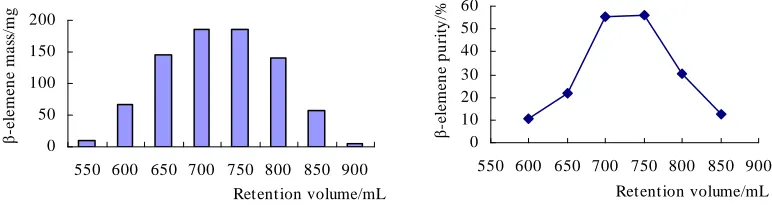
Fig.2 Results of AgNO3 silica gel column chromatography for isolation of β-elemene from volatile oil (
x
, n=3)2.5.2 HP20 macroporous resins column chromatography. 3.00 g of E. adenophorum volatile oil was loaded onto
the chromatography column of 300.0 mL HP20 macroporous resins, and eluted with 600 mL of distilled water, 80%, 85%, 90%, 95%, 100% ethanol in sequence at a flow rate of 6 mL·min
-1 to collect bottles of eluate, each 100 mL.
HPLC method was used to detect the concentration of β-elemene in each bottle of eluate, and subsequently the mass of β-elemene was calculated. Each eluate was extracted three times with petroleum ether (V/V, 1:1). Following the removal of solvent as the method earlier, the extract was weighed, so as to calculate the purity and yield of β-elemene.
2.6 HPLC preparation and molecular structure identification of β-elemene product
Through HP20 column chromatography, the rough product containing 63.1% β-elemene (oily product at the retention volume of 2 600 to 2 900 mL) was isolated from E. adenophorum volatile oil. Shimadzu LC-20 A high performance liquid chromatographic system was used to prepare high-purity β-elemene. To be specific, after 1 mL of the rough product was loaded onto the preparation column (10 mm×150 mm), an elution with mobile phase of anhydrous ethanol-water (V/V, 80:20) was initiated at a flow rate of 2 mL·min
-1. And the detection wavelength was
set to 210 nm. The collected product was extracted three times with petroleum ether (V/V, 1:1), and the extract was subjected to the determination of β-elemene concentration. Following the removal of solvent as the method earlier, the extract was weighed, so as to calculate the purity of β-elemene. In addition, IR, 1H NMR, 13C NMR and HRMS spectroscopy methods were used to confirm the molecular structure of β-elemene high-purity product.
RESULTS AND DISCUSSION
3.1 Extraction of volatile oil from E. adenophorum
The experimental results of two different distillations were to see Table 1. Evidently, in comparison with traditional water distillation, “water + glycol distillation” has far more yield of volatile oil, far more purity and extraction rate of β-elemene. So, “water + glycol distillation” is the better way to extraction volatile oil from E. adenophorum.
Table 1 Results of two different distillations(
x
, n=3 , t-test, P=0.01,%)Medium of distillaton Oil yield Purity of β-elemene extraction rate of β-elemene
Water 0.6b 10.1b 23.6b
Water + glycol 1.2a 27.2a 70.4a
Note: The data with different letters indicated a very significant difference between them
3.2 Isolation of β-elemene from volatile oil
3.2.1 AgNO3 silica gel column chromatography. The result of AgNO3 silica gel column chromatography was as
Fig.2. The purity and yield of β-elemene in 600-850mL of eluent were 36.5% and 80.6%, respectively. When the retention volume was 750 ml, the purity of β-elemene was the highest, 56.1%. For the purpose of 55% purity, 700-750mL of eluent was taken, in which the yield of β-elemene was 45.6% .
3.2.3 Comparison of two chromatographic methods β-elemene isolation efficient of two column chromatographic methods was compared by means of t-test[9] using purity and yield as indexes (Table 2). As a result, compared with AgNO3 silica gel, HP20 was slightly inferior in yield, but the purity of main product and high purity product was far
higher. As a kind of chromatography medium, HP20 macroporous resins was characteristic of lower cost and easy operation. So, HP20 macroporous resin column chromatography is the more efficient way to isolate β-elemene from volatile oil.
Table2 Comparison of 2 chromatography methods ( , n=3, t-test, P=0.01, %)
Medium Main product High-purity product Purity Yield Purity Yield AgNO3 silica gel 36.5b 80.6a 55b 45.6a
HP20 63.1a 75.6b 80a 43.3a
Note: The data with different letters indicated a very significant difference between them
3.3 HPLC preparation and molecular structure identification of β-elemene product
According to the method “2.6”, β-elemene product with 98.6% purity and 68.5% yield was obtained from the rough product containing 63.1% β-elemene (oily product at the retention volume of 2 600 to 2 900 mL from HP20 column chromatography). Spectroscopic data from IR, 1H NMR,13C NMR and HRMS spectroscopy analysis were: IR (KBr), ν/cm-1: 3 082, 2 969, 2 931, 2 861, 1 643, 1 440, 1 414, 1 375, 1 004, 909, 889. 1H NMR (400 MHz,CDCl3 ), δ:
5.86-5.80(1H, dd, J=11.0, 17.4), 4.93-4.89 (2H, m), 4.83-4.82(1H, t, J=1.6), 4.73- 4.71(2H, m), 4.60(1H, bs), 2.04-2.00(1H, m), 1.96-1.92(1H, m), 1.75(3H, s), 1.72(3H, s), 1.62- 1.43(6H, m), 1.01(3H, s). 13C NMR(400 MHz,
CDCl3 ), δ: 150.4, 150.3, 147.7, 112.1, 109.8, 108.2, 52.7, 45.7, 39.9, 39.8, 32.9, 26.8, 24.8, 21.1, 16.6. HRMS(EI):
C15H24, m/z calculated value 205.1951, measured value 205.1933. The above data of this product matched well the
molecular structure of β-elemene, which was also in accord with previous reports [10-12]. Therefore, this product was elucidated as β-elemene.
In experiments above, β-elemene product with 98.6% purity and 36.5% yield was gained from E. adenophorum drying sample through three steps of “water + glycol” distillation, HP20 column chromatography and HPLC preparation.
In previous studies, β-elemene is mostly separated from plant essential oils by using silica gel column chromatography or silver ion coordination chromatography [5, 8]. A study from Huang Han-Chang et al. reports that the silver ion coordination chromatography is superior to silica gel column chromatography in separation efficiency
[8]. But in the present study, in comparison with silver ion coordination chromatography, HP20 macroporous resin
has higher efficiency and takes advantages of high purity, low cost and easy operation. Thus it can be seen that HP20 macroporous resin column chromatography is the most efficient way to separate β-elemene from E. adenophorum.
Acknowledgement
This project was supported by the 2010 Science & Technology Condition Special Program of Sichuan Province (No. 2060503), 2010 Research & Development Fund of Application Technology of Panzhihua City(No. 2010TX-3).
REFERENCES 0 50 100 150 200
23 24 25 26 27 28 29 30 31 32
Retention volume/100mL β -e le m e n e m a ss /m g 0 20 40 60 80 100
24 25 26 27 28 29 30 31
Retention volume/100mL β -e le m e n e p u ri ty /%
Fig.3 Results of HP20 column chromatography for isolation of β-elemene from volatile oil
(
x
, n=3)[3] Yuan J, Wang PQ. Chin Pharma, 1998,9(5): 230-231.
[4] Li DJ, Shao JL, Zhang ZL, et al. Lishizhen Medicine Medica Res,2001,12(12):1123-1125.
[5] Guo YT, Wu XY, Chen YR. Chin Mater Med, 1983, 8(3): 31
[6] Li SB, Shun MG, Zhou L, et al. An industrialized production method of β-elemene with high purity as pharmaceutical raw materials: China, 200810228769.3 [P]. 2008-11-14.
[7] Wei HP, Zhao M, Yan Y, et al. Med Plant, 2011, 2(11): 17-19.
[8] Huang HC, Zhu HJ, Jiang ZF. Chin J Inorgan Chem, 2009, 25(3):433-438.
[9] Yu WJ. Biological statistics and experimental design [M]. Beijing:Agricultural Publishing House, 1987, 52-54.
[10] Corey EJ, Bryan ER, Brian RD. J Am Chem Soc, 1995, 23(117): 93-95. [11] Juan AF, Shuiqin W, Joe C, et al. Tetrahedron, 2007, 63 (2007) : 7733–7742.