Journal of Chemical and Pharmaceutical Research, 2014, 6(7):1141-1145
Research Article
CODEN(USA) : JCPRC5
ISSN : 0975-7384
Dynamic simulation research of road bicycles based on the
mathematical model
Jingfei Chen
1, Shujuan Yuan
1and Aimin Yang
21
Qinggong College, Hebei United University, Tangshan, Hebei, China
2
Science College, Hebei United University, Tang Shan, China
_____________________________________________________________________________________________
ABSTRACT
Cycling is an integrated effect process of several physical forces including gravity, support force, air resistance and ground friction. For the changes of air speed and riding road, the stress processes of outdoors road cycling are more complex. In the process of riding, how to provide realistic scenes like the real scene, not only in the visual, but also to achieve the consistency of exercise bicycle riding load and actual riding feeling is more important. Based on the analysis of the stress, the research constructed the mathematical model of cycling process of road bicycle and studied the features and laws under different riding conditions by solving the model. The findings are follows,. Firstly, speed should be maintained at around 13m/s in the relatively flat road riding; Secondly, in the continuous rolling road, we can accelerate the riding speed if the distance is short, we should reduce the speed if it is longer; Thirdly, in rated power uphill and downhill riding, speed has little effected when there are the uphill section with smaller inclined angle and downhill section with larger inclined angle; Lastly, spring 180m can reach speed peak, while the best distance to the sprint stage is180~220m. These parameters will be used for the control system of exercise bicycle.
Key words: Exercise Bike; Road bicycle; Dynamics; model; Simulation
_____________________________________________________________________________________________
INTRODUCTION
With the rise of people’s material and cultural life, bicycles have also become a kind of sports equipment as well as the transportation equipment. Exercise bikes can be used to simulate the force and power of outdoor cycling process, it is similar to road cycling on fitness effect. Interactive exercise bikes combine computer technology, sensor technology and the man-machine engineering technologies, which can provide to the rider a full range of sensory stimulation, a more realistic simulation of bicycle driving, and how to provide realistic scene, as it is, not only in the process of cycling performance on the vision, but more important is to realize the consistency of the load of fitness cycling and cycling on the spot [1-5].
Road bikes belong to the dominant class physical endurance project, with single cycle, cycling process has the characteristics of uninterrupted, long duration and ordinary medium to large cycling intensity and large intensity of sprint, on the one hand, these characteristics put forward the corresponding requirements on the power output of the rider at different stages, on the other hand, physical consumption and tactics combined together is the key to get victory [6-9]. The mechanics principle of road cycling process is complex. When the rider drive the bike by stamping the pedal, it must be overcome a lot of resistance caused by the car body, ground and air, and the deceleration in the cycling ,route ,wind direction and other factors, Apparently, in the real sense, if the total quality of the bike and rider is lower and the frontal area and wind speed will become smaller accordingly,thus the chain
is added together, the relationship of the comprehensive effect of the variation and the consumption of energy will become more complicated. Therefore, this article starts from the stress organism of the road cycling, building the mathematical model, applying the simulation technology to the model test of the variations. Thus the dynamic data we get can be applied to the invention of the force control system of the exercise bicycle.
MECHANICAL ANALYSIS IN THE PROCESS OF CYCLING
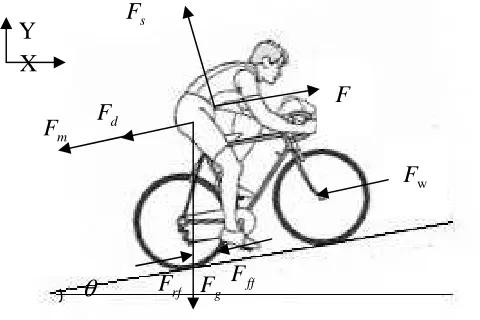
When we ride bikes, the riders, bicycles and the construction of the bike are influenced by the gravity, ground support force, air and ground resistance. However, cycling is different from the ordinary motion of rigid body. The structure stencil formed by the rider and the bike will change the maximum head size and drag coefficient. Coefficient of wheel spin and lower pedaling action will make the Magnus effect. Meanwhile, comparing with the track cycling, and the wind variation and the road surface undulation in the outdoor environment will stress the structure and process is more complicated. Constructed in the direction perpendicular to the ground in a two-dimensional coordinate system, the total forces of the bike and rider in the process of cycling are composed of
gravity(
F
g), surface support(F
s), rider-bike head air obstruction(F
d), air resistance when wheel spinning(F
w),the friction of the tire and the ground(
F
f ) and body mechanical friction(F
m ).(Figure1) [image:2.595.177.417.294.454.2]While pedaling hard during the cycling process is the guarantee to keep the rider and bike moving ahead.
Figure 1 schematic diagram of bike riding stress
When we ride on the steep road, we can distribute a component force of the direction of motion(
′
gF
) from the
gravity(
F
g),however, when riding uphill,′
gF
is opposite to the direction of the movement and it is the resistance
of the cycling, when riding downhill,
′
gF
is similar to the direction of the motion, thus it is the driving force of cycling, the expressions should be:
θ
θ
sin
sin
Mg
F
F
g′
=
g=
In the expressions,
M
is the total mass of the rider and the body of the bike;θ
is the angle of the ground and the water level. When riding uphill, we take the positive value; when riding downhill, we take negative value; when riding on the level road, we take 0.When riding in the level road, the rider and the bike can produce a positive stress
F
gin the direction of Y and the force is similar to the gravity, while riding on the non-level road, the component force, which belongs to the gravity,produces the positive stress to the ground
″
gF
. Extrusion of the stress leads to the elastic deformation of the tire and because of the tire and road surface roughness, the relative motion of the bike and road surface, thus the friction between wheels and the pavement was formed. In the process of riding, pushing the pedal and the wheels spin, and the dynamic friction of the wheel and the ground will be produced. This is the forces to make the bike move forward. However, the front wheel cannot be driven by the force and its friction is opposite to the direction of the motion, which are the fricative resistance of moving forward. The expressions of the friction of body and ground should be:
F
θ
X
Y
F
sg
F
mF
ff
F
dF
w
F
θ
cos
mg
C
F
f=
rIn the expression,
C
fis the coefficient of rolling friction of the wheels and the ground. The coefficient of rollingfriction is determined by the surface of the road and the material of the tire.
C
fis determined by the surface of the road and the pressure of the tire.When riding forward, the front air is condensed to produce the pressure, the surface of two sides’ fricate with the air. All above produces the air resistance, which is opposite to the direction of the motion. The air resistance acting site is located in the center of the frontal area. The expression is:
2 w
2
1
V
A
C
F
=
dρ
d
C
is air resistance coefficient;
A
is windward-the largest cross-sectional area;ρ
is the air density of the locatedaltitude;
V
is the relative speed of body and the air flow.Rotating object creates asymmetric flow in a viscous fluid dynamic, and the effects of wheel motion of air resistance are generated by the wheels spinning in the air. The research of Greenwell shows that spin resistance depends on the wheel size and shape of the wheel, wheel speed does not significantly change. Meanwhile, due to the effects of the human body and bike vertical beam, the air resistance of the back wheel will decrease by 25%. Generally speaking, the radius of two wheels of the road bicycles is similar to the spokes, the expressions of the air resistance when the front and back wheels spin is:
2 2 w 2 2 w 2 2 w d
r
8
7
2
1
4
3
r
2
1
ρ
π
ρ
π
ρ
π
V
C
r
V
C
V
C
F
F
F
=
fd+
rd=
+
×
=
w
C
is the coefficient of the air resistance of the wheels,
r
is the radius of the wheel,ρ
is the air density of thelocated altitude,
V
is the relative speed of body and the air flow.2 Establishment of Mathematical Model
Based on the Newton's second law, we can formulate the basic dynamic formula during riding bikes. The formula is:
a
M
F
F
F
F
F
-
g′
-
f-
w−
d=
⋅
F
is the forward force produced by the riders’ pedaling. Forthe foot pedaling around the crank axis in the course of a lap is not constant, the forward force
F
should be represent by the ratio of instant power and speed. On the other hand, some energy will be lost when the chain drives the rear wheel moving. Overseas research shows that chain transfer efficiency is positively correlated with the level of riding. On general, the chain transfer efficiency of road bicycles reduces about 98.5%.Based on the force analysis above, the basic dynamic formula during riding bikes can be listed:
(t) d ) (M r (t) 8 7 -gsin -cos C -) (t) (AC 2 1 -(t) 985 . 0 2 2 2 2 w f 2
d ′ ′ = + + ′′
′ × r I r I d C M g M d d
P ρ θ θ ρ π f r
I
randI
f are the moment of inertia of the front and back wheels.Table 1 Model Equation of Initial Parameters List
Parameters Value
Environmental indicators T=20ºC,P=1atm,ρ=1.266kg/m2 Human target M=80kg,H=180cm,Cd=0.5,A=0.5m2 Vehicle index r=0.35m,If=Ir=0.08kg*m2,Cw=0.0397,Cr=0.004
ANALYSIS OF SIMULATION RESULT The riding speed selection on the way
Riding on the way refers to the starting from the ride to the front of the sprinting, including four basic forms over long distances, level, ups and downs, long uphill and downhill sections. Obviously, the dynamic equation shows that faster cycling can lead to larger wind resistance on condition that other factors are stable, it can also produce the greater the energy consumption. We set on a wind speed of 3 m/s in this study. Foreign research shows that, when riding in a relatively flat road on the way, the athletes' average power output is about 350 w under normal circumstances. In figure 2a ,dotted line shows the speed of change after into the horizontal road in the rated power of 350 w, in the speed of 6 m/s, 8 m/s, 10 m/s, 12 m/s, 14 m/s, 16 m/s respectively. As you can see, riding in a horizontal road, the initial speed of 6 m/s, 8 m/s, 10 m/s, the speed rise gradually and this is the accelerating cycling stage; The initial speed of 14 m/s, 16 m/s, the speed is falling and this is decelerating cycling period; And when the initial speed of 12 m/s, it can maintain a constant speed and motivation through the pedal power transmission and air resistance held the line. Therefore, at the speed of 12 m/s , riding relatively flat road surface is the most effective way of cycling. The conclusion corresponds to an average speed of about 11.0 ~ 13.3 m/s which is excellent athletes riding in major international road cycling events in each period.
a
b
Figure 2 Riding Speed Variation under the Rated Power in Horizontal and the Ups and Downs Road
The solid lines in Figure 2a is the variation of the speed on the conditions mentioned above. Figure 2b is the
variation of the ups and downs as well as the angles, the model of the formula is
y
=
5
sin
(x/10)
,x
∈
[5
π
,25
π
]
, and the maximum tilt is 5%, which goes well with the regulations of the average tilt—less than 8%of ordinary road and less than 5%of the high speed road.Comparing with riding on the smooth road, riding on the steep road for 5 seconds, the variation of the speed is unimodal. That is, when riding downhill, the acceleration goes down gradually. After getting the valley bottom, with the tilt going up, the acceleration becomes negative gradually and the speed becomes lower. Seen from the change curve of different speed, with the increase of the initial speed, the rate of the increase of the speed becomes lower. When riding through the steep road, the variation of the speed becomes short and the initial speed of the next period is lower. The figure shows that, when the initial speed is 8m/s and the initial speed of each steep road surface is constant, the duration of the circle is about 5.2s. Therefore, when riding on the constant steep road, we should select the riding speed accordingly. And when riding in a short but steep distance, we should fasten the speed, while if the distance is long; we should lower the speed and go through the steep road smoothly.
The Sprint Distance Selection
speed. If the selected sprint distance is too short, the athletes cannot fully apply their speed advantages under the ultimate strength, or the fastest speed will not appear after the race completed. While, if the distance is too long, the athletes cannot stand the strong load, the sprint speed might decrease. Thus, the selection of the sprint distance is very important to the sprint results.
Figure3 Sprint Speed Chart
Research shows that the average anaerobic power of the excellent athletes in our country is 820.17±113.22w and the anaerobic power is 1209.75±280.80w. The average power of Figure 3 is 820w. At the 4th second, it reaches the maximum power 1200w.The initial speed is 12m/s, and the figure is the sprint speed on the smooth road. From the figure, we can see that the variation of the speed in the sprint period is the same as the parabola. 180m is the peak of the speed. By calculating, when the sprint distance is 100m, 150m, 200m, 250m, 300m, the instantaneous velocity is 15.5m/s, 16.3m/s, 16.4m/s, 16.2m/s, and 16.0m/s respectively. We can conclude from the result that sprint distance between 150m to 250m can get the highest speed, but when the distance is less than 180m, the duration of the high speed is relatively short. Thus, the best sprint result cannot be achieved. While , if the sprint distance is between 180m to 220m, the athletes can not only ride at a relatively high speed, but also can keep it longer. So this distance span should be the best selection.
CONCLUSION
Bike riding is a process of combination of a variety of physical force; these forces include gravity, ground support, air and ground friction. Road bike riding is riding in the outdoor, the change of the wind and the ups and downs of surface make the composition of stress and process more complicated.
At the level of the rated power of 350 w road cycling, cycling speed of 12 m/s can maintain uniform state basic, the effect of cycling is best, the speed of the current is also used by the world excellent road bikes athletes.
When riding through the ups and downs , faster does not necessarily lead to ideal cycling effect, and we need choose the cycling speed according to the specific length of the section. When the distance is short, we can increase the cycling speed and ride quickly through the ups and downs, and when the distance is long, we can reduce the corresponding speed and keep relatively stable through the ups and downs.
When riding uphill and downhill in long distance , the change of speed is affected by the combination of wind resistance and the component of gravity force , a smaller and larger extent of up/down to speed effects are not obvious, and in the larger and smaller up/down, we can increase the riding hard for periodic advantage.
Sprinting to the process of speed curve is similar to parabolic changes. Model simulations show that the speed can reach the speed of the peak in the 200 m sprint distance, and when sprinting at the end distance between 200 ~ 250 m, we can remain riding relatively high speed, and speed down is not too obvious, so it is the best distance to complete the sprinting .
REFERENCES
[1]Liu Xiao-lan. China Sport Science and Technology. 1984, 29(13), 46-49.
[2]Luo Yang-chun. Journal of Shanghai Physical Education Institute. 1994, 23(12), 46-47. [3]Wan Hua-zhe. journal Of Nanchang Junior College. 2010, 3, 154-156.
[4]Li Ke. Journal of Shenyang Sport University. 2012, 31(2), 111-113.
[5]Zhang Shu-xue. Journal of Nanjing Institute of Physical Education. 1995, 31(2), 25-27. [6]Pan Li. Journal of nanjing institute of physical education(natural science). 2004, 19(1), 54-55. [7]Li Yu-he; Ling Wen-tao. Journal of Guangzhou Physical Education Institute. 1997, 17(3), 27-31. [8] Xu Guo-qin. Journal Of Hebei Institute Of Physical Education. 2008, 22(2), 70-72.