,Applied Mechanics and Materials Vols. 465-466 (2014) pp 1065-1069
0 (2014) Trans Tech Publications, Switzerland doi:I 0.4028/www,scientiJic.net/'.465-466.1065
Decision Making of Screw Manufacturing for the Best Environmental
and Economic Combination by Using AHP
Mohd Azwir ~ z l a n ~ ' ,
Andy Anak ~ u j a ~ ' ~ ~ ,
Chee Kiong siac'
,
Nik Hisyamudin Muhd Nor and Jalil ~zlis-sanie'
'~aculty of Mechanical and Manufacturing Engineering, Universiti Tun Hussien Onn Malaysia,
86400 Batu Pahat, Johor, Malaysia
2
Department of Mechanical Engineering, Politeknik Kuching Sarawak, 93050 Kuching Sarawak
Keywords: Screw manufacturing, Sustainable, Environment, Economic, Viable, AHP
Abstract. This study is an approach to investigate the viable impacts of screw manufacturing. At the same time, choose the suitable material and selected manufacturing process of screw by considering environmental aspects without sacrificing the economic aspect. It is important to the organisation to improve the environmental aspect. Therefore in this study, the decision making was focused on economic aspects to produce the synergy results between economic and environmental impact. The parameters involved were types of material and manufacturing process of screw which using the available data of environmental and production volume. The two different manufacturing approaches being evaluated were machining and forging process. The types of material concerned for forging process encompassed lowcarbon steel, alloy steel stainless steel, and aluminium alloy. On the other hand, for machining process, the material being considered in screw manufacturing were cast iron, low carbon steel, alloy steel, stainless steel and aluminium alloy. The information of environmental impacts that generated from Solidworks Sustainability tool and screw production cost were calculate using Manufacturing cost model, both information was used in Analytic Hierarchy Process ( A m ) analysis to obtain local priority of economic and environmental impacts.
Then, the ranking of both global and local priorities fkom economic impact and environmental impacts had enabled the determination of appropriate material used for those selected screw manufacturing process. As result, low carbon steel was chosen for forging process whereas cast iron was excelled in machining process, at the same time, stainless steel was not suggested to be used in both two processes.
Introduction
Recently, the environmental problems such as global warming, acid rain and pollution had increased the awareness of the public on environmental issues. There are a lot of researches have been conducted to improve profitability in manufacturing processes such as concurrent product development [I], manufacturing process selection and costing [2] and etc. Thus, most industries in developing countries have to look f o m d to be more aware about the environment. Today, the key for manufacturers in order to sustain in very competitive and challenging market is the ability to cope with the needs of sustainable development. Brundtland (1987) had reported; in 1987 the development which meets the needs of the present without compromising the ability of future generations to meet their own need is known as sustainable development [3] had declared. Theoretically, although sustainability contains of three pillars, which are economic, environmental as well as social, but, this study was merely concentrated on the economic aspect without neglecting the environmental aspect. Through literature, interlocking circle model [5J emphasized e~vironment as the most critical aspect which need to be improved. Hence, the goal is to position environmental aspect as important as economic aspect.
All rights resewed. No part of contents bf this paper may be reproduced or transmitted In any form or by any means without the written permission of lTP,
1066 4th Mechanical and Manufacturing Engineering
[image:2.595.149.424.83.165.2]THE THEORY NOW THE CHANGE NEEDED
Figure 1 : Interlocking circle model, from left to right, the theory, the reality and the change needed [5]
Previous study by Chee Kiong Sia et al (2013), only investigated the environmental impact of screw manufacturing [ 6 ] . The selection of screw mainly based on 4 environmental impacts
generated fiom SolidWorks Sustainability. This study had continuity from previous study. In this study, the viable impact, the combination economic growth and environmental protection pillars were analysed. The role play by a decision maker is to determine the best alternative and to rank the entire set of alternatives. AHP was recognized as one of the most popular analytical technique which usually used in complex decision making task [7]. In fact, it is easy to perform and does not need advanced technical knowledge as the judgement is made based on people's experiences. This report is regarded to the study that investigates the environmental and economic impacts of screw manufacturing with respect to alternative material over t ~ o manufacturing process which are machining and forging process. Then, the final decision is selected based on the ranking from the analytic hierarchy process (AHP).
Methodology
The study began with the CAD modelling of M5 hexagonal machine screw. After all the parameters had been decided, the sustainability analysis concerning environmental impacts was carried out using SolidWorks Sustainability, at the same time manufacturing cost was calculated. Then, the data of environmental impacts and screw manufacturing cost were applied in AHP, so that the selection of suitable material with minimum environmental impacts and maximum economic impacts that respected to both manufacturing methods in screw manufacturing can be done.
SolidWorks Sustainability tool. The SolidWorks Sustainability software is a kind of powerful
sustainability tool that integrates in Solidworks software. It can be used in sustainability analysis to evaluate the four environmental impacts throughout the life cycle of product yet incorporate sustainability into design process. In this study, this tool has been adopted for environmental impact analysis for two selected manufacturing process with alternate material change.
Screw Manufacturing Cost Model. The process cost is determined using a basic processing cost
(the cost of producing an ideal design for that process) and design-dependent relative cost coefficients (which enable any component design to be compared with the ideal)
[a].
The model is based on type of material, material volume and shape of the part that produced. Material costs are calculated taking into account the transformation of material to yield the final form, so single process model for manufacturing cost, M , can be formulated as,[8J:MI = VCmt
+
R, PC (1)Applied Mechanics and Materials Vols. 465-466 1067
Analytical hierarchy process (AHP). Firstly, the problem was structured by identifying those
possible attributes that contributes to the solution. Data were used to calculate production cost and four environmental impacts generated fiom SolidWorb Sustainability tool. As the hierarchy was
well constructed, the matrices of pair-wise comparisons were formed for each criterion and alternatives. These comparisons were used to obt& the weights of importance of the decision criteria and the relative performance measures of the alternatives in term of each individual decision criterion.
Results and discussion
During the sustainability analysis, the input includes material, manufacturing process, location of manufacture and distribution. The material type and manufacturing process were the variables while the location of manufacture and distribution was assumed happened in Asia region. Subsequently, regarding to the environmental impacts, they are measured in term of carbon dioxide (C02), sulphur dioxide (SO2), phosphate (PO4) and energy [9]. Meanwhile for economic pillar, the manufacturing cost of different kind of material and process was calculated, production volume was - -
taken into account in production cost analysis. These impacts were specifically referred to single unit of screw.
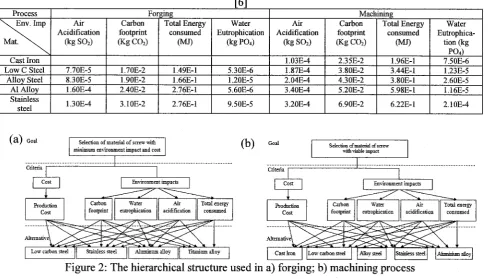
All in all, different types of material with different manufacturing process had given different results of environmental impacts. This study was using M5 hexagonal screw as the only example. When looking at the details of hexagonal head screw production, there were several stages usu&ly will be gone through to get the final product. There were similarity for some stages like cutting the thread, heat treatment and also coating for both forging and machining processes, so these similar stages were neglected in this study. The Table 2 had represented the data of environmental impacts obtained fiom the sustainability analysis for one piece of screw on the forging operation and
(a) GO^
Critrda Cd&
- -
-machining operation respectively, the study was then proceeds to evaluate stage where AHP was
undertaken. The following Figure 2 had depicted the hierarchical structure that utilized in both forging and machining process accordingly, the criteria are the manufacturing cost and the four environmental impacts.
Table 2: Data of environment impacts for M5 hexagonal screw under forging and machining operation
Process Forging [61 Machining
Roduchbn Rodnction
Cost Cost
[image:3.595.51.540.475.754.2]I I I
Figure 2: The hierarchical structure used in a) forging; b) machining process Air
Acidification (kg SOz)
At criteria level, the local priorities for these four impacts were obtained. They were ranked Cast Iron
Low C Steel Alloy Steel
A1 Alloy
Stainless
steel
according to above important level, with values of 0.5959,-0.2010, 0.1086 and 0.0845 respectively. In the following determination of local priorities on the alternative level, it was based on the data of
Carbon footprint
(3% Cod
4th Mechanical and Manufacturing Engineering
screw manufacturing cost model calculation and environmental impacts that collected from sustainability analysis with different types of materials, material used were cast iron (CI), low carbon steel (S), alloy steel (AS), stainless steel (SS) and aluminium alloy (AA). The global weight were determined, the table 3 were regarding to the composite priority weight for alternative in both processes. To improve the environmental pillar the change need to have the weight for the environment and cost at 5050.
I
TOTAL1
0.51
Finally, the maximum value found in global priorities was denoted as the best alternative. By referring to Table 4 (a) which displayed the results of global priority in forging process, low carbon steel, was selected as the best option because had attained the largest value of global priority, which was 0.3104 follow by alloy steel (AS), aluminium alloy (AA) and stainless steel (SS) were 0.2663, 0.2212 and 0.2022 respectively. In brief, stainless steel was not an environmental friendly material and was not encouraged to be used if the environment was concerned in the forging process of - - - screw manufacturing in addition, it is also the highest in screw manufacturing cost. On the contrary, the utilization of low carbon in this process was highly demanded as it exhibited the minimum environmental impacts.
However, when referring to Table 4 (b), it can be deduced that cast iron was the most desirable outcome since it had obtained the highest value of global priority that was 0.2758 compared to others material. The low carbon steel that normally used in screw products had achieved the second place, with the value of global priority of 0.2188. In a nutshell, stainless steel was not recommended to be applied in screw manufacturing because neither in forging nor machining process, it had given the smallest value in global priority which means not an environmental friendly material and high manufacturing cost.
Applied Mechanics and Materials Vols. 465-466
Furthermore, generally it is known the higher the production volume the cheaper the manufacturing cost for a single part. Next, by referring to table 5 (a) which displayed the results of global priority in forging process with different production volumes, low carbon steel, was selected as the best option because had attained the largest value of global priority. Global priority for aluminium alloy increased as the production volume increased. Lastly, in machining process the utilization of cast iron was highly demanded as it exhibited the minimum environmental impacts and maximum economic impacts regardless of the production volume, second was low carbon steel, refer table 5 (b). Specifically for stainless steel and alloy steel the higher the production volume goes the smaller value in global priority, for viable impact this two materials is not recommended for screw manufacturing.
Table 5: Results of global priority with different production volume in (a). Forging (b). Machining cess
Conclusion
In conclusion, the best combination with the optimum performance between environmental and economic aspects of screw manufacturing was obtained. This was done by ranking the priorities using the AHP. The results obtained from viable impacts analysis were only focused on screw head and screw shape formation, in spite of others stages such as screw thread and screw treatment in screw manufacturing process chain regard with the manufacturing cost. Production volume was used in economic impact analysis; with different production volume low carbon steel still the best to choose from in forging process, meanwhile in machining cast iron was chosen regardless of the production volume. In a nut shell, AHP is a user fiendly decision making method. Stainless steel was not recommended to be applied in screw manufacturing because neither in forging nor machining process, it had given the smallest value in global priority which means not an environmental friendly material and high manufacturing cost.
References
[I] E.M. Shehab & H.S. Abdalla, Manufacturing cost modelling for concurrent product development, Robotics and Computer Integrated Manufacturing 1 7 (200 1) 34 1-3 53
[2] A J Allen & K G Swift. Manufacturing process selection and costing. Proc Instn Mech Engrs, Vol204 (1 990) 143
€31 World Commission on Environment & Development. Our common future . United Kingdom: Oxford University Press. (1987)
[4] Pope, J., Annandale, D., & Morrison-Saunders, A,. Conceptualising sustainability assessment.
Environmental Impact Assessment Review (24), (2004), 595-6 1 6.
[5] Information on http://www.iucn.org/programme/
[6] Chee Kiong Sia, Loo Yee Lee, Siaw Hua Chong, Mohd Azwir Azlan & Nik Hisyamudin Muhd Nor. "Decision Making with the Analytical Hierarchy Process (AHP) for Material Selection in Screw Manufacturing for Minimizing Environmental Impacts." Applied Mechanics and
Materials 3 15 (2013): 57-62.
[7] Rao, R. V. Decision Making in the Manufacturing Environment: Using Graph Theory and
Fuzzy Multiple Attribute Decision Making Method. London: Springer. (2007)
[8] Swift, K. G. & Booker, J. D.. Process Selection : From Design to Manufacture. Jordan Hill, GBR: Butterworth-Heinemann, 2003. p 250-273.
![Figure 1 : Interlocking circle model, from left to right, the theory, the reality and the change needed [5]](https://thumb-us.123doks.com/thumbv2/123dok_us/8767176.897050/2.595.149.424.83.165/figure-interlocking-circle-model-theory-reality-change-needed.webp)