© 2016, IRJET | Impact Factor value: 4.45 | ISO 9001:2008 Certified Journal | Page 1332
A Study on Various Classification Techniques for Sentiment Analysis
on Social Networks
N.SARANYA MSc (SS), MCA, M.Phil,
1, Dr.R.GUNAVATHI
21
Assistant Professor, PG Department of Computer Science, Sree Saraswathi Thyagaraja College, TN, India.
2
Head,Department of Computer Application, Sree Saraswathi Thyagaraja College, TN, India.
---***---Abstract -
Sentiment analysis, which is additionally called asopinion mining, involves in building a system to gather and examine opinions regarding the merchandise created in journal posts, comments, reviews or tweets. Sentiment Analysis is the study of automatic identification of online user’s preference and classification of these preferences into its positive, negative or neutral orientation. A major problem occurs when we try to determine the sentiment or the class of these data i.e. whether the data is good or bad. Analyzing the sentiment of a text, document or an article is a challenging task in the world. Several methods were implemented for sentiment analysis throughout the years, but still more improvement and perfection is needed. Here in this paper various sentiment analysis techniques are reviewed.
Key Words: Opinion Mining, Classification Techniques, Sentiment Analysis, Sentiment Classification, Summarization.
1. INTRODUCTION
E-commerce and the rapid growth of the social
media, individuals and organizations are progressively using the content on these media for decision making purpose [1], [2]. Hence there is a need for effective and accurate automated approach which predicts the opinions presented in the reviews. Opinion mining systems classify opinion data available on web into their respective opinion polarity of positive, negative or neutral. In the current web era, opinion mining is one of the widely studied topics under Web Mining and Natural Language Processing. Opinion mining is analyzed at the document level, sentence level and aspect level. This survey aims to give a closer look on these enhancements and to summarize and categorize some articles presented in this field according to the various Sentiment Analysis (SA) and Sentiment Classification (SC) techniques.
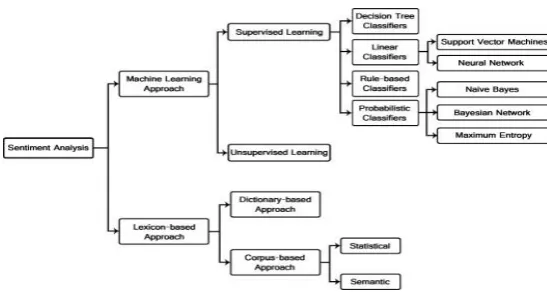
The sentiment classification techniques, as shown in Figure 1 are discussed with more details illustrating related articles and originating references as well.
[image:1.595.307.581.318.464.2]Figure 1 - Sentiment classification techniques.
2. RELATED WORKS
Opinion mining is a popular research topic because
© 2016, IRJET | Impact Factor value: 4.45 | ISO 9001:2008 Certified Journal | Page 1333
summarization of the reviews was performed in 3 steps as 1)Mining of product aspects reviewed by customers. 2) Opinion sentence identification in each review and determining whether particular sentences is positive or negative, each opinion sentence should contain features extracted in step 1, which is extract based on step 1. 3) Summarizing the results. They used online Word Net dictionary to predict semantic orientations and orientation of opinion sentences, which gave a good accuracy in predicting sentence orientation, the average accuracy of the five products is 84%. For this research work, authors worked with customer opinions on different products like cellular phone, DVD player, digital cameras and mp3 player. These opinions were collected from Amazon.com and Cnet.com.
Long Jiang et al [4] specialize in target-dependent Twitter sentiment classification; particularly, given a question, the others classify the emotions of the other sets as positive, negative or neutral in keeping with whether or not they contain positive, negative or neutral sentiments this question. Here the question is the target of the emotions. The state-of the-art approaches for finding this downside continually adopt the target-independent strategy, which may assign tangential sentiments to the given target. Moreover, the progressive approaches solely take the other set to be classified into thought once classifying the sentiment; they ignore its context (i.e., connected the other sets). The others, as a result of the other sets area unit typically short and a lot of ambiguous, typically it's not enough to think about solely this the other set for sentiment classification.
Rui Xia et al [5] we have a tendency to propose a model referred to as twin sentiment analysis (DSA), to handle this downside for sentiment classification. we have a tendency to initial propose a completely unique information growth technique by making a sentiment-reversed review for every coaching and take a look at review. On this basis, we have a tendency to propose a twin coaching algorithmic rule to create use of original and reversed coaching reviews in pairs for learning a sentiment classifier, and a twin prediction algorithmic rule to classify the take a look at reviews by considering 2 sides of 1 review. we have a tendency to conjointly extend the DSA framework from polarity (positive-negative) classification to 3-class (positive negative-neutral) classification, by taking the neutral reviews into thought.
Jithe and Eduard [6] propose a semi-supervised bootstrapping algorithmic rule for analyzing China’s foreign relations from the People’s Daily. Our approach addresses sentiment target clump, subjective lexicons extraction and sentiment prediction in a much unified framework. Totally different from existing algorithms within the literature, time data is taken into account in our algorithmic rule through a
hierarchical theorem model to guide the bootstrapping approach.
Ryan McDonald et al [7] investigate a structured model for together classifying the sentiment of text at variable levels of roughness. Abstract thought within the model relies on commonplace sequence classification techniques victimization strained Viterbi to make sure consistent solutions. The first advantage of such a model is that it permits classification selections from one level within the text to influence selections at another.
Duyu Tang et. al, [8] propose to make large-scale sentiment lexicon from Twitter with an illustration learning approach. we have a tendency to solid sentiment lexicon learning as a phrase-level sentiment classification task. The challenges area unit developing effective feature illustration of phrases and getting coaching information with minor manual annotations for building the sentiment classifier. Specifically, we have a tendency to develop an obsessive neural design and integrate the sentiment data of text (e.g. sentences or tweets) into its hybrid loss operate for learning sentiment-specific phrase embedding (SSPE). The neural network is trained from large tweets collected with positive and negative emotions, with none manual annotation.
Alec Go et al [9] introduce a completely unique approach for mechanically classifying the sentiment of Twitter messages. These messages area unit classified as either positive or negative with relation to a question term. This is often helpful for customers United Nations agency need to analysis the sentiment of product before purchase, or firms that need to watch the general public sentiment of their brands. There’s no previous analysis on classifying sentiment of messages on micro blogging services like Twitter.
Xiaowen et al [10] propose a holistic lexicon-based approach to finding the matter by exploiting external evidences and linguistic conventions of tongue expressions. This approach permits the system to handle opinion words that area unit context dependent, that cause major difficulties for existing algorithms. It conjointly deals with several special words, phrases and language constructs that have impacts on opinions supported their linguistic patterns. It conjointly has a good operate for aggregating multiple conflicting opinion words in a very sentence. A system, referred to as Opinion Observer, supported the projected technique has been enforced.
© 2016, IRJET | Impact Factor value: 4.45 | ISO 9001:2008 Certified Journal | Page 1334
Andrew et al [12] gift a model that uses acombination of unattended and supervised techniques to be told word vectors capturing linguistics term–document data also has made sentiment content. The projected model will leverage each continuous and multi-dimensional sentiment data also as non-sentiment annotations. We instantiate the model to utilize the document-level sentiment polarity annotations gift in several on-line documents (e.g. star ratings). We have a tendency to value the model victimization little, widely used sentiment and judgment corpora and realize it out-performs many antecedently introduced strategies for sentiment classification.
Maite et al [13] gift a lexicon-based approach to extracting sentiment from text. The linguistics Orientation calculator (SO-CAL) uses dictionaries of words annotated with their linguistics orientation (polarity and strength), and incorporates intensification and negation. SO-CAL is applied to the polarity classification task, the method of assignment a positive or negative label to a text that captures the texts.
In 2011, Magdalini Eirinaki, Shamita Pisal and Jaspinder Singh [14], introduced an opinion search engine system which consist of two novel opinion mining algorithms, one for identifying and extracting the features that are most important and characteristic of each review, and other that takes as input these features, assigns ranks to them and decides the final classification of the review as positive, neutral, or negative. For identifying and extracting the features the High Adjective Count (HAC) algorithm extracts nouns for which lots of opinions are available. The noun is scored based on the adjective associated with it, which can be used to rank and filter the nouns. For ranking purpose The Max Opinion score algorithm assigns ranks to the extracted features by making use of the opinion scores allotted by HAC algorithm. The aspect based opinion summary demonstrated here, assist users in focusing on various aspects of the product a customer is interested in, offering small summary of the search. Their experimental results showed that their algorithm succeeds to classify more than 87% of the reviews correctly in the worst case and has close to 97% accuracy in the best case. For this research work, authors worked on the product review datasets provided by Prof Bing Liu, which are DVD Player (small) Data Set (90 reviews), DVD Player (large) Data Set (300 reviews) and Vacuum Data Set (40 reviews).
In 2014, Edison Marrese-Taylor, Juan D. Velasquez and Felipe Bravo-Marquez [15], presented an extension of an existing Bing Liu’s [2], aspect-based mining approach in order to apply it to the tourism domain, particularly to opinions available on the web in the manner of tourism products reviews. They developed new and more complex NLP-based rules for subjective and sentiment classification. The process consisted of three distinct steps which are 1) Aspect identification, for aspect extraction from the review. 2) Sentiment prediction, to determine sentiment orientation
on each aspect. 3) Summary generation, to present processed results in a simple manner. Their experimental results showed that their extension is able to perform better than that of Liu’s model for tourism domain. Their experimental results showed that their extension is able to perform better than that of Liu’s model, with an average accuracy of 95%. For this research work, authors collected reviews about hotels and restaurants from Lake District in TripAdvisior, which consisted of 1435 reviews of 100 restaurant and hotel.
In 2013, Hasiang Hui Lek and Danny C.C. Poo [16] presented an approach to perform aspect-based sentiment classification for Twitter, which made use of a POS tagger, a sentiment lexicon and a few gazetteer list to produce results of the form [aspect, sentiment words, polarity]. They used a layered classification approach which uses the aspect-based classifier as the first layer classification and the tweet-level classifier as the second layer classification. The process consists of three main steps: 1) Aspect sentiment extraction, to determine list of possible aspect candidates along with their associated sentiments and polarity. 2) Aspect ranking and selection, aspect candidates are ranked and set of most important aspects are selected. 3) Aspect classification, aspects are obtained along with their polarity for each tweet. For tweet level sentiment classification, they experimented with Maximum Entropy and Naïve Bayes classifiers. Aspect based opinion classifier is then added to existing tweet-level opinion classifier using three methods like 1) Layered classification, for precise classification of the sentiments associated with the target aspect. 2) Sentiment words as features, for using sentiment words associated with aspect as feature for tweet level opinion classification [17]. 3) Polarities as features, for using opinion orientation of aspect as a feature [17]. Their experimental results showed that their classification is more effective than a classifier trained using target-dependent features, with an accuracy of 84.2%. For this research work, authors used four datasets: Stanford Twitter Sentiment (STS) consisting of 800,000 positive an 800,000 negative tweets, Sander Twitter Corpus (STC) consisting of 511 positive and 561 negative tweets, Telecommunication Company Dataset 1 & 2 (TCD1/TCD2) consisting of tweets from two different telecommunication companies in Singapore.
© 2016, IRJET | Impact Factor value: 4.45 | ISO 9001:2008 Certified Journal | Page 1335
to indicate the degree of satisfaction presented in the reviewtowards the aspect and aspect weights are used to indicate the degree of emphasis placed by reviewer of the review on aspect. Their experimental results showed that their demonstrated LRR model can solve LARA problem in an effective manner, revealing differences in aspect ratings even when the overall ratings are the same as well as differences in user's rating behavior on various aspects. For this research work, authors collected 235,793 hotel reviews from a website Trip Advisorin a period of one month.
In 2011, Jianxing, Zhazj, Wang and Chuats [19], developed an aspect ranking algorithm which identifies significant aspects by taking into account aspect frequency as well as impact of customer’s opinion given to individual aspects on the overall rating of opinions. They recognized significant aspects by applying shallow dependency parser. For deciding opinion orientation on multiple aspects they used a SVM based sentiment classifier and for ranking significant aspect they used a Multivariate Gaussian Distribution approach. Their experimental study demonstrated the effectiveness of their approach in identifying vital aspects from the opinions. They used the results obtained from the aspect ranking and applied it to classify document-level opinions for improving the performance of classification results. For this research work, authors used a dataset containing customer’s reviews in 4 different domains on 11 products, which were crawled from various web sites like gsmzrena.com, viewpoints.com, cnet.com and reevoo.com.
More over a lot of work and researches are applied for sentiment analysis or opinion mining. There is a huge open research field to work for the same. Many machine learning techniques were implemented in a document to analyze its sentiment [20], [21], [22], and [23]. Using movie reviews referred as data, they found that the supervised machine learning techniques performs better than the human-produced baselines [24], [25]. Works concluded by examining factors make the sentiment classification problem more challenging. Another piece of work was done where an inference was build based on standard sequence classification techniques to ensure consistent solutions [26]. The primary advantage of such a model is that it allows classification decisions from one level in the text to influence decisions at another. [27] Describes another way to sentiment analysis, in which support vector machines (SVMs) was used to bring sources of information, including some favorable measures for phrases and adjectives and knowledge of the topic of a text together. A lot of work and experiments were done to classify the sentiment class using naive bayes classifier [28], [29], [30]. [31] introduced an EM-like approach that combines Expectation Maximization (EM) algorithm with Naive Bayes classifier. Sentiment analysis of tweets is now a growing research area where multiple works
are going on to determine the type of tweets [32], [33], [34]. This also shows how to collect a twitter corpus automatically for sentiment analysis and opinion mining. Researchers have also worked for collecting data from online sites like any movie review site or any online shopping site. These researches show us that a good sentiment analyzer, which can easily determine an emotion, feelings, etc., is very necessary nowadays. These articles are categorized according to their contributions in the various SA techniques.
3. SUMMARY GENERATION
The last step in the process of aspect based opinion mining is summary generation which varies from different application and approaches. It basically summarizes the overall process by representing reviews along with the aspects commented in the review and its corresponding opinion associated with each aspects. In some of the approach summary also present the score in terms of stars associated with different aspects in addition to its opinion orientation.
4. PROBLEMS AND DIRECTIONS
The major challenge in opinion mining lies in the fact that reviewer refer differently to different kinds of the products when writing reviews on the web. Hence domain plays a vital role in case of opinion mining. The other challenge in opinion mining is the problem of Natural Language Processing (NLP). It takes into the consideration various unsolved problems in NLP like word sense disambiguation, co-reference resolution and negation handling. With the help of Part-of-Speech Tagging (POS), Aspect Extraction, Opinion Word Extraction and Analysis on multiple aspects we can use a machine learning based sentiment classifier along with an efficient ranking scheme.
5. CONCLUSION
© 2016, IRJET | Impact Factor value: 4.45 | ISO 9001:2008 Certified Journal | Page 1336
beat their individual drawbacks and have the good thingabout each other’s deserves, and eventually enhance the sentiment classification performance. Hence in future to improve the accuracy of classification results various approaches need to be combined to overcome drawback of individual approaches and gain from each other’s benefits.
REFERENCES
[1] Park, Do-Hyung, and Sara Kim. "The effects of consumer knowledge on message processing of electronic word-of-mouth via online consumer reviews”, Electronic Commerce Research and Applications 7, no. 4 2009, pp. 399-410
[2] Zhu, Feng, and Xiaoquan Zhang. "Impact of online consumer reviews on sales: The moderating role of product and consumer characteristics", Journal of Marketing 74, no. 2, 2010, pp.133-148.
[3] Hu, Minqing, and Bing Liu. "Mining and summarizing customer reviews”, In Proceedings of the tenth ACM SIGKDD international conference on Knowledge discovery and data mining, ACM, 2004, pp. 168-177. [4] L. Jiang, M. Yu, M. Zhou, X. Liu, and T. Zhao,
“Target-dependentTwitter sentiment classification”, in Proceedings of the Association for Computational Linguistics: Human Language Technologies – Vol.1, Portland, Oregon, 2011, pp. 151–160.
[5] Xia, R., Xu, F., Zong, C., Li, Q., Qi, Y., & Li, T. (2015). Dual sentiment analysis: Considering two sides of one review. Knowledge and Data Engineering, IEEE Transactions on, 27(8), 2120-2133.
[6] Jithe othersi Li and Eduard Hovy, Sentiment Analysis on the People’s Daily, J Li, EH Hovy - EMNLP, 2014. [7] McDonald, R., Hannan, K., Neylon, T., Wells, M., & Reynar,
J. (2007, June). Structured models for fine-to-coarse sentiment analysis. In Annual Meeting-Association For Computational Linguistics (Vol. 45, No. 1, p. 432). [8] Duyu Tang, Building Large-Scale Twitter-Specific
Sentiment Lexicon: A Representation Learning Approach, Proceedings of COLING 2014, the 25th International Conference on Computational Linguistics: Technical Papers, pages 172–182, Dublin, Ireland, August 23-29 2014.
[9] Go, A., Bhayani, R., & Huang, L. (2009). Twitter sentiment classification using distant supervision. CS224N Project Report, Stanford, 1, 12.
[10] Xiaowen Ding, A Holistic Lexicon-Based Approach to Opinion Mining, WSDM’08, February 11-12, 2008, Palo Alto, California, USA.ung-Chen Chou, Chih-Hung Lin, Pao-Ching Li, Yu-Chiang Li, “A (2, 3) Threshold Secret Sharing Scheme Using Sudoku”, Sixth International Conference on Intelligent Information Hiding and Multimedia Signal Processing, IEEE 2010.
[11] Preslav Nakov, SemEval-2013 Task 2: Sentiment Analysis in Twitter,D11-1141, Named Entity Recognition in Tweets: An Experimental Study (self citation),2011.
[12] AndrewL.Maas, LearningWord Vectors for Sentiment Analysis, http://www.andrew-maas.net/data/sentiment
[13] Maite Taboada, Lexicon-BasedMethods for Sentiment Analysis, Submission received: 14 December 2009; revised submission received: 22 August 2010; accepted for publication: 28 September 2010. Volume 37, Number 2
[14] Eirinaki, Magdalini, Shamita Pisal, and Japinder Singh. "Feature-based opinion mining and ranking", Journal of Computer and System Sciences 78, no. 4, 2012, pp. 1175-1184.
[15] Marrese-Taylor, Edison, Juan D. Velásquez, and Felipe Bravo-Marquez. "A novel deterministic approach for aspect-based opinion mining in tourism products reviews", Expert Systems with Applications, 41, no. 17, 2014, pp. 7764-7775.
[16] Hasiang Hui Lek and Danny C.C. Poo, "Aspect-based Twitter Sentiment Classification”, IEEE Twenty-fith International Conference on Tools with Artificial Intelligence, 2013, pp. 366-373.
[17] L. Jiang, M. Yu, M. Zhou, X. Liu, and T. Zhao, “Target-dependentTwitter sentiment classification”, in Proceedings of the Association for Computational Linguistics: Human Language Technologies – Vol.1, Portland, Oregon, 2011, pp. 151–160
[18] Wang, Hongning, Yue Lu, and Chengxiang Zhai. "Latent aspect rating analysis on review text data: a rating regression approach", In Proceedings of the 16th ACM SIGKDD international conference on Knowledge discovery and data mining, ACM, 2010, pp. 783-792. [19] Yu, Jianxing, Zheng-Jun Zha, Meng Wang, and
Tat-Seng Chua. "Aspect ranking: identifying important product aspects from online consumer reviews”, In Proceedings of the 49th Annual Meeting of the Association for Computational Linguistics: Human Language Technologies-Volume 1, Association for Computational Linguistics, 2011, pp. 1496-1505. [20] Pang, Bo, Lillian Lee, and Shivakumar
Vaithyanathan. "Thumbs up? sentiment classification using machine learning techniques." Proceedings of the ACL-02 conference on Empirical methods in natural language processing-Volume 10. Association for Computational Linguistics, 2002. Available: http://en.wikipedia.org/wiki/Sentiment_analysis also in http://dl.acm.org/citation.cfm?id=1118704.
[21] Read, Jonathon. "Using emoticons to reduce dependency in machine learning techniques for sentiment classification." Proceedings of the ACL Student Research Workshop. Association for Computational Linguistics, 2005.
© 2016, IRJET | Impact Factor value: 4.45 | ISO 9001:2008 Certified Journal | Page 1337
[23] Ye, Qiang, Ziqiong Zhang, and Rob Law. "Sentimentclassification of online reviews to travel destinations by supervised machine learning approaches. “Expert Systems with Applications 36.3 (2009): 6527-6535. [24] Thet, Tun Thura, Jin-Cheon Na, and Christopher SG
Khoo. "Aspect-based sentiment analysis of movie reviews on discussion boards." Journal of Information Science 36.6 (2010): 823-848.
[25] Kennedy, Alistair, and Diana Inkpen. "Sentiment classification of movie reviews using contextual valence shifters." Computational Intelligence 22.2 (2006): 110-125.
[26] McDonald, Ryan, et al. "Structured models for fine-to-coarse sentiment analysis." Annual Meeting-Association for Computational Linguistics. Vol. 45. No. 1. 2007.
[27] Mullen, Tony, and Nigel Collier. "Sentiment Analysis using Support Vector Machines with Diverse Information Sources." EMNLP. Vol. 4. 2004. Available in http://research.microsoft.com/apps/pubs/default.aspx ?id=65510
[28] Tan, Songbo, et al. "Adapting naive bayes to domain adaptation for sentiment analysis." Advances in Information Retrieval. Springer Berlin Heidelberg, 2009. 337-349.
[29] Dave, Kushal, Steve Lawrence, and David M. Pennock. "Mining the peanut gallery: Opinion extraction
and semantic classification of product reviews. “Proceedings of the 12th international conference on World Wide Web. ACM, 2003. Also available in [3]. [30] Durant, Kathleen T., and Michael D. Smith. "Mining
sentiment classification from political web logs." Proceedings of Workshop on Web Mining and Web Usage Analysis of the 12th ACM SIGKDD International Conference on Knowledge Discovery and Data Mining (WebKDD-2006), Philadelphia, PA. 2006.
Available in
http://citeseer.uark.edu:8080/citeseerx/viewdoc/sum mary?doi=10.1.1.154.9186
[31] Nigam, Kamal, et al. "Learning to classify text from labeled and unlabeled documents.” AAAI/IAAI 792 (1998).
[32] Go, Alec, Richa Bhayani, and Lei Huang. "Twitter sentiment classification using distant supervision." CS224N Project Report, Stanford (2009): 1-12.
[33] Bollen, Johan, Huina Mao, and Alberto Pepe. "Modeling public mood and emotion: Twitter sentiment and socio-economic phenomena." ICWSM. 2011. [34] O'Connor, Brendan, et al. "From tweets to polls: