© 2016, IRJET | Impact Factor value: 4.45 | ISO 9001:2008 Certified Journal
| Page 1616
Facial Expression Recognition: A Review
Akhil Upadhyay
1, Asst. Prof. Amit Kumar Dewangan
21
Department of Computer Science & Engineering, Dr. C.V. Raman University, Bilaspur, India
2Asst. Professor, Department of Computer Science & Engineering, Dr. C.V. Raman University, Bilaspur, India
---***---Abstract -
Facial expression is one or more motions orpositions of the muscles underneath the skin of the face.
Facial expressions are a very important part of
communication. Though nothing is said verbally, there is much to be understood about the messages we send and receive through the use of nonverbal communication, such
as facial expression. Between Verbal and Non-Verbal type of
correspondence (contact) outward appearance is type of non-verbal correspondence yet it assumes significant part. The feelings expressed on a person's face; "a sad expression “a look of triumph “an angry face “This paper incorporates presentation of facial feeling acknowledgment framework, Application, relative investigation of well known face look acknowledgment methods and periods of programmed outward appearance acknowledgment framework. Facial expression plays a principal role in human interaction and communication since it contains critical and necessary information regarding emotion. This paper goal is to present needs and utilizations of outward appearance acknowledgment.
Key Words: Emotion recognition, Facial expression, Image processing, Human Machine Interface.
1. Introduction:
Facial expression is one of the most powerful, natural and immediate for the human beans to communicate and express their emotion and intention. Automatic facial expression analysis more interesting and challenging problem and it impact important application in many areas such as human computer interaction and data driven animation. Facial expression or motion is plays one of the most important role in human expression to find out his/her mind set. For more than a century expressions have been approached as bidimensional, static, instantaneous, self-contained, well-defined, and universal signals When we can text and message to our friends we use some symbolic diagram to express our filling so facial expressions is most important in our communications. Face recognition is one of the most challenging research areas in the field of computer vision. Even though face exhibits different facial features, which can be instantly recognized by human eyes, it is very difficult for a computer to extract and use the information content from these features. Communication between human been are done by verbal and non-verbal, facial expression is the part of non-verbal communication to communicate human been. Human face consists of mainsensory inputs and sensory outputs. It is used to identify gender, ethnicity, attractiveness, personality, information about age etc.
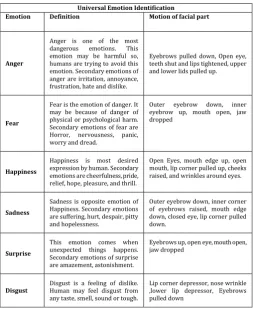
[image:1.595.303.557.406.716.2]2. Facial Expression classification and it’s features: Outward appearance presents key system to portray human feeling. From beginning to end of the day human changes a lot of feelings, it might be a direct result of their mental or physical circumstances. In spite of the fact that people are loaded with different feelings, present day brain science characterizes six essential outward appearances: Happiness, Sadness, Surprise, Fear, Disgust, and Anger as widespread feelings. Facial muscles developments recognize human feelings. Essential facial components are eyebrow, mouth, nose and eyes.
Table -1: Universal Emotion Identification
Universal Emotion Identification
Emotion Definition Motion of facial part
Anger
Anger is one of the most dangerous emotions. This emotion may be harmful so, humans are trying to avoid this emotion. Secondary emotions of anger are irritation, annoyance, frustration, hate and dislike.
Eyebrows pulled down, Open eye, teeth shut and lips tightened, upper and lower lids pulled up.
Fear
Fear is the emotion of danger. It may be because of danger of physical or psychological harm. Secondary emotions of fear are Horror, nervousness, panic, worry and dread.
Outer eyebrow down, inner eyebrow up, mouth open, jaw dropped
Happiness
Happiness is most desired expression by human. Secondary emotions are cheerfulness, pride, relief, hope, pleasure, and thrill.
Open Eyes, mouth edge up, open mouth, lip corner pulled up, cheeks raised, and wrinkles around eyes.
Sadness
Sadness is opposite emotion of Happiness. Secondary emotions are suffering, hurt, despair, pitty and hopelessness.
Outer eyebrow down, inner corner of eyebrows raised, mouth edge down, closed eye, lip corner pulled down.
Surprise
This emotion comes when unexpected things happens. Secondary emotions of surprise are amazement, astonishment.
Eyebrows up, open eye, mouth open, jaw dropped
Disgust Disgust is a feeling of dislike. Human may feel disgust from any taste, smell, sound or tough.
© 2016, IRJET | Impact Factor value: 4.45 | ISO 9001:2008 Certified Journal
| Page 1617
Fig-1: Basic sex facial Expressions
3. Foundation Analysis:
Human can perceive feelingsimmediately and exertion yet acknowledgment of outward appearance by machine is a major test. A portion of the crucial outward appearance acknowledgment methods are:
3.1. Measurable development based:
This paper
proposed clamor and revolution invariant outward
appearance acknowledgment which is based of
Statistical development that is Zernike minutes.
Removed component structure Zernike minutes are
given as contribution to Naive Bayesian classifier for feeling acknowledgment.Star:
i) The turn invariance is accomplished with the assistance of Zernike minutes.
ii) Recognition time under 2 seconds for frontal face picture. Con:
i) Emotion acknowledgment framework got influenced in light of revolution of facial pictures.
3.2. Auto-Illumination remedy based:
In this paper,
outward appearances are resolved utilizing confinement of focuses called Action Unit (AU's) without marking them. Face is perceived by utilizing the skin and Chrominance of the extricated picture. By utilizing mapping system separated eyes and mouth are mapped together. Skin and non-skin pixels are isolated to discrete face from the foundation by utilizing Haar-Cascaded technique. This paper depends on various face picture acknowledgment.
Star:
i) Single and different face location framework.
ii) Limitation of light is evacuated and consequently revised utilizing shading consistency calculation.
Cons:
i) 60% acknowledgment rate accomplished while identifying different face pictures. In this way, it is required to accomplish more exactness.
ii) This framework endures under extremely poor lighting framework.
3.3. Distinguishing proof driven Emotion
acknowledgment framework for a Social Robot:
Keeping in mind the end goal to give customized feeling acknowledgment, this paper incorporates ID venture preceding feeling characterization. For discovering facial arrangement half breed approach utilized which incorporates Active Space models and Active appearance models. Face tracker is utilized for face discovery. Composition data comprises of as set of vectors to portray the substance of 3D model.Star:
i) Identification of subject and earlier learning about the subject improve the execution acknowledgment in term of value and speed of grouping.
ii) 82% acknowledgment rate when facial picture taken in a social robot working environment that incorporates different lighting conditions and distinctive positions and introductions of subject face.
Cons:
i) Required preparing before utilizing it as utilization of social robot feeling acknowledgment framework.
ii) Required suitable layout in the following information to cover the entire elements space for feeling acknowledgment.
3.4. E-learning based feeling acknowledgment
framework:
This paper proposed E-learning based feelingacknowledgment system.SVM (Support Vector Machine) classifier based Adoost calculation used to find human face. Advertisement help calculation contrasts the classifier by removing components and week classifier to solid classifier. This is iterative weight redesigning process.
Star:
i) This paper presents application for the feeling in system instructing framework.
ii) Wearing glasses on the face range has no impact on feeling acknowledgment.
Cons:
i) Distance between the Camera and face will affect a range of face acknowledgment.
ii) Regional effect of the human face impact the execution of feeling acknowledgment like-Hear, Sitting stances, Light quality.
3.5. Psychological Face Analysis System for
Interactive TV System
:
This paper proposed, feeling discovery of individuals staring at the TV Program. Face look acknowledgment are utilized to distinguish particular TV viewer and perceive their interior enthusiastic state. Ada-LDA technique utilized based acknowledgment. Every second more than 15 casings can worked.
Star:
i)This paper presented a novel engineering without bounds intelligent TV.
© 2016, IRJET | Impact Factor value: 4.45 | ISO 9001:2008 Certified Journal
| Page 1618
iii) It can work at more than 15 outlines for every second.Cons:
i) Recognition rate vary with sort of facial database utilized. ii) Need to enhance execution of acknowledgment and timing for continuous application.
3.6. Movement identification based outward
appearance utilizing Optical stream:
So as to confine facial components around dynamic
Infra-Red (IR) brightening utilized. Source Vector (SV)
utilized for vector accumulation which indicates
movement and misshapening because of feeling
representation. Feelings are characterized by evaluated
comparability between the source vector and execution
movement vector and most elevated level of likeness could be distinguished as identified feeling.Star:
i) Few number of picture casings (three edges) are adequate to recognize outward appearance.
ii) Not important to decide accurate facial component areas, just the estimated qualities are adequate.
Cons:
i) Recognition rate of feeling "Trepidation" is not exactly different feelings.
Table -1: Comparative Study
Comparative Study S.N
o. Title Technique Database Performance (%)
Remarks
1
Statistical Moments based Facial expression Analysis Feature Extraction: Zernike moments Classificatio n: Naive Bayesian classifier JAFFE (Japanese Female Facial expression) database 60 images used for experiment.
Average accuracy for six emotions are 81.66% in time less than 2 seconds. Emotion accuracy graph shows highest recognition rate of happiness and lowest recognition rate of sadness.
2 Facial expression recognition with Auto-Illumination correction Expressions on the face are determined with Action Units (AU’s)
Single and Multiple face image
60% recognition rate for multiple face image
Illumination on image plays vital role.
3
Identification-driven Emotion recognition system for a Social Robot
Hybrid approach used for personalized emotion recognition,
MUG facial expression database used. More than 50 people frontal face database used aged between 20-25 years.
82% performanc e achieved with KNN Classifiers.
3D model facial image used.KNN classifier gives good performanc
e for
emotion recognition.
4 The application study of learner’s face detection and location in the
SVM(Suppor t Vector Machine) classifier based
PIE face image database used Detection and Correction rate 95% or
Presents application of face emotion recognition.
teaching network system based on emotion recognition
Adaboost algorithm used
more. With
application
of
E-learning system.
5
Cognitive Face Analysis System for Future Interactive TV Ada-LDA learning algorithm and MspLBP features used for effective multi-class pattern classifier
JAFFE and MIT+CMU database
Recognition rate of over 15 frames per second
Real time performanc e with high recognition rate 6 An Efficient Algorithm for Motion Detection Based Facial Expression Recognition using Optical Flow Infra-Red(IR) illumination used for facial feature approximate ly localization. Source Vector (SV) used for vector collection and identificatio n of emotion is based on highest degree of similarity between source vector and execution motion vector
Approximate ly 1000 images sequences of Cohn-Kanada Facial Expression Database with 65% female facial image used for experiment
94% recognition rate
Only three frames are sufficient to detect facial expression. 7 Emotion Recognition System Using Open Web Platform Facial Action Coding System(FAC S) and Facial Action Coding System Affect Interpretatio n Dictionary
Accuracy of 76.6% for Determining exact emotion
Classificatio
n of
Emotion id Made Based in the Movement of Reading Point 8 Multimode Emotion Recognition(ME R) System
The use Microsoft XBOX KINECT Sensor,The data include 2D facial images,3D face Feature
MER fusion Recognition part and new database
There is 25 feature in 2D data,32 feature in 3D data an 13 feature in audio data 9 Rodust Facial Expression Recognition Using Spatially Localized Geometric Model
For Feature Extraction The Algorithm Uses Edge Projection Analysis
The Cohn Kanade database consists of Grayscale image sequence
The Algorithm Achieves an Accuracy of 90% for Facial Expression Recognition
A Lip-enhanceme nt Transform for Better Segmentatio n of Lip-region in color image was Proposed
10 Natural Face Classification Using Personalized
The Proposed Method is Made Rohust
CK+,ISL and Internal Database are
With low Complexity Pre-Processer
© 2016, IRJET | Impact Factor value: 4.45 | ISO 9001:2008 Certified Journal
| Page 1619
Appearance Mode For Fast And Robust Emotion Detection
to Varius type of user head Motions
used having a Pre-processing Accuracy of 66%
talking Face
4.5 Classification:
Classification stage follows the output
of feature extraction stage. Classification stage identifies the facial image and grouped them according to certain classes and help in their proficient recognition. Classification is a complex process because it may get affected by many factors. Classification stage can also called feature selection stage, deals with extracted information and group them according to certain parameters
5. APPLICATION AREA:
With the rapid development of technologies it is required to build an intelligent system that can understand human emotion. Facial emotion recognition is an active area of research with several fields of applications. Some of the significant applications are:
i) Alert system for driving.
ii) Social Robot emotion recognition system. iii) Medical Practices.
iv) Feedback system for e-learning.
v) The interactive TV applications enable the
customer to actively give feedback on TV Program.
vi) Mental state identification. vii) Automatic counseling system. viii) Face expression synthesis. ix) Music as per mood.
x) In research related to psychology. xi) In understanding human behavior. xii) In interview
6. CONCLUSION:
Extensive efforts have been made overthe past two decades in academia, industry, and government to discover more robust methods of assessing truthfulness, deception, and credibility during human interactions. Efforts have been made to catch human expressions of anyone. Emotions are due to any activity in brain and it is known through face, as face has maximum sense organs. Hence human facial activity is considered. The objective of this research paper is to give brief introduction towards techniques, application and challenges of automatic emotion recognition system
REFERENCES:
[1] A.Mehrabian, ”Communication without Words” Psychology Today, Vol.2, no.4, pp 53- 56, 1968 [2] Ekman P, Friesen WV. Constants across cultures in the
face and emotion Journal of personality and social psychology 1971; 17:124
[3] Bharati A.Dixit and Dr. A.N.Gaikwad ”Statistical Moments Based Facial Expression Analysis” IEEE International Advance Computing Conference (IACC), 2015
[4] S.Ashok Kumar and K.K.Thyaghrajan ”Facial Expression Recognition with Auto-Illumination Correction” International Conference on Green Computing, Communication and Conservation of Energy (ICGCE), 2013
[5] Mateusz Zarkowski “Identification-deiven Emotion Recognition System for a Social Robot” IEEE, 2013 [6] Shuai Liu and Wansen Wang “The application study of
learner’s face detection and location in the teaching network system based on emotion recognition” IEEE, 2010
[7] Kwang Ho An and Myung Jin Chung “Cognitive Face Analysis System for Future Interactive TV”IEEE, 2009 [8] Ahmad R. Naghsh-Nilchi and Mohammad Roshanzamir
“An Efficient Algorithm for Motion Detection Based Facial Expression Recognition using Optical Flow” International Scholarly and Scientific Research and Innovation, 2008
[9] Y.Kosaka,K.Kotani,”Facial Expression Analysis by Kernal Eigen Space Method based on Class Features (KEMC) Using Non-Linear Basis For Separation of Expression Classes “International Conference on Image Processing (ICIP)2004.
[10] Hong-Bo Deng, Lian-Wen Jin, Li-Xin Zhen, Ian-Cheng Huang,”A New Facial Expression Recognition Method Based on Local Gabor FilterBank and PCA plus LDA”,International Journal of Information Technology Vol.11,No.11.2005.
[11] Marian Stewrt Bartlett, Javier R, Movellan and Terrence J Seinowski,”Face Recognition by Independent Component Analysis”, IEEE Transactions on Neural Networks, Vol.113, No.6, November 2002.
© 2016, IRJET | Impact Factor value: 4.45 | ISO 9001:2008 Certified Journal
| Page 1620
Wavelets",Proceedings,Third IEEE InternationalConference on Automatic Face and Gesture Recognition, April 14-16 1998, Nara Japan, IEEE Computer Society, pp. 200-205.World Academy of Science, Engineering and Technology 42 2008 562
[13] M. Pantic, L. Rothkrantz, Automatic analysis of facial expressions: the state ofart, IEEE Transactions on Pattern Analysis and Machine Intelligence 22 (12)(2000) 1424–1445.
[14] B. Fasel, J. Luettin, Automatic facial expression analysis: a survey, Pattern Recognition 36 (2003) 259–275. [15] M. Pantic, L. Rothkrantz, Toward an affect-sensitive
multimodal human–computer interaction, in: Proceeding of the IEEE, vol. 91, 2003, pp. 1370–1390. [16] Y. Tian, T. Kanade, J. Cohn, Handbook of Face
Recognition, Springer, 2005 (Chapter 11.Facial Expression Analysis).
[17] Y. Yacoob, L.S. Davis, Recognizing human facial expression from long image sequences using optical flow, IEEE Transactions on Pattern Analysis and Machine Intelligence 18 (6) (1996) 636–642.
[18] I. Essa, A. Pentland, Coding, analysis, interpretation, and recognition of facial expressions, IEEE Transactions on Pattern Analysis and Machine Intelligence 19 (7) (1997) 757–763.
[19] M.J. Lyons, J. Budynek, S. Akamatsu, Automatic classification of single facial images, IEEE Transactions on Pattern Analysis and Machine Intelligence 21 (12) (1999) 1357–1362.
[20] G. Donato, M. Bartlett, J. Hager, P. Ekman, T. Sejnowski, Classifying facial actions, IEEE Transactions on Pattern Analysis and Machine Intelligence 21 (10) (1999) 974– 989.
[21] M. Pantic, L. Rothkrantz, Expert system for automatic analysis of facial expression, Image and Vision Computing 18 (11) (2000) 881–905.
[22] Y. Tian, T. Kanade, J. Cohn, Recognizing action units for facial expression analysis, IEEE Transactions on Pattern Analysis and Machine Intelligence 23 (2) (2001) 97– 115.
[23] I. Cohen, N. Sebe, A. Garg, L. Chen, T.S. Huang, Facial expression recognition from video sequences: temporal and static modeling, Computer Vision and Image Understanding 91 (2003) 160–187.
[24] L. Yin, J. Loi, W. Xiong, Facial expression representation and recognition based on texture augmentation and topographic masking, in: ACM Multimedia, 2004. [25] M. Yeasin, B. Bullot, R. Sharma, From facial expression to
level of interests: a spatio-temporal approach, in: IEEE Conference on Computer Vision and Pattern Recognition (CVPR), 2004.
[26] J. Hoey, J.J. Little, Value directed learning of gestures and facial displays, in: IEEE Conference on Computer Vision and Pattern Recognition (CVPR), 2004.
[27] Y. Chang, C. Hu, M. Turk, Probabilistic expression analysis on manifolds, in: IEEE Conference on Computer Vision and Pattern Recognition (CVPR), 2004.
[28] R.E. Kaliouby, P. Robinson, Real-time inference of complex mental states from facial expressions and head gestures, in: IEEE CVPR Workshop on Real-time Vision for Human–Computer Interaction, 2004.