© 2016, IRJET | Impact Factor value: 4.45 | ISO 9001:2008 Certified Journal
| Page 494
Enhancing Performance of Face Recognition
System Using Independent Component Analysis
Dipti Rane
1, Prof. Uday Bhave
2, and Asst Prof. Manimala Mahato
3Student, Computer Science, Shah and Anchor Kuttchi Engineering College, Mumbai, India 1
Guide, HOD, Computer Science, Shah and Anchor Kuttchi Engineering College, Mumbai, India 2
Co-Guide, Assistant Prof., Computer Science, Shah and Anchor Kuttchi Engineering College, Mumbai, India 3
---***---Abstract -
Face recognition is very popular
research topic nowadays. It is attracting much
attention in the society of network multimedia.
There are many techniques which can be used for
face recognition that are Principal Component
Analysis (PCA),
Independent Component Analysis
(ICA) etc. Principal component analysis is one of
the popular methods used in face recognition. ICA
is a generalization of PCA is also used for face
recognition. ICA separates a multivariate signal
into additive subcomponents that are both
statistically independent and non Gaussian. There
are many classifiers used to classify the images
into different classes. One such classifier is
Support Vector Machine classifier. This paper
presents an approach for face recognition system
based on Independent Component Analysis (ICA)
and Support Vector Machine (SVM).
ICA aims to
find an independent, than an uncorrelated, image
decomposition and representation. SVM (Support
Vector Machine) classifier classifies independent
components into different classes. There are
standard face database used in proposed system is
ORL face database.
Key Words
:
PCA (Principal Component Analysis), ICA (Independent Component Analysis), SVM (Support Vector Machine), ORL (Olivetti Research Laboratory) Face Database.1. INTRODUCTION
Nowadays biometric-based techniques have proved as the most promising option for recognizing individuals. There are many ways to provide authentication and access to individuals like passwords, PINs, smart cards, plastic
cards, tokens and keys. Biometric based methods examine an individual’s physiological characteristics in order to determine his identity and provide them authentication. Biometric based recognition is better than other methods as an individual’s biological traits cannot be misplaced, forged, forgotten and stolen. Face recognition is one such method used to recognize any individual. Face recognition is a type of biometric software application that can identify a specific individual in an image by analyzing and comparing patterns. Face recognition can be done passively without any physical contact with the user. Face images can of user be acquired from a distance by a camera. Face recognition systems are commonly used for security purposes. But use of face recognition is also increased in variety of other applications for example facebook uses face recognition system to help automate user tagging in photographs. To design high performance algorithms for automatic face recognition systems is a challenging task in the field of computer vision and pattern recognition for real time applications.
© 2016, IRJET | Impact Factor value: 4.45 | ISO 9001:2008 Certified Journal
| Page 495
2.
PROBLEM
STATEMENT
Face recognition is very popular and challenging problem nowadays and has received a great attention over the last few years because of its usage in many applications in various areas. The face recognition problem can be given as: An input face image, i.e. test image is given to face recognition system and the system will display the closest similar image from the training database containing training images. The proposed system uses PCA, ICA with SVM to increase the recognition rate of face recognition.
3. LITERATURE REVIEW
Face recognition system is one of the most promising ways to provide security and is used in many applications. It is a computer application that is used to identify or verify an individual from an image or video. Face
recognition algorithms identify facial features by
extracting features from an image of the subject's face. For example, an algorithm may analyze the relative position, size, shape of the eyes, nose, cheekbones, and jaw. These features are then used to recognize face when new image
is given to system. One such popular face recognition
algorithm is PCA (Principal Component
Analysis) using eigenfaces. There are many other approaches of face recognition like, LDA (Linear Discriminent Analysis), ICA (Independent Component Analysis) etc to perform face recognition task.
Sirovich and Kirby [1] were the first to utilize Principal Components Analysis (PCA) [2, 3] to economically represent face images. They stated that any particular face can be efficiently represented along the Eigen pictures coordinate space. They also stated that any face can be approximately reconstructed by using small collection of Eigen pictures and the corresponding coefficients along each Eigen picture. Turk and Pentland [4, 5] realized based on Sirovich and Kirby’s findings, those projections along Eigen pictures could be used as classification features to recognize faces. They have employed a face recognition system that builds Eigen faces and it correspond to the eigenvectors associated with the dominant Eigen values. Any particular faces can be recognized by comparing their projections along the Eigen faces to those of the face images of the known individuals. The method was tested on a database containing 2,500 images where images of 16 people under different combinations of 3 head positions, 3 head sizes or scales, and 3 lighting conditions and various resolutions were used for testing. Recognition rates reported for lighting, position and scale variation were 96%, 85% and 64%. The method appears to be fairly strong to lighting variations but when there is change in scale its performance degrades [10].
Belhumeur et al. [6, 10], PCA appears to work well when a single image of each individual is available, but when
multiple images per person are present, and then Belhumeur et al. stated that PCA retains unwanted variations due to lighting and Face expression by choosing the projection which maximizes total scatter. The eigenvectors found by using PCA method depends only on pair wise relationships between the pixels in the image database. Basis vector found by other existing methods depend on higher-order relationships among the pixels, and it seems fair to expect that utilizing such techniques would provide even better recognition results.
Independent component analysis (ICA) [7, 10], a generalization of PCA, is one such method that has been used for the face recognition task. ICA provides more powerful data representation. Aim of ICA is to find an independent, rather than an uncorrelated, image decomposition and representation [14].
Database: There are many face databases available like YALE, FERET, IFD, ATT, ORL etc. The database should contain images of different individuals with different expressions and different poses. Training images are taken from these databases and used in the proposed work. ORL (Olivetti Research Laboratory) Face Database: This database contains images of 40 people, each person in 10 different poses. The face images were taken at different moments, in different conditions like Face expressions (eyes closed/opened, smiling/not smiling), lighting, Face poses and Face details (with/without glasses etc), among other type of variations. The images are in gray scale, with dimension of 92x112 pixels [8, 9].
4. EXISTING SYSTEM
Existing system uses principal component analysis for face recognition. PCA is used to extract features from images. PCA uses eigenface approach to extract features. Eigenface approach converts the images into eigenfaces where images are represented using few eigenvectors corresponding to high eigenvalues. Euclidean distance classifier is used to recognize face when any new image is given to system. Euclidean distance classifier calculates the distance between two face points. The test image is compared to the images in the database. Euclidean distance classifier is used for comparison. Eigenvectors with least eigenvalue represents least variance in test image and image in database i.e. that image closest match to the test image.
5. PROPOSED SYSTEM
© 2016, IRJET | Impact Factor value: 4.45 | ISO 9001:2008 Certified Journal
| Page 496
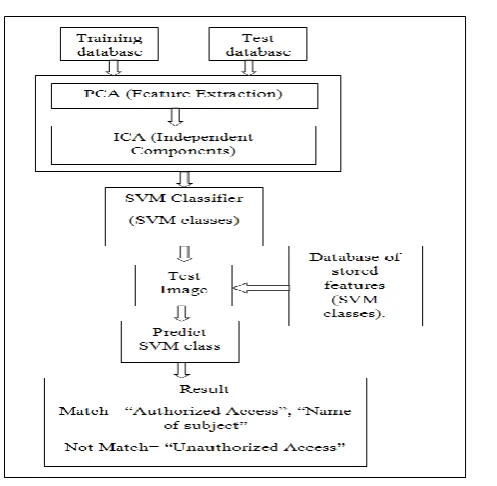
these independent components into different classes.These classes are labeled. Thus these components are used to train the SVM classifier. The more variety of images we will provide to SVM stronger the classifier will become. The proposed system uses multiclass SVM for classification. When a test image is given as input to the system, the system recognizes the face and predicts its class using SVM. If the given test image belongs to the database available, the system displays “Authorized Access” otherwise displays “Unauthorized Access”. Strong classifier can increase accuracy of the system. Accuracy of the system is shown by confusion matrix. A confusion matrix is a table mostlyused to describe the performance of a classification model or classifier. The performance of classifier is described on a set of test data for which the true values are known.
The performance measures can be obtained from the predicted labels and true labels, as a post-processing step:
1. Precision = TP / (TP+FP)
2. Recall = TP / (TP+FN)
3. Accuracy = (TP + TN) / (TP + TN + FP + FN)
Where TP, FP, TN, FN are number of true positives, false positives, true negatives and false negatives, respectively.
6. BLOCK DIAGRAM AND FLOWCHART
[image:3.595.321.541.112.478.2]6.1 Block diagram
Figure 1: Block diagram of proposed system
[image:3.595.37.286.497.740.2]6.2. Flowchart
Figure 2: Block diagram of proposed face recognition system using ICA and SVM.
7. TECHNIQUES
The techniques used in proposed system are PCA and ICA. These techniques are used for feature extraction. SVM classifier is used for classification and recognition.
7.1. Principal Component Analysis
© 2016, IRJET | Impact Factor value: 4.45 | ISO 9001:2008 Certified Journal
| Page 497
components. Each principal component is a linearcombination of the original variables and all the principal components are orthogonal to each other, so there is no redundant information. The principal components as a whole form an orthogonal basis for the space of the data.
Let us consider the face images Ii of size m by n. Then we convert the image matrix into a vector of size m x n. The training set of N faces can be written as I = (I1, I2,… , IN) and the average image ‘A’ is found by equation (1)
∑
(1)
The vector Yi = Ii – A is the difference image of each face image. The face images have been centred. The covariance matrix ‘C’ is obtained from the difference image as given equation (2)
∑ (2)
The eigenvectors of the covariance matrix are calculated.
The eigenvectors Vi and eigenvalues λi of the covariance
matrix are related as given in equation(3)
(3)
The calculated eigenvectors are then sorted. After feature extraction using PCA the next step is classification which uses Euclidean Distance for comparing/matching of the test and trained images.
Calculate the Euclidean distance between the testing image and the reconstructed image. The minimum distance gives the best match. The straight line distance between two points is called as Euclidean distance. The distance between a test face T and the training feature vectors V is given by equation (4),
√ (4)
The eigenvector which is associated with the largest eigenvalue reflects the greatest variance in the image. And the smallest eigenvalue is associated with the eigenvector that finds the least variance.
7.2. Independent Component Analysis
Independent Component Analysis is a strong technique to separate independent sources from mixed sources. ICA separates a multivariate signal into subcomponents. It reduces both second-order and higher-order dependencies in the input data. ICA tries to find the basis along which the data are statistically independent [3]. The difference between ICA and other methods is that ICA looks for components that are both statistically independent and non Gaussian [11, 13]. The ICA defines a productive model to extract some unknown hidden variables from a linear mixture of them.
Usually the observed multivariate data is given by a huge database of samples. In ICA the data variables are assumed to be the linear mixture of unknown latent variables. The mixing system is also unknown. The latent variables are supposed to be mutually independent and non Gaussian. The latent variables are i.e. hidden components are called the independent components of the observed data. The independent components are also called as sources or factors and can be found by the ICA. ICA is powerful technique than PCA.
The problem can be defined as the following model given in equation (5).
=
, i = 1, 2.., N (5)
The above equation (5) can also be expressed in matrix as shown in equation (6):
X = AS (6)
Where A represents the unknown mixing system and S corresponds to the voice signal source.
The ICA can give us the estimation of X. Thus, it can recover the voice samples using a separate system as long as exists. S can be represented in form of matrix as shown in equation (7)
(7)
© 2016, IRJET | Impact Factor value: 4.45 | ISO 9001:2008 Certified Journal
| Page 498
7.3. Support Vector Machine
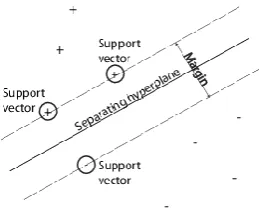
Support Vector Machine is one of a popular supervised learning method. SVM method analyzes data and recognize pattern. SVM is based on the concept of decision planes. These decision planes define decision boundaries. SVM is primarily a method that performs classification task. SVM performs classification by constructing hyper planes in a multidimensional space. This hyperplane separates data in different classes and label them. Support Vectors increase the distance or margin between the hyper plane and the closest points. Suppose some data points are given, each belongs to one of the two classes. The goal of SVM is to decide in which class the new data point will be in. A SVM classifies data by finding the best hyperplane. The hyperplane is said to be best when it separates all data points of one class from those of the other class. The best hyperplane for an SVM has the largest margin between the two classes. Margin means the maximum width of the block parallel to the hyperplane that has no interior data points as shown in the Figure 3. The support vectors are the data points that are closest to the separating hyperplane. These points are on the boundary of the block [11, 13]
[image:5.595.57.187.430.536.2]The following figure illustrates these definitions, with + indicating data points of type 1, and – indicating data points of type –1.
Figure 3: Support Vector Machine
There are two types of approaches in which SVM can be used i.e. one vs. one and one vs. all. In this paper one vs. all approach is used. SVM training algorithm builds a model that estimates whether input given falls into one category or the other. SVM estimates the support vectors through concluding a hyperplane. Support Vectors increase the distance or margin between the hyperplane and the closest points.
Suppose a set of N points and Xi ∈ Rn, i=1, 2, 3,.. , N. Each point belongs to one of the two classes i.e.Yi ∈ {−1,1} , it is given by equation (8).
( ) ∑ (8)
This quadratic equation f(x) decides the classification of a new point data in the above equation. The new data will fall in any one class.
The below table 1 shows comparison between the techniques used for face recognition [11].
Table 1: Comparison of PCA and ICA.
8. CONCLUSION
The aim of this paper is to overcome problems occurred in the normal face recognition system like improper alignment, illumination, and different poses. It is possible to overcome the problem using Independent Component Analysis technique and Support Vector Machine classifier. The proposed system uses PCA and ICA with SVM to enhance the performance of face recognition system. The performance is increased in terms of accuracy shown my confusion matrix. By using ICA it is possible to increase the efficiency of proposed system and reduce the drawbacks of the existing system. It is difficult to get accurate recognition of face due to different face expressions, poses and also some effect present due to distance of face from camera. But overall it is possible to recognize the face very effectively using ICA.
ACKNOWLEDGEMENT
First of all I would like to thank my guide and HOD Prof. Uday Bhave and my Co-guide Asst Prof.Manimala Mahato for helping me and providing valuable insight to the project work throughout the completion of the project. I would like to thank my principal for showing faith in me to complete my project.
REFERENCES
[1] Sirovich, Lawrence, and Michael Kirby. "Low-dimensional procedure for the characterization of human faces." Josa a 4.3 :519-524, 1987.
[2] Jain, Anil K., and Richard C. Dubes, “Algorithms for clustering data” Prentice-Hall, Inc., 1988.
Techniques Memory
usage Recognition Rate Data Representation
PCA High Better Than
Eigen and Fisherface.
Powerful Data Representation.
ICA Moderate Better Than
© 2016, IRJET | Impact Factor value: 4.45 | ISO 9001:2008 Certified Journal
| Page 499
[3] K. Fukunaga, “Introduction to Statistical PatternRecognition”, second ed. Boston, MA: Academic Press, 1990.
[4] M. Turk and A. Pentland, "Face Recognition Using Eigen faces," in Proceedings of the IEEE Conference on Computer Vision and Pattern Recognition, pp.586-591, 1991[4].
[5] M. Turk and A. Pentland, "Eigen faces For Recognition," Journal of Cognitive Neuroscience, Vol.3, pp.71-86, 1991[5].
[6] P. N. Belhumeur, J. P. Hespanha, and D. J. Kriegman, "Eigen faces vs. Fisher faces: Recognition using class specific linear projection," IEEE Transactions on Pattern Analysis and Machine Intelligence, Vol.19, pp.711-720, 1997[6].
[7] Comon, Pierre, "Independent component analysis, a new concept?" Signal processing 36.3 (1994): 287-314.
[8] Dandpat, Swarup Kumar, and Sukadev Meher. "Performance improvement for face recognition using PCA and two-dimensional PCA." Computer Communication and Informatics (ICCCI), 2013 International Conference on, IEEE, 2013.
[9] ORL database: http://www.camorl.co.uk.
[10] Jafri, Rabia, and Hamid R. Arabnia. "A Survey of Face Recognition Techniques." JIPS 5.2 (2009): 41-68.
[11] Rakesh Saini, Abhishek Saini, Deepak Agarwal, “Analysis of Different Face Recognition Algorithms”, IJERT, November-2014.
[12] Bartlett, Marian Stewart, Javier R. Movellan, and Terrence J. Sejnowski. "Face recognition by independent component analysis." Neural Networks, IEEE Transactions on 13.6 (2002): 1450-1464.
[13] Zhang, Jia Jun, and Yu Ting Shi. "Face recognition systems based on independent component analysis and support vector machine." Audio, Language and Image Processing (ICALIP), 2014 International Conference on, IEEE, 2014.