© 2016, IRJET | Impact Factor value: 4.45 | ISO 9001:2008 Certified Journal | Page 758
A Review on Recent Trends on Parametric Optimization in WEDM
Joshi Guruprasad R.
1, A. N. Chapgaon
21
Research Scholar, Dept. of Mechanical Engg., AMGOI, Kolhapur, Maharashtra, India
2Professor and PG Head Studies, Dept. of Mechanical Engg., AMGOI, Kolhapur, Maharashtra, India
---***---Abstract
– The WEDM process is the most popular and aninevitable non-conventional machining process used for the machining of hard and difficult-to-cut material such as tungsten carbide and its composites. The most important goals of WEDM are to achieve a higher productivity, accuracy and reliability. Due to a large number of variables and improper combination of process parameters, the optimal performance of WEDM processes is very difficult to achieve. This goal can be achieved by determining the relationship between the process parameters and response variables of the WEDM process and selecting the optimum process parameters. Researchers have used different analytical and statistical Design of Experiment (DOE) methods to select best combination of process parameters for determining the most significant/optimum process parameter. In view of above, this paper presents a review of current research work on parametric optimization in Wire cut EDM.
Keywords: WEDM, Process Parameters, Response Variables,
Optimization, DOE, difficult-to-cut material, etc…..
1. INTRODUCTION
Research in advanced engineering materials has opened new opportunities for the manufacturing sector. The materials such as tungsten carbide and its composites, titanium based alloys and other superalloys – have been developed to meet the extreme demands in aerospace, turbine, automobile, tool and die manufacturing sector. The traditional metal cutting processes utilizes shearing action on the work piece for material removal during machining. The properties such as high hardness, toughness, corrosion resistant have made these materials difficult-to-cut using traditional metal cutting processes. Since these difficult-to-cut materials possess excellent mechanical properties which can be useful in many important applications, machining of them can open up opportunities of utilizing them widely. Therefore, the machining of difficult-to-cut materials is a critical issue for the industries in the field of manufacturing [1-5]. Nowadays innovative research and developments in the area of non-traditional machining processes such as Wire Electro-Discharge Machining (WEDM) process are considered as alternative replacements for conventional machining methods of metal working. WEDM has the capability of machining the intricate features of hard and difficult-to-cut materials such as tungsten carbide with high dimensional accuracy which has made WEDM process the most popular and an inevitable non-conventional machining
process [1,2]. Both EDM and micro-EDM processes in recent years have been extensively used in the field of mould making, production of dies and cavities etc. for aerospace, nuclear, missile, turbine, automobile, tool and die making industries where accuracy in the range of ±2μm to ±3μm is maintained.
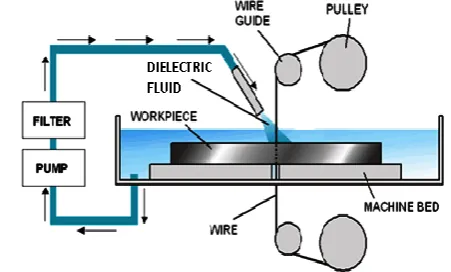
WEDM was first introduced in the late 1960’s to manufacturing sector. WEDM as shown in Fig-1 [15] is a thermal-based process in which the spark is generated between workpiece and tool i.e., conductive wire (usually brass wire).
Fig -1: WEDM Setup
The workpiece and tool electrode are connected in an electrical circuit and high frequency DC pulses are discharged from the wire tool to the work piece. Material removal takes place due to rapid and repetitive spark discharges (more than thousand times per second) between workpiece and tool electrode [3-5]. The gap of 0.025 to 0.075 mm is continuously maintained between the wire and workpiece using servo controlled mechanism [15]. Liquid dielectric medium usually deionized water is continuously passed in the gap provided between the wire and workpiece which also act as a coolant. The wire is continuously fed during machining process. Huge amount of heat is generated (about 10,000 OC) due to sparking, which is sufficient to melt
[image:1.595.317.543.338.474.2]© 2016, IRJET | Impact Factor value: 4.45 | ISO 9001:2008 Certified Journal | Page 759
2. RELEVANCE
Every machine tool consists of two types of parameters such as process parameters i.e., input parameters and response variables i.e., output parameters. The process parameters of WEDM such as peak current (Ip), gap voltage (V), pulse on time (Ton), pulse off time (Ton), polarity, wire feed rate, work feed rate, rate of flushing, type of electrode material, type of work piece material and type of dielectric fluid etc. seriously affects the response variables like material removal rate (MRR), surface roughness (Ra), kerf width (KW), wire wear rate (WWR), cutting rate, dimensional deviation, hardness, surface integrity etc. during machining. The most important goals of WEDM are to achieve a higher productivity (i.e., MRR) and accuracy (i.e., Ra, KW) and reliability. Due to a large number of variables and improper combination of process parameters, the optimal performance of WEDM processes is very difficult to achieve. This goal can be achieved by determining the relationship between the process parameters and response variables of the WEDM process and selecting the optimum process parameters [3-5].
3. EFFECT AND OPTIMIZATION OF WEDM
3.1 Design of Experiments (DOE)
In the recent years numerous studies have reported an investigation on parametric optimization of WEDM process using various Design of Experiments (DOE) techniques. During these studies a variety of process parameters such as peak current, gap voltage, pulse on time, pulse off time, polarity and wire feed rate etc. have been optimized by investigating there effect on response variables such as MRR, Ra, KW, cutting rate, WWR and dimensional deviation etc. through controlled experiments [1-5].
3.2 Different DOE Techniques
Researchers have used different analytical and statistical DOE methods to analyze different combinations of process parameters to determine the most significant/optimum process parameter. Some of the important and extensively used methods by researchers in industry are Taguchi’s orthogonal array method, Regression Analysis Method, Particle Swarm Optimization (PSO), Response Surface Methodology (RSM), Central Composite Design (CCD), Grey Relational Analysis (GRA), Feasible-Direction Algorithm, Genetic Algorithm, Fuzzy clustering, Artificial Neural Network (ANN), SA algorithm, Pareto, Artificial Bee Colony (ABC), Tabu-Search Algorithm, Principle Component Method and Grey-Fuzzy Logic etc [3-5].
3.3 Effect of Process Parameters on Response
variables
Most of the study reveals that, pulse-on-time is the most influential factor for all the response variables such as MRR, Ra, and KW. Peak current with higher pulse off time was observed to be next significant parameter for KW and dimensional deviation, whereas for MRR and Ra servo voltage was observed to be the next significant parameter. The value of kerf width decreases with decrease in pulse-off time and wire feed rate. It can be observed in literature review. The literature review reveals about the effect of single and multi process parameters on different response variables in WEDM.
4. LITERATURE REVIEW
K. P. Rajurkar et al. [1] reviewed the two major electro-machining processes with unique capabilities i.e., the Electrochemical Machining (ECM) and Electro-Discharge Machining (EDM) processes. The study reveals that, both the machining processes i.e., EDM and ECM offer a better and the only alternative in machining of difficult to machine materials. The technological and economical comparison of rough milling operation of titanium and nickel based alloys reveals that, depending on the geometry, ECM is as good as in machining titanium alloy. For smaller batch sizes EDM has been found to be a better choice, whereas for large scale production ECM is more suitable choice.
M. P. Jahan et al. [2] evaluated both the electrodischarge machining (EDM) process and Micro-EDM. The study reveals that, EDM has the capability of machining hard and difficult-to- cut material such as tungsten carbide and its composites with high dimensional accuracy and intricate features which has made EDM process most popular and an inevitable non-conventional machining process. Both EDM and micro-EDM processes in recent years are used extensively in the fields such as mould making, production of dies and cavities. The study reveals about current research trends in EDM and micro-EDM of tungsten carbide, there problems and challenges and the importance of compound and hybrid machining processes.
Vijay D. Patel et al. [3] studied the various research works involving the optimization of the different process parameters and their effect on machining performance and productivity for titanium alloy (Ti6Al4V). The effect of various WEDM process parameters like pulse on time, pulse off time, servo voltage, peak current, dielectric flow rate, wire speed, wire tension on different process response parameters like material removal rate, surface roughness, Kerf, wire wear ratio and surface integrity factors have been revealed in this paper.
© 2016, IRJET | Impact Factor value: 4.45 | ISO 9001:2008 Certified Journal | Page 760 Vikram Singh et al. [5] reported several approaches in
Electrical Discharge Machining (EDM). The study reveals that the performance variables such as MRR, tool wear rate (TWR), relative wear ratio (RWR) and SR are important to evaluate the performance. The EDM machining process parameters like discharge current, pulse on time, pulse off time mainly affects the performance variables. Many researchers have reported the measurement of EDM performance on the basis of MRR, TWR, RWR, and SR for various materials.
U. A. Dabade et al. [6] made an attempt to analyze the machining conditions for MRR, SR, cutting width (kerf) and dimensional deviation during WEDM of Inconel 718 using L8 orthogonal array Taguchi method. The result of the study reveals that, pulse-on-time is the most influential factor for all the response variables such as MRR, SR, Kerf. Peak current was observed to be next significant parameter for kerf and dimensional deviation whereas for MRR and SR, servo voltage was observed to be the next significant parameter.
Bijaya Bijeta Nayak et al. [7] carried out an experimental investigation during taper cutting of deep cryo-treated Inconel 718 for optimization of six input parameters such as part thickness, taper angle, pulse duration, discharge current, wire speed and wire tension and three output parameters such as angular error, surface roughness and cutting speed in WEDM process using Taguchi method and Artificial Neural Network (ANN). The result of the study reveals that, increase of part thickness causes decrease in angular error. Surface roughness initially increases with increase of thickness of work piece and then decreases however, increase of pulse duration and discharge current causes an increase in surface roughness.
Pujari Srinivasa Rao et al. [8] presented an investigation on a parametric analysis of wire EDM parameters for residual stresses in the machining of aluminum 2014 T6 alloy using L8 orthogonal array Taguchi method by considering input parameters viz., pulse on time (Ton), peak current (Ip) and spark gap voltage (Sv). The result of the study reveals that, the surface roughness and cutting speed increases with increase of pulse on time and peak current. The surface roughness decreases with the increase of spark gap voltage. The spark gap voltage with pulse on time and peak current had a significant effect on the residual stresses. The value of residual stress and surface roughness increases with an increase in cutting speed.
H. Dong et al. [9] investigated the compound machining (CM) compounded with electrical discharge machining (EDM) and arc machining for Inconel718 material. Various machining parameters affecting MRR and diameter of overcut (DOC) such as peak current, electrode rotation speed and peak voltage were analyzed using Response Surface Method (RSM). The result of the study reveals that, MRR gradually increases with the increase of electrode rotation speed when the peak voltage remains a large value. MRR and DOC significantly increase with the increase of peak current. The DOC decreases and then increases with the increase of peak
voltage regardless of peak current and it decreases with the increase of electrode rotation speed.
Mohammad Antar et al. [10] studied high speed hole drilling (Ø 0.8mm) of nickel based aerospace alloy (5-10mm thick) with EDM and laser drilling machines on basis of drilling speed, recast layer thickness and hole taper. EDM showed better results with regards to recast layer (10-15μm compared to ~80μm for laser) and geometric accuracy / taper particularly for thicker samples. Laser drilling, however, was far superior in terms of speed with less than 3 second drilling time for 10mm thick samples compared to 48 second best recorded EDM drilling time.
Feng Yerui et al. [11] examined EDM process parameters using TiC/Ni metal ceramic material for the influence of peak current, pulse duration on the surface roughness, MRR and material removal mode (MRD). Experimental result indicates that the surface roughness and material removal rate increases gradually with the increase of peak current also, the surface roughness and MRR of the workpiece increases with the increase of pulse duration. The change of pulse duration has little effect on the MRD.
Sreenivasa Rao M. et al. [12] used Nimonic-263 alloy for the effect of WEDM process parameters such as pulse on time, pulse off time, peak current and servo voltage on MRR, SR using RSM and Particle Swarm Optimization (PSO). The significance of process parameters have been estimated using ANOVA. The result of the study reveals that, higher pulse on time, peak current and interaction between them are significant for higher MRR. At higher values of servo voltage, the gap between workpiece and wire becomes wider and it decreases the number of sparks, stabilizes electric discharge yielding better surface finish.
Giovanna Gautier et al. [13] evaluated the interactions between common process parameters of WEDM and final quality of the generated surface, through analysis of variance (ANOVA) and regression models based on experimental results. The paper focuses on the effects of Ton, Toff, SV and wire tension (WT) on the surface finish (Ra) during the WEDM of a Gamma-TiAl alloy. Analysis of results shows that, the factors Ton, SV and WT show significant effect on Ra. In particular, lower levels of Ton and WT give maximum Ra and the lowest value of SV gives the minimum Ra.
Fabrizia Caiazzo et al. [14] conducted the study on electrical discharge machining for Renè 108 DS using two electrode materials, graphite (Poco EDM-3) and copper-infiltrated-graphite (Poco EDM-C3) using current, voltage, duty cycle and electrode polarity. The process is discussed in terms of MRR, TWR, wear ratio and final surface roughness of the work-piece. The result of the study reveals that, an increase in discharge voltage increases both MRR and TWR. The tool is suggested to be made anode in order to reduce the wear ratio also, the lowest wear ratio is possible by using graphite with low level of discharge current and high level for discharge voltage and better surface finish result from extended pulse-off time with reduced duty cycle.
© 2016, IRJET | Impact Factor value: 4.45 | ISO 9001:2008 Certified Journal | Page 761 machining (WEDM) using Taguchi method. Pure titanium as
work material and two different types of wire electrodes (uncoated, zinc coated) were used for experimentation. The effect of key process parameters such as wire type, Ton, Toff, Ip, WF, SV and wire offset (Woff) were investigated on MRR, surface roughness and wire weight consumption (eroded weight of wire after machining) in WEDM. The result of the study reveals that, two parameters (Toff, Woff) are highly significant for MRR in trim cut operation in WEDM. Shailesh Dewangan et al. [16] applied grey-fuzzy logic-based hybrid optimization technique to determine the optimal settings of EDM process parameters like Ip, Ton, tool-work time (Tw) and tool-lift time (Tup) for AISI P20 tool steel to improve surface integrity aspect using RSM considering the white layer thickness (WLT), surface crack density (SCD) and SR as response variables. The result of the study reveals that, for multiple performance characteristics of surface integrity Ton is the most contributing parameter followed by Ip, whereas tool work time and tool lift time do not significantly affect the surface integrity.
Neeraj Sharma et al. [17] presented the research work, which deals with the effect of Ton, Toff, Ip, WT and SV on the overcut while machining the HSLA steel on WEDM using Response Surface Methodology (RSM) and Genetic Algorithm (GA) to find out the optimum machining parameters. The result of the study reveals that, the overcut slightly decreases with the increase of Ip and SV. The overcut decreases due to decrease in the discharge energy and it increases with increase in the WT.
J. Udaya Prakash et al. [18] worked on optimization of the wire electrical discharge machining (WEDM) process parameters for AISI H13 tool steel using the Grey Relational Analysis (GRA). In this study, the input machining parameters such as gap voltage, pulse on time, pulse off time and wire feed are optimized with considerations of material removal rate, surface roughness and cutting width (kerf) as output parameters. The optimal levels of machining parameters were selected from response table and response graph from the grey relational grade. The result of the study reveals that, the optimum values of output parameters are gap voltage 30V, pulse on time 7μs, pulse off time 3μs and wire feed 8mm/min.
Balram Jakhar et al. [19] evaluated the effect of input parameters such as taper angle, peak current, pulse-on time, pulse-off time and dielectric flow rate on surface roughness and cutting speed in WEDM machine for Inconel 600 using Taguchi method. The result of the study reveals that, as the value of peak current and pulse on time increases cutting speed increases but, it is constrained when better surface finish is required. Larger value of taper angle increases cutting speed up to limited extent.
Rupesh Chalisgaonkar et al. [20] conducted this research in which input parameters such as Ton, Toff, Ip, WF, WT and SV for process capability investigation in WEDM process of commercially pure titanium using Taguchi method. The process capability index was evaluated for machining characteristics such as machined work-piece dimension
(MWD) and SR. The result of the study reveals that, higher amount of pulse on time increases melting and evaporation of work piece material. The increment of pulse off time and increased spark gap voltage results in decrement of the effective pulse discharge energy.
Vikram Singh et al. [21] used AISI D2 steel for the effects of various WEDM process parameters such as pulse on time, pulse off time, servo voltage and wire feed rate on the MRR, SR and cutting rate using Taguchi L27 orthogonal array and RSM. The result of the study reveals that, the Cutting rate and MRR is mainly affected by pulse on time and pulse off time. The SR was mainly affected by pulse on time.
M. Dastagiri et al. [22] investigated Stainless Steel and En41b for the influence of four design factors current (I), voltage (V), Ton and duty factor (ƞ) in EDM process over machining specifications such as MRR, TWR, Ra and HR. The result of the study reveals that, more MRR is achieved as the peak current and discharge power increases. At 50% duty factor more MRR is achieved irrespective of the other conditions. Investigation shows that depth of crater increases with pulse duration.
Kaushik Kumar et al. [23] studied the effect of the various input process parameters like pulse on time, pulse off time, discharge current and voltage over the SR for an EN41 material in EDM. The five different output parameters concerned with surface roughness like Ra, Rq, Rsk, Rku and Rsm are taken and optimized using the Grey-Taguchi method. The result of the study reveals that, the current had larger impact over the surface roughness value, followed by the voltage.
Brajesh Kumar Lodhi et al. [24] optimized the machining parameters such as of pulse-on-time, pulse-off-time and peak current in WEDM for surface roughness using (L9 Orthogonal Array) Taguchi methodology for AISI D3 Steel. The result of the study reveals that, the discharge current was the most influential factors on the surface roughness also, the pulse on time and current have influenced more than the other parameters.
Kaushik Kumar et al. [25] compared the MRR for EN19 and EN41 material in a die sinking EDM machine using various input factors like pulse on time, pulse off time, discharge current and voltage using Taguchi method. The result of the study reveals that, the discharge current had a larger impact as compared to other processing parameters on the MRR. It was found that current followed by the pulse-off time and voltage had larger impact over the MRR.
G. Ugrasen et al. [26] examined WEDM machining parameters namely pulse-on, pulse-off, current, and bed speed for accuracy, surface roughness, volumetric material removal rate using the L16 orthogonal array Taguchi’s technique for Stavax material. The result of the study reveals that, current has larger effect on the surface roughness, volumetric MRR and accuracy.
© 2016, IRJET | Impact Factor value: 4.45 | ISO 9001:2008 Certified Journal | Page 762 process using Taguchi method. The result of the study
reveals that, higher pulse-on time setting leads to thicker recast layer. At lower value of pulse-on time and at higher value of pulse-off time, the wire deposition on the machined surface is low. The material removal rate increases when the pulse-on time, peak current and wire tension were increased. The Increase in the pulse duration time increases the WWR, whereas increasing the wire speed decreases the WWR.
Bijaya Bijeta Nayak et al. [28] used Austenitic Stainless Steel 304 for multi response optimization approach to determine the optimal process parameters in WEDM during taper cutting operation using Taguchi’s L27 orthogonal array and Analytical Hierarchy Process (AHP) and utility theory. Six input parameters such as part thickness, taper angle, pulse duration, discharge current, wire speed and wire tension are used for obtaining the responses like angular error, surface roughness, and cutting speed. It is evident that part thickness, taper angle, pulse duration, discharger current are the significant parameters for overall utility index value. Milan Kumar Das et al. [29] found out the combination of process parameters such as pulse on time, pulse off time, discharge current and voltage for optimum SR and MRR in EDM for EN31 tool steel using Artificial Bee Colony (ABC) algorithm and RSM. It has been observed that SR and MRR increases with an increase in current and pulse on time. J. B. Saedon et al. [30] examined the effects of the process parameters such as pulse-off time, peak current, wire feed and wire tension on different responses such as surface roughness (Ra), cutting rate and MRR for Titanium alloy in WEDM using Taguchi method and GRA. The result of the study reveals that, pulse-off time is the most significant machining parameter that affects the multiple performance characteristics, followed by other factors i.e., peak current, wire feed and wire tension.
D. Sudhakara et al. [31] investigated the effect of wire electrical discharge machine (WEDM) process parameters such as pulse on time, pulse off time, servo voltage, peak current, wire tension and water pressure for normal surface roughness (Ra) while machining the VANADIS 4e using Taguchi L27 orthogonal array method. The result of the study reveals that the surface roughness increases with increase in pulse on time and peak current and decreases with pulse off time, spark gap set voltage and wire tension. S. Assarzadeh et al. [32] optimized process parameters viz., discharge current, pulse-on time, duty cycle, and gap voltage in terms of MRR, TWR and Ra for tungsten carbide-cobalt composite (Iso grade: K10) using RSM in EDM. The result of the study reveals that, the MRR increases by selecting both higher discharge current and duty cycle. The TWR can be minimised by applying longer pulse on-time with lower current intensities while smoother work surfaces are attainable with small pulse durations with higher levels of discharge currents.
Probir Saha et al. [33] proposed a Neuro-Genetic technique to optimize the multi-response of WEDM process for 5 vol.% titanium carbide (TiC) reinforced austenitic manganese steel
metal matrix composite (MMC). Four independent input parameters, viz., Ton, Toff, Vg and Wf were selected to assess the EDM process performance in terms cutting speed (mm/min), Kerf width (mm). The result of the study reveals that, cutting speed decreases with the increase in average gap. Maximum cutting speed was obtained at a gap voltage of 50V. It was observed that, cutting speed increases with the increase in pulse on time within the range and kerf width increases with the increase of pulse on-time and gap voltage. Nixon Kuruvila et al. [34] studied the parametric influence and optimum process parameters for dimensional error (DE), SR and VMRR for Hot Die Steel (HDS) in WEDM using Taguchi technique and GA. The pulse-on duration, current, pulse-off duration, bed-speed and flushing rate have been considered as the important input parameters. The result of the study reveals that, regarding pulse-on duration, higher values are recommended for error constrained machining with higher MRR and constrained/limited values are recommended for attaining good surface texture. Smaller current is suggested for better surface finish/texture control, medium range for error control and high value for MRR. D. Bhaduri et al. [35] explained the effects of EDM process parameters such as Ton, Ip, duty cycle (t) and Vg on MRR, EWR, radial overcut and taper angle while machining TiN– Al2O3 composite through Taguchi L9 orthogonal array method. The study indicates that EDM has a good potential in machining of TiN–Al2O3 ceramic composite. The result of the study reveals that, Ip and Vg have the maximum effect on MRR. Vg has the maximum effect on EWR, and Ton also has some influence on it, whereas Ip and duty cycle have less effect on EWR.
5. CONCLUSIONS
© 2016, IRJET | Impact Factor value: 4.45 | ISO 9001:2008 Certified Journal | Page 763
ACKNOWLEDGEMENT
The authors would like to thank the management of AMGOI, Kolhapur, India for extending the help in preparation of this review paper.
REFERENCES
[1] K. P. Rajurkar, M. M. Sundaram, A. P. Malshe, “Review of Electrochemical and Electrodischarge Machining”, The Seventeenth CIRP Conference on Electro Physical and Chemical Machining, Procedia CIRP 6 ( 2013), pp.13-26. [2] M. P. Jahan, M. Rahman, Y. S. Wong, “A review on the conventional and micro-electrodischarge machining of tungsten carbide”, International Journal of Machine Tools & Manufacture, 51 (2011), pp. 837–858.
[3] Vijay D. Patel, Dr. D. M. Patel, Prof. U. J. Patel, Biraj Patel, Nilesh Butani, “Review of Wire-Cut EDM Process on Titanium alloy”, Int. Journal of Engineering Research and Applications, Vol. 4, Issue 12( Part 5), December 2014, pp.112-121.
[4] Naveen Kumar, Navdeep Malhotra, S.K. Sharma, “Review on Current Research Work in Wire Electrical Discharge Machining”, International Journal of Advance Research and Innovation, Volume 3, Issue 1 (2015), pp. 68-76. [5] Vikram Singh, S. K. Pradhan, “Optimization of EDM
Process Parameters: A Review”, International Journal of Emerging Technology and Advanced Engineering, Volume 4, Issue 3, March 2014, pp. 345-355.
[6] U. A. Dabade, S. S. Karidkar, “Analysis of response variables in WEDM of Inconel 718 using Taguchi technique”, 48th CIRP Conference on MANUFACTURING SYSTEMS, Procedia CIRP 41 (2016), pp. 886 – 891. [7] Bijaya Bijeta Nayak, Siba Sankar Mahapatra,
“Optimization of WEDM process parameters using deep cryo-treated Inconel 718 as work material”, Engineering Science and Technology, an International Journal, 19 (2016), pp. 161–170.
[8] Pujari Srinivasa Rao, Koona Ramji, Beela Satyanarayana, “Effect of wire EDM conditions on generation of residual stresses in machining of aluminum 2014 T6 alloy”, Alexandria Engineering Journal, 55 (2016), pp. 1077-1084.
[9] H. Dong, Y. Liu, Y. Shen, X. Wang., “Optimizing Machining Parameters of Compound Machining of Inconel 718”, 18th CIRP Conference on Electro Physical and Chemical Machining, Procedia CIRP 42 (2016), pp. 51 – 56. [10] Mohammad Antar, Dimitrios Chantzis, Sundar
Marimuthu, Philip Hayward, “High Speed EDM and Laser Drilling of Aerospace Alloys”, 18th CIRP Conference on Electro Physical and Chemical Machining, Procedia CIRP 42 (2016), pp. 526 – 531.
[11] Feng Yerui, Guo Yongfeng, Li Zongfeng, “Experimental Investigation of EDM Parameters for TiC/Ni Cermet Machining”, 18th CIRP Conference on Electro Physical and Chemical Machining, Procedia CIRP 42 (2016), pp. 18 – 22.
[12] Sreenivasa Rao M., Venkaiah N, “Parametric optimization in machining of Nimonic-263 alloy using RSM and particle swarm optimization”, 2nd International Conference on Nanomaterials and Technologies, Procedia Materials Science 10 (2015), pp. 70 – 79.
[13] Giovanna Gautier, Paolo C. Priarone, Stefania Rizzuti, Luca Settineri, Vincenzo Tebaldo, “A contribution on the modelling of wire electrical discharge machining of a Gamma-TiAl alloy”, 15th CIRP Conference on Modelling of Machining Operations, Procedia CIRP 31 (2015 ), pp. 203–208.
[14] Fabrizia Caiazzo, Luigi Cuccaro, Ilaria Fierro, Giuseppe Petrone, Vittorio Alfieri, “Electrical discharge machining of Rene 108 DS nickel superalloy for aerospace turbine blades”, 9th CIRP Conference on Intelligent Computation in Manufacturing Engineering, Procedia CIRP 33 (2015), pp. 382–387.
[15] Rupesh Chalisgaonkar, Jatinder Kumar, “Multi-response optimization and modeling of trim cut WEDM operation of commercially pure titanium (CPTi) considering multiple user's preferences”, Engineering Science and Technology, an International Journal, 18 (2015), pp. 125-134.
[16] Shailesh Dewangan, Soumya Gangopadhyay, Chandan Kumar Biswas, “Multi-response optimization of surface integrity characteristics of EDM process using grey-fuzzy logic-based hybrid approach”, Engineering Science and Technology, an International Journal, 18 (2015), pp. 361-368.
[17] Neeraj Sharma, Rajesh Khanna, Rahul Dev Gupta, “WEDM process variables investigation for HSLA by response surface methodology and genetic Algorithm”, Engineering Science and Technology, an International Journal, 18 (2015), pp. 171-177.
[18] J.Udaya Prakash, R.Ramkumar,T.V.Moorthy, S.Anburose, “Parametric Optimization of Wire-Edm on AISI H13 tool Steel”, International Journal of Applied Engineering Research, Vol. 10 No.68 (2015), pp. 472-475.
[19] Balram Jakhar, Puneet Katyal, Vishal Gulati, “Investigating the Process Parameters for optimization on Inconel 600 using wire cut EDM”, International Journal of Advance Research and Innovation, Volume 3, Issue 3 (2015), pp. 508-513.
[20] Rupesh Chalisgaonkar, Jatinder Kumar, “Process capability analysis and optimization in WEDM of commercially pure titanium”, 12th GLOBAL CONGRESS ON MANUFACTURING AND MANAGEMENT, Procedia Engineering 97 (2014), pp. 758–766.
[21] Vikram Singh, S.K. Pradhan, “Optimization of WEDM parameters using Taguchi technique and Response Surface Methodology in machining of AISI D2 Steel”, 12th GLOBAL CONGRESS ON MANUFACTURING AND MANAGEMENT, Procedia Engineering 97 (2014), pp. 1597–1608.
© 2016, IRJET | Impact Factor value: 4.45 | ISO 9001:2008 Certified Journal | Page 764 En41b”, 12th GLOBAL CONGRESS ON MANUFACTURING
AND MANAGEMENT, Procedia Engineering 97 (2014), pp. 1551–1564.
[23] Vikas, Apurba Kumar Roy, Kaushik Kumar, “Effect and Optimization of various Machine Process Parameters on the Surface Roughness in EDM for an EN41 Material using Grey-Taguchi”, 3rd International Conference on Materials Processing and Characterization, Procedia Materials Science 6 ( 2014), pp. 383–390.
[24] Brajesh Kumar Lodhi, Sanjay Agarwal, “Optimization of machining parameters in WEDM of AISI D3 Steel using Taguchi Technique”, 6th CIRP International Conference on High Performance Cutting, Procedia CIRP 14 (2014), pp. 194–199.
[25] Vikas, Shashikant, A.K. Roy and Kaushik Kumar, “Effect and Optimization of Machine Process Parameters on MRR for EN19 & EN41 materials using Taguchi”, 2nd International Conference on Innovations in Automation and Mechatronics Engineering, Procedia Technology 14 (2014), pp. 204–210.
[26] G.Ugrasen, H.V. Ravindra, G.V. Naveen Prakash, R. Keshavamurthy, “Process optimization and estimation of machining performances using artificial neural network in wire EDM”, 3rd International Conference on Materials Processing and Characterization, Procedia Materials Science 6 (2014), pp. 1752–1760.
[27] Amitesh Goswami, Jatinder Kumar, “Investigation of surface integrity, material removal rate and wire wear ratio for WEDM of Nimonic 80A alloy using GRA and Taguchi method”, Engineering Science and Technology, an International Journal, 17 (2014), pp. 173-184. [28] Bijaya Bijeta Nayak, Siba Sankar Mahapatra, “A Utility
Concept Approach for Multi-objective optimization of Taper Cutting Operation using WEDM”, 12th GLOBAL CONGRESS ON MANUFACTURING AND MANAGEMENT, Procedia Engineering 97 (2014), pp. 469–478.
[29] Milan Kumar Das, Kaushik Kumar, Tapan Kr. Barman and Prasanta Sahoo, “Application of Artificial bee Colony Algorithm for Optimization of MRR and Surface Roughness in EDM of EN31 tool steel”, 3rd International Conference on Materials Processing and Characterisation, Procedia Materials Science 6 (2014), pp. 741–751.
[30] J. B. Saedona, Norkamal Jaafarb, Mohd Azman Yahaya, NorHayati Saad and Mohd Shahir Kasim, “Multi-objective optimization of titanium alloy through orthogonal array and grey relational analysis in WEDM”, 2nd International Conference on System-Integrated Intelligence: Challenges for Product and Production Engineering, Procedia Technology 15 (2014), pp. 832– 840.
[31] D. Sudhakara, G. Prasanthi, “Application of Taguchi Method for Determining Optimum Surface Roughness in Wire Electric Discharge Machining of P/M Cold Worked Tool Steel (Vanadis-4E)”, 12th GLOBAL CONGRESS ON MANUFACTURING AND MANAGEMENT, Procedia Engineering 97 (2014), pp. 1565–1576.
[32] S. Assarzadeh, M. Ghoreishi, “Statistical modeling and optimization of process parameters in electro-discharge machining of cobalt-bonded tungsten carbide composite (WC/6%Co)”, The Seventeenth CIRP Conference on Electro Physical and Chemical Machining, Procedia CIRP 6 (2013), pp. 463–468.
[33] Probir Sahaa, Debashis Tarafdar, Surjya K. Pal, Partha Saha, Ashok K. Srivastava, Karabi Das, “Multi-objective optimization in wire-electrodischarge machining of TiC reinforced composite through Neuro-Genetic technique”, Applied Soft Computing, 13 (2013), pp. 2065–2074.
[34] Nixon Kuruvila & Ravindra, H. V., “PARAMETRIC INFLUENCE AND OPTIMIZATION OF WIRE EDM OF HOT DIE STEEL”, Machining Science and Technology: An International Journal, 15 (2011), pp. 47-75.