Connor, Steven (2008) Gasworks. 19: Interdisciplinary Studies in the Long
Nineteenth Century (6), ISSN 1755-1560.
Downloaded from:
Usage Guidelines:
Please refer to usage guidelines at or alternatively
BIROn -
B
irkbeck
I
nstitutional
R
esearch
On
line
Enabling open access to Birkbeck’s published research output
Gasworks
Journal Article
http://eprints.bbk.ac.uk/2639
Version: Publisher draft
Citation:
© 2008 S. Connor
Publisher version
______________________________________________________________
All articles available through Birkbeck ePrints are protected by intellectual property law, including copyright law. Any use made of the contents should comply with the relevant law.
______________________________________________________________
Deposit Guide
Contact: [email protected]
Steven Connor, Gasworks
Left to our own devices, we are apt to imagine the nineteenth century as an epoch of
weight, mass, and density, characterised by a clogging profusion of Big Stuff —
factories, chimneys, bridges, girders, engines, pistons, interior furnishings and
epically improbable masses of underclothing. The industrial revolution of the
nineteenth century has sometimes been divided into its kinetic and sensory phases,
marked by the passage from raw thermodynamic motility to the subtle modifications
and extensions of sensibility effected by the electric inventions and applications of
the end of the century. But the nineteenth century was itself characterised by a
strange collaboration of the ponderous and the imponderable, the dense and the
nebular. Britain was increasingly not just massy but gassy, and characterised not just
by furnaces, turbines and sofas but also by the vapours, fumes and gases which
provided the energy to make and move all this vast weight. This is hinted at in
Emerson’s essay ‘Poetry and Imagination’ (1876). The essay begins by evoking the
dominion of common sense, to which every mind, however expansive and
imaginative, must be subjected; a common sense based in the ‘perception of matter’:
The common-sense which does not meddle with the absolute, but takes things at their word, – things as they appear, – believes in the existence of matter, not because we can touch it, or conceive of it, but because it agrees with ourselves, and the universe does not jest with us, but is in earnest, – is the house of health and life.1
But this familiar perception of matter is not definitive for Emerson, and not because
of any power of the human imagination to escape the enthralments of matter, but
because matter itself is volatile:
The material imagination of the nineteenth century had to deal increasingly with
what had previously been thought to be immaterial, or as good as, and with largely
imaginary forms of material. The century was one in which the material and the
immaterial entered into new and surprising alliances and exchanges, exchange
becoming in the process the principal mode in which the material world was made
apprehensible. Increasingly, the material world was immaterialised, with the
growing dependence on invisible gases, vapours and substances, from steam (or,
more strictly, water-vapour), to coal-gas, to the ether of space that provided such an
indisputable and indispensable ground for nineteenth-century physics.
Conterminously, previously immaterial qualities, most particularly light and time,
became increasingly subject to processes of stockpiling, investment, division,
mensuration and quantification which seemed to reduce them to, or make them
coextensive with, the realm of material extension. All that was solid was melting
into to air, to be sure: but all that had been previously air was becoming newly
palpable and tractable.
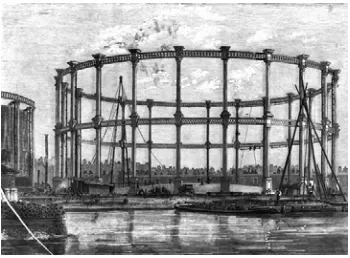
One emblem of this dichotomy between the material and the immaterial, iron
and gas, inertia and evaporation, is the gasholder — the huge, featureless, iron lung
that was used to store the gas that for much of the nineteenth century was the
principal source of fuel for light and, to a lesser extent (but one that grew more
important towards the end of the century), for heating and cooking. Gasholders
began to spring up all over London in the second decade of the century, growing
larger and more numerous as the century wore on (see fig. 1). By the middle of the
1820s, most towns with populations
greater than 10,000 had their own
gasworks; this was extended to towns with
populations as low as 4,000 during the
1830s; and by the middle of the century,
only towns with populations smaller than
2,500 would not have been provided with
gas, and therefore gasworks.3 The most
conspicuous feature of the gasholder is the fact that, unlike a factory building, it
gives a continuous image of the amount of fuel in storage, through the movement of
[image:4.595.330.505.533.662.2]the drum up and down. The structure is both massive and yet governed by vacuity,
to which the movements of the drum give witness. Gasholders are the principal
forms in which gasworks — the work of producing gas and the poetic work of
producing a material imagination of gas — were visibly bodied forth.
Perhaps the novel was another such confection of the material and the
immaterial. Bulky and ponderous in its physical form, the nineteenth-century novel
projected human relationships in terms of the flows and networks of matter that
were becoming indispensable in the organisation of social life. There was no more
representative flow, no more immaterial thing, than gas.
I
Administered Light
Combustible gases had been known since antiquity, though they were thought of as
vapours rather than ‘gases’, as is attested by the survival of the suggestion of
moistness in the word ‘damp’ which — as in ‘firedamp’ and ‘chokedamp’ — was
an early name for a gas (and survives in the German Dampf). But it was not until the
1780s that the possibility of collecting and transporting combustible gas and burning
it for light or heat seriously began to be considered. In 1792, William Murdoch
succeeded in lighting his house in Cornwall with coal gas, and subsequently used it
to light Boulton and Watt’s factory in Soho in 1798. But the establishment of gas
lighting would depend upon the arrival on the scene of an extravagant, obscure
impresario, in the person of Friedrich Albert Winzer, or, after his arrival in England,
Winsor. Winsor, who had learned of the possibilities of coal-gas from the
thermolampe invented by the French chemist Philippe Lebon, with whom he worked
for a time, was an amazing and, for many, infuriating compound of crackpot and
smart-alec. It was he who seems first of all to have recognised, not only that gas was
useful, but that, in order to be put to use, it would need to be considered, not as a
transportable material (like coal) but as a public utility that would require a massive
physical and political infrastructure to allow it to be integrated into the social fabric,
which it would in the process transform. It was Winsor, in short, who saw that gas
would need to be constructed as a mediate material.
By 1807, following a successful demonstration of gas lighting on the walls
‘National Light and Heat Company’, which he intended to be in effect a
nationally-sponsored private monopoly. He estimated that the net profit to the nation from the
collection and use of combustible coal gas, including saving of wasted resource and
tax revenue, would be £111,845,294.4 However, Winsor’s proposal met with considerable and concerted opposition. One objector declared that ‘no one would
rely upon so foolish and unlucky a thing as gas’.5 Winsor’s emphasis on the purity of gas was mocked in a poetic squib issued in the year following his first prospectus.
Feigning to reject the views of those who ‘say thy Gas imparts a fetid gust/To nasal
nerves, and gives to metals rust’, the poem sardonically pumps up Winsor’s rhetoric
of purity into a philosophical principle:
O! could thy Gas with equal power convey, To the mind’s eye an intellectual ray, With flame ætherial decomposed from coal, Illumine and HYDRO-CARBONATE the soul; Our streets, so long with walking Idiot’s curst, Where ‘Dunce the second elbows Dunce the first’, Might see parade their crowded path along,
A novel species – an enlightened throng […] […]
The active principle thy Gas supplies, Haply may bid a new creation rise; With atmospheric oxygen combin’d, Bid human nature leave its dross behind; Like the wise serpent cast away its case, But like an oxyde still retain its base; And Man, with faculties sublim’d and rare, Forsake his humbler walk, and tread on air.6
These mockeries help us to recapture the association between Winsor’s
sociopolitical utopianism and the more poetic and philosophical elation encouraged
by the remarkable discoveries made in the chemistry of gases at the end of the
eighteenth century. Winsor’s inflammable air would have been easy to associate
with the exhilarating gases investigated by Priestley, Lavoisier and Davy, that
promised ecstatic visions in the worlds of art and poetry. The association is made by
the reprinting as a frontispiece to the Heroic Epistle of James Gillray’s satirical
portrait of Humphrey Davy’s demonstrations of nitrous oxide and other gases in his
lectures at the Royal Institution in 1803. Even more than this, the Heroic Epistle
that it was a commodity based upon a new, ambivalent kind of matter, or body, that
in its turn entered into composition with new kinds of social body:
Bid Gas and Coke in statute pride display Their patent blaze by night, their heat by day, And give to airy nothings (LIGHT and FLAME), A BODY CORPORATE in deed and name.7
Gaslight appears in the fiction of the nineteenth century increasingly as an evoker of
visual atmosphere, or ophthalmic accessory. As Bruno Latour has suggested, it is
perhaps the tendency of objects in such wide use to sink into the background that
makes it imperative to find ways of restoring them to articulation:
Objects, by the very nature of their connections with humans, quickly shift from being mediators to being intermediaries, counting for one or nothing, no matter how internally complicated they might be. That is why specific tricks have to be invented to make them talk, that is, to offer descriptions of themselves, to produce scripts of what they are making others – humans or non-humans – do.8
Wolfgang Schivelbusch has suggested that the most important principle of gas
lighting, which was reinforced rather than reversed by electric lighting, was that of
distance. Not only was the gas flame much less intimate than the candle flame, the
fuel was not produced locally, but at a distance. For Gaston Bachelard, whose
meditation on candles and lamps helps to define the world that gaslight both
supersedes and discloses, the flame is ‘a becoming-being, a being-becoming’, in
which matter strives visibly into the form of light.9 The gas jet abstracts even the idea of the flame, through the use of magnifying and diffusing shades and frosted
glass to diffuse and regularise the flame into panes of light.10 The aim was to produce uniform intensity in place of the fluctuations and irregularities typical of
extended matter. What had previously been proximate, iterative and particular was
to become remote, absolute and general. This kind of abstraction partook more of an
idea or principle than of the conditions of matter. Matter was to be rationalised as
well as theorised, made to approach more and more closely to the principles of its
operation. Gas represents a kind of purification of things into the abstract matter of
which they are composed. Matter thereby becomes both less and more ‘material’.
The development of the gas meter, which was among the most important and
necessary technical developments in the introduction of gas, made gas an abstract
made little empirical sense to customers. The introduction of the coin-in-the-slot
meter in the late 1880s converted the unit to a penny’s-worth. Gas announces the
arrival of what Bachelard mournfully calls ‘an age of administered light’.11 Bachelard suggests that every flame is a kind of rising striving: ‘one could say that
everything upright, everything vertical in the cosmos, is a flame’.12 Even before the development of the incandescent gas-mantle, one of the earliest signs of the
denaturing of the flame in gaslight was the demonstration that flames could be made
to burn at any angle, including straight downwards. One of its early enthusiasts
wrote that the properties of gas ‘render it particularly fit for ornamental illumination.
As there is nothing to spill, the flame may be directed either downwards, upwards,
or horizontally; and the points from which it issues may be disposed in any form that
taste or fancy may suggest’.13 Unlike candles or even electric lights, (both of which were portable to some degree, and could shine upwards), gaslights were nearly
always positioned so that they cast their light downwards. This may also explain
their lowering capacity.
II
Sightly Operations
The most important form of distancing or abstraction was the separation of light
from combustible matter. Jonathan Crary has suggested that the 1820s saw the
situation of vision within the body as a physiological event.14 If this is true, then the artificial light supplied by gas seemed like a kind of autonomous vision, a harsh
provocation to and denial of the embodied
eye. Gaslight seems to have been
experienced as a kind of flattening or
banishing of more comfortable and familiar
kinds of gradations. The commonest
adjective to apply to gas seems to have been
‘garish’. The word derives perhaps from
‘gaure’ to stare, suggesting that at which one is constrained to stare, as well as,
[image:8.595.120.281.550.681.2]perhaps, to be reflexively stared at by.
Fig 2. Thomas Rowlandson, A Peep at the
Gas was associated not just with crepuscular gloom or flicker, but also with
its opposite — a gaunt flattening. The associations of gas with theatricality (theatres
being early adopters of gas) spread across into non-theatrical locations — especially
shops and streets — to turn them into places of display and exhibition (see fig. 2).
As Lynda Nead has said ‘[g]aslight turned the London streets into a stage’.15 The gaslit theatre of the streets reduced everything in them to the fact of their being seen,
a kind of penury of shownness. In her account of the theatrical life, Olive Logan
described going on stage as ‘a leap in the dark, but a leap into the light — into the
gaslight, the streaming, gleaming, all-revealing gaslight’.16 Later, she quotes another judgement on the exposure of the performer:
‘Men and women who are compelled by their vocation to move before the world in a perpetual glare of gaslight, and to submit to a surveillance which is ceaseless, and to a judgment which is seldom charitable, are sure to be suspected however innocent, and equally sure to be detected however cautious’.17
Where the flames of candles and lamps seemed to suggest an ‘igneous time’
of slow, rhythmic accumulation and elapse, gaslight could be lit and extinguished
instantly, without prelude or residue.18 Even before the arrival of electric light, which did not require one to be in the vicinity of the light itself to turn it on and off,
gas seemed to offer a new experience of rapid alternation between opposite states,
effected by the switch. As Bachelard writes:
A finger on the switch is enough to make dark space immediately bright. The same mechanical gesture causes the inverse transformation. A little click says yes and no with the same voice. Thus the phenomenologist has the means of placing us alternately in two worlds, which is as much as to say ‘two consciousnesses’. With an electric switch one can play the games of yes and no endlessly. But in accepting this mechanism the phenomenologist has lost the phenomenological density of his act.19
Gaslight also suggested a kind of flashbulb vision, substituting sudden flarings,
irradiations or exposures for the more restrained, approximate, ambivalent
reciprocities of light, eye and object. Gas provides sudden revelations and reversals
of perception, abrupt transformations: ‘Oliver felt her hand tremble; and, looking up
in her face as they passed a gas-lamp, saw that it had turned a deadly white’.20 In Wilkie Collins’s Basil (1852), an obsessed pursuer suddenly sees himself through
I remember passing two men in this way, in some great thoroughfare. They both stopped, turned, and walked a few steps after me. One laughed at me, as a drunkard. The other, in serious tones, told him to be silent; for I was not drunk, but mad – he had seen my face as I passed under a gas-lamp, and he knew that I was mad.
‘MAD!’ – that word, as I heard it, rang after me like a voice of judgment.21
Though gaslight is nowadays associated with crime, mystery and enigma
(‘[t]his gaslight is a sort of an artificial moonlight, you know, and sometimes it
produces the same effects’),22 its raw, uncompromising glare gave it the reputation of dispelling romance and spectrality. Worrying about being haunted by the ghost of
the murdered George Talboys, Robert Audley in Lady Audley’s Secret (1862) looks
to gas for reassurance:
‘I haven't read Alexander Dumas and Wilkie Collins for nothing’, he muttered. ‘I'm up to their tricks, sneaking in at doors behind a fellow's back, and flattening their white faces against window-panes, and making themselves all eyes in the twilight. It's a strange thing that your generous-hearted fellow, who never did a shabby thing in his life, is capable of any meanness the moment he becomes a ghost. I'll have the gas laid on to-morrow and engage Mrs. Maloney's eldest son to sleep under the letter-box in the lobby. The youth plays popular melodies upon a piece of tissue paper and a small-tooth comb, and will be quite pleasant company’.23
Gas seems to emaciate what it illuminates, leaving no excess beyond what is
rendered up to sight. Graham’s first sight of Julie Caumartin in Bulwer-Lytton’s The
Parisians (1873) suggests this hollowing effect:
On first entering the gardens, Graham's eye was attracted and dazzled by a brilliant form. It was standing under a festoon of flowers extended from tree to tree, and a gas jet opposite shone full upon the face, – the face of a girl in all the freshness of youth. If the freshness owed anything to art, the art was so well disguised that it seemed nature. The beauty of the countenance was Hebe-like, joyous, and radiant, and yet one could not look at the girl without a sentiment of deep mournfulness. She was surrounded by a group of young men, and the ring of her laugh jarred upon Graham's ear.24
Graham’s friend Frederic explains that Julie’s appearance is indeed the product of an
eclipse: ‘ “A little while ago her equipage was the most admired in the Bois, and
great ladies condescended to copy her dress or her coiffure. But she has lost her
splendour, and dismissed the rich admirer who supplied the fuel for its blaze, since
The powers of gaslight not just to exhibit, but also cruelly to amplify the
effects of dissipation that are on display in Emerson Bennett’s Ellen Norbury
(1855):
[…] the stately Mrs. Pinchbeck sailed in, dressed in silk. She was a large woman, and, in her younger days, had probably been good looking; but her features now were coarse, and a near inspection showed the crow's-feet around her small, keen eyes, notwithstanding a pretty free use of cosmetics. Her hair and teeth were false, her eyebrows pencilled, and her large flabby cheeks painted. Still, by gas-light, she was as passably comely as could be expected of a woman verging on fifty, who had spent a good portion of her time in fashionable dissipation.26
One of the most memorable distinctions between the inhumanly enhanced mode of
vision provided by gas and embodied human vision is provided in Sam Weller’s
protest, in response to Serjeant Buzfuz’s sarcastic enquiry ‘ “Have you a pair of
eyes, Mr Weller?” ’:
‘If they wos a pair o’ patent double million magnifyin’ gas microscopes of hextra power, p’raps I might be able to see through a flight o’ stairs and a deal door; but bein’ only eyes, you see, my wision’s limited.’27
Perhaps not many readers would have known that since 1824, gas microscopes had
indeed been available for the enhancement of vision. Julian Wolfreys sees this
passage as one of the ways in which the writing of vision in Pickwick Papers evokes
‘the ghostly revenant of technology-to-come’.28 In a note, he acknowledges the contemporary existence of the gas microscope, but somewhat petulantly protests that
‘literature […] is irreducible to fact, date, or event […] Dickens should perhaps be
read with an eye directed more to the spirit, rather than the letter of the historical’.29 In fact, it need not come to a choice, or to precisely this kind of choice, between
historical fact and future projection. For the device in question used gas merely as a
source of illumination, which gave the clarity of image which would allow
projection on to a screen (thus, a gas microscope may have been part of the kind of
magic lantern capable of throwing ‘the nerves in patterns on the screen’ that
Prufrock imagines a century later). Andrew Pritchard dates the first public use of
such a device to 1824, when it was employed by George Birkbeck in two lectures on
optical instruments delivered at the London Mechanics’ Institute, in one of which:
gases, and to indicate the practicability of applying successfully this method of illumination to the microscope.30
But the rhetoric of gas might have encouraged readers in 1837 (and Sam Weller
himself) to have imagined for gas not just the power to illuminate things more
clearly, but also to see into or even through them. The gas is both a lens and an
X-ray before the fact, and Weller’s exasperated exaggeration does indeed seem to peer
into the future of vision.
George Eliot hints, more soberly, at a similar association, in her account of
the influence of the biologist Bichat on Lydgate in Middlemarch (1871-2):
No man, one sees, can understand and estimate the entire structure or its parts – what are its frailties and what its repairs, without knowing the nature of the materials. And the conception wrought out by Bichat, with his detailed study of the different tissues, acted necessarily on medical questions as the turning of gas-light would act on a dim, oil-lit street, showing new connections and hitherto hidden facts of structure which must be taken into account in considering the symptoms of maladies and the action of medicaments.31
Here, the X-ray spectacle of gas does not merely dissolve the material fabric of
things, but rather shows the network of connections that make the body as a whole
intelligible, just like the underground reticulations of pipework that made gas supply
possible. Indeed, Eliot invokes another more intense form of gas lighting, when she
posits an intellectual light even more searching and revealing than that of the gas,
‘another light, as of oxy-hydrogen, showing the very grain of things’.32
Visitors to London like Flora Tristan were struck by the infernal majesty of the
gasworks and the workers who sustained them. Her 1840 account of the Horseferry
Road gasworks emphasises the physical horror of the place:
[…] it was hot. I could not remain in this inferno; the air was unbreathable, the gas fumes were making me giddy, the heat was suffocating […]. At every moment one is assailed by noxious fumes. I came out from the shed I was under, hoping to breathe purer air in the yard, but I was pursued everywhere by the foul exhalations of gas and the smell of coal, tar, etc.34
And yet she is also moved to appalled raptures by the spectacle of the red-hot coke
being removed from the retorts:
Nothing could be more terrible, more majestic than these mouths vomiting flames! Nothing could be more magical than the cellar suddenly lit up by the burning coals which were rushing down like a waterfall cascading from the heights, and similarly engulfed in the abyss! Nothing could be more terrifying than the sight of the stokers, streaming with perspiration as if they had just come out of the water, and illuminated from all around by those dreadful sheets of fire whose tongues of flame seem to be darting out to devour them. Ah no, it would be impossible to see a more awesome spectacle!35
Gustave Doré’s engraving of the Lambeth gasworks in his London Pilgrimage
(1872) (see fig. 3) with Blanchard Jerrold offers a slightly more oblique perspective,
but one that is intended to suggest similarly infernal associations. The point of the
picture seems to be the rather strange contrast between the huddled, haggard misery
of the figures gathered listlessly in the foreground and the desperate industry of the
stokers glimpsed in the retort room in the background. It is not clear what
transaction is taking place over the person of the obligatory swaddled mite on the
right of the picture, but it certainly seems an insalubrious atmosphere for one of such
tender years to be imbibing. Doré seems to be showing in the background the same
stage in the process as Tristan — the clearing out of the retorts — using the long
scoops of which an example is being held by the central figure in the foreground, in
a bizarre and unintelligible parody of a sentry on guard. The stokers behind seem
rather to be engaged in a desperate struggle against the advance of the flames than
We are offered here a kind of
primal scene of the production of gas,
the apparent concentration, in one
visible place and time, of the toil and
suffering that are required to wrest
light from the sediments of the ages.
We might recall that two of the most
important pressures which prompted
the development of gas as a public
utility, after the long dormancy of
more than a century during which the
viability of using it to provide
lighting had been well-known, were
the demands of new, large public spaces, especially factories and places of
[image:14.595.307.514.32.287.2]entertainment.36 The factory-theatre is a predictable hybrid outcome from this demand.
Fig. 3 Gustave Doré, ‘Lambeth Gasworks’, in
London, A Pilgrimage (1872)
But there is no simple overcoming of alienation, or bringing to light of
industrial process in Doré’s illustration. The clearest, most legible part of the
illustration is the foreground, in which materiality, in the lumps of coal visible in the
carriers, is merely matter, and the exhausted workers appear just as inert and
purposeless. Strenuous action is visible in the background of the picture, where the
coordination of the gangs is in contrast with the arbitrary aggregations of the figures
in the foreground, but their action seems to have thinned them to spectres. The real
process of producing the ‘wild spirit’ of the gas remains invisible, occurring
somewhere between the lines of retorts and the large gas-pipe leading away in the
top right of the picture to the gasholder. There is no primal scene in the matter of
gas; the source of light lets itself be seen. As Dickens remarked, in his description of
the gas-making process in his article ‘The Genii of the Lamps’ which appeared in
Household Words in October 1861, ‘[t]he manufacture of gas, although it includes
many beautiful scientific processes, is not on the whole, a sightly operation. What is
not seen may be refined and interesting; but what is seen decidedly savours of
III
A Part of Ourselves
Inevitably, though more slowly and unevenly than we might perhaps expect, gas
combustion also proved to be resistant to the process of abstraction. The sensory
paradox of gas is that a substance that must at all costs and at all stages of its
production and distribution remain safely enclosed and insulated, should have
effects that spill beyond those enclosures. Increasingly, the light of the gas began to
be thought of as itself a kind of gaseous emanation, which entered into competition
and composition with the air. Although early promoters of gas emphasised the fact
that the fuel provided both light and heat, the great technical problem for later
designers of gas appliances and installations was how to maximise the lighting
output of gas jets while reducing to a minimum the tendency to heat the air. One
manufacturer of a ventilation system for gas lighting warned that:
Like fire and water, gas is a good servant but a bad master; and in ninety-nine houses out of a hundred it is simply a licensed despot, who revenges himself for the light he cannot help giving, by poisoning the very air to which he is indebted for life and brilliancy.38
However assiduously engineers and designers tried to isolate the gas burner from its
environment, it proved to be closely dependent upon and determining of it. Gas
burned differently depending on variations in atmospheric pressure, a rise of an inch
in barometric pressure increasing the luminosity of the flame by 5%. Humidity also
affected the flame, as did the pressure of the gas (too much pressure produced
over-aeration and a reduction in the intensity of the light).39
Gas was therefore essentially fluctuant, in pressure and quality. The residual
feature of gas was the variability of its quality, or the quality of its variability,
against which designers and advertisers struggled. Lynda Nead suggests that the
most important feature of gas was the way in which it created fascinating, seductive,
and also sinister urban chiaroscuro.40 George Cukor’s film Gaslight (1944) emphasises the flickering of the gaslights, for this is the way in which a husband
convinces his wife that she is losing her mind. As a result of this, the term ‘to
gaslight’ means to disorientate. In the end, the continuing success of gas has come to
consist in this very aptness to fluctuation, the ‘organic’ sensitivity of gas that makes
Gas had implications for physiology as well as physics. The early nineteenth
century inherited from the heady days of gas discovery in the 1780s a strong and
seemingly inextinguishable predisposition to believe in the health-giving effects of
various kinds of gas. Not only were the tonic powers of oxygen and nitrous oxide
touted, other more surprising gases like carbonic acid gas, were found to have
therapeutic or vitalising powers. Most surprisingly of all (given the widespread
knowledge of how toxic it was) coal-gas was included in this roster of medicinal
gases. F. A. Winsor made some very enthusiastic claims about the health-giving
properties of coal-gas during his vigorous campaign of publicity on behalf of gas
lighting and heating. One of them is in answer to the imagined question of an
objector:
Q. But is it not hurtful to respiration?
A. Not in the least! – On the contrary, it is more congenial to our lungs than vital air, which proves too strong a medicine, because it only exists from one-fifth to one-fourth in the atmosphere; whereas, inflammable air exists above two-thirds in the animal and vegetable kingdoms, in all our drink and victuals. It forms a part of ourselves.41
We learn from the anonymous Heroic Epistle of 1808 that Winsor went even further
in his claims for the healthgiving properties of his gas: ‘Mr. Winsor, in his Lectures,
states that he has cured himself of a constitutional asthma, by superintending the
works at his stoves, and inhaling his own hydro-carbonic gas, and invites any
persons afflicted with disorders of the lungs to attend at his house, and try the
remedy gratis’.42 One historian of the gas industry wrote in 1988 of his own ‘childhood memories of being dragged to the Torquay and Paignton Gas Company
where the smell of the sulphurous discharge was supposed to induce sickness and
cure whooping cough’.43
In many of the salacious tours of urban night-life in which gaslight featured,
the toxicity of gas blended with its intoxicating accompaniments, as for example in
George Ellington’s complaint in his Women of New York that ‘crowds of boys and
girls of a susceptible age meet together under the intoxicating influence of music,
gaslight, full dress, late suppers, wines and punches’.44 Dickens associates gas with the effects of intoxication too, in the account of Mr Snodgrass’s fluctuant process of
The wine, which had exerted its somniferous influence over Mr Snodgrass, and Mr Winkle, had stolen upon the senses of Mr Pickwick. That gentleman had gradually passed through the various stages which precede the lethargy produced by dinner, and its consequences. He had undergone the ordinary transitions from the height of conviviality to the depth of misery, and from the depth of misery to the height of conviviality. Like a gas lamp in the street, with the wind in the pipe, he had exhibited for a moment an unnatural brilliancy: then sunk so low as to be scarcely discernible: after a short interval he had burst out again, to enlighten for a moment, then flickered with an uncertain, staggering sort of light, and then gone out altogether.45
Gas gradually fell under suspicion as the century wore on, as domestic gas became
associated with sewer-gas and the many other noxious vapours with which the
miasmatist Victorian hygienists were much preoccupied. Gasworks were accused,
often with good warrant, of polluting the air, water and ground in their vicinity,
ironically, often as a result of the byproducts of the processes employed to purify the
gas.46 In France, Evariste Bertulus blamed gas-pipes for the vitiation of wells and water supplies and even blamed it for epidemics of yellow fever and typhus in
Marseilles.47
The adoption of gas for cooking towards the end of the century, and the
spread of gas ovens into domestic houses, especially of the working class, made for
a new kind of bodily intimacy with gas. Indeed, one may say that, with the arrival of
electricity, gas came to seem more familiar and companionable, for all its apparent
inconvenience, and perhaps partly because of it. Where electricity meant excitement,
gas meant comfort, as Thomas Newbigging observed:
People little reflect, how much of comfort they owe to gas. The cheapness of the light, the ease with which it is manipulated, its handiness and homeliness, so to speak – because the gas is always there, ready at the moment when wanted; its cleanliness, its safety, are all advocates of gas lighting, and speak eloquently in its favour. Gas is like a good and willing and trustworthy servant. It is not obtrusive or despotic in its manifestations, as is the electric light, nor dirty and slatternly like candles, oil, and the oil lamp. These latter oppress the mind, because you are never sure of them, or rather you are always sure of their uncertainty: but gas, like a good stomach and liver, goes cheerfully and brightly on, minding its own proper business.48
A somewhat surprising confirmation of the bodily intimacy of gas is the adoption
and growing popularity of gas poisoning as a method of suicide. Histories and
becoming common until the early years of the twentieth century. The Lancet
reported in 1908 that a coroner in Manchester had requested that newspapers not
publish details of the method employed by one gas suicide, in order to discourage
copycatting, suggesting that the technique may have seemed quite novel. The
historian of suicide Olive Anderson suggests that this may have been the case in
Manchester in particular owing to the slow penetration of gas into working-class
homes there:49
A verdict of suicide during insanity was returned yesterday, in the case of a clerk who had lost his situation through drink and poisoned himself with gas. The city coroner pointed out that suicides through gas poisoning were on the increase. Three had occurred within a week and ‘he could not help thinking that some sort of suggestion was going on’. Whether due to harmful literature, describing how it could be accomplished by gas, or whether it was through details being given in the daily press, he did not know; but ‘he thought he was justified in asking the press on this occasion to keep out the details of the case’. He thought if this were done the ‘epidemic’ would probably cease. There is no question as to the wisdom of this suggestion and in this instance the local papers seem very properly to have acted up to it.50
IV
Convivial
Gas does not represent the simple thinning or abstraction of matter. Rather, gas
procures and represents what may be called mediate matter. George Sala took a hint
from the opening of Bleak House (1852-3) for his literary gazetteer of the capital,
Gaslight and Daylight in London, making gas a kind of universal witness and
conductor:
An impartial gas, it shines as brightly on the grenadier's quart-pot as on the queenly crown. A convivial gas, it blazes cheerfully in the mess room of the Beauchamp Tower. A secretive gas, it knows that beneath the curtains and flags of that same mess-room there are dark words and inscriptions cut into the aged wall – the records of agony and hopeless captivity, anagrams of pain, emblems of sorrow and hopes fled and youth and joy departed.51
The gas becomes the image and the medium of Sala’s own writerly perambulations,
both bringing to light and whispering of secrets. The most important feature of the
accessible even as it inhabits privacy. It is for this reason that, as we have seen,
George Eliot takes gas-light as a kind of analogy for her own fictional process of
tracing out the ‘primary webs and tissues’ of social life.52 Gas has two modes of propagation: as illumination it exposes and integrates, dispelling secrecy and
enigma; as diffusive matter it infiltrates and propagates, itself secret and invisible.
Because chemically and scopically it is everywhere the same, it can adapt itself to
any circumstances and insinuate itself into every space:
As I walk about the streets by night, endless and always suggestive intercommunings take place between me and the trusty, silent, ever-watchful gas, whose secrets I know. In broad long streets where the vista of lamps stretches far, far away into almost endless perspective; in courts and alleys, dark by day but lighted up at night by this incorruptible tell-tale; on the bridges; in the deserted parks; on wharfs and quays; in dreary suburban roads; in the halls of public buildings; in the windows of late-hour-keeping houses and offices, there is my gas – bright, silent, and secret. Gas to teach me; gas to counsel me; gas to guide my footsteps, not over London flags, but through the crooked ways of unseen life and death, of the doings of the great Unknown, of the cries of the great Unheard. He who will bend himself to listen to, and avail himself, of these secrets of the gas, may walk through London streets proud in the consciousness of being an Inspector – in the great police force of philosophy – and of carrying a perpetual bull's-eye in his belt.53
Chemically purified, gas is epistemologically compounded, and imbricated. The gas
network, more complex and far-reaching than the water network, produced a chain
of collaborations and corroborations. The most extended enactment of the mediating
functions of this material is Dickens’s Bleak House. In the opening sequence of the
novel, gas forms part of the diffusive series of elements — mud, fog, gas — which
are connected by their shared capacity for interfusion. Amid the November fog, the
gas is not a source of illumination, but rather itself a visible element, as though the
gas were shining through itself:
Gas looming through the fog in divers places in the streets, much as the sun may, from the spongey fields, be seen to loom by husbandman and ploughboy. Most of the shops lighted two hours before their time – as the gas seems to know, for it has a haggard and unwilling look.54
Gas belongs to the new world, rather than the flickering world of the Dedlocks, as is
suggested by the contrast between gas and oil lamps during Sir Leicester Dedlock’s
The day is now beginning to decline. The mist, and the sleet into which the snow has all resolved itself, are darker, and the blaze begins to tell more vividly upon the room walls and furniture. The gloom augments; the bright gas springs up in the streets; and the pertinacious oil lamps which yet hold their ground there, with their source of life half frozen and half thawed, twinkle gaspingly, like fiery fish out of water – as they are.55
Gas belongs to the explosive economy of the novel, as suggested by Phil’s roster of
accidents, in which matter and flesh promiscuously intermingle:
‘what with blowing the fire with my mouth when I was young, and spileing my complexion, and singeing my hair off, and swallering the smoke; and what with being nat’rally unfort’nate in the way of running against hot metal, and marking myself by sich means; and what with having turn-ups with the tinker as I got older, almost whenever he was too far gone in drink – which was almost always – my beauty was queer, wery queer, even at that time. As to since; what with a dozen years in a dark forge, where the men was given to larking; and what with being scorched in a accident at a gasworks; and what with being blowed out of winder, case-filling at the firework business; I am ugly enough to be made a show on!’56
But the explosiveness of Bleak House is matched by the tendency of matter to
aggregate and congeal. The distinguishing feature of a gas, as explained in a popular
exposition of its chemistry in the Edinburgh Review for 1809, was that it was ‘an
invisible elastic fluid […] which no cold nor affusion of water can condense or
absorb’.57 But Dickens’s gas tends to precipitate or deposit itself in reluctant sludge. The winds are the ‘messengers’ which convey ‘Tom’s corrupted blood’, but that
corruption is imagined as an impossible kind of airborne slime, both volatile and
viscous:
There is not an atom of Tom’s slime, not a cubic inch of any pestilential gas in which he lives, not one obscenity or degradation about him, not an ignorance, not a wickedness, not a brutality of his committing, but shall work its retribution, through every order of society, up to the proudest of the proud, and to the highest of the high.58
Dickens’s gas is no ‘incorruptible tell-tale’, for adulteration is the very essence and
method of its tale-telling.59 The two sides of gas, its power of illumination and its tendency to pollute, cross over curiously in the description of the churchyard where
Nemo is buried. Dickens calls for light, not in order to dispel the gloom of the place,
Come night, come darkness, for you cannot come too soon, or stay too long, by such a place as this! Come, straggling lights into the windows of the ugly houses; and you who do iniquity therein, do it at least with this dread scene shut out!
The gaslight burning above the iron gate seems to provide only intermittent
illumination, fluctuating grudgingly between the immaterial condition of light and
the cloying condition of grease. ‘Come, flame of gas, burning so sullenly above the
iron gate, on which the poisoned air deposits its witch-ointment slimy to the touch!
It is well that you should call to every passer-by, “Look here!” ’60 The passage between the airy and the slimy is suggested neatly in that ‘witch-ointment’, a
reference to the medieval and early modern belief that witches greased their brooms
with ‘flying ointment’ brewed up from toxic herbs and the fat of boiled babies to
assist their flight. Here the gas both illuminates and leaks into the ‘poisoned air’
condensing in the form of slime.
Rather than being a raw material, which the network simply supplied, gas
was an ambivalent material — a modern spiritus silvestris, or wild spirit, that itself
produced and transposed positions and values. It is, as Bruno Latour has suggested,
not just a neutral intermediary, that connects things up and passes unchanged and
unchanged from place to place: it is a mediator.61 As such, it is an ‘actor’, in the sense defined by ‘actor-network theory’, defined as ‘not the source of an action but
the moving target of a vast array of entities swarming towards it’.62
The nineteenth century produced an intensification of the condition known as
modernity in which, according to one form of its self-understanding, human beings
were both dislocated from the natural world of matter, and swallowed up in a
‘materialism’ of their own making. Matter was first abstracted from nature, and as a
result nature — including human nature — was itself abstracted into matter, set
intimidatingly and puzzlingly over and against human life. In either case, it is
believed that what is lost is some mutually-defining and enriching interchange
between matter and whatever exceeds it, in the manner of Emerson’s imagination.
Now, matter can only be figured in symbolism or representation. Bruno Latour has
urged us to do without this myth of dissociation, paying attention instead to an
objects, nor a dialectical overcoming of their antagonism, but rather an attentiveness
to the ‘Middle Kingdom’, in which quasi-objects and quasi-subjects reciprocally
precipitate each other:
Of quasi-objects, quasi-subjects, we shall simply say that they trace networks. They are real, quite real, and we humans have not made them. But they are collective because they attach us to one another, because they circulate in our hands and define our social bond by their very circulation.64
Carefully regulated by a series of joints, relays, switches and valves, gas
itself became a mobile switch — between the global and the local, the economic and
the physiological, the immediate and the mediate. It is a matter that ultimately
enacted a translation or switching between matter and the immaterial. As such, it
provides a kind of correlative to the imaginary plasma of the novel itself, which
equally arises from a curiosity with the complexity of conjunctures, with the
intimate traffic of proximity and distance. In this respect, the novel itself may be
seen as one of the nineteenth century’s most pervasive gas-works.
Endnotes:
1
Ralph Waldo Emerson, ‘Poetry and Imagination’, in Letters and Social Aims (London: Chatto & Windus, 1876), p. 3.
2
Emerson, Letters and Social Aims, p. 4.
3
Malcolm Falkus, ‘The British Gas Industry Before 1850’, Economic History Review, 20 (1967), 494-508, (p. 498).
4
Frederick Albert Winsor, A National Light and Heat Company, For Providing Our Streets and Houses With Hydrocarbonic Gas-Lights, On Similar Principles, As They Are Now Supplied With
Water [...] (London: for F. A. Winsor, 1805), p. 10.
5
Quoted in Dean Chandler, Outline of History of Lighting By Gas (London: Chancery Lane Printing Works, 1936), p. 24.
6
An Heroic Epistle to Mr. Winsor, The Patentee of the Hydro-Carbonic Gas Lights and Founder of
the National Light and Heat Company (London: for R. Spencer, 1808), pp. 7, 8.
7
An Heroic Epistle to Mr. Winsor, p. 18.
8
9
Gaston Bachelard, The Flame of a Candle, trans. Joni Caldwell (Dallas: Dallas Institute Publications, 1988), p. 24.
10
Wolfgang Schivelbusch, Disenchanted Night: The Industrialisation of Light in the Nineteenth
Century, trans. Angela Davies (Oxford, New York and Hamburg: Berg, 1988), p. 44.
11
Bachelard, Flame of a Candle, p. 64.
12
Bachelard, Flame of a Candle, p. 43.
13
‘Pamphlets on the Gas-Lights’, Edinburgh Review, 13.26 (1809), 477-88 (p. 487).
14
Jonathan Crary, Techniques of the Observer: On Vision and Modernity in the Nineteenth Century
(Cambridge, MA: MIT Press, 1990).
15
Lynda Nead, Victorian Babylon: People, Streets and Images in Nineteenth-Century London (New Haven and London: Yale University Press, 2000), p. 98.
16
Olive Logan, The Mimic World and Public Exhibitions: Their History, Their Morals, and Effects
(Philadelphia, PA. and Cincinnati, OH: New-world Publishing Co., 1871), p. 132.
17
Logan, The Mimic World, p. 415.
18
Bachelard, Flame of a Candle, p. 69.
19
Bachelard, Flame of a Candle, p. 64.
20
Charles Dickens, The Adventures of Oliver Twist, ed. Steven Connor (London: J. M. Dent, 1994), p. 109.
21
Wilkie Collins, Basil (New York: Dover, 1980), p. 166.
22
George Ellington, The Women of New York; or, The Under-world of the Great City. Illustrating the Life of Women of Fashion, Women of Pleasure, Actresses and Ballet Girls, Saloon girls, Pickpockets
and Shoplifters, Artists' Female Models, Women-of-the-town, etc. [...] (New York: New York Book
Co., 1869), p. 344.
23
Mary Elizabeth Braddon, Lady Audley’s Secret, ed. Jenny Bourne Taylor (London: Penguin, 1998), p. 395.
24
Edward Bulwer-Lytton, The Parisians, 2 vols. (London: George Routledge and Sons, 1875), I, p. 182.
25
Bulwer-Lytton, The Parisians I, p. 182.
26
Emerson Bennett, Ellen Norbury: Or, The Adventures of an Orphan (Philadephia, PA: T. B. Peterson, 1855), p. 35.
27
Charles Dickens, The Posthumous Papers of The Pickwick Club, ed. Robert L. Patten (Harmondsworth: Penguin, 1972), p. 573.
28
Julian Wolfreys, The Old Story, With a Difference: Pickwick’s Vision (Columbus, OH: Ohio State University Press, 2006), p. 94.
29
Wolfreys, The Old Story, p. 112, n. 7.
30
Essays on Reflecting, Solar, Oxy-hydrogen Gas Microscopes, Micrometers, Eye-pieces, &c. &c.
(London: Whittaker & Co., 1837), p. 171.
31
George Eliot, Middlemarch, ed. W. J. Harvey (Harmondsworth: Penguin, 1976), p. 177.
32
Eliot, Middlemarch, pp. 177-8.
33
Zerah Colburn, The Gas-Works of London (London: E. & F. N. Spon, 1865), pp. 24-5.
34
Flora Tristan, London Journal: A Survey of London Life in the 1830s, trans. Dennis Palmer and Giselle Pincetl (London: George Prior, 1980), pp. 67-8.
35
Tristan, London Journal, p. 68.
36
Malcolm Falkus, ‘The Early Development of the Gas Industry, 1790-1815’, Economic History Review, 35 (1982), 217-34 (p. 219).
37
Quoted in Hugh Barty-King, New Flame: How Gas Changed the Commercial, Domestic and Industrial Life of Britain Between 1813 and 1984 (Tavistock: Graphmitre, 1984), p. 257.
38
Thomas H. Hine, Warming and Ventilation (London: Hamilton Adams & Co., 1874), p. 6.
39
Chandler, Outline of History of Lighting By Gas, pp. 160-1.
40
Nead, Victorian Babylon, p. 102.
41
Frederick Albert Winsor, Plain Questions and Answers. Refuting Every Possible Objection Against the Beneficial Introduction of Coke and Gas Lights (London: for the Author, 1807), pp. 5-6.
42
Heroic Epistle, p. 3.
43
Malcolm Falkus, Always Under Pressure: History of North Thames Gas Since 1949 (Basingstoke: Macmillan, 1988), p. xi.
44
Ellington, Women of New York, p. 112.
45
Dickens, Pickwick Papers, p. 86.
46
‘Gas Nuisances and Their Removal’, Sanitary Review and Journal of Public Health, 3 (1857), 191-192.
47
Evariste Bertulus, Mémoire d’hygiène publique sur cette question: Rechercher l’influence que peut
exercer l’éclairage au gaz sur la santé des masses dans l’intérieur des villes? (Marseilles: Veuve
Marius Olive, 1853).
48
Thomas Newbigging, ‘The Gas Industry of the United Kingdom’, Scottish Review, 9 (1887), 297-316 (p. 307).
49
Olive Anderson, Suicide in Victorian and Edwardian Britain (Oxford: Clarendon Press, 1987), p. 352.
50
‘Suicide and Suggestion’, The Lancet, no. 4440 (October 3, 1908), p. 1041.
51
George Augustus Sala, Gaslight and Daylight: Some London Scenes They Shine Upon (London: Chapman & Hall, 1859), p. 159.
52
Eliot, Middlemarch, p. 177.
53
Sala, Gaslight and Daylight, p. 159.
54
Charles Dickens, Bleak House, ed. Norman Page (Harmondsworth: Penguin, 1972), pp. 49-50.
55
56
Dickens, Bleak House, p. 422.
57
‘Pamphlets on the Gas-Lights’, p. 478.
58
Dickens, Bleak House, p. 683.
59
Sala, Gaslight and Daylight, p. 159.
60
Dickens, Bleak House, p. 203.
61
Latour, Reassembling the Social, pp. 37-42.
62
Latour, Reassembling the Social, p. 46.
63
Latour, Reassembling the Social, pp. 9, 2.
64