3043
SYSTEMATIC REVIEW OF DATA QUALITY RESEARCH
1M.IZHAM JAYA, 2FATIMAH SIDI, 3LILLY SURIANI AFFENDEY, 4MARZANAH A. JABAR, 5ISKANDAR ISHAK
1,2,3,5Department of Computer Science, Faculty of Computer Science and Information Technology,
Universiti Putra Malaysia
4Department of Information System and Software Engineering, Faculty of Computer Science and
Information Technology, Universiti Putra Malaysia Corresponding Author: [email protected]
ABSTRACT
Data quality drawn a major concern when dealing with data especially in the event that insightful outputs is needed. Research in data quality emerged in various topics and diversification in known knowledge and used approach is inevitable. In this paper, we apply systematic review study to explain the landscape of data quality and to identify available research gap by using categorization and mapping. Our search scope is limited to research articles from journals, conference proceedings and magazine published between 2010 until 2016. We defined three types of main categorization to map the selected research articles and to answer our research questions. These categorization focus on research topics, research type and contribution type. On average, fifty-four research articles related to data quality were published every year. This number shows the importance of data quality research in various research topics such as online users, database, web information, sensors and big data. This study also indicates that almost half of the selected articles proposed a novel solution or an essential extension of an existing data quality technique. Moreover, most of the selected research articles belongs to the model type in the contribution category. Our mapping also suggests that obvious contribution disparity happen between contribution in metric type and model type category.
Keywords: Data Quality, Information Quality, Systematic Review
1.INTRODUCTION
Research in data quality has been widely applied in many areas such as health, finance, corporate organization and information system. It included the needs to uniquely understand the dimensions of data quality, measurement methods, assessment techniques and improvement process in each domain. Lately, data quality also drawn attention in the big data wave. Although the numbers of collected data in big data are huge, but the quality of these data and the impact of having low data quality are still in debate. Despite the fact that the landscape of data quality research is wide, researchers and practitioners have agreed that high quality data is always referred to the data which is fit for use and meet the criteria set by the data user according to its domain [1]–[5].
Many years of research in data quality has seen a lot of advancement being made in defining data quality dimensions, measurement techniques,
assessment models and improvement methods. Diversification in used approach and research domain cannot be avoided and there is a need to synergies the existing knowledge for further expansion. The landscape of data quality research has also changed from years to years to adapt the new coming technology such as big data, crowdsourcing, sensors network and online web data. Such changes opened the opportunity for collaboration among research community.
3044 quality research [7]. Furthermore, both review articles did not categorized and described the research approach and contribution type of each research paper included in the review.
Our study examined the landscape of data quality using systematic review study. We select research articles from journals, conference proceedings and magazine published in 2010 until 2016. This study highlights and critically discuss topics in data quality research, types of research, types of research contribution, the research methods being used in each of selected articles and techniques used to solve the discussed problems. The findings are then categorized and presented in a visual representation using bubble plot.
This paper is organized as follows. We explain the methodology used for this review in Section 2. Then, in Section 3, we present the results of this study. Section 4 discuss the answers to our research questions. Lastly, in Section 5, we conclude our study. In most of the research articles being reviewed, data quality and information quality are always used as synonym to each other. We shall follow this convention in this paper.
2.METHODOLOGY
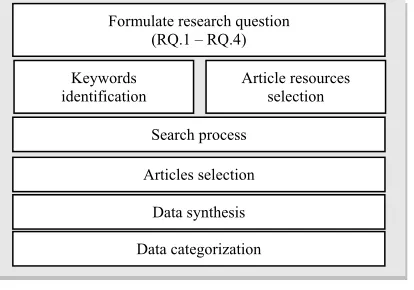
[image:2.612.93.300.537.682.2]This study has been conducted based on the guidelines in doing systematic review proposed in [8]. The execution of this study involved eight stages including the formulation of research questions, keywords identification, selection of article resources, searching process, selection of articles, data synthesis and the categorization of data. We summarized the execution of this study in Figure 1.
Figure 1: Execution of review protocols
The following section explained the execution phase in detail.
2.1 Research Questions
Our primary aim is to explain the landscape in data quality research and to identify available gap by using categorization and mapping. For this reason, we considered four research questions to be answered:
RQ.1 What are the topics being discussed in data quality research?
RQ.2 What types of research has been carried out in each data quality topics?
RQ.3 What are the types of contribution being proposed so far in each of data quality research topics?
RQ.4 What kind of research methods is being used in data quality research?
2.2 Search Strategy
We developed search strategy based on three factors including keywords identification, article resources selection and search process.
2.2.1 Keywords identification
Keywords for articles searching were built based on these criteria [8]:
(a) Keywords must be identified from the research questions.
(b) Identification of keywords from other relevant studies and review articles.
(c) Synonym, abbreviation and alternative spelling should be considered as keywords. (d) Usage of the Boolean OR for synonym,
abbreviation and alternative spelling. (e) Usage of the Boolean AND for linkage
between keywords.
We identified the following keywords based on the criteria and used during the search process: “data quality” OR “quality data” AND ‘information quality” OR “quality information”.
2.2.2 Article resources selection
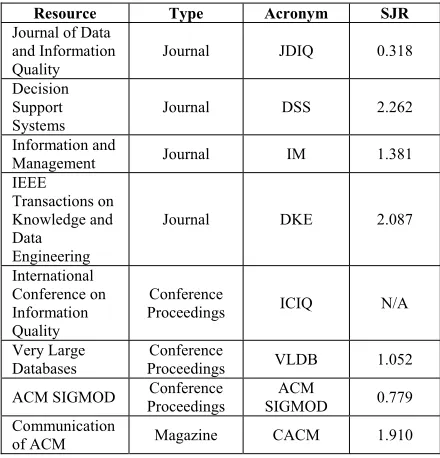
In order to ensure that all the relevant articles were included, we took into consideration previous review articles available in data quality research including [9][10][6][11] and examined the article resources used. As a result, four journals, three conference proceedings and one magazine which considered important in data quality research were selected. Table 1 listed the selected journals, conference proceedings, and magazine. We provided the SCImago Journal & Country Rank (SJR) from Scopus website for each article resources to justify the influences of selected Formulate research question
(RQ.1 – RQ.4) Keywords
identification
Article resources selection Search process
3045 resources as the SJR is calculated based on the citation received.
Table 1: Selected Journal, Conference Proceedings and Magazine
Resource Type Acronym SJR
Journal of Data and Information Quality
Journal JDIQ 0.318
Decision Support Systems
Journal DSS 2.262
Information and
Management Journal IM 1.381
IEEE Transactions on Knowledge and Data
Engineering
Journal DKE 2.087
International Conference on Information Quality
Conference
Proceedings ICIQ N/A
Very Large Databases
Conference
Proceedings VLDB 1.052
ACM SIGMOD Proceedings Conference SIGMOD ACM 0.779 Communication
of ACM Magazine CACM 1.910
2.2.3 Search process
We performed automatic search in each of the selected article resources using keywords as defined earlier. We scoped the searching process to only include articles being published between 2010 and 2016. Each articles found has been label as ‘prospective’.
2.3 Articles Selection
During the searching process, a total of 409 prospective articles has been retrieved. Manual screening has been done on the articles title, abstract and keywords to eliminate any irrelevant and repetitive study. As a result, 381 articles was selected and labeled as ‘relevant’. Thereafter, an inclusion and exclusion criteria has been applied to the relevant articles. During the process, a manual screening and a brief study on each of relevant article has been conducted. Consequently, 374 articles has been selected and being labelled as ‘selected’.
2.3.1 Inclusion and exclusion criteria
Manual screening of the relevant articles has been done based on the inclusion and exclusion criteria with aim to select articles that reflected our study. For this reason, any articles published between 2010 until 2016 and satisfied the following inclusion criteria were labelled as ‘selected’. The
inclusion and exclusion criteria used in this study are adopted from [8].
a) Articles published in English language. b) Articles that discussed on data quality or
information quality.
c) Articles which are able to answer at least one of our research questions.
We excluded articles which has the criteria described below:
a) Articles not published in English language. b) Articles not related to any of our research
questions.
c) Duplicate articles. In case of duplicate articles, outdated articles and most incomplete content were excluded.
2.4 Data Synthesis
In this phase, we standardized, organized and consolidated evidences from the selected articles in order to answer our research questions. We listed the criteria used to collect evidence from the articles content in Table 2. The criteria were used to help us in finding precise answers for each research questions and to guide us during data synthesis phase.
Table 2: Criteria for data synthesis
Criteria Description
Identification number and bibliographic references
Unique identification number, article title, author, year and source Focus of research Research topic, research problems
and article contribution
Type of research Type of research conducted in the articles e.g. solution proposal, validation research, evaluation research
Research method Type of analysis and evaluation used in articles e.g. statistical analysis, experimental evaluation, empirical evaluation
Application domain Application domain of the research e.g. financial, health
[image:3.612.312.521.438.604.2]3046
Table 3: Collected data
Quantitative Qualitative
Number of articles by sources Research topic Number of publication by year Research problem Number of contribution type by
sources Type of research Number of type of research by
sources Article contribution Number of research topic by
sources Research method Citation number in Scopus and
Google Scholar
Qualitative data of research topic and research problems were synthesized to answer RQ.1. Categorization of the discussed topic in data quality research has been made and a pie chart has been used to visualize the findings in quantitative format. For RQ.2, we synthesized type of research data and further generalized the data into 6 categories and presented the findings in a pie chart and bar graph. As for RQ.3, we categorized articles contribution into 6 main categories by synthesized the article contributions. A pie chart and bar graph was used to summarize the most type of contribution in data quality research. In order to answer RQ.4, we categorized the research method used in the selected research articles according to its related research topic and present the finding in a table. Lastly, we mapped the findings of RQ.1, RQ.2, RQ.3 and RQ.4 into a bubble plot to explain the available gap in data quality research.
We confirm the validity of these finding by doing crosscheck between researchers involved. A random sample of synthesized data has been validated in a group discussion among the researchers. In a case of conflicted findings, discussion had been done and mutual agreement had been achieved.
2.5 Data Categorization
2.5.1 Categorization of data quality research topics
Categorization of data quality research topics are done based on the classification proposed in [12]. The classification anchored by four main topics including impact of data quality, data quality in the context of computer science and IT, technical solution in data quality related to database and data quality in curations. As recent technologies emerged, current domains and techniques in data quality such as web, crowdsourcing, big data and online communities has not been discussed in details by the previous work. We extended the
discussion in this study by included current domains and techniques available in data quality research. We categorized data quality research topics into three and eliminated data quality in curations from our research topic categorization. We believed that data quality in curations should be discussed in details in more related subcategory such as measurement and assessment, security and database cleansing.
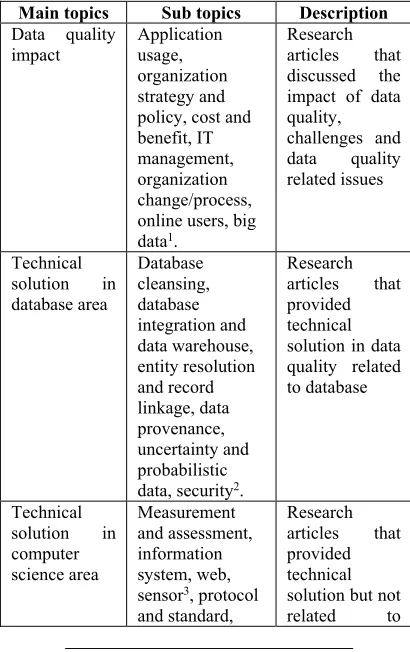
We thoroughly read each selected articles to examine the topic being discussed. Then, we classified the articles into three main topics as listed in Table 4. Most frequent words such as cost, virtual communities and mobile application in each articles were considered as theme and determined the related sub topics.
Table 4: Classification of data quality research topics
Main topics Sub topics Description
Data quality impact
Application usage, organization strategy and policy, cost and benefit, IT management, organization change/process, online users, big data1.
Research articles that discussed the impact of data quality, challenges and data quality related issues
Technical solution in database area
Database cleansing, database integration and data warehouse, entity resolution and record linkage, data provenance, uncertainty and probabilistic data, security2.
Research articles that provided technical solution in data quality related to database
Technical solution in computer science area
Measurement and assessment, information system, web, sensor3, protocol and standard,
Research articles that provided technical solution but not related to
1 Online users and big data are newly added subcategories in data quality impact topic compared to previous subcategories in [12]
3047
Main topics Sub topics Description
network,
security. database area
2.5.2 Categorization of research type
[image:5.612.319.519.109.338.2]We categorized the selected articles into six related research types including solution proposal, validation research, evaluation research, conceptual proposal, experience paper and opinion paper. In doing the categorization, we read through the methodology and conclusion chapter from each of selected articles. The categorizations are determined by the type of research approach and the methodology used by the author. For a better understanding, in Table 5, we provided the classification criteria as proposed in [13] which are adopted in our categorization of research type.
Table 5: Categorization of research type
Classification criteria
Description
Solution
proposal Data quality research that proposed a novel solution or an essential extension of an existing technique
Validation research
Data quality research that examined solution proposals that have not yet been applied in practice. It can be presented by experiments, prototype, simulations and mathematical analysis. Evaluation
research
Data quality research that examined solutions that have been already applied in practice. Results can be presented in case studies or field studies.
Conceptual proposal
Research articles that represented things that have already existed. It can be presented in taxonomies and theoretical frameworks.
Experience paper
Authors explained the process, achievement and experiences from projects.
Opinion paper Discussed the suitability or unsuitability of a specific technique or a tool based on personal opinion of author.
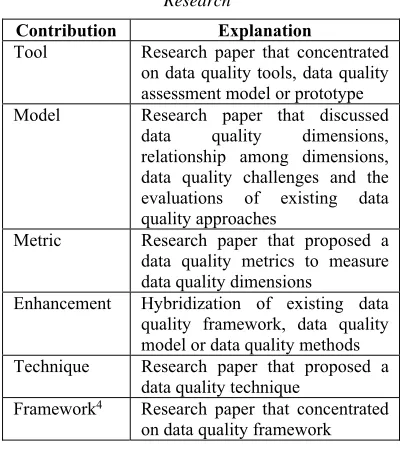
2.5.3 Categorization of article contribution Article contribution has been identified based on the introduction, result, discussion and conclusion in each of selected articles. In order to identify significant contribution of each article, we relate each finding with defined problem statement. The contribution is then categorized into six main categories including tool, model, metric, enhancement, technique and framework. The categorization scheme has been outlined from [14]. However, we added framework as a new type of contribution and widen the classification area to suit data quality research. We explained each type of contributions in Table 6.
Table 6: Types of Contribution in Data Quality Research
Contribution Explanation
Tool Research paper that concentrated on data quality tools, data quality assessment model or prototype Model Research paper that discussed
data quality dimensions, relationship among dimensions, data quality challenges and the evaluations of existing data quality approaches
Metric Research paper that proposed a data quality metrics to measure data quality dimensions
Enhancement Hybridization of existing data quality framework, data quality model or data quality methods Technique Research paper that proposed a
data quality technique
Framework4 Research paper that concentrated on data quality framework
3.RESULTS
This section summarized the findings of our study. We first presented our search result including the number of prospective articles, relevant articles and selected articles according to articles resources. Next, we discussed the overview of selected articles.
3.1 Search Results
Table 7 tabulates the result of the search process according to article sources and year published. 409 articles retrieved during the search process and 381 articles were found relevant to this study. We then scrutinize the relevant articles and finally selected 374 articles to be included in this study.
Our result showed that JDIQ published most of data quality journal articles with 67 publications. Nevertheless, only 57 articles are selected in this study. DKE published the lowest number of data quality articles with 16 articles. As JDIQ main subject is data quality and information quality research, the high numbers of data quality publication are expected. The same reason applied to ICIQ conference proceedings with 178 articles compared to the lowest number in ACM SIGMOD with 12 articles.
[image:5.612.84.301.302.555.2]3048
Table 7: Sources searched for the years 2010 – 2015
Source Year Prospective Relevant Selected
JDIQ
2010 5 4 3
2011 7 7 6
2012 14 14 13
2013 8 8 7
2014 9 8 8
2015 12 10 9
2016 12 11 11
DSS
2010 2 2 2
2011 3 3 3
2012 7 7 7
2013 5 5 5
2014 6 5 5
2015 10 10 10
2016 7 7 7
IM
2010 1 1 1
2011 1 1 1
2012 1 1 1
2013 5 5 5
2014 2 1 1
2015 5 5 5
2016 2 2 2
DKE
2010 1 1 1
2011 1 1 1
2012 1 1 1
2013 4 3 2
2014 2 2 2
2015 5 5 5
2016 2 2 2
ICIQ
2010 31 30 30
2011 36 36 36
2012 27 27 27
2013 21 21 21
2014 30 30 30
2015 11 11 11
2016 23 23 23
VLDB
2010 13 10 10
2011 1 1 1
2012 12 10 10
2013 13 11 11
2014 9 6 6
2015 3 2 1
2016 2 2 2
ACM SIGMOD
2010 1 1 1
2011 5 5 5
2012 0 0 0
2013 0 0 0
2014 1 1 1
2015 3 3 3
2016 2 2 2
CACM
2010 8 6 6
2011 6 3 3
2012 4 3 3
2013 2 1 1
Source Year Prospective Relevant Selected
2014 2 2 2
2015 2 1 1
2016 1 1 1
TOTAL 409 381 374
3.2 Overview of Selected Studies
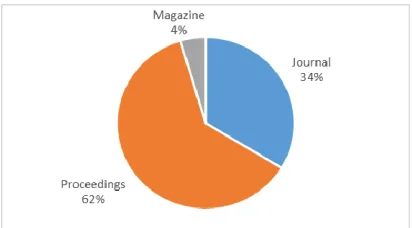
[image:6.612.82.527.89.735.2]We further evaluated the result to give overview of publication trend in the area of data quality research. On average, fifty-four selected articles in related to data quality were produced yearly. Sixty-two percent of these articles were published in conference proceedings. On the other hand, forty-one percent of the selected articles were published in journals and magazine. High percentage in conference proceedings was due to the availability of data quality related conference such as International Conference of Information Quality (ICIQ). High acceptance rate for the conference proceedings compared to journal also contributed to the differences. Figure 2 described the source distribution further.
Figure 2: Source distribution of related articles
We also found out that the number of data quality research articles published from 2010 until 2016 are maintaining the same trend as proposed in [6], [9]. The trend shows that data quality research is still significant and retained the same amount of research articles publication each year. Moreover, this trend may indicate the importance of data quality research. We illustrated the trend in Figure 3.
[image:6.612.315.521.368.482.2]3049 4.DISCUSSION
In this section, we discussed the answers to our research questions. At the end of the discussion, we presented a mapping of data quality research landscape and the research gap available for future data quality research.
4.1 RQ.1 What Are the Topics Being Discussed in Data Quality Research?
[image:7.612.90.301.508.646.2]Data quality research has attracted researchers for many years and thus, the topics of discussion are really broad. We believed that categorization of research topics in data quality are vital to direct researcher attention to the least explored topic. For this reason, we categorized the selected articles according to the topic discussed and classified the research topics into three main areas including data quality impact, technical solution in database area and technical solution in computer science area. As presented in Figure 4, most focus has been given to the technical solution in computer science area. However, only one hundred and twenty-nine research articles focus on data quality impact. It is known that the early stage of data quality research encompassed on the development of data quality knowledge structure [6]. As we are entering the growth stage of data quality research, lower number in data quality impact can be justified. Surprisingly, the numbers of research in technical solution in database area are still low compared to other research areas. We further discussed each topic found within 2010 until 2016 in the next subsection.
Figure 4: Research topic
4.1.1Data quality impact
As shown in Figure 4, a total of one hundred and twenty-nine articles analyze and provided explanation to the impact of data quality. The influences can be further categorized into six different subcategories as described below:
Application usage
Within this subcategory, articles investigate the role of data quality in ensuring success of specific application and proposed ways to measure and improve data quality in specific application including Enterprise Resource Planning (ERP), Business Intelligent System (BIS), Supply Change Management (SCM) and Engineering Asset Management (EAM). From the review, we strongly agreed that high data quality in specific application could increase trust and believability of the application output and further help to ensure success of the specific application usage. For discussion purposes, we highlighted examples in BIS and ERP application in the next paragraph.
A quantitative survey based study was conducted in previous research to understand the correlation between success dimensions in BIS. The research confirmed that information quality played important role in ensuring BIS success and effective data quality management resulted high acceptance of BIS [15], [16]. Data quality capabilities has the same important role in decision environment. The ability of the organization to manage data quality efficiently helps to determine the success of BIS application in decision environment [17] Evidence found from both research justified our earlier suggestion that data quality management is essential in ensuring success of specific application usage. However, in both research, the organizational behavior and its culture in managing data quality is not being fully considered. Level of data quality in organization as we know, reflected by the organization culture towards data quality [18], [19]. Further research could be done to investigate the impact of data quality in different organization culture setup and behavior towards the success of BIS.
3050 quality management. Yet, the ERP application applied in each company could be differed and thus the challenges in managing data quality problem are varied. We believed that modelling the complexity of specific application in large organization helps to determine the critical factors and relationship among them in order to achieve high data quality. Further analysis could be done to analyze the impact of specific application complexity towards data quality level in organization.
It is essential to explore knowledge from the context of specific application usage especially to support data quality initiative within the organization. We believe that more research will be done within this category in the upcoming years as the application such as ERP and SCM will faces new challenges in big data era. As data volumes, data velocity and data variety increase, complexity of specific application as discussed before cannot be avoided.
Organization strategy and policy
Specific strategy and policies for managing data quality within the organization played important role in ensuring high data quality. Within this category, reviewed articles investigated organizational issues, influences factor, policy and suggest the effective strategy to manage data quality within the organization. Additionally, the organization should be able to strategize employees’ task in managing data and should clearly understand its influences towards organizational data quality level. Data quality problem occurred within the organization when employees have different views in data quality dimensions such as timeliness, accuracy and completeness. The differences caused low quality of data product especially when the needs of other employees which tasks are linked cannot be satisfied and being misunderstood. This inability to meet the needs of data user promotes low level of data quality within the organization. Employee empowerment approach [21] resolved the interdependency problem between employee tasks in the organization. The approach proposed that the employee who collected the data should be given responsibility to process the same data. At the same time, organization should encourage collective quality decision to achieve high quality data. Collective quality decision eliminates individual decision and facilitates common understanding of data quality dimensions. In order to further increase
the organization data quality level, a clear goal should be setup to each team and employees. Incentives and rewards should be given to the team and employee who achieved the goal. On the other hand, the strategies outlined in this research have never been applied in a real organization environment. Changes in organization policy and modification in the suggested approach might be essential to adapt with a fast changing organization.
Common understanding of data quality facilitates the organization to strategize business efficiently by avoiding flaws data during decision making. Thus, a proper and well managed data quality policy is needed to create employee awareness when managing data. A data quality metadata (DQM) is one of the example that explained data quality level within the organization. On top of that, DQM also describe data quality according to the organization description. Usage of DQM during strategic decision making improves decision accuracy and decision confidence [22]. However, as DQM usage increased decision time, it is not suitable for task that need to be accomplish urgently. Further enhancement such as DQM visualization [23] can be done to address the limitation of using DQM in urgent task.
Organization expenses and investments information such as organization investment plan and costs are highly valuable to the organization. On the other hand, disclosure of such information might influence positive view towards the organization specifically the aspirations to be more productive, competitive and innovative. Research in [24] investigated the impact of IT investment information disclosure including plans, costs and benefits towards market information quality and factors that encourage managers to disclose such valuable information. Information can be disclosed either in quantitative or qualitative format determined by the assessed risk. This research paves the way for organization to review its information disclosure policy and at the same time to gain more economic value. However, the benefit gains and occurred cost when information being disclosed are varied depends on the context of risk assessment.
Cost and benefit
3051 proposed improvement steps to minimize the effect. In supply chain management, data quality influence the economic benefit of the organization [25]. However, improvements towards data quality required the organization to determine which data quality dimensions that should be improve. Proper study related to the information flow within the organization and data quality dimensions that involved is needed. Furthermore, the identification of data quality dimensions and its relationship is important to minimize the economic effect and further to gain more economic benefit. On the other hand, high data quality does not increased the economic net-benefit of the organizations to the optimum level [26]. However, as this finding is only supported by the assessment of data currency and data completeness dimensions, further evidence from other data quality dimensions is needed to strengthen the findings. As mentioned before, data quality could cause negative impact towards the economic outcome if it is not properly managed. For example, the analysis done in previous research shows that inaccurate project data in the organization cause increment in project cost [27]. As a solution, a filter is used to increase data accuracy in distributed project. However, as the proposed filter required variables that is estimated from the data noise, performance of the filter could be jeopardize in high noise environment as variables are dynamic.
IT management
We believed that attaining high data quality within the organization entail the ability of information technology (IT) employees to understand their role in managing data quality. Research in this area disclosed IT employee roles and factors affecting IT management decision in data quality management.
IT management should be able to exploit the expertise of knowledge workers in order to improve data quality within the organization. Expertise of knowledge workers can be model to enabled task routing during data cleaning [28]. Such routing is important to maximize the accuracy in verifying changes made to data. Modelling the expertise of knowledge workers enable the IT management to determine suitable employee with the right expertise in handling data. However, this approach will not guarantee optimum data quality result as other factors including workload constraint, cost, latency and workers motivations is not considered in the research article. Considering these factors with balanced workload and expertise will help to
improve data quality optimally. Another initiative from the IT management that will positively impact data quality is to appoint a Chief Data Officer (CDO) [29]. Result from this empirical study suggested that CDO appointment improved organization strategic growth and increase the organization data quality capabilities. However, as CDO tenure is not considered in this study, we argued that the duration of appointment could affect the CDO performance and determined result in data quality capabilities.
Organization change/process
Organization employed data quality knowledge to structure and design processes within the organization. This initiative helps to improve data quality and further increase the level of trust to the data they have. Research in this category investigated the relationship between data quality and organization process and its impact.
As example, the development of IT acceptance model within the organizations suggested that information quality dimensions such as usefulness and ease of use are among important factors to determine IT acceptance rate within the organization [30]. Such findings are useful in the organizations process redesign and familiarizing new IT application to the employees. However, the result may not be generalized as the study was done only to nursing staff. Data quality are dependent to the context of the application and for this reason, further study should be conduct on diverse area to generalize the result. In [31], a study to investigate the negative relationship between input accuracy and output accuracy has been conducted. This study examined the effects caused by high input error probability towards the output error probability. From the findings, it is statistically proven that if inputs are incorrect, the output from OR operation are always correct. This finding is important in allocating resources and to design related task in organization. However, we cannot see any evaluation of this finding in real-life settings. Such evaluations will help us to understand the sign of occurrence in real problem.
Online Users (Web, intranet, mobile application, virtual communities)
3052 application and intranet. Articles in this subcategory investigated, measured and highlighted the importance of data quality towards online users. For example, information quality played an important role to determine online users satisfaction compared to interactivity features [32] [33]. Information quality also played important role to influence online users to buy products from social media [34]. However, consideration should also been given to other factors such as users’ computer literacy and online users psychological state as these factors could affect online users in making decision. Previous research as mentioned before does not explained the relationship between computer literacy, psychological state, information quality and it influence against online users.
In mobile application, data quality dimensions such as accuracy and timeliness determined user experienced and continuous usage [35], [36]. Nevertheless, user behaviors and tendency to use mobile application is dynamic. Based on this argument, further research can be conducted by investigating user behavior and information quality effect towards continuance usage of mobile application.
Another study was conducted in [37] to evaluate factors that determined virtual community decision on contributing and consuming information in virtual space. The result suggested that information quality dimensions such as information reliability, objectivity and information format are vital to determine virtual community participation. Information from trusted user are considered as reliable to the virtual community and information that doesn’t meet participant objective such as commercial comments will be ignored. In order to maintain online user participations, information should be posed in a simple format and more freedom should be given to users in expressing their experience. As this study implemented in a large virtual community, smaller size virtual community may not produce the same result as smaller virtual community may know each other well and build up trust easily. In [38], a model was developed to examined social capital dimensions which influenced information quality within virtual community. This study suggested that increasing numbers of information in virtual community will not increase the quality of information. Information quality in virtual community is influenced by relational capital and cognitive capital such as trust, mutual benefit, shared language and shared vision. Though, this study measured limited information
quality dimensions such as reliability, accuracy, timeliness and relevancy.
Data quality also determined user intention in adopting intranet [39]. A model of intranet quality and acceptance has been developed and used in this research to assess collected data. However, this is just a preliminary work in intranet quality and acceptance model. Thus, it may not addressed the real problem in intranet quality and acceptance. More research is needed and should be tested in more than one organization to produce better result.
Big data
There is a major concern to the quality of massive data available in big data technology. The debate between large volume of data and the uncertainty level of quality that the data have are still continue. In [40], an empirical investigation using data mining classification methods has been conducted to analyze data size effect towards data quality problem. The result proved that as data volume increase, possibility to have data quality problem are larger. Nevertheless, the result can still be argued as the dataset used in this experiment are still small compared to what we have in real big data application.
Big data application makes used data with unusual characteristic such as vast volume, high velocity and high variety. In regards to these characteristic, existing data quality initiatives is incapable to efficiently manage data quality as some data quality dimensions such as data completeness and concise presentation has become more important than before [41]. Thus, extension to the existing approach especially in data quality management model and assessment methods is required to support the impact of such changes in data characteristic.
3053 reported as the factor that contribute to the big data quality problem.
4.1.2 Technical solution in database area We found 112 research articles which proposed and discussed data quality in related to database. These articles measured, analyzed and improved data quality in database area. We divided these articles into several subcategories as follows.
Database cleansing
Database cleansing improved data quality by detecting and correcting low quality data. A lot of progress has been seen in this topic with most of the articles trying to automate the database cleaning process and reduced user interventions. As example, USHER, a real time feedback system for data quality improvement during data entry process [43]. USHER make used probabilistic model constructed from the user answers in the online form to enable real time feedback. However, as the user answers played important role in constructing the probability model, cross validation towards the answer can be is very crucial. This important feature was not considered in this research. Another example to reduce user interventions during data cleansing is a reasoning based solution trough ontology [44]. In this approach, conditional functional dependencies (CFD) and conditional inclusion dependencies (CIND) have been used to discover data quality problems. However, constructing the ontology and domain knowledge for reasoning are expensive in term of time and expert involvement. Another approach used a machine learning technique for automatic data correction [45]. This approach learns from user feedback in the cleaning process and further refines its learning model. Future research can be done to extend this research especially by using other dependency rules such as CIND, matching dependencies and matching rules. An algorithm to accurately match database records and repairing them based on conditional functional dependency (CFD) rule and matching dependency (MD) rule was proposed in [46]. However, it is difficult for the user to determine the correct rules to be used.
Database integration and data warehouse
Crowdsourcing can be considered as a new approach in managing data quality in integrated database and data warehouse. In [47], crowdsourcing approach has been proposed to reduce uncertainty in schema matching during database integration. Correspondence correctness
question (CCQ) is used to gathered crowdsourcing feedback. However, there is still quality issues in adopting this approach such as the ability of non-domain expert to clearly understand data and the level of trust in adopting crowdsourced answers. There is a wide challenge in adopting crowdsourcing approach unless we can measure the level of trust in crowdsourced answers.
A belief function theory has been adopted in [48] to assess data reliability in database integration process. In order to resolved inconsistent information and evaluate data reliability, the researcher has proposed a merging technique using maximal coherent subset (MCS). Yet, to gain more information in data reliability, additional sources of information such as user feedback can be considered.
Entity resolution, record linkage
Entity resolution and record linkage is a technique to discover data records related to the same entity [49], [50]. Discovery of related data records enabled us to solve data quality problems such as data inconsistency and data redundancy. However, the quality of the outcome of this approach depends on the technique used to discover related data records. In [51], evaluation of learning based and non-learning based technique for entity resolution has been carried out. The outcome showed that the learning based technique produced more quality result but the execution time is higher compared to non-learning technique. Nevertheless, the experimental setting in this research used a bibliographic data and does not enough to reflect the scalability of learning based technique. Entity resolution in e-commerce data and biological data may need more robust experiment setup.
New era of big data introduced challenges in managing high data velocity environment. Data are rapidly coming and record linkage need to accommodate this new data characteristic. Research in [52] adopted incremental record linkage approach to enabled linkage record update during data arrival. This approach fit the challenges in high data velocity environment. However, to enable the application of this research in big data, the proposed approach should be able to handle unstructured data type such as text.
3054 Data provenance offered information regarding data sources and history of the data which are important and related to data quality dimensions such as accuracy, consistency, completeness and believability [53]. However, provenance information itself are prone to quality problems such as correctness, completeness and relevancy. Research in [53] adhered this problem with an analysis framework for analyzing the quality of provenance. In this framework, technique to analyze annotation, timestamps and structure of provenance traces has been proposed. In [54], a research was conducted to find minimum recovery for missing events in event data based on index and pruning technique. In data provenance analysis, event data played prominent role and inaccurate event data could jeopardize the analysis result. This approach returned a list of possible event recovery and a human intervention is needed to identify accurate recovery solution. Future research should integrate machine learning technique to automate the recovery process and reduce human intervention.
Uncertainty and probabilistic data
Data could be uncertain and probably associated with multiple values. Data quality research in uncertainty and probabilistic type of data has been conducted to find the relationship between these types of data and data quality. In [55], probabilistic target model was used to enable automatic deduplication process and further improved decision in uncertain condition. Another research in [56], discussed the problems in deteminizing probabilistic data. A branch-and-bound algorithm has been proposed which aim to find near optimal solution. Experiments conducted in this research proved that the proposed solution produced high quality result.
Security
Research in this category aims to secure database from unauthorized activity that violates data integrity, confidentiality and availability. In [57], an update certificate has been proposed in order to protect data against improper update. Such approach protected database integrity, control unintentional data update and increase data quality in database. However, in case of multiple update happen, protection from improper update could cause latency in uncertified update detection.
Believability towards data are subjected to a true, real and credible data source [11]. Conversely, data source that are open to attacks, unauthorized alteration and deletion could affect data believability. In order to protect database against intruder and to protect data ownership, a watermarking scheme for relational databases has been proposed in [58]. Although the proposed approach does not degrade data accuracy, this approach is only limited to numerical data type. In a real case, signed data and non-numerical data cannot be excluded. Enhancement to the approach by including signed data and non-numerical data are longed-for.
4.1.3 Technical solution in computer science area
As shown in Figure 3, most of our selected articles proposed data quality technical solution in computer science area. We further categorized the selected articles into nine subcategories as following.
Measurement and Assessment
Many methods have been proposed to measure and assess data quality. For example, score card index [59], Business Process Modelling Notation (BPMN) [60], probability based currency metric [61] and hybrid assessment approach [62]. The notion of these approaches is to evaluate data quality before any improvement being made. The evaluation process is time consuming and required extensive involvement of domain expert especially in a very large collection of data and heterogeneous data format [48], [63]–[68]. As example, the online financial data. In [63], ontology-based framework has been proposed to assess data quality via ontology mapping. In this approach, rectification of duplicated online financial data and missing value has been addressed by using financial knowledge in the ontology. We argued that usage of domain knowledge may not be dynamic enough to accommodate fast changing environment. Furthermore, to enable the application of this research, other data quality dimension such as reliability, consistency and accuracy should be evaluated as well.
3055 in another context of study unless we can confirm that the measurement technique and impact of information volatility remains regardless of the context of study.
Information system
Articles in this category proposed techniques and methods to manage data quality problems within information system. Managing data quality within a complex information system is challenging as multiple sources of data either hardware or software involved. Challenges included analysis and processing large data collection to ensure high quality data. Research in [70] proposed the usage of agent-based middleware to manage data validation and data consistency in Data Management System (DMS) architecture. Yet, this approach is designed only for pervasive environment in mobile health. Further research can be done using this approach in non-pervasive environment.
Web
The web has become dominant resource of information in recent years. Large number of information available in the web increased the user acceptance towards web technology. However, the quality of information contained in the web is doubtful even though the numbers are large. For this reason, data quality research has taking place to investigate, assess and improve the quality level of supplied information. User should be given enough freedom to assess the usefulness of web information by providing enough description regarding the quality of web information [71]. Data fusion method has been applied in [72] which proved the possibility to resolve conflicting web information. Yet, conflicting web information is not just between its sources, but also within data category in a single website. As example, in a health website, data about disease A is accurate but likewise, data about disease B is inaccurate. Such examples are important to improve fusion performance. Empowering web users to estimate the quality of information provided by web are important to avoid inaccurate information being consumed. In [73], Support Vector Regression (SVR) methods has been used to assess information quality in web digital libraries. Ranking features can be considered to assist user selection of high quality information.
Sensor
Sensors have been widely used to collect data in the latest technology of big data and internet-of-things. However, as any other data sources, sensors data are prone to data quality problems such as accuracy. Data quality research in this subcategory proposed methods and techniques to handle data quality problems in sensors data. A Bayesian inferenced-based framework has been proposed in [74] to clean RFID data. This approach takes advantage on data redundancy problem in RFID to improve data accuracy. Alternately, research in [64] combined statistical analysis using Dynamic Time Wrapping (DTW) and ontology for outliers detection in wireless sensor data stream. In this approach, the ontology is used to represent expert domain knowledge and facilitate in reasoning the outliers. Both research used different technique in managing data quality problem in sensor data. DTW in [64] is used to compute similarity between sensor whereas Bayesian inference used in [74] to exploit sensor redundancy. However, validation of approach proposed in [64] has never been done in a real environment. Experimental evaluation using test dataset and generated outliers in [64] is not sufficient.
Protocol and standard
Protocol and standard impact data quality level within the organization in many ways. For example, confusion in the data format during data exchange can create data consistency and interpretability problem to the organization. Standards are needed to govern data exchange by specifying consensus understanding between organizations. Research in data quality has to fill in the gap by providing solution to improve standards and quality levels within the organization. The implementation of ISO 8000-1x0 for master data exchange using web services has been reported in [75]. As part of the research, service architecture, I8K, has been proposed which included assessment and certification of data quality level in terms of accuracy and completeness. However, more data quality dimensions could be added to the proposed approach. Data quality dimensions such as consistency and timeliness could help the organization to use the exchanged data efficiently and further reduce the cost for data processing.
3056 been proposed. The proposed framework has not provided redundancy identification in data standard. Redundancy identification can be used to exploit redundancy for completeness.
Within this category, we also found one article that can be sub categorized into network and five articles in security area. However, as the numbers of related articles is small, further description of these sub categories will not be discussed.
4.2 RQ.2 What Types of Research Has Been Carried Out In Each Data Quality Topics?
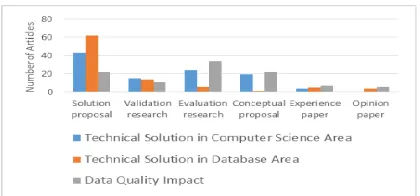
[image:14.612.313.523.241.339.2]In this study, we found 140 articles, proposed a novel solution or at least an essential extension of an existing technique. This enormous number remark the advancement and progress in data quality research within 2010-2016. Meanwhile, 77 articles were examined and evaluated various existing approaches in data quality research. The differences between number of published research articles in these two categories are vast, and supported our claim that data quality research is still relevant and in positive growth. Articles that presented existing techniques, tools, models and conceptual frameworks or validated techniques, tools and models that are still not in practice are lower compared to the first two categories. Only 22 articles are categorized as opinion paper. Opinion papers were mostly found in data quality conference proceedings and discussed data quality techniques or tools based on personal opinion. We presented the findings of RQ.2 in Figure 5.
Figure 5: Types of research and numbers of related articles
In order to provide answer for RQ.2, we found that types of research are related to the topics being discussed in the articles. A huge number in solution proposal research type are contributed by articles that discussed technical solution in computer science and database area. Whereas, articles that
discussed data quality impact mostly adopted evaluation research type. Assessment of data quality impact and investigation of data quality dimensions relationship using existing models and theory can be the reason of this finding. Existing models and theory are used to support the findings of the investigation or assessment. Surprisingly, we found that conceptual proposals are dominated by articles in data quality impact and technical solution in computer science research topics. We presented the number of articles according to the type of research and research topics in Figure 6.
Figure 6: Distribution between types of research and data quality research topic
4.3 RQ.3 What Are the Types of Contribution Being Proposed So Far in Each of Data Quality Research Topics?
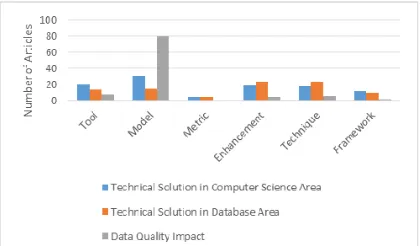
Most of the research done within 2010 until 2016 contributed to data quality model. 139 articles investigated data quality dimensions relationship, highlighted the challenges in managing data quality and evaluated existing data quality approaches. Besides, a moderate number of articles contributed to the development of data quality techniques, tools and the enhancement of existing data quality frameworks, models and methods. From this study, we also found 36 articles that proposed a data quality framework. Figure 7 depicted the contribution based on its category.
[image:14.612.89.299.497.625.2] [image:14.612.312.524.557.685.2]3057 We see less attention is given in data quality metrics as only 22 research articles were found related. Metrics were used in data quality research to measure accuracy, timeliness and other data quality dimensions. For example, in [61], a currency metrics based on probability theory has been proposed to assess data currency. In data quality assessment, metrics is used to highlight the root causes of data quality problems and to determine necessary action to improve data quality. Surprisingly, we see most of articles in data quality impact research topics adopted existing metrics in their research.
[image:15.612.320.517.115.399.2]We found that most of the articles that contributed in model category discussed data quality impact. This are expected as the articles in data quality impact research topics measured, analyzed and explained data quality impact. In order to measure, analyze and explain the impact, investigations of data quality dimension relationship have been conducted. Whereas, articles that discussed technical solution in database area mostly proposed technique or enhancement of existing frameworks, models or methods. The findings are shown in Figure 8.
Figure 8: Distribution between articles contribution and data quality research topic
4.4 RQ. 4 What Kind of Research Methods Being Used in Data Quality Research?
[image:15.612.91.301.392.515.2]Data quality research covered wide topics of discussion in various domains as addressed in RQ.1. On top of that, a number of research methods and techniques have been adopted to suit the needs of the problem being solved in data quality research articles. Table 8 summarized data quality research methods according to data quality research topics.
Table 8: List of research method in data quality research topic
Research Methods
Data Quality Impact
Technical Solution in Computer Science
Area
Technical Solution in
Database Area
Empirical / /
Qualitative / / /
Case Study / / /
Theory and Formal Proofs
/
Econometric /
Quantitative / /
Mathematical
Modelling / /
Statistical
Analysis / / /
Experimental / / /
Design
Science / /
Action
Research / /
Ethnography / Delphi
Method /
3058 Qualitative, case study, statistical analysis and experimental research methods are common in data quality research that discussed data quality impact, technical solution in computer science area and technical solution in database area. Qualitative research methods has been used to gathered in-depth knowledge about human behavior or phenomenon via qualitative methods such as interviews, focus group or observation and to analyze factors that affect data quality within the organization [12]. In data quality research, qualitative methods are important to gathered knowledge from data users and stakeholders [25] especially when knowledge about data are inadequate. However, the generalization of the
resulted studies is highly depended on the participant selection methods being used. Factors such as size of participants and participants’ background is important. Whereas, case study is used to analyze data quality problems faced in real environment by the specific organization, group or individual. For example, in [20], case study has been used to investigate data quality problems in multinational manufacturer in China. However, case study limited the generalization of the findings and further implementation of the proposed solution required more attention [20], [42], [77].
The abovementioned limitation, nevertheless, does not limit the knowledge acquisition of data quality problems, issues and challenges from the conducted case study [78]. On the other hand, case study has also been used to evaluate and validate proposed solution in data quality research. For example, in [79], a case study has been used to validate ontology-based data quality framework for data stream application. The validation of proposed solution using case study enabled real-life exploration on limitation and constraint to implement proposed solution. Another common method used in data quality research is statistical analysis. Statistical analysis has been used to find correlation between data quality dimensions, to
[image:16.612.97.525.267.546.2]identify data quality problems and also to improve data quality within the organization. In [80], structural equation modelling (SEM) has been used to validate the model of relationship between information quality, trust and risk perceptions. Statistical analysis also has been used in experimental research to evaluate effects. For example, in [81], analysis of variance (ANOVA) has been adopted to analyze effect of problem complexity in data mining classification algorithms towards data quality.
3059 Other research methods such as empirical, quantitative, design science and action research are used in data quality research that discussed data quality impact and technical solution in computer science area. Empirical research methods gathered
empirical evidence using observation technique such as experiments, case study, survey and search engine query to gain knowledge about the studied problem. For example, in [82], empirical study to evaluate online health information quality has been conducted using data gathered from search engine query result. Quantitative research in data quality analyzed quantifiable data using statistical analysis and mathematical modelling to identify data quality problems and to probe causes of data quality problems. Quantifiable data in data quality research usually collected from questionnaire and web survey. In [60], a questionnaire has been designed to evaluate data quality dimensions using score. Quantifiable data gathered from the questionnaire is then used to construct a radar plot which explained scores for each data quality dimensions. On the other hands, design science has been adopted in [83] to build quality model for semantic IS standards. In this approach, the model has been evaluated and improved using survey results in repeated cycles. Design science research approach involved rigorous processes with users’ evaluation to improve proposed solution [84]. Action research has been adopted in [85] to design and evaluated a process for Total Information Risk Management (TIRM). Three research phase including process design, process testing and process refinement in real environment and lastly, the application of the process in a case study. Both research methods are suitable for data quality research especially when
assessment of contextual data quality problem such as relevancy, timeliness and completeness [3] are needed. Iterative communication with users helps to define data quality problem and solution refinement.
[image:17.612.94.522.153.351.2]Whereas, theory and formal proofs, econometric, mathematical modelling and ethnography has been used in investigating data quality impact. For example in [86], an error dominance theory has been proposed to explain data accuracy effects in decision making. Mathematical techniques have been used to provide proof in the proposed theory. Whereas, econometric approach has been used in [26] to assess the effect of data quality management towards economic outcomes such as utility, cost and net-benefit. Econometric approach makes used statistical and mathematical techniques to answer questions regarding economic. Knowledge of the relationship between data quality and economic value are important to the organization in determining suitable action to be taken to manage data quality and to minimize impact to the organization cost. In [21], mathematical modelling has been used to proof the proposed guidelines for organizational data quality policies setup. Mathematical modelling is one of the methods available in quantitative research approach. Research in data quality also adopted ethnography approach to study behavior in specific environment or context. For example, in [87], ethnography approach has been used to analyze issues in forming master data management (MDM) initiatives.
3060 A small number of articles that discussed technical solution in computer science area adopted Delphi method during the validation process. In [88], a Delphi method has been used to validate information quality dimensions ranking. Delphi method is a group communication process involving experts and included multiple iterations of expert involvement and feedback [89]. In data quality research, user and domain expert feedback are important as expectation regarding same data quality dimensions could be differed.
Looking further, computer science techniques such as data mining, machine learning and fuzzy logic were mostly used to assess and improved data quality in the articles that proposed technical solution in computer science and database area. Whereas, constraint based technique such as currency constraint and conditional functional dependencies [90], [91] was adopted only in research that discussed technical solution in database area. Constraint based technique were mostly utilized in database cleaning. For example, constraint such as relaxed functional dependencies (RFDS) has been used to identified missing values and data redundancy [92]. It is clearly shown in Figure 9, twenty-five percent of articles that discussed technical solution in database area and twelve percent of articles that discussed technical solution in computer science area adopted data mining technique. Data mining technique unveiled important information from dataset especially during database data cleaning using techniques such as blocking strategy [93], [94] , affinity propagation and affinity scores [95], [96] and association rule mining [97]. Nevertheless, research in [81], [98], [99] adopted data mining technique to assess data quality in software engineering and financial data. We also found that, twenty percent of articles discussed technical solution in database area and seventeen percent articles that discussed technical solution in computer science area adopted machine learning technique for database cleansing [100] and entity resolution [49]. Additionally, machine learning techniques such as Bayesian network [43] and hidden Markov model [101] also been used for database cleansing. Machine leaning also used to assess information quality in web [73]. In [102], Support Vector Machine (SVM) was used to categorized online product review according to review quality. Furthermore, machine learning technique such as Bayesian inference was used in [74] for sensor data cleansing. Machine learning technique in data quality allowed automated data quality management which reduced human
intervention for result verification. However, the effectiveness of machine learning technique is depended to the classification and learning technique used.
Within 2010-2016 we could see new techniques such as crowdsourcing and semantic web technologies being used to improve data quality in database and generally in computer sciences domain such as sensors, web and information system. Knowledge gathered from crowdsourcing technique used to improve data quality in data warehouse [65], [103]. Whereas, crowdsourcing also been proposed in [104] as a method to improve information quality. However, usage of crowdsourcing technique has attracted researcher to assess and measure the quality of knowledge gathered. Seven percent of the articles that discussed technical solution in database area and three percent of articles from technical solution in computer science area used crowdsourcing technique. Semantic web technology such as ontology and Resource Description Framework (RDF) enabled automated reasoning during database cleansing as proposed in [44], [63], [105]. In sensors, ontology adoption allowed domain expert to provide knowledge for effective outlier detection process [64]. Percentage of articles that employed semantic web technology is higher compared to crowdsourcing.
Twenty-one percent of the articles that discussed technical solution in computer science area adopted semantic web technology in their research. The percentage is higher than other techniques such as machine learning, natural language processing, data mining, neural network, statistical techniques, image processing, data fusion, fuzzy logic, crowdsourcing and watermarking. Natural language processing is important in assessing the quality of unstructured data such as names and online review. For example in [106], sentence level LDA (SLDA) has been adopted to address inconsistency issue in online review data. Another example is the adoption of phonetic and string matching technique in [107]. Natural language processing technique is used in this research to suggest possible substitute for misspelled name.