8145
INITIAL CONCEPT OF
COUNTENANCE
MODEL BASED ON
ANEKA
-
TRI HITA KARANA
IN EVALUATING COMPUTER
LEARNING QUALITY AND STUDENTS’ CHARACTER
1DEWA GEDE HENDRA DIVAYANA, 2I PUTU WISNA ARIAWAN, 3AGUS ADIARTA, 4I WAYAN SUWENDRA, 5I MADE SUNDAYANA
1 Department of Information Technology Education, Universitas Pendidikan Ganesha, Indonesia
2Department of Mathematics Education, Universitas Pendidikan Ganesha, Indonesia
3Department of Electrical Education, Universitas Pendidikan Ganesha, Indonesia
4Department of Hinduism Education, STKIP Agama Hindu Singaraja, Indonesia
5Department of Evaluation in Education, STIKES Buleleng, Indonesia
Correspondence E-mail: [email protected]
ABSTRACT
The evaluation of computer learning character and quality that were learned by students (especially student of the vocational school of information technology) are still in very minimum grade currently. The problems arose when teachers assumed that student competencies have able to measured through just in their cognitive abilities, even though student competencies is also supported by the positive character which they have. Based on these, the purpose of this research was to determine the countenance evaluation model that is integrated with the ANEKA concept and the Tri Hita Karana concept, so that it can be used to comprehensively assess of student cognitive abilities and character in computer learning process. The initial location of this research was on one of the vocational school of information technology in Bali Province that was SMK TI Udayana. The subjects that were involved in this research there were four people, those were two informatics engineering experts and two education evaluation experts. This research was carried out for three years using Borg and Gall development method, wherein the first year research was carried out the conceptual development of evaluation model, in the second year the research will make an evaluation application and field testing, while on the third year the research will doing an operational field testing and dissemination of applications which is ready to be used on a wide scale. Especially in this first-year research, the development of evaluation model’s conceptual design was done used a data collection tool in the form of questionnaires, documentation picture, observation guidelines, and interview guidelines. The data those had been collected then analyzed by using quantitative descriptive analysis techniques. The results of this research indicated the design of countenance evaluation model based on ANEKA-Tri Hita Karana, and those had been tested by experts with effectiveness level of 88%, so it is ready to be used as a basis in making the physical design of the application in the next second-year research.
Keywords: ANEKA, Countenance Model, Tri Hita Karana, Computer Learning
1. INTRODUCTION
Currently competency and achievement students are often measured in terms of their cognitive capability without regard to aspects of their personality. The impact of this is that many students who have high achievements are found to be not good characters. Based on the result of the interview and observation that had be made on 2018 at some vocational school of information technology in Bali [1], indicate that some students who have high ability in operating computers and internet are more likely to abuse the computer
8146 do things that violate norms and rules because depression in consequence of a bullying culture, the emergence of motorcycle gang activity and promiscuity that started from friendship and introduction on facebook, and other negative things. The results of other research that reinforce the statement that the lack of caring, discipline and sense of responsibility of students in consequence of internet abuse is research that was conducted by Sanditaria, Fitri, and Mardhiyah [3] which states that the indifferent attitude for surrounding environment and lazy culture of learning, the low sense of responsibility to do duty of school that is given by the teacher was begins to occur since students begin to recognize the existence of online games and until they experience addiction to the game. Paying attention to the negative impacts arising from the misuse of information technology, it is necessary to be examined and evaluated in depth to find aspects that need special attention in improving the quality of computer learning while maintaining the student positive characters in the learning process. Evaluation activities are very appropriate and important to do to obtain appropriate recommendations in determining aspects that will need to be refined to realize the learning that have a certain caliber, quality and character. The statement is in accordance with several opinions of several researchers, those are: Mak [4], Oktarina, Widiyanto, and Soekardi [5], Goodwin, Piazza, and Rozin [6], Urban and Trochim [7], Kokoszka and Smith [8], Zumbach and Funke [9], Belousova and Pishchik [10], Ahmed and Bhatti [11], Martinez, Schweig, and Goldschmidt [12], Galustyan [13], Dvorianchikov, et al [14], Machaka [15], Mapitsa and Khumalo [16], Tsai [17], Son, Marshal, and Bur [18], Darmayanti and Wibowo [19], Huang and Hu [20], Urban, et al [21], Rosell-aguilar and Qian [22], Ulusoy [23], which in principle states that evaluation activities are carried out to get the right recommendations for improvement of the object being studied/evaluated. There are several evaluation models that can be used to evaluate the quality of computer learning and student characters at some vocational school of information technology in Bali, those are: CSE-UCLA model, goal free model, goal oriented model, responsive model, countenancemodel, and discrepancy model. One of the most suitable models that gone use is the countenance model, because this model evaluates the learning quality and student character based on the description matrix and judgement matrix. The description matrix is used to indicate how far the expected goals can be realized, while the judgement
matrix is used to determine the appropriate recommendations based on the results of an assessment that refers to the standards that have been set in determining the quality of student learning and character.
In general, the countenance model can be used to evaluate the quality from computer learning and character of students in vocational school of information technology. When it is seen from the characteristics of Balinese culture that continues to put forward constancy Bali culture in the dynamics of life and the development of information technology in the 4.0 industrial revolution era, this model has not been able to conduct a thorough evaluation on the quality from computer learning and character of students on vocational school of information technology in Bali. Therefore, it needs a new innovation by modifying the countenance model. Modification is done by inserting the ANEKA concept into evaluation aspects of the description matrix and by inserting the Tri Hita Karana concept in the evaluation standard contained in the judgement matrix.
Based on the obstacles and ideas of a new innovation in modifying the countenance model, then the formulation of the research problem is “how is the initial concept of countenance evaluation model that is integrated with ANEKA concept and Tri Hita Karana concept that is able to be used to evaluate the cognitive abilities and character of students on vocational school of information technology in computer learning process?”.
8147 applied by college student through thinking, attitudes, and behavior in daily life, so that they lead to positive change for themselves and others that are called as akhlakul karimah values. It is a praiseworthy character and is ideally owned by a college student who has a character. However, the obstacle that was found in the research which was conducted by Hidayat is there are still many college students who have not applied the akhalkul karimah values optimally. This is because many college students do not understand the meaning of akhlakul karimsh, they have not formed a personal awareness to practice it, there are no examples that can be exemplified, and there are no official criteria for evaluating character education.
Referring to the formulation of the problem and the research behind this research, then the researchers are interested in researching a modified countenance evaluation model by integrating the ANEKA concepts and Tri Hita Karana concepts into the description matrix and judgement matrix so as to produce an effective evaluation model to evaluate the quality from computer learning and character of students in vocational school of information technology.
2. RESEARCH METHODOLOGY
This study used a development approach, because it aims to develop a new innovation in the form of a countenance evaluation model that is integrated with the ANEKA concepts and Tri Hita Karana. The method will be used to develop evaluation model is research and development method with 10 stages of the Borg and Gall model [26], it consist of: (1) Research and Information Collecting, (2) Planning, (3) Develop Preliminary Form of Product, (4) Preliminary Field Test, (5) Main Product Revision, (6) Main Field Test, (7) Operational Product Revision, (8) Operational Field Testing, (9) Final Product Revision, (10) Dissemination and Implementation. This research will be carried out for 3 years starting from year 2018 up to 2020, and specifically in year 2018 the research only in 5 stages were carried out, that is: (1) Research and Information Collecting, (2) Planning, (3) Develop Preliminary Form of Product, (4) Preliminary Field Test, and (5) Main Product Revision.
The research subjects were determined using purposive sampling technique, namely the parties that are directly related to the process of computer learning at vocational school of information technology in Bali Province. The reason for using
purposive sampling technique because this technique is very useful for finding deep information from parties who have interest and knowledge about the object being evaluated. The subjects that are involved in conducting initial trial in the 2018 research were 4 people, namely: 2 education experts and 2 informatics experts. The location of this research was carried out at vocational school of information technology in 5 Regencies, namely: Tabanan, Gianyar, Buleleng, Badung, and Denpasar. Data collection tools those were used in this research are questionnaires, observation guidelines, interview guidelines, and documentation. Questionnaires were used to obtain quantitative data from the results of the initial trials conducted by experts. Interview guidelines and observation guidelines are used to obtain qualitative data about the quality of learning and character at some vocational school of information technology in the province of Bali as initial evidence of why this research is important to do. Documentation photos are used as secondary data to confirm the arguments and results of the analysis in this research.
This 2018 study was analyzed accurately using an analytical technique which is often referred to as quantitative descriptive, by using a percentage descriptive calculation approach to obtain the results of the assessment percentage which can then be used as a basis for interpreting the trial results of the evaluation model that was developed. Calculating descriptive percentages can be replaced by using the formula that was found by Subana and Sudrajat [27], this follows.
∑ (Answer x Weight of Each Choice)
Percentage = --- *100% (1) n x Highest Weight
Notes: ∑ = Amount
n = Number of all questionnaire items
The formula that can be used to process the calculation of the entire subject percentage is as follows.
F
Percentage = --- (2)
N
Notes:
F = Total percentage of subjects N = Number of subjects
8148 Table 1: Percentage of Effectiveness Rate Conversion by
Eleven Scales
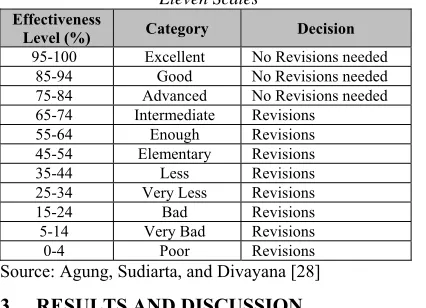
Effectiveness
Level (%) Category Decision
95-100 Excellent No Revisions needed
85-94 Good No Revisions needed
75-84 Advanced No Revisions needed 65-74 Intermediate Revisions
55-64 Enough Revisions
45-54 Elementary Revisions
35-44 Less Revisions
25-34 Very Less Revisions
15-24 Bad Revisions
5-14 Very Bad Revisions
0-4 Poor Revisions
Source: Agung, Sudiarta, and Divayana [28] 3. RESULTS AND DISCUSSION 3.1 Results
Appropriate with Borg and Gall stages specifically used in the study of 2018, some of the research results can be explained as follows. a. Research results at research and information
collecting stage
[image:4.612.90.303.110.264.2]At this stage there were several aspects and at once the items of the countenance evaluation model instrument which was integration between ANEKA concept and Tri Hita Karana which was used to evaluate the quality from computer learning and students character of vocational school of information technology in Bali Province. These aspects can be seen on Table 2.
Table 2: The Aspects of Countenance Model Evaluation Based on ANEKA-Tri Hita Karana
No
Countenance Evaluation Model
ANEKA-Tri
Hita Karana Evaluation Aspect Description Matrix Description Matrix ANEKA Component ANEKA Component
1. Accountability Parahyangan Honest Responsibilit y
Consistent
Pawongan Prioritize
public interests Participative
Palemahan Clarity of
Target Neutral 2. Nationalism Parahyangan Work ethic
Confidence Transparent Not greedy Wise
Pawongan Tolerant
Deliberation Mutual help
Palemahan Kinship
Mutual Cooperation
No
Countenance Evaluation Model
ANEKA-Tri
Hita Karana Evaluation Aspect Description Matrix Description Matrix ANEKA Component ANEKA Component
3. Public Ethics Parahyangan High integrity Respect Obey on the Command
Pawongan Careful
Polite
Palemahan Obey on the
Regulations 4. Quality
Commitment Parahyangan
Efficiency
Pawongan Effectiveness
Innovation
Palemahan Quality
Oriented 5. Anti-Corruption Parahyangan Independent
Fair Brave
Pawongan Care
Palemahan Hard
working Discipline Simple
Source: Divayana, Ariawan, and Adiarta [29]
b. The research results at planning stage
At this stage was obtained data those were related to the planning of labor needs and the time that was needed to make a design of countenance evaluation model based on ANEKA-Tri Hita Karana. The estimated amount of human resources and time that was needed in making the model design up to main product revision stages the design of ANEKA-based countenance evaluation model that is integrated with the Tri Hita Karana concept can be seen on Table 3.
Table 3: The Human Resources and Time Needs in Producing a Design of Countenance Evaluation Model
Based on ANEKA-Tri Hita Karana Up to the Main Product Revision
No Activities
Amount of Human Resources (Person) Time (Day)
1. Determination of evaluation components 3 6
2. The making of model design 3 7
3. The making of preliminary field test instrument 3 7
4. Implementation of the preliminary field test 4 10
5. Implementation of main product revision 3 12
Total 16 42
8149 c. The research results at develop preliminary
form of product stage
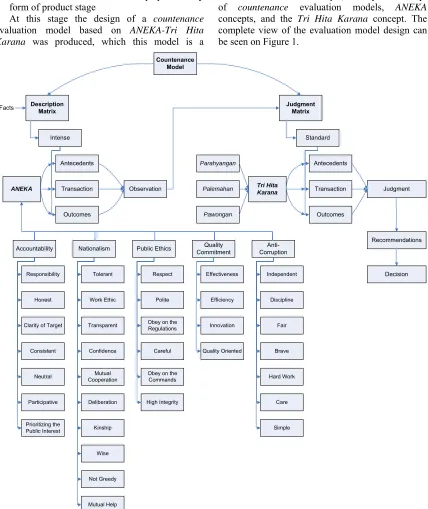
At this stage the design of a countenance evaluation model based on ANEKA-Tri Hita Karana was produced, which this model is a
combination of three concepts, namely the concept
of countenance evaluation models, ANEKA
concepts, and the Tri Hita Karana concept. The complete view of the evaluation model design can be seen on Figure 1.
Countenance Model
Description Matrix
Judgment Matrix Facts
Intense Standard
Antecedents
Transaction
Outcomes ANEKA
Accountability Nationalism Public Ethics CommitmentQuality Corruption
Anti-Responsibility
Honest
Clarity of Target
Consistent
Neutral
Participative Prioritizing the Public Interest
Tolerant
Work Ethic
Transparent
Confidence Mutual Cooperation
Deliberation
Kinship
Wise
Not Greedy
Mutual Help
Respect
Polite
Obey on the Regulations
Careful Obey on the Commands
High Integrity
Effectiveness
Efficiency
Innovation
Quality Oriented
Independent
Discipline
Fair
Brave
Hard Work
Care
Simple
Observation
Antecedents
Transaction
Outcomes Tri Hita
Karana
Parahyangan
Palemahan
Pawongan
Judgment
Recommendations
[image:5.612.95.523.104.613.2]Decision
Figure 1: Design of Countenance Evaluation Model Based on ANEKA-Tri Hita Karana
Figure 1 above indicates the design of a countenance model modified with the ANEKA concept and the Tri Hita Karana concept, which the model can be used optimally to evaluate the quality from computer learning and students character of vocational school of information technology, especially those in Bali Province. The model consists of two main components, namely the
8150 used to evaluate the process of running a program. Outcomes were used to evaluate the impact of running a program. Three sub components were adopted the ANEKA concept, those were: accountability, nationalism, public ethics, quality commitment, and anti-corruption to obtain accurate and optimal measures of computer learning quality for students. Accountability aspect was consisted of: responsibility, honest, clarity of target, consistent, neutral, participative, and prioritizing the public interest. Nationalism aspect was consisted of: tolerant, work ethic, transparent, confidence, mutual cooperation, deliberation, the kinship, a wise, not greedy, and mutual help. Public ethics aspects, consist of: respect, polite, obey on the regulations, careful, obey on commands, and high integrity. Quality commitment, consist of: effectiveness, efficiency, innovation, and quality oriented. Anti-corruption aspect, consist of: independent, discipline, fair, brave, hard work, care, and simple.
The results of processing and evaluation of facts through three components (antecedents, transactions, and outcomes) those were contained in the description matrix were then observed. The results of observation were then compared and interpreted into the judgment matrix using 3
standard judgment, namely: antecedent’s standard, transaction standard, and outcomes standard. Three standard judgment needs to adopt the Tri Hita Karana concept, which consists of Parahyangan, Palemahan, and Pawongan to make it easier to obtain information about improving the positive character of students on vocational school of information technology.
Interpretation of observations result are using 3 standard judgments that have been integrated with the Tri Hita Karana concept can produce several recommendations that are appropriate and later make it easier in making a decision about the quality of computer learning and character improvement of students on vocational school of information technology.
d. The research results at preliminary field test stage
In the preliminary field test of the countenance evaluation model based on ANEKA-Tri Hita Karana, it involved two IT education experts and two education evaluation experts. The tool was used to conduct the testing by experts was in the form of a questionnaire that containing by 10 questions. The results of the preliminary field test can be seen on Table 4.
Table 4: The Results of Preliminary Test by Four Experts
Items-
Respondents
IT Education Expert-1 Education Evaluation
Expert-1 IT Education Expert-2
Education Evaluation Expert-2
1 5 5 5 5
2 4 4 4 5
3 4 4 4 5
4 5 5 4 4
5 5 5 4 4
6 4 5 4 4
7 4 4 5 4
8 4 4 4 5
9 4 4 4 5
10 4 5 4 5
43 45 42 46
Effectiveness 86.00%% 90.00% 84.00% 92.00%
Average 88.00%
Source: Divayana, et al [30]
Referring to Table 4 above it can be seen that the assessment which was given to countenance model design based on ANEKA-Tri Hita Karana in preliminary field test showed the level of effectiveness that was included in good categories by information technology education expert-1. The effectiveness level was categorized as good by education evaluation expert-1, advanced category
by information technology education expert-2, and good category by education evaluation expert-2.
e. The research results at main product revision stage
8151 good, but there are some thought/suggestions for improvement that was provided by experts to improve the design of the model, so that later the model which is developed can be more optimal in providing decision. There are some of these suggestions, can be seen on Table 5.
Table 5: Suggestion for Improvement that Provide by Four Experts
No Expert Suggestion
1 IT Education
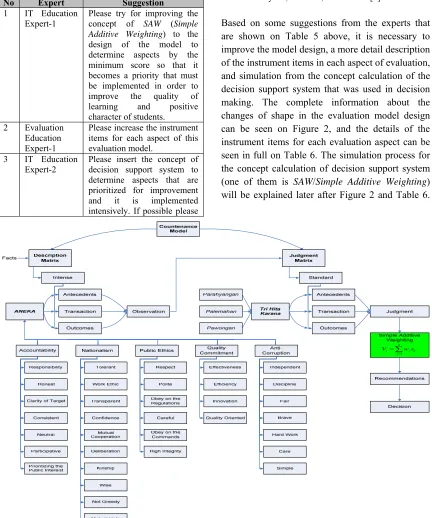
Expert-1 Please try for improving the concept of SAW (Simple Additive Weighting) to the
design of the model to determine aspects by the minimum score so that it becomes a priority that must be implemented in order to improve the quality of learning and positive character of students. 2 Evaluation
Education Expert-1
Please increase the instrument items for each aspect of this evaluation model.
3 IT Education
Expert-2 Please insert the concept of decision support system to determine aspects that are prioritized for improvement and it is implemented intensively. If possible please
No Expert Suggestion
also improve a simulation for the concept calculation process of the decision support system that is used. 4 Evaluation
Education Expert-2
Please explain in detail the instrument items for each aspect of each evaluation component.
Source: Divayana, Ariawan, and Adiarta [1]
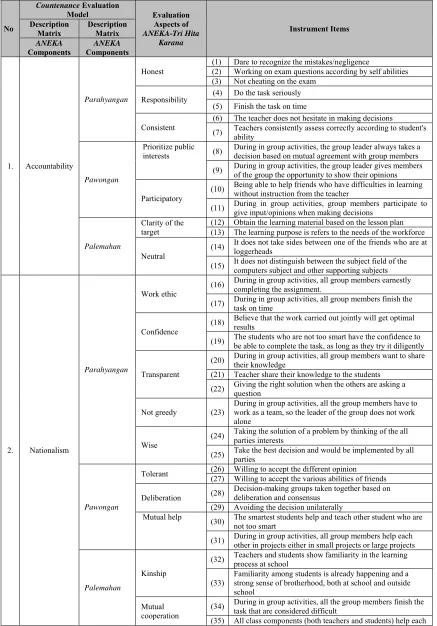
Based on some suggestions from the experts that are shown on Table 5 above, it is necessary to improve the model design, a more detail description of the instrument items in each aspect of evaluation, and simulation from the concept calculation of the decision support system that was used in decision making. The complete information about the changes of shape in the evaluation model design can be seen on Figure 2, and the details of the instrument items for each evaluation aspect can be seen in full on Table 6. The simulation process for the concept calculation of decision support system (one of them is SAW/Simple Additive Weighting) will be explained later after Figure 2 and Table 6.
n
j ij j
i wr
V
1
[image:7.612.92.524.197.715.2]8152
Table 6: The Instrument Items for Each Evaluation Aspect Model Countenance Based on ANEKA-Tri Hita Karana
No
Countenance Evaluation
Model Evaluation
Aspects of
ANEKA-Tri Hita
Karana
Instrument Items Description
Matrix Description Matrix
ANEKA
Components
ANEKA
Components
1. Accountability
Parahyangan
Honest
(1) Dare to recognize the mistakes/negligence
(2) Working on exam questions according by self abilities (3) Not cheating on the exam
Responsibility (4) Do the task seriously (5) Finish the task on time
Consistent
(6) The teacher does not hesitate in making decisions
(7) Teachers consistently assess correctly according to student's ability
Pawongan
Prioritize public
interests (8)
During in group activities, the group leader always takes a decision based on mutual agreement with group members (9) During in group activities, the group leader gives members of the group the opportunity to show their opinions
Participatory
(10) Being able to help friends who have difficulties in learning without instruction from the teacher
(11) During in group activities, group members participate to give input/opinions when making decisions
Palemahan
Clarity of the target
(12) Obtain the learning material based on the lesson plan (13) The learning purpose is refers to the needs of the workforce
Neutral
(14) It does not take sides between one of the friends who are at loggerheads
(15) It does not distinguish between the subject field of the computers subject and other supporting subjects
2. Nationalism
Parahyangan
Work ethic
(16) During in group activities, all group members earnestly completing the assignment.
(17) During in group activities, all group members finish the task on time
Confidence
(18) Believe that the work carried out jointly will get optimal results
(19) The students who are not too smart have the confidence to be able to complete the task, as long as they try it diligently
Transparent
(20) During in group activities, all group members want to share their knowledge
(21) Teacher share their knowledge to the students (22) Giving the right solution when the others are asking a question
Not greedy (23)
During in group activities, all the group members have to work as a team, so the leader of the group does not work alone
Wise
(24) Taking the solution of a problem by thinking of the all parties interests
(25) Take the best decision and would be implemented by all parties
Pawongan
Tolerant (26) Willing to accept the different opinion (27) Willing to accept the various abilities of friends
Deliberation (28)
Decision-making groups taken together based on deliberation and consensus
(29) Avoiding the decision unilaterally
Mutual help (30) The smartest students help and teach other student who are not too smart
(31) During in group activities, all group members help each other in projects either in small projects or large projects
Palemahan
Kinship
(32) Teachers and students show familiarity in the learning process at school
(33) Familiarity among students is already happening and a strong sense of brotherhood, both at school and outside school
Mutual cooperation
8153
No
Countenance Evaluation
Model Evaluation
Aspects of
ANEKA-Tri Hita
Karana
Instrument Items Description
Matrix
Description Matrix
ANEKA
Components Components ANEKA
others to create a conducive learning situation
3. Public Ethics
Parahyangan
High integrity
(36) Keeping of the school reputation
(37) Always defend the school reputation if there is an insult to the school
Respect
(38) Giving a greeting during the learning process and settlement process of learning
(39) Always ask the teacher for permission when you want to leave the class
(40) Give a smile when meeting the teacher / older person Obey the
Command (41)
Carrying out as well as possible the instructions that is given by the teacher during the learning process (42) Listen and do the positive advice that is given by the teacher
Pawongan
Careful
(43) Careful in expressing opinions
(44) Careful and critical in learning the influences that come from outside
Polite
(45) Express the opinion politely
(46) Avoiding the using harsh words when communicating with teachers or friends
Palemahan Obey on the Regulations (47) Follow the rules (48) Avoiding the things that against the rules
4. Commitment Quality
Parahyangan Efficiency
(49) Students are able to develop a computer application that is able to minimize the operating expenses of a company
(50) Students are able to develop computer applications that can minimize the use of resources /energize
Pawongan
Effectiveness (51)
Students are able to develop computer applications that help the government in making decisions both quickly and accurately
Innovation
(52) Students are able to develop smart applications
(53) Students are able to develop wireless computer applications that can be accessed anytime and anywhere
Palemahan Quality oriented
(54)
Students are able to develop dynamic and responsive computer applications so that they can interact to the changes
(55) Students are able to develop the computer applications that is sustainable and integrated
5. Corruption
Anti-Parahyangan
Independent (56) Finishing the exam by self ability (57) Working the own tasks maximally
Fair
(58) The teachers fair in giving score to the students (59) Students use the same right to get knowledge
(60) The Punishment from teacher based on level of the mistake
Brave (61)
Always ready to report if there is a cheating while on the exam
(62) Always ready to admit the self mistake
Pawongan Care (63)
Pay attention to things that might be cheating in the learning process
(64) Noticing the supporting facilities of learning
Palemahan
Hard Working (65)
Persistently in answering exam questions without being influenced by the invitation of friends to cheat (66) Never give up to complete a difficult task
Discipline
(67) Never skip school during the learning process (68) Doing the task in accordance with the guidelines and instructions that is given by the teacher
Simple (69) Dressed neatly and according to the rules (70) It does not exhibit excessive cleverness
Source: Divayana, Ariawan, and Adiarta [29]
The following are described the simulation of the calculation process SAW method (Simple Additive Weighting), which is one of the methods Decision
8154 of performance ratings on each alternative of all attributes. The SAW method requires the decision matrix
normalization process (X) to a scale that can be compared with all available alternative ratings [31]. The formula for normalization is as follows:
(3)
The rij is the performance rating that is normalized of the Ai alternative to the Cj attribute; i = 1,2, ..., m and j = 1,2, ..., n. The preference value for each alternative (Vi) is given as:
(4)
[image:10.612.90.520.154.432.2] [image:10.612.102.456.474.735.2]A larger Vi value indicates that Ai's alternative is preferred. It is as for the complete about calculating process to determine aspects of priority improvement can be explained as follows.
Table 7: Initial Data of SAW Calculation Simulation
Tri Hita Karana Aspects
ANEKA Components
Accountability Nationalism Public Ethics Commitment Quality Corruption
Anti-A Parahyangan
A1 Tolerance of prayer procedures among students of different religions 4.50 4.75 4.50 4.75 4.75
A2 Maintaining a culture of diligent prayer 4.75 4.75 4.75 5.00 4.75
B Pawongan
B1 Work together 4.75 4.50 4.50 4.25 4.50
B2 Understand the character of others 4.50 4.25 4.25 4.50 4.25
B3 Mutual maintaining the orderly and the comfort of the learning process 4.75 4.50 4.25 4.25 4.25
B4 Mutual respect 4.75 4.75 4.50 4.25 4.50
C Palemahan
C1 Keeping cleanliness and wholeness of the school’s facilities 4.25 4.25 4.50 4.25 4.75
C2 Keeping cleanliness of the school’s environment 4.25 4.50 4.75 4.25 4.25
Source: Divayana, et al [30]
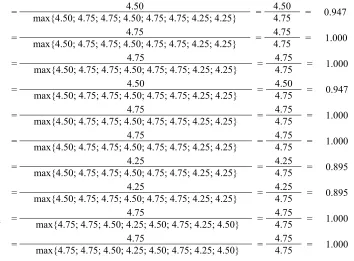
Based on the data that is shown on Table 7 above and considering that all the ANEKA components are included in the profit attribute, so the normalization calculation process can be carried out as follows.
r11 = max{4.50; 4.75; 4.75; 4.50; 4.75; 4.75; 4.25; 4.25} 4.50 = 4.50 4.75 = 0.947
r21 = max{4.50; 4.75; 4.75; 4.50; 4.75; 4.75; 4.25; 4.25} 4.75 = 4.75 4.75 = 1.000
r31 = max{4.50; 4.75; 4.75; 4.50; 4.75; 4.75; 4.25; 4.25} 4.75 = 4.75 4.75 = 1.000
r41 = max{4.50; 4.75; 4.75; 4.50; 4.75; 4.75; 4.25; 4.25} 4.50 = 4.50 4.75 = 0.947
r51 = max{4.50; 4.75; 4.75; 4.50; 4.75; 4.75; 4.25; 4.25} 4.75 = 4.75 4.75 = 1.000
r61 = max{4.50; 4.75; 4.75; 4.50; 4.75; 4.75; 4.25; 4.25} 4.75 = 4.75 4.75 = 1.000
r71 = max{4.50; 4.75; 4.75; 4.50; 4.75; 4.75; 4.25; 4.25} 4.25 = 4.25 4.75 = 0.895
r81 = max{4.50; 4.75; 4.75; 4.50; 4.75; 4.75; 4.25; 4.25} 4.25 = 4.25 4.75 = 0.895
r12 = max{4.75; 4.75; 4.50; 4.25; 4.50; 4.75; 4.25; 4.50} 4.75 = 4.75 4.75 = 1.000
r22 = max{4.75; 4.75; 4.50; 4.25; 4.50; 4.75; 4.25; 4.50} 4.75 = 4.75 4.75 = 1.000
nj
ij j
i
w
r
V
1
attribute cost
a is j if
attribute benefit
a is j
ij ij i
ij i
ij
ij
x x Min
if x Max
x
8155
r32 = max{4.75; 4.75; 4.50; 4.25; 4.50; 4.75; 4.25; 4.50} 4.50 = 4.50 4.75 = 0.947
r42 = max{4.75; 4.75; 4.50; 4.25; 4.50; 4.75; 4.25; 4.50} 4.25 = 4.25 4.75 = 0.895
r52 = max{4.75; 4.75; 4.50; 4.25; 4.50; 4.75; 4.25; 4.50} 4.50 = 4.50 4.75 = 0.947
r62 = max{4.75; 4.75; 4.50; 4.25; 4.50; 4.75; 4.25; 4.50} 4.75 = 4.75 4.75 = 1.000
r72 = max{4.75; 4.75; 4.50; 4.25; 4.50; 4.75; 4.25; 4.50} 4.25 = 4.25 4.75 = 0.895
r82 = max{4.75; 4.75; 4.50; 4.25; 4.50; 4.75; 4.25; 4.50} 4.50 = 4.75 4.75 = 0.947
r13 = max{4.50; 4.75; 4.50; 4.25; 4.25; 4.50; 4.50; 4.75} 4.50 = 4.50 4.75 = 0.947
r23 = max{4.50; 4.75; 4.50; 4.25; 4.25; 4.50; 4.50; 4.75} 4.75 = 4.75 4.75 = 1.000
r33 = max{4.50; 4.75; 4.50; 4.25; 4.25; 4.50; 4.50; 4.75} 4.50 = 4.50 4.75 = 0.947
r43 = max{4.50; 4.75; 4.50; 4.25; 4.25; 4.50; 4.50; 4.75} 4.25 = 4.25 4.75 = 0.895
r53 = max{4.50; 4.75; 4.50; 4.25; 4.25; 4.50; 4.50; 4.75} 4.25 = 4.25 4.75 = 0.895
r63 = max{4.50; 4.75; 4.50; 4.25; 4.25; 4.50; 4.50; 4.75} 4.50 = 4.50 4.75 = 0.947
r73 = max{4.50; 4.75; 4.50; 4.25; 4.25; 4.50; 4.50; 4.75} 4.50 = 4.50 4.75 = 0.947
r83 = max{4.50; 4.75; 4.50; 4.25; 4.25; 4.50; 4.50; 4.75} 4.75 = 4.75 4.75 = 1.000
r14 = max{4.75; 5.00; 4.25; 4.50; 4.25; 4.25; 4.25; 4.25} 4.75 = 4.75 5.00 = 0.950
r24 = max{4.75; 5.00; 4.25; 4.50; 4.25; 4.25; 4.25; 4.25} 5.00 = 5.00 5.00 = 1.000
r34 = max{4.75; 5.00; 4.25; 4.50; 4.25; 4.25; 4.25; 4.25} 4.25 = 4.25 5.00 = 0.850
r44 = max{4.75; 5.00; 4.25; 4.50; 4.25; 4.25; 4.25; 4.25} 4.50 = 4.50 5.00 = 0.900
r54 = max{4.75; 5.00; 4.25; 4.50; 4.25; 4.25; 4.25; 4.25} 4.25 = 4.25 5.00 = 0.850
r64 = max{4.75; 5.00; 4.25; 4.50; 4.25; 4.25; 4.25; 4.25} 4.25 = 4.25 5.00 = 0.850
r74 = max{4.75; 5.00; 4.25; 4.50; 4.25; 4.25; 4.25; 4.25} 4.25 = 4.25 5.00 = 0.850
r84 = max{4.75; 5.00; 4.25; 4.50; 4.25; 4.25; 4.25; 4.25} 4.25 = 4.25 5.00 = 0.850
r15 = max{4.75; 4.75; 4.50; 4.25; 4.25; 4.50; 4.75; 4.25} 4.75 = 4.75 4.75 = 1.000
r25 = max{4.75; 4.75; 4.50; 4.25; 4.25; 4.50; 4.75; 4.25} 4.75 = 4.75 4.75 = 1.000
8156
r45 = max{4.75; 4.75; 4.50; 4.25; 4.25; 4.50; 4.75; 4.25} 4.25 = 4.25 4.75 = 0.895
r55 = max{4.75; 4.75; 4.50; 4.25; 4.25; 4.50; 4.75; 4.25} 4.25 = 4.25 4.75 = 0.895
r65 = max{4.75; 4.75; 4.50; 4.25; 4.25; 4.50; 4.75; 4.25} 4.50 = 4.50 4.75 = 0.947
r75 = max{4.75; 4.75; 4.50; 4.25; 4.25; 4.50; 4.75; 4.25} 4.75 = 4.75 4.75 = 1.000
r85 = max{4.75; 4.75; 4.50; 4.25; 4.25; 4.50; 4.75; 4.25} 4.25 = 4.25 4.75 = 0.895
Based on the normalization results, then the conversion of each value is carried out into the following matrix.
0.947 1.000 0.947 0.950 1.000 1.000 1.000 1.000 1.000 1.000 1.000 0.947 0.947 0.850 0.947
R = 0.947 1.000 0.895 0.947 0.895 0.895 0.900 0.850 0.895 0.895
1.000 1.000 0.947 0.850 0.947 0.895 0.895 0.947 0.850 1.000 0.895 0.947 1.000 0.850 0.895
The next step is to do the ranking process using data from the R matrix and the weight of decision makers for each ANEKA component with the following details:
- The value of accountability component = 20%
- The value of nationalism component = 20%
- The value of public ethics component = 20%
- The value of quality commitment component = 20%
- The value of anti-corruption component = 20%
It as for the ranking process, the full description can be explained as follows.
V1 = (0.2)(0.947) + (0.2)(1.000) + (0.2)(0.947) + (0.2)(0.950) + (0.2)(1.000) = 0.969
V2 = (0.2)(1.000) + (0.2)(1.000) + (0.2)(1.000) + (0.2)(1.000) + (0.2)(1.000) = 1.000
V3 = (0.2)(1.000) + (0.2)(0.947) + (0.2)(0.947) + (0.2)(0.850) + (0.2)(0.947) = 0.938
V4 = (0.2)(0.947) + (0.2)(0.895) + (0.2)(0.895) + (0.2)(0.900) + (0.2)(0.895) = 0.906
V5 = (0.2)(1.000) + (0.2)(0.947) + (0.2)(0.895) + (0.2)(0.850) + (0.2)(0.895) = 0.917
V6 = (0.2)(1.000) + (0.2)(1.000) + (0.2)(0.947) + (0.2)(0.850) + (0.2)(0.947) = 0.949
V7 = (0.2)(0.895) + (0.2)(0.895) + (0.2)(0.947) + (0.2)(0.850) + (0.2)(1.000) = 0.917
V8 = (0.2)(0.895) + (0.2)(0.947) + (0.2)(1.000) + (0.2)(0.850) + (0.2)(0.895) = 0.917
From the ranking results, it is found that the aspect of the character that needs to be a priority for improvement is V4 (aspect of “understand the character of others” which is in one part of the Tri Hita Karana concept that is pawongan). Besides that, if referring to the aspect of V4 which is a priority aspect in supporting the character improvement, then the determinant component of learning quality that needs to be prioritized is nationalism, public ethics, and anti-corruption (which is contained in the ANEKA component).
3.2 Discussion
In this section the researcher will specifically discuss a number of things that have not been done in the research results. These are some of the following.
8157 relationship with each other, and they are able to maintain a harmonious relationship with the natural environments. If it is related with this research, the Tri Hita Karana concept can be used as a basis for measuring the character of the students at vocational school of information technology in following the learning process.
The average effectiveness percentage is 88.00% was obtained through a trial of the evaluation model design that has been shown earlier in Table 4 and when it is compared with the Percentage of Effectiveness Rate Conversion by Eleven Scales that was shown in Table 1, it can be said that the design of the evaluation model is included in the good category, so there is no need to make major improvements to the model design. Nevertheless, some of the advice that has been given by the experts is very good for the improvement of the evaluation models design toward a better especially in the case of adopting the SAW method (Simple Additive Weighting), so as to facilitate this evaluation model in determining the minimum aspects that become the priority improvements in order to realize the improvement of the quality from computer learning and positive character of students in vocational school of information technology.
The simulation results of the SAW method calculation (Simple Additive Weighting) which has been shown previously has been able to show high accuracy in determining the minimum aspects that become the priority improvements. Priority aspects in realizing character improvement are determined based on the minimum value of Tri Hita Karana aspect, while the components that become the priority in realizing the improvement of learning quality for students at vocational school of information technology are determined based on the minimum value of the ANEKA component that is integrated from the acquisition from the minimum aspect of Tri Hita Karana.
This research is an effective solution to answer some of the weaknesses that was found in previous research that was conducted by Arnyana, et al and Hidayat. The solution is by demonstrating the innovation of the countenance evaluation model based on ANEKA-Tri Hita Karana that is able to indicate in detail the aspects that is used to evaluate students cognitive abilities so that it can be found out the quality level of computer learning and evaluate students attitudes so that students positive character can be identified. Those solution distinguishes this research with previous research, namely in the case of an appropriate evaluation
model used to evaluate the character and quality of computer learning for vocational students of information technology. Although this research has some advantages, in reality there are still obstacles that are found, namely the calculation process is still limited of using only one SAW method, whereas if combined with other methods will get more accurate and optimal results.
4. CONCLUSIONS
The design of countenance evaluation model based on ANEKA-Tri Hita Karana has been well-made and tested from competent experts, so that the effectiveness level is generally good because it has been able to combine well between the concept of countenance evaluation models, ANEKA concepts, and the Tri Hita Karana concept comprehensively. This model also gets improvement by inserting the SAW method (Simple Additive Weighting) to facilitate the calculation process of determining aspects that become the priority improvements, so that later can optimize the evaluation process from cognitive abilities and character of students on vocational school of information technology who follow the computer learning process. The recommendations that can be offered to solve the obstacles that found in this study are “it can produce more accurate calculations from the results of previous calculations by trying to mix the SAW method with other decision support system methods”.
ACKNOWLEDGMENTS
The researchers expressed their deepest gratitude to the Directorate of Research and Community Service, the Ministry of Research, Technology and Higher Education of the Indonesia Republic, who has given funding in this research. The researcher also expressed his gratitude to the academic community, all parties who provided moral and spiritual support so that this research could be completed properly and on time.
REFERENCES
[1] D.G.H. Divayana, I.P.W. Ariawan, and A. Adiarta. Pengembangan Model Evaluasi Countenance Berbasis Nilai ANEKA Yang Diintegrasikan Dengan Konsep Tri Hita Karana Dalam Rangka Peningkatan Karakter dan Kualitas Belajar Komputer Siswa SMK TI di Provinsi Bali. Singaraja: LPPM Universitas Pendidikan Ganesha, 2018.
8158 Penguatan Individu di Era Revolusi Informasi, pp. 311–319, 2017.
[3] W. Sanditaria, S.Y.R. Fitri, and A.Mardhiyah. Adiksi Bermain Game Online Pada Anak Usia Sekolah di Warung Internet Penyedia Game
Online Jatinangor Sumedang. Bandung:
Fakultas Ilmu Keperawatan Universitas Padjadjaran, 2017.
[4] W.S. Mak, “Evaluation of a Moral and Character Education Group for Primary School Students,” Discovery: SS Student E-journal, vol. 3, pp. 142–164, 2014.
[5]
N. Oktarina, Widiyanto, and Soekardi, “Character Education Evaluation Model Based on School Culture for Elementary School,” IOSR Journal of Research & Method in Education, vol. 5, no. 5, pp. 11–14, 2015. [6] G.P. Goodwin, J. Piazza, and P. Rozin,
“Moral Character Predominates in Person Perception and Evaluation”, Journal of Personality and Social Psychology, vol. 106, no. 1, pp. 148–168, 2014.
[7] J.B. Urban, and W.M. Trochim, “Advancing Evaluation of Character Building Programs”, Journal of Character Education, vol. 13, no. 2, pp.13–27, 2017.
[8] C. Kokoszka, and J. Smith, “Fostering Character Education in An Urban Early Childhood Setting”, Journal of Character Education, vol.12, no.1, pp. 69–74, 2016. [9] J. Zumbach, and J. Funke, “Influences of
Mood on Academic Course Evaluations,” Practical Assessment, Research & Evaluation, vol. 19, no. 4, pp. 1–12, 2014.
[10] A. Belousova, and V. Pishchik, “Technique of Thinking Style Evaluating,” International Journal of Cognitive Research in Science, Engineering and Education, vol. 3, no. 2, pp. 1–8, 2015.
[11] I. Ahmed, and A. Bhatti, “Design and Implementation of Performance Metrics for Evaluation of Assessments Data,” International Journal of Evaluation and Research in Education, vol. 5, no. 3, pp. 235– 245, 2016.
[12] J.F. Martinez, J. Schweig, and P. Goldschmidt, “Approaches for Combining Multiple Measures of Teacher Performance: Reliability, Validity, and Implications for Evaluation Policy,” Educational Evaluation and Policy Analysis, vol. 38, no. 4, pp. 738– 756, 2016.
[13] O.V. Galustyan, “Some Methodological Aspects of the Evaluation of Students’ Educational Achievements at University,”
International Journal of Cognitive Research in Science, Engineering and Education, vol. 5, no. 1, pp. 43–48, 2017.
[14] N.V. Dvorianchikov, V.V. Delibalt, A.V. Degtyaryov, E.G. Dozortseva, R.V. Chirkina, V.A. Pimonov, M.G. Debolsky, and D.A. Malkin, “Evaluation of Cognitive Functions, Personality and Regulatory Sphere in Minors With Deviant and Delinquent Behavior Within the Authority of the Psychological, Medical and Educational Committee,” International Journal of Cognitive Research in Science, Engineering and Education, vol. 5, no. 2, pp. 107–118, 2017.
[15] R.K. Machaka, “The Method, Rights and Resources Model for Evaluation of the Effectiveness of Environmental Impact Assessment Systems,” African Evaluation Journal, vol. 5, no. 2, pp. 1–8, 2017.
[16] C.B. Mapitsa, and L. Khumalo, “Diagnosing Monitoring and Evaluation Capacity in Africa,” African Evaluation Journal, vol. 6, no. 1, pp. 1–10, 2018.
[17] K. Tsai, “An Empirical Examination of the Relationships among Creativity, the Evaluation of Creative Products, and Cognitive Style Among Chinese Undergraduates,” International Journal of Cognitive Research in Science, Engineering and Education, vol. 6, no. 1, 53–60, 2018. [18] L. Son, Marshal, and M. Bur, “Empirical
Evaluation of Variation of Orifice Blocking Ratio in A Tuned Liquid Column Damper Using Frequency Response Function Measurement,” International Journal on Advanced Science, Engineering and Information Technology, vol. 8, no. 2, pp. 489–494, 2018.
[19] S.E. Darmayanti, and U.B. Wibowo, “Evaluasi Program Pendidikan Karakter di Sekolah Dasar Kabupaten Kulon Progo,” Jurnal Prima Edukasia, vol. 2, no. 2, pp. 223– 234, 2014.
[20] X. Huang, and Z. Hu, “On the Validity of Educational Evaluation and Its Construction,” Higher Education Studies, vol. 5, no. 4, pp. 99–105, 2015.
[21] J.B. Urban, M.R. Linver, J. Thompson, R. Davidson, D. Lorimer, “Evaluating Youth Character Development Programs Using Evolutionary Evaluation and the Systems Evaluation Protocol,” Applied Developmental Science, vol. 22, no. 4, pp. 245–257, 2018. [22] F. Rosell-aguilar, and K. Qian, “Design and
8159 Teach Chinese Characters,” JALT CALL Journal, vol. 11, no. 1, pp. 19–40, 2015. [23] M. Ulusoy, “Pre-Service Teachers’
Retrospective and Prospective Evaluations: Program, Self, and Teaching Profession,” International Journal of Progressive Education, vol. 11, no. 1, pp. 59–72, 2015. [24] I.B.P. Arnyana, I.W. Sadia, I.K. Suma, and
D.G.H. Divayana, “Determination of Effectiveness of Evaluation Results on School Culture and Character of Junior High School Students Using Character Assessment Instruments with the Local Wisdom of Bali Based on Mobile Phone,” Journal of Theoretical and Applied Information Technology, vol. 95, no. 20, pp. 5348–5359, 2017.
[25] A. Hidayat, “Persepsi dan Perilaku Mahasiswa Dalam Pendidikan Karakter (Studi Deskripsi di Fakultas Keguruan dan Ilmu Pendidikan Universitas Mathla’ul Anwar Banten Tahun 2013)”, Jurnal Etika dan Pekerti, vol. 1, no. 2, pp. 1–12, 2013.
[26] W.R. Borg, and M.D. Gall. Educational Research: An Introduction, Fifth Edition. New York, USA: Longman, 2008.
[27] M. Subana, and Sudrajat. Dasar-dasar Penelitian Ilmiah. Bandung, Indonesia: CV. Pustaka Pelajar, 2001.
[28] A.A.G. Agung, I.G.P. Sudiarta, and D.G.H. Divayana, “The Quality Evaluation of School Management Model Based on Balinese Local
Wisdom Using Weighted Product
Calculation”, Journal of Theoretical and Applied Information Technology, vol. 96, no. 19, pp. 6570–6579, 2018.
[29] D.G.H. Divayana, I.P.W. Ariawan, and A. Adiarta, “Validitas dan Reliabilitas Instrumen Evaluasi Countenance Berbasis ANEKA-Tri Hita Karana,” Prosiding Seminar Nasional Pendidikan Teknik Informatika (SENAPATI) Ke-9, pp. 44–50, 2018.
[30] D.G.H. Divayana, I.P.W. Ariawan, A. Adiarta, D.P. Parmiti, I.W.E. Mahendra, and N.N. Parmithi, “Development of ANEKA-Based Countenance Model Integrated with Tri Hita Karana-SAW in Evaluating Student’s Character and Quality of Computer Learning in Bali,” Journal of Engineering and Applied Sciences, vol. 13, no. 15, pp. 6303–6315, 2018.