ORIGINAL RESEARCH ARTICLE
THE SYSTEMATIC MAPPING OF THE PRODUCTION OF THESES AND DISSERTATIONS ABOUT THE
NEW FOREST CODE
*1
Alexandre Junior de Souza Menezes,
2Adrielle Cristina de Souza Costa,
3Ana Cristina Barbosa de
Oliveira,
4Angelita Rosa de Oliveira Rocha and
2Roseli Ramos de Oliveira
1
Mestre em Ecologia Humana e Gestão Socioambiental, pela Universidade do Estado da Bahia – UNEB/DTCS,
campus III – Juazeiro – BA
2
Departamento de Tecnologia e Ciências Sociais –UNEB/DTCS, campus III – Juazeiro -BA
4Mestra em Ecologia Humana e Gestão Socioambiental, pela UNEB, campus VIII – Paulo Afonso -BA
3Mestranda em Ecologia Humana e Gestão Socioambiental, pela UNEB/DTCS, campus III – Juazeiro -BA
ARTICLE INFO ABSTRACT
We propose with the writing of this text, a bibliographical survey, of the literature of the theses and dissertations type, through the catalog of CAPES, in order to understand the scientific production through graduate programs, about the new code forestry that came into force in 2012. The main objective of this work is to do a survey of master's and doctoral products in the last five years, in the national territory, after the last update. I use the principles of systemic review so that the work can take shape and analysis. In this sense, it is a method of bibliographical research using as methodology the systematic review, which seeks in a structured, organized and systematized way, to find scientific papers of impact that can serve as a basis for future work. To set up a systematic review survey, some criteria should be followed, including reference texts and standards, for the development of the study, then having the well-delimited research object, inclusion and exclusion criteria, search and ultimately defined the main databases to be searched. Thus the systemic review is a fundamental step for a scientific investigation, serving as a guide for the development of future studies, where we can systematize and analyze how studies are found in that area. For this research, I will use the thesis and dissertations bank of CAPES. As initial results, more than 500 papers were found, after applying the inclusion criteria and repeated works, restoring 38 works between theses and dissertations, to compose the portfolio in the period between 2012 and 2017. These works point, in a brief analysis, that the studies that deal with this theme are focused on the dimension of theories that support this area, as well as constructing reflections on the implementation processes of the new law, after approval, as well as critiques and evaluations of the construction process and contemporary demands.
Copyright © 2019,MENEZES, A. J. S. This is an open access article distributed under the Creative Commons Attribution License, which permits unrestricted use, distribution, and reproduction in any medium, provided the original work is properly cited.
INTRODUCTION
In recent years, the number of academic production has grown rapidly, due to the opening of several Postgraduate Programs (PPG), be they masters and doctorates in Brazil and the world (CIRANI et al, 2015), tripling academic production and bringing new research perspectives, in which it only contributes to the development of the country.However, with this increase of studies developed by the PPG, some care should be highlighted, to avoid repetition of studies or, weak
*Correspondingauthor: Alexandre Junior de Souza Menezes,
Mestre em Ecologia Humana e Gestão Socioambiental, pela Universidade do Estado da Bahia – UNEB.
study developed or when it is wanted a survey of a type of investigation, it is indicated that the studies before being initiated , a bibliographical research is done, aiming to find the differential to be researched, or even works that will contribute to the study to be developed. In some areas of knowledge the development of research becomes an important tool to demonstrate the negative and positive points evidenced by the same. In this perspective, I make a cut for the social sciences applied, in the field of environmental law, more accurate with the new forest code and its amendments in 2012. Also known as the law number 12.651, from the changes that have been causing controversy, especially in the legal context, the arguments are diverse, ranging from the principle of
ISSN: 2230-9926
International Journal of Development Research
Vol. 09, Issue, 04, pp. 27107-27114, April, 2019
Article History: Received 17th January, 2019
Received in revised form 20th February, 2019
Accepted 22nd March, 2019
Published online 29th April, 2019
Available online at http://www.journalijdr.com
Citation: MENEZES, A. J. S, et al. 2019. “The systematic mapping of the production of theses and dissertations about the new forest code”, International Journal of Development Research, 09, (04), 27107-27114.
RESEARCH ARTICLE
OPEN ACCESS
Key Words:
Forest code, Law 12.651, New forest code,
innovation, based on the need to achieve technological advances and the foundations of the globalized world and the second ground in the fact that many claimed the legislative lag of the old Diploma. The centrality of the recast proposes to guarantee the fundamental right to an environmentally balanced environment. Among the several changes made and proved, some controversial, among them the extension of the Permanent Preservation Areas - APPs, changes in the Legal Reserve (RL) and Amnesty grant. Like this,[...] the ordinary legislator inserted in the reform of the mentioned diploma the parameters of sustainability that are being implemented to improve the world situation so as to at least leave a reasonably habitable environment for future generations. But despite this good intention of the legislature, what we have are heated and endless discussions about the unconstitutionality of the new Brazilian Forest Code due to the retroaction of the environmental law to achieve the need for recovery of the areas of permanent preservation and Legal Reserve. (ALVES, 2013, s / p).
Based on the federal constitution of 1988 and the study of Alves, we can affirm that the environment as an untouchable right makes this a fundamental right, whose essential core can never be removed under penalty of elimination of the right to the environment balanced and guarantor of the healthy quality of life (SOUZA, 2014).In dialogue with the previous discussion, taking into account that the new forest code was approved in 2012 and we have already five years in force, it is necessary to understand how the scientific production on the subject has been constructed, I propose a systematization of studies that deal with the processes of academic production in what concerns the knowledge produced in the field of environmental law, which can organized and systematized facilitate the reflection and organization of these contents in order to contribute to the better understanding. Thus, the present study aims to develop a structured research in the new forest code, drawing a study that seeks to know and expand the discussion already developed, since the primary studies and analyzes carried out by specialists only point to the legal retrogression, with the changes, besides taking stock of what has been discussed after its approval. For this study, I use the theoretical principles in the studies of ANTUNES, 2004; MARTINS, 2007; MILARÉ, 2003; SILVA, 2004; FIORILLO, 2013; TELLES do VALLE, 2010.Thus, the text is organized in topics, where I present in a first moment the contextualization, which is structured in two subtopics, with the first, raising the historical and theoretical framework of the forest code, then another structuring and explaining the step by step of the realizing and reinforcing the research model addressed, besides detailing, where it specifies the selected bases, the inclusion and exclusion criteria; then a second topic is done approach the result, called portfolio, with a table with all the works selected by the criteria and end the conclusion, making a brief analysis of the works found and arguing the need for further studies in this field.
Contextualization
This session aims to broaden the discussion around law 12.651, also known as the forest code and how it was designed and all its reformulation process. Next, we will focus on the methodological structuring, in order to carry out a bibliographical research, which seeks to systematize the work already done, on the law, starting from the last five years, which marks the reformulation of the new forest code.
The Construction of the Theme: "Ecological Law - is the set of techniques, rules and legal instruments systematized and informed by appropriate principles that aim at the discipline of behavior related to the environment." (ANTUNES, 2004, p. 06). The author, referring to the legal protection of the environment, refers to what we call ecological law, also called environmental law, which is a set of techniques, rules and legal instruments organically structured to ensure behavior that does not the minimum sanity of the environment. For this assertion, which the previous author confirms to us, it was necessary to understand that environmental history studies show that socio-environmental processes and problems had become an unavoidable concern and the disciplinary centralities of the environment ceased to be a monopoly of ecologists and geographers, to become an interdisciplinary research theme. all scientists began to dedicate more effort to the production of a renewed "environmental knowledge" (MARTINS, 2007, p.14). However, in the legal context, it is not easy to define the environment, as well warned (MILARÉ 2003: 165), "the environment belongs to one of those categories whose content is more easily intuited than definable, because of the richness and complexity of the (Freire, 2000, p.17) "the environment is the natural universe that, in fact or potentially, exerts influence on living beings" (SILVA, 2004, p.20) "encompassing all nature, artificial, and original, as well as related cultural goods, thus comprising soil, water, air, flora, natural beauties, historical, artistic, tourist, landscape and archaeological heritage, "and (FIORILLO, 2013, "the definition of the environment is broad, and it should be noted that the legislator has chosen to bring an indeterminate legal concept in order to create a positive space for incidence of the norm."
The range of environmental concepts defined by
environmental law is probably a challenge for the legal field, making it difficult to analyze this universe of concepts and interpretations that can be generated. The definition of Silva (2004, p.20), since the anthropocentric and ecocentric vision of the schools of environmental thought is overcome, it is clear that the environment must be considered as a whole, in a global way, just as it is the protection of art. 225 of the Federal Constitution. However, in order to reach the current level of legal apparatus, in favor of nature, we go through several stages and processes for the current scenario. The first federal norm emphasized in the field of Environmental Law, according to Antunes (2013, p.9) was Decree No. 4,421, dated December 28, 1921, creating the Brazilian Forest Service, but twelve years later, Environmental Law in Brazil was codified. In 1934, the first Brazilian Forest Code was written, with the approval of Decree nº 23.793, of January 23, 1934. According to Telles Do Valle (2010, p. 349), "Getúlio Vargas, when he sanctioned it, was concerned only with guarantee the reserves of firewood (the 25% of forest immune to cutting in each property, which later was called the legal reserve - RL). "The Brazilian Forest Code did not represent a dramatic and sudden state intervention on private property, according to Antunes, the proposal...
and deliberate resistance" (TELLES do VALLE, 2010, p. "The failures of the Forest Code soon became evident ... in this way, the displeasure of part of the population with the failures of the Code of 1934, caused that, as early as 1950, the President of the Republic sent a new project proposal to the National Congress "Daniel de Carvalho Project" (AHRENS, 2005). It is understood that punctual changes could invigorate the code and put it into operation. It was only in 1962 that a new forest regulation was reformulated and completed and approved in 1965, through Law no. 4,771 / 1965. Thus, until 2000, the law changed, correcting some flaws or creating more restrictions, becoming, in the expression of Antunes (2013, p.9), a "patchwork quilt" without any internal coherence or systematization, characteristics of the normative codification. Telles do Valle (2010, p.352), summarized that:
[...] in 2000 the Forest Code underwent another profound reform, not its objectives, [...] inadvertently effected by a provisional measure that increased the legal reserve in the Amazon to 80% of the area of the property, and not of a pre-conceived organic project. The edition of the MP ended up generating a wave of dissatisfaction, which caused the disagreements with the other points of the law to surface, which made it impossible to keep it as it was. After a severe fall of the arm between ruralists and environmentalists, the latter, with the massive support of Brazilian society, succeeded in having a progressive reform in Brazil approved by another MP (something totally inappropriate to deal with a structuring law). Within the scope of the National Environment Council - CONAMA, which made some of its instruments more flexible while improving several of its definitions. The current forest code is considered the fourth major federal law to discipline the use of Brazilian forests (ANTUNES, 2013, TELLES do VALLE, 2010). The aforementioned was issued with a veto in his art. 1, with criticism in the lack of coherence of the legal text. The veto message is based on the idea that the original wording of the device did not accurately indicate the parameters for interpretation and enforcement. (ANTUNES, 2013, page 8).
Finally, the New Forest Code was controversial in its textual structure, expressly revoking Law 4.771 / 65 (former Forest Code), amended by Provisional Measure 571/2012, later converted into Law 12,727, of October 17, 2012, for another one benefits a series of degraders that negatively impacted the vegetation on their properties until July 22, 2008. Thus, the approval of the New Forest Code was marked by controversy and heated debates, not always with the necessary exemption and analysis. Thus, as the previous studies point out, the history of the creation until the present day of the legislations that govern the environmental theme, especially the forest code, was pointed out as a controversial creation and needed more medium and long term studies for a greater
understanding and understanding of the possible
consequences. For this it is necessary of scientific studies, that allows a greater systematic understanding for the development of the same. For this, the systematic review of the literature is a way of evaluating the work accomplished by the graduate programs in Brazil.
Methodological Construction: I believe that this type of research activity is of the utmost importance. In this sense, the literature review has several objectives, among which it is possible to learn more about a certain area of knowledge and it also facilitates the identification and selection of methods for
the development of the research, besides providing inputs for the writing of scientific academic work and in this case, the condition of knowing other possible universes for the planning and control of production. In this way it is possible to understand that according to Targino (1995, p.12):
[...] systematic and safe methods, which can be considered conclusive in certain circumstances. That is, these explanatory ecosystems are not definitive and immutable, since they are part of an uninterrupted process of research, which mak es science a dynamic, continuous, cumulative social institution. In this way, with the advancement of information and communication technologies and the increase of scientific production, databases have emerged that can be defined as the informational supports composed of articles and scientific works elaborated by specialized organizations in the various areas of knowledge. For this reason, what is most commonly occurring is Internet search and databases that have scientific credibility, using search engines to locate bibliographic material. Because literature review is a prerequisite for the performance of any and all research, with respect to which bibliographic research is a fundamental step before the elaboration or development of a study. It is worth noting that this step can not be random, so it implies a set of procedures for the construction of the research protocol (LIMA, MIOTO, 2007).
Because there are a number of possibilities for literature review, I focus on this study the construction of a systematic review, which, like other types of review studies, is a form of research that uses as a data source the literature on a particular topic . This type of research provides a summary of the evidence related to a specific intervention strategy, through the application of explicit and systematized methods of search, critical appraisal and synthesis of the selected information. Systematic reviews are particularly useful for integrating information from a set of studies performed separately on a particular therapy / intervention, which may present conflicting and / or overlapping results, as well as identify issues that require evidence, assisting in guiding future research (WILLICH, 2003).In recent years, a model of bibliographic research has gained new adepts in theoretical / literary studies. The systemic review is one of the most secure and efficient methods, since it uses criteria and rules for the composition of its text bank, also known as portfolio, it is worth noting that the role of systematic review is not to make the state of the art, and yes, carry out a survey of the academic works in a certain area, sub-supervision of steps, delimited and registered. The systemic review is organized in several stages until the conclusion of its portfolio, only then begins a brief study of the works found. For a better understanding of the method employed in this study, I will separate in stages and detail each.
1st stage: this is known as the first stage / first phase, where the systematic review execution plan is planned, organized and assembled, in which reference texts are defined to serve as a basis for the definition of the sense nuclei up to the databases to search. For this moment, several questions must be formulated, which has the objective of eliminating the possible errors, besides avoiding future questions, for Gil (2007), a problem must be formulated in the form of a question, be clear and precise, susceptible of solution and delimited to a viable dimension. Thus the guiding questions of the research were chosen: How was the new forest code accepted by society?
What were the strengths and weaknesses of the new formulation? What is the scientific participation in the elaboration of the new forest law? What are the possible results with the implementation of the new forest code? What are the work developed by the masters and doctoral programs after the implementation of the new forest code?
Even in the first stage, the sense nuclei are defined, which would be the same as the centrality of the research or guiding themes, in which they are formulated from the research question, with which the keywords and their synonyms are defined. In this sense for this systematic research was defined the two main banks of theses and dissertations of Brazil, to investigate the existing works with the terms defined in this stage.
After a study with respect to which databases could work, was chosen the Catalog of Thesis and Dissertations of the Coordination of Improvement of Higher Level Personnel - CAPES, being considered the largest national bank of works of these categories, where it has a direct link with all strictosensu postgraduate programs (master's and doctoral degree that as of 2013, all academic production is made available in full format, prior to this date, with only the basic information of the works. Finally, according to Bereton 2007, a team is organized to carry out this activity, aiming at validating and evaluating the stages of research development, as well as assisting in the generation of research protocols, in order to document and record the results found.
Step 2: This step is known as the identification phase, where the procedures are organized, initially the strings are defined and then the procedures are started. The first one is the quantification of the works found, with the use of Boolean operators and the techniques of quotation marks (""), we can make a general quantification of the works found.
Thus, the words defined and their synonyms were: law 12.651, forest code, and new forest code. Initially, an initial research was done using the last two, but the works were repeated, thus, the term new forest code was excluded and the first two worked.In addition, other problems were identified in the research with the use of quotation marks, where not using it, gave an alarming number, in addition to the distortion and leakage of the researched topic, a good example, we can mention the first ten works surveyed in a free way using the term Law 12.651, in the last five years, in the catalog of theses and dissertations of CAPES:
1: Comparative study of sonication with intraoperative cultures for the identification of the microbial agent in infected arthroplasties of the lower limbs; 2: Brazilian Anti-Corruption Law: The Impact on the Corporate Governance Structures of the Financial Institutions of the State of Rio Grande do Sul; Adherence to antimicrobial therapy given orally in adults with osteomyelitis; 5: Gram-negative bacillus osteomyelitis: a
comparative study of clinical and microbiological
characteristics and risk factors for Staphylococcus aureus infections 6: The Civil Police and adolescents in conflict with the law 7: guardianship, child budget and socio-educational policy 8: contributions to a critical understanding of the use of pre-trial detention by state criminal judgments of Curitiba, 9: the constitutional police delegate and the infraction act and 10: adolescents in deprivation of liberty, capacity for work: challenges for labor insertion.
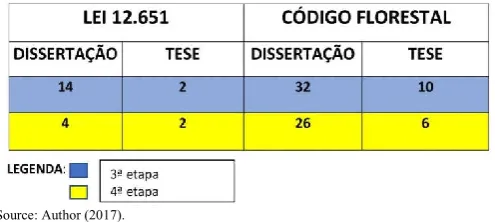
As seen in the example above, the margin of error in the search for terms is large and far from the expected result, so another way of searching is the use of quotation marks, to limit the desired words, thus, we arrive at a result positive, as shown in the image below:
[image:4.595.308.561.122.201.2]Source: Author (2017).
Figure 1. Search tabulation with terms with and without quotation marks
Thus, with the use of quotation marks, we can delimit the number of works and prove the relationship with the desired term and area. Thus, it was defined that for the selection of papers for content analysis (abstract or full text).
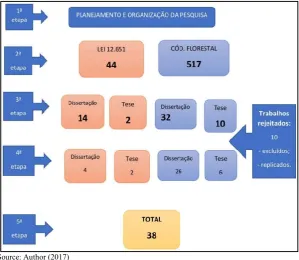
Step 3: This phase is known as the selection stage, after performing an analysis of the titles of the works found in the databases, and the selection of the works that have relevance to the research theme is done. After this stage 131 works of the catalog of thesis and dissertations of the capes were selected, which presented a correlation between the terms, as systematized in Figure 2.Soon after the systematization of the works with correlation between the terms, we moved to the fourth stage, for an analysis, applying at this moment the inclusion / exclusion criteria, from a more detailed reading of the works.
Step 4: This stage is called eligibility, since it is considered the main and most important of the process, in which an analysis of the content of the selected texts is done, in which it has a relation with the theme, from here a more detailed reading is made of the abstracts and if necessary of the original (complete) text for a better understanding. In this step, the inclusion and exclusion criteria are applied. To do so, we present below those used to carry out this study. For the EXCLUSION were considered works where: works that are duplicated, that is, repeated, works with a superficial approach on the subject, incomplete or no results, work done before 2012.For the INCLUSÃO we indicate as criteria: texts have relation with the new forest code, realized from 2012 and work with complete result. Next, in Figure 2, I bring the detail of the third, which corresponds to the reading of the title and its adherence to the study and the fourth stage of the study, which deals with the selection of the works after applying the inclusion / exclusion criteria, in addition to the duplicate works and finally, the reading of the abstract or the complete text:
Source: Author (2017).
[image:4.595.309.557.663.774.2]Step 5: This is the last and named inclusion, in which the works have already been selected and will be systematized in the table format, this material is also called portfolio, with information for understanding and a better analysis of the data. As it was seen, the systematic review is composed of several stages, of which they are distinct and extremely important, in which we can make a detailed evaluation of each step, besides better understanding the procedure, it will be an instrument for mapping works published in banks of data, using a specific research theme, allowing the researcher the ability to elaborate a synthesis of existing knowledge about a given subject (BIOLCHINI et al., 2007).Given the above, it was possible to carry out the construction of significant data so that the study took shape and allowed to enter the field of research. We consider that it is pertinent to carry out the systematic review to provide security and solidity to the results that will originate from the development of the study. In this way, we present the result / synthesis of the steps shown in this flowchart.
Thus, the methodology is built for the bibliographic study, based on the systematic review, as the previous flowchart, presents us, for its realization, that it is divided into stages, from planning, application of the criteria, and analysis for exclusion of duplicate or non-consistent works for this study, and finally the construction of the portfolio.Still dealing with the portfolio, below I present the systematized result of the selected studies.
RESULTS
At the beginning of this study, a total of 51,893 papers were counted, between theses and dissertations, with the application of the quotation marks, aiming to delimit the field, 561 texts were found, of these with the reading of the titles restore 48, with the reading of the abstracts and texts, went on to the last step, called the portfolio remaining 38 works, according to the flowchart shown in Figure 3 present in this work.
[image:5.595.152.452.268.528.2]Source: Author (2017)
[image:5.595.36.567.565.806.2]Figure 3. Flowchart of the steps of the systematic review
Table 1. Portfolio of the results of the systematic review. Source: Author (2017)
ANO TITULO AUTOR TIPO TRATA-SE
2016 Dinâmica do quadro institucional
legal para a questão florestal no brasil nas últimas décadas: uma abordagem a partir da Nova Economia Institucional
MAURICIO JOAO
ATAMANCZUK
TESE tese tem o objetivo analisar aspectos que explicam a formação e
caracterizam o quadro institucional formal contidos na legislação brasileira sobre florestas. O terceiro capitulo da tese busca compreender os argumentos para legitimar a posição de grupos de interesse na formação do quadro legal ambiental brasileiro a partir da análise da opinião de duas frentes antagônicas sobre a aprovação da Lei Federal 12.651, de 26 de maio de 2012, que institui o Novo Código Florestal Brasileiro.
2016 Impactos do novo Código Florestal
Brasileiro, Lei Federal nº
12.651/2012
THAIS MUNIZ
OTTONI SANTIAGO
TESE Esse trabalho investigou as respostas de produtores rurais da Amazônia
ao novo contexto legal e analisou os potenciais impactos do CF de 2012.
2016 Construção de dispositivos legais e
agentes em disputa: o debate em torno do novo Código Florestal Brasileiro
ANA CAROLINE
PIRES MIRANDA
TESE Analisa-se nesta tese o processo legislativo de discussão, votação e
aprovação da Lei nº 12.651, de 25 de maio de 2012, que dispõe sobre a proteção da vegetação nativa e revoga o Código Florestal Brasileiro de 1965.
2016 Mudar o código é a salvação da
lavoura! Propriedade da terra,
classes dominantes e representação política no Brasil contemporâneo – a reforma do Código Florestal Brasileiro de 1965.
JANAINA TUDE
SEVA
TESE Esta tese de doutorado versa sobre as classes dominantes, a propriedade
privada sobre a terra e a natureza e a representação política no Brasil republicano. Situada no campo de estudos da questão agrária, foca a atuação das elites agrárias no processo de elaboração e revisão dos textos legais sobre a preservação ambiental e a apropriação dos recursos naturais, apontando para os processos e relações que permeia e, dialeticamente, estruturam o Estado.
2015 Artigo de opinião como
macrogênero: relações
lógicosemânticas na perspectiva
sistêmico-funcional
GESSELDA SOMAVILLA FARENCENA
TESE O principal objetivo consiste em analisar as relações lógico-semânticas na
organização do texto em etapas e fases, em artigos de opinião relacionados à temática do Novo Código Florestal Brasileiro e publicados no Observatório da Imprensa.
………..Continue
2015 A Lei 12.651/2012 avanços e retrocessos
ELTON ABREU
COBRA
TESE O presente trabalho tem por objetivo uma análise da Lei 12.651/2012 e
identificar os avanços e retrocessos na regularização ambiental das propriedades rurais.
2014 Código Florestal Brasileiro:
construção e trajetória
PAULO COSME DE OLIVEIRA
TESE A tese descrever a trajetória da lei federal conhecida como Código
Florestal, desde a sua origem em janeiro de 1934 a outubro de 2012, quando sofreu as últimas modificações.
2014 Capacidade de Gerenciamento de
Stakeholders como elemento de
planejamento estratégico nas
organizações públicas brasileiras: o caso do Código Florestal Brasileiro
ESTELA ALVES DE MEDEIROS
TESE A tese analisa como as organizações governamentais brasileiras
gerenciam os stakeholders na implementação de programas estratégicos. Para tanto, foi realizado um estudo de caso comparativo sobre a revisão do Código Florestal a partir da ótica de dois principais atores governamentais: Ministério do Meio Ambiente (MMA) e Ministério da Agricultura, Pecuária e Abastecimento (MAPA).
2016 Proteção jurídica do bioma caatinga JOÃO PAULO
ALVES DE LIMA.
Dissertação Esta pesquisa reflete a manutenção do bioma como uma peculiaridade e
exclusividade do Brasil, onde a Lei 12.651/2012, refletiu severamente no exclusivo bioma brasileiro: a Caatinga.
2016 O novo código florestal e o
princípio da vedação de retrocesso:
Uma análise das alterações
retrógradas da Reserva Legal e da Área de Preservação Permanente
MIKAELA MINARE BRAUNA
DIEFENTHAELER
Dissertação A pesquisa consiste em demonstrar que o retrocesso legislativo, na área
ambiental, decorrentes das alterações introduzidas no Novo Código Florestal, Lei 12.651 de 25 de maio de 2012, pode afetar a preservação e a proteção de recursos ambientais e do meio ambiente como um todo, violando, assim, um princípio constitucional de proteção ao meio ambiente.
2016 O novo código florestal e a
regularização do passivo ambiental dos imóveis rurais: o caso de Querência
MARTA MARIA
ROHE SALOMON
Dissertação Esta pesquisa investigou o processo de construção do passivo florestal e
as iniciativas de adequação dos produtores rurais e identificou a recuperação dos déficits de vegetação nativa como o principal desafio da implementação do novo Código Florestal.
2016 O Código Florestal Brasileiro de
2012 e suas contradições
GISELLY POSSAMAI
Dissertação Este estudo tem como objetivo refletir sobre aspectos do Código Florestal
Brasileiro de 2012, na perspectiva de explicitar suas principais contradições, identificar alguns aspectos que retrocederam, além dos que são contraditórios e dos que avançaram
2016 Conflitos nas políticas ambientais:
uma análise do processo de
alteração do Código Florestal
Brasileiro
ISABELA KOJIN
PERES
Dissertação Esta dissertação tem como objetivo analisar o cenário e os processos
políticos que culminaram com a alteração do antigo Código Florestal Brasileiro (Lei Federal nº 4.771/1965), revogado pela Lei Federal nº 12.651/2012.
2016 As redes sociais online como arenas
de embate e o papel da campanha “veta dilma” no processo de elaboração do novo código florestal brasileiro
ALEXANDRE GIBSON JUNIOR
Dissertação A presente dissertação busca compreender qual foi o papel das redes
sociais online no processo de elaboração do novo Código Florestal Brasileiro.
2015 A quem respondem os ruralistas?
Base eleitoral e proposições
legislativas dos deputados federais da 54ª Legislatura
RAFAEL GEORGES DA CRUZ
Dissertação Este trabalho analisa e testa estas hipóteses com o intuito de explicar o
que sustenta a agenda rural na 54 a Legislatura da Câmara dos Deputados (2011-2015). O principal elemento a ser explicado foi o conjunto de proposições de políticas públicas traduzidas em Projetos de Emenda à Constituição, Projetos de Lei, Requerimentos e Indicações.
2015 Da aplicação do princípio da
vedação do retrocesso quanto à tutela do direito difuso ao meio
ambiente ecologicamente
equilibrado no novo código
florestal.
KERTON
NASCIMENTO E
COSTA
Dissertação Nesse cenário de conflitos, buscamos demonstrar os argumentos pró e
contra a adoção da vedação do retrocesso como um princípio protetor do meio ambiente. Em suma, existem retrocessos na legislação, oriundos da aprovação do Novo Código Florestal, mas também existem avanços.
2015 O estado na revisão do código
florestal brasileiro: democracia,
articulação discursiva e hegemonia.
LUCAS AZEVEDO
DE CARVALHO
Dissertação O presente trabalho busca, de modo mais amplo, compreender a
complexa relação entre o processo legislativo, as relações de poder, o Estado e a democracia deliberativa, tendo como base o processo de revisão do Código Florestal.
2015 O "novo Código Florestal" (Lei
12.651/12) e suas implicações no
contexto da sustentabilidade
socioeconômica ambiental
JULIO CESAR
TEIXEIRA CRIVELLARI
Dissertação Este trabalho analisa o conteúdo e as normas do novo Código Florestal
Brasileiro, sob a perspectiva da sustentabilidade-resiliência, mostrando que a Lei nº. 12.651/2012 reduziu consideravelmente a proteção das áreas de vegetação ripária e reserva legal, em comparação com a legislação anterior, por meio da regularização de desmatamentos, da anistia de infrações ambientais e da consolidação de ocupações urbanas e rurais naquelas áreas, comprometendo a integridade dos atributos que justificam sua proteção, e violando a Constituição Federal.
2014 Discurso e representações sobre a
natureza: o novo código florestal brasileiro
LAURA PATRICIA
SCARTON
Dissertação Este estudo busca analisar os discursos relacionados à alteração do
Código Florestal Brasileiro e as representações que a Natureza ganha nesse debate, utilizando, para tanto, as noções da Teoria da Análise do Discurso.
2014 Terminologia do código florestal
brasileiro
FABIO XAVIER DA SILVA ARAÚJO
Dissertação Trata-se de uma pesquisa que teve como objetivo principal organizar um
glossário terminológico sobre o léxico do maior diploma que compõe o direito ambiental brasileiro.
2014 O princípio do não retrocesso e sua
aplicação na seara ambiental quanto à proteção das áreas de preservação permanente: uma análise da reforma do código florestal
MARCOS GIMENEZ Dissertação A presente dissertação tem como objetivo principal trazer à discussão as
recentes alterações legislativas no Código Florestal, através da promulgação Lei 12.651/2012, e a aplicação do princípio do não retrocesso ambiental
2014 "A cobertura do Código Florestal
Brasileiro no Jornal Nacional"
TAIS GARCIA
TEIXEIRA
Dissertação A presente dissertação tem como objetivo analisar a cobertura sobre o
Código Florestal Brasileiro no Jornal Nacional de março de 2012 até maio de 2013. Com base na Análise de Conteúdo para verificar quais os valores-notícia de seleção e de construção que mais apareceram nas categorias de questão ambiental e política.
2014 Atividades de baixo impacto e uso
antrópico consolidado previstos no novo código florestal brasileiro (lei nº 12.651/12)
SARITA SORAIA DE ALCANTARA LAUDARES
Dissertação Este trabalho teve como objetivo pesquisar a legislação ambiental
brasileira com ênfase no Código Florestal, com intuito de mostrar as falhas ainda vigentes na nova legislação, analisar as formas de uso-ocupação consolidadas pela nova lei ambiental e propor atividades sustentáveis que minimizem os impactos negativos causados a essas áreas de suma importância para o equilíbrio do ecossistema.
In this way, I present the result of the works that were selected and their descriptions for a better understanding.
Conclusion
Thus, the Systematic Reviews of Literature, according to Kitchenham 2004 and Mergel 2014, is characterized as a secondary studies, which plays an important role in the research, since they synthesize the existing work in a non-biased way, evaluate and interpret the relevant research available for a particular research question, topic of the area or
phenomenon of interest, and for this purpose, using pre-established protocols for searching and identifying primary studies, moreover, the strategy adopted in a review should be clear enough to allow its repetition by other researchers. Following this logic, it is worth emphasizing a fundamental element of the research of systematic review, pointed out by Biolchini, 2007, that to this type of study, this one is not to evaluate qualitatively and to issue critics of the work and yes, to realize a balance on what already was produced on that theme, this study is different from the state of the art of research (Ferreira, 2002). In view of the data presented in the
2014 Os efeitos de sentido no/do
jornalismo alternativo: uma análise sobre o discurso de mídia na votação do projeto de alteração do novo código florestal brasileiro, de 1965
PATRICIA DE
OLIVEIRA CLAUDINO
Dissertação Este estudo busca compreender se a discursividade proposta pela mídia
alternativa na atualidade é a mesma quando de seu surgimento no Brasil, ou se uma nova versão deste discurso está sendo praticada sob uma mesma nomenclatura, valendo-se de toda uma memória social incorporada.
2014 As modificações dos institutos da
reserva legal e das áreas de preservação permanente diante da lei n. 12.651/2012 (novo código florestal brasileiro): avanços ou retrocessos?
PAULA SANTOS
ARAUJO
Dissertação O estudo dedicou-se à identificação das inovações (avanços) e
incompatibilidades (retrocessos) normativos do Novo Código Florestal. A partir de uma investigação histórico-jurídica, analisaram-se noções introdutórias de Meio Ambiente, da proteção jurídica das florestas e demais espécies de vegetação nativa. Estabelecida a fundamentalidade da proteção ambiental, analisaram-se as particularidades dos institutos da Reserva Legal e Áreas de Preservação Permanente.
2013 A lógica da ação na reforma do
código florestal
AMANDA MARIA
CAMPANINI PEREIRA
Dissertação Este trabalho busca apontar quais recursos utilizados pelas coalizões
foram determinantes no resultado da política, analisada a fase inicial da tramitação na Câmara dos Deputados até a aprovação no Plenário da Casa.
2013 Análise das alterações no código
florestal brasileiro vigente propostas pelo substitutivo do projeto de lei nº 1876/99 sob a perspectiva da ética ambiental
THAISY CAMPOS
NASCIMENTO NUNES
Dissertação O trabalho pensou-se em observar se a Ética Ambiental estaria sendo
levada em conta diante dessas propostas de alteração, já que ela surgiu da necessidade de se discutir uma ética com relação ao meio ambiente, partindo da preocupação e da sensibilidade ecológica como reação a uma mentalidade predatória da natureza.
2013 O direito intertemporal no código
florestal brasileiro.
LIVIA BARTOCCI
LIBONI
Dissertação Este trabalho tem por objeto analisar a aplicação dada à lei florestal
revogada sob o âmbito do direito intertemporal e avaliar a recepção expressa do princípio constitucional da irretroativdade no Novo Código Florestal.
2013 Impactos socioeconômicos do
Código Florestal Brasileiro: uma discussão à luz de um modelo computável de equilíbrio geral
TIAGO BARBOSA
DINIZ
Dissertação Este trabalho analisa quais os efeitos que o cumprimento do antigo e do
novo Código Florestal trariam à economia do país e de seus estados.
2013 Código Florestal: a retórica de
ruralistas e ambientalistas nos
artigos de opinião do Correio do Estado
BARBARA CUNHA FERRAGINI
Dissertação O presente trabalho parte da compreensão de que a retórica está presente
nos processos comunicativos contemporâneos.
2013 A norma jurídica à luz da semiótica
de peirce: um estudo de caso
MICHELLE TAVARES VERGINASSI
Dissertação O presente estudo pretende demonstrar de modo geral e simplificado com
base na teoria Semiótica de Peirce, como é possivel se analisar e descrever dispositivos legais, aqui propostos os artigos vetados do novo Código Florestal Brasileiro, buscando de certa forma trazer à luz suas ambiguidades, vaguezas, lacunas e ideologias subssumidas pelos textos
2013 Da fronteira florestal aos limites da
ciência: Um estudo sobre a
participação de especialistas nas
audiências públicas para a
elaboração do novo Código
Florestal
JEAN CARLOS
HOCHSPRUNG MIGUEL
Dissertação Esta pesquisa tem como objetivo investigar a participação de especialistas
em audiências públicas. Como estudo de caso, adotam-se as audiências realizadas pelo Congresso Nacional no período de 2009 a 2012 sobre a reformulação do Código Florestal brasileiro.
2013 O papel das novas mídias no debate
ambiental: Uma análise dos fluxos comunicativos no Twitter sobre as mudanças no Código Florestal
PRISCILA MUNIZ
DE MEDEIROS
Dissertação O presente trabalho foi elaborado com o intuito de promover uma maior
compreensão acerca do papel que as novas mídias estão desempenhando dentro do debate ambiental, especificamente as mudanças no Código Florestal Brasileiro
2013 Reunião & Dispersão: Um estudo
dos discursos sobre a reforma do Código Florestal nos jornais Folha de S.Paulo e O Estado de S. Paulo
JOSE ANTONIO
BONATO
Dissertação O trabalho aborda os textos sobre a reforma do Código Florestal nos
jornais Folha de S.Paulo e O Estado de S.Paulo entre maio de 2011 e junho de 2012 com o objetivo de descrever as características da cobertura dos dois jornais sobre o tema.
2013 A proibição de retrocesso ambiental
no contexto da teoria dos direitos fundamentais: os limites das leis restritivas.
ROGERIO LUIZ
GALLO
Dissertação Trata-se de investigação para situar o princípio da proibição de retrocesso
no âmbito do direito constitucional ambiental brasileiro.
2012 Código florestal e desenvolvimento
sustentável: análise da norma
jurídica e de sua e implementação no estado socioambiental
FERNANDA SALGUEIRO BORGES
Dissertação O presente trabalho teve por objetivo analisar o papel do Código Florestal
como instrumento jurídico do Estado Socioambiental na consecução do direito ao meio ambiente ecologicamente equilibrado e do direito ao desenvolvimento sustentável, mediante a análise dos elementos jurídicos que os compõem.
2012 O lugar do Rio Grande do Sul na
Esfera Pública Referente à
Alteração do Código Florestal Brasileiro
JÚLIA VAZ
LORENZETTI
Dissertação Este trabalho teve como objetivo investigara dinâmica da esfera pública
relativa à tramitação de Projeto de Lei para alteração do Código Florestal Brasileiro, no âmbito do estado do Rio Grande do Sul. Trata-se de um estudo local frente a um debate nacional.
2012 Retrocessos no Novo Código
Florestal: análise das mudanças relativas às Áreas de Preservação Permanente e Reserva Legal
LUIS OTÁVIO
VINCENZI DE
AGOSTINHO
Dissertação O estudo pretende analisar o princípio da proibição de retrocesso no
Direito Ambiental, especificamente no que diz respeito às mudanças trazidas pela Lei 12.651/12, que disciplinou o novo Código Florestal.
systematic review, it is possible to infer that there are many scientific scholarly works produced around the theme, for each keyword used and with the intervention of the search boleanos, 38 papers were found that signal the discussion. Counting 8 theses and 30 dissertations in the last five years. Still discussing the previous approach, we can note that the greatest number of studies were in 2016, with 6 dissertations and 4 theses and 2013 with 10 dissertations, both with the same number of studies, followed by 2014, which were 7 dissertations and 2 theses, from these data, it is understood that a year after the law came into force, had a good number of studies related to it and following the same logic, the highest number of theses were in 2016, and were completed four years after approval, being the same period of completion of a PhD course. The study shows how much it is pertinent to carry out studies on the new forest code, since it makes it possible to understand what is being produced in the academy. In addition, it shows us the diversity of works and their areas of study, this only shows us how important interdisciplinary work is. The analysis made it possible to construct a panorama from the last five years, considered as starting point the year of 2012.
In this universe of study it is detected that the works produced in the scope of Work of Conclusion of Course of graduation and post-graduation latosensu, dissertation master's and doctoral thesis, and are geared towards the large area of Environmental Management, Applied Social Sciences, Agribusiness Management, and Interdisciplinary Management. The centrality of the discussions is within the scope of better understanding of the changes in the second forest code, in addition to the consequences for the ecosystem, as well as the criticism of the ruralist group, which is pointed out by most studies as responsible for its approval (ANTUNES, 2013). Such aspects are possible to identify because the review has shown that throughout the 38 papers, after the application of the inclusion and exclusion criteria, among them repetition in the database for the account of the keywords. Thus, identified and included as a source of analysis are linked to theoretical and empirical research, which extends the possibilities of interpretation and condition of analysis for the various areas of study. As the present study aims to develop a structured research in the understanding of what was produced in the academic field, in the year that has been approved to date, in master's and doctoral programs in the Brazilian territory, it is possible to observe the importance of the constant occurrence of the articulation between these perspectives so that in fact it can obtain significant results for the branch of environmental law applied to several areas.
REFERENCES
___________. Comentários ao novo código florestal. São Paulo: Editora Atlas. 2013.
AHRENS, Sérgio. O código Florestal brasileiro e o uso da terra: histórico, fundamentos e perspectivas (uma síntese introdutória). São Paulo: Revista de Direitos Difusos. Vol 31, maio-junho. 2005
ALVES, Isabelle. O novo código florestal. JUSBRASIL. 2013.
Disponível em <
https://isabellealves.jusbrasil.com.br/artigos/111697485/o-novo-codigo-florestal > acessado em: 11/11/2017.
ANTUNES, Paulo de Bessa. Direito ambiental. Rio de Janeiro: Lúmen Júris, 2004.
BERETON et al. Lessons from Applying the Sistematic Literature Review Process within the Software Engineering Domain. The Journal of System and Software, v. 80, , 2007.
BIOLCHINI, J.C.A., et al. Scientific research ontology to support systematic review in software engineering. AdvancedEngineeringInformatics, v.21, n.2. 2007.
CIRANI, Claudia Brito Silva; CAMPANARIO, Milton de Abreu; SILVA, Heloisa Helena Marques. A evolução do ensino da pós-graduação senso estrito no Brasil: análise exploratória e proposições para pesquisa. Avaliação. Campinas; Sorocaba, SP, v. 20, n. 1, p. 163-187, mar. 2015 FERREIRA, NORMA SANDRA DE ALMEIDA. AS
PESQUISAS DENOMINADAS “ESTADO DA ARTE”. Educação & Sociedade, ano XXIII, no 79, Agosto/2002. FIORILLO, Celso Antônio Pacheco. Curso de direito
ambiental brasileiro. São Paulo: Saraiva, 2013.
FREIRE, William. Direito Ambiental Brasileiro. Rio de Janeiro: AIDE Editora, 2000.
GIL, A. Como elaborar projetos de pesquisa. Atlas: São Paulo, 2007.
Kitchenham, B.“Procedures for performing systematic reviews”. KeeleUniversity, 2004, 33 p.
LIMA, T. C. S.; MIOTO, R. C. T. Procedimentos metodológicos na construção do conhecimento científico: a pesquisa bibliográfica. Rev. Katál., Florianópolis, v. 10 n. Esp., p. 37-45, 2007.
MARTINS, Marcos Lobato. História e meio ambiente. São Paulo: Annablume; Faculdades Pedro Leopoldo, 2007. MILARÉ, Edis. Direito do ambiente. São Paulo: Revista dos
Tribunais, 2003.
SILVA, José Afonso da. Direito ambiental constitucional. São Paulo: Malheiros, 2004.
SOUZA, Alcian Pereira de. TUTELA JURÍDICA DO MEIO AMBIENTE A PARTIR DO “CÓDIGO FLORESTAL”: RETROCESSO AMBIENTAL. Dissertação apresentada ao Programa de Pós- graduação em Direito Ambiental da Universidade do Amazonas. MANAUS-AM. 2014.
TARGINO, M. G. A interdisciplinaridade da ciência da Informação como área de pesquisa. Inf. Soc., João Pessoa, v. 5, n. 1, p. 12-17, 1995.
WILLICH, Linde K, SN. How objective are systematic reviews? Differences between reviews on complementary medicine. J R Soc Med. 2003.