ORIGINAL RESEARCH ARTICLE
ANALYSIS OF THE BEHAVIOR OF THE COATING MORTAR WITH USE OF FELDSPATO POWDER IN
PARTIAL REPLACEMENT TO THE KID AGGREGATE
*1
Vilson Menegon Bristot,
1Leopoldo Pedro Guimarães Filho,
2Daiane dos Santos da Silva
Godinho,
2Elaine Guglielmi Pavei Antunes,
2Luiz Henrique Piuco,
3Aline Eyng Savi,
4Vilmar Menegon Bristot and
5Cristina Keiko Yamaguchi
1Universidade do Extremo Sul Catarinense - UNESC, Brasil – Núcleo de Estudos em Engenharia de Produção – NEEP
2Universidade do Extremo Sul Catarinense - UNESC, Brasil – Departamento de Engenharia Civil
3Universidade do Extremo Sul Catarinense - UNESC, Brasil – Departamento de Arquitetura e Urbanismo
5Universidade do Planalto Catarinense - UNIPLAC, Brasil
ARTICLE INFO ABSTRACT
Mortar coatings, whether on an internal or external surface, are of great importance for the longevity of the work because they are directly exposed to adverse situations, such as: rainfall, temperature variation, trepidation, soil movement, among others, and must resist all without cracks and cracks, which can lead to infiltrations causing their performance to be compromised. In view of the above, we seek new mixtures and materials that improve the properties of the mortar coating and that may restrain future pathological manifestations. From this problem, this work investigates the influence of the use of feldspar powder in the mixture in substitution to the kid's aggregate (sand), using additive to establish the water / cement factor with the substitution levels of 0%, 10%, 20 % and 30%. For this, the following tests were carried out: Traction Resistance in Axial Flexion, Tensile Strength by Diametral Compression, Capillarity Water Absorption, Capillary Coefficient, Elasticity Modulus, Microstructure and Scanning Electron Microscopy (SEM). From the results obtained in the tests, it was possible to observe an increase in the tensile strengths in the axial flexion and the traction by diametral compression, besides an increase in the modulus of elasticity and a reduction of the water absorption by capillarity, thus improving the characteristics of the mortar and increasing the useful life of buildings.
Copyright © 2019, Vilson Menegon Bristot. This is an open access article distributed under the Creative Commons Attribution License, which permits unrestricted use, distribution, and reproduction in any medium, provided the original work is properly cited.
INTRODUCTION
The properties of the materials used in construction are of great importance for the durability of the work. More and more new technologies are being sought for the processes and materials used in order to reduce the high pathological and waste phenomena. The choice of the type of coating to be used and the type of application are important parameters for the preservation and durability of the construction. According to Sabbatini (1986), mortars are "complex materials consisting essentially of inert materials of low granulometry (small aggregates) and a paste with binding properties, composed of minerals and water (active materials) ".
*Corresponding author: Vilson Menegon Bristot,
Universidade do Extremo Sul Catarinense - UNESC, Brasil – Núcleo de Estudos em Engenharia de Produção – NEEP
There are several types of mortars, which can be classified according to their characteristics and those of their binders besides their functions. Figuerola (2004) says that the main functions of Coating Mortar are to protect the structure of the action of the weather, in the case of external coatings, besides contributing with the thermal and acoustic insulation, water tightness, fire safety and surface quakes. To properly fulfill all these functions, mortars need specific properties both in the fresh state and in the hardened state. Table 1 shows the properties of the coating mortar. The application of the mortar coating requires some characteristics of its own. According to Bauer (2016) it is necessary to have plasticity to deform on the surface of the substrate during application, fluidity to involve the roughness of the substrate and water retention to maintain workability during application. The constituent materials of the mortar are essentially aggregated kids and binders. To avoid
ISSN: 2230-9926
International Journal of Development Research
Vol. 09, Issue, 04, pp. 26901-26908, April, 2019Article History: Received 17th January, 2019 Received in revised form 20th February, 2019
Accepted 09th March, 2019
Published online 29th April, 2019
Key Words:
Coating, Water, Cement Factor, Feldspar
Citation: Vilson Menegon Bristot, Leopoldo Pedro Guimarães Filho, Daiane dos Santos da Silva Godinho et al. 2019. “Analysis of the behavior of the coating mortar with use of feldspato powder in partial replacement to the kid aggregate”, International Journal of Development Research, 09, (04), 26901-26908.
pathologies, it is important to study new materials that have properties that can improve the performance of mortars. In the search for new mixtures that improve the properties of mortars, this work will investigate the influence of the use of feldspar powder in the mixture to partially replace the sand. Feldspar is a mineral used in the process of manufacturing porcelain stoneware tiles. For Kummer et al (2007), apud PEDRO, 2016 p.3) "porcelain stoneware is a denser material than the usual white ceramics. It can be polished with ease and has little water absorption due to a higher percentage of feldspar. "In a study conducted by Pedro in the year 2016, the addition of feldspar powder was investigated in 20%, 30% and 50% percentages in the coating mortar. In this same study, water was added to maintain the mortar coating abatement by changing the a / c factor of the blend as the percentage of feldspar powder addition increased. It is known that a water cement ratio with a high percentage can compromise the mechanical characteristics of the Mortar Coating. In order to determine the real influence of the feldspar powder on the mortar coating, this work aims to continue the work of Pedro (2016), but maintaining the factor a / c correcting the abatement with the use of additives to analyze the behavior of the coating mortar, for the following factors: tensile strength in axial flexure, tensile strength by diametrical compression, water absorption by capillarity, capillary coefficient, modulus of elasticity, SEM test and microscopy with the objective of analyzing an improvement mechanical strength, compactness, impermeability and durability, and thus, future pathological manifestations related to the mortar coating can be avoided and contributing data to the technical environment.
Table 1. Properties of Coating Mortars
Cool State Hardened State
Adequate specific air and mass content
Adherence
Workability Ability to absorb deformations Initial Adherence Mechanical resistance Water Retention Wear Resistance Retraction in Drying Durability Source: Aurich e Leggerini (2016)
Experimental Prodedures: This research was carried out in four stages, the first of which consisted of a bibliographical research for a better knowledge about coating mortar and feldspar dust. The trace was used (1: 5), which is often used in civil construction and was the same used by Pedro 2016. The second step consisted of performing the test to determine the Consistency Index according to the standard ABNT NBR 13276 : 2005, through which the water / cement and additive ratio was obtained for each trait used and subsequent preparation of the test specimens. In the third step, the mechanical characterization tests of the test specimens were carried out, namely: Tensile Strength by Diametral Compression according to ABNT NBR 7222: 2011, Tensile Strength in Flexion and Compression in accordance with ABNT NBR 13279: 2005; Capillarity Water Absorption according to ABNT NBR 15259: 2005, Modulus of Elasticity according to ABNT NBR 8522: 2008, Microscopy and Scanning Electron Microscopy (SEM). With the partial replacement of the kid's aggregate by feldspar dust in percentages of 0%, 10%, 20% and 30%. In order to carry out the study, it was used medium sand with fineness modulus 2,2, cement CPIV-32 and superplasticizer additive. The fourth and final step consisted in the statistical analysis of the results obtained.
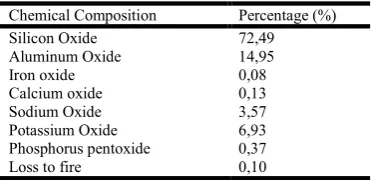
The materials used in the present study were: CPIV cement, sand, feldspar powder, additive and water. The feldspar powder used in the blends is the same used in most of the ceramic companies in the southern region of Santa Catarina. This material has a specific mass of 2.1 g/cm³ and a particle size less than 0.075 mm. The chemical characteristics of feldspar dust are described in Table 2.
Table 2. Chemical characteristics of feldspar dust
Chemical Composition Percentage (%)
Silicon Oxide 72,49
Aluminum Oxide 14,95
Iron oxide 0,08
Calcium oxide 0,13
Sodium Oxide 3,57
Potassium Oxide 6,93 Phosphorus pentoxide 0,37
Loss to fire 0,10
Source: Authors (2018)
Superplasticizer additives are used in mortars and concretes to achieve greater fluidity using less water. The additive used in this work was the Tec-flow 8000. This additive has as main characteristics an auto power of reduction of water for kneading maintaining the same consistency, increase the fluidity for an extended time and increase of the cohesion, allowing an auto yield due to its functionality in small dosages.
[image:2.595.47.277.429.501.2]In the work previously carried out by Pedro (2016), it was verified that with the increase of the percentage of substitution of the small aggregate, the water / cement factor also increased considerably. Based on the studies carried out it is known that a high water / cement content can alter the characteristics of the mortar. The consistency index test aims to determine the consistency index for each trace used. For this, a reference trait was obtained with 0% substitution of the kid's aggregate, thus establishing a water / cement factor (a / c) reference for the other traits and defining the correct percentage of additive for each trait while maintaining the water / cement factor equal for all the traces, since the addition of feldspar powder added an additive to maintain consistency, and the reference was the same as that used by Pedro (2016). Table 3 shows the traits used in the study.
Table 2. Traits used in the test
Trace Cement: Sand: Feldspar Ratio (a/c)
T0 1:5:0 0,76
T10 1:4,5:0,5 0,76
T20 1:4:1 0,76
T30 1:3,5:1,5 0,76
Source: Authors (2018)
The test was performed with the table of determination of the consistency index as shown in Figure 1. In the determination of the consistency index, the amount of water and plasticizer additive followed the one determined in the standard ABNT NBR 13276: 2005, which recommends a reduction of (260 ± 5) mm.
[image:2.595.332.532.574.626.2]Source: Authors (2018)
Figure 1. Test to determine the consistency index. a) molded material for the test. b) measurement of the sample after the test
[image:3.595.45.281.191.361.2]Source: Authors (2018)
Figure 2. Diametral Compression Test
The Tensile Strength by Diametral Compression of cylindrical specimens was calculated according to equation 1.
,
=
2
. .
(
. 1)
At where:
fct, sp: is the tensile strength by diametrical compression, in megapascals;
F: is the maximum force obtained in the test expressed in Newtons;
d: is the diameter of the specimen expressed in millimeters; l: is the length of the specimen expressed in millimeters.
The determination of tensile strength in flexion was performed according to ABNT NBR 13279: 2005, using three prismatic specimens measuring 4 cm x 4 cm x 16 cm for each defined trait. Figure 3 demonstrates the Flexural Tensile Strength test.
Source: Authors (2018)
Figure 3. Flexural tensile test
The tensile strength at flexion was calculated according to equation 2:
=
1,5.
.
40³
(
. 2)
At where:
Rf: is the tensile strength in flexion, in megapascals;
Ff: is the load applied vertically in the center of the prism, in newtons;
L: is the distance between the supports, in millimeters.
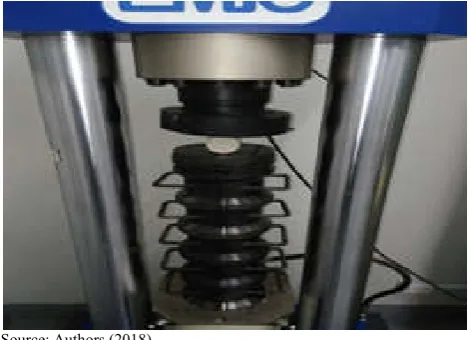
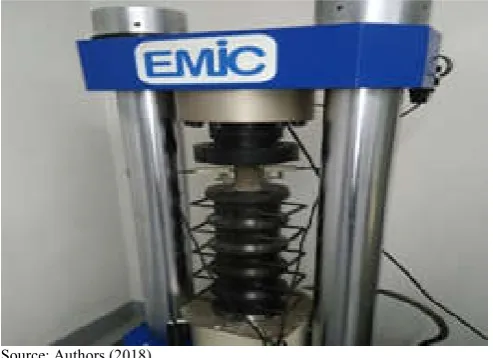
The determination of the axial compression strength was performed according to the ABNT NBR 13279: 2005 standard using the halves of the three test specimens of the flexural traction test for each defined trait. Figure 4 shows the Axial Compression Resistance test.
Source: Authors (2018)
Figure 4. Flexural tensile test
The Axial Compression Resistance was calculated according to equation 3:
=
1600 ( . 3)
At where:
Rc: is the compressive strength in megapascals; Fc: is the maximum load applied, in newtons.
[image:3.595.313.555.258.453.2]Source: Authors (2018)
Figure 5. Modulus of elasticity test
[image:3.595.315.554.573.744.2] [image:3.595.42.284.598.775.2]8522: 2008 standard, which is used for concrete tests, and an adaptation was made for this, using three cylindrical specimens with a diameter of 50 mm and 100 mm in length for each defined stroke. Figure 5 shows the test for the determination of the Static Compression Elasticity Modulus.
The Static Compression Elastic Modulus was calculated according to equation:
=
∆∆
10
=
,
10
(Eq. 4)
At where:
σ_b is the highest voltage, in megapascals; σ_b = 0.3 f_c or enter specific voltage in design;
0.5 is the basic voltage expressed in megapascals (MPa); ε_b is the mean specific strain, (ɛ = ΔL / L) of the specimens
under the greatest stress;
ε_a is the average specific strain of the specimens under the basic specific stress (0.5 MPa).
The determination of the water absorption by capillarity and the capillary coefficient was performed according to ABNT NBR 15259: 2005, using three prismatic specimens measuring 4 cm x 4 cm x 16 cm for each defined trait. Immediately after the determination of the initial mass, (m0) in grams for each test specimen, they were positioned with the square face downwards in the test vessel, maintaining the water level constant (5 ± 1) mm above the face in contact with water. After 10 and 90 minutes, the mass of each specimen was determined (m10) and (m90) respectively. Figure 6 shows the capillary water absorption determination test.
[image:4.595.41.288.442.621.2]Source: Authors (2018)
Figure 6. Test of Determination of water absorption by capillarity
The Capillarity Water Absorption test was performed according to ABNT NBR 15259: 2005 for each time and should be expressed in (g/cm2) grams per square centimeter. The absorption of water by capillarity is given by the mass variation by the cross-sectional area of the test piece in contact with water, according to equation 5.
= − 0
16 ( . 5)
At where:
At: water absorption by capillarity, for each time, approximate to the nearest hundredth, in grams per square centimeter;
mt: mass of the specimen at each time, approximate to the nearest hundredth, in grams;
t: corresponds to the times of 10min and 90min, in seconds; 16: area of the test piece, in square centimeters.
The determination of the Capillary Coefficient was performed according to the ABNT NBR 15259: 2005 standard, which defines the capillary coefficient (C), being equal to the angular coefficient of the line that passes through the respective points of the determinations carried out at 10 min and 90 min , considering as:
Abcissa: the root of time, in minutes;
Ordered: the absorption of water by capillarity, in grams per square centimeter.
The capillary coefficient being approximately equal to the mean value of the masses at 10 min and 90 min. The microstructural analysis of the mortar coating was composed by the Microscopy and Scanning Electron Microscopy (MEV) tests. The microscopy assay demonstrates images of the surface of the part through the use of an optical microscope. From this test it was possible to analyze microstructure of the compounds used in the mortar mixture. The experiment was carried out using an Olympus microscope, model MX41M-LED, belonging to the Laboratory of Metallography and Microscopy of the Institute of Engineering and Technology - IDT / UNESC. To perform the test the samples were retained in cylindrical specimens measuring 100 x 200 mm, which were cut in an Isomet 1000 model saw and soon after sanded and polished, leaving the surface smooth. Scanning Electron Microscopy is an assay capable of displaying high resolution images of the surface of materials. This test was done in a scanning electron microscope of the brand ZEISS, model MA10 belonging to the Laboratory of Technical Ceramics of the Institute of Engineering and Technology - IDT / UNESC. To perform the test the samples were retained in cylindrical specimens measuring 100 x 200 mm, which were cut in an Isomet 1000 model saw and soon after sanded and polished, leaving the surface smooth. Prior to carrying out the test the samples were kept at a controlled temperature of 105 °C until mass constancy was obtained.
RESULTS AND DISCUSSIONS
The use of the superplasticizer in high replacement percentages also made the mortar very plastic.
Table 4. Result of the Consistency Index Analysis
Trace Cement: Sand: Feldspar
Ratio (a/c)
Additive (%)
Deduction (mm)
T0 1:5:0 0,76 - 261,30
T10 1:4,5:0,5 0,76 0,15 265,00
T20 1:4:1 0,76 0,30 262,00
T30 1:3,5:1,5 0,76 0,70 264,00
Source: Authors (2018)
Immediately after the dosages, it was verified that additions of feldspar powder in percentages above 30% significantly compromised the consistency of the mortar. For additions above 30% it was not possible to correct the consistency using an additive because it requires an amount of additive that exceeds the limit recommended by the manufacturer, making its use economically impracticable. All rebates were within the tolerance established by ABNT NBR 13276: 2005 which establishes a reduction of (260 ± 5) mm. The use of the superplasticizer in high replacement percentages also made the mortar very plastic. The diametral compression traction test was performed 28 days after the consistency index test, and three cylindrical bodies were used for each trait. The results of this test are described according to Figure 7.
[image:5.595.36.287.110.171.2]Source: Authors (2018)
Figure 7. Results of Diametral Compression Draw
After the test it was found that the T20 trait was the one that obtained the most satisfactory average result of Tensile Strength by Diametral Compression, being this approximately 45% greater than the tensile strength of the reference trace T 0, followed by the T 30 trait with value approximately 35% higher.
[image:5.595.38.289.362.516.2]Source: Authors (2018)
Figure 8. Results of the tensile strength at flexion
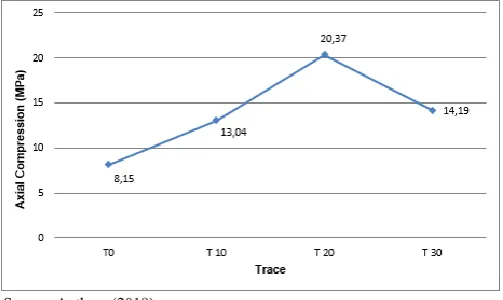
The trait T 0, without addition of feldspar powder, showed the lowest value of tensile strength. According to the ANOVA statistical analysis, the T 20 trait was the one that obtained the highest variance showing that this substitution percentage presents a significant increase in the tensile strength of the mortar coating compared to the reference trace T 0. The flexural tensile strength test was performed after the diametral compression tensile test. Three prismatic specimens aged 28 days were used. The results of this assay are described in Figure 8. The test of Tensile Strength in Flexion showed that the higher the percentage of substitution, the higher the Tensile Strength Limit. The T 30 trait obtained the highest mean result being approximately 147% greater than the reference trait T 0, followed by the T 20 trace that presented a value approximately 144% higher. Again the trait T 0 obtained the lowest result. According to ANOVA statistical analysis the trait T 30 was the trait that presented a greater statistical variance showing that this percentage of substitution is the most significant for the increase of tensile strength. Comparing the results of the T 20 trace with the T 30 one can say no to a statistically significant variance between the two results. Comparing the results obtained in the test with the results of Pedro (2016) it was observed that there was a significant increase in tensile strength in flexion with the use of additive to fix the water / cement factor (a/c), with the trace T 30 obtained the most significant increase, about 65%, and the T 20 trait obtained an increase of about 17% improving the traction combat in the mortar coating. For the test of determination of the Resistance to Axial Compression were used the test specimen halves of the tensile test in flexion respecting the age of 28 days. Figure 9 shows the results of this assay.
[image:5.595.309.561.435.585.2]Source: Authors (2018)
Figure 9. Results of Resistance to Axial Compression
[image:5.595.40.287.629.780.2]satisfactory result, with about 20% higher than the reference trace T 0, the T 20 trace even though it did not obtain the best result was about 4% higher than the reference trait. According to the ANOVA statistical analysis, the T 30 trait was the one that obtained greater statistical variance in the results compared to the T0 showing that the results are significant. Most ceramic materials have pores that allow the circulation of water inside. The transport of liquid water in these pores occurs essentially by capillarity, which is the process of progression of water through the capillary pores of that material. The absorption of capillary water is measured by the capillary coefficient C, which is described as the ability of the hardened mortar to absorb water. The determination of this coefficient defines the speed at which water is absorbed by the material. (PASCOA, 2012). Figure 11 shows the results obtained in the assay.
[image:6.595.308.560.121.337.2]Source: Authors (2018)
Figure 10. Results of the Elasticity Module
[image:6.595.38.291.250.397.2]Source: Authors (2018)
Figure 11. Water Absorption by Capillarity
The assay demonstrated that the T 20 trait was the most satisfactory, with a 50% lower absorption content at 10 min and 60% at 90 min relative to the reference trace T 0, followed by the T 30 trait which had a content absorption of 47% and 43% at 10min and 90min times respectively. In the ANOVA statistical analysis, the T 20 trait showed the highest statistical variance in relation to the reference trait T 0, showing that the values obtained in the tests are significant. Comparing the values obtained, with the values of Pedro (2016), it was verified that the use of additive to establish the water / cement factor (a/c) once again had a great influence on the results, with the T 20 water absorption content 27% and 72% lower for the 10 min and 90 min times, respectively, if it is shown to be more effective in reducing percolation of water by capillarity. According to REIS & TRISTÃO (2017) the residue,
presenting low granulometry fills the voids in the mortar, contributing to the improvement of density and decrease of porosity. Figure 12 shows the image of the samples Olympus, model MX41M-LED with magnification of 500 μm, of samples T 0, T 10, T 20 and T 30 respectively.
[image:6.595.38.291.435.587.2]Source: Authors (2018)
Figure 12. Microscopy images of the samples
From the preparation of the specimens for the microscopy test it can be seen that the reference trace T 0 and the T 10 trait presented lower resistance to abrasion, while the traces of T 20 and T 30 showed better. In Figure 12 the uniform distribution of the sand particles in the cementitious matrix can be observed. The feldspar particles were not highlighted in the images, because the granulometry that was used in this work does not allow the direct observation in the microscope with the increases used. Figure 13 shows the Results of Scanning Electron Microscopy.
Source: Authors (2018)
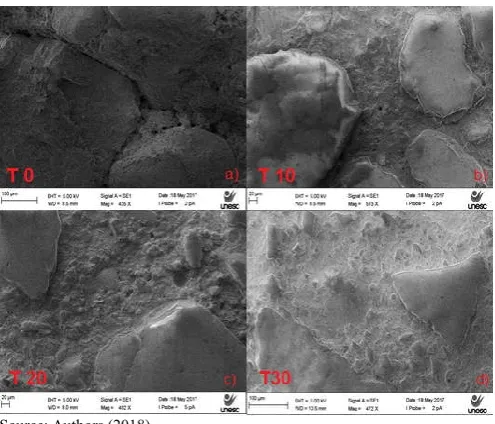
Figure 13. Scanning Electron Microscopy
[image:6.595.311.559.496.708.2]microcracks in these interfaces as the kid's aggregate is replaced by feldspar powder. Figure 13-c, which represents the trait T 20, presents characteristics similar to those presented in figure 13-b, however with the higher percentage of addition of the feldspar powder, better void filling occurs, which is reflected in the image 13-c by smaller presence of microchips. This is corroborated by what was observed in the mechanical tests of resistance to compression and bending. Figure 13-d depicting the T 30 trait is the one with the least porous interface among the samples. However, the compressive strength test presented lower values than the T 20 trace indicating that the feldspar powder is already present in excess.
Conclusion
From the results of the analysis, it can be seen that the substitution of the kid's aggregate by feldspar powder in the mortar coating improved the properties of the material when compared to the trace.
Through this work it can be concluded that:
Through the analysis of the consistency index it was verified that no additions above 30% of feldspar were possible because these values did not allow the correction of the consistency of the mortar coating with additive contents below the percentage indicated by the manufacturer, making the coating mortar very plastic, the rebates were within the limit established by norm.
For the Diametral Compression test the T 20 trait was the one that showed the best properties when compared to the reference trace T 0.
In the Flexural Traction test the T 30 traces followed by the T 20 were the traits that obtained the most satisfactory results in relation to the reference trait T 0.
In the test of Resistance to Axial Compression, it was possible to conclude that the T 20 trait obtained the best result among the tests of mechanical resistance with about 150% superior to the trace reference T 0 and about 28% higher than the value obtained by Pedro (2016) for the same trace with 20% substitution.
However, in the Elasticity Modulus test the T 30 trait obtained the most significant result, followed by the T 10 trait and T 20, which was the one that obtained the best mechanical results mentioned previously, yet it presented values of about 4% above the reference trace T 0.
Through the tests of Water Absorption by Capillarity and Capillarity Coefficient it can be affirmed that these properties are directly linked to the prevention of future pathological manifestations, considering that one of the most frequent pathologies in works is the infiltration of water by capillarity. In this study it was concluded that the use of feldspar with a percentage of substitution of 20% obtained the lowest value of Water Absorption at 10 min and 90 min, with values 50% and 60% respectively lower than the reference trace T 0, also obtaining the lowest capillary coefficient.
The replacement of the kid's aggregate by the feldspar powder was evident in the microscopy and scanning electron microscopy SEM study, showing that the T 20 trait obtained a better relation between the kid's aggregate, the feldspar powder and the cementitious paste.
In order to better understand the influence of feldspar dust, it is of fundamental importance that other studies are conducted to understand the influences that the feldspar powder exerts on the mortar coating.
For suggestions of future research it is mentioned:
To analyze more deeply the influence of the contents between 20% and 30% of substitution;
Perform traction adhesion test;
Verify economic viability;
Use of this coating for places where good fire resistance is required.
REFERENCES
Associação Brasileira DE Normas Técnicas. NBR 13276: Argamassa para assentamento e revestimento de paredes e tetos – Preparo da mistura e determinação do índice de consistência. Rio de Janeiro, 2005.
Associação Brasileira DE Normas Técnicas. NBR 13279: Argamassa para assentamento e revestimento de paredes e tetos – Determinação da resistência à tração na flexão e à compressão. Rio de Janeiro, 2005.
Associação Brasileira DE Normas Técnicas. NBR 13281: Argamassa para assentamento e revestimento de paredes e tetos – Requisitos. Rio de Janeiro, 2005.
Associação Brasileira DE Normas Técnicas. NBR 15259: Argamassa para assentamento e revestimento de paredes e tetos – Determinação da absorção de água por capilaridade e do coeficiente de capilaridade. Rio de Janeiro, 2005. Associação Brasileira DE Normas Técnicas. NBR 7215:
Cimento Portland –Determinação da resistência a compressão. Rio de Janeiro, 1996.
Associação Brasileira DE Normas Técnicas. NBR 7222: Concreto e argamassa – Determinação da resistência à tração por compressão diametral de corpos-de-prova cilíndricos. Rio de Janeiro, 2011.
Associação Brasileira DE Normas Técnicas. NBR 8522:Concreto– Determinação do módulo estático de elasticidade a compressão. Rio de Janeiro, 2008.
Aurichi, Mauren; Leggerini, Maria Regina Costa. Capítulo IV – Argamassa de Revestimento. Apostila, Materiais Tecnicas e Estruturas I, PUCRS – Faculdade de Arquitetura, 13p.
BAUER, Edson. Revestimentos de Argamassa: Características e Peculiaridades. Disponível em: http://www.comunidadedaconstrucao.com.br/upload/ativos /123/anexo/revesar.pdf. Acesso em: 29 ago. 2016.
DA SILVA, Narciso Gonçalves. Argamassa de revestimento de cimento, cal e areia britada de rocha calcária. 2006. 180p. Dissertação (Mestrado em Construção Civil) – Universidade Federal do Paraná – Curitiba.
Grace Construction products. TecFlow – Aditivo Superplastificante para concreto. Disponível em: https://gcpat.com/construction/pt-br/Documents/TEC-FLOW_2015.pdf . Acesso em: 30 out. 2016.
Páscoa, Liliane Sofia Neno. Índice de secagem como parâmetro em serviço dos rebocos aplicados em paredes exteriores. 2012. 136p. Dissertação (Mestrado em Engenharia Civil) – Universidade Técnica de Lisboa, Instituto Superior Técnico – Lisboa.
na argamassa de revestimento. 2016. 17p. Trabalho de Conclusão de Curso (Graduação em Engenharia Civil) – Universidade do Extremo Sul Catarinense – Criciúma. REIS, Alessandra Savazzini dos; TRISTÃO, Fernando
Avancini. Análise de argamassas com resíduo de corte de rochas ornamentais. Dissertação. Universidade Federal do Espírito Santo. Vitória, 2017.
SANTOS, Leandro Damião dos; AMARAL, Fernanda Ferreira; SOMMERFELD, Karin Cristina. Sistema de revestimento com argamassa industrializada. Revista Pensar Engenharia, v.2, n. 2, Jul./2014.